Endangered red wolves need space to stay wild. But there’s another predator in the way — humans

A red wolf crosses a road on the Alligator River National Wildlife Refuge, Thursday, March 23, 2023, near Manns Harbor, N.C. Over the course of 25 years, the red wolf went from being declared extinct in the wild to becoming hailed as an Endangered Species Act success story. But the only wolf species unique to the United States is once again at the brink. The last wild populations of Canis rufus are clinging to life on two federal refuges in eastern North Carolina. (AP Photo/David Goldman)

1 of 29 | 

https://apnews.com/article/red-wolves-endangered-species-extinction-f3232e07520fbff33b2ba179dc8ee651

A red wolf crosses a road on the Alligator River National Wildlife Refuge, Thursday, March 23, 2023, near Manns Harbor, N.C. Over the course of 25 years, the red wolf went from being declared extinct in the wild to becoming hailed as an Endangered Species Act success story. But the only wolf species unique to the United States is once again at the brink. The last wild populations of Canis rufus are clinging to life on two federal refuges in eastern North Carolina. (AP Photo/David Goldman)Read More

Jeff Akin stands next to a sign declaring his property is part of the U.S. Fish and Wildlife Service's Prey for the Pack program, Tuesday, May 9, 2023, in Hyde County, N.C. The program provides sanctuary for the endangered red wolf on private land, something Akin suspects his neighbors aren't too happy about. "It's not nature that's taken the red wolf out," he says. "It's us. I just philosophically believe it's our responsibility, that we should try to help those that we damage," he says. "Nature really just needs a chance." (AP Photo/Allen G. Breed)

2 of 29 | 

Jeff Akin stands next to a sign declaring his property is part of the U.S. Fish and Wildlife Service’s Prey for the Pack program, Tuesday, May 9, 2023, in Hyde County, N.C. The program provides sanctuary for the endangered red wolf on private land, something Akin suspects his neighbors aren’t too happy about. “It’s not nature that’s taken the red wolf out,” he says. “It’s us. I just philosophically believe it’s our responsibility, that we should try to help those that we damage,” he says. “Nature really just needs a chance.” (AP Photo/Allen G. Breed)

Ron Sutherland, a biologist with the Wildlands Network, looks for red wolves, the only wolf species found solely in the United States, on the Alligator River National Wildlife Refuge, Thursday, March 23, 2023, near Manns Harbor, N.C. Once declared extinct in the wild, the wolves were reintroduced in the late 1980s on the refuge near North Carolina's Outer Banks. Over the next quarter century, it became a poster child for the Endangered Species Act, and a model for efforts to bring back other species. (AP Photo/David Goldman)

3 of 29 | 

Ron Sutherland, a biologist with the Wildlands Network, looks for red wolves, the only wolf species found solely in the United States, on the Alligator River National Wildlife Refuge, Thursday, March 23, 2023, near Manns Harbor, N.C. Once declared extinct in the wild, the wolves were reintroduced in the late 1980s on the refuge near North Carolina’s Outer Banks. Over the next quarter century, it became a poster child for the Endangered Species Act, and a model for efforts to bring back other species. (AP Photo/David Goldman)

Ron Sutherland, a biologist with the Wildlands Network, looks at a map while out installing wildlife cameras on the Pocosin Lakes National Wildlife Refuge, Wednesday, March 22, 2023, near Columbia, N.C. "The red wolf program was a tremendous conservation success," says Sutherland. "It was the first time that a large carnivore had been returned to the wild after being driven extinct, anywhere in the world." (AP Photo/David Goldman)

4 of 29 | 

Ron Sutherland, a biologist with the Wildlands Network, looks at a map while out installing wildlife cameras on the Pocosin Lakes National Wildlife Refuge, Wednesday, March 22, 2023, near Columbia, N.C. “The red wolf program was a tremendous conservation success,” says Sutherland. “It was the first time that a large carnivore had been returned to the wild after being driven extinct, anywhere in the world.” (AP Photo/David Goldman)

5 of 29 | 

Ron Sutherland, a biologist with the Wildlands Network, looks at a map while out installing wildlife cameras along a fire break on the Pocosin Lakes National Wildlife Refuge, Wednesday, March 22, 2023, near Columbia, N.C. “The animals the red wolves eat, like rabbits and rats and deer and things and species like that, they like this kind of habitat,” says Sutherland. “Our job is to document whether this fire break is … creating more local abundance of these different wildlife species.” (AP Photo/David Goldman)

6 of 29 | 

Ron Sutherland, a biologist with the Wildlands Network, walks out of a wooded area on the Pocosin Lakes National Wildlife Refuge after installing wildlife cameras, Wednesday, March 22, 2023, near Columbia, N.C. Coupled with recent releases of captive-bred adults and the fostering of pups, one might assume the red wolf population is growing. But as of August, the U.S. Fish and Wildlife Service said the known/collared wild population was 13, with a total estimated wild population of 23 to 25. That’s down from June, when the numbers were 16 and 32-34. (AP Photo/David Goldman)

7 of 29 | 

Ron Sutherland, a biologist with the Wildlands Network, locks a wildlife camera he installed on the Pocosin Lakes National Wildlife Refuge, Wednesday, March 22, 2023, near Columbia, N.C. The cameras are not to capture images of red wolves, but of the critters they like to eat. Hunting leases are big business out east. One of the big complaints here is that the wolves will gobble up all the big game, especially white-tailed deer, one of the red wolves’ favorite meals. Sutherland believes those fears are unfounded, and he’s hoping his cameras will prove it. (AP Photo/David Goldman)

8 of 29 | 

Photographer and wildlife tour guide Aspen Stalls looks out for endangered red wolves on the Alligator River National Wildlife Refuge near Manns Harbor, N.C., Thursday, March 23, 2023. For the first time in nearly three decades, the U.S. Fish and Wildlife Service is poised to release an updated recovery plan for the red wolf. According to a draft, the agency proposes to spend a quarter billion dollars over the next 50 years to rebuild and expand the wild wolf population. (AP Photo/David Goldman)

9 of 29 | 

Waves wash over the shore of Stumpy Point, N.C., near the Alligator River National Wildlife Refuge, Thursday, March 23, 2023. The U.S. Fish and Wildlife Service has yet to identify suitable locations for other wild red wolf populations. If Greenland continues to melt at the current rate, the East Coast could see more than 3 feet of sea level rise in the next 50 years, says Jeffress Williams, a senior scientist emeritus with the U.S. Geological Survey. The average elevation at Alligator River: about 3 feet. (AP Photo/David Goldman)

10 of 29 | 

Joe Madison, a program manager with the U.S. Fish and Wildlife Service, uses a telemetry antenna to locate radio-collared red wolves on the Alligator River National Wildlife Refuge near Manns Harbor, N.C., on Thursday, April 6, 2023. “Based on the radio telemetry, there are six red wolves hunkered down in there,” says Madison, motioning to a patch of brush between two cleared farm fields. That’s roughly half of the world’s total known wild red wolf population. (AP Photo/Allen G. Breed)

11 of 29 | 

A red wolf roams the Alligator River National Wildlife Refuge, Thursday, March 23, 2023, near Manns Harbor, N.C. U.S. The U.S. Fish and Wildlife Service has launched numerous initiatives to cut down on human-caused deaths. Gunshots are top of the list. The wolves are outfitted with orange, reflective collars to make them more visible at night, and to distinguish them from coyotes. (AP Photo/David Goldman)

12 of 29 | 

Ron Sutherland, left, a biologist with the Wildlands Network, reacts to a photo of a red wolf taken by James Ford, as they watch for wolves with fellow photographer and wildlife tour guide Aspen Stalls, right, on the Alligator River National Wildlife Refuge near Manns Harbor, N.C. Wednesday, March 22, 2023. (AP Photo/David Goldman)

13 of 29 | 

Photographer and wildlife guide Aspen Stalls takes a photo of red wolf droppings on the Alligator River National Wildlife Refuge near Manns Harbor, N.C., Thursday, March 23, 2023. Stalls says the wolves can benefit the local economy. But she says that’s not the point. “They have been here for a very, very, very long time, long before us,” says Stalls, who studied canid ecology in college and sports a wolf tattoo on her left arm. “And they are a vital part of keeping this ecosystem balanced.” (AP Photo/David Goldman)

14 of 29 | 

Red wolf pawprints are visible in the dirt beside human footprints on the Alligator River National Wildlife Refuge near Manns Harbor, N.C., Friday, March 24, 2023. From extinct in the wild to success story and back to the brink, “America’s Wolf” is at a crossroads. (AP Photo/David Goldman)

15 of 29 | 

Wildlife photographers look out across the Alligator River National Wildlife Refuge for red wolves near Manns Harbor, N.C., Thursday, March 23, 2023. The red wolves became a poster child for the Endangered Species Act and a model for efforts to bring back other species. But the wild population is now back to the brink of oblivion, decimated by gunshots, vehicle strikes, suspected poisonings and, some have argued, government neglect. (AP Photo/David Goldman)

16 of 29 | 

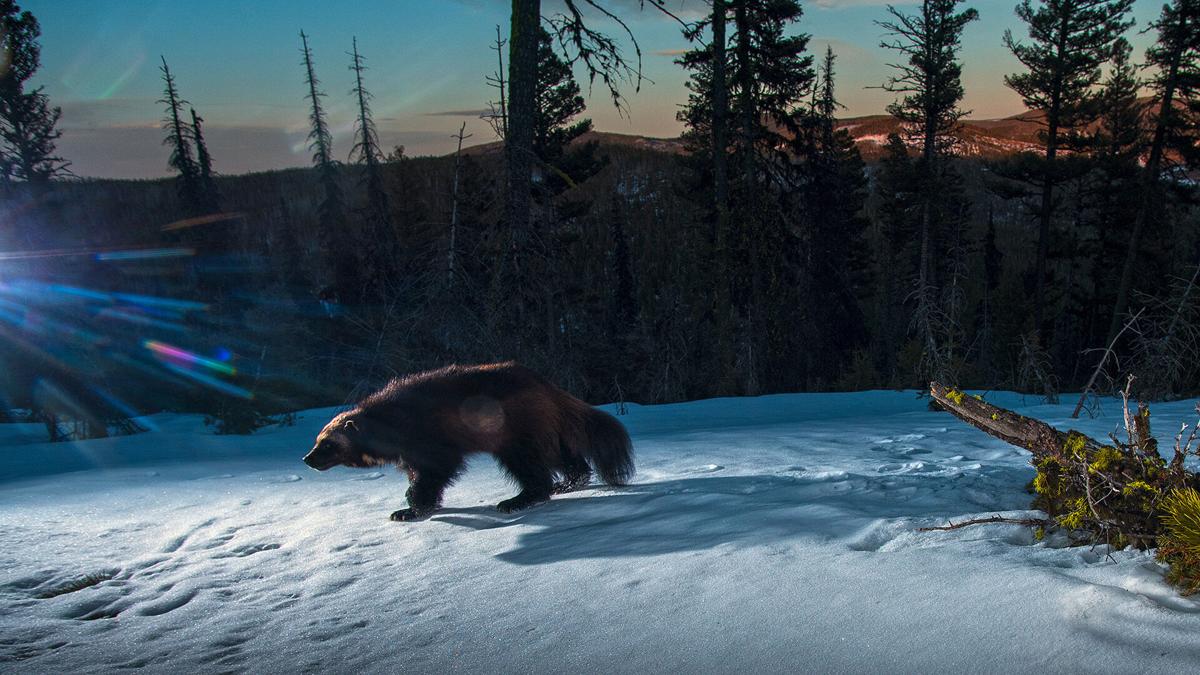
A red wolf roams across the Alligator River National Wildlife Refuge as the sun sets, Thursday, March 23, 2023, near Manns Harbor, N.C. Coupled with recent releases of captive-bred adults and the fostering of pups, one might assume the red wolf population is growing. But as of August, the U.S. Fish and Wildlife Service said the known/collared wild population was 13, with a total estimated wild population of 23 to 25. That’s down from June, when the numbers were 16 and 32-34. (AP Photo/David Goldman)

17 of 29 | 

A sign warns motorists on U.S. 64 to watch out for crossing red wolves on the Alligator River National Wildlife Refuge, Wednesday, March 22, 2023, near Manns Harbor, N.C. By 2012, the population of wild red wolves reached a peak of about 120 animals. Shootings and vehicle strikes – busy U.S. 64 to the Outer Banks runs through the middle of the refuge – were the leading causes of death. (AP Photo/David Goldman)

18 of 29 | 

Ron Sutherland, a biologist with the Wildlands Network, looks through binoculars for red wolves in the Alligator River National Wildlife Refuge, Thursday, March 23, 2023, near Manns Harbor, N.C. “The red wolf program was a tremendous conservation success,” says Sutherland. “It was the first time that a large carnivore had been returned to the wild after being driven extinct, anywhere in the world.” (AP Photo/David Goldman)

19 of 29 | 

A taxidermy red wolf is displayed at the Pocosin Lakes Visitor Center as a groundskeeper passes by with a lawnmower Thursday, March 23, 2023, in Columbia, N.C. Over the course of 25 years, the red wolf went from being declared extinct in the wild to becoming hailed as an Endangered Species Act success story. But the only wolf species unique to the United States is once again at the brink. The last wild populations of Canis rufus are clinging to life on two federal refuges in eastern North Carolina. (AP Photo/David Goldman)

20 of 29 | 

Members of the public listen to a U.S. Fish and Wildlife Service meeting about the red wolf recovery program at the Mattamuskeet School in Swanquarter, N.C., Tuesday, May 9, 2023. While agency staff talked about recent litters and captive releases, several in the crowd questioned whether the wolf should even be there. (AP Photo/Allen G. Breed)

21 of 29 | 

A group of red wolves stretch out on the Alligator River National Wildlife Refuge, Thursday, March 23, 2023, near Manns Harbor, N.C. The wolves are outfitted with orange, reflective collars to make them more visible at night and distinguish them from coyotes, which wear white ones. (AP Photo/David Goldman)

22 of 29 | 

A red wolf stuffed toy sits in a gift shop at the Coastal North Carolina Refuges Gateway Visitor Center, Thursday, March 23, 2023, in Manteo, N.C. From extinct in the wild to success story and back to the brink, “America’s Wolf” is at a crossroads. (AP Photo/David Goldman)

23 of 29 | 

Brave, a 7-year-old mother red wolf, walks through her enclosure at Roger Williams Park Zoo in Providence, R.I., Friday, March 31, 2023. The captive red wolf population stands at around 270. Once classified “threatened with extinction,” the red wolf is now listed as simply “endangered.” (AP Photo/David Goldman)

24 of 29 | 

Zookeepers Heather Medeiros, left, and Anne Tan, clean the red wolf enclosure at Roger Williams Park Zoo in Providence, R.I., Friday, March 31, 2023. For the first time in nearly three decades, the U.S. Fish and Wildlife Service is poised to release an updated recovery plan for the red wolf. According to a draft, the agency proposes to spend a quarter billion dollars over the next 50 years to rebuild and expand the wild wolf population. (AP Photo/David Goldman)

25 of 29 | 

Brave, a 7-year-old mother red wolf, looks out from her enclosure at the Roger Williams Park Zoo in Providence, R.I., Wednesday, April 12, 2023. In 2020, conservationists sued the U.S. Fish and Wildlife Service, alleging the suspension of captive red wolf releases violated the Endangered Species Act. Releases and pup fostering resumed the following year. In early August, the agency settled with the groups, promising regular releases from the captive population, which currently stands at around 270, over the next eight years. (AP Photo/David Goldman)

26 of 29 | 

Visitors walk past the red wolf enclosure at the Roger Williams Park Zoo in Providence, R.I., Wednesday, April 12, 2023. Thanks to a network of breeding facilities like this one, there is little danger of the species going extinct. But the goal has always been a viable wild population. (AP Photo/David Goldman)

27 of 29 | 

Visitors look through a fence at Brave, a 7-year-old mother red wolf, at the Roger Williams Park Zoo in Providence, R.I., Friday, March 31, 2023. The captive red wolf population stands at around 270. Once classified “threatened with extinction,” the red wolf is now listed as simply “endangered.” (AP Photo/David Goldman)

28 of 29 | 

A family of red wolves, from right, 3-month-old pups, Sentinel and Sabine; their mother, Brave, 7, and their father, Diego, 8, lie in their enclosure at the Roger Williams Park Zoo in Providence, R.I., Friday, July 7, 2023. Thanks to a network of breeding facilities like this one, there is little danger of the species going extinct. But the goal has always been a viable wild population. (AP Photo/David Goldman)

29 of 29 | 

Brave, a 7-year-old mother red wolf, looks out from her enclosure at Roger Williams Park Zoo in Providence, R.I., Wednesday, April 12, 2023. From extinct in the wild to success story and back to the brink, “America’s Wolf” is at a crossroads. (AP Photo/David Goldman)

BY ALLEN G. BREEDUpdated 10:13 PM PDT, September 3, 2023Share

ALLIGATOR RIVER NATIONAL WILDLIFE REFUGE, N.C. (AP) — Jeff Akin had to bite his tongue.

He was chatting with a neighbor about efforts to protect and grow the area’s red wolf population. The endangered wolves are equipped with bright orange radio collars to help locals distinguish the federally protected species from invasive, prolific coyotes.

“If I see one of those wolves with a collar on, I’m going to shoot it in the gut, so it runs off and dies,” Akin says the neighbor told him. “Because if it dies near you, and they come out and find the collar, they can arrest you.”

ADVERTISEMENT

Akin is a hunter and the walls of his country house are lined with photos of the animals he’s killed. But what he heard made him sick.

OTHER NEWS

This 2012 photo provided by Delbridge Museum shows an exhibit at the Delbridge Museum of Natural History in Sioux Falls, S.D. The Great Plains Zoo in South Dakota said Thursday, Aug. 17, 2023, that it has pulled its taxidermy collection off display after almost 40 years over concerns about the impact of strong chemicals used to preserve the animals. (Delbridge Museum of Natural History via AP)

Lions, tigers, taxidermy, arsenic, political squabbling and the Endangered Species Act. Oh my.

A family of red wolves, from right, 3-month-old pups, Sentinel and Sabine; their mother, Brave, 7, and their father, Diego, 8, lie in their enclosure at the Roger Williams Park Zoo in Providence, R.I., Friday, July 7, 2023. Thanks to a network of breeding facilities like this one, there is little danger of the species going extinct. But the goal has always been a viable wild population. (AP Photo/David Goldman)

Takeaways from AP’s reporting on efforts to restore endangered red wolves to the wild

FILE - A polar bear walks over sea ice floating in the Victoria Strait in the Canadian Arctic Archipelago, Friday, July 21, 2017. (AP Photo/David Goldman, File)

Scientists say study found a direct link between greenhouse gas emissions and polar bear survival

“I wouldn’t shoot a squirrel in the stomach if I was hungry,” he says. “It’s just not humane.”

In a way, the anecdote sums up the plight of this uniquely American species.

Once declared extinct in the wild, Canis rufus — the only wolf species found solely in the United States — was reintroduced in the late 1980s on the Alligator River National Wildlife Refuge, just across the sound from eastern North Carolina’s famed Outer Banks. Over the next quarter century, it became a poster child for the Endangered Species Act and a model for efforts to bring back other species.

https://imasdk.googleapis.com/js/core/bridge3.587.0_en.html#goog_1138954651

0 seconds of 5 minutes, 47 secondsVolume 90%

The red wolf came howling back from being declared extinct in the wild, making it a poster child for the Endangered Species Act. The only wolf unique to the U.S. is again clawing its way back from the brink, but will humans make room for “America’s wolf?”

ADVERTISEMENT

“The red wolf program was a tremendous conservation success,” says Ron Sutherland, a biologist with the Wildlands Network. “It was the first time that a large carnivore had been returned to the wild after being driven extinct, anywhere in the world.”

But the wild population is now back to the brink of oblivion, decimated by gunshots, vehicle strikes, suspected poisonings and, some have argued, government neglect.

For the first time in nearly three decades, the U.S. Fish and Wildlife Service is poised to release an updated recovery plan for the red wolf. According to a draft, the agency proposes spending a quarter billion dollars over the next 50 years to rebuild and expand the wild wolf population.

“It was done once before,” says Joe Madison, North Carolina manager for the Red Wolf Recovery Program. “And we can do it again.”

A red wolf roams across the Alligator River National Wildlife Refuge as the sun sets, Thursday, March 23, 2023, near Manns Harbor, N.C. (AP Photo/David Goldman)

ADVERTISEMENT

But the effort depends heavily on cooperation from private landowners. And the passage of 36 years seems to have done little to soften locals’ hearts toward the apex predator.

Out here, farming and leasing land to hunters are big business. The red wolf is seen by some as competition, and a threat to a way of life on a fragile landscape already imperiled by climate change.

“They don’t belong here!” a woman shouted at agency staff during a recent public meeting on the program.

Add to that a widespread mistrust of government and the road ahead looks long and perilous for “America’s wolf.” But allies like Akin and Sutherland say they have to try.

“The red wolf, it’s ours,” Sutherland says. “It’s ours to save.”

ADVERTISEMENT

___

On a recent visit to Alligator River, Madison parks his truck beside a canal, climbs out and hoists an H-shaped antenna into the air. Faint beeps emanate from a radio in his left hand as he slowly swivels from side to side.

“Based on the radio telemetry, there are six red wolves hunkered down in there,” says Madison, motioning to a patch of brush between two cleared farm fields. His bushy red-and-grey beard lends him an uncanny resemblance to his quarry.

That’s roughly half of the world’s total known wild red wolf population.

The red wolf once roamed from central Texas to southern Iowa and as far northeast as Long Island, New York. But generations of persecution, encroachment and habitat loss reduced them to just a remnant clinging to the ragged Gulf coast along the Texas-Louisiana border.

ADVERTISEMENT

https://308cf75d23dc2b85127c8e103be4ec51.safeframe.googlesyndication.com/safeframe/1-0-40/html/container.html

Starting in 1973, the year Congress passed the Endangered Species Act, the last wolves were pulled from the wild and placed in a captive-breeding program.

“By 1980,” Madison says, “they had declared red wolves extinct in the wild.”

But the captive breeding program did so well that, after just a few years, officials felt it was time to try restoring the red wolf to the wild.

They chose Alligator River, a 158,000-acre (63,940-hectare) expanse of upland swamp on North Carolina’s Albermarle Peninsula, not far from Sir Walter Raleigh’s doomed “lost colony” of Roanoke.

A group of red wolves stretch out on the Alligator River National Wildlife Refuge, Thursday, March 23, 2023, near Manns Harbor, N.C. The wolves are outfitted with orange, reflective collars to make them more visible at night and distinguish them from coyotes, which wear white ones. (AP Photo/David Goldman)

The program started in 1987 with four breeding pairs. Five years later, a second group was placed in Great Smoky Mountains National Park — 522,427 acres (211,418 hectares) of forest straddling the border of North Carolina and Tennessee.

The inland experiment was ended in 1998, due to “low prey availability, extremely low pup survival, disease, and the inability of red wolves to maintain stable territories within the Park,” the government said at the time.

But with the releases of adults and fostering of captive-born pups into wild family groups, the Alligator River population thrived.

“It was the model for how gray wolves were returned to Yellowstone,” Sutherland says of the Western species, which has since been taken off the endangered list. “And it’s been the model since then for all kinds of re-wilding of projects all over the world.”

By 2012, the population in the five-county restoration area reached a peak of about 120 animals. Then the bottom fell out.

Shootings and vehicle strikes — busy U.S. 64 to the Outer Banks runs through the middle of the refuge — were the leading causes of death.

Meanwhile, coyotes moved into the area and began mating with the depleted wolf stock. Around the same time, the North Carolina Wildlife Resources Commission allowed nighttime spotlight hunting of coyotes, which are much smaller, but look similar to red wolves.

A sign warns motorists on U.S. 64 to watch out for crossing red wolves on the Alligator River National Wildlife Refuge, Wednesday, March 22, 2023, near Manns Harbor, N.C. By 2012, the population of wild red wolves reached a peak of about 120 animals. Shootings and vehicle strikes - busy U.S. 64 to the Outer Banks runs through the middle of the refuge - were the leading causes of death. (AP Photo/David Goldman)
A sign warns motorists on U.S. 64 to watch out for crossing red wolves on the Alligator River National Wildlife Refuge, Wednesday, March 22, 2023, near Manns Harbor, N.C. By 2012, the population of wild red wolves reached a peak of about 120 animals. Shootings and vehicle strikes – busy U.S. 64 to the Outer Banks runs through the middle of the refuge – were the leading causes of death. (AP Photo/David Goldman)

In January 2015, the state commission asked Fish and Wildlife to end the program and once again declare the red wolf extinct in the wild. The federal agency suspended releases from the captive population while it re-evaluated the “feasibility” of species recovery.

A 2018 species status assessment declared the wild population would likely disappear within six years “without substantial intervention.”

With no new releases, the wild population eventually dipped to just seven known animals.

In 2020, conservationists sued the agency, alleging the suspension of captive releases violated the Endangered Species Act. Releases and pup fostering resumed the following year.

In early August, the agency settled with the groups, promising regular releases from the captive population, which currently stands at around 270, over the next eight years. Meanwhile, a new recovery plan and population viability analysis are due out this fall.

The most recent draft called for spending of more than $256 million over the next 50 years. The red wolf could be delisted by 2072, the agency concluded, providing “all actions are fully funded and implemented” and with “full cooperation of all partners.”

The service has yet to identify suitable locations for other wild populations and it’s unclear whether the North Carolina wolves have a half century.

If Greenland continues to melt at the current rate, the East Coast could see more than 3 feet (0.9 meters) of sea level rise in the next 50 years, says Jeffress Williams, a senior scientist emeritus with the U.S. Geological Survey. The average elevation at Alligator River: about 3 feet (0.9 meters).

“They ought to be factoring that in,” says Williams, who works at the Woods Hole Coastal and Marine Science Center in Massachusetts. “Because within 50 years, a lot of the habitat areas that they’re looking at will very likely be underwater due to sea level rise or, certainly, underwater during the storm surge events such as such as hurricanes.”

So, the wolves will have to roam farther and farther inland, into more densely populated areas. And that is only going to put them in more competition with what Akin calls the real “apex predator” — Homo sapiens.

___

One of the big complaints around here is that the wolves will gobble up all the game, especially white-tailed deer, the main food source of Canis rufus. And that would eat into landowner profits.

Although exact numbers for the recovery zone are hard to come by, the wildlife commission says hunting generated $1 billion statewide last year. Recent hunting leases posted online ranged from $861 for a 22-acre (8.9-hectare) property to $3,050 on 167 acres (67.5 hectares) with “everything deer need,” the site boasted.

Sutherland believes fears of “a wildlife disaster” are unfounded, and he’s out to prove it.

Braving snakes and brushing feeder ticks from his clothes and gear, he kneels beside a pine tree on the Pocosin Lakes National Wildlife Refuge and starts drilling holes. He bolts a wildlife camera about a foot up the trunk, secures it with a lock and cable, then uses pruning shears to cut down any brush that might obscure the camera’s view.

“The animals the wolves eat, like rabbits and rats and deer and things and species like that, they like this kind of habitat,” he says. “Our job is to document whether this fire break is … creating more local abundance of these different wildlife species.”

As for the wolves, their numbers are in constant flux.

Two litters of four pups each were born in April at Pocosin Lakes, followed in May by five pups at Alligator River. Coupled with recent releases of captive-bred adults and the fostering of pups, one might assume the population is growing.

But as of August, Fish and Wildlife said the known/collared wild population was 13, with a total estimated wild population of 23 to 25. That’s down from June, when the numbers were 16 and 32 to 34.

“It’s certainly trending in the right direction,” says Ramona McGee, an attorney with the Southern Environmental Law Center, which filed the lawsuit to restart the captive release program. “Although the population remains in dire straits.”

“We’ve got a long way to go,” Madison concedes.

Fish and Wildlife has launched numerous initiatives to cut down on human-caused deaths. Gunshots are top of the list.

The wolves are outfitted with orange, reflective collars to make them more visible at night.

“Most hunters and the general public know that bright orange, hunter orange, means, ‘Don’t shoot,’” says Madison. “It’s a safety color.”

He also reminds people at public meetings it’s illegal to intentionally kill an endangered wolf that is not threatening humans, pets or livestock. The death must be reported to Fish and Wildlife within 24 hours.

The agency enlists landowners to help trap, but preferably not shoot, coyotes.

“You can’t kill your way out of a coyote problem,” Madison says.

The coyotes are sterilized, but left hormonally intact. That way, they can act as “placeholders” for the wolves, Madison says.

“They will continue to defend their territory,” he says. “They’ll hold that space for the rest of their lives and they won’t allow other coyotes to move in, but they also can’t reproduce.”

Those coyotes get white collars, to further differentiate them from the wolves.

To cut down on road kills, officials have placed flashing signs at both ends of the Alligator River preserve to warn motorists on US 64 to watch out for endangered wolves and “drive with caution.”

But the biggest hurdle to red wolf recovery is space.

The two refuges’ combined 270,000 acres (109,265 hectares) — roughly 422 square miles (1,093 kilometers) — of federal land might sound like a lot. But Madison says a single pack’s territory can be as much as 80 square miles (207 square kilometers), depending on prey availability.

“There’s not a large enough land mass of public land in the Southeast within the historic range that can fully support a viable red wolf population,” he says. “We’re going to have to rely somewhat on private land for reintroduction.”

That’s where Prey for the Pack comes in.

___

Started in 2020, the program offers landowners incentives to make habitat improvements. The government will reimburse people up to 80% of the cost of thinning woods and planting the kinds of vegetation that will attract the types of prey red wolves prefer, says Luke Lolies, who runs the program.

In exchange, Fish and Wildlife gets access to do such things as install wildlife cameras or come onto their land to capture coyotes.

Basically, Lolies says, “They allow red wolves to peacefully live on their property.”

But if a recent public meeting is any indication, Lolies and the wolves are facing an uphill battle.

A crowd of about 60 braved thunderstorms and torrential rains to gather in the gymnasium of Mattamuskeet High School in Swanquarter, North Carolina.

They listened politely as Madison and others gave an update on the program. But no sooner had the floor been opened to questions than things got heated.

One man referred to the wolves as a “hybrid predator,” repeating a common belief here that all the animals are now mixed with coyotes. That’s despite a 2019 National Academy of Sciences report confirming the red wolf was a “distinct” and “taxonomically valid” species.

Madison noted two hybrid litters were discovered last year and euthanized.

Another concern was safety for humans and animals.

There has never been a documented attack by a red wolf on a human, Madison says. And a “depredation fund” set up by the Red Wolf Coalition to reimburse people for animals killed by a wolf has only paid out one claim, coalition director Kim Wheeler says.

A bearded man in a camouflage jacket questioned the program’s costs versus the number of jobs created in the five counties. Another wondered how landowners who make money off hunting would be compensated for all the game the wolves will eat.

“If you do not get landowner cooperation in the five-county area, will you stop the program?” asked one man, who farms 15,000 acres (6,070 hectares) in the wolf-recovery area.

An exasperated Madison says it wasn’t for him to say.

“We all know what the answer is,” the farmer replies sarcastically. “You just can’t say it out loud.”

Aspen Stalls, who recently started a wildlife guiding business in the area, says the wolves can benefit the local economy, but that’s not the point.

“They have been here for a very, very, very long time, long before us,” says Stalls, who studied canid ecology in college and sports a wolf tattoo on her left arm. “And they are a vital part of keeping this ecosystem balanced.”

The five-county wolf recovery area covers 2,765 square miles (7,161 square kilometers), which is nearly 1.8 million acres (728,434 hectares). But in three years, Prey for the Pack has managed to sign up only four landowners, for a total of just 915 acres (370 hectares).

Of the four Prey participants, only one agreed to be identified: Jeff Akin.

___

About eight years ago, the retired Raleigh real estate developer built a hunting and fishing getaway on 80 acres (32 hectares) of what he calls “Hyde County thicket: Sucker pines, loblolly pines, wax myrtles and briers.”

“I had to use a machete to walk through it the first time to find the edges,” he says. “Snakes and mosquitoes love it.”

With help from Lolies and his staff, he hopes the wolves will love it, too.

Riding through the woods on an all-terrain vehicle, he points to areas of scorched scrub and tree stumps.

“This has been thinned and burned,” he says. “And the burning should release the seeds, and the sunlight will grow the types of grass and plants that’ll bring in small mammals and game animals that would be ultimately prey for a pack of wolves.”

New grasses and wildflowers are already coming up. Recently planted blackberry bushes are ready to bear fruit.

A white sign bolted to a tree along the main road declares Akin a member of “Partners for Fish & Wildlife.” He suspects his neighbors aren’t too happy about it.

Lee Williams, who lives just down the road, can’t believe the government is spending millions of taxpayer dollars to protect what he considers “a mongrel.”

“I never had it around here when I was growing up, and I really didn’t miss it,” the 74-year-old retired state marine patrol officer says. “I didn’t miss a dinosaur and I wouldn’t miss them.”

About a week after the public meeting, a red wolf was found dead along a fence line in neighboring Washington County, shot in the torso.

After witnessing the hostility in the school gym, Akin got together with another wolf supporter to try to develop a better “sales pitch” for fellow landowners.

“We need to break down some resistance to wolf recovery and some existing fears about putting your land in a government program of any kind,” he says.

He knows his 80 acres (32 hectares) are just “a drop in the bucket.” But he can’t just do nothing.

“It’s not nature that’s taken the red wolf out,” he says. “It’s us. So, we are the ones to help them get back.”

World on brink of five ‘disastrous’ climate tipping points, study finds

This article is more than 11 months old

Giant ice sheets, ocean currents and permafrost regions may already have passed point of irreversible change

Damian Carrington Environment editor

@dpcarringtonThu 8 Sep 2022 14.00 EDT

The climate crisis has driven the world to the brink of multiple “disastrous” tipping points, according to a major study.

It shows five dangerous tipping points may already have been passed due to the 1.1C of global heating caused by humanity to date.

These include the collapse of Greenland’s ice cap, eventually producing a huge sea level rise, the collapse of a key current in the north Atlantic, disrupting rain upon which billions of people depend for food, and an abrupt melting of carbon-rich permafrost.

At 1.5C of heating, the minimum rise now expected, four of the five tipping points move from being possible to likely, the analysis said. Also at 1.5C, an additional five tipping points become possible, including changes to vast northern forests and the loss of almost all mountain glaciers.

In total, the researchers found evidence for 16 tipping points, with the final six requiring global heating of at least 2C to be triggered, according to the scientists’ estimations. The tipping points would take effect on timescales varying from a few years to centuries.

“The Earth may have left a ‘safe’ climate state beyond 1C global warming,” the researchers concluded, with the whole of human civilisation having developed in temperatures below this level. Passing one tipping point is often likely to help trigger others, producing cascades. But this is still being studied and was not included, meaning the analysis may present the minimum danger.

Prof Johan Rockström, the director of the Potsdam Institute for Climate Impact Research, who was part of the study team, said: “The world is heading towards 2-3C of global warming.https://interactive.guim.co.uk/uploader/embed/2022/09/tipping-points-graphic/giv-6562iFHFkiqJaINd/

“This sets Earth on course to cross multiple dangerous tipping points that will be disastrous for people across the world. To maintain liveable conditions on Earth and enable stable societies, we must do everything possible to prevent crossing tipping points.”

Dr David Armstrong McKay at the University of Exeter, a lead author of the study, said: “It’s really worrying. There are grounds for grief, but there are also still grounds for hope.

“The study really underpins why the Paris agreement goal of 1.5C is so important and must be fought for.

“We’re not saying that, because we’re probably going to hit some tipping points, everything is lost and it’s game over. Every fraction of a degree that we stop beyond 1.5C reduces the likelihood of hitting more tipping points.”

Recent research has shown signs of destabilisation in the Amazon rainforest, the loss of which would have “profound” implications for the global climate and biodiversity, as well as the Greenland ice sheet and the Gulf Stream currents that scientists call the Atlantic meridional overturning circulation (Amoc).

A recent report by the Intergovernmental Panel on Climate Change said the risk of triggering climate tipping points becomes high with 2C of global heating.

The analysis, published in the journal Science, assessed more than 200 previous studies on past tipping points, climate observations and modelling studies. A tipping point is when a temperature threshold is passed, leading to unstoppable change in a climate system, even if global heating ends.

The nine global tipping points identified are: the collapse of the Greenland, west Antarctic and two parts of the east Antarctic ice sheets, the partial and total collapse of Amoc, Amazon dieback, permafrost collapse and winter sea ice loss in the Arctic.skip past newsletter promotion

Sign up to Down to Earth

Free weekly newsletter

The planet’s most important stories. Get all the week’s environment news – the good, the bad and the essential

https://www.google.com/recaptcha/api2/anchor?ar=1&k=6LdzlmsdAAAAALFH63cBVagSFPuuHXQ9OfpIDdMc&co=aHR0cHM6Ly93d3cudGhlZ3VhcmRpYW4uY29tOjQ0Mw..&hl=en&type=image&v=0hCdE87LyjzAkFO5Ff-v7Hj1&theme=light&size=invisible&badge=bottomright&cb=7tsektww1jsPrivacy Notice: Newsletters may contain info about charities, online ads, and content funded by outside parties. For more information see our Privacy Policy. We use Google reCaptcha to protect our website and the Google Privacy Policy and Terms of Service apply.

The assessment of the Amazon tipping point did not include the effects of deforestation. “The combination of the warming and the deforestation could bring that a lot sooner,” said Armstrong McKay.

https://f5a2f5ea81b0a7bbe25d2b12f2515b95.safeframe.googlesyndication.com/safeframe/1-0-40/html/container.html

A further seven tipping points would have severe regional effects, including the die-off of tropical coral reefs and changes to the west African monsoon. Other potential tipping points still being studied include the loss of ocean oxygen and major shifts in the Indian summer monsoon.

The scientists define crossing a tipping point as “possible” when its minimum temperature threshold is passed and “likely” beyond the central threshold estimate.

Prof Niklas Boers, at the Technical University of Munich, said: “The review is a timely update on the Earth’s potential tipping elements, and the threat of tipping events under further warming is real.”

He added that much more research was needed to narrow down the critical temperature thresholds, with current estimates remaining highly uncertain.

Prof Thomas Stocker, at the University of Bern, said: “The science on tipping points is far from done – it has barely begun – and much better models are needed to address the question [of] what warming level is critical for which tipping point.”

A special IPCC report on climate tipping points was proposed in May by the Swiss government.

Prof Tim Lenton at the University of Exeter, a co-author of the analysis, said: “Since I first assessed tipping points in 2008, the list has grown and our assessment of the risk they pose has increased dramatically.

“Our new work provides compelling evidence that the world must radically accelerate decarbonising the economy. To achieve that, we need to trigger positive social tipping points.”

https://wordpress.com/post/theextinctionchronicles.wordpress.com

Scientists Believe The Chickens We Eat Are Being Slaughtered While Conscious

The U.S. poultry industry has a dreadful secret.

https://www.huffpost.com/entry/chickens-slaughtered-conscious_n_580e3d35e4b000d0b157bf98?fbclid=IwAR05QbPa4qC5BEZuGaqQzi2u4kWRFuZ9QW380GS0-1TtZsUYVifHoDlo4_I

By Nico Pitney

Oct 28, 2016, 04:24 AM EDT

|Updated Oct 28, 2016

VIEW COMMENTS

Roughly 9 billion chickens are slaughtered for food each year in the United States, and according to the poultry industry, each one of these sentient animals is mercifully stunned into unconsciousness before its neck is slit by an industrial blade.

But scientists have come to a far more ghastly conclusion. Their research shows that the method favored by U.S. poultry processors to stun the birds ― moving them through a vat of electrified water ― does not consistently render birds insensible before slaughter.

ADVERTISEMENT

As a result, scientists say, an untold number of the chickens that we eat ― hundreds of millions of them and potentially many more ― likely experience intense suffering when they are slaughtered.

Brain activity indicates that these animals may be capable of experiencing pain first when they receive a paralyzing electric shock that induces tonic muscle seizures, then when their throats are forced against a sharpened blade.

The extent of suffering is almost certainly vast. If just 1 percent of chickens raised each year in the U.S. are not effectively stunned, it means roughly 90 million animals are experiencing a violent and painful death. That’s more than the total number of dogs kept as pets in this country.

Unlike in Europe, there are virtually no U.S. regulations governing the humane slaughter of chickens. Nevertheless, following public pressure, the first major U.S. poultry producer, Perdue, pledged this year to phase out the use of electric water-baths.

ADVERTISEMENT

Now animal protection groups are pressuring Perdue’s competitors, like Tyson Foods, and large U.S. food service companies, like Aramark, to follow suit.

https://giphy.com/embed/5xKYr2yF0RAQw

Immobilized chickens are shown exiting an electric water-bath stunner. (Credit: U.S. Poultry and Egg Association)

Researchers say that a properly calibrated electric water-bath can reliably stun a large majority of birds that pass through it. But the devil is in the details.

Each water-bath has various electricity settings (for features like current, voltage, and frequency), and changes to these settings involve major trade-offs.

ADVERTISEMENT

Using a lower-frequency charge increases the chance that a bird will be stunned, but it also raises the likelihood of damage to the bird’s carcass. Lower-frequency shocks can trigger more intense muscle seizures, sometimes causing fractured bones and ruptured blood vessels. The resulting meat can be too damaged or visually unappealing to sell.

As a result, and with no animal welfare regulations to guide them, U.S. poultry companies use electric water-bath settings aimed at producing the best quality meat, not ensuring that chickens are reliably stunned.

In other words, they use higher-frequency, lower-voltage shocks, which may leave birds paralyzed (so they can be easily whisked around the processing factory line) but not always unconscious, according to an extensive record of published studies that measured chickens’ brain activity after administering shocks at different settings.

https://giphy.com/embed/118KzVQffzk6D6

Immobilized chickens have their throats cut by an industrial blade. Scientists believe many of them are conscious as it happens. (Credit: U.S. Poultry and Egg Association)

ADVERTISEMENT

No one knows how many individual chickens farmed in the U.S. might be conscious while they are slaughtered. Each processing plant uses its own water-bath settings, and none makes their settings public. Federal regulators don’t record the settings, let alone check that animals are unconscious before slaughter. Independent researchers say they are virtually never allowed to set foot in commercial processing plants.

But scientists say what little is known about standard U.S. industry practices is cause for alarm.

A review by Dr. Mohan Raj, the most widely cited researcher on this topic and an adviser to the European Union’s food safety agency, concluded, “We are aware of no direct evidence demonstrating that the electrical settings used in the United States are adequate to meet international standards for humane stunning and slaughter of poultry.”

The co-author of that review, Dr. Sara Shields, who is now a welfare specialist for Humane Society International, told The Huffington Post that the settings used by U.S. poultry companies “have not been demonstrated to actually produce an effective stun.”

Steve Wotton, a researcher at the University of Bristol’s School of Veterinary Sciences, one of the world’s leading centers for animal welfare research, said much the same. “The U.S. settings that have been reported to me and that I’ve read in published papers are far too low to stun.”

A spokesman for Tyson Foods, the largest U.S. poultry processor, told HuffPost that “proper animal handling is an important moral and ethical obligation and we take it very seriously.”

ADVERTISEMENT

But, he acknowledged, “like most of the industry, our plants currently use low-voltage electrical stunning.” The company maintains no standard electrical settings, he added, “due to variation from plant to plant.”

https://giphy.com/embed/5kGG83etQcSwE

Chickens experience a tonic seizure during the application of the electrical stun (in this footage, the stun is administered by an electrified head-only application rather than a water-bath). During a tonic seizure, “the body of the bird stiffens as muscles contract, the neck is arched, the legs are rigidly extended, rhythmic breathing stops, the eyes are wide open, and the blink reflex is absent.” Chickens at U.S. poultry facilities may be conscious during and following these seizures. (Credit: TopKip)

Welfare researchers favor an alternative approach called “controlled atmosphere killing,” whereby birds are exposed to a steadily rising concentration of gas (typically carbon dioxide) until they irreversibly lose consciousness.

More than 20 percent of chickens farmed in Europe are already stunned using controlled atmosphere killing systems, including the majority of chickens in Britain and about half in Sweden, a shift that has not led to price increases for consumers, analysts said.

ADVERTISEMENT

Even if electric stunners were perfectly effective, animal researchers say they would still be inferior because they involve several additional steps that can inflict pain on the billions of birds that are processed every year.

To prepare for the water-bath, the birds must first be removed from their transport crates, an inelegant process that can result in broken bones and wings as chickens are dropped from their crates.

Each bird is then turned upside-down and has its legs shackled into a metal conveyor. Nearly every aspect of this process causes the animals stress and pain, studies have found.

Unlike humans, chickens do not have diaphragms, so when inverted their viscera compresses their heart and lungs. Chickens also have pain receptors in their legs, and studies show the shackling process causes bruising to thigh muscles and damage to their legs.

https://giphy.com/embed/5hAGPsGjHodnG

ADVERTISEMENT

Chickens are inverted and shackled into a conveyor. (Credit: U.S. Poultry and Egg Association)

Disoriented and in pain, about 90 percent of chickens flap their wings immediately after shackling. Because the birds that we eat are very young ― just six weeks old on average ― their joints and tendons are underdeveloped, so intense wing-flapping can lead to dislocated joints, broken bones and hemorrhages of the wing tip.

Flapping can also cause birds to receive painful pre-stun shocks as their wings touch the electrified water before their heads are submerged.

Footage of birds entering electric water-baths is rare, but one such video, posted online by a water-bath manufacturer, appears to show one or more ducks receiving pre-stun shocks as they approach an electrified bath. Warning: The footage may be unpleasant for some viewers.

Some chickens manage to avoid being killed by both the water-bath and the neck-cutting, only to suffer an arguably worse fate. The U.S. Agriculture Department estimates that hundreds of thousands of birds are unintentionally boiled alive each year because they manage to survive until they reach a scalding water tank that helps loosen feathers from carcasses.

ADVERTISEMENT

Controlled atmosphere killing avoids virtually all of these problems, since birds are exposed to gas while still inside their transport crates and all of the subsequent steps are performed after they’re dead.

Gas stunning systems also produce consistently superior meat quality, analysts say, and employees enjoy better conditions. They don’t need to handle live animals, and they can work under normal lighting conditions (electric water-bath facilities are darkened to calm the birds).

Chickens make up well over 90 percent of the land animals slaughtered each year in the United States. The chickens sold for meat, known as broilers, spend their brief lives ballooning to immense proportions, over six times their natural weight, a result of intense genetic selection.

Their underdeveloped bones often cannot handle their body’s own mass, academic and industry studies have found, so many experience painful skeletal disorders, including deformed bones and bowed legs. Others barely walk or just sit stationary.

Then, after six weeks of life, it’s off to the slaughterhouse.

Hoping to build upon recent welfare advancements for egg-laying hens, prominent animal groups, including Mercy for Animals and The Humane League, this year launched the first major campaigns to improve conditions for broilers.

ADVERTISEMENT

Perdue Farms, the fourth-largest U.S. poultry company, told HuffPost it plans to have a gas stunning system installed in one of its facilities by the end of 2017, and then determine a roll-out schedule for their nine other processing plants.

Nico Pitney is a senior editor at The Huffington Post. Tips? Feedback? Email him at nico.pitney [at] huffingtonpost.com.

Bird Flu ‘Ticking Time Bomb’ Cannot Be Stopped Without Major Farming Reforms, Warns New Report

Wednesday, 23 August 2023, 6:26 am
Press Release: Compassion in World Farming

https://www.scoop.co.nz/stories/WO2308/S00167/bird-flu-ticking-time-bomb-cannot-be-stopped-without-major-farming-reforms-warns-new-report.htm

Without major reforms to industrial farming it will not be possible to end the spread of bird flu or reduce the risk of a global human pandemic, warns a compelling new report released today (22 Aug) by Compassion in World Farming.

The report – called Bird flu: Only major farm reforms can end it – shows that, contrary to popular belief, wild birds are typically victims of the disease rather than the cause, and it is spiralling out of control due to the rise of factory farming. This view is supported by the international Scientific Task Force on Avian Influenza, which was set up to provide governments with recommendations and guidance.

Backed by the very latest scientific evidence and illustrated with powerful images of poultry affected by bird flu around the world from We Animals Media, the report urges governments to implement a three-point action plan which includes:

  1. Mass vaccination of flocks to slow the spread
  2. Radical restructuring of the poultry industry, to adopt smaller flocks with lower stocking densities and more robust breeds and avoid clusters of poultry farms to reduce the risk of highly pathogenic strains emerging and spreading.
  3. Changing the way pigs are farmed as factory farmed pigs can act as ‘mixing vessels’ to create new pig, bird and human viruses.

Today, the animal welfare and environmental NGO has written to governments across Europe, the UK and the US urging them to work with the World Organisation for Animal Health (WOAH) and the United Nations Food and Agriculture Organization (FAO) to implement this action plan without delay.

Tens of thousands of wild birds are reported to have died from bird flu, although the true number is thought to be in the millions. Until recently, the bird flu that circulated in wild birds generally caused them little harm. But when the virus enters overcrowded factory farm poultry sheds – often carried in on workers’ contaminated shoes, clothing or equipment – it can evolve into dangerous Highly Pathogenic Avian Influenza (HPAI).

These factory farms create the ideal conditions for the spread of the disease as they give viruses a constant supply of hosts – allowing infections to spread rapidly – and for highly harmful new strains to emerge.

More than half a billion farmed birds have died or been culled globally due to bird flu since 2021. Many were broilers (meat chickens) confined in factory farms where they are crammed closely together in huge sheds, or egg-laying hens that live confined in cages around the size of an A4 sheet of paper.

Author of the report and Chief Policy Adviser at Compassion in World Farming, Peter Stevenson, said: “Bird flu is like a ticking time bomb. Unless we wake up and take urgent action to end factory farming we will simply be unable to stop its rapid spread across the globe or reduce the risk of a serious human pandemic developing.

“Cramming animals together in factory farms is not only totally inhumane, it’s creating the perfect place for bird flu and other viruses to spread and mutate into more dangerous strains. That’s why our END.IT campaign seeks to end factory farming and transform our global food system to ensure the future health of animals, people and our planet.

“Three key actions are needed to tackle this disease – vaccination, major reform of the poultry industry and an end to the factory farming of pigs. Governments around the world must implement this three-point plan without delay. If they don’t, millions more birds and other mammals are likely to suffer and die and the health of millions of people may be in serious jeopardy.”

Birds are not the only animals affected by avian flu. The disease has already spread to mammals – infecting otters, foxes, dolphins, sea lions, mink, and domestic dogs and cats, amongst others. It has also developed the ability to spread from one mink to another – something it previously had not been capable of in mammals; this makes it far more dangerous. If it develops the same ability to spread between humans, it becomes a real pandemic risk.

At least 875 people have been infected worldwide since 2003. The swine flu epidemic of 2009 and the 1918 Spanish flu outbreak, caused by a flu virus with genes of an avian origin, powerfully highlight the capabilities of zoonotic disease.

Professor Devi Sridhar, chair of global public health at the University of Edinburgh, has said: “The more chances the virus has to jump into a human and mutate, the more likely it is a dangerous strain will emerge that could set off the next pandemic.”

This view is supported by a joint statement from the UN’s Food and Agriculture (FAO), World Organisation for Animal Health (WOAH) and the World Health Organisation (WHO) in July 2023 which said: “Avian influenza viruses normally spread among birds, but the increasing number of H5N1 avian influenza detections among mammals—which are biologically closer to humans than birds are—raises concern that the virus might adapt to infect humans more easily.”

Compassion in World Farming’s END.IT campaign is building a global movement to end factory farming and transform our global food system to ensure the future health of animals, people and our planet. To sign the petition visit www.END.IT

Welfare group says wild birds are ‘victims’, not cause, of bird flu

© Paul/Adobe Stock© Paul/Adobe Stock

https://www.fwi.co.uk/livestock/poultry/welfare-group-says-wild-birds-are-victims-not-cause-of-bird-flu

Wild birds are being unfairly blamed for spreading avian influenza and are instead the victims of a disease caused by intensively farmed poultry, according to animal welfare group Compassion In World Farming (CIWF).

A new CIWF report, Bird flu: Only major farm reforms can end it, claims avian influenza is “spiralling out of control due to factory farming” and is demanding changes to the way chickens are reared.

See also: Guidance on avian flu with England’s chief vet

“Until recently, the bird flu that circulated in wild birds generally caused them little harm,” it suggests.

“But when the virus enters overcrowded factory farm poultry sheds – often carried in on workers’ contaminated shoes, clothing or equipment – it can evolve into dangerous Highly Pathogenic Avian Influenza (HPAI).”

Worst-ever outbreak

The UK is currently experiencing its worst-ever outbreak of avian influenza, with almost 300 cases reported since October 2021, resulting in the compulsory slaughter of many millions of farmed or captive birds.

Globally, CIWF says more than 500m farmed birds have died or been culled since 2021 due to avian influenza.

It has therefore suggested a three-point plan which it wants governments to adopt across the world. This consists of:

Explore moreKnow How

Visit our Know How centre for practical farming advice

  • Mass vaccination of flocks to slow the spread of bird flu
  • A radical restructuring of poultry production, with smaller flocks, lower stocking rates and greater distances between farms
  • An end to intensive pig production, as pigs can act as “mixing vessels” for viruses.

Claims dismissed

But the claims have been dismissed by poultry sector representatives, who insist that it is migratory birds that have spread the disease.

“No [commercial] bird has avian influenza when it goes onto farm,” said British Poultry Council chief executive Richard Griffiths.

“All incidents derive from outside the farm through wild bird incursion. When disease is detected, the farm population is culled, so disease is not spread.”

Mr Griffiths also suggested that conflating disease control with opinions on how food is produced in the UK was “irresponsible”.

“Our primary concern here is ensuring the health of our birds and the sustainability of a world-class food system producing nutritious and affordable food. In these times, that matters more than ever,” he said.

Reality

Representing the egg sector, British Free Range Egg Producers Association chief executive Robert Gooch said the CIWF report “flies in the face of reality on the ground”.

“Calling for less-intensive poultry systems in the UK is perverse when approximately 70% of laying hens are free-range or organic, yet these birds have to be locked up in houses most winters to prevent them being infected by wild birds.

“Wild birds are the source of bird flu, not poultry, and are a big threat to extensive, free-range production systems.”

Iceland resumes fin whale hunting, but killing needs to be faster

Reuters

https://www.reuters.com/business/environment/iceland-resumes-fin-whale-hunting-killing-needs-be-faster-2023-08-31/

August 31, 202312:52 PM PDTUpdated 2 days ago

A man stands near a finwhale being towed to a port in Reykjavik

[1/2]A man stands near a finwhale being towed to a port in Reykjavik June 18, 2013. REUTERS/Sigtryggur Johannsson/File Photo Acquire Licensing Rights

OSLO, Aug 31 (Reuters) – Iceland’s government said on Thursday it will resume hunting fin whales after a two-month halt, but with new guidelines aimed at killing them as quickly as possible to reduce suffering.

Iceland resumed hunting fin whales, which can reach lengths of over 20 metres (65 feet), in 2006 after a 20-year pause.

The International Whaling Commission – a global body that oversees whale conservation – imposed a moratorium in 1986 after some species came close to extinction. Although several are still endangered or even on the brink of extinction, Iceland, along with Norway and Japan, have resumed commercial whaling.

Advertisement · Scroll to continueReport this ad

Reykjavík suspended commercial whaling in June after a government-commissioned report said that it took too long for whales to die after they were harpooned, sometimes hours, in breach of its law on animal welfare.

The hunting will be resumed after a government working group concluded that it was possible to improve the hunting methods.

“A Regulation will be issued that will include detailed and stricter requirements for hunting equipment and hunting methods, as well as increased supervision,” the Ministry of Food, Agriculture and Fisheries said in a statement.

Advertisement · Scroll to continueReport this ad

Iceland’s public broadcaster said whale hunters would be required to complete a course in whale biology, pain perception and stress.

They will be also provided with detailed instructions of how to harpoon the animals to make sure that they die quickly.

Pa. cleared to resume “normal” poultry trade following HI-PATH outbreak

After more than a year of combating an outbreak of Highly Pathogenic Avian Influenza, afflicting poultry farms across the commonwealth, state officials said Wednesday that Pennsylvania has received the “all clear” to resume normal international poultry trade.

By 

Pennsylvania Capital-Star

Pennsylvania Capital-Star

https://www.agriculture.com/pa-cleared-to-resume-normal-poultry-trade-following-hi-path-outbreak-7964105

The Pennsylvania Capital-Star is a nonpartisan, nonprofit news site dedicated to honest and aggressive coverage of state government, politics, and policy. Since the launch in February 2019, the Capital-Star has emerged as a go-to source for in-depth original reporting, explainers on complex topics, features that ground policy debates, as well as progressive commentary on a range of issues. The Capital-Star is part of States Newsroom, a national 501(c)(3) nonprofit supported by grants and a coalition of donors and readers.

SUCCESSFUL FARMING’S EDITORIAL GUIDELINES

Published on August 31, 2023

Chickens in Pennsylvania

By Cassie Miller

After more than a year of combating an outbreak of Highly Pathogenic Avian Influenza, afflicting poultry farms across the commonwealth, state officials said Wednesday that Pennsylvania has received the “all clear” to resume normal international poultry trade. 

State officials announced that Pennsylvania had received the “HPAI-free” designation from The World Animal Health Organization on Wednesday, celebrating the good news for Pennsylvania’s $7.1 billion poultry industry.

State Agriculture Secretary Russell Redding praised private and governmental partnerships for seeing Pennsylvania through the outbreak, which began in April 2022. 

“Pennsylvania’s coordinated, aggressive, and effective response to the hi-path avian influenza outbreak has brought us to this point,” Redding said. “Planning, coordination, and critical partnerships forged among every level of the industry, working in concert with two Pennsylvania government administrations, including the Department and PA Veterinary Diagnostic Lab System, the USDA, and Penn State Extension, have made the difference in minimizing the impact of what has been the costliest animal agriculture emergency in U.S. history.”

https://30e74d41d21e9ae5931f8220f4bd31ab.safeframe.googlesyndication.com/safeframe/1-0-40/html/container.html

HI-PATH is highly contagious and can infect both birds and humans, according to the Centers for Disease Control and Prevention. 

The outbreak of the current HI-PATH strain has affected 31 commercial flocks, 36 backyard flocks, and caused the loss of 4,648,240 domestic birds, according to state agriculture officials. 

The last confirmed infection of the current strain of highly pathogenic avian flu in Pennsylvania was on March 17, 2023, in Lancaster County. 

While farm-specific restrictions were lifted earlier this month, the commonwealth remains under “general quarantine,” with the department continuing to monitor and test for infections statewide. 

Pennsylvania Capital Star is part of the States Newsroom, a network of similar news bureaus supported by grants and a coalition of donors as a 501c(3) public charity.