The family said they had raised Batman, their 8-year-old Chihuahua, since he was a puppy.Lost Dogs of Wisconsin/Facebook
An 18-year-old Wisconsin babysitter is accused of brutally murdering her longtime client’s dog.
The family, who lives in the Milwaukee suburb of Sussex, was devastated when they came home Thursday to find that their dog was missing after the babysitter was at the house, local station WISN reported.
But on Friday afternoon, they found Batman, their 8-year-old chihuahua, dead under a bundle of blankets and stuffed animals. WISN reported that he appeared to have stab wounds and a bag over his head.
Police interviewed the 18-year-old suspect and arrested her on suspicion of cruelty to animals. Her name hasn’t been released because she has not yet been formally charged.
The family told police they’d had Batman since he was a puppy. They had originally reported him missing to Lost Dogs of Wisconsin, a non-profit that shares information about missing dogs on Facebook.
“That’s kind of scary to think that there’s somebody who would be willing to do that,” neighbor Scott Calmes told WISN. “I can’t imagine why anyone would want to kill a small dog.”
The Waukesha County Sheriff’s Office is investigating the incident.
The Avian Flu outbreak has led to the destruction of over 1 million birds in the region, causing significant economic damage to farmers, workers, and customers alike.
Avian flu outbreak has led to the destruction of over 1 million birds in California farms
This highly contagious viral disease is seen in domestic poultry
In humans, the symptoms can range from mild to severe
Over the last few weeks, the US state of California, once known as the “Egg Basket of the World,” is facing a severe crisis as highly pathogenic avian influenza (HPAI) wreaks havoc across its poultry farms.
In Sonoma County, a state of emergency has been declared following the infection of Mike Weber’s Sunrise Farms, where 5,50,000 egg-laying hens had to be culled to prevent further spread of the disease.
ADVERTISEMENT
This outbreak has led to the destruction of over 1 million birds in the region, causing significant economic damage to farmers, workers, and customers alike.
Avian flu or bird flu is caused by the influenza A virus which usually birds contract, but it can infect humans too.
This highly contagious viral disease is seen in domestic poultry including guinea hens, ducks, geese, and chickens. People can get this virus if they come in contact with a sick bird.
SYMPTOMS OF AVIAN FLU
Avian flu presents various symptoms in birds, including diarrhoea, breathing difficulties, swollen heads, and sudden death.
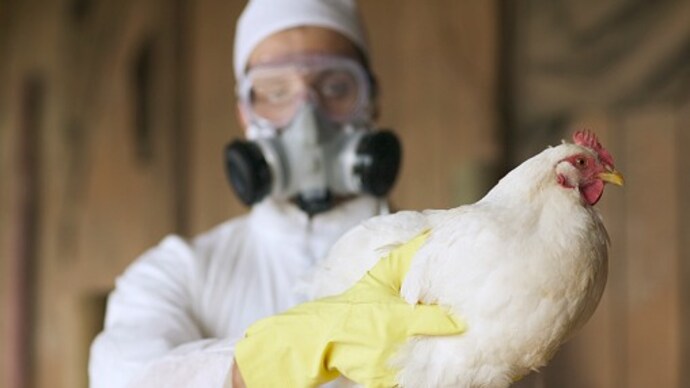
Avian flu or bird flu is caused by the influenza A virus which usually birds contract, but it can infect humans too. (Photo: Getty Images)
In humans, the symptoms can range from mild, such as cough, headache, sore throat, and fever, to severe conditions like pneumonia requiring hospitalisation.
Other human symptoms include shortness of breath, chills, fatigue, congestion, muscle aches, and in some cases, conjunctivitis.
Transmission of Avian Flu to Humans
The transmission of avian flu to humans typically occurs through direct contact with infected birds, contaminated surfaces, or bird droppings.
It is unlikely for the virus to spread to people from consuming undercooked eggs or poultry. However, people who handle infected birds or come into contact with their environments are at higher risk.
Preventive Measures
To prevent the spread of avian flu, experts recommend several measures:
Properly handle and cook poultry and eggs to an internal temperature of 73.8°C to kill viruses.
Practice good hygiene, especially when handling raw poultry.
Use separate utensils for cooked and raw meat.
Avoid contact with live birds and poultry.
Implement biosecurity measures, such as restricting access to poultry farms and disinfecting clothing and equipment.
Treatment for Avian Flu
While there is no specific treatment for avian flu in birds, infected flocks are euthanised to contain the virus.
For humans, antiviral medications such as oseltamivir may be prescribed to treat the infection.
It is crucial for individuals who suspect they have been exposed to avian flu to seek medical attention promptly.
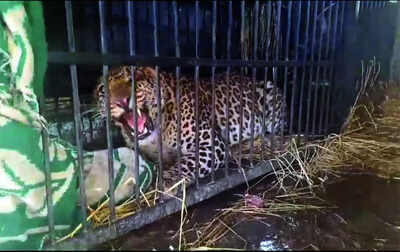
Shamli: Poachers’ traps, intended for wild boars, unexpectedly ensnared two leopards in Shamli and Baghpat districts, prompting a wildlife rescue team from Meerut to intervene. According to forest officials, both trapped leopards are currently undergoing health tests, and on receiving health clearance, they will be released back into the forest. In the first incident at Sunna village in Shamli district, locals informed forest officials about a trapped leopard around 10pm on Friday.
Toncerned
District forest officer (Shamli) Jaydev Singh said, “We received information and immediately dispatched a team from Meerut, which reached the spot around 2am on Saturday. The leopard was safely transferred to a secure enclosure.” In the other incident on Saturday morning in Shahpur Ban Ganga village field of Baghpat’s Binoli area, a second leopard was rescued from a trap set for illegal hunting. District forest officer (Baghpat) Vandana Phogat said, “Locals reported a trapped leopard, and an expert team conducted a meticulous operation to successfully rescue the injured animal. The leopard is currently under medical observation and treatment.” The Shamli leopard is identified as a female, approximately two and a half years old, while the Baghpat leopard is a male of around one and a half years. Both leopards sustained injuries while trying to free themselves from the traps. Authorities are investigating the traps set in farmers’ fields, initially targeting wild boars and nilgai. Additionally, efforts are under way to scrutinise the activities of poachers engaged in illegal wildlife hunting in these areas. Notably, leopard sightings in Shamli and Baghpat districts are rare occurrences, according to locals.
Martin Luther King Jr. (left) and Dexter King, right, who played his father in the 2002 film The Rosa Parks Story. (Beth Clifton collage)
Going vegan in 1987, advised by Dick Gregory, may have almost doubled Dexter King’s lifespan in long fight against cancer
MALIBU, California––Dexter Scott King, 62, second son of Martin Luther King Jr., influential for more than 35 years in boosting vegetarianism and veganism among African-Americans, on the morning of January 22, 2024 “transitioned peacefully in his sleep at home with me in Malibu,” his wife Leah Weber King said in a media statement distributed by the Atlanta-based Martin Luther King Jr. Center for Social Change.
Dexter Scott King and Leah Weber King had been married since 2013.
Dexter King died from prostate cancer, a disease he apparently fought for most of his life.
Left: Dick Gregory doubled as 5-kilometer runner and marching band member at St. Louis University in 1956. Right: Gregory running five miles to demonstrate his health, four months into a fast against the Vietnam War, during which he consumed only fruit juice. (St. Louis Post-Dispatch photos, Beth Clifton collage)
“He faced this hurdle with bravery and might”
“He gave it everything and battled this terrible disease until the end. As with all the challenges in his life, he faced this hurdle with bravery and might,” Leah Weber King said.
According to a 1997 profile by Kevin Sack of the Tampa Bay Times, Dexter King “dropped out of his father’s alma mater, Morehouse College, because of an illness he will not discuss. He said the condition became manageable after he adopted a vegan diet and took ‘a journey of self-discovery.’”
In 1987 Dexter King visited a health spa that athlete, comedian, and activist Dick Gregory founded in the Bahamas.
Influenced by Gregory, “On January 30, 1988, my twenty-seventh birthday, I became a strict vegetarian. I developed a passion for health and nutrition,” Dexter King testified in 2003. “My diet consists of fruits, vegetables, grains, nuts and legumes only, and has for the past 15 years now.”
“His family – mother Coretta Scott King, sisters Bernice and Yolanda, and brother Martin Luther III – greeted his new regimen with curiosity,” wrote Jill Howard Church in 1995 for Vegetarian Times.
Coretta Scott King in 2003. (Thomas Englund photo)
Mother & friends followed Dexter King’s example
“My family has always been very open-minded,” said Dexter King, “but certainly [veganism] was not their orientation. They were not sure what to think.
“When I first became a vegetarian, I was very self-righteous about it,” Dexter King added. “As I’ve aged and become more seasoned with time, I’ve mellowed. The best testimonial is the proof in the pudding.”
Part of that proof was that Dexter King’s mother, Coretta Scott King (1927-2006), also persuaded by her lifelong friend Barbara Reynolds, became vegan in 1995 and remained vegan for the last 12 years of her life, as did several of her other friends.
Martin Luther King Jr. next to the bus that Rosa Parks rode, #2857, in the incident that touched off the Montgomery, Alabama bus boycott. (Beth Clifton collage)
Rosa Parks
Among them was Rosa Parks (1913-2005), whose 1955 refusal to give up her seat on a bus to a white man in Montgomery, Alabama, led to her arrest and touched off a boycott of the city-owned bus company led by Martin Luther King Jr., then a young local minister.
This led to the November 1955 U.S. Supreme Court decision that abolished segregation in public transportation, was among the first major victories of the 20th century civil rights movement, and projected Martin Luther King Jr. to national prominence.
“I was not in the practice of eating a lot of meat,” Rosa Parks explained.
In childhood, she said, “We had peach, apple, plums. We would go into the woods and eat blackberries. It was not hard at all for me to not eat meat.”
Adds the Vegetarians of Washington website, “Among her favorite vegetables were broccoli, greens, sweet potatoes and string beans.”
“Higher level of awareness”
Deeply involved in the affairs of the Martin Luther King Jr. Center for Social Change, and quiet by nature, Dexter King except in that 1995 Vegetarian Times article relatively seldom spoke in public about veganism and animal advocacy.
Though noted in passing seven times in Dexter King’s 2004 memoir Growing Up King, his beliefs about animals and food were usually mentioned by others almost as a footnote to articles focused on the legacies of his father, Martin Luther King Jr., and, sometimes, Dick Gregory.
But Dexter King made his views clear to Jill Howard Church.
“Veganism has given me a higher level of awareness and spirituality,” Dexter King said, “primarily because the energy associated with eating has shifted to other areas.
“If you are violent to yourself by putting [harmful] things into your body that violate its spirit, it will be difficult not to perpetuate that [violence] onto someone else,” Dexter King added.
From left: Dexter King, Yolanda King, Martin Luther King Jr., Bernice King, Coretta Scott King, and Martin Luther King III, in 1966.
“I know more African-Americans who are becoming aware”
Dexter King also observed that, “Women in general are probably more sensitive to their health needs and sensitive to what they eat. Men generally are not as concerned.
“I don’t know a heck of a lot of African-Americans who are vegetarian,” Dexter King admitted, “but I know more who are becoming aware.”
That was 28 years before his death.
By then the downtown Atlanta neighborhood surrounding the Martin Luther King Jr. Center for Social Change had become one of the national hubs of the fast-growing African-American vegan/vegetarian movement.
Traci Thomas.
Traci Thomas
Traci Thomas, who founded the Black Vegetarian Society of Georgia in 2002, the first of an international string of Black Vegetarian Societies, credited Dick Gregory rather than Dexter King with inspiring her to give up meat in 1994, but when in Atlanta, Dexter King was a regular customer at the tiny Black Vegetarian Society of Georgia restaurant.
Thomas was among the first vegans––of any ethnicity––to win national media notice as a vegan teacher and advocate without initially achieving celebrity as an athlete, entertainer, or spiritual leader. Her 2002 recommendation of corn on the cob as a simple vegan focal food for summer picnics won extensive notice in Midwestern small town newspapers that might never before have published the word “vegan.”
Thomas followed up by popularizing vegan recipes consisting of five ingredients or fewer, to appeal to anyone whose time for shopping and cooking is limited.
(Beth Clifton collage)
Slutty Vegan
Later, fellow Atlanta resident Pinky Cole founded her Slutty Vegan burger counter in the neighborhood.
“Slutty Vegan became the place to be seen waiting, especially if you’re an African-American celebrity,” observed New York Times reporter Kim Severson on July 1, 2019.
Since then, the vegan burger restaurant has expanded successfully to five locations serving majority African-American neighborhoods around Atlanta; Athens and Columbus, Georgia; Birmingham, Alabama; and Brooklyn and Harlem in New York City.
(Beth Clifton collage)
Taking care of business
Dexter King meanwhile established himself as a businessman on another front.
“After succeeding his mother as both the head of the King Center for Social Change and executor of Dr. King’s estate, Dexter King quickly consolidated control over the family’s social agenda and financial affairs,” recounted Kevin Sack of the Tampa Bay Times.
Dexter King’s first tenure heading the King Center, in 1989, was brief, as his initial attempts to exercise leadership met intense opposition from within.
When Dexter King returned, in 1994, the King Center was reportedly almost bankrupt.
NFL defensive lineman David Carter, speaking for Vegan Outreach.
“Cobbled together a vision”
“Since then, with halting, often awkward steps,” Sack wrote in his 1997 profile, Dexter King has cobbled together a vision for preserving his father’s legacy that relies more on the Internet and intellectual property rights than on the cause-oriented mission that Mrs. King established for the King center in 1968.
“In many ways,” Sack observed, “the transition from mother to son has highlighted the generational differences between the marchers and dreamers of the civil rights era and the deal makers and realists of today.
James Earl Ray in 1959. (Beth Clifton collage)
James Earl Ray
An early bizarre misstep was a March 1997 televised prison meeting with the terminally ill confessed Martin Luther King Jr. assassin James Earl Ray––who later recanted his own testimony.
“Without any showing of evidence,” summarized Sack, “Dexter King declared that his family believed Ray innocent of any knowing involvement in the killing.”
“Dexter King later implicated President Lyndon B. Johnson in a government conspiracy,” Sack continued, “a theory promoted by Ray’s lawyer, William Pepper.”
“I have never seen myself the way the media has portrayed me, as a leader,” Dexter King told Sack. “I’m not trying to have a constituency. I’m not trying to be preachy or be on a pedestal. I’m not trying to effect change on that level, not because it’s not something that should be done, but that’s just not my best destiny.”
Dexter Scott King. (X photo)
“Befuddlement”
Sack noted “intense opposition or, at the very least, befuddlement,” from “civil rights veterans who marched at Dr. King’s side, from board members of the King Center, from the pulpit of the church where Dr. King, his father, and his maternal grandfather had been pastor, and from the liberal black editorial page editor of the Atlanta Constitution.”
Lawsuits filed against Dexter King in 2008 by his sister Bernice King and brother Martin Luther King III followed, including a case filed by Bernice King on behalf of the estate of Coretta Scott King. All three lawsuits were settled out of court in 2009.
The Dexter King legacy as regards the legacy of Martin Luther King Jr. may remain controversial for years to come.
Beth & Merritt Clifton.
His “best destiny,” meanwhile, may be a statistic: when Dexter King became vegan in 1988, only about 3% of Americans of European descent were vegans and vegetarians, and barely 1% of Americans of African descent.
Today the percentage of Americans of European descent who are vegans or vegetarians is still only about 3%, but the percentage of Americans of African descent who are vegans or vegetarians is at 8% and rapidly growing.