MNRF trying to safeguard and protect Ontario’s wildlife from illegal hunting and fishing
Reply

https://www.spokesman.com/stories/2024/jan/26/montana-proposes-delaying-start-of-bird-hunting-se/
Jan. 26, 2024 Updated Fri., Jan. 26, 2024 at 5:14 p.m.

By Brett FrenchBillings Gazette
BILLINGS – Citing concerns about increasing hunting pressure in eastern Montana, two amendments have been proposed to push back by two weeks the start of the upland game bird and bird dog training seasons for nonresidents.
“This is really a response to comment after comment after comment and the desire by people to see something other than the status quo,” said Dustin Temple, director of Fish, Wildlife & Parks, during a Jan. 17 meeting in Scobey.
At Temple’s request, the amendments are being carried by Fish and Wildlife Commission chair Lesley Robinson, who represents Region 6 in northeastern Montana. The commission will consider the proposals at its Feb. 16 meeting. Public comment on the items will be taken until 31 Wednesday.
If passed, the nonresident bird dog training season would be pushed back from Aug. 15 to Sept. 1. Hunting for nonresidents would start on Sept. 15 instead of Sept 1. With the changes, resident hunters and dog trainers would have two weeks to themselves at the beginning of the seasons.
Last year, 300 residents and 100 nonresidents purchased dog training licenses, the first time the licenses have been offered.
The proposals were first announced at meetings Fish, Wildlife & Parks held last week in Glendive and Scobey where regional wildlife managers updated the public on bird populations, hunter numbers and hunter days afield.
Contained in the slides flashed across the screen were trend lines showing nonresident hunter license sales and days afield climbing. For example, Region 7 has seen the average number of hunting days for residents climb from 3.3 in 2007 to 5.6 in 2022. Nonresident hunter days have been relatively flat, averaging 3.4 days over the 16-year timespan. No data was collected in 2013. Most information comes from annual hunter harvest surveys.
“I think it’s a fair assumption the trend will continue into the future,” said Brett Dorak, Region 7 wildlife manager, as social media has brought more attention to the region.
Region 7 also saw nonresident hunters outpace residents in harvesting Hungarian partridge, sage grouse and sharp-tailed grouse last year. Whereas residents took about twice as many turkeys in 2022 as nonresidents, roughly 1,400 compared to about 700 birds, respectively.
Dorak estimated the differences in hunter harvest is about the amount of time spent in the field.
Although not everyone who purchases an upland game bird license hunts the species, Dorak said southeastern Montana has seen a 5½-fold increase in license purchases from 2016 to 2023. One estimate put the number of license buyers who actually hunt upland birds at 20% to 30%.
In comparison in Region 6, resident hunter days afield have risen from 9.6 in 2014 to 13.2 in 2022 in just the eastern portion of the management area. Resident and nonresident hunters, on average, are spending about 2.5 to three more days afield than in the past.
Drought in the western portion of the region has hurt bird populations. For example, in 2023 the eastern portion saw sharp-tailed grouse numbers climb by 17% in a year, 31% above the long-term average. In comparison, the western portion of the region saw a 9% drop in 2023, 37% below the long-term average.
Among nonresidents, the eastern region has seen hunters average 10.6 days from 2014 to 2022 although climbing in 2021 and 2022 to 12.7 and 11.7 days, respectively. The Plentywood area and northern portion of Valley County have seen the largest increases in hunter numbers.
Two landowners spoke at the meeting saying they were surprised by the numbers, noting they see many more nonresident license plates parked at access points than resident vehicles.
“What you see on the ground is not always, certainly, reflected in the data,” said Ken Plourde, upland gamebird biologist for Region 6. “This is all self-reported. So take it all with a grain of salt. We certainly do. It gives you a general idea of what’s going on, but this is not perfect by any means.”
The upland bird harvest, of all species, has averaged more than 71,000 in Region 6. Almost 60% of that harvest is coming from the eastern portion of the region.
Highlighting these meetings was the announcement that sage grouse numbers continue to fall in southeastern Montana. FWP bases its population trends on the number of males at sage grouse breeding grounds, called leks.
In Region 7, the number of males peaked in 2001 at 36 males. This spring the number of males was six.
If the trend continues for another year, FWP will shut down sage grouse hunting in Zone 3’s 18 counties.
Under the state’s adaptive harvest management plan for sage grouse, if populations are 45% or more below the long-term average for three years, more restrictive regulations are initiated, Dorak explained. Since other means to reduce harvest in Region 7 had been tried, the next step is to halt hunting entirely.
In Region 6, which has less sage grouse habitat, male counts in 2023 were down 26% in a year and 36% below the long-term average.
Hunting is not believed to lead to sage grouse declines. Instead, the bird’s population is more likely to be affected by loss of habitat, construction of powerlines and roadways.
While sage grouse numbers have deteriorated, other species such as sharp-tailed grouse and Hungarian partridges boomed this spring where moisture was sufficient to create habitat.
“This year we’ve seen more Huns than in the last 20 years,” Region 7 commissioner Bill Lane said.
The upland bird populations may have also been boosted by fewer cattle on grazing lands, said Brad Schmitz, Region 7 supervisor. Due to four to five years of drought, some ranchers have cut their herds by as much as 50%, he said.
“Most of the gamebird counts in our region, our year-to-year fluctuations, are really driven by moisture and precipitation,” Plourde said. “The moral of the story is: If you get good rain in this neck of the woods, bird populations follow. And when we see bird populations not doing well it’s often driven by weather.”
California has a growing number of wolves, and they’ve been attacking cattle at such a rate that the state’s compensation fund for ranchers is running out of money. Unlike Wyoming, ranchers there can’t kill wolves.
January 25, 20245 min read
https://cowboystatedaily.com/2024/01/25/unlike-in-wyoming-california-ranchers-cant-touch-wolves/
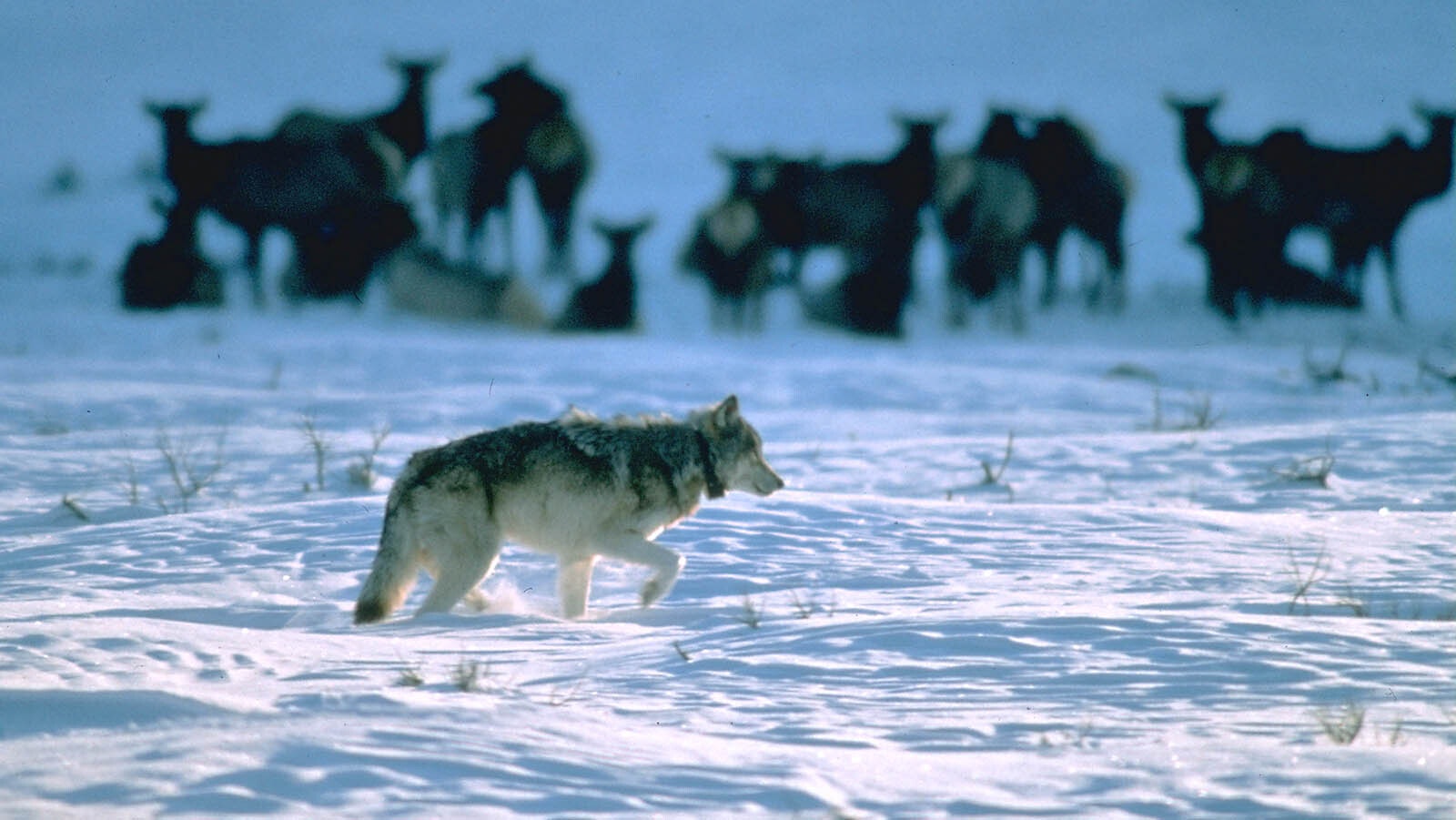
In stark contrast to how Wyoming ranchers can manage predatory wolves, If ranchers in California see them attacking their cattle, they can do little more than watch, and a state fund to compensate them for their losses is running out of money.
“You can see a wolf attacking, killing and eating one of your calves. Not only could you not kill it, you could not injure it in any way,” Kirk Wilbur, vice president of government affairs for the California Cattleman’s Association, told Cowboy State Daily.
That’s the polar opposite of wolf policy throughout much of Wyoming, where wolves can be shot on sight at any time.

Wolves started trickling into California from Oregon about a decade ago, and the northern part of the state now has an estimated 42 wolves in several established packs.
California launched a $3 million wolf livestock compensation pilot program in 2021, but it’s running out of money, according to the California Department of Fish and Wildlife (CDFW).
“To date, the Department of Fish and Wildlife has received a total of 102 grant applications for the CDFW Wolf Livestock Compensation Interim and Pilot Program that are projected to exhaust the current fund,” the agency recently announced.
The cattleman’s association will lobby the California Legislature to replenish the fund. But given the state’s projected $38 billion budget deficit, “it’s a tricky proposition this year,” Wilbur said.
“There are a lot of programs that are having their funding zeroed out, or their funding cut,” he said. Replenishing the depredation fund “is something we are interested in pursuing. We’re cognizant of that big, $38 billion elephant in the room.”
The first documented wolf in recent memory in California was a lone radio-collared male, “wolf OR-7,” that came in from Oregon in 2011, Wilbur said.

California started formulating a wolf management plan, calling together representatives of various interest groups, including ranchers, hunters and conservationists.
“The process began in 2012. At that time, it was called a ‘wolf management plan,’ but it ended up being called a ‘wolf conservation plan,’” Wilbur said.
In 2013, there was a push to list wolves as an endangered species under both federal and state regulations, he said. That was finalized in June 2014.
“By that time, OR-7 had returned to Oregon,” Wilbur said. “There were actually no known wolves in California at the time that wolves were designated as an endangered species here.”
More wolves started coming south from Oregon, and by 2015 had established the first known pack in California.
“In a matter of about a decade, we’ve had a significant increase in the wolf population, and that has come with significant livestock depredation,” Wilbur said.
So far, established wolf packs have stuck mostly to the northern part of California. One lone radio-collared wolf, “OR-93,” wandered as far south as the Santa Barbra area, he said.
That wolf was stuck and killed by a car in Kern County, California, where Bakersfield is the county seat.
Even if federal protection is lifted – as it has been in Wyoming, Montana and Idaho – wolves will still be listed as endangered under California law, and thus still essentially untouchable, Wilbur said.
That leaves California ranchers with even more limited recourse than Colorado ranchers now have.
Wolves were reintroduced to Colorado in December and remain a federally protected species there, meaning that the public can’t hunt or shoot them, as they can in Wyoming.
However, under the Centennial State’s wolf management plan, agents from Colorado Parks and Wildlife (CPW) have the option of killing wolves in cases of extreme attacks on livestock.
In California, even CDFW agents can’t kill wolves for preying on cattle, Wilbur said.
The only circumstances under which a wolf could be killed in California is if it posed an immediate threat to human life or safety, “such as if a wolf were trying to attack your child,” he said, and there haven’t been any reports of such incidents.
But should any of those newly reintroduced Colorado wolves cross over into Wyoming, ranchers north of the state line won’t hesitate to shoot them on sight.
California’s livestock depredation program has “three prongs,” Wilbur said.
One is direct compensation for losses, or repayment for the fair market value of each livestock animal confirmed to have been killed by wolves. There were 21 confirmed wolf depredations in 2023.
“Confirmed depredations are much lower than actual depredations,” Wilbur said.
The second prong compensates ranches for expenses related to nonlethal wolf deterrents, such as range riders.
And the third is for other negative effects of wolves being near cattle. Such things as cows having decreased conception rates or aborting their calves because of stress caused by the proximity of the predators, Wilbur said.
Applications for compensation are retroactive back to 2021. It’s likely that a flood of recent applications for the third category of compensation – other negative effects of wolves – is what’s pushing the fund to its limits, Wilbur said.
Even in the face of a monster state deficit, Wilbur said his organization and others are going to keep pushing for more money.
The state owes that to its ranchers, he said.
“As long as they have made the policy choice to designate wolves as a fully-protected species, then they ought to compensate ranchers for the impacts of that fully-protected species,” he said.

