The state sees a major increase in hunting incidents involving serious injury or death
Reply


JULIA FELTON | Wednesday, Dec. 6, 2023 5:03 p.m.

TRIBUNE-REVIEW
TribLIVE’s Daily and Weekly email newsletters deliver the news you want and information you need, right to your inbox.
Animal-rights legislation being considered by Pittsburgh City Council would ban fur sales, horse-drawn carriages and the French delicacy foie gras in the city.
The would-be ban on fur sales and manufacturing is needed because of the “tremendous suffering” that millions of animals face each year when they are killed for their fur, according to the legislation introduced this week.
Councilman Bruce Kraus, D-South Side, who sponsored or co-sponsored all of the related bills, acknowledged there’s not a large market in Pittsburgh for any of the items targeted, but he said the legislation is meant to be “preventive in nature because we don’t have anything on the books.”
The first council bill, sponsored by Kraus and Erika Strassburger, D-Squirrel Hill, would ban the manufacturing and sale of fur products in the city. It includes exceptions for used fur products and fur products that are used for religious, traditional tribal, cultural or spiritual purposes.
If approved, those violating the ban could face fines of up to $500 per violation.
Carl Herrmann, whose family has owned Carl Herrmann Furs in Downtown Pittsburgh for over a century, said he feels the proposed fur ban unfairly targets only one of many industries that rely on animal products. The ban does not extend to leather, down, fleece or other products that require butchering an animal.
“This is a direct attack on the animal fur industry,” Herrmann said. “What happened to freedom of choice? If you don’t like fur, don’t wear it.”
Herrmann said fur products constitute about 65% to 70% of his business, and a ban on such products would have a significant impact. He said he’s already seen a decline in the popularity of fur since some people began protesting against it decades ago.
Herrmann said he doesn’t believe arguments that the fur industry breeds animal cruelty. People who raise animals for fur, he said, are careful not to abuse animals or allow them to be malnourished or sick because that can have a negative impact on the quality of the fur. If the goal is to create the “finest product they can,” he said, people in the fur industry have to care for animals properly.
A second bill, sponsored by Kraus, would ban horse carriages. Kraus said it would build upon legislation passed in 2017 that restricts how people can handle wild and exotic animals in the city.
Kraus said he was inspired to push for the measure after interacting with a horse that was drawing a carriage in New Orleans.
“I looked him in the eyes and that horse was dead,” Kraus said. “I thought, what a horrible way to live your life, for your entertainment value.”
A third bill, co-sponsored by Kraus and Strassburger, would ban the sale of foie gras and force-fed animal products. Anyone seeking to sell foie gras — a French delicacy made from the enlarged liver of a goose or duck — would have to prove the animal was not force-fed.
The legislation said producing foie gras typically involves inserting a footlong metal rod or plastic tube down a bird’s throat and injecting unhealthy amounts of feed into the animal’s stomach. This continues until the animal’s liver is diseased and enlarged up to 10 times its normal size.
Violators of that ban would faces fines of up to $500 per violation.
Other areas already have enacted similar bans on fur products and foie gras. A statewide ban on the production and sale of fur products was approved in California in 2019 after several California cities enacted similar measures, and the state also has banned foie gras. New York City also banned foie gras, and some French cities have outlawed the delicacy. Bans on fur products are in place in Ann Arbor, Mich., Hallandale Beach, Fla., and several cities in Massachusetts.
The measures could be ready for a preliminary vote as early as next week and a final vote as soon as the following week.

RICHARD BAILEY/GETTY IMAGES
SHARE:

A version of this story appeared in Science, Vol 382, Issue 6675.Download PDF
RELATED PODCAST
Farm animals show their smarts, and how honeyguide birds lead humans to hives
BY SARAH CRESPI, DAVID GRIMM, KATHERINE IRVING
DUMMERSTORF, GERMANY—You’d never mistake a goat for a dog, but on an unseasonably warm afternoon in early September, I almost do. I’m in a red-brick barn in northern Germany, trying to keep my sanity amid some of the most unholy noises I’ve ever heard. Sixty Nigerian dwarf goats are taking turns crashing their horns against wooden stalls while unleashing a cacophony of bleats, groans, and retching wails that make it nearly impossible to hold a conversation. Then, amid the chaos, something remarkable happens. One of the animals raises her head over her enclosure and gazes pensively at me, her widely spaced eyes and odd, rectangular pupils seeking to make contact—and perhaps even connection.
It’s a look we see in other humans, in our pets, and in our primate relatives. But not in animals raised for food. Or maybe we just haven’t been looking hard enough.
That’s the core idea here at the Research Institute for Farm Animal Biology (FBN), one of the world’s leading centers for investigating the minds of goats, pigs, and other livestock. On a campus that looks like a cross between a farm and a small research institute—with low-rise buildings nestled among pastures, stables, and the occasional dung pile—scientists are probing the mental and emotional lives of animals we’ve lived with for thousands of years, yet, from a cognitive perspective, know almost nothing about.
The latest news, commentary, and research, free to your inbox daily
The work is part of a small, but growing field that’s beginning to overturn the idea that livestock are dumb and unworthy of scientific attention. Over the past decade, researchers at FBN and elsewhere have shown that pigs show signs of empathy, goats rival dogs in some tests of social intelligence, and, in one of the field’s, um, splashiest recent finds, cows can be potty trained, suggesting a self-awareness behind the blank stares and cud chewing that has shocked even some experts.
“There’s a lot to be learned by studying the mental lives of these creatures,” says Christopher Krupenye, a Johns Hopkins University psychologist who explores cognition in humans and more traditional animal models such as chimpanzees and dogs. Ignoring livestock, he says, has been a “missed opportunity” by the scientific community.
The field faces challenges, however, and not just because of rambunctious goats. Farm animals can be huge, many are hard to train, and traditional funders and high-profile journals have generally spurned such studies. But as scientists push past these obstacles, they are gaining insights not only into the minds of livestock, but into the evolution of our own cognition as well. What they learn could even change the way we house and treat these creatures.
“If we don’t understand how these animals think, then we won’t understand what they need,” says Jan Langbein, an applied ethologist at FBN. “And if we don’t understand what they need, we can’t design better environments for them.”
IN AN ENCLOSED L-shaped barn at FBN that houses more than 700 pigs, I’m in for a bit of hazing. Or at least that’s what it feels like at first. Before entering the main part of the building, my guides tell me to strip down to my underwear and don a baggy pair of blue overalls. “Now we’ll see who’s gone to the gym this week,” jokes Birger Puppe, director of FBN’s Institute of Behavioural Physiology. In truth, the researchers don’t want visitors bringing in deadly diseases like African swine fever. But the disrobing has other benefits: A thick, sour miasma of pig excrement engulfs me as I make my way inside, and I’m glad I’ve left my clothes behind.
In a small room, researchers are herding hulking hogs—just 6 months old but already 120 kilograms—one by one into a run with a treadmill. Instead of a conventional treadmill’s control panel, there’s a grapefruit-size glowing blue button at snout height that the animals can press to run the machine for a few seconds. Today, however, no one seems very interested in working out.
Like a person having second thoughts about their gym membership, most of the pigs step briefly onto the treadmill, then walk off, emitting squeals and deep, belchlike grunts as they exit through a door on the other side of the run.
“We have sports pigs, but also couch potato pigs,” Puppe laughs. Katharina Metzger and Annika Krause, the postdoc and technician, respectively, running the study, tell me I may be making the animals nervous. Last week, they say, one pushed the button seven times and kept coming back for more.
The goal is to train the pigs for an experiment that will test whether they’ll exercise just because it makes them feel good, a window into their emotions. “The idea comes from human sports physiology,” Puppe says. “That exercise can improve mood.”
A couple of decades ago, work like this would have been laughed out of the barn. There are an estimated 78 billion farm animals on Earth—a number that dwarfs monkeys, rodents, and humans combined—and we have lived with them longer than any other creature save dogs. Yet in an era where researchers are modeling rat brains on computers and showing that our canine pals may be able to intuit our thoughts, livestock remain a black box.

That’s because, until recently, scientists didn’t take their cognition seriously. “When I went to my first research conferences, people didn’t understand why I was studying the minds of farm animals,” says Christian Nawroth, a behavioral biologist at FBN. Why waste your time if it’s not going to improve milk or meat production, he recalls them asking. “They didn’t see the point.”
Nawroth did. Though he began his career researching decision-making in great apes, he switched to livestock in 2010. He was looking for a Ph.D. position when an intriguing opportunity popped up at a German zoo. He came to run some pilot tests on minipigs, exploring whether the animals were capable of “object permanence”—understanding that something still exists when it “disappears” behind a barrier, an important milestone in the cognitive development of children. Nawroth was hooked. “Almost nothing had been done on farm animals,” he says. “You had a feeling of being one of the first explorers.”
IN A DIFFERENT ROOM in the pig barn, Nawroth’s colleagues are investigating whether pigs are sensitive to one another’s feelings. Ten 6-week-old piglets cower together in the corner of a gated pen spread with straw. Like the treadmill hogs, they don’t seem to be fans of strangers. The question is, are they fans of each other?
Ethologist Liza Moscovice is hoping to find out. At an opening in the pen, she has placed a large box with a mesh window and a door. After a few minutes, the pigs begin to explore the new installation, congregating around a handle on the door. None has been trained to open a box like this, but they are soon sniffing and biting the lever until a couple realize that they can snout it up to open the door. Several then rush inside and begin to nose around.
In recent experiments, the box becomes a trap. Once a piglet enters, the door closes. Will the others come to its rescue? The study is a test of empathy inspired by a 2020 incident on a wildlife preserve near Prague. Several boars—the ancestors of modern pigs—gathered around a cage containing two younglings, until one figured out how to open it. At FBN, Moscovice and her colleagues have observed something similar in piglets. In a study published this summer, the team showed that, 85% of the time, the animals freed a trapped companion within 20 minutes.
The liberators were more likely to open the box when a pig was trapped inside than when it was empty, ruling out mere curiosity. Those that spent more time staring at their trapped companion were also more likely to help, especially if that companion squealed in distress, suggesting the helpers were sensitive to the “emotional state” of the boxed pigs.
“We think the helping behavior is based on some understanding of the other’s needs,” Moscovice says. “That’s a critical component of empathy that’s really exciting to see.”
Critics have argued that animals might help others simply to alleviate their own stress at seeing or hearing a trapped companion. But saliva samples Moscovice collected did not show elevated levels of the stress hormone cortisol in the helper pigs, consistent with a more selfless reason for the assistance.
Elsewhere in the barn, behavioral biologist Sandra Düpjan has been replicating the famous “marshmallow test” with pigs. As with humans, the goal is to see whether the animals can delay gratification, forgoing a smaller reward now in hopes of a larger one later. For pigs, the prize isn’t marshmallows but applesauce, an especially favored treat. “They will sell their mother for it,” Düpjan jokes.
Studies in the early 1970s suggested children who pass the test tend to be more successful later in life (though those findings have been disputed). Pigs aren’t going to college, but the experiment may help probe why some animals seek out more productive feeding grounds instead of settling for closer, poorer foraging.

Düpjan is also exploring what some consider signs of optimism and pessimism in pigs. In an open arena, the animals learn that one side always contains a box with a treat (again, the applesauce), whereas the other always features a “punishment.” (The applesauce is inaccessible, and the researchers wave a plastic bag over the pigs, which they apparently hate.) The scientists then place a box in the middle of the arena. If the pigs explore it, it’s a sign of optimism—they’re willing to make the effort, hoping they’ll get applesauce again; if they don’t, it’s a sign of pessimism—they’re expecting the bag.
Cows, too, show signs of optimism and pessimism, other researchers have shown. And like pigs, they may be capable of much more.
A SQUAT YELLOW building about 1 kilometer north of the pig facility doesn’t look like much, but it’s home to one of the most headline-grabbing findings in farm animal research. Two years ago, scientists potty trained cows here, teaching the animals to hold their bladder as they navigated a metal-gated hallway to a patch of artificial turf. That may not seem like a big deal to us, but it was startling in creatures that seem to have no control over their excretions. Not only did the cattle learn to “hold it” faster than many children do, their very ability to sense that they had to go countered the conventional wisdom that they lack “interoceptive awareness”—the capacity to think about what’s going on in their own bodies, which in humans has been linked to happiness, love, and even life satisfaction.
“These are not dumb creatures,” says Langbein, a co-author on the potty training study. “They have a rich emotional life and personality.”
Langbein’s new work could cement this idea. Next door, he shows me around a (blessedly) open-air stable, where four groups of dairy cows munch hay in separate quarters. Data cables run to blue troughs, recording how much and how often each animal eats. Collars around their necks send wireless signals to metal boxes in the ceiling, which, along with mounted cameras, track the precise location of each cow in real time, documenting which companion they associate with, and for how long. It all seems pretty complicated, but the goal here is simple.
“We’re trying to figure out if cows have friends,” says Annkatrin Pahl, the Ph.D. student leading the project. On a real farm, she explains, farmers move dairy cows around multiple times a year, disrupting their social groups. Are they also breaking up besties?

These are not dumb creatures. They have a rich emotional life and personality.
After identifying each cow’s ostensible best friend and worst enemy, Pahl brings the pairs into an open arena. In a recent trial, “enemy” cows began head butting. But when one was placed with her friend, the two began grooming each other and following each other around. As part of the study, which is still in its early stages, Pahl is also collecting heart rate and hormone level data to see how being separated from the group affects a cow’s stress levels, and whether pairing it with a preferred companion can help.
“If a farmer knows which of his cows like each other, it might be better to keep them together when moving the herd around,” Langbein says. He’s not just speaking academically. Langbein trained as a cattle breeder 40 years ago, and he’s especially sensitive to the housing conditions on modern dairy farms, where animals are often tied up for long stretches or confined to tight pens.
But convincing farmers to change their ways is going to take more than a few scientific publications, Langbein says. “That’s why we publish in farm journals, too, so they understand what we’re discovering in the language of normal people.” Already, he’s starting to see changes. “When I worked as a cattle breeder, nobody talked about how these animals think or feel. Now, we have heated waterbeds for piglets and automatic brushes for cattle to groom themselves,” he says. “I think farmers are more willing to accept that these animals are not just production units.”
NAWROTH LIKES to describe himself as the man who stares at goats. He’s referencing the 2009 George Clooney movie based on a Jon Ronson book about the U.S. Army’s attempts to harness psychic energy to kill the animals by glaring intently at them. (The efforts, shockingly, weren’t successful.)
Nawroth’s own studies are more grounded. After abandoning his early work with pigs because he found the animals too hard to train, he switched to goats, which seemed just as interested in him as he was in them. “They pay a lot of visual attention to what you’re doing,” he says. “It may not seem like there’s a lot going on in their head, but they are processing information all the time, even if they’re just standing there looking at you.”

It’s the sense of connection I experienced myself, and it has driven much of Nawroth’s research. In early work, he explored how goats measure up to dogs in a battery of cognitive tests. In an experiment known as the “impossible task,” dogs confronted with a food bowl they can’t access turn to humans for help, a behavior that’s been chalked up to their intensive coevolution with us. But Nawroth showed that goats did the same, the first time the experiment had been tried with a food animal. (Speaking of which, yes FBN has a slaughterhouse, and yes Nawroth has partaken in its spoils. This may be the only field of research where scientists eat their subjects when the study is over.) “Some of them started hoofing the experimenter, as if they were begging for help,” he says. “You thought it was a dog in goat’s clothing.”
Further experiments showed that goats, like dogs, could distinguish between pictures of happy and angry people, suggesting they are tuned into our emotional states; that they could locate food behind an obstacle more quickly if they watched humans move the food there first, a rare example of cross-species learning; and, in Nawroth’s most significant finding, that goats seem to understand what we mean when we point at something, a complex reading of our social cues that eludes even chimpanzees.
“Christian’s work has exposed a lot of commonalities that people would be surprised to find,” says Krupenye, the Hopkins psychologist. That’s the advantage of studying livestock, he says. Because farm animals encompass so many different species that are so far apart on the tree of life, they allow scientists to test just how widespread certain cognitive abilities are. And because humans may have domesticated themselves when they began living in close-knit groups, such studies could even provide insight into the evolution of our own minds. The studies on livestock, Krupenye says, are providing “a really important insight.”
Now, Nawroth is pushing his goat research even further.
IN A YARD BEHIND FBN’s goat barn, Nawroth shows me a “fake apple tree.” A tall metal pole juts out of the grass with another one balanced across the top. The resulting seesaw holds a brick on one end and a birdfeeder-like container on the other. Dangling from the center of the contraption is a square platform covered in artificial turf. The whole thing wouldn’t be out of place at a modern art museum.
The device took Nawroth and his colleagues 3 years to perfect. The idea is to explore in a far more controlled environment a phenomenon that’s been observed in the wild: goats pulling down the branches of an apple tree so that a companion can reach the fruit. The behavior might sound like altruism, and that’s what Nawroth hopes to test.
When a goat jumps on the platform, the birdfeeder (filled with dried penne pasta, which the animals munch like potato chips) lowers into a fenced-off area of the yard. The goat on the platform can’t reach it, but a nearby goat can. And in some cases, the platform goat lowers the food without any attempt to get it herself; she seemingly wants to help her companion reach it.
Nawroth, says it’s too soon to say whether the animals are exhibiting altruism. But Krupenye says any insight into the behavior will help scientists understand whether altruism truly exists in the animal kingdom—a subject of debate—and, if so, how it works. “It’s going to be really important for nailing down the mechanism.”
Meanwhile, inside the barn, a goat is playing with an oversize iPad. Or at least that’s what it looks like. The animal is poking her head through an aperture in her enclosure, nosing a thin computer monitor that’s displaying a livestock version of the “which one doesn’t belong?” game. Four pictures of goat faces flash on the screen, one slightly different from the rest. When she nuzzles the correct one, which she always seems to do, a tube squirts water into her bowl. (The game is harder than it sounds. The images are nearly identical, and when I try it myself, I’m quite relieved when I get a squirt.)
The setup can test memory, too. In other experiments, the animals have learned the order of 28 symbols, and correctly recalled it weeks later—a performance comparable to that of primates and dolphins.
Nawroth finds it easy to work with goats—“They don’t throw poo at you like great apes,” he says—and most are game to participate in his experiments. But farm animals can still be challenging to study. The sheer weight of cows and pigs makes them dangerous, and most livestock are used to living in herds; they can become uncooperative when separated from their group. Elodie Briefer, an ethologist at the University of Copenhagen, says it can take up to a month for sheep to participate in her studies of emotion. “Even then, very often you don’t get results.”
When the results do come, big journals often don’t take notice. They go to the dogs—literally. “It seems like there’s a dog paper every day,” says Alan McElligott, a zoologist at the City University of Hong Kong who has studied the minds of goats and other farm animals. “It’s almost impossible to keep up with it.” What’s worse, others say, most money for livestock research still goes to studies aimed at improving milk or meat yields, not to figuring out how these creatures think.
All of this may be keeping young scientists away, says Rebecca Nordquist, a biological psychologist at Utrecht University who explores cognition in pigs and chickens. There are only about a half-dozen labs researching livestock cognition worldwide, and no conferences dedicated exclusively to the topic. She also worries that many people may not want to know if the animals they think of as dinner turn out to have rich inner lives. “Some would prefer to keep them dumb.”
Still, Nawroth is optimistic. He’s spearheading a major initiative called ManyGoats that will connect dozens of researchers across the globe to share data, increasing sample sizes and bringing more rigor to livestock studies. “I hope it will be an example for other labs,” he says.
Jean-Loup Rault, head of the Institute of Animal Welfare Science at the University of Veterinary Medicine Vienna, is starting to see interest from researchers who used to scoff at farm animal studies. When he presented some of his early livestock cognition findings in 2010 at the Society for Neuroscience conference—which typically attracts tens of thousands of attendees—he was the only one with a pig poster. “Now, there’s more of us,” says Rault, a collaborator on FBN’s pig empathy and fake apple tree studies, “and people are becoming more interested in our work.”
Krupenye says the growing pains in the farm animal field remind him of dog cognition research, which had to fight for its own respect a couple of decades ago when it was still in its infancy. “Dogs have really helped people see that there’s a lot of value to studying species beyond primates and rodents,” he says. “I think the livestock folks are riding a similar wave.”
At the very least, Nawroth hopes the work will give people new respect for animals that have been overlooked for so long. Getting inside their minds will expand our own, he says. “Different species play by different rules. We have to see the world not just how we see it, but how they do.”
Reuters
December 7, 20231:47 AM PSTUpdated 13 hours ago
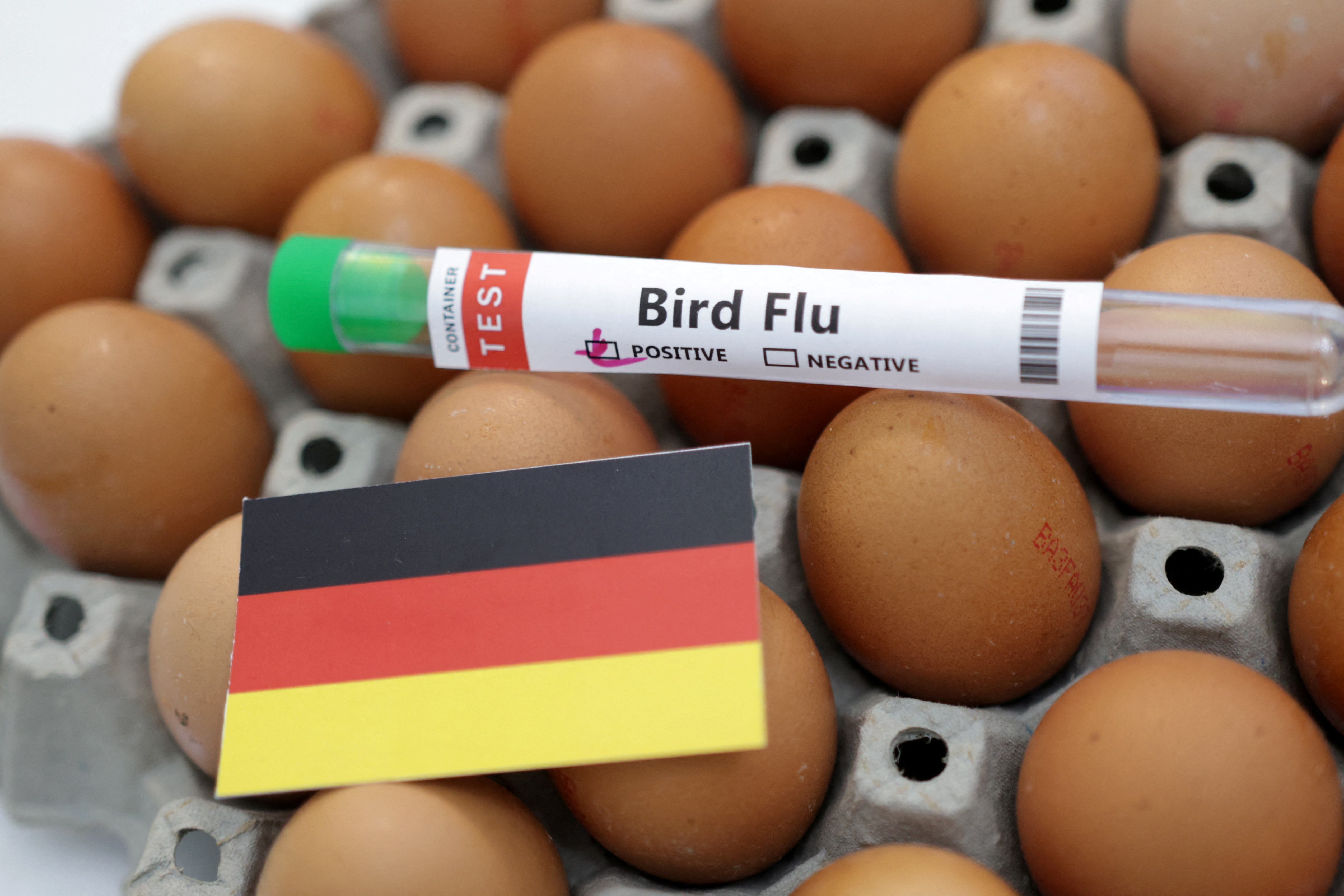
HAMBURG, Dec 7 (Reuters) – About 6,700 ducks and geese are to be slaughtered after an outbreak of the highly pathogenic H5N1 bird flu on a farm in east Germany, authorities said on Thursday.
The disease was confirmed on a farm in Schonberg in the eastern state of Mecklenburg-Vorpommern, the state agriculture ministry said.
Several other bird flu cases in Germany have been reported in recent weeks.
Bird flu, which has led to the culling of hundreds of millions birds in the past years, usually strikes in Europe during autumn and winter, often with infection spread by wild birds.
Advertisement · Scroll to continue
It has recently been detected on farms in several countries including France, the Netherlands and Belgium.
France raised the risk level of bird flu to ‘high’ from ‘moderate’ on Tuesday after new cases of the disease were detected, forcing poultry farms to keep birds indoors to stem the spread of the highly contagious virus.

