Does smoking cigarettes while hunting scare away deer?
Reply

If you come across an injured or wounded big game animal in Wyoming, and you don’t have a valid tag for that sex and species – legally, you have to let it suffer until a game warden or law enforcement officer can come shoot it.
November 23, 20235 min read
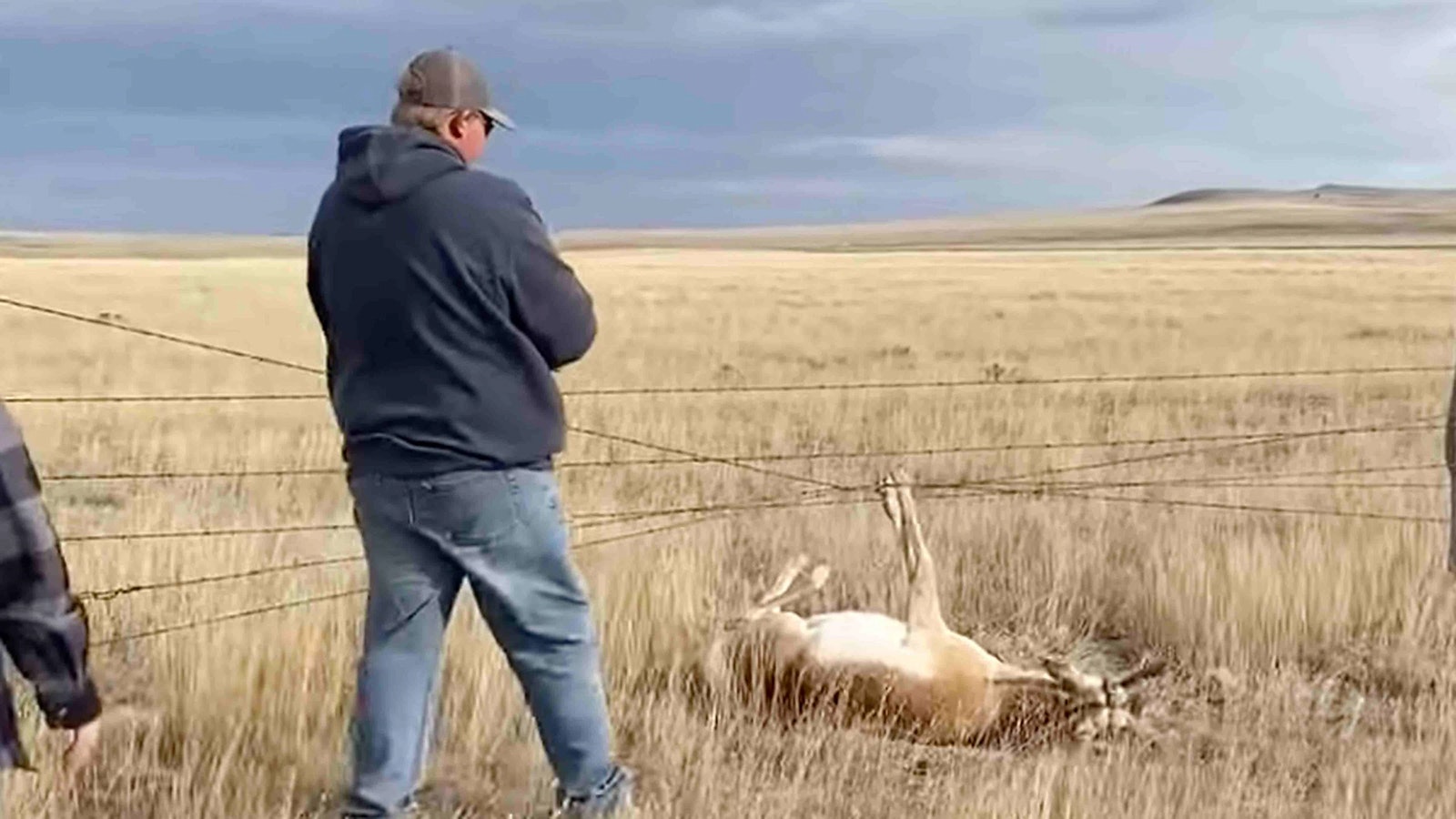
It’s a situation nobody wants to be in – there’s a wounded or injured big game animal suffering in front of you, but unless you have a valid hunting tag for that species and sex, you can’t legally kill it.
Instead, you’ll have to wait for a game warden or law enforcement to come put it out of its misery, if it doesn’t linger and die in the meantime.
From an emotional standpoint, it’s a horrible situation, for Wyoming hunters. But creating a “mercy killing” exemption in game laws would probably open the floodgates to abuse and illegal poaching.

The laws regarding killing a big game animal in Wyoming are hard and fast, Wyoming Game and Fish Department Public Information Officer Breanna Ball told Cowboy State Daily.
“It is illegal to harvest an animal without the proper license,” she said. “Hunters must make a reasonable effort to retrieve their animal and can use blood-trailing dogs within 72 hours of shooting the animal to attempt to locate the animal. It is recommended that if hunters do come across a wounded animal they contact the local game warden, wildlife biologist or regional Game and Fish office as soon as possible.”
Recalling an incident this fall, elk hunter Patrick Sullivan of Casper told Cowboy State Daily that he watched a bull elk that had been shot by another hunter die slowly, because he only had a cow elk tag. He said he left voicemails for game wardens in the area. After the elk died, he said he left without approaching the carcass.
Avid hunter and wildlife photographer Tessa Fowler of Cody told Cowboy State Daily that she found herself in a similar situation when she saw a cow elk get hit by a vehicle.
“I once saw a cow elk get hit on the North Fork (highway) and it was badly injured but still alive,” she said. “I called the game warden and told him she was in a bad way, and can I put her out of her misery? He said no. I told him I had already called 911 because the car that hit her was totaled and the driver was OK, but in shock.
“He told me to wait until the sheriff or HP (Wyoming Highway Patrol) got there, and they can shoot the elk.”

As hard as such a situation is to take, it’s the way the law works, and game wardens respond as quickly as they can, Fowler said.
“Most game wardens may even come out and investigate the situation and they can make the decision whether to shoot the animal. It’s not always the decision a person likes, but it’s the law,” she said.
Describing another incident, outdoorsman Paul Ulrich of Pinedale told Cowboy State Daily that when he was hunting with a cow/calf elk tag near Meeteetse this fall, he spotted a bull elk that he was pretty sure had been wounded.
“It was late in the day, and I spotted a bull elk in the next drainage over that was just mulling around,” Ulrich said. “He was in an area that just seemed odd for him to be in, and he hung around there for way too long.”
It was a troubling sight, but Ulrich left the bull alone and hiked back out for the day. The next morning, some hunters who had a bull tag found that elk and killed it. Ulrich said he spoke with a game warden later that day, and the warden confirmed that the bull had been previously wounded.
“It raises a very interesting ethical dilemma. Do I do the right thing, legally. Or do I do the right thing perhaps ethically, in my heart?” Ulrich said. “None of us want to see any animal suffer, and in particular needlessly suffer. However, if you don’t have the proper hunting tag, you’re not allowed, or would you – or should you – drop an animal you don’t have a tag for.”
Ulrich and avid hunter and mule deer conservationist Zachary Key of La Barge agreed that as tough as the regulation against mercy killing seems, they understand the reasoning behind it.
Poachers would take advantage of a mercy killing exemption, they said.
“People would take advantage of it,” Ulrich said. “How do you prove, without a lot of forensic analysis, that they didn’t just go out and shoot an animal to wound it first, and then drop it under the auspices of a mercy killing?”
Key agreed bad actors would abuse such a legal exception.
“I just know peoples’ nature. I just think some people would see a big buck and think, ‘Oh, I can just go ahead and shoot that without a tag, and then just say it was wounded,’” he said. “Human nature is just … I hate saying it, but any loophole people can find, they will find it.”
Social media technology could help hunters alert game wardens, or each other, about wounded critters, Ulrich said. But at least for now, many hunting areas are too remote for cellular service.
“I do think that, outside of a regulatory fix, it would be good to have some mechanism to report a wounded animal, and report it quickly. Not only to Game and Fish, but to other hunters in the area who do have a tag for that animal,” he said.
Ban will protect people, pets and wildlife from indiscriminate M-44 devices used for predator control on BLM lands EUGENE, OR – Predator Defense is pleased to announce that the U.S. Department of the Interior has banned the use of M-44 devices, commonly known as ‘‘cyanide bombs,’’ on lands administered by the Bureau of Land Management (BLM). This includes over 245 million acres, roughly a tenth of the nation’s land mass. M-44s are spring-loaded ejectors armed with cyanide powder long used by government agents for predator control. They have injured many people to date, and inhumanely killed thousands of animals every year, including endangered species and pets. “I am immensely relieved that countless people and animals will now be spared death and poisoning on a huge portion of the American landscape,” said Brooks Fahy, executive director of Predator Defense, a national wildlife advocacy group. “Working with victims of M-44 tragedies for over 30 years, I’ve seen what these indiscriminate devices do to families who have lost beloved pets, been poisoned themselves, or potentially lost a child. I commend the Interior Department for making BLM lands immeasurably safer.” BLM is the only agency within the Interior Department that uses M-44s to target predators like coyotes. They are not used on lands administered by the National Park Service, the U.S. Fish and Wildlife Service or the Bureau of Reclamation. However, M-44 use continues on U.S Forest Service lands, which are managed by the U.S. Department of Agriculture (USDA) and span 193,000,000 acres. They are also placed on private property by owner request. Most M-44s are placed by agents of Wildlife Services, the USDA’s animal-killing program. According to Wildlife Services’ data, in 2022 the program poisoned approximately 6,000 animals with M-44s in 10 states: Colorado, Montana, Nebraska, Nevada, New Mexico, North Dakota, Oklahoma, Texas, West Virginia and Wyoming. State agencies in South Dakota, Montana, Wyoming, New Mexico and Texas are also authorized to use M-44s. The public repeatedly expresses surprise that these dangerous devices continue to be used, especially after a well-known tragedy in 2017 in Pocatello, Idaho. Canyon Mansfield was 14 years old when he inadvertently triggered an M-44 device, thinking it was a sprinkler head. The M-44 had been illegally set on BLM land on a hill behind his home. It killed Canyon’s dog, Kasey, and injured him. Canyon was believed to have been spared from death because of the wind’s direction. The Mansfield family is thrilled by the BLM ban on M-44 use, but continues to push for a comprehensive ban. “We are so happy to finally see one federal government department banning another’s reckless and indiscriminate actions, telling Wildlife Services their use of these barbaric and antiquated devices must stop,” said Dr. Mark Mansfield, Canyon’s father. “We celebrate this critical move forward–ridding BLM lands of cyanide bombs. But there is more to do. Congress must enact ‘Canyon’s Law’ as a final act to ban M-44s on all public lands in America.” The current version of Canyon’s Law, which originated in 2019 in response to the Mansfield family’s tragedy, would ban M-44s on all public lands–federal, state and local. It was reintroduced in both houses of Congress in June 2023. Today’s BLM ban came about in response to a formal letter to Interior Secretary Deb Haaland, sent in October 2022 by U.S. Rep. Jared Huffman (D-CA) and former Rep. Peter DeFazio (D-OR) at the urging of Predator Defense. In it the Congressmen noted that the Interior Department had expressed openness to banning M-44s in their testimony to a Congressional subcommittee. The Congressmen urged they take immediate action to prevent future tragedies. Rep. Huffman followed up on this letter in 2023 after receiving status queries from Predator Defense, as the letter had appeared to languish. This month the Interior Department finally formalized their decision. Initial notice from Interior Department | Rep. Huffman’s press release Boosting work at the federal level, public demand for a ban has increased over time and is largely attributed to major media coverage of M-44 tragedies and popular statewide bans on the West Coast. Concurrent pressure has been applied by conservation organizations, e.g., the 2023 APA petition jointly filed by Predator Defense and the Center for Biodiversity and signed by over 70 conservation groups. “We are deeply grateful to Representative Huffman for pushing the BLM ban over the finish line,” said Fahy. “And since the Interior Department sees the wisdom of banning cyanide bombs, surely the USDA can, too. It’s high time our government steps up and stops putting people’s and animals’ lives at risk. They could save a lot of time, money and suffering by banning all M-44 use immediately.” |
| # # # Predator Defense is a national nonprofit advocacy organization devoted to protecting essential native predators, helping people learn to coexist with wild animals, and ending America’s war on wildlife.They have been championing native predators with science, sanity and heart since 1990. |
https://paulshapiro.medium.com/when-plastic-saved-the-elephants-pool-balls-and-the-bakelite-revolution-a5d56bb03d37

·
5 min read
·
3 days ago
5

Imagine losing your life so that the people in far-away lands could amuse themselves with your body parts. That was the fate of vast numbers of elephants for centuries who were killed to keep European nobility playing pool.
Billiards goes back to the 15th century, when wooden balls were used by the elites enjoying this new game. As European colonization expanded, new materials like ivory became more available, ushering a shift from wooden pool balls to the functionally superior ones made from the tusks of unfortunate Asian elephants.
Amazingly, one tusk of an Asian elephant could only make 4–5 billiard balls, meaning that by the 19th century, the trade required almost industrial scale slaughter. One company alone, Burroughes and Watts (which still sells pool tables and accessories today, though of course not ivory) boasted in the 19th century that it sold 1,140 elephants’ worth of billiard balls each year.
As the game’s popularity increased, the number of Asian elephants decreased, leading to a crisis for the billiards industry. (While pool balls were a driving force in the ivory trade, other culprits included ivory combs and piano keys — though the latter were typically made from African elephants, not Asian.)
Necessity Was the Mother of Invention
It was technological innovation, not humane sentiment nor conservation concerns, that saved the elephants.
Dwindling elephantine numbers caused the price of pool balls to skyrocket, with one set of ivory billiard balls in the mid 1800s (just three balls total at that time) costing about $60, or $1,400 in 2023 dollars.
Things got so dire that in 1863, pool table manufacturer Phelan and Collender announced a $10,000 prize to any innovator who could invent a pool ball not made of ivory (nor wood).
One of America’s most prolific inventors, John Wesley Hyatt was inspired by the contest and discovered an ivory substitute: nitrocellulose. Sadly, he didn’t win the money, as the nitrocellulose balls stemming from his invention, while superior in many ways to ivory, had one fatal flaw: they sometimes exploded — including midgame!
It wasn’t until the first decade of the 20th century that elephants would finally get their permanent reprieve from billiards enthusiasts. Belgian chemist Leo Baekeland had no interest in elephant conservation, but his 1907 invention of Bakelite (just for fun: Polyoxybenzylmethyleneglycolanhydride) did more to save the gentle giants than just about any environmental campaign would have. The so-called “Father of the Plastics Industry” made a material that was so durable, inexpensive, and functional — and it had the advantage of not exploding like celluloid balls — that the ivory ball was relegated to the history books.
According to one historian:
“It was not too long before the majority of pool balls being manufactured were made using Bakelite. By the 1920s, Bakelite billiard balls had become the preferred standard. Even the wealthy had to switch to Bakelite balls when they needed to replace their ivory pool balls.”
Today, we play pool with balls made from phenolic resin, polyester resin, and epoxy resin. Unlike the ivory balls, these balls can last for 40 years, or up to 400,000 impacts.
In other words, it was an inventor’s imagination, not an activist’s persuasive arguments, that spared tens of thousands of elephants from becoming pool balls.
Lessons Learned
It’s seductive to think that humans, when we learn about an abusive industry we may support, will recoil from our ways and change our behavior. Sadly, our species rarely works that way.
As Harvard economist John Kenneth Galbraith put it: “Faced with the choice between changing one’s mind and proving that there is no need to do so, almost everyone gets busy on the proof.”
Even if they cared about elephants, few people in the 19th century would have stopped playing pool to save them from slaughter, just as few people today — even those who love animals — will do things like stop eating chickens and pigs to save them from factory farms.
Rather, what seems far more likely to end the factory farming of animals for meat, eggs, and milk, is new technology.
In fact, nearly every category of animal exploitation that’s ever been essentially ended has seen its demise not because people made altruistic sacrifices for the purpose of ending cruelty. Consider, for example:
The point isn’t to suggest that animal advocates shouldn’t make ethical arguments and expose how poorly farmed animals are often treated. Rather, the point is that moral awareness is virtually never sufficient to end an abusive industry. Humans need clearly superior alternatives to warrant switching away from animal use.
Today, almost no one would consider killing an elephant to play pool, or harpooning a whale to light their room, mostly because we don’t need to. With new inventions, this can be true in the future about tormenting billions of animals to produce our food. At that point, people may be as grateful that they no longer need to produce food via animal exploitation as we are grateful today that we don’t need to kill elephants to play pool.

OLYMPIA — Conservation groups’ petition to help fix what they say is a broken system — resulting in the killing of nearly 45 gray wolves protected under federal and state laws — was recently denied.
Nonprofits Center for Biological Diversity, Washington Wildlife First and eight other conservation groups filed the petition Sept. 15. It was presented during a hearing Oct. 26 to the Washington Fish and Wildlife Commission, and was voted against.
The Washington Department of Fish and Wildlife denied an interview request by The Wenatchee World, but materials were provided.

“We ask the commission to approve rules that focus on using effective non-lethal measures to prevent livestock-wolf conflict,” the petition states, “promote social tolerance for coexisting with wolves, prevent the use of legal loopholes to kill wolves, and institute a consistent, transparent, and science-based process to guide the department in authorizing any lethal control actions.”
Conflicts between wolves and livestock — and the farmers who experience livestock losses — have been around for as long as wolves and humans have coexisted. But according to Amaroq Weiss, a senior wolf advocate with the Center for Biological Diversity, livestock deaths caused by wolf predation are surprisingly rare.
“Of the 5% to 10% of livestock losses that are due to predators, wolves are near the bottom of the list,” Weiss said. “Up near the top are coyotes. After that are domestic dogs.”

According to data from the United States Department of Agriculture in 2021, 1.19 million head of livestock were in Washington state. Meanwhile, self-reported data from livestock owners total approximately 15.5 confirmed wolf-related losses per year and 1.75 probable losses per year, Weiss said. Statistically, that breaks down to about .001% of livestock that are lost each year to wolf predation. A WDFW report stated it “removed” 44 wolves since 2012, but residents may legally kill a wolf if their livestock is threatened.
“For the individual livestock owner who loses livestock to wolves, it can feel very traumatic,” Weiss said. “It’s their family business, it’s their lifestyle; some of them are very attached to their animals. I think anyone who has done wolf work for a long time acknowledges that it is really traumatic if you are a livestock owner and you lose livestock to wolves. And that’s all the more reason why there should be rules in place and the agency should be required to help you put into place non-lethal measures that are appropriate for your operation, for your livestock, for your situation, to make sure that’s as least likely to happen as possible.”
Science has not shown that killing wolves is an effective solution for resolving these predation instances, Weiss said. In fact, numerous studies have shown the most successful means for resolving wolf-livestock conflicts is using non-lethal conflict deterrent measures.
These methods, Weiss said, include things like using livestock guarding dogs, range riders, electric fences and night penning of vulnerable livestock. One of the most effective methods is the use of fladry — a series of bright cloth flags hung at 18-inch intervals along a rope or fence line — to deter wolves from crossing into an area. According to Weiss, non-lethal methods have not been used consistently by livestock owners in the state, despite the legal requirements to do so, and little to no effort has been taken to prove such measures were in place before issuing orders to kill wolves.
“If you simply kill all the wolves, you may not have any problems for the next year or two, until the next wolf pack moves in, but if you as the livestock owner have not changed your husbandry practices to better protect your vulnerable livestock, you could have the same problems all over again,” Weiss said.
According to Weiss, the petition was turned down by commissioners because they didn’t think it was necessary.
“They said they just didn’t think it was needed and they trusted the department was following the protocol,” Weiss said. “(There were) different statements by different commissioners, of course. The ones who voted against it said that they felt like the department was doing a good job and that there was no reason to tie their hands with rules.”
According to a presentation given by the WDFW during the hearing, the WDFW recommended the commission deny the petition for several reasons.
First, the WDFW presentation showed imposing a regulatory approach would likely undermine one-on-one relationships with local WDFW staff and decrease acceptance of non-lethal tools by livestock owners.
“WDFW staff strongly believe the complex issue of wolf-livestock conflict is best addressed not by codification of rules,” according to the presentation. “WDFW staff have concerns that if WAC 220-440-080 is made too restrictive and does not reasonably allow for killing a wolf attacking livestock, working dogs, or pets, these actions would not be reported to WDFW for fear of criminal enforcement, increasing undocumented wolf mortality and impeding WDFW from tracking mortality sources and trends.”
The presentation also showed WDFW believed that strict implementation of non-lethal tools would likely “impose more than minor costs on businesses” and could have a “disproportionate impact on small businesses” in the industry.
“Some of the commissioners expressed a great deal of frustration that they didn’t get a chance to talk over all of these things,” Weiss said. “Accepting the petition would have allowed them to have (those) discussions. That’s how you get the information — you accept the petition. Unfortunately, Washington’s commission seems to be of the view that they do not discuss the substance of any administrative petitions that come before them, before they make the decision of whether or not to accept the petition. They don’t even allow the petitioners to have time to present their side, their view of the issues at those meetings. Only the department gets to.”
Accepting the petition does not bind the commission to end up with a particular set of rules — or any rule at all, Weiss said.
“They (the commissioners) get to have the final say of what is in that rule,” Weiss said. “The petitioners can propose specific language; they can propose what types of amendments to make to existing regulations, or can propose brand new regulations. Once the rulemaking process opens up with an acceptance of the petition, then the commission has the opportunity to really dig in and look at the proposed language, consider other options, ask the agency to propose some rules or language themselves, take public comment on it, and invite outside experts to come in and talk to them about particular aspects of what the commission might be interested in putting into rule.”
Ultimately, Weiss, along with the other petitioners, are concerned about the future of gray wolves in Washington state if no changes are made.
“We expect to continue to see wolves be killed when they shouldn’t be,” Weiss said. “Repeatedly wiping out wolf packs isn’t an acceptable solution. They are a state endangered species.”
Petitioners have until Saturday to decide whether they would like to file an appeal with Gov. Jay Inslee.
“We are considering right now whether or not to appeal,” Weiss said. “We have 30 days from the date of the decision by the commission to file an appeal with the governor, so we are examining our options and deciding if that’s the route we want to go or not. If it’s not the route we would decide to go, we will look at what other options we have instead.”
In the meantime, it is important the public voices how they feel to the commission, Weiss said. This can be done by attending commission meetings and testifying, or by going online and writing a letter.
“Future generations of humans deserve to have the wildlife that we have now, and the wildlife themselves deserve to be around,” Weiss said.