Fox snared by illegal trap in Arlington, Massachusetts, recovering after having leg amputated
Reply

Could such a different neurology really evolve purely by natural selection acting on random mutations?DENYSE O’LEARY SEPTEMBER 29, 2023 4Share
https://mindmatters.ai/2023/09/octopus-intelligence-is-unlike-anything-we-know/
The octopus, considered to be separated from us by about 700 million years of evolution, is believed to be the most intelligent invertebrate. It challenges many common assumptions about animal intelligence because it is also a short-lived loner. And we are discovering that its nervous system apparatus for intelligence is also completely different from typical mammal or bird models.
Rather than having a centralized nervous system, the octopus’ nervous system is spread throughout its body. Two-thirds of its neurons are not inside its brain. Researchers aren’t even sure how this system can work, but it does …
But it gets even more interesting. Many of these neurons can communicate with each other without going through the brain. Essentially, the nervous system inside the octopus’ arms can bypass the brain and communicate with each other …
In other words, the octopus brain is not even aware of what the arm is doing, which is hard to even fathom.– MIHAI ANDREI, “OCTOPUS ARMS CAN MAKE DECISIONS ON THEIR OWN WITHOUT A BRAIN,”ZME SCIENCE, SEPTEMBER 27, 2023 THE CONFERENCE PAPER IS OPEN ACCESS.
One recent study found that the octopus’s memory system is also different from what we might have expected:
Unlike typical models, the vertical lobe’s network operates in a feed-forward configuration, like a one-way street, with information only from the input neurons to output neurons that control octopus behavior.
Central to this simplicity is the organizational structure of approximately 25 million interneurons, divided into two distinct groups: simple amacrine cells (SAMs) and complex amacrine cells (CAMs). The SAMs, numbering around 23 million, specialize in learning visual characteristics through synaptic reinforcement. In contrast, the CAMs, totaling approximately 400,000, play a pivotal role in consolidating activity levels.
The two types of cells send their axonal branches to connect with bigger cells in the output layer. Simple cells, that transmit “learned” information, make the big cells active, while complex cells make them less active, controlling how the brain works efficiently.– HEBREW UNIVERSITY OF JERUSALEM, UNLOCKING MYSTERIES OF OCTOPUS COGNITION: PAVING THE WAY FOR MEMORY RESEARCH,PHYS.ORG, AUGUST 16, 2023. THE PAPER IS OPEN ACCESS.
The octopus’s system is consistent with considerable intelligence.
An octopus’s remarkable intelligence makes it a unique subject for marine biologists and neuroscientists as well. Research has revealed the brain power of the octopus allows it to unscrew a jar or navigate a maze. But, like many children, the octopus also develops an impish tendency to push the boundaries of behavior. Several aquariums have found octopuses memorizing guard schedules to sneak into nearby tanks to steal fish; meanwhile, marine biologists have discovered that wild octopuses will punch fish… for no apparent reason.– KENNA HUGHES-CASTLEBERRY, “WE’RE ONE STEP CLOSER TO READING AN OCTOPUS’S MIND,” ARS TECHNICA, APRIL 8, 2023
Dominic Sivitilli, a University of Washington behavioural scientist and co-author of the first paper mentioned above, is interested in octopus research because it may help us test the limits of how life could survive elsewhere in the universe. But extraterrestrial life is hardly the only question the octopus raises. But, if the universe is supposed to be without intelligence or design how do — not just one — but at least two quite different systems for enabling it come to exist? What are the odds?
As it turns out, jellyfish can learn without a brain too. And currently, a dispute rages about the intelligence of plants.
If it is “natural” for vastly different life forms to develop altogether different systems of intelligence, there is probably something underlying our universe that drives some life forms toward intelligence. It cannot just be Darwinian natural selection for survival because vast numbers of other life forms can survive quite well with very limited intelligence.
It’s the same problem as we encounter with arguments for the evolution of human consciousness. We are informed that human consciousness evolved simply to enable humanoids to hunt more efficiently. But packs of wolves, prides of lions, and pods of orcas have never needed anything like a human type of consciousness to hunt efficiently. A theory whose aim is to show that there is really no intelligence or consciousness underlying the universe is not very good at accounting for how either comes to exist.
We have only begun to study the topic of different systems for enabling intelligence seriously. And there are apt to be more surprises along the way.
You may also wish to read: Octopus intelligence shakes up Darwin’s tree. There does not seem to be a Tree of Intelligence, which deepens the mystery of intelligence.
Published October 4, 2023 11:46am EDT
A speedboat tour guide in Phuket province, Thailand, recently rescued a sea turtle that was tangled in ghost net. The turtle was successfully set free and released back into the water.
A sea turtle was successfully rescued after it was spotted with a net caught around its body in the middle of the ocean.
A speedboat tour guide spotted a sea turtle off the coast of Phuket province, Thailand, while out on the water.
The group of tourists was approaching a dock at the pier when they saw that the turtle was stuck, as Viral Press reported.
‘COLD-STUNNED’ SEA TURTLES RESCUED IN GEORGIA DUE TO ‘UNUSUAL EXTREME COLD WEATHER’
The group stopped to help the sea turtle by using a knife to tear the net that had worked its way around the turtle’s body and flippers.
(SEE the dramatic video of the rescue at the top of this article.)
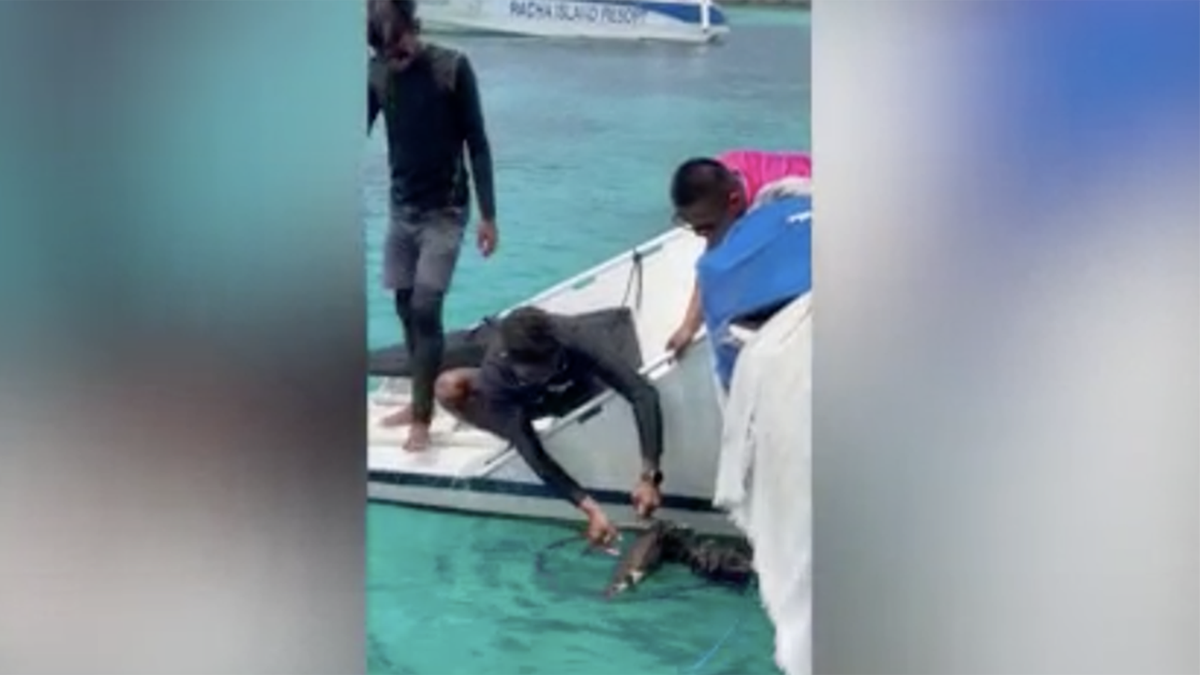
A sea turtle was spotted with a fishing net around its neck off the coast of Thailand. Members of a touring group stopped to help the trapped reptile. (Viral Press)
In the video, the turtle can be seen after the rescue successfully flapping.
CLICK HERE TO SIGN UP FOR OUR LIFESTYLE NEWSLETTER
Its helpers then released it back into the water.
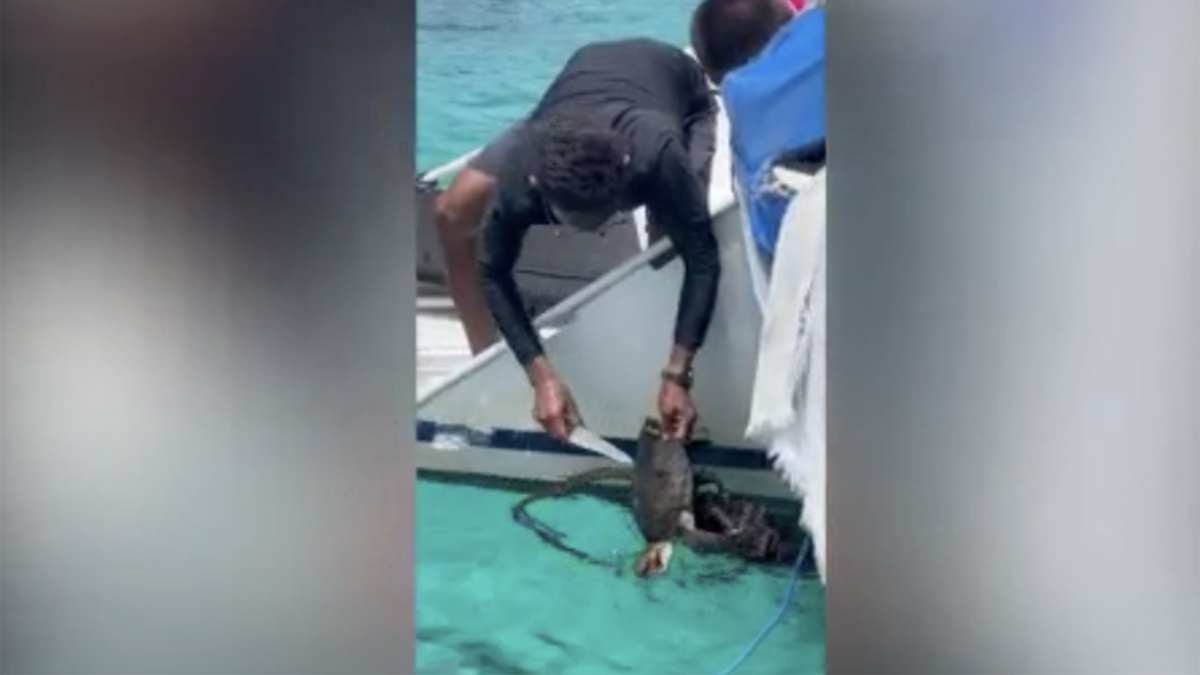
A touring speedboat stopped to help the struggling sea turtle back to safety. (Viral Press)
And the reptile can be seen swimming away successfully.

After the men successfully freed the turtle from the net, they set the sea creature back into the water. (Viral Press)
The net, which is thought to be a ghost net, is typically a fishing net that has been lost at sea, according to Viral Press.
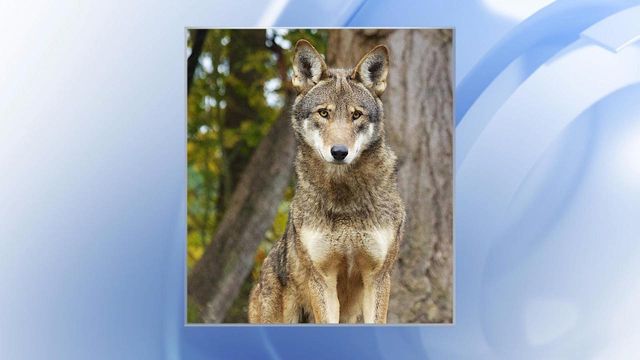
There are only 13 known wild red wolves in eastern North Carolina, according to the Center for Biological Diversity.
Posted 11:55 a.m. Yesterday
– Updated 11:59 a.m. Yesterday
By WRAL Staff
The Center for Biological Diversity filed a lawsuit Wednesday challenging the U.S. Fish and Wildlife Service’s decision to classify the wild population of red wolves as “nonessential.”
There are only 13 known wild red wolves in eastern North Carolina, according to the Center for Biological Diversity. The center also states the red wolf is listed as endangered under the Endangered Species Act.
https://imasdk.googleapis.com/js/core/bridge3.594.0_en.html#goog_1707538429
https://imasdk.googleapis.com/js/core/bridge3.594.0_en.html#goog_1707538430
https://imasdk.googleapis.com/js/core/bridge3.594.0_en.html#goog_1707538431 Top VideosWATCH MOREWRAL News Brief
“It’s absurd for the Fish and Wildlife Service to conclude that the world’s last wild population of red wolves isn’t essential,” said Perrin de Jong, Southeast staff attorney at the Center. “It’s time for the agency to acknowledge that this persecuted population of endangered wolves is an irreplaceable part of Southeastern ecosystems.
“These severely imperiled animals deserve the highest level of protection.”
Wednesday’s lawsuit, filed in the U.S. District Court for the Eastern District of North Carolina, notes that the Endangered Species Act defines an experimental population as “essential” if the loss of the population would significantly reduce the likelihood of the species’ survival in the wild.
Because the red wolf experimental population is the only wild population of the species, its loss would eliminate the species from the wild.
The suit claims the law compels the federal entity to designate red wolves as “essential” and provide them with greater protections.
The Center for Biological Diversity claims red wolves once roamed the American Southeast and beyond, from Texas to Florida and as far north as New York. The center also claims people killed the predators after the colonization of the Americas until only a handful remained.
“The agency must follow the letter and spirit of the Endangered Species Act and start treating red wolves with the utmost level of care,” de Jong said.
The suit also aims to remove the agency’s rules allowing private landowners to shoot red wolves.
Wednesday’s lawsuit challenges the denial of a January 2023 petition filed by the Center for Biological Diversity.
The petition, which began in 2016, sent to the U.S. Fish and Wildlife Service sought to reclassify red wolves as “essential” and eliminate allowances for private landowners to kill non-offending wolves.
In 1995, the agency created allowances for private landowners to kill red wolves. In 1986, the service established an experimental population of red wolves in North Carolina’s Alligator River National Wildlife Refuge and designated it as “nonessential.”

Last week, the U.S. Fish and Wildlife Service released a red wolf recovery plan that calls for important conservation measures, including the establishment of new wolf populations and a reduction in human-caused wolf deaths.
The analysis found the endangered red wolf can survive in the wild, but only with “significant additional management intervention.”
Specifically, the U.S. Fish and Wildlife Service’s recovery plan is for “Canis rufus” — the only wolf species unique to the United States. It calls for spending nearly $328 million over the next 50 years to get the red wolf off the endangered species list.


AP |
Oct 03, 2023 06:32 PM IST

South Africa has culled nearly 2.5 million chickens in an effort to contain dozens of outbreaks of two separate strains of avian influenza that have threatened to create a shortage of eggs for consumers and are hitting an industry already struggling due to an electricity crisis, the government said on Tuesday.

Another 205,000 chickens have died from bird flu in at least 60 separate outbreaks across the country, with more than half of those outbreaks in Gauteng province, which includes the country’s biggest city, Johannesburg, and the capital, Pretoria.
We’re now on WhatsApp. Click to join.
Some grocery stores in Johannesburg were limiting the number of eggs customers were allowed to buy this week — in some cases to one carton of six eggs — and the government acknowledged there were “supply constraints.”
The government was moving to fast-track new import permits for companies to bring in eggs from other countries “to ensure sufficient supplies for consumers,” Agriculture Minister Thoko Didiza said. Her ministry is also considering embarking on a vaccination program to halt the bird flu outbreaks and said the number of farms with cases was increasing.
PROMOTED
Swollen Feet: Don’t Ignore the Warning SignsNativePath|
Say Goodbye To Manual Processes: Accounts Payable Automation SimplifiedYahoo Search | Accounts Payable Automation Software|
55 Chinese sailors dead after vessel stuck in its own ‘trap’: ReportHindustan Times
Research Best Workplace Management SoftwareWorkplace Software | Yahoo Search|
Chandramukhi 2 box office collection day 5: Kangana Ranaut film witnesses slight dip, earns ₹28 cr so far in IndiaHindustan Times
https://googleads.g.doubleclick.net/pagead/render_post_image_v1.htmlBlue Eyeglasses For Men – Warby…Warby Parker|
Instant Loans, Fast Cash – $100-$5,000 Same Day DepositYahoo Search|
Powerful “Fat Destroying Gummy” Burns Belly Fat OvernightLafitcenter|
Neighboring Namibia has banned chicken meat and egg imports from South Africa.
The South African Poultry Association said the outbreaks were the worst since 2017.
Wilhelm Mare, chairman of the poultry group in the South African Veterinary Association, said 8.5 million egg-laying chickens could be affected, as well as another 2.5 million chickens used in the meat production business.
“It tells me we’re going to have problems with this situation for quite a while,” Mare said, calling it “catastrophic” for the industry.
The United States’ Centers for Disease Control and Prevention said last month that bird flu outbreaks were on the rise globally, with more than 21,000 outbreaks across the world between 2013 and 2022. Bird flu only rarely infects humans.
Eggs are an important and affordable source of protein in South Africa, but prices had risen steadily this year and the shortages caused by bird flu were expected to push prices up again and add to high food inflation for South Africans.
The chicken industry in South Africa has already been hit hard this year by power shortages, which have resulted in regular electricity blackouts to save energy and have badly impacted businesses.
South African farmers said in January they had been forced to cull nearly 10 million young chicks, as Africa’s most advanced economy experienced record blackouts at the start of the year, causing production to slow dramatically and leading to overcrowding on chicken farms.

