Are Russia and China going to destroy the US economy?
Reply

Est. 4min
Oct 12, 2023 (updated: Oct 12, 2023)
Content-Type: News Service

Beachgoers are seen next to the US Navy aircraft carrier USS Gerald R. Ford in Piraeus, Greece 30 July 2023. The USS Gerald R. Ford, the largest warship in the world, is deployed to deployed to the U.S. Naval Forces Europe (NAVEUR) area of operations. [EPA-EFE/GEORGE VITSARAS]
EURACTIV is part of the Trust Project >>>
The United States must prepare for possible simultaneous wars with Russia and China by expanding its conventional forces, strengthening alliances and enhancing its nuclear weapons modernisation program, a congressionally appointed bipartisan panel said on Thursday (12 October).
The report from the Strategic Posture Commission comes amid tensions with China over Taiwan and other issues and worsening frictions with Russia over its invasion of Ukraine.
A senior official involved in the report declined to say if the panel’s intelligence briefings showed any Chinese and Russian nuclear weapons cooperation.
“We worry … there may be ultimate coordination between them in some way, which gets us to this two-war construct,” the official said on condition of anonymity.
The findings would upend current US national security strategy calling for winning one conflict while deterring another and require huge defense spending increases with uncertain congressional support.
“We do recognise budget realities, but we also believe the nation must make these investments,” the Democratic chair, Madelyn Creedon, a former deputy head of the agency that oversees US nuclear weapons, and the vice chair, Jon Kyl, a retired Republican senator, said in the report’s preface.
Addressing a briefing held to release the report, Kyl said the president and Congress must “take the case to the American people” that higher defense spending is a small price to pay “to hopefully preclude” a possible nuclear war involving the United States, China and Russia.
The report contrasts with US President Joe Biden’s position that the current US nuclear arsenal is sufficient to deter the combined forces of Russia and China.
The arsenal’s makeup “still exceeds what is necessary to hold a sufficient number of adversary targets at risk so as to deter enemy nuclear attack,” the Arms Control Association advocacy group said in response to the report.
“The United States and its allies must be ready to deter and defeat both adversaries simultaneously,” the Strategic Posture Commission said. “The US-led international order and the values it upholds are at risk from the Chinese and Russian authoritarian regimes.”
Congress in 2022 created the panel of six Democrats and six Republicans to assess long-term threats to the United States and recommend changes in US conventional and nuclear forces.
The panel accepted a Pentagon forecast that China’s rapid nuclear arsenal expansion likely will give it 1,500 nuclear warheads by 2035, confronting the United States with a second major nuclear-armed rival for the first time.
The Chinese and Russian threats will become acute in the 2027-2035 timeframe so “decisions need to be made now in order for the nation to be prepared,” said the 145-page report.
The report said the 30-year US nuclear arms modernisation program, which began in 2010 and was estimated in 2017 to cost around $400 billion by 2046, must be fully funded to upgrade all warheads, delivery systems and infrastructure on schedule.
Other recommendations included deploying more tactical nuclear weapons in Asia and Europe, developing plans to deploy some or all reserve US nuclear warheads, and production of more B-21 stealth bombers and new Columbia-class nuclear submarines beyond the numbers now planned.
The panel also called for boosting the “size, type, and posture” of US and allied conventional forces. If such measures are not taken, the United States “will likely” have to increase its reliance on nuclear weapons, the report said.
https://www.msn.com/en-us/news/us/theodore-roosevelt-national-park-to-reduce-bison-herd-from-700-to-400-animals/ar-AA1ib0Pt?ocid=msedgdhp&pc=ENTPSP&cvid=52e6eb9aeb8040dc9c91ccd0d852f46f&ei=20

The Associated PressFollow
Story by By JACK DURA, Associated Press •6h
FILE – In this May 24, 2017, file photo, a bison grazes in Theodore Roosevelt National Park in western North Dakota. National Park officials are planning to gather and reduce the bison herd in Theodore Roosevelt National Park in North Dakota. The “bison capture” is scheduled to start on Saturday, Oct. 14, 2023, and continue through the week in the park’s South Unit near Medora. (AP Photo/Blake Nicholson, File)© Provided by The Associated Press
National park officials are planning to gather and reduce the bison herd in Theodore Roosevelt National Park in North Dakota, rehoming the animals to a number of Native American tribes.
The “bison capture” is scheduled to start on Saturday and continue through the week in the park’s South Unit near Medora. The operation will be closed to the public for safety reasons.
The park plans to reduce its roughly 700 bison to 400. The park will remove bison of differing ages.
 Related video: Book available to accompany PBS show about the American bison history (KPAX Missoula, MT)
deep connection to indigenous communities and the land.
Loaded: 55.48%Play
Current Time 0:16
/
Duration 1:59Quality SettingsCaptionsFullscreen

Book available to accompany PBS show about the American bison historyUnmute
0
More videos
Bison removed from the park will be rehomed and come under tribal management, InterTribal Buffalo Council Executive Director Troy Heinert told The Associated Press.
The bison will provide genetic diversity and increase numbers of existing tribal herds, he said. The Mandan, Hidatsa and Arikara Nation and the Standing Rock Sioux Tribe will receive bison; more bison could go to other tribes, depending on demographics, said Heinert, who is Sicangu Lakota.
A helicopter will herd bison into a holding area, with a survey of the landscape and a population count before the gathering of the bison.
The park alternates captures every year between its North Unit and South Unit, to maintain the numbers of the herd due to limited space and grazing and for herd health reasons, Deputy Superintendent Maureen McGee-Ballinger told the AP.
Share https://www.bbc.com/news/uk-scotland-north-east-orkney-shetland-67088869
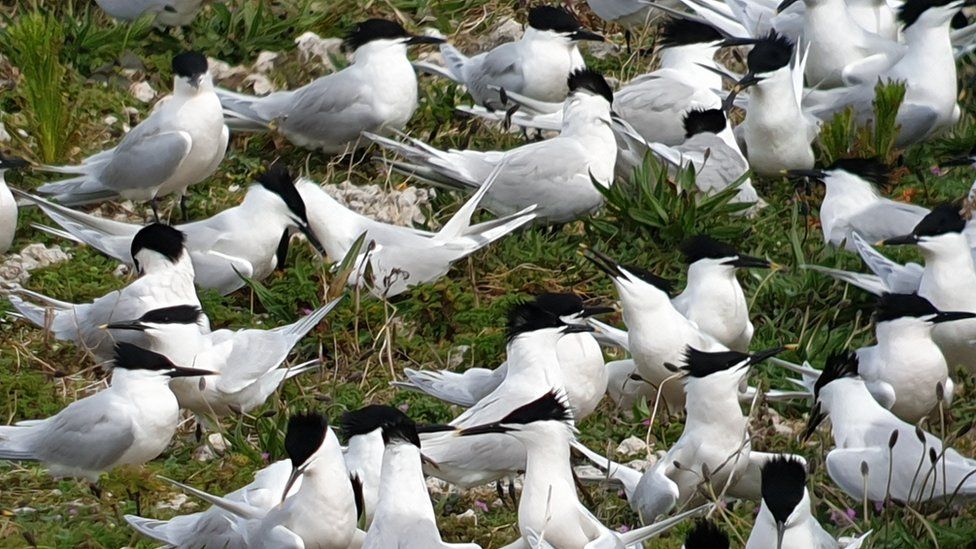
Guillemots, kittiwakes and terns in Scotland have suffered “huge losses” this summer due to avian flu, according to Scotland’s nature agency.
There were among 9,610 reports of dead and sick wild birds reported to NatureScot between 3 April and 1 October, mostly along the east coast.
Experts say there are signs some birds are building immunity to the virus.
But at Aberdeenshire’s Forvie National Nature Reserve alone more than 40% of this year’s tern chicks died.
NatureScot said that a degree of natural mortality is normal among tern chicks, but the scale and sudden nature of avian flu-related deaths this past summer has been unusual.
And when combined with the number of adult deaths reported, the losses are extremely concerning for the recovery of the long-lived birds.
The avian flu outbreak in wild birds in the UK began in 2021. Its risk to human health is low.
Following a quiet start to spring this year, a sudden increase in mortalities began in June and reached a peak in mid-July when around 2,300 sick and dead birds were reported to NatureScot in a two-week period.
The agency said guillemots, kittiwakes, and terns have experienced huge losses at their breeding colonies this summer.
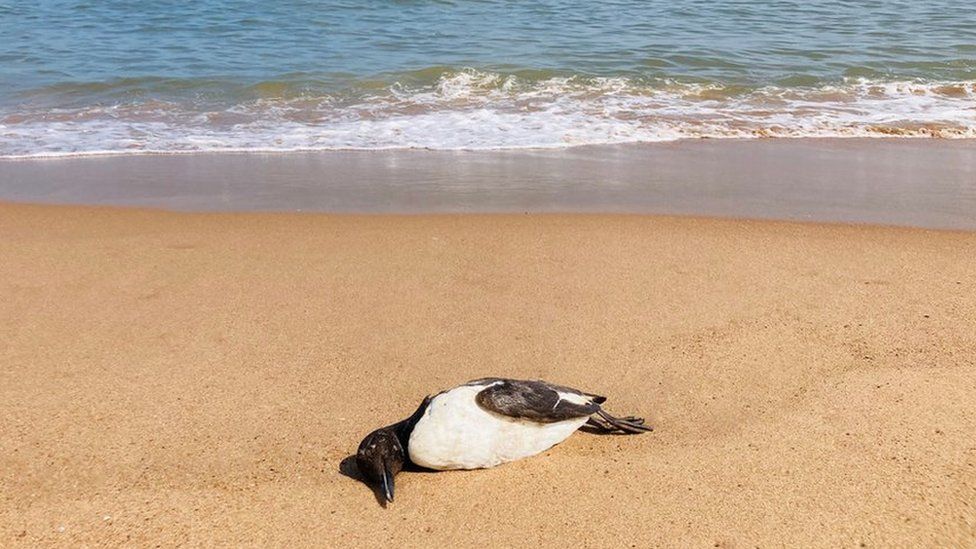
The highest number of reported mortalities were among guillemots, a seabird of the auk family – 3,519 deaths were reported over the summer.
Eileen Stuart, NatureScot’s deputy director of nature and climate change, said: “With very few great skua and gannet deaths this summer, we are hopeful that some wild birds are building immunity to HPAI [highly pathogenic avian influenza].
“But other species, such as kittiwakes and terns that were impacted last year, have still been greatly affected this year.”
The agency said many seabirds are already experiencing multiple pressures and population declines and they are trying to understand why some species have been hit harder than others.
It also said populations are likely to take years to recover, with an estimated 20,000 seabirds perishing from avian flu in summer 2022 in addition to the deaths this summer.
Claire Smith, the senior policy officer for the Royal Society for the Protection of Birds Scotland, said it was devastating to see thousands of dead birds again this year.
“This needs to be a wake-up call to step up the speed and scale of practical conservation actions to help our globally important seabird populations recover,” she said.

