Hunting season: ‘Hunters taking advantage to illegally target protected species’ – BirdLife
Reply

September 5, 2023
https://greekreporter.com/2023/09/05/tasmanian-tiger-back-to-life/
CanFACEBOOKTWITTERWHATSAPPLINKEDINEMAIL
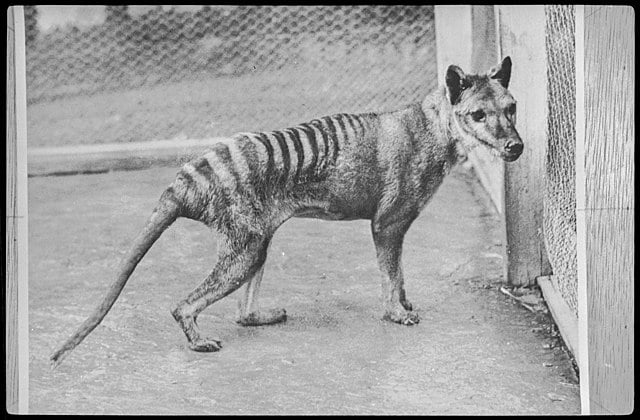
Almost 100 years after its extinction, scientists at The University of Melbourne are ready to try and bring the Tasmanian tiger (thylacine) back to life. The species has been declared extinct since the 1930s.
The initiative now has a partnership with the ‘De-extinction’ company, part of the US-based ‘Colossal Biosciences’ genetic engineering firm, which will provide the study team access to more DNA editing technologies as well as assistance from a group of top scientists from around the world.
The Thylacine Integrated Genetic Restoration Research (TIGRR) Lab, directed by Professor Andrew Pask, will greatly benefit from this collaboration.
https://googleads.g.doubleclick.net/pagead/ads?gdpr=0&us_privacy=1—&client=ca-pub-4210934692882880&output=html&h=174&slotname=3356935663&adk=3886436095&adf=2599648119&pi=t.ma~as.3356935663&w=696&fwrn=4&lmt=1693951278&rafmt=11&format=696×174&url=https%3A%2F%2Fgreekreporter.com%2F2023%2F09%2F05%2Ftasmanian-tiger-back-to-life%2F&wgl=1&uach=WyJXaW5kb3dzIiwiMTUuMC4wIiwieDg2IiwiIiwiMTE2LjAuMTkzOC42OSIsW10sMCxudWxsLCI2NCIsW1siQ2hyb21pdW0iLCIxMTYuMC41ODQ1LjE0MSJdLFsiTm90KUE7QnJhbmQiLCIyNC4wLjAuMCJdLFsiTWljcm9zb2Z0IEVkZ2UiLCIxMTYuMC4xOTM4LjY5Il1dLDBd&dt=1693951278116&bpp=2&bdt=M&idt=2&shv=r20230831&mjsv=m202308290101&ptt=9&saldr=aa&abxe=1&cookie=ID%3Ddb18954924c278b2-2281ba7222e10005%3AT%3D1693947473%3ART%3D1693947473%3AS%3DALNI_MZdGYM3RDkmrL0HuwUdggjzMCn0KQ&gpic=UID%3D000009c2263e24aa%3AT%3D1693947473%3ART%3D1693947473%3AS%3DALNI_MZDol2ZMJerKezz6tVuh_TNafRZjw&prev_fmts=0x0%2C1068x280%2C300x600&nras=1&correlator=6649453949742&frm=20&pv=1&ga_vid=1443136991.1693947472&ga_sid=1693947474&ga_hid=2094963143&ga_fc=1&rplot=4&u_tz=-420&u_his=1&u_h=864&u_w=1536&u_ah=816&u_aw=1536&u_cd=24&u_sd=1.25&dmc=8&adx=222&ady=1701&biw=1511&bih=708&scr_x=0&scr_y=395&eid=44759837%2C44759926%2C44759875%2C31076839%2C31077328%2C31076994%2C42532360%2C44798323&oid=2&psts=AOrYGsmcHsmJR0wfgNrM92_EU4xyTuK9OZ3qdKvfMycDLJHu6aPymLRZdYvedgI-Q6W9Rinv67dviOMQnonzfiYATJ4g%2CAOrYGsk1e4-LFB5xwPPfXz0uFNHbYeObYGdG9SculXID2e3JQTZSdNScb6VDKA3aZaVtAmWEt21vRRjDZoMWpoAKjvYuzjhq&pvsid=1107576786601373&tmod=1905567892&wsm=1&uas=3&nvt=1&ref=https%3A%2F%2Fnews.google.com%2F&fc=1920&brdim=0%2C0%2C0%2C0%2C1536%2C0%2C1536%2C816%2C1528%2C708&vis=1&rsz=%7C%7CoeEbr%7C&abl=CS&pfx=0&fu=128&bc=31&ifi=5&uci=a!5&btvi=2&fsb=1&xpc=s7iXs2lRbM&p=https%3A//greekreporter.com&dtd=11
Pask said recently that “a lot of the challenges with our efforts can be overcome by an army of scientists working on the same problems simultaneously, conducting and collaborating on the many experiments to accelerate discoveries.”
“With this partnership,” he added, “we will now have the army we need to make this happen.”

According to Professor Pask, as this collaboration progresses, Colossal Biosciences will use its CRISPR gene editing and computational biology capabilities to reproduce thylacine DNA while TIGGR concentrates its efforts on developing reproductive technologies specifically suited to Australian marsupials, such as IVF and gestation without a surrogate.
However, according to Professor Pask, the main question is how long it might take until a living thylacine is seen. Pask believes that it will be possible to attain an edited cell within ten years. This would then allow for the de-extinction of the animal.
“With this partnership, I now believe that in ten years’ time we could have our first living baby thylacine since they were hunted to extinction close to a century ago,” he said.
https://googleads.g.doubleclick.net/pagead/ads?gdpr=0&us_privacy=1—&client=ca-pub-4210934692882880&output=html&h=174&slotname=6174670694&adk=2780735912&adf=1074015879&pi=t.ma~as.6174670694&w=696&fwrn=4&lmt=1693951279&rafmt=11&format=696×174&url=https%3A%2F%2Fgreekreporter.com%2F2023%2F09%2F05%2Ftasmanian-tiger-back-to-life%2F&wgl=1&uach=WyJXaW5kb3dzIiwiMTUuMC4wIiwieDg2IiwiIiwiMTE2LjAuMTkzOC42OSIsW10sMCxudWxsLCI2NCIsW1siQ2hyb21pdW0iLCIxMTYuMC41ODQ1LjE0MSJdLFsiTm90KUE7QnJhbmQiLCIyNC4wLjAuMCJdLFsiTWljcm9zb2Z0IEVkZ2UiLCIxMTYuMC4xOTM4LjY5Il1dLDBd&dt=1693951279535&bpp=1&bdt=M&idt=1&shv=r20230831&mjsv=m202308290101&ptt=9&saldr=aa&abxe=1&cookie=ID%3Ddb18954924c278b2-2281ba7222e10005%3AT%3D1693947473%3ART%3D1693947473%3AS%3DALNI_MZdGYM3RDkmrL0HuwUdggjzMCn0KQ&gpic=UID%3D000009c2263e24aa%3AT%3D1693947473%3ART%3D1693947473%3AS%3DALNI_MZDol2ZMJerKezz6tVuh_TNafRZjw&prev_fmts=0x0%2C1068x280%2C300x600%2C696x174&nras=1&correlator=6649453949742&frm=20&pv=1&ga_vid=1443136991.1693947472&ga_sid=1693947474&ga_hid=2094963143&ga_fc=1&rplot=4&u_tz=-420&u_his=1&u_h=864&u_w=1536&u_ah=816&u_aw=1536&u_cd=24&u_sd=1.25&dmc=8&adx=222&ady=2850&biw=1511&bih=708&scr_x=0&scr_y=1562&eid=44759837%2C44759926%2C44759875%2C31076839%2C31077328%2C31076994%2C42532360%2C44798323&oid=2&psts=AOrYGsmcHsmJR0wfgNrM92_EU4xyTuK9OZ3qdKvfMycDLJHu6aPymLRZdYvedgI-Q6W9Rinv67dviOMQnonzfiYATJ4g%2CAOrYGsk1e4-LFB5xwPPfXz0uFNHbYeObYGdG9SculXID2e3JQTZSdNScb6VDKA3aZaVtAmWEt21vRRjDZoMWpoAKjvYuzjhq&pvsid=1107576786601373&tmod=1905567892&wsm=1&uas=3&nvt=1&ref=https%3A%2F%2Fnews.google.com%2F&fc=1920&brdim=0%2C0%2C0%2C0%2C1536%2C0%2C1536%2C816%2C1528%2C708&vis=1&rsz=%7C%7CoeEbr%7C&abl=CS&pfx=0&fu=128&bc=31&ifi=6&uci=a!6&btvi=3&fsb=1&xpc=VIPDt5Pq27&p=https%3A//greekreporter.com&dtd=12
The idea of resurrecting the thylacine surfaced in the late 1990s. The ambitiously named Lazarus Project aimed to clone the animal using DNA from preserved museum specimens; it was halted when available genetic material from which to replicate the animal proved too degraded and fragmentary.

About three thousand years ago, thylacines were quite common throughout Australia but it was specifically Tasmania that the species thrived.
Tasmanian Tigers were being hunted to extinction by European settlers who considered it a danger to the Tasmanian sheep business. The last known captive thylacine passed away in 1936.
Among living marsupials at the time, the Tasmanian Tiger was unique. It had a huge head and a long, stiff tail, granting it its recognizable wolf or dog appearance that led to the description “long dog with stripes.”
A biobank of species, created from marsupial stem cells could be immensely beneficial in preventing their extinction. However, the emergence of such a thing would surely necessitate further technological advancements. Animals are vulnerable to extinction in such instances as the recent Australia bushfires, so such a bank would prove quite valuable.
https://googleads.g.doubleclick.net/pagead/ads?gdpr=0&us_privacy=1—&client=ca-pub-4210934692882880&output=html&h=174&slotname=2426997372&adk=3276246329&adf=3354761885&pi=t.ma~as.2426997372&w=696&fwrn=4&lmt=1693951281&rafmt=11&format=696×174&url=https%3A%2F%2Fgreekreporter.com%2F2023%2F09%2F05%2Ftasmanian-tiger-back-to-life%2F&wgl=1&uach=WyJXaW5kb3dzIiwiMTUuMC4wIiwieDg2IiwiIiwiMTE2LjAuMTkzOC42OSIsW10sMCxudWxsLCI2NCIsW1siQ2hyb21pdW0iLCIxMTYuMC41ODQ1LjE0MSJdLFsiTm90KUE7QnJhbmQiLCIyNC4wLjAuMCJdLFsiTWljcm9zb2Z0IEVkZ2UiLCIxMTYuMC4xOTM4LjY5Il1dLDBd&dt=1693951281463&bpp=2&bdt=M&idt=2&shv=r20230831&mjsv=m202308290101&ptt=9&saldr=aa&abxe=1&cookie=ID%3Ddb18954924c278b2-2281ba7222e10005%3AT%3D1693947473%3ART%3D1693947473%3AS%3DALNI_MZdGYM3RDkmrL0HuwUdggjzMCn0KQ&gpic=UID%3D000009c2263e24aa%3AT%3D1693947473%3ART%3D1693947473%3AS%3DALNI_MZDol2ZMJerKezz6tVuh_TNafRZjw&prev_fmts=0x0%2C1068x280%2C300x600%2C696x174%2C696x174&nras=1&correlator=6649453949742&frm=20&pv=1&ga_vid=1443136991.1693947472&ga_sid=1693947474&ga_hid=2094963143&ga_fc=1&rplot=4&u_tz=-420&u_his=1&u_h=864&u_w=1536&u_ah=816&u_aw=1536&u_cd=24&u_sd=1.25&dmc=8&adx=222&ady=4308&biw=1511&bih=708&scr_x=0&scr_y=3034&eid=44759837%2C44759926%2C44759875%2C31076839%2C31077328%2C31076994%2C42532360%2C44798323&oid=2&psts=AOrYGsmcHsmJR0wfgNrM92_EU4xyTuK9OZ3qdKvfMycDLJHu6aPymLRZdYvedgI-Q6W9Rinv67dviOMQnonzfiYATJ4g%2CAOrYGsk1e4-LFB5xwPPfXz0uFNHbYeObYGdG9SculXID2e3JQTZSdNScb6VDKA3aZaVtAmWEt21vRRjDZoMWpoAKjvYuzjhq%2CAOrYGsmOZi1oar-9AOim2pv6oXC3kDlymSrR3UV0EpVb4nU0fny09I_cn3XCz4wPikRzxL0OaPW-HVW9cIjmsX8VcGuxNw%2CAOrYGskjBOgzdfZ6Xzx4-uhSSVfA1p1mVnvNXkLgwru2p5-hrWLg2GgElmiQUE6vkX8OiZWl8bm-SmfgBoghIKkeOdZp-6-D&pvsid=1107576786601373&tmod=1905567892&wsm=1&uas=1&nvt=1&ref=https%3A%2F%2Fnews.google.com%2F&fc=1920&brdim=0%2C0%2C0%2C0%2C1536%2C0%2C1536%2C816%2C1528%2C708&vis=1&rsz=%7C%7CoeEbr%7C&abl=CS&pfx=0&fu=128&bc=31&ifi=7&uci=a!7&btvi=4&fsb=1&xpc=9htHsn5UqF&p=https%3A//greekreporter.com&dtd=13
Additionally, research on embryo growth and development, as well as marsupial cloning, can support species management plans and breeding efforts for these animals.
Australian Museum Chief Scientist Kris Helgen, a mammalogist has expressed doubts on whether the Tasmanian tiger can be recreated.
Speaking to National Geographic he says that the biggest impediment is the genetic distance of the thylacine from any of its living relatives.
Unlike the woolly mammoth—the other charismatic extinct mammal that has become a high-profile target for de-extinction—the thylacine lacks a closely related species to serve as a genetic reference and provide cells that can become viable embryos that carry the thylacine genome. For the woolly mammoth, that role is served by the Asian elephant.
“The thylacine stood alone,” he argues. “It was as different as a cat is to a dog or a horse is to a rhino. The idea that we can bring back this carnivorous marsupial because we have all these modern genetic tools—no.
https://newrepublic.com/article/175337/bs-behind-usdas-new-climate-friendly-beef-label
September 5, 2023
HAVING A COW
DANIEL ACKER/BLOOMBERG/GETTY IMAGES
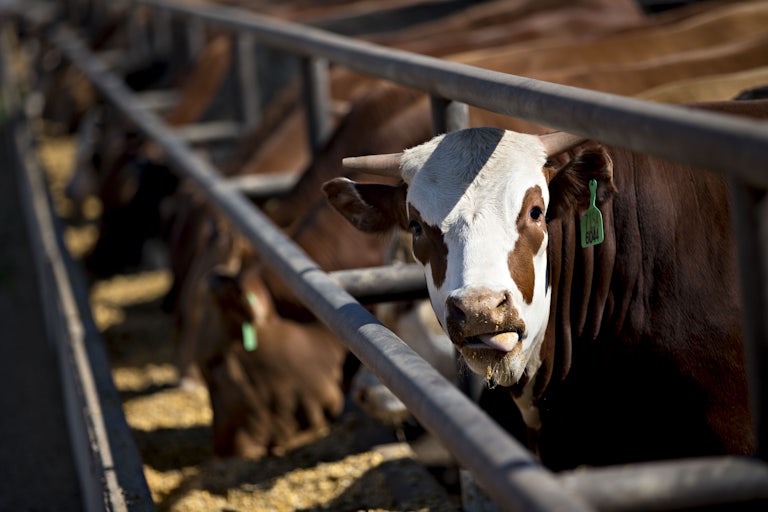
A beef cow at a ranch in Texas
Amid ever more frequent climate-related disasters, Americans are becoming increasingly conscious of climate change—and are slowly making the connection between the food they eat and greenhouse gas emissions. The food system’s biggest contributor of greenhouse gases is cows, which create methane through their belches and manure. Most proposals for reducing the climate impact of our diets call for a drastic reduction in beef consumption in high-consuming countries like the United States.

The beef industry has recognized this threat—but also sees a marketing opportunity for greenwashing its products, funding research and public messaging designed to assuage shoppers’ climate concerns. Over the past few years, the industry has helped spread claims that cows can be made low-carbon, with suggestions ranging from cutting emissions by converting manure into biogas to adding methane-inhibiting seaweed additives to cows’ feed, to simply raising and killing them faster.
Now burgers branded with potentially false climate claims are coming to a supermarket near you. Earlier this year, beef giant Tyson launched its Brazen Beef brand, which claims to have a 10 percent reduction in its climate hoofprint. The company has made sure to mention its impressive environmental consulting partners in this effort, like the Nature Conservancy and the Environmental Defense Fund, as a way of juicing up its climate bona fides. Now it has the official blessing of the U.S. Department of Agriculture, which is funding Tyson’s efforts to expand the market for its ostensibly lower-emissions products and, last March, approved a “climate-friendly” label for Brazen Beef. The first products marked with this label launched in supermarkets late last month.
To say there are problems here would be an understatement. The government is not only working with major carbon emitters to promote their products, but it’s providing them a virtual blank check of taxpayer money to do so. It’s the latest instance of a too-close-for-comfort relationship between agri-food corporations and the agency that’s supposed to oversee and regulate them. Beyond the politics, the math behind “climate-friendly beef” just doesn’t add up.
For one, no one can seem to find any evidence behind Tyson’s government-endorsed claim of 10 percent emissions reductions. In January, Matt Reynolds of WIRED looked into the USDA’s plans to support a “Low Carbon Beef” program and found scant information other than that the program might rely on a third-party certification scheme. In May, Emily Atkin and Arielle Samuelson of the popular climate blog Heated attempted a deeper dive but couldn’t get any information on who is collecting the data, where it’s coming from, what methods and models are being used, and whether or how any of the results are being verified. No additional information has come to light since then. (Representatives from Tyson and the USDA did not respond to a request for comment by our deadline for this article.)
Even if all of these protocols do in fact exist somewhere, it’s nearly impossible to confirm such a marginally small reduction in emissions in one specific product. Tyson sources its beef from across a wide range of farms; production methods among farms vary widely, with one study showing a 30 percent variation in carbon emissions between three commonly used beef-rearing methods in the Midwest. Even estimating emissions from a single rancher’s operations can be extremely tricky. What’s more, studies have shown that the methods for estimating emissions employed by the USDA and the Environmental Protection Agency might drastically undercount livestock methane emissions. There’s simply no reliable way to estimate a change in greenhouse gas emissions as small as 10 percent on any one farm—let alone a complex network of them.
If that wasn’t confounding enough, understanding the carbon savings of “climate-friendly beef” depends on what you’re counting down from. One of the trickiest parts about businesses making claims about “low-emissions” products is that much of the time, consumers don’t have sufficient information about what the product in question is being contrasted with. The choice of a baseline matters here—a lot.
There’s a little math involved in understanding the P.R. tricks at play here, so stay with us. One study conducted last year found that the average amount of carbon dioxide needed to produce one kilogram of beef across the U.S. was 21.3 kg of CO2 equivalent (CO2eq). It would be normal to assume that, per its marketing, Tyson’s Brazen products would use around 10 percent less than a similar number—or, at least, use a peer-reviewed baseline average. But the USDA actually allows companies to choose their own baseline from which to market products—and allowed another beef product to advertise itself as “low emissions” using a baseline of 26.3 kg of CO2eq per kilogram of beef. That’s around 11 percent more emissions than the number the other study found was the U.S. average. None of Tyson’s public Brazen materials state what baseline the company will be using to calculate its 10 percent emissions-reduction claim—and the USDA has already proven it’s willing to let companies use baselines that make their products look much better than they are.
The sketchy choice of baseline combined with all the uncertainties involved in quantifying emissions means that any consumer picking Tyson’s “climate-friendly beef” off the shelf hoping to reduce their carbon footprint could actually end up purchasing a product with more emissions than the burger or steak sitting right next to it. But even if we assume none of the aforementioned problems exist—that methods used to calculate emissions are best practice, that the assumed reductions are actually being achieved, and that the 10 percent reduction is compared to an accurate national average—Brazen beef’s emissions would still be higher than those of almost any other food on supermarket shelves except conventional beef (which, for comparison, has more than five times the emissions of tofu).
There should be little doubt that Tyson’s USDA-sanctioned “climate-friendly beef” label will confuse and mislead consumers. Getting consumers to change their diets is notoriously difficult, especially when it comes to making more climate-friendly choices. Asking people to reduce meat consumption runs headlong into a wall of dietary and cultural habits, concerns around food costs and access, and defense mechanisms, especially those awakened by having the government tell them what to eat or by making perceived sacrifices.
That said, studies have shown that labeling the climate impact of foods can shift consumers toward less greenhouse gas–intensive products. In efforts to align consumers’ climate concerns with their purchasing decisions, labels are a small but potentially useful tool. Consumers tend to trust labels that contain expert or government-derived information. But this usefulness and trust is undermined if labels make unverifiable or deceptive claims like “climate-friendly beef.”
All the recent carte-blanche funding and greenwashing that the USDA has provided to major meat companies betray its public mission of regulating U.S. agriculture. The regulatory capture of the agency is so blatant as to be mundane, and its revolving-door policy with industry as unapologetic as in other federal agencies. The current Agriculture Secretary Tom Vilsack, for instance, who also served for eight years under President Obama, spent most of the Trump administration promoting milk as head of the U.S. Dairy Export Council; he has since returned to his USDA post under President Biden. On most issues, Vilsack’s claims align with those of major commodity producers, and his line on meat is no different. He has said he believes that Americans don’t need to reduce the amount of animal products we consume and produce and that marginal methane reductions will instead be sufficient to right the climate ship.
It’s not just Vilsack. Even climate leaders like John Kerry, the Biden administration’s special envoy on climate, have avoided recommendations or even perceptions of advancing meat or livestock reductions, publicly placing their bets on methane-reducing technologies. This new government orthodoxy, however, flies in the face of the latest science, which is clear that reducing both production and consumption of highly-emitting products like beef is a necessary and unavoidable measure to reduce global warming.
The USDA could readily nudge consumers toward gradual beef reduction. Initiatives like universal carbon labels could better inform shoppers about climate impacts across every product. Denmark, for instance, is currently trialing a government-funded “eco-label” project with the goal of building both consumer trust and climate knowledge. The European Union is also working on its own emissions labeling scheme. By providing trustworthy information and more choices, the USDA could help lower emissions without impinging on anyone’s liberty to sell or consume meat.
But instead, the USDA is doubling down on its incumbent-friendly approach of investing in high-emitting products, promoting marginal technological fixes, and putting massive marketing resources behind them. Tyson gets to bask in the good P.R. and cash in on government contracts. And consumers will end up misled by the very government agency meant to educate and empower them.
In August, 15-year-old Ruben took a 5,200-mile trip from a shuttered private zoo in Armenia to his new sanctuary home in South Africa
By
Updated on September 5, 2023 01:49PM EDT
https://people.com/loneliest-lion-rescued-closed-zoo-moved-south-africa-sanctuary-7965449
Trending Videos
https://imasdk.googleapis.com/js/core/bridge3.587.0_en.html#goog_810711183
0 seconds of 30 secondsVolume 0%
This ad will end in 26
:max_bytes(150000):strip_icc():focal(745x453:747x455):format(webp)/Loneliest-lion-return-090523-tout-8b5847ac6b804587a3c485fd64907a17.jpg)
A lion left by himself at an abandoned zoo in Armenia for five years has finally found freedom at a sanctuary in South Africa.
According to the animal rescue organization Animal Defenders International (ADI), 15-year-old Ruben was the only remaining animal at a private zoo in Armenia that closed five years ago. New homes were found for the shuttered zoo’s other animals, but none of these locations had room for Ruben.
As a result, Ruben spent five years in a concrete cell, where his mobility deteriorated due to malnutrition and no exercise.
:max_bytes(150000):strip_icc():focal(772x303:774x305):format(webp)/Loneliest-lion-return-090523-4-8b0f3d26c3d54008b641ac9f45b7927d.jpg)
“Lions are the most sociable of the big cats, living in family prides in the wild,” ADI President Jan Creamer said in a statement. “So it must have been devastating for Ruben to have no contact or communication with other lions.”
Fortunately, “the world’s loneliest lion” got help through ADI and Qatar Airways Cargo, which arranged Ruben’s 5,200-mile trip from Armenia to the ADI Wildlife Sanctuary in Free State, South Africa.
How Cher Helped Save the ‘World’s Loneliest Elephant’ and Even Sang to Him: ‘It Was Life-Changing’
After a successful flight to the sanctuary in August, Ruben is acclimating to his new home in his natural environment and rehabilitating from his lonely years at the zoo. The 455-acre sanctuary houses 32 rescued lions and tigers, per ADI.
:max_bytes(150000):strip_icc():focal(968x418:970x420):format(webp)/Loneliest-lion-return-090523-3-80d7f1c0de594c90bc7ad16d7f7102c6.jpg)
Never miss a story — sign up for PEOPLE’s free daily newsletter to stay up-to-date on the best of what PEOPLE has to offer, from celebrity news to compelling human interest stories.
“Ruben was really in trouble until Qatar Airways Cargo stepped up,” Creamer added. “ADI had been funding his care in Armenia since December, and when we could find no flights for him, we feared he could be stuck there.”
:max_bytes(150000):strip_icc():focal(864x449:866x451):format(webp)/Loneliest-lion-return-090523-tout2-70eb9e0c46944aad9ebd961b727b4c1b.jpg)
ADI said that Ruben was examined at a veterinary clinic in Pretoria and that his habitat at the sanctuary was built with ramps and guard rails to help the lion stay active safely while he works on regaining his mobility.
“Ruben has already started to get his roar back, his morning calls getting steadily louder as he regains his confidence,” ADI shared in its news release.
“Seeing him walk on grass for the first time, hearing the voices of his own kind, with the African sun on his back, brought us all to tears,” said Creamer, who added that Ruben’s demeanor has been totally changed, and he is no longer fearful.
4 Orphaned Lion Cubs from Ukraine Start New Life in Minnesota
“His determination to walk is inspiring. If he stumbles or falls, he just picks himself up and keeps going. He is nothing short of heroic. Incredibly, in just a few days, his movement is already improving. We know this will be a long road and will require ongoing veterinary treatment, but the start of his new life could not have been better,” Creamer added.
Those interested in contributing to Ruben’s continued care can learn more atadiwildlifesanctuary.org.za.
Story by Ian Randall •11h

A poultry farm in China© Getty Images
Asubtype of avian influenza found in Chinese poultry farms is undergoing mutations which may increase the risk of widespread human transmission.
This is the warning of a team of scientists from China and the UK, who are calling for “concerted research” to monitor the evolution of the viruses and the threat they may pose.
In humans, infection with the H3N8 avian influenza virus has been known to cause acute respiratory distress syndrome – and can even be fatal.
However, exactly how it might be transmitted from animals to humans has been poorly understood.
In their study, the researchers analyzed a sample of H3N8 taken from a human patient, using laboratory ferrets and mice as models for human infection.
They found that the strain has undergone several adaptive changes that allow it to cause severe animal infections – and have facilitated airborne transmission between animals.
A phial of blood labelled H3N8© Getty Images
 Related video: Australia monitoring new ‘Eris’ COVID-19 variant as it spreads in the US (Dailymotion)
The analysis was undertaken by veterinary molecular medicine expert Professor Kin-Chow Chang of the University of Nottingham and his colleagues.
Prof. Chang said: “We demonstrate that an avian H3N8 virus isolated from a patient with severe pneumonia replicated effectively in human bronchial and lung epithelial cells.”
(Epithelial cells are those that line the airways and make the mucus which lubricates and protect the lungs.)
The virus, Prof. Chang continued, “was extremely harmful in its effects in laboratory mammalian hosts and could be passed on through respiratory droplets”.
Chickens© Getty Images
Paper co-author and veterinary medicine researcher Professor Jinhua Liu of the China Agricultural University in Beijing added: “Importantly, we discovered that the virus had acquired human receptor binding preference and amino acid substitution PB2-E627K, which are necessary for airborne transmission.
Where to Stay in Langston, AL – Browse Vacation Packages
“Human populations, even when vaccinated against human H3N2 virus, appear immunologically naive to emerging mammalian-adapted H3N8 avian influenza viruses and could be vulnerable to infection at epidemic or pandemic proportions.
“Acid resistance of influenza virus is also an important barrier for avian influenza virus to overcome to acquire the adaptability and transmissibility in new mammals of humans.
“The current novel H3N8 virus has not acquired the acid resistance yet. So, we should pay attention to the change in acid resistance of the novel H3N8 virus.”

