The members of the family use the palms of their hands in a “bear crawl”.
A family living in Turkey has baffled scientists studying the evolution of humans. Certain members of the Ulas family walk on all fours, which had not been observed in fully-grown adults before this discovery. This unusual behaviour was first documented in a 2006 BBC documentary titled ‘The Family That Walks on All Fours’. The video shows the members of the family using the palms of their hands in a “bear crawl”. A scientific paper has also been published, giving details about the family.
The BBC quoted Professor Humphrey, from the London School of Economics (LSE), as saying that four sisters and one brothers were born with the unusual trait that could yield clues to why our ancestors made the transition from four-legged to two-legged animals.
Unfortunately, a sixth member of the family, who also had the characteristic, died.
Powered By
PlayUnmute
Loaded: 0.16%Fullscreen
“I never expected that even under the most extraordinary scientific fantasy that modern human beings could return to an animal state,” Professor Humphrey said on 60 Minutes Australia.
“The thing which marks us off from the rest of the animal world is the fact that we’re the species which walks on two legs and holds our heads high in the air,” he explained.
“Of course, it’s language and all other sorts of things too, but it’s terribly important to our sense of ourselves as being different from others in the animal kingdom. These people cross that boundary,” added the expert.
A study by researchers at Liverpool University said that the children at the centre of the study had skeletons with more resemblance to apes than humans and a shrunken cerebellum, said New York Post.
Post a commentProfessor Humphrey later said that a physiotherapist later and equipment used to help them walk on just two feet, which led to significant improvements in mobility.
SHAREShare Article via FacebookShare Article via TwitterShare Article via LinkedInShare Article via Email
U.S. philantropist Bill Gates speaks during the Global Fund Seventh Replenishment Conference in New York on September 21, 2022.
Ludovic Marin | AFP | Getty Images
Bill Gates has spent years, and billions of dollars, working to combat climate change.
The billionaire’s foundation has invested vast sums in various climate tech solutions while regularly raising the alarm about the leading contributors to climate change, like the greenhouse gas emissions stemming from major energy and manufacturing companies burning fossil fuels at prodigious rates.
But, according to Gates, most people are still unaware of the role played by one of the biggest contributors to climate change: agriculture, specifically methane emissions from livestock and fertilizers.
“Of all the climate areas, the one that people are probably least aware of is all the fertilizer and cows, and that’s a challenge,” Gates recently said on the latest episode of his podcast, “Unconfuse Me.”
The topic came up because Gates was in conversation with musician and director Ahmir “Questlove” Thompson, who, like Gates, also happens to be an early investor in several plant-based food startups, such as Impossible and NotCo.
Thompson, who is from Philadelphia, even recently partnered with Impossible to create a plant-based cheesesteak that counts former president Barack Obama as a fan, he told Gates.
Thompson told Gates he was won over by plant-based foods’ ability to mimic the taste of real meat, among other products: “Something told me plant-based is going to be the future … and I want to be the person that plants the seed,” he said.
While plant-based foods have won support from those looking for alternatives to products made from animals, Gates said that he started backing plant-based food ventures because of their potential to combat climate change.
“I came to it more from that climate angle,” he said.
Gates has pointed out in the past that the agricultural industry contributes roughly 24% of the world’s greenhouse gas emissions, with much of that stemming from methane emissions from livestock and fertilizer used to cultivate crops, according to data from the U.S. Environmental Protection Agency.
In fact, if cattle “were a country,” Gates wrote in 2018, “they would be the third-largest emitter of greenhouse gases [in the world].”
In his 2021 book, “How to Avoid a Climate Disaster,” Gates wrote that effectively combating climate change will take people being willing to commit to new ideas, like switching to electric cars and synthetic meats.
That same year, Gates argued that wealthy countries that have the resources to do so “should move to 100% synthetic beef” in order to meaningfully reduce global emissions from livestock, he told the MIT Technology Review.
“You can get used to the taste difference, and the claim is they’re going to make it taste even better over time,” he said at the time. “Eventually, that green premium is modest enough that you can sort of change the [behavior of] people or use regulation to totally shift the demand.”
Plant-based meat sales still represent just a small percentage of the total meat market, and even Gates admits it will be difficult to convince enough people to stop eating real meat to make a significant difference.
That’s why Gates and his foundation have financially backed plant-based and lab-grown meat startups such as Impossible, Beyond Meat and Upside Foods. He’s also backed Neutral, a carbon-neutral food startup. Speaking to Thompson about the plant-based meat startups, like Impossible, Gates said that “they’re doing well, but a lot of people want him to make [the product] even slightly better.”
“They have a good roadmap, so I’m optimistic,” he said.
After avian influenza killed 21 endangered California Condors, government officials are testing a vaccine that could protect the massive scavengers from infection
The threat of avian influenza became real for Ashleigh Blackford in March. Three years after the world took drastic steps to slow the spread of a different respiratory virus, she found herself living a twisted version of that experience—this time with the nearly 600 iconic birds she oversees as California Condor coordinator at the U.S. Fish and Wildlife Service.
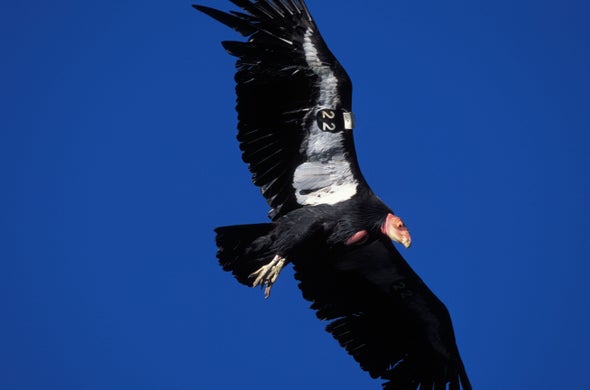
California Condors (Gymnogyps californianus) are North America’s largest wild birds—and are among the most endangered. In 1982 there were just 22 of the birds left. Conservationists captured and bred them to painstakingly claw the birds back from the brink of extinction. At the beginning of this year, there were 561 California Condors, more than half of which lived in the wild across several western U.S. states. But this spring, as March turned into April and more birds got sick, the species’ success looked imperiled.
“It was [like], ‘We’ve lost five birds today. We lost two more,’ and it just kind of felt like it was snowballing on us,” Blackford says of the losses. Many of these were condors that had roosted in Arizona’s Vermilion Cliffs, the same place where captive-bred birds were first released in 1996. By the end of spring, avian influenza had killed 21 condors out of the flock that soars over Arizona and Utah—and Blackford says the outcome could have been much worse.ADVERTISEMENT
Now the FWS has begun testing an avian influenza vaccine in the iconic birds in hopes of eventually inoculating every living condor against the disease, which experts fear may come roaring back as temperatures drop this fall.
Avian influenza comes in two varieties. Traditionally, wild birds have been known to carry low-pathogenicity avian influenza, which is typically asymptomatic, whereas highly pathogenic avian influenza is usually found in poultry. But in Europe a highly pathogenic strain became epidemic in numerous species of wild birds by 2021, and the strain reached the U.S. the following year. By now that strain has likely killed millions of wild birds, experts estimate.
“This is very different from what we’ve seen historically [from avian influenza],” says Samantha Gibbs, lead veterinarian at the FWS Wildlife Health Office. “I don’t think it’s just going to disappear.”
And while dead Caspian Terns (Hydroprogne caspia), Mallards (Anas platyrhynchos) and Red-tailed Hawks (Buteo jamaicensis) are bad news, none of those animals are as rare as the California Condor. “With a really nice, big population that’s healthy, we may lose a number of birds, but we would feel like they could bounce back,” Gibbs says. “We just don’t have that bench strength with the condors.”
Condors are particularly vulnerable to avian influenza because of how they live, says Jonathan Hall, a wildlife ecologist at Eastern Michigan University, who specializes in the massive birds. Like humans, “they really interact with each other quite a bit, so that makes this disease much more easily communicable,” he says. “We’re talking about animals that live in extended family groups and kin networks.”ADVERTISEMENT
Blackford says the flock that suffered from the virus this spring may have inadvertently cultivated it in cool, damp cliff-bound sanctuaries where they raise their chicks. “I think we had some little petri dishes in our nest caves that unfortunately had a greater impact on our population than if they had known to social distance,” she says.
Unlike more plentiful species, condors are confronting avian influenza with the cards stacked against them. The mighty birds struggle to maintain their numbers because, like humans, they mature slowly and then reproduce at a low rate; they naturally lay just one egg every year or two. Although conservationists have found ways to increase that rate slightly in a captive breeding program, every bird remains precious.
“They’re on this growth trajectory, but it’s slow going, and it’s really expensive, and condors are clearly not at a level where they’re self-sustaining,” says Jacqueline Robinson, an evolutionary geneticist at the University of California, San Francisco, who has studied the birds’ genome. “This loss of so many individuals in such a short time is a pretty big setback for them on that road to once again being a wild, free-ranging, self-sustaining population.”
Desperate for anything that could protect the condors, the FWS reached out to the U.S. Department of Agriculture to ask for permission to test an avian influenza vaccine in the birds. “We didn’t know if there would be a vaccine even available,” Gibbs says. “Because no birds have ever been vaccinated against highly pathogenic avian influenza in the U.S., we didn’t think it was a high probability.”
After some discussion, the USDA authorized the FWS to use a vaccine developed from a killed virus found in a Gyrfalcon (Falco rusticolus) in the mid-2010s, Gibbs says. But the USDA was reluctant to release a vaccine that could end up being used in poultry because there’s no way to differentiate between such domesticated birds that have been infected with avian influenza and those that have been vaccinated for it. The agency included strict constraints on the condor program to ensure none of the vaccine makes its way to poultry and imperils the $5-billion export market for the latter birds.ADVERTISEMENT
“There are very tight controls on the way we use and administer the vaccine,” Gibbs says. “It’s akin to using controlled substances, like ketamine.” For example, only a certified veterinarian can administer the vaccine, and each vial must be destroyed within 24 hours after it is opened, she says.
Once the condor team had the precious vaccine in hand, the first step was to test it on 20 Black Vultures (Coragyps atratus), which are not endangered, to check for any negative side effects. Now condors are receiving the shot, and 20 birds have been fully vaccinated as of August 25, according to the FWS. Although poultry vaccines are typically administered in two doses, the agency is testing how effective it is to give both the prime shot and the booster in one injection, compared with the usual strategy.
How does one vaccinate a 20-pound bird with a nine-foot wingspan and a hooked beak that is often found slicing through an animal carcass? Blackford says experienced condor wranglers are accustomed to using one hand to clamp the beak shut while using the other to hold the bird. A second person does the injecting—down near the bird’s hip, Gibbs says.
With the initial doses doled out to the trial condors, the FWS is now monitoring the birds and preparing to measure antibody levels to the virus in their blood beginning next month. “Step one was safety, step two is efficacy, and then step three will be ‘What’s the practicality in the wild flock?’” Blackford says.
She says that if all goes well, she and her colleagues hope to plan a rollout strategy by, perhaps, October to protect all the condors before spring migration starts. Then the team will look into giving the birds annual boosters, which Blackford says she hopes can easily fit into the yearly health checks the team already conducts. During these checks, each bird is vaccinated for West Nile virus—a mosquito-borne pathogen that also threatens them—and has blood drawn to check for lead exposure from hunters’ ammunition in mammal carcasses that the massive scavengers eat.ADVERTISEMENT
Those standard health checks are a testament to the effort people have poured into keeping condors in the sky. And while Blackford says she’s grateful to have a path toward protecting her charges from avian influenza, she would rather it wasn’t necessary.
“Our goal is not to always touch every condor every year—it’s to not touch them, to not be able to capture them because they’re so wild and so self-sufficient,” Blackford says. Unfortunately, entering that next phase of recovery will require changing human behavior, not just neutralizing a virus, she says, because hunters’ use of lead bullets remains condors’ biggest threat.
“I think it’s a lot easier to combat the avian flu issue because it’s much more straightforward,” Hall says. “The ongoing threats that condors face, really primarily because of the way that the environment has changed over the last 500 years on this continent due to colonization—that’s a much harder issue to address.”
The culture war pitting plant-based meat against its animal-based counterpart rages on, it seems. Plant-based alternatives are called “ultra-processed,” “fake” and “synthetic” — juxtaposed against factory farmed animal meat that’s touted as “all natural” and “single ingredient.” How did we get here?
One recent source of this conflict — and the subsequent backlash to plant-based meat — can be traced back to meat industry manipulation. A Super Bowl commercial and a New York Times ad, paid for by a public relations firm used by the meat industry, planted seeds of doubt about “scary” ingredients in plant-based meat back in 2020.
Sales of Beyond and Impossible burgers went on to plateau — for a number of reasons that food industry media continues to hash out. But even as the debate over “unnatural” and high-tech plant-based products persists, the assumed naturalness of animal products appears to be flying under the radar. It shouldn’t.
70 Percent of the World’s Meat Comes From Factory Farms
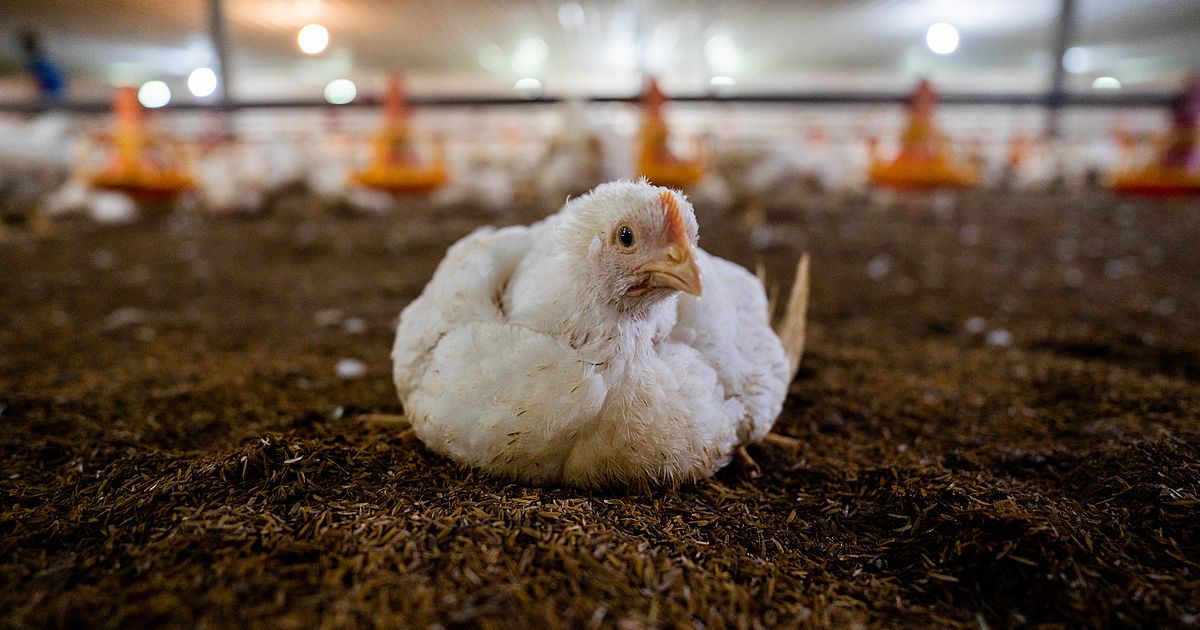
Those oft-invoked images of small family farms, rolling bucolic pastures and friendly neighborhood abattoirs are far from reality across most of today’s food system. More than 70 percent of the world’s meat comes from factory farms. The setting usually features massive windowless sheds and packed dusty lots run more by technology than humans — mechanized, production line-style slaughterhouses that use gas chambers and electricity to kill more animals per day than ever before. In other words, in most of the world, animal agriculture is anything but natural.
Of course, the entire point of modern farming is to harness natural resources to grow enough to feed humans, which is not a bad thing — but it’s far from a wild, all-natural ecosystem. Perhaps more productive than measuring which foods are “natural,” would be to measure how to best feed people humanely and justly while leaving actual nature alone as much as possible.
Consider just how many farm animals populate the globe today. The number of livestock farms across the western world has been in steady decline over the last fifty years. The number of animals, though, has drastically increased. The industry calls this efficiency, but many animal and environmental researchers see it as great cause for concern.
Sometimes called confined animal feeding operations (CAFOS), or industrialized or intensive farming, the predominant method of producing meat and dairy today involves packing large numbers of animals into confined spaces or onto barren lots — a far cry from their natural habitats. In these confined spaces, animals may be manipulated with light, deprived at times and over-stimulated at others and impeded from exhibiting many natural behaviors, even the simple act of turning around.
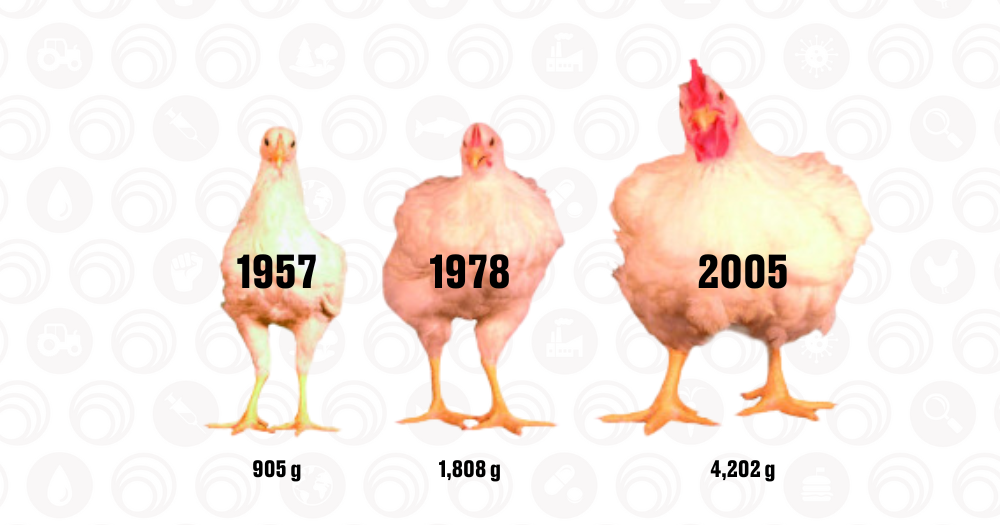
Animals farmed for food today are bred and genetically manipulated to possess more profitable traits, like accelerated growth and larger size, for instance. This results in farmed animals bearing very little resemblance to their wild ancestors, and who suffer from various ailments due to their unnatural physiology.
Zuidhof, MJ, et al. 2014 Poultry Science 93 :1–13
Most Soy and Corn Feed Animals, Not Plant-Based Nuggets
And despite increased promotion of grass-fed beef and regenerative grazing over the last few years, the vast majority of animals farmed for food in the global north are not out to pasture chowing on fresh foliage. About a third of all corn grown in the U.S. (the nation’s top crop), is used for animal feed while about 60 percent of all soybean meal produced in the US also goes to feeding farmed animals. On a global scale nearly 80 percent of the world’s soybeans go to animals farmed for food.
What’s more, there is often confusion about what grass-fed even means — it can actually include cattle who were fed grass (including farmed and harvested grasses) for only a portion of their lives. The bottom line — the arguments that a plant-based diet promotes mono-crops, GMOs and even mass death of small animals killed in crop harvesting is moot when you consider that most of the soy and corn grown today goes to farmed animal feed.
Horse Blood, Antibiotics and Hormones
There is also nothing natural about the way animals are raised on industrial meat operations. In order to produce enough meat to satisfy a population of meat-eaters, pig farms, for example, often feed sows a hormone sourced from the blood of pregnant horses — entire horse blood farms exist just to extract blood from mares, in fact.
Chickens, pigs and cows are often fed antibiotics, hormones and even the same vitamin supplementation that plant-based eaters are chastised for: B12. These practices are designed to minimize the spread of disease in what are unsanitary and unnatural conditions — and as a consequence we are experiencing skyrocketing rates of antimicrobial resistance (AMR) among humans. The World Health Organization declared this one of the top 10 global public health threats to humanity in 2019, and the United Nations estimates it could kill as many as 10 million people annually by 2050.
“All-Natural” Meat Has Deep Roots
If all this comes as a surprise, you’re not alone. Our collective perception of meat as natural is deeply rooted in our psyche, according to Melanie Joy, PhD, social psychologist and author of Why We Love Dogs, Eat Pigs, and Wear Cows: An Introduction to Carnism. The meat industry has long relied on the narrative that meat is normal, natural and necessary, she argues. Now, boosters for animal agriculture are doubling down on those efforts.
Ultimately, there is nothing natural about modern meat, dairy and eggs. Their environmental toll on nature is indisputable — wild ecosystems that are essential for keeping climate pollution and pandemics in check are being destroyed by industrial meat. It’s modern meat that’s the threat to nature, not plant-based burgers. Yet somehow, that’s not what we’re talking about.
The Point Reyes National Seashore has formalized its proposal to remove the 2-mile fence enclosing tule elk at Tomales Point as part of a larger plan for the 2,900-acre promontory that would shift the balance away from long-held ranching interests in favor of native herds.
The multifaceted proposal is among three drastically differing alternatives offered up for public review over the next month as the National Park Service updates its overall management plan for Tomales Point — a rugged, wind-swept landscape adjoining historic range lands for dairy and beef cattle.
At the other extreme, there remains potential for use of lethal force to control elk populations — a hot-button topic that has caused substantial criticism of the National Park Service and the Point Reyes National Seashore in recent years.
“It’s very clearly sort of one future or another, so to speak,” said Chance Cutrano, program director with the Fairfax-based Resource Renewal Institute, adding that he suspected pressure from activists was influencing the park’s direction.
Cutrano’s organization is one of three conservation groups that sued the Seashore over provisions in a recent General Management Plan Amendment that include culling a separate elk herd in the park to cap the population. The Institute and the other plaintiffs are currently engaged in confidential mediation with the Seashore, along with numerous ranchers from the area who intervened on the park’s behalf.
There also is a pending suit in the Ninth Circuit Court of Appeal directly involving activists’ demands that the Tomales Point fence come down — part of an outcry that escalated during the last, extended drought, which is believed to have contributed to die-offs in the enclosed herd that reduced its size from 445 in 2019 to 220 in 2021.
“That is 100% attributable to the fact they were fenced in,” said Jeff Miller, a conservation advocate with the Center for Biological Diversity, which was among the groups that sued the Seashore. Even with drought, two other, free-roaming herds “were actually expanding.”
“That’s just a bad look for a national park to be keeping native wildlife in a zoo-like condition,” he said.
The Tomales Point herd this year numbered 262. It is one of three tule elk populations in the park. Two of them — in the Drakes Beach and Limantour wilderness areas — are free-roaming and managed separately from the Tomales Point herd, which is currently under the purview of a 1998 operational plan that would be replaced by the new one.
All of the Seashore’s tule elk — once the region’s dominant grazer — are descendant from 10 individual animals relocated to the park in 1978 from a small isolated herd that was preserved after hunting and ranching diminished the state population to very few. Tule elk only exist in California.
When reintroduced, the elk were kept behind a tall fence meant to sequester them from cattle. Twenty years later, in 1998, the herd had surpassed 300 individuals, and some were moved to the area near Limantour Beach to relieve population pressure.
Established by Congress in 1962, the 71,000-acre Seashore has long wrestled with competing demands from ranchers rooted on the landscape for generations and environmentalists who believe the commitment made to agriculture conflicts with the park’s mission to protect natural resources.
There has been friction over competition for land and forage, as well as concern prompted by Johne’s disease, a usually fatal, bacterial infection related to tuberculosis that can be transmitted among cattle, elk, deer and other cud-chewing, hoofed animals.
The new proposal is the result of more than a year of public engagement over how to improve management of the Tomales Point herd.
The public may comment on the three alternatives until Sept. 25.
The first option is to maintain current operations on Tomales Point, confining the herd and providing supplemental water when natural water sources are limited, as occurred during the drought.
Management of invasive plants would be limited, and Pierce Ranch, a historic, mid-19th and early 20th-century dairy farm listed on the Natural Register of Historic Places, would exist as a passive exhibit with self-guided tours.
The Seashore’s proposed alternative would bring considerable change, including removal of the high fence that runs across it, as well as removal of 12 other barriers designed to keep elk out of vegetation monitoring areas.
The park also would consider adding a fence to keep cattle off the point.
This approach would feature greater coordination with the Federated Indians of Graton Rancheria, which entered into a partnership with the U.S. Department of the Interior two years ago, incorporating traditional ecological and ethnobotanical knowledge. The potential use of prescribed fire to promote native plant species would be included.
The latest proposal also calls for development of Pierce Ranch as a “core location for visitor use,” improving access, increasing capacity for parking and extending trails while improving them to better protect natural resources. It also would refine the park camping program and beach access to protect natural and cultural resources.
A third alternative would not only retain the fence but allow for lethal removal of elk to control population size. It would also call for removal of supplementary water systems.
The National Seashore is hosting a virtual public meeting Sept. 7 so the public can learn more about the alternatives in advance of the Sept. 25 comment deadline.
Park spokeswoman Melanie Gunn said the next step would be for the Seashore to develop an environmental assessment of the options, which would be subject to public comment likely next summer, with a final decision expected in late 2024.
Under federal law, the park is required to offer a “no change” alternative, as well as a range of options, even if it’s only three.
But the proposed option, which includes the fence removal, “is at this point the proposed action the National Park Service believes will best address the purpose and need,” Gunn said.
But Miller, with the Center for Biological Diversity, was cautious.
“This is a proposal right now,” he said. “The park service has not agreed to this or implemented it. They’ve implemented planning processes before and abandoned them.“