The extreme temperatures being recorded this summer are the result of the combination of natural variations within the climate system and human-caused climate change,with a hefty serving of El Niño thrown in.
Here’s what to know:
How do we know climate change is fueling this heat? Couldn’t it be just a hot summer?
Stream local breaking news and original programming, live 24/7, from ABC7 Bay Area.
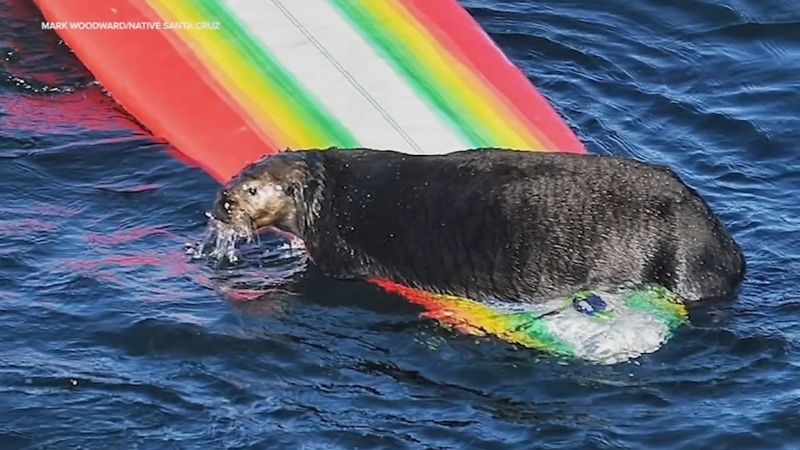
SANTA CRUZ, Calif. (KGO) — The surfboard-biting sea otter in Santa Cruz has once again – evaded capture attempts by wildlife officials.
Patrick Philips and his wife Jennifer are both visiting Santa Cruz from Concord. Patrick was excited he was able to get cellphone video of the mischievous otter. She’s identifiable by a blue tag on her left webbed foot.
“I came over here and everyone’s talking about it. I was videotaping a cute little otter and everybody said – hey, that’s 841!” Philips said.
Colleen Young, a sea otter Biologist for the California Department of Fish and Wildlife is one of the divers on the capture team.
“I’m extremely frustrated and exhausted,” Young said.
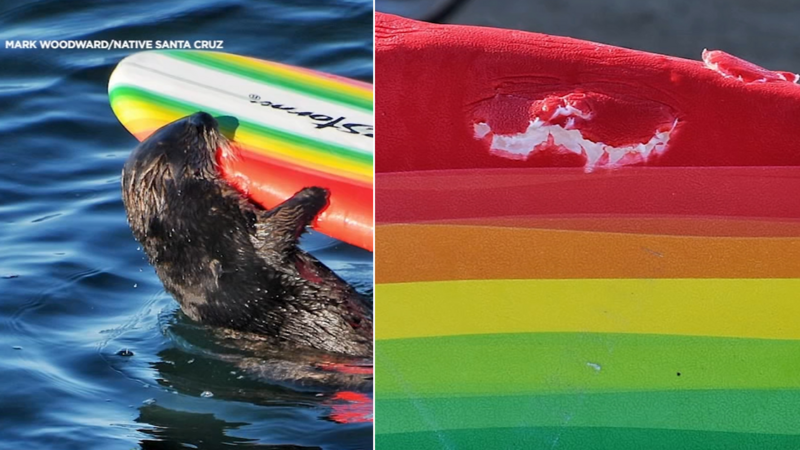
Wildlife officials are now monitoring and attempting to capture an infamous sea otter in Santa Cruz who has a thing for surfers.
The CDFW has been working with Monterey Bay Aquarium staff since July 2. Officials are responding because this 5-year-old female otter is showing concerning and unusual behavior by approaching people.
They’re able to locate her every day, but her behavior changes every day.
“For this particular animal, she’s got a lot of variability when she’s active, when she’s resting and that makes it really challenging because we have different capture strategies depending on what her behavior is. So we need to plan in advance what those capture strategies are going to be because we have different people that are experts in the different types of strategies,” Young said.
Authorities issue warning after aggressive sea otter seen going after surfers along Santa Cruz coastline near West Cliff Drive.
This otter has quite the history. A spokesperson for Monterey Bay Aquarium said the otter’s mom was rescued in Santa Cruz in 2016. The mom had reports of approaching people on kayaks and boats but nothing to the extent of her daughter, otherwise known as otter 841 which is her rescue number.
Young explained they tried catching this otter last year when she was showing similar, unusual behavior. The otter has some familiarity with nets.
“Last year, we also made some capture attempts which turned out to be successful in hazing her and discouraging the behavior so we didn’t end up capturing her because she stopped doing the behavior,” Young said.
“Although we haven’t observed her being aggressive towards people, she’s really focused on the boards or if they’re wearing fins she’s focused on the fins. We don’t want to have a person accidently bit,” Young said.
Officials says when she is captured she will undergo a health assessment and eventually rehomed in a zoo or aquarium.
Local surfer Joseph Wilcox said that’s a shame. He held a surfboard Friday that said “keep 841 free.”
“Every time humans come across some nature that doesn’t act their way acts like nature we got to put it in cage and you know take it somewhere. This is where she belongs, this is her home this is our home we can share it and yeah watch out for the otters,” Wilcox said.
“Obviously the ocean is her home, anyone who is in there is a visitor but – unless everyone is willing to stay out of the water – which is unlikely – capturing her is the only way we see this resolving,” Young said.
FILE – A North Atlantic right whale feeds on the surface of Cape Cod bay off the coast of Plymouth, Mass., March 28, 2018. A review of the status of the vanishing species of whale found that the animal’s population is in worse shape than previously thought, federal ocean regulators said Monday, July 17, 2023. (AP Photo/Michael Dwyer, File)(ASSOCIATED PRESS)
PORTLAND, Maine (AP) — A review of the status of a vanishing species of whale found that the animal’s population is in worse shape than previously thought, federal ocean regulators said Monday.
The North Atlantic right whale numbers less than 350, and it has been declining in population for several years. The federal government declared the whale’s decline an “unusual mortality event,” which means an unexpected and significant die-off, in 2017.
A spokesman for Manx Wild Bird Aid said 40 “dead or dying” sea birds had been found in Port Erin, with a further 27 discovered on Fenella Beach in Peel.
The charity, which cares for sick and injured wild birds, has urged people not to take them to any of its rehabilitation…
Ron and Cindy Ecklund were enjoying a Saturday afternoon in their backyard when their dog, a chocolate Labrador mix named Tucker, began barking.
“Usually if I call him he comes right back to the house,” Ron Ecklund described to ABC News. “He wouldn’t, so I said, ‘Cindy, let’s get on the golf cart.’”
Ron and Cindy Ecklund, owners of Tucker, the dog who helped capture an escaped prisoner and murder suspect, near Warren, Pa.WJET
Off they went into their backyard, expecting to find a fisherman or a hiker near the creek on their property. Instead, the couple came face-to-face with Michael Burham, who had escaped from a local prison over a week ago.
Burham escaped from the Warren County Prison in Pennsylvania on July 6, using a rope fashioned from bed sheets to descend from the roof of the prison. In the following eight days, the high-profile fugitive held the town of Warren on edge, with daily press conferences reminding residents not to approach the dangerous fugitive, who police warned might be armed.
A fan of tennis balls and birds, Tucker generally loves people, though “he knew something was going on” when he discovered Burham, according to Cindy Ecklund.
Tucker, the dog who helped capture an escaped prisoner and murder suspect, near Warren, Pa.WJET
When confronted by the Ecklunds, Burham claimed that he was “camping” in the couple’s backyard.
“I thought he was gone. I never thought he was in the backyard,” Ron Ecklund said in an interview with ABC affiliate WJET.
Returning to his home, Ecklund called police around 3:57 p.m. on Friday, according to Pennsylvania State Police Lt. Col. George Bivens. Police eventually tracked Burham to a nearby road, where he was arrested at gunpoint by officers from the U.S. Marshalls, Customs and Border Protection, and NY State Police, according to Bivens.MORE: Official describes video of Michael Burham’s prison escape: ‘Like a spider’
For their role in the arrest, Crime Stoppers plans to award the couple and their loyal chocolate Labrador mix $2,000 in cash, according to Warren County District Attorney Rob Greene.
Cindy Ecklund said that for his role in the arrest, Tucker — a six-year-old chocolate Labrador and Chesapeake Bay retriever — is being rewarded with a steak dinner tomorrow. “He has been eating very well,” she added.
While the $2,000 could purchase over 13,000 Milk-Bone dog biscuits, Cindy Ecklund said they plan to use their reward to improve their water well, or improve their home’s siding if they receive the full reward of over $20,000.
Since Putin’s tanks crossed into Ukrainian territory last year, three options have been on the table for how this war would end: victory for one side or the other, a frozen conflict or a negotiated settlement. The public comments made this week byOleksiy Arestovych, a former advisor to Volodymyr Zelensky’s chief of staff, appear to indicate the last may be more likely than previously thought.
[1/3]Gas is extracted from a coalbed methane well in Jincheng, Shanxi province, China November 14, 2018. REUTERS/David Stanway/File Photo
BEIJING, July 17 (Reuters) – This week’s visit by U.S. climate envoy John Kerry to China after years of diplomatic disruptions could boost cooperation between the world’s two biggest greenhouse gas polluters on the key issue of methane emissions.
Kerry arrived in Beijing on Sunday for talks aimed at reviving efforts by China and the United States toward curbing climate-warming emissions. Experts have said any move to cooperate on methane – a greenhouse gas responsible for roughly 30% of global warming – could provide a way forward.
Advertisement · Scroll to continue
“Methane is particularly important for our cooperation,” Kerry told a congressional hearing on Thursday in Washington. “China agreed to have a methane action plan out of our prior talks in Glasgow (in 2021), and again in Sharm el-Sheikh” in November.
During those COP27 climate talks last year in Egypt, China’s top climate envoy, Xie Zhenhua, made an unexpected appearance at a meeting of the Global Methane Partnership, a U.S.-EU led initiative aimed at slashing 2020-level methane emissions by 30% by the end of this decade.
Advertisement · Scroll to continue
Xie said China had drafted a plan with concrete measures to curb methane emissions from energy, agriculture and waste. China has yet to make the plan public.
Sources in contact with Kerry’s team said the United States hopes China will unveil the plan before the U.N. climate conference, COP28, in December in Dubai.
“It’s the opening salvo to be able to sit down and have some more serious discussions about methane in China,” said Jonathan Banks, global director for methane prevention at the Boston-based global nonprofit Clean Air Task Force (CATF).
Advertisement · Scroll to continue
China is aiming to bring carbon dioxide emissions to a peak by 2030 and achieve net-zero CO2 emissions by 2060. But it has yet to set targets for methane and other non-CO2 greenhouse gases, and is still working out how to measure them accurately.
The administration of President Joe Biden aims to decarbonize the U.S. economy by 2050. The 2022 Inflation Reduction Act imposes fees on methane emissions from the oil and gas industry starting in 2024, and the Biden administration has proposed a rule to crack down on the pollution, including a “super emitter” program requiring operators to respond to reports from environmentalists and others of large methane leaks.
Xie acknowledged last year that China’s ability to control methane remains “weak”, as the country was first focusing on monitoring efforts.
An April report from the Beijing-based Innovative Green Development Program think tank suggested that China’s rising methane levels were putting its non-CO2 climate emissions on track to increase 50% from 2015 levels by mid-century. This would make carbon neutrality impossible, it said.
‘A BIT OF RELUCTANCE’
Reforms to China’s industrial and agriculture sectors, however, could lead to 30-40% reductions in methane from 2015 levels by the end of the decade, a study published in August by scientists at California’s Lawrence Berkeley National Laboratory suggested.
“There may be a bit of reluctance to commit to anything without a better sense of what they’re emitting,” Banks said. “But that in and of itself could be a commitment that they can make to improve the quality of data from the sector.”
Two big sources of methane emissions growth in China are livestock and rice production, neither of which are included in the country’s climate plans. The agriculture ministry last year recommended new farming practices, such as paddy irrigation management and low-protein diets for livestock, as ways to bring down methane.
Landfills are also a rising concern. But China’s massive coal sector could prove the biggest challenge.
China is the world’s largest source of methane from coal mines, with 28% of the world’s biggest methane emissions points, according to Antoine Halff, co-founder of the environmental research group Karryos.
While China has been capturing some of that gas for use in its energy sector for more than a decade, it would need to do more to impact global emissions, Halff said.
The province of Shanxi – the only region to have developed a coalbed methane industry – said last week it would raise coalbed methane use rates to 50% by 2025. However, many Chinese mines are in remote locations with no infrastructure to collect methane.
“When you look around at the sources of coal mine methane worldwide, China is three or four times bigger than the next country’s coal mine methane emissions,” Banks said.
The United States and China have problems with coal mine methane and both have an opportunity to learn from each other’s experiences on abatement strategies, according to Global Energy Monitor, a California-based nonprofit.
An area with immediate potential for China-U.S. cooperation could be in measuring methane, and Chinese firms are already working with the Clean Air Task Force on accounting for the emissions.
“It’s a great opening for the United States to work with China,” Banks said.
Reporting by Valerie Volcovici in Beijing and David Stanway in Singapore; Additional reporting by Dominique Patton in Beijing and Timothy Gardner in Washington; Editing by Katy Daigle and Will Dunham
Slapping ‘free range’ on a box of eggs simply hides the catalogue of routine horrors that are allowed under this reassuring bannerMon 30 Jan 2017 04.00 EST
Meat eaters may think vegans look down on them – but actually no one is more scornful of carnivores than the meat industry that feeds them. While frontline workers slaughter 22 million animals each day in the UK alone, teams in the back office rebrand those carcasses, packaging them up and using inventive words to hide the truth from the consumer.
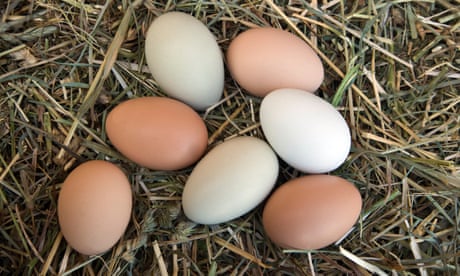
Of all their cons, the “free range” egg is perhaps the most audacious. You’d need Disney-level imagination to believe the UK can produce more than 10bn eggs each year without inconveniencing any chickens. But by slapping “free range” on the label, and perhaps a nice pastoral scene with a few chickens roaming free, most consumers never realise how the eggs came to be in the box.
For vegans the very concept of the ethical egg is essentially oxymoronic
The question of the ethical egg is back on the agenda after the government ordered that, in the face of bird flu, poultry must be kept indoors until at least the end of February. This means “free range” eggs may have to be renamed “barn eggs”. Yet whatever they’re called, few shoppers realise what “free range” means and what routine horrors are allowed under its reassuring banner.
Beak trimming is commonplace in the UK. Almost all young hens have part of their beaks burned off without anaesthetic to stop them pecking at the other hens in their cramped, traumatised flocks. Free range sheds can contain up to nine birds per square metre – that’s like 14 adults living in a one-room flat. Some multi-tier sheds (still “free range”) contain 16,000 hens. So while these poor birds can theoretically go outdoors, they can also be too crammed in and too traumatised to find the few exit holes.
What hell we put them through: hens in the wild lay just 20 eggs per year but modern farms with high protein feed and near-constant lighting push them to lay closer to 500 eggs annually. Their exhausted bodies are then discarded within months – routinely sent to slaughter having lived less than one-tenth of their natural lifespan.
And that’s a long life compared to the male chicks. They are financially worthless to egg farmers and therefore killed within hours of their birth. On a daily basis unimaginable numbers get unceremoniously tossed into a machine and ground up alive, or gassed by carbon dioxide, or simply dumped in a bin bag and left to suffocate. So yes, let’s talk about the ethics among all this cruelty.
One way to avoid eggs laid by beak-trimmed hens is to buy them from organic farms certified by the Soil Association, which bans the practice. Yet that does not address other welfare concerns, not least the fate of male chicks.
Researchers within the industry are proposing a genetically modified approach under which female embryos are identified prior to hatching by making them fluoresce under UV light. This means the male chicks could be identified and crushed in their shells prior to hatching. For some people this is a step forward, but for many the proposal merely produces a new moral dilemma.
Meanwhile, the question of ethical eggs remains a popular touchstone of the defensive meat eater. Such carnivores will ask a vegan: “Tell me this, if I kept chickens, which were allowed to roam free and live their full lives, would you eat their eggs?”
Oh, how the flesh guzzler loves a side order of hypothetical scenario: if a pig lived a happy life, lovingly tended to 24 hours a day in perfect, blissful conditions, and then gently stroked as it was put to sleep, would you eat its meat? If you were trapped on a desert island and could only survive by eating animals, would you eat them?
It’s just self-indulgent displacement, performed by people who want to turn their faces away from the horrors of factory farms and animal slaughter but fund it anyway. The people who describe this theoretical egg production don’t actually run such operations, nor even buy their eggs from such farms. Indeed, very few people even buy organic: of the 12.2bn eggs sold in the UK in 2015, just 2% were organic.
From a vegan perspective, the answer is more holistic and philosophical: we should stop regarding animals as commodities. We should cease our global war on animals and learn to live in harmony. So for vegans the very concept of the ethical egg is essentially oxymoronic.
Or maybe not entirely. One of my vegan friends makes alternative “eggs” using balls of flax seeds and mashed banana. If that sounds a bit bizarre (and I confess it does to me) remember what “real” eggs represent – millions of animals enduring painful, miserable lives so humans can consume the product of chicken periods as a source of protein, or to make nice cakes. Cruelty has been normalised. That’s why they hide the truth.
Firefighters extinguish a house burning during a wildfire in southeast Attica in Lagonisi, Greece on 17, July 2023.
Extreme weatheris causing alarm around the world right now, and Twitter is asking: how much more can we endure before we act?
Record-breaking temperatures – believed to be a result of the climate crisis – have made global headlines in recent weeks, with heat health alerts issued in both Italy and the US.
On Friday, theBelgian Federal government’s Council of Ministers,approved a legislative proposal for a ban on the import of hunting trophies of endangered species put forth by Zakia Khattabi, Minister of Climate, Environment, Sustainable Development and Green Deal.
The Minister’s preliminary draft bill follows the Federal Parliament of the Kingdom of Belgium’sunanimous voteinMarch 2022in support of a resolution demanding that the government put the brakes on the issuance of trophy import permits for a broad array of threatened and endangered species.
The resolution protects species such ashippopotamus, Southern whiterhinos,African savannah elephants, lions, polar bearsandargali sheep,who are sadlykilled for so-called sport. The scope of the resolution also extends to all species listed in Annex A, along with certain species in Annex B, of theEuropean Regulation 338/97on the protection of species of wild fauna…


 Top Stories00:4201:12











 Top Stories00:5901:12











 Top Stories00:1601:12










 Top Stories00:1900:36