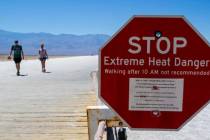
A person watches the weather forecast at a cooling center on July 14 in Phoenix. Photo: by Brandon Bell/Getty Images
A dangerous heat wave will reach its peak todayacross the Southwest, breaking longstanding records. However, the heat will also spread across the West, and no major cool down is in sight for many areas.
The big picture:About 100 million people were under heat alerts as of Sunday morning, stretching across a dozen states from South Florida to Oregon, according toheat.gov.
TheNational Weather Service is predicting”widespread record-breaking high temperatures” as well as record warm overnight minimum temperatures for many locations.
Why a US Civil War could be even more disastrous than the first:When NPR beings to weigh in, as was the case years back, it is safe to say that talk of a second American Civil War has officiallygone mainstream.
Shockingly, however, given the gravity of the topic, much of the current, rancorous debate appears to underestimate the long-term damage that would ensue following a second Civil War.
Five burros were illegally shot and killed this week in Death Valley National Park, according to the National Park Service.
The burros were found in the Lower Wildrose area of the park. The park service reminded visitors that it is illegal to discharge a firearm in a national park in the release.
“While these animals have a negative impact on the natural and cultural desert environment, park officials say these irresponsible actions were not warranted,” the release stated.
Burros are not native to the desert and were first brought to North America by Christopher Columbus in 1495. During the Gold Rush, the animals were brought to the desert by Mexican explorers and were later abandoned or escaped, according to the park service.
The park service also clarified that the burrows were not killed as part of any internal removal efforts.Play Video
After pushback, the BLM said it will require a full environmental review for Rover Metals’ lithium drilling project outside Ash Meadows National Wildlife Refuge.
Of 38 lakes and reservoirs tested, Lake Tahoe came in with the third-highest concentration of microplastics, according to the study published in Nature.
Las Vegas kicked off this year using far less water than previous years. But a dry outlook for the rest of summer could put a dent in those water use reductions.
By continuing to browse or by clicking “I Accept Cookies” you agree to the storing of first-party and third-party cookies on your device and consent to the disclosure of your personal information to our third party service providers or advertising partners to optimize your experience, analyze traffic and personalize content.
I Accept Cookies
5
articles remaining
Local journalism makes a difference.
For unlimited access to the Las Vegas Review-Journal, subscribe today.
Waterhas power. So much power, in fact, that pumping Earth’s groundwater can change the planet’s tilt and rotation. It can also impact sea-level rise and other consequences of climate change.
Pumping groundwater appears to have a greater consequence than ever previously thought. But now—thanks to a new studypublishedin the journalGeophysical Research Letters—we can see that, in less than two decades, Earth has tilted 31.5 inches as a result of pumping groundwater. This equates to .24 inches of sea level…
Vladimir Putin’s rumoured plot to sabotage Zaporizhzhia nuclear power plant with explosives will start a nuclear war if he succeeds, a Ukrainian former minister fears.
Volodymyr Zelensky, Ukraine’s President, last week accused Moscow of planting “objects resembling explosives” on top of the facility, in the south of the country, which Russian troops have occupied since the start of the war.
Speaking on Monday, Herman Halushchenko, the country’s Minister of Energy, claimedPutinwas ready to use ZNPP as a “tool” against Ukraine, saying: “There are no red…
“The 360” shows you diverse perspectives on the day’s top stories and debates.
Illustration by Alex Cochran for Yahoo News; photos: Anadolu Agency via Getty Images, Scott Olson/Getty Images, Yasuyoshi Chiba/AFP via Getty Images
What’s happening
The United States agreed last week to provide Ukraine withcluster bombsto aid its counteroffensive against Russia, despite concerns from human rights groups and American allies about collateral damage the controversial weapons may cause.
President Biden toldCNNthat he made the “difficult decision” to add cluster bombs to the stockpiles being sent to Ukraine over fears that the country’s munitions were running low after intense fighting to hold off invading Russian forces for nearly a year and a half. “The main thing is, they either have the weapons to stop the Russians now … or they…
A new study by the company moveBuddha says Dallas is poised to become America’s most populous metropolis by 2100. Tyler Adams
Does it feel like things are getting a little crowded? It may not be your imagination or an unconfirmed fear that the world is somehow shrinking.
A new report conducted by the moving website moveBuddha predicts that based on current trends, Dallas-Fort Worth could become the nation’s new population leader.
The report estimates that DFW’s population could be as high as 33.9 million by the year 2100, making it the largest metropolis in the country and ahead of estimates for other Texas cities including Houston and Austin and even massive metropolitan areas like New York, Atlanta and Los Angeles.
“Dallas may not be the fastest-growing big city in America but by 2100, we project it could be the nation’s largest,” says the moveBuddha study. “The Dallas metropolitan area is already ranked No. 4 by population nationally in 2021. If its current growth rate continues, it will climb to No. 1 by 2100 and boast nearly 34 million residents.”
The report is based on data taken from the U.S. Census Bureau that compared the 10-year growth rates of metropolitan areas with more than 250,000 residents between 2010 and 2020. The latest census data shows that DFW’s current population stands around 7.6 million, up from 6.4 million a decade ago.
The numbers seem to be borne out by similar studies. Another recent study conducted by the Site Selection Group suggests that growth is exploding across several states in the Sun Belt. Many of the metro areas in those states, including Texas, are some of the fastest-growing in the nation. Eight of the top 10 growth markets in the nation are located in Texas, Florida, North Carolina and Tennessee. The study projects a growth rate of 8.64 percent over the next 10 years, the fifth-highest in the nation.
North Texas tops the list of the state’s fastest-growing areas, according to U.S. Census data collected between July 2021 and July 2022. The Dallas-Fort Worth-Arlington area saw a population change of 2.1 percent in just a year, the highest increase of any U.S. metro area. That figure contrasts with the previous year when the city of Dallas alone lost almost 15,000 citizens, possibly due to the rising cost of housing and rent.
Even past trends seem to confirm DFW’s rapid growth. In 2018, the U.S. Census reported an estimated population increase of 146,000 in just a year
“Historically, the Dallas metro area attracts large numbers from both international and domestic migration,” says Census Bureau demographer Molly Cromwell in a released statement. “Many of the other largest metro areas in the country rely mostly on international migration and natural increase for growth.”
The data isn’t being noticed only by census data analyzers. Last year, Freakonomics Radio took note of DFW’s bewildering growth and dedicated a two-part series to the subject. Producer Ryan Kelley said the cost of living is a major factor for the growth trend, but the explanation also includes accessibility to entertainment, shopping and other cultural elements that make some areas more appealing.
“I think for people who are considering moving to a new place and certainly moving to a place like Dallas, that we think of cultural hubs with Broadway in New York and the movie industry in Los Angeles,” Kelley said. “People want to see those types of facilities and have access to that type of stuff […] but corporate thinking of expanding and opening new offices, they know employees want those things and are asking if they have those things: ‘Is this a vibrant and exciting place?'”
SANTA CRUZ, Calif. (KRON) — Santa Cruz’s wild surfing sea otter has attracted many fans with its mischievous pirate-esque passion for stealing surfboards. The fuzzy longboard larcenist was photographed swimming up to surfers, commandeering surfboards, and even catching a few waves.
Wildlife officials tried catching the 5-year-old sea otter earlier this week near Steamer Lane. The crew launched a boat, placed a board as bait in the water, and deployed a decoy surfer. The savvy sea otter didn’t fall for it and she eluded capture.
The sea otter’s fans grew concerned and asked KRON4, why are wildlife officials trying to pluck a wild sea otter out of its ocean home?
(Photo by Mark Woodward / Native Santa Cruz)
On Friday, the U.S. Fish and Wildlife Service released a statement explaining why officials want to take the otter into captivity.
The 5-year-old female southern sea otter is “exhibiting concerning and unusual behaviors in Santa Cruz, California, including repeatedly approaching surfers and kayakers. This individual has been aggressively approaching people and biting surfboards,” USFWS wrote.
A curious harbor seal watches the sea otter balance on a surfboard. (Photo by Mark Woodward / Native Santa Cruz)
The USFWS authorized the capture of the sea otter after hazing techniques failed to stop the otter’s surfboard antics.
“Due to the potential public safety risk, a team from (California Department of Fish & Wildlife) and the Monterey Bay Aquarium trained in the capture and handling of sea otters has attempted capture of the sea otter when conditions have been favorable since July 2. Standard methods for capturing healthy wild sea otters have been unusable or ineffective so far due poor underwater visibility, the sea otter’s wariness of nets from previous capture attempts, and the sea otter’s behavioral patterns varying from day to day. Scientists suggest successful capture may take days or weeks given logistical considerations, the sea otter’s behavior, and shifting environmental conditions,” USFWS wrote.
The sea otter catches a wave on the westside of Santa Cruz. (Photo by Mark Woodward / Native Santa Cruz)
Colleen Young, an environmental scientist and sea otter biologist with CDFW, explained, “The usual method for safely capturing healthy, wild sea otters is a clandestine underwater approach. In this case, however, the water has generally been too murky for us to see the animal from below. We are adapting other capture methods to this situation.”Photos: Surfing sea otter steals surfboards by the seashore
The otter is tagged with a radio transmitter and is being actively monitored by biologists.
The sea otter steals a surfboard from a surfer. (Photo by Mark Woodward / Native Santa Cruz)
As of Friday morning, the sea otter was still wild and free in the open ocean. “She’s one smart little otter,” said local photographer Mark Woodward, who documented the surfing sea otter for several weeks.
If the surfing sea otter is apprehended, she will undergo a health assessment at the Monterey Bay Aquarium, and eventually, she will be rehomed in captivity, wildlife officials said.
Euthanasia and other lethal methods are not under consideration, according to USFWS.
A sea otter warning sign was posted near the Santa Cruz Lighthouse. (Photo by Mark Woodward / Native Santa Cruz)
“The goal is the safe capture of this female sea otter to remove the potential public safety risk, while also recognizing and acknowledging the important role sea otters play in coastal ecosystems along the Central California coast,” said Lilian Carswell, Southern Sea Otter Recovery and Marine Conservation Coordinator with the U.S. Fish and Wildlife Service.
USFWS, CDFW, MBA, and Association of Zoos and Aquariums will work together to find her a long-term home in a zoo or aquarium.
A conservation group in the Republic of Ireland has warned of unprecedented outbreaks of bird flu
Matt Fox
BBC News NI
Published14 July 2023
A conservation group in the Republic of Ireland has warned of “alarming and unprecedented outbreaks” of avian influenza.
BirdWatch Ireland said the highly pathogenic H5N1 strain of the virus is devastating key Irish seabird colonies.
The group manages the four most important tern colonies in Ireland.
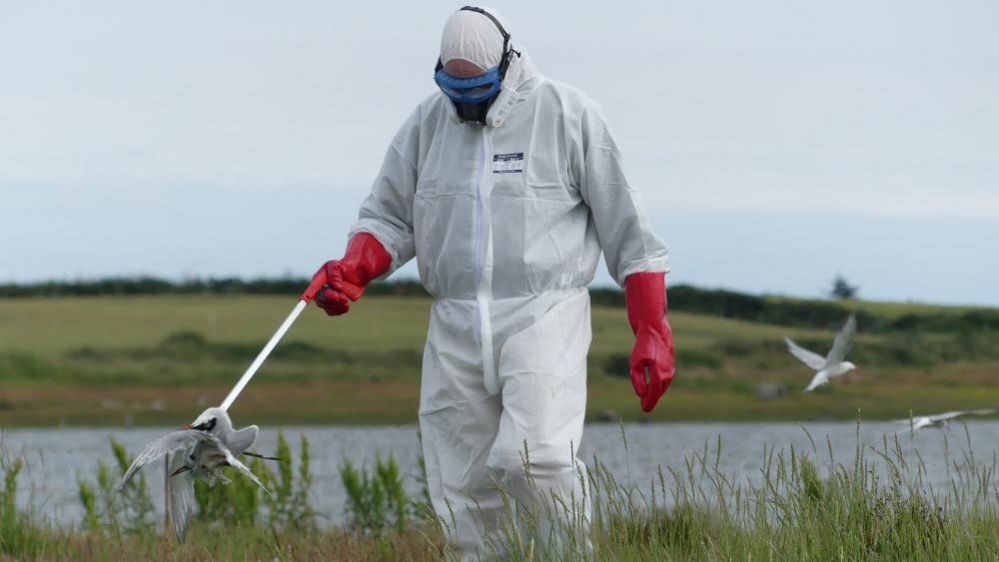
Hundreds of dead birds have been discovered in recent weeks with carcasses testing positive for bird flu.
Image caption,BirdWatch fieldworkers have collected hundreds of dead birds in recent weeks
In a recent statement, external the group said while it was early to assess the full impact, more than 160 adult common terns and 450 chicks were found dead at a breeding colony at Lady’s Island Lake in County Wexford.
It also said the disease was threatening sandwich terns and roseate terns nesting there.
BirdWatch added it is concerned by the long-term consequences of an avian flu outbreak on Irish seabirds.
“A poor breeding season at a tern colony, with few chicks surviving, is unfortunate, but can be compensated for by better breeding success in subsequent years.
“However, the deaths of large numbers of adult terns of breeding age has a much bigger impact, and recovery will take a long time.”
The Department of Agriculture, Food and the Marine eased specific biosecurity measures to mitigate the spread of avian influenza on 1 June.
The department has been contacted for an update on bird flu in the Republic of Ireland.
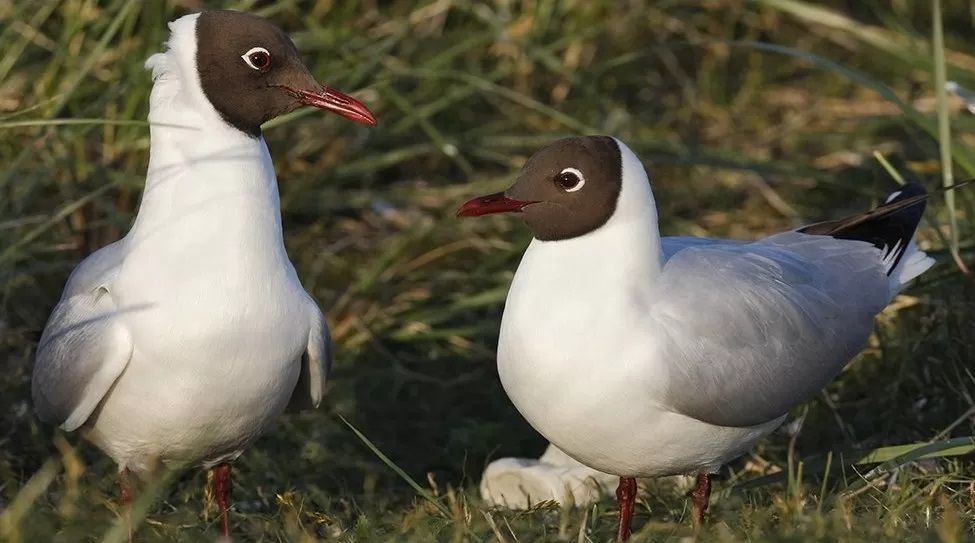
Image caption,A number of black-headed gulls tested positive for the virus in Northern Ireland last month
Belfast’s Window on Wildlife nature reserve was closed to the public last month after a number of gulls were found to have died from the virus.
Further infections were detected in Comber, Coalisland, and Magherafelt.
Northern Ireland’s chief vet, Dr Robert Huey, called on all bird and poultry keepers to immediately step up their biosecurity measures and remain vigilant against the latest threat of avian flu.
He said the latest findings are a “stark warning to all of us” that avian influenza is a “constant and dynamic threat”.
A recent update from the Department of Agriculture, Enviornment and Rural Affairs (DAERA) said there is now an now an increasing likelihood of incursion into kept flocks.
“The findings at locations near Lough Neagh present the greatest concern, as they are in close proximity to high-density areas of commercial poultry premises.”
If members of the public find dead waterfowl or other wild birds, DAERA advises they should not touch the carcasses but take immediate action to report them to the department.
DAERA has been contacted for an update on avian influenza in Northern Ireland.
Health services in the Republic of Ireland and Northern Ireland took part in an exercise in County Louth last month to enhance cross-border preparation for future incidents of bird flu.
What is bird flu?
Bird flu is an infectious disease of poultry and wild birds that has been around for a century. It usually flares up in autumn before fading away in spring and summer
The H5N1 virus, which is the most prevalent strain now, was first reported in China in 1996
It can spread through entire flocks of domestic birds within a matter of days
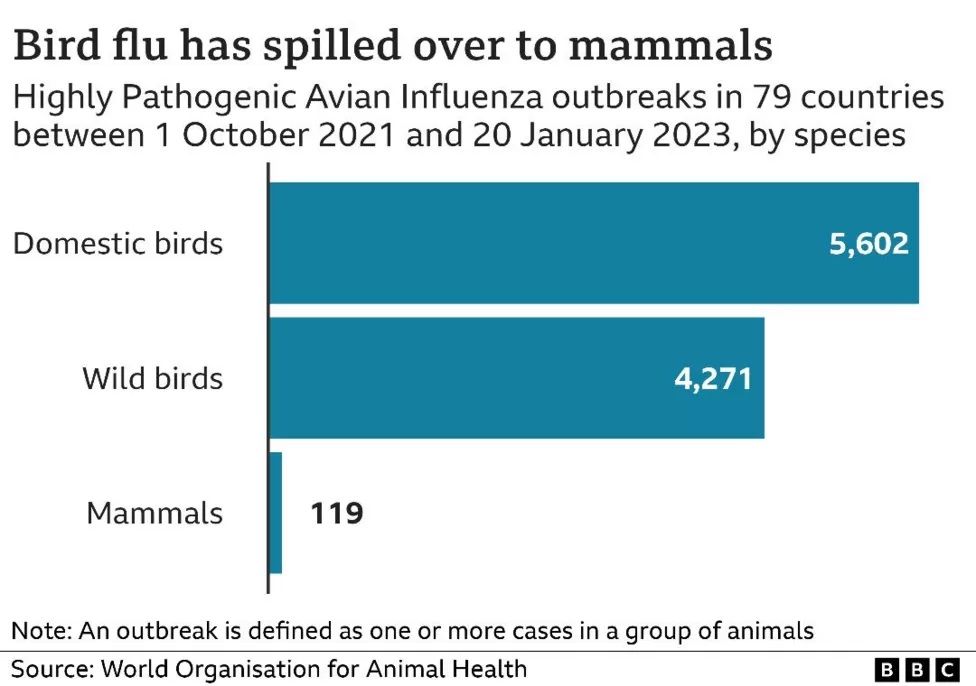
Last year saw the biggest ever outbreak of bird flu in the UK and the world
Dozens of different species of wild birds were hit, including golden eagles, buzzards, herring gulls and gannets
Bird flu restrictions, which were imposed across most of the UK this year, were eased in April but experts have advised the H5N1 virus is still circulating, posing an ongoing risk to wild birds