Plans for the world’s first commercial octopus farm are well advanced – just as science discovers more about this curious, intelligent and affectionate animal. Can it be done ethically?
by Ashifa Kassam in O Grove, Pontevedra
Seascape: the state of our oceans is supported by

Sun 25 Jun 2023 04.00 EDT
The sterile boardroom, much of it taken up by a lengthy white table, is at the heart of the sprawling building in northern Spain. The corporate chatter that fills this room these days, however, is dominated by the scene playing out one floor below, where about 50 adult male octopuses are in a tank the size of a budget hotel room.
A handful of the octopuses – the fifth generation to be born in this Spanish multinational’s concrete-and-glass office and research centre – skim through the shallow waters, some brushing up against each other while others tuck into the tank’s barren corners. A low-intensity light casts a pale glow as researchers lay the groundwork for one of the world’s most controversial endeavours: the first commercial octopus farm.
“From a scientific point of view, this project is a global milestone,” says Roberto Romero Pérez, a marine biologist who oversees aquaculture at Grupo Nueva Pescanova. “The truth is that we’re finding the mood to be a bit more hostile than expected.”
The company’s vision for a farm that could eventually provide up to 3,000 tons of octopus meat a year – requiring the slaughter of about 1 million Octopus vulgaris – came into public view in 2021 when it applied for permits. The planned farm has since become an international flashpoint, pitting the company and other proponents of octopus farming against those who argue that the solitary, intelligent animals are ill-suited to being farmed.
From Mumbai to Mexico City, protesters have mobilised, adding their voice to the more than 100 academics who contend that farming a carnivorous animal known to be curious, affectionate and exploratory would be unethical and environmentally unsustainable. Others have sought to crackdown on the sector before it gets started; lawmakers in the US state of Washington are mulling a ban on octopus farming while an online petition calling for a global ban has received nearly 1m signatures.
At the heart of the debate is the question of whether octopuses should be subject to the long-documented mistakes seen in the factory farming of animals such as pigs, says Jennifer Jacquet, a visiting professor of environmental science and policy at the University of Miami.
“We’re not having the conversation of should we eat octopus or not, we’re simply at a crossroads where we can decide whether or not to put octopus into mass production. Do we need to do this? It’s really a luxury good. It’s not for survival,” says Jacquet. “This is a symbol of what humans should not be doing in the 21st century.”
https://imasdk.googleapis.com/js/core/bridge3.578.0_en.html#goog_940353408
https://imasdk.googleapis.com/js/core/bridge3.578.0_en.html#goog_904074906
https://imasdk.googleapis.com/js/core/bridge3.578.0_en.html#goog_1085757150


 About 6m across US at risk of extreme weather as over700,000 without power
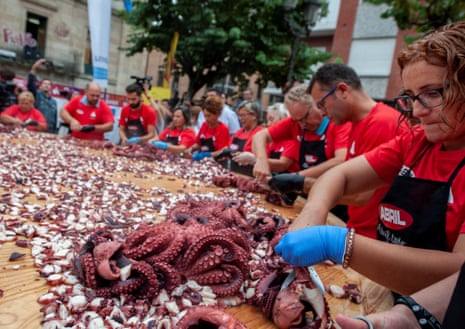
Long consumed across the Mediterranean and parts of Asia, as well as Mexico, octopus meat has been growing in popularity globally, as the world’s wealthiest populations embrace octopus-laden sushi, poke and tapas. Much of the demand has so far been met by wild stocks: between 1950 and 2015 the catch of wild octopuses increased more than tenfold to an estimated 400,000 tons.
While proponents of octopus farming argue that it could help alleviate pressure on wild stocks, there’s little precedent to suggest this will happen, says Jacquet. A 2019 study that delved into more than four decades of data from around the world suggested that, overall, increases in aquaculture did not result in fewer wild fish being caught. Instead, researchers found that aquaculture may be contributing to increased demand for seafood.
The decades-long push to farm octopus has played out in parallel with a growing interest in octopus research, offering a deeper understanding of an animal once described as “probably the closest we will come to meeting an intelligent alien”.
I’ve never encountered a facility that groups octopuses together without incidents of aggression or escape
Alex Schnell, comparative psychologist
The octopus has long been celebrated for its inquisitive nature, penchant for daring escapes and ability to transform the colour and texture of its skin to mimic its surroundings. A recent report by the London School of Economics found “very strong evidence of sentience” in octopods.
The finding – which suggests octopuses are capable of experiencing pain and distress – was based on a review of more than 300 scientific studies, including one that found injured octopuses protect a wound by wrapping an arm around it and another that suggested that injured octopuses, if given the opportunity, will self-medicate by seeking out pain relievers.
“Just because an animal has been deemed sentient, doesn’t mean we can’t farm them,” says Alex Schnell, a comparative psychologist who was part of the review. “But there are certain practices that need to be put in place to be able to farm a sentient animal.”
Currently, there are no EU rules that protect farmed octopuses, as the existing animal welfare legislation doesn’t apply to invertebrates. The kinds of protections that would be needed to farm octopus – a soft-bodied animal that can be easily hurt by tank collisions or if handled roughly and that requires a mentally stimulating environment – led Schnell and the other members of the research team to conclude that “high-welfare octopus farming is impossible”.
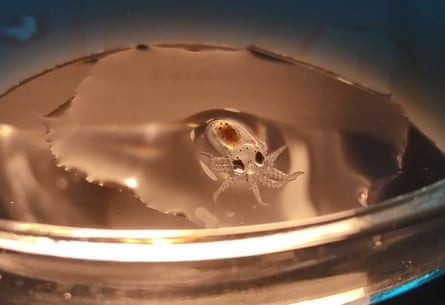
When placed in close quarters, octopus can become aggressive or territorial, says Schnell. “In my 15 years of experience, I’ve never encountered a facility that groups octopuses together without incidents of aggression or escape,” she says. “Cannibalism commonly occurs when octopuses are housed together. Stress from overcrowding or non-ideal living conditions can lead to self-cannibalism, where they eat their own arms.”
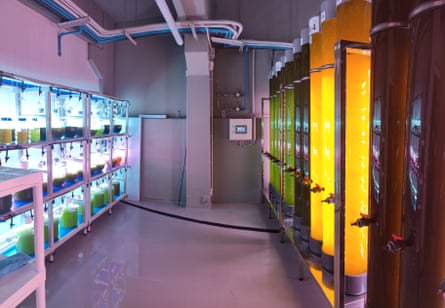
Inside a secured area at Grupo Nueva Pescanova’s research facility in Galicia, nine tanks filled with dozens of Octopus vulgaris, the common octopus, sit side by side. About 15 biologists spend their days here, testing how slight variations in light levels, nutrition and other conditions affect them.
Researchers lift the thick, black plastic curtains that shroud three of the tanks, offering a glimpse into a darkened space containing about 40 spawning females and another tank that is home to a handful of elderly octopuses who researchers suspect are dying.
What the company is keen to show me, however, is the 16 sq metre tank where 50 or so adult octopuses, many of them weighing as much as 3kg, are grouped together.
“We’re not observing any territoriality, or cannibalism, or attacks, or anything like this. Why? Because the conditions are just right,” says Romero Pérez, citing parameters from water temperature to the lack of predators and ready availability of food. “So our animals, which is a bit of what most people don’t understand, are in very good condition. They are in a situation that nobody has seen them in before. Nobody.”
For this age group, the aim is to gradually increase the size of the tank – the current water depth is slightly less than one metre – and number of animals, says Romero Pérez. “The aim is to increase the density in order to make it economically profitable.”
While reports suggest that the density could eventually climb to between 10 and 15 animals per cubic metre, he says the exact figure is still being worked out. “We say that the density will be optimal for the animal to be well,” he says. “We don’t know what density we can get to. We’re starting low, then we’ll see how we manage it.”
Romero Pérez describes the project as being in an “experimentation” phase, as researchers gather data that will guide the plans for the farm. The company eventually envisions a facility where the animals would be divided into about 1,000 tanks based on life phases, with the conditions tailored to promote growth in each phase. “It’s not the density that is important, but rather the conditions,” says Romero Pérez, who denies the allegations that the animals would at times be subject to constant light. “It won’t be 24 hours,” he says. “Different ages have different light requirements, in terms of daylight hours, light intensity and wavelengths.”
Pablo García, one of the centre’s octopus researchers, points to the facility’s tanks, which bear more resemblance to a children’s pool shrouded in black plastic than the fortified glass structures of aquariums. “Other researchers have told us that if this were their animals, they would have octopuses trying to climb out in the corner, turning up in the hallways or dead out of the water. But here there’s no problems,” he says. “For them this would already be cannibalistic fodder, they’re almost afraid to group two or three octopuses together.”
The difference, he suggests, is that these are not wild octopus but rather the fifth generation bred in captivity at the centre. “There’s been an indirect selection process here,” he says. “That wasn’t the goal, but in the end you end up with the ones that are best suited to the conditions … The first generation had a different type of behaviour but this has evolved very positively.”
Save for a few large tubes for egg deposits in the females’ tank, the spaces are void of any kind of cognitive stimulus. “At the beginning we had nooks and crannies, parts of tubes or rocks for them because we were going with what was known,” says Romero Pérez. “Little by little we pulled them out as we realised they weren’t needed. What’s important is the temperatures, the oxygen levels, the PH, the light.”
If they have somehow or another managed to selectively breed calm octopuses, where’s their data?
Jennifer Mather, professor, University of Lethbridge
The company’s observation flies in the face of what is known about Octopus vulgaris, argues Jennifer Mather, a professor at University of Lethbridge, in Alberta, Canada, who served as the scientific adviser on the Oscar-winning film My Octopus Teacher. “If they have somehow or another managed to selectively breed calm octopuses, where’s their data?” she asks.
Octopuses’ proclivity for brazen escapes have been well documented: from Inky the octopus’s four-metre dash across an aquarium floor and shimmy down a 50-metre drainpipe in 2016 to the century-old story of the octopus at the Brighton aquarium renowned for sneaking out of his tank in the dead of night to feast on lumpfish.
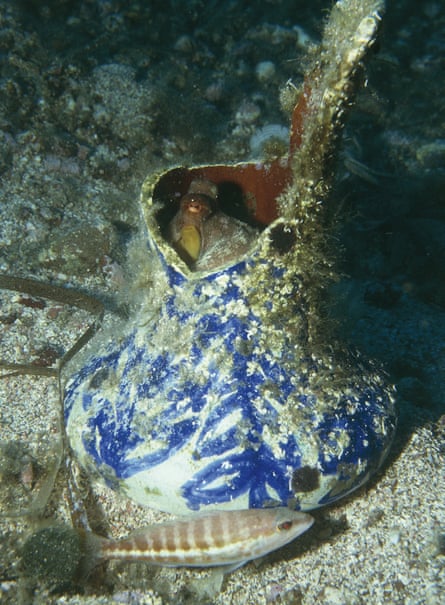
Octopuses are known for having strong personalities with huge differences between individuals, says Mather – and Octopus vulgaris is no exception. “I found vulgaris to be an up-and-at-’em species. Really active, really exploratory, really likely to escape,” she says. “In some ways the most interesting of octopuses. On the other hand, invariably the least likely to tolerate the kind of crap we’re going to do to them.”
A global cohort of companies has for decades been working to unlock the mystery of how to raise octopus in captivity, hoping to cash in on the ballooning trade of an animal that grows quickly and has a high reproductive rate.
Nueva Pescanova – a pioneer in aquaculture, with shrimp and turbot farms that span a surface area of more than 10,000 football fields – pulled into the lead in 2019 after it announced that it had managed to replicate the life cycle of Octopus vulgaris in captivity.
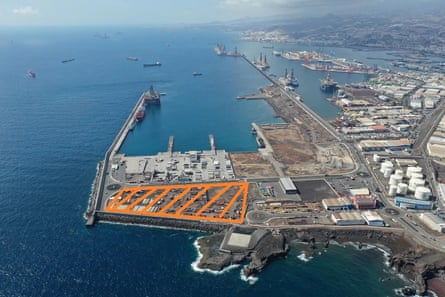
Two years later it began soliciting licences to build a two-storey farm at the port of Las Palmas in Gran Canaria. The location of the facility, which will be fed by seawater from a nearby bay, was chosen because of the temperature of the surrounding waters.
The company hopes to have its application approved by the end of this year, paving the way for it to begin the two-year task of constructing the reportedly €65m (£55m) farm. From there, stocked with octopuses transported from the research facility in northern Spain, it would take about a year and a half for the octopus to reach the adult phase. The timeline suggests the first batch of product – estimated to initially be between 300 and 500 tons of octopus meat – would probably not hit the market before 2027, says Romero Pérez.
From there, the aim is to gradually ramp up production over the next four years to 3,000 tons of meat annually. This would mean the slaughter of about 1 million octopuses a year – a projection complicated by the lack of existing international standards on the humane slaughter of them.
The aim is to ramp up production to 3,000 tons of meat annually – meaning the slaughter of 1 million octopuses a year
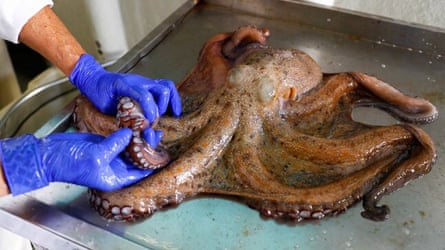
Nueva Pescanova plans to kill the animals using baths of ice flakes and water that would gradually drop to -3C, says Romero Pérez, describing the method as superior to clubbing the animals over the head, and the many unknowns regarding how to stun octopuses with electricity. For octopuses caught in the wild, a variety of methods are used to kill them, from clubbing to asphyxiation in a net and slicing their brains.
Ice baths are the “standard method used in global aquaculture,” says Romero Pérez. “Basically, it sets off a neural response that lowers the ability to feel. It’s the most respectful, most humane form of sacrifice that we know of today.”
His view contrasts with that of the World Organisation for Animal Health, which in 2019 said that the method has been shown to “result in poor fish welfare”. A 2014 review carried out in part by the Humane Slaughter Association suggested that while fish often stop moving relatively quickly after being placed in ice or ice slurry, “brain activity indicates the potential for the continuation of consciousness for a substantial period”.
Nueva Pescanova says it is working with researchers at a university in the Canary Islands to explore how to improve the slaughter. “People are imagining things that don’t exist; you don’t take an animal and throw it out there on the ice,” says Romero Pérez, who has worked in aquaculture for more than two decades. “European legislation allows for immersion in ice water but there is a protocol that needs to be developed before the animal reaches the phase of immersion in ice so that it suffers as little as possible. And that is what we are working on.”
As it stands, the mortality rate before slaughter is projected to be between 10% and 15%. “Our goal is to keep improving it,” says Romero Pérez. “But it’s very low for the world of farming. For the species most commonly cultivated in the Mediterranean, for example, the normal mortality rate is between 15% and 20%.”
He argued that it was in Nueva Pescanova’s best interests to keep the mortality rate as low as possible. “How we make more money is by ensuring animal welfare. It’s something that seems contradictory, but really that’s the way it is.”
Eurogroup for Animals slammed the company’s justification of the mortality rates as unacceptable. “This level is a problem to solve, not to repeat,” says Keri Tietge of the group.
How we make more money is by ensuring animal welfare. It’s something that seems contradictory, but that’s the way it is
Roberto Romero Pérez, Grupo Nueva Pescanova
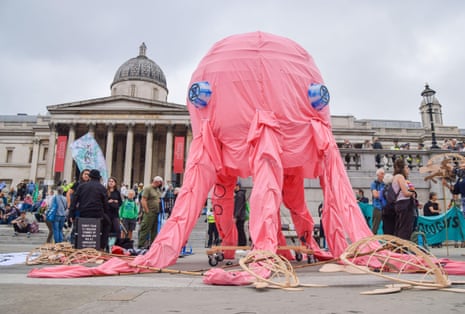
As the company waits to hear on the permits for the farm, campaigners have seized on the drawn-out timeline, calling on the EU to ban octopus farming as well as imports of farmed octopus.
“We have a chance to stop this before it starts,” says Tietge. “It’s a very strong signal to all the industry players that are trying to do the same thing. If they see all this pushback and regulatory troubles, it makes them think twice.”
In the meantime, campaigners have worked to flag the potential environmental impact of the farm, from the waste runoff that could be created by the mass of octopuses to the wild fish that could be needed to sustain a carnivorous animal that requires as much as three times their weight in feed.
“For carnivorous species, these commercial pellet feeds are made with fishmeal and fish oil ingredients, which of course leads to more fishing in order to catch the wild forage fish that these ingredients are produced from,” says Tietge. This reliance could also potentially exacerbate food security issues in the regions of the global south that are home to the main industrial fishmeal plants, she adds.
Nueva Pescanova says its feed includes byproducts of already-caught fish and that it is working to replace some of the animal protein with plant-based sources. When it comes to the risk posed by the farm’s runoff, it says it has provided the regional government of the Canary Islands with detailed plans as to how it would disinfect and filter all of the water leaving the facility.
In an email to the Guardian, the directorate general for fisheries in the Canary Islands said that it is “obliged to process all projects that comply with the law”.
While the project is still proceeding through the standard administrative process and is waiting on the regional government’s environmental impact assessment, it noted that “to-date the initial project complies with all of the requirements”.
It added: “The project for an octopus farm in Gran Canaria falls within an EU mandate that urges us to develop aquaculture as a fundamental element of the blue economy.”
The company says it has a good handle on the octopuses in its research facility, though Tietge contends it remains to be seen how the situation will play out if it attempts to house together more than a million conflict-prone animals known for their ability to take things apart and squeeze through openings the size of a coin.
“I think it is easier not to see these types of problems in the lab setting where there are people constantly tending to the situation and the environment and making sure the conditions are perfect,” says Tietge.
“When you then have nearly 1,000 tanks in production, there’s just no way to control it as much. So I think they will have a lot of these health and welfare issues popping up in much bigger numbers if they are able to start farming.”
Ultimately, the debate over octopus farming comes down to whether we are prepared to subject octopuses to the same kinds of mistakes we’ve made when it comes to the intensive farming of animals such as pigs, says Elena Lara of Compassion in World Farming.
“We have put very intelligent animals in intensive farms that are now suffering. Let’s not do it again,” she says. “Now that we have better science, better knowledge, let’s take that information and use it in the right way. We should learn from the past.”


 Daily Express US