SINGAPORE (Reuters) – The target of keeping long-term global warming within 1.5 degrees Celsius (2.7 Fahrenheit) is moving out of reach, climate experts say, with nations failing to set more ambitious goals despite months of record-breaking heat on land and sea.
As envoys gathered in Bonn in early June to prepare for this year’s annual climate talks in November, average global surface air temperatures were more than 1.5C above pre-industrial levels for several days, the EU-funded Copernicus Climate Change Service (C3S) said.
Though mean temperatures had temporarily breached the 1.5C threshold before, this was the first time they had done so in the northern hemisphere summer that starts on June 1. Sea temperatures also broke April…
Melting Antarctic ice has slowed an important ocean current that helps regulate the Earth’s climate, and scientists are worried about the consequences, including rising sea levels and changing weather patterns.
What’s happening?
A recent study revealed that a deep ocean current called the Southern Ocean overturning circulation has slowed down by about 30% since the 1990s. According to the Guardian, this current is important in regulating the Earth’s climate, including rainfall and warming patterns, along with how much heat and carbon dioxide the oceans store. What’s more, scientists expect a 40% slow down by 2050.
The circulation starts in the frigid and dense waters located deep off of Antarctica’s continental shelf. It spreads to other oceans from there, carrying oxygen to the deep ocean and bringing much-needed nutrients to the surface.
The Guardian reports that researchers say the slowing trend is due to global heating, which is causing Antarctic glacial ice to melt at a faster rate. This, in turn, adds freshwater, making the seas increasingly buoyant.
Why is the slowing ocean current concerning?
The slowing circulation could have cascading negative impacts, including rising sea levels and changing weather patterns, and it could deprive underwater ecosystems of nutrients.
“Changes in the overturning circulation are a big deal,” the study’s co-author, oceanographer Steve Rintoul, told the Guardian. “It’s something that is a concern because it touches on so many aspects of the Earth, including climate, sea level, and marine life.”
Related video: ‘We really need to care for this ocean as if our life depended on it’ (France 24)
Thanks so much for being with us here on France
Loaded: 13.00%Play
Current Time 0:05
/
Duration 5:23QualitySettingsCaptionsFullscreen
France 24
‘We really need to care for this ocean as if our life depended on it’Unmute
For one thing, it could cause “miserable weather” for places like the United Kingdom and Western Europe, Shenjie Zhou, a physical oceanographer at the British Antarctic Survey, told Wired.
It could also accelerate global warming because of the slowing absorption of heat and carbon dioxide in the world’s oceans. Plus, it could impact food security and threaten marine animals.
What can I do?
“Unless we act soon we will commit ourselves to changes that we’d really rather avoid,” Rintoul told the Guardian. “We need to act to reduce emissions, and we need to do everything we can as fast as we can.”
For ordinary citizens, that means taking actions to reduce environmental impact. Simple ways to do this include switching off lights when they’re not in use, taking the stairs instead of the elevator, riding a bike or mass transportation instead of driving, doing full loads of laundry, and maintaining a moderate room temperature.
But that’s not enough. Government policy is an important piece of the climate puzzle, and according to Yale School of the Environment, “Strong public demand increases the likelihood that governments will prioritize climate change action.”
That means it’s time to put pressure on government officials. You can do this by contacting them directly or by joining an environmental organization campaigning for climate policy, such as the Sierra Club.
“With drastic action, we could probably stop that slowdown from being a full collapse,” oceanographer and climate scientist Matthew England told Wired. “But it’s pretty tight.”
On Saturday Russia was thrown into disarray by a failed mutiny by Yevgeny Prigozhin, leader of the Wagner mercenary group.
The mutiny, which showed some of the cracks in the edifice of the Russian state that Vladimir Putin has created, triggered some concerns over the status of Russian nuclear weapons.
The idea of combatants in a civil war seizing nuclear weapons is one of the nightmare scenarios for security analysts.
Of course, this is hardly the first attempt at a violent transfer of authority in a nuclear power country; most countries with nuclear weapons have suffered from some kind of extra-legal leadership crisis.
France
On February 13, 1960, France detonated its first atomic device at a remote site deep in the hinterlands of Algeria. The test was politically awkward because Paris was in the throes of a struggle with both the community of French citizens in Algeria (pied noir) and with the Algerian independence movement (FLN). A little over a year later, as the intentions of the De Gaulle government to grant Algeria its independence became apparent, a group of French generals launched a coup intended to forestall the cession by ceasing the French state. The coup failed to trigger a general uprising in either Algeria or metropolitan France and collapsed after several days.
USSR and Russian Federation
Probably the scariest coup in the history of nuclear weapons happened in the autumn of 1991 when a group of Soviet generals made a belated effort to turn back the collapse of the Soviet Empire. The coup plotters took power for about three days, putting President Mikhail Gorbachev under house arrest and contesting control of Moscow and other parts of the country. U.S. policymakers panicked, but kept their panic as quiet as possible in order to avoid upsetting the development of events. The failure of the coup precipitated the collapse of the Soviet Union, driving the constituent republics of the USSR into independence. Gorbachev reassumed power but for only long enough to preside over the end of the state that he led.
Related video: Instability in nuclear-armed Russia ‘not a good thing’: EU’s Borrell (Dailymotion)
The Russian Federation inherited most of the Soviet nuclear arsenal and much of its instability. In the autumn of 1993, a constitutional crisis broke out into open fighting in Moscow between partisans of the Russian Duma and President Boris Yeltsin. Yeltsin defeated his opponents and maintained control of Russia’s nuclear arsenal throughout the crisis.
China
The People’s Republic of China went nuclear in 1964, on the eve of the Great Proletarian Cultural Revolution. In September 1971 the divide between Mao Zedong and one of his chief lieutenants, Lin Biao, had become unbridgeable. Details of the “Lin Biao Incident” remain hazy, but Chinese authorities assert that Lin attempted to seize power from Mao, then tried to flee to the Soviet Union when the attempt went badly. Lin’s plane crashed in Mongolia, killing everyone on board.
Upon the death of Mao Zedong control of the Chinese state briefly seemed up in the air. The “Gang of Four,” including Mao’s widow Jiang Qing, made a play for power in Beijing, establishing control over the city and challenging the broader leadership of the Chinese Communist Party (CCP). However, at this time the power base of the Chinese Communist Party was tied up tightly with regional military control, putting stark limits on the ability of any outsiders to seize control of the state. The Gang of Four was arrested after a month-long contest for influence over the People’s Liberation Army. Access to nuclear weapons was apparently never in question, remaining in the hands of army officials.
Pakistan
One of the major concerns about Pakistan’s development of nuclear weapons involved perceptions of its unstable political system. Pakistan suffered many coups and coup attempts before it went nuclear, and perhaps more ominously suffered catastrophic military defeat and dismemberment at the hands of its neighbor.
In October 1995, a group of army officers tried and failed to overthrow President Benazir Bhutto. In 1999 Pakistani General Pervez Musharraf overthrew Prime Minister Nawaz Sharif in a coup precipitated by the latter’s effort to arrest the former. This coup caused considerable consternation in the West, in large part because there was uncertainty about the nature and structure of Pakistan’s systems of command and control. The fact that the state was taken over by the chief of the armed forces offered some solace, however, as the fundamental lines of authority over nuclear weapons remained unchallenged.
United States
On January 6, 2021, presiding U.S. President Donald Trump attempted an autogolpe, an extra-legal effort to remain in power despite losing the 2020 Presidential election. Trump’s effort foundered quickly, although he remained Commander in Chief for another two weeks. The military did not participate in the coup and Congressional certification of the election proceeded with only a small delay. The situation remained tense for the remainder of Trump’s term, but on January 21 authority over nuclear weapons peacefully passed to President Joseph Biden.
What Should We Think?
Nuclear weapons have not granted their owners domestic serenity or immunity from domestic unrest. On more than one occasion, control over nuclear weapons has been at stake during violent efforts to change the government. Only Britain, Israel, North Korea, and India have avoided a violent domestic incident since going nuclear, and in India’s case, the emergency came very close. Fortunately, this disorder has yet to lead to a situation in which nuclear weapons were either up for grabs or ended up on different sides of a civil conflict. However, as the situation in Russia over the past few days has demonstrated, nuclear weapons and domestic instability are two tastes that most definitely do not go well together.
HELENA — Montana Fish, Wildlife and Parks says wolf numbers across the state fell slightly in 2022 but remain healthy.
The state estimates there are 1,087 wolves in Montana, 44 fewer than the previous year. The total number of packs in the state is 181 packs, down 10 packs from 2021. FWP says hunters harvested 248 wolves between the spring and fall hunting seasons.
On August 17, the Fish and Wildlife Commission will consider a new 289-wolf quota for the 2023-2024 season, including maintaining the six-wolf quota for the management unit north of Yellowstone National Park. The new region quotas in total are 167 lower than the previous season.
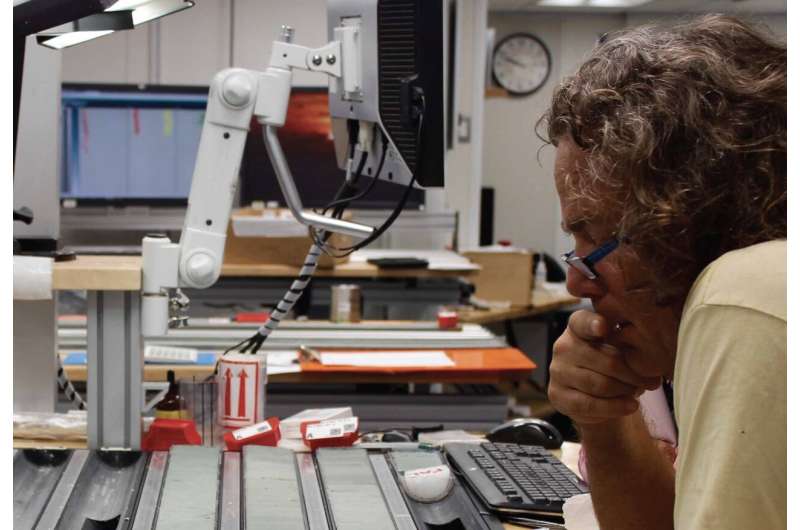
Rutgers Professor Yair Rosenthal, a coauthor on the study, examines deep-sea sediments aboard the Joides Resolution. Credit: Courtesy, Yair Rosenthal, Rutgers University
An analysis of oxygen levels in Earth’s oceans may provide some rare, good news about the health of the seas in a future, globally warmed world.
A Rutgers-led study published inNatureanalyzingocean sedimentshows that ocean oxygen levels in a key area were higher during the Miocenewarm period, some 16 million years ago when the Earth’s temperature was hotter than it is today.
In recent decades, levels of life-sustaining oxygen in the ocean have been decreasing, raising concerns that oxygen-deficient zones in key parts of the world oceans will expand, further harming marine life.
Scientists have attributed the trend toclimate change-induced rising temperatures, which affect the amount of oxygen that can be absorbed from the atmosphere.
The report sparked outrage and applause when it was published in 1972.Image credit: santoelia/Shutterstock.com
When researchers revisited a damning report from the early 1970s that predicted global collapse within the coming century, they reached a worrying conclusion: their decades-old data was proving to be surprisingly accurate. Worse still, the planet was still heading down the same path with little sign of change on the horizon.
In 1972, a team of scientists from MIT used a computer model to look into the future of humanity after receiving a commission from the Club of Rome, an international group of leading academics, scientists, business leaders, and politicians.
Outdoor workers are vulnerable to prolonged heat waves like the one hitting Texas, which climate scientists warn are becoming more common.
David J. Phillip/AP
If there’s one kind of weather extreme that scientists clearly link to climate change, it’s worsening heat waves.
“They are getting hotter,” says Kai Kornhuber, adjunct scientist at Columbia University and scientist at Climate Analytics, a climate think tank. “They are occurring at a higher frequency, so that also increases the likelihood of sequential heat waves.”
In Texas, the Southern U.S. and Mexico, athree-week heat wavehas gripped the region with temperature records falling for days in a row. Extreme heat has also hit India, China and Canada, where widespread wildfires are burning.
“Most of the world’s population has experienced record-breaking heat in recent days,” says Daniel Swain, climate scientist at the University of California, Los…
Controversial new lab-grown meat has been slammed by nutritionists and farmers skeptical of its nutritional value — and whether it should even be labeled beef or chicken.
The US Department of Agriculture and the Food and Drug Administration have given the green light to two companies, UPSIDE Foods and GOOD Meat, to sell their products — which are cultivated in a lab rather than coming from slaughtered animals — in the US.
The meat is created from live stem cells taken from the muscle and skin…
Tegmark is a professor doing AI research at the Massachusetts Institute of Technology
We know that an all-out U.S.-Russia nuclear war would be bad. But how bad, exactly? How do your chances of surviving the explosions, radiation, and nuclear winter depend on where you live? The past year’s unprecedented nuclear saber-rattling and last weekend’s chaos in Russia has made this question timely. To help answer it, I’ve worked with an amazing interdisciplinary group of scientists (see end credits) to produce the most scientifically realistic simulation of a nuclear war using only unclassified data, and visualize it as avideo. It combines detailed modeling of nuclear targeting, missile trajectories, blasts and the electromagnetic pulse, and of how black carbon smoke…
INDIANAPOLIS —Wildfire smoke blowing from Canadais causing low visibility in central Indiana and across much of the country. But the haze is the least of the problems, as the unhealthy levels of pollution can cause serious health impacts.
The good news is there are several ways to protect yourself and your family from some of the negative effects of the smoke.
But first, you need to understand the problem and why it is so hazy in Indiana.
Smoke is made of tiny particles of soot, carried in the air. It’s their size that makes them a problem. For a sense of scale, your average grain of sand is about 90 microns in diameter.


 Related video: ‘We really need to care for this ocean as if our life depended on it’ (France 24)
 France 24


 PublishedJune 28, 2023
 11Comments
 380Shares

 Top Stories00:2401:06


