‘No future’: Iceland cancels whale hunt over animal welfare concerns

by Elizabeth Claire Alberts on 21 June 2023

  • Citing animal welfare concerns, Iceland has suspended its whale hunting season until Aug. 31.
  • This decision follows the release of a government-commissioned independent report that found that many whales suffer immensely after being harpooned.
  • Iceland had been set to kill around 200 fin whales, up from the 148 it killed in 2022.

Iceland has suspended its planned hunt for fin whales this year, citing animal welfare concerns.

On June 20, Svandís Svavarsdóttir, the country’s minister of food, agriculture and fisheries, announced that the whale hunt was postponed because “the fishing method used when hunting large whales does not comply with the law on animal welfare.”

This decision follows the release of a government-commissioned independent report that found that 41% of whales targeted in the Icelandic hunts did not die immediately, but suffered immensely after being shot with harpoons. It also found that some whales took up to two hours to die.

The hunt has been suspended until Aug. 31, but experts close to the matter say it’s unlikely it will start after the suspension lifts, since September usually marks the end of the whaling season.

Harpoon on Icelandic whaling ship
A harpoon on an Icelandic whaling vessel. The 2023 whale hunt in Iceland was suspended until August 31, 2023. Image by Arne Feuerhahn / Hard to Port.

“I have made the decision to temporarily stop whaling in light of the unequivocal opinion of the professional council on animal welfare,” Svavarsdóttir said in a statement in Icelandic. “The conditions of the law on animal welfare are inescapable in my mind, if the government and license holders cannot guarantee welfare requirements, this activity does not see a future.”

Only one whaling company, Hvalur, holds a license to hunt whales in Iceland, which is set to expire in 2023. Another Icelandic whaling company, IP-Utgerd, ceased operations in 2020 due to financial difficulties.

Arne Feuerhahn, founder of Hard to Port, a German organization that has worked to end the Icelandic whale hunts, says the news surprised him.

“I was standing in front of one of the whaling ships … when I received the news,” Feuerhahn, currently in Iceland, told Mongabay by phone. “It was a very, very special and emotional moment because so many people have put a lot of energy over the past few months and years to get to this outcome.”

Before receiving the news, Feuerhahn said he’d been expecting the whalers to begin hunting on June 21.

Feuerhahn, who has been working with partners to document the Icelandic whale hunts since 2015, says he previously shared video of the whale hunts with Svavarsdóttir. The government then placed observers on all whaling ships in 2022.

This year, Iceland was set to kill around 200 fin whales (Balaenoptera physalus), considered vulnerable to extinction by the global conservation authority IUCN.
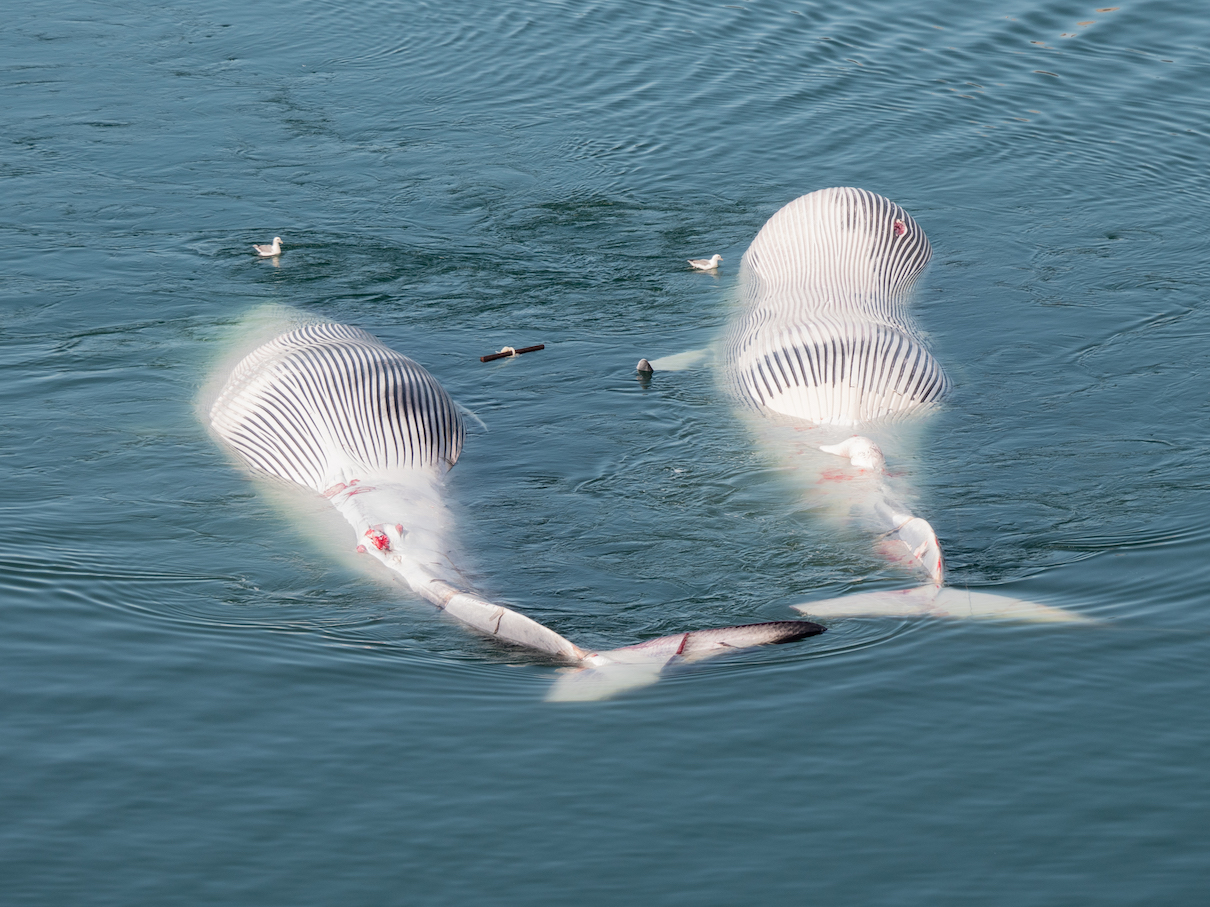
Two fin whales being dragged through the water. In 2022, Iceland killed 148 fin whales. Image by Arne Feuerhahn / Hard to Port.

In 2022, Iceland killed 148 fin whales. In 2018, it killed 44 fin whales and two rare hybrids of fin and blue whales.

Iceland has been one of the very few countries, along with Japan and Norway, that has continued to hunt whales despite the International Whaling Commission enacting a global moratorium on commercial whaling in 1986.

A survey conducted by Icelandic research company Maskína found that 51% of Icelanders oppose the whale hunts, while only 29% are in favor. Most of those in favor were 60 years or older.

“This is a major milestone in compassionate whale conservation,” Ruud Tombrock, the executive director of the Humane Society International in Europe, said in a statement.

“There is no humane way to kill a whale at sea, and so we urge the minister to make this a permanent ban,” Tombrock added. “Whales already face so many serious threats in the oceans from pollution, climate change, entanglement in fish nets and ship strikes, that ending cruel commercial whaling is the only ethical conclusion.”

Banner image caption: The harpoon or catcher ship Hvalur 8 arrives at the whaling station in Hvalfjörður, West Iceland. Two fin whales are tied to the starboard side of the ship. Image by Arne Feuerhahn / Hard to Port.

Elizabeth Claire Alberts is a senior staff writer for Mongabay. Follow her on Twitter @ECAlberts.https://news.mongabay.com/2020/04/iceland-wont-be-killing-any-whales-this-year/embed/#?secret=peunp8ulLl#?secret=Kyz5RBmLV2
Biden administration moves to restore endangered species protections dropped by Trump

By MATTHEW BROWN35 minutes ago

https://apnews.com/article/endangered-species-biden-trump-rollbacks-9791aaaa955d26b599ba802d7c931e7c

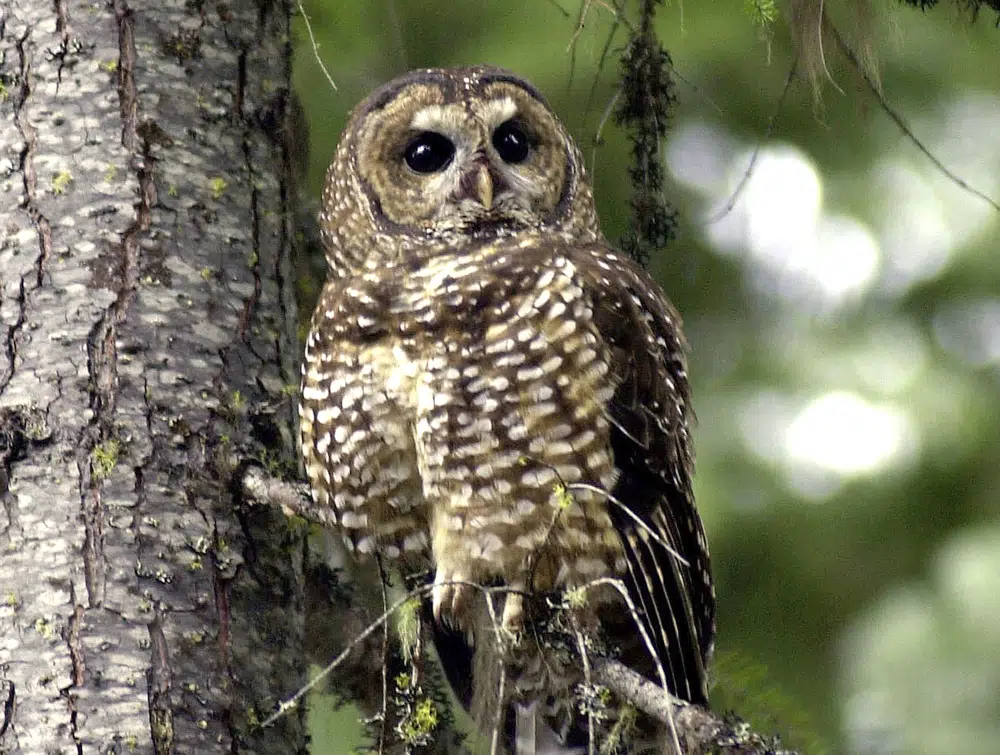
FILE - In this May 8, 2003, file photo, a northern spotted owl sits on a tree branch in the Deschutes National Forest near Camp Sherman, Ore. The U.S. Fish and Wildlife Service plans to reinstate a decades-old regulation that mandates protections for species that are newly classified as threatened. (AP Photo/Don Ryan, File)

1 of 2

FILE – In this May 8, 2003, file photo, a northern spotted owl sits on a tree branch in the Deschutes National Forest near Camp Sherman, Ore. The U.S. Fish and Wildlife Service plans to reinstate a decades-old regulation that mandates protections for species that are newly classified as threatened. (AP Photo/Don Ryan, File)

BILLINGS, Mont. (AP) — The Biden administration proposed bringing back rules to protect imperiled plants and animals on Wednesday as officials moved to reverse changes under former President Donald Trump that weakened the Endangered Species Act.

The U.S. Fish and Wildlife Service said it would reinstate a decades-old regulation that mandates blanket protections for species newly classified as threatened.

The blanket protections regulation was dropped in 2019 as part of a suite of changes to the application of the species law that were encouraged by industry, even as extinctions accelerate globally due to habitat loss and other pressures.

Officials also would no longer consider economic impacts when deciding if animals and plants need protection. And the rules make it easier to designate areas as critical for a species’ survival, even if it is no longer found in those locations.

That could help with the recovery of imperiled fish and freshwater mussels in the Southeast, where the aquatic animals in many cases are absent from portions of their historical range, said Fish and Wildlife Service Assistant Director Gary Frazer.

ADVERTISEMENT

DONALD TRUMP

Trump-Russia special counsel Durham at center of political clash as he appears before CongressHouse poised to censure Rep. Adam Schiff over Trump-Russia investigationsDemocrats downplay Hunter Biden’s plea deal, while Republicans see opportunity to deflect from TrumpBiden-Modi relationship built on common bonds

Frazer said Wednesday’s proposal would restore “baseline” protections so species don’t get pushed further toward extinction.

“We have the opportunity to try to improve the status of species before they get to the brink,” he said.

Details on the proposed rules, which could take a year to finalize, were obtained by The Associated Press in advance of their public release.

They’ll face strong pushback from Republican lawmakers, who say President Joe Biden’s Democratic administration has hampered oil, gas and coal development, and favors conservation over development.

ADVERTISEMENT

ADVERTISING

“These proposed rules take us in the wrong direction and are entirely unnecessary given the proven track record of success from private conservationists and state and local land managers,” said House Natural Resources Committee Chairman Bruce Westerman, a Republican from Arkansas.

ADVERTISEMENT

Industry groups have long viewed the 1973 Endangered Species Act as an impediment. Under Trump they successfully lobbied to weaken the law’s regulations as part of a broad dismantling of environmental safeguards. Trump officials rolled back endangered species rules and protections for the northern spotted owl, gray wolves and other species.

The spotted owl decision was reversed in 2021 after career wildlife officials said Trump’s political appointees used faulty science to justify opening millions of acres of West Coast forest to potential logging. Protections for wolves across most of the U.S. were restored by a federal court last year and the Biden administration has said it will decide by next February if they should remain in place.

Many of the changes under Trump were finalized during his last weeks in office.

Since then, officials imposed less restrictive protections for more than a dozen animals and plants compared to what they would have received, said Jonathan Wood with the Property and Environment Research Center, a free-market policy group based in Bozeman, Montana.

ADVERTISEMENT

Wood said the Biden administration changes could hurt efforts by state and private landowners to recover species, by imposing more punitive regulations that undermine the incentive to work voluntarily for conservation.

Biden administration officials said they were trying to bring the endangered species law into alignment with its original intent and purpose.

U.S. Fish and Wildlife Service Director Martha Williams said in a statement that the changes “reaffirm our commitment to conserving America’s wildlife and ensuring the Endangered Species Act works for both species and people.”

National Oceanic and Atmospheric Administration Fisheries Assistant Administrator Janet Coit said the rules would ensure the species law remains effective as climate change alters habitats around the globe, and plants and animals become extinct.

The Biden administration had earlier withdrawn a 2020 rule that limited which lands and waters could be designated as places where imperiled animals and plants could receive federal protection. It also reversed Trump’s decision to weaken enforcement of the century-old Migratory Bird Treaty Act, which made it harder to prosecute bird deaths caused by the energy industry.

But environmentalists have been frustrated that it’s taken more than two years for Biden to act on some of the Trump-era rollbacks. Stoking their urgency is the prospect of a new Republican administration following the 2024 election that could yet again ease protections.

“These are promising steps to get us back to the Endangered Species Act’s purpose, its power to protect,” attorney Kristen Boyles with Earthjustice said of the new rules. The group sued on behalf of environmental groups to block the Trump rules and prevailed in U.S. District Court then lost on appeal.

An array of industry groups have long maintained that economic impacts are not given enough consideration in U.S. government wildlife decisions. Those groups range from livestock and ranching organizations to trade associations representing oil, gas and mining interests.

The Endangered Species Act is credited with helping save the bald eagle, California condor and scores of other animals and plants from extinction since President Richard Nixon signed it into law. It currently protects more than 1,600 species in the United States and its territories.

“Beijing is telling the U.S.: ‘We are willing to die to the last Chinese for Taiwan. You Americans are not.’”

Exposing the Big Game's avatarThe Extinction Chronicles

Clever Rebel

Clever RebelFollow

Story by Jon Gefner • Yesterday 2:26 PM

“Beijing is telling the U.S.: ‘We are willing to die to the last Chinese for Taiwan. You Americans are not.’”©Provided by Clever Rebel

In Brief …

  • China’s Navy vessel’s dangerous proximity to a US destroyer in Taiwan Strait raises global tensions.
  • Council on Foreign Relations President Haass believes China aims to dissuade the US from pursuing interests in the Indo-Pacific by raising risk level.
  • China sends mixed signals to US: Open to economic talks while raising the temperature on military-security issues.
  • Haass says more US-China standoffs could have “incalcuable” economic consequences.

Richard Haas©Wikimedia

In a move that raised global tensions,a Chinese Navy vessel cruised within 150 yards of an American destroyer, causing a near collision in the Taiwan Strait. This provocative June 4th encounter comes on the heels of a Chinese fighter jet executing an “unnecessarily aggressive maneuver”…

View original post 357 more words

‘Extremely absurd and irresponsible’: China fires back after Biden labels Xi a dictator

Exposing the Big Game's avatarThe Extinction Chronicles

MarketWatch

MarketWatchFollow

Story by Associated Press•1h ago

MarketWatch

‘Extremely absurd and irresponsible’: China fires back after Biden labels Xi a dictator

Was this content a good use of your time?

Your feedback will help us improve the product

‘Extremely absurd and irresponsible’: China fires back after Biden labels Xi a dictator©leah millis/Press Pool

ASSOCIATED PRESS

BEIJING (AP) — China has called comments by President Joe Biden describing Chinese leader Xi Jinping as a dictator “extremely absurd and irresponsible.”

Related video:What will happen to the markets if China invades Taiwan?(Benzinga)

This is the wild card. This is always been the

Loaded:37.78%Play

Current Time0:00

/

Duration1:35QualitySettingsCaptionsFullscreen

Benzinga

What will happen to the markets if China invades Taiwan?Unmute

View on Watch

The new clash of words comes just over a day after Secretary of State Antony Blinken concluded a visit to Beijing that sought to break the ice in a relationship that…

View original post 289 more words

13,000 Years Ago, Ancient Humans Likely Helped Drive a Mass Extinction in North America

Exposing the Big Game's avatarCommittee to Abolish Sport Hunting Blog

The earliest people who lived in North America shared the landscape with huge animals — but none remain.

https://www.inverse.com/science/ancient-humans-mass-extinction-america

BYTHE CONVERSATIONANDCHRISTOPHER R. MOORE

JUNE 19, 2023

Elena Duvernay/Stocktrek Images/Stocktrek Images/Getty Images

The earliest people who lived in North America shared the landscape with huge animals. On any day, these hunter-gatherers might encounter a giant, snarling saber-toothed cat ready to pounce or a group of elephant-like mammoths stripping tree branches. Maybe a herd of giant bison would stampede past.

Obviously, you can’t see any of these ice-age megafauna now. They’ve all been extinct for about 12,800 years. Mammoths, mastodons, huge bison, horses, camels, very large ground sloths, and giant short-faced bears all died out as the huge continental ice sheets disappeared at the end of the Ice Age. What happened to them?

Scientists have pointed to various potential causes for the extinction. Some suggestenvironmental changes happened fasterthan…

View original post 963 more words

Iceland suspends whale hunting over animal rights concerns

Rights groups advocate an end to the slaughter and say the mammals are also under serious threat from climate change.

https://www.aljazeera.com/news/2023/6/20/iceland-suspends-whale-hunt-on-animal-rights-concerns

A ship off the coast of Reykjavik is seen transporting a 20-metre long fin whale off its hull
The ship Hvalur 9 on June 24, 2022, transports a 20-metre-long fin whale off its hull to the processing plant in Hvalfjordur, near Reykjavik, Iceland, the first to be caught in nearly four years [File: Halldor Kolbeins/AFP]

Published On 20 Jun 202320 Jun 2023

Iceland’s government said it was suspending this year’s whale hunt until August 31 due to animal welfare concerns, likely bringing the controversial practice to a historic end.

A recent monitoring report by the country’s Food and Veterinary Authority on the fin whale hunt found that the killing of the animals took too long based on the main objectives of the Animal Welfare Act.

KEEP READING

list of 3 itemslist 1 of 3

Iceland to end whaling as demand dwindles

list 2 of 3

Ships must slow down to save endangered whales, US gov’t says

list 3 of 3

Photos: Volcano near Iceland’s main airport erupts

end of list

The veterinary authority broadcast shocking video clips that showed a whale’s agony as it was hunted for five hours.

“If the government and licensees cannot guarantee welfare requirements, these activities do not have a future,” said Svandis Svavarsdottir, the minister of food, agriculture and fisheries, in a statement on Tuesday, as she announced the suspension of “all whaling operations”.

Animal rights groups and environmentalists hailed the decision, with the Humane Society International calling it “a major milestone in compassionate whale conservation”.

Svavarsdottir said she would seek the opinions of experts and whale-hunting licence holders to explore further limitations on whaling in the future, the government said.

Iceland has only one remaining whaling company, Hvalur, and its licence to hunt fin whales expires in 2023.

Another company hung up its harpoons for good in 2020, saying it was no longer profitable.

Iceland’s whaling season runs from mid-June to mid-September, and it is doubtful Hvalur would head out to sea that late in the season.

The hunting of fin whales, which can reach lengths of more than 20 metres (65.6 feet), was resumed in Iceland in 2006 following a 1986 moratorium. Annual quotas authorise the killing of 209 fin whales – the second-longest marine mammal after the blue whale – and 217 minke whales, one of the smallest species.

Sign up for Al Jazeera

Week in the Middle East

Catch up on our coverage of the region, all in one place.Sign up

By signing up, you agree to our Privacy Policy

But catches have gone down drastically in recent years because of a dwindling market for whale meat.

Whales also threatened by pollution, climate change     

Iceland, Norway and Japan are the only countries that have continued whale hunting in the face of fierce criticism from environmentalists and animal rights defenders.

https://e80002a0af7c5ea547a06fdc7b1c7726.safeframe.googlesyndication.com/safeframe/1-0-40/html/container.html

“There is no humane way to kill a whale at sea, and so we urge the minister to make this a permanent ban,” the Humane Society International’s director Ruud Tombrock said in a statement.

“Whales already face so many serious threats in the oceans from pollution, climate change, entanglement in fish nets and ship strikes, that ending cruel commercial whaling is the only ethical conclusion.”

Robert Read, the head of Sea Shepherd UK, said the decision was also “a huge blow” to other whaling nations.

“If whaling can’t be done humanely here … it can’t be done humanely anywhere.”

Opposition to whaling has been on the rise in Iceland with a majority now in favour of abolishing the practice.

A survey published in early June indicated that 51 percent of Icelanders were opposed to the hunt and 29 percent were in favour, with over-60s those most in favour.

Iceland has depended heavily on fishing and whaling for centuries.

In the past two decades its tourism industry, including whale watching tours, has thrived – and these two key sectors of the economy have diverging interests.

Japan, by far the biggest market for whale meat, resumed commercial whaling in 2019 after a three-decade hiatus, drastically reducing the need for imports from Iceland.

S

Animal activists want mass killings to control avian flu to use more humane methods

birdflu_406x250.jpg

By News Desk on June 19, 2023

Mass killings to control highly contagious, highly pathogenic avian influenza are being criticized by at least one animal activist organization.

The non-governmental Animal Welfare Institute (AWI) has petitioned the USDA’s Animal and Plant Inspection Service (APHIS), asking the government to “incentivize producers to adequately plan for the rapid killing of infected and exposed animals.”

The AWI’s petition references the 2018 APHIS rule that requires producers to have an approved biosecurity plan that is audited at least every two years in order to be eligible for avian flu claims. Biosecurity plans are seen as critical to protecting flocks and reducing the risk of disease.

The petition, however, calls for more producer “incentives” before USDA could pay claims for the loss of a flock due to an avian flu outbreak.

“The ongoing HPAI outbreak has been an animal welfare nightmare that has caused untold suffering not only for the birds who are actually infected but for potentially healthy birds as well,” said Dena Jones, AWI’s farmed animal program director. “Unfortunately, if one infection is confirmed, every single bird at the location must be killed — even if that means killing millions of potentially uninfected birds.”

The petition claims more humane methods can be used for the mass killings.

The AWI reports that one controversial method used to kill large numbers of birds during the current outbreak is “ventilation shutdown plus” (VSD+). VSD+ involves turning off the airflow in a barn and ratcheting up the heat to above 104 degrees, leaving trapped birds to die from heat stroke over several hours. 

It says VSD+ likely causes extreme suffering, and 3,500 veterinary professionals have gone on record to oppose its use. Nevertheless, according to an AWI analysis of USDA records, between February 2022 and March 2023, at least 44.9 million birds — nearly 77 percent of the commercial birds impacted in the United States — were killed in depopulations using VSD+ alone or in combination with other methods. 

By comparison, the primary depopulation methods used during the 2014-2015 HPAI outbreak — considered at the time to be the largest and most serious animal health disease incident in U.S. history — were water-based foam and carbon dioxide (CO2) gassing. 

After the USDA noticed depopulation delays during that outbreak, particularly on layer operations with hundreds of thousands or millions of birds, the department established a policy that depopulations must occur within 24 to 48 hours of avian flu being detected. Further, the department sanctioned the use of VSD+, essentially as a method of last resort to be used only when AWI claims other, more humane alternatives are not available. 

The Animal Health Protection Act authorizes the USDA to order the depopulation (mass killing) of domestic bird flocks or other farmed animals to combat the spread of disease. Following disease outbreaks in poultry, the department also has the power to indemnify producers for the loss of birds and eggs, as well as certain costs associated with depopulation, disposal, and other virus-elimination activities.

For the past 16 months, the United States and countries around the world have been grappling with a highly pathogenic avian influenza (HPAI) outbreak of unprecedented scale. Research indicates that the disease is becoming enzootic (established) in wild bird populations in Europe and may soon become similarly entrenched in North America.

Clearly, HPAI is not going away. By February 2023, the U.S. government had spent an estimated $661 million in HPAI response activities and indemnity payments, with no end in sight. During the 2014-2015 outbreak, the USDA spent an estimated $950 million on HPAI response and preparedness activities and indemnity payments.

As of June 15, HPAI has been confirmed in 325 commercial and 511 backyard flocks in 47 states, resulting in the depopulation of nearly 59 million domestic birds. The three states with the highest number of birds affected by the ongoing outbreak are Iowa (over 15.9 million), Nebraska (over 6.7 million), and Colorado (over 6.2 million).

Even with the recent widespread use of VSD+, the USDA’s depopulation timeline has not been met in a majority of cases involving large flocks (at least 100,000 birds), according to AWI’s analysis. Of the 37 depopulation events of large flocks that involved VSD+, nearly two-thirds took at least three days to complete. In the most extreme cases, in which at least 1 million birds were involved, depopulation took more than two weeks. 

“Clearly, the size of an operation creates logistical challenges for performing depopulation in a timely manner, specifically within the USDA’s goal of 24-48 hours. These challenges are undoubtedly exacerbated by a lack of preparedness,” AWI wrote. “Because the USDA has declined to limit the size of operations, the only way to better ensure that depopulation can be carried out pursuant to USDA’s goal of 24-48 hours is to incentivize better preparation.”

According to AWI, other countries around the world hit hard by HPAI — including Canada, the United Kingdom, and much of the European Union — have avoided using depopulation methods that rely on heat stroke, and since the 2014-2015 outbreak, numerous depopulation methods considered more humane have become available.

The AWI petition asks APHIS to exercise its authority to require audited emergency action plans that prioritize the use of more humane methods of depopulation as a condition for HPAI-related payments. These plans should include detailed descriptions of procedures to

·       Depopulate flocks within 24 to 48 hours in a manner that rapidly renders individual animals unconscious  

·       Avoid the use of methods such as VSD+ and others categorized by the American Veterinary Medical Association as “permitted under constrained circumstances”

·       Minimize pain and distress from catching, handling, and confining birds during depopulation

(To sign up for a free subscription to Food Safety News, click here.)

HPAI: Urgent need for humane approaches to mass killings

19 June, 2023

The Animal Welfare Institute (AWI) has submitted a petition to the US Department of Agriculture (USDA), urging a revision of animal disease regulations. The petition calls for the implementation of audited emergency response plans, including humane depopulation strategies, as a prerequisite for compensating producers for losses during disease outbreaks. The Animal Health Protection Act grants the USDA the authority to order the depopulation of domestic bird flocks or other farmed animals to combat disease spread. In such cases, the USDA can indemnify producers for the loss of birds, eggs, and associated expenses related to depopulation and virus elimination activities.
Over the past 16 months, the United States and other countries have been confronted with an unprecedented highly pathogenic avian influenza (HPAI) outbreak. Research suggests that the disease is becoming endemic in wild bird populations in Europe and may soon establish itself similarly in North America. The HPAI outbreak persists, with the US government already having spent an estimated $661 million on response activities and indemnity payments by February 2023, with no end in sight. During the 2014-2015 outbreak, the USDA spent an estimated $950 million on response and preparedness activities, as well as indemnity payments.
As of June 15, HPAI has been confirmed in 325 commercial and 511 backyard flocks across 47 states, resulting in the depopulation of nearly 59 million domestic birds. The three states most affected by the ongoing outbreak are Iowa (over 15.9 million birds), Nebraska (over 6.7 million birds), and Colorado (over 6.2 million birds).
AWI’s petition, submitted to the USDA’s Animal and Plant Inspection Service (APHIS), cites a 2018 agency rule that requires producers to have an approved biosecurity plan audited at least every two years to be eligible for HPAI-related claims. While biosecurity planning plays a crucial role in protecting birds and reducing the risk of disease introduction, AWI argues that it should not be the sole criterion for compensation eligibility. The USDA must also incentivize producers to adequately prepare for the rapid and humane depopulation of infected and exposed animals to control disease spread.
During the current outbreak, a contentious method known as “ventilation shutdown plus” (VSD+) has been employed to kill large numbers of birds. VSD+ involves cutting off airflow in a barn and raising the temperature above 104 degrees Fahrenheit, leading trapped birds to die from heat stroke over several hours. VSD+ likely inflicts severe suffering, and 3,500 veterinary professionals have voiced their opposition to its use. Nonetheless, according to AWI’s analysis of USDA records from February 2022 to March 2023, at least 44.9 million birds, accounting for nearly 77% of the impacted commercial birds in the United States, were depopulated using VSD+ either alone or in combination with other methods.
In comparison, during the 2014-2015 HPAI outbreak, which was regarded as the most significant and severe animal health disease incident in US history at that time, the primary depopulation methods employed were water-based foam and carbon dioxide (CO2) gassing. Due to depopulation delays observed during that outbreak, particularly in layer operations with large numbers of birds, the USDA implemented a policy mandating depopulation within 24 to 48 hours of avian flu detection. Additionally, the department authorized the use of VSD+ as a last-resort method when more humane alternatives were not available. Despite the widespread use of VSD+ in recent times, AWI’s analysis reveals that the USDA’s depopulation timeline has not been met in the majority of cases involving large flocks (at least 100,000 birds). Of the 37 depopulation events involving VSD+ in large flocks, nearly two-thirds took at least three days to complete. In the most extreme cases, involving at least 1 million birds, depopulation took over two weeks. AWI argues that the size of an operation presents logistical challenges to timely depopulation within the USDA’s goal of 24 to 48 hours. These challenges are further exacerbated by a lack of preparedness. As the USDA has declined to impose size limits on operations, AWI asserts that the only way to ensure depopulation aligns with the USDA’s timeline is to incentivize better preparation. In contrast, other countries severely impacted by HPAI, such as Canada, the United Kingdom, and much of the European Union, have avoided using depopulation methods that rely on heat stroke. Since the 2014-2015 outbreak, several more humane depopulation methods have become available. The petition requests that APHIS exercise its authority to mandate audited emergency action plans that prioritize the use of more humane depopulation methods as a requirement for HPAI-related payments. These plans should include detailed procedures to: Depopulate flocks within 24 to 48 hours in a manner that rapidly renders individual animals unconscious. Avoid the use of methods like VSD+ and others categorized by the American Veterinary Medical Association as “permitted under constrained circumstances. “Minimize pain and distress during the catching, handling, and confinement of birds during depopulation.

Dead Shark Washes Up on Beach Hours After Killer Whale Hunting Spree

BY ROBYN WHITE ON 6/19/23 AT 9:47 AM EDT01:10

Top 5 Interesting Facts About Orcas

Share https://www.newsweek.com/dead-shark-beach-killer-whale-hunting-1807629

Share on FacebookShare on TwitterShare on LinkedInShare on RedditShare on FlipboardShare via EmailComments

WILDLIFEORCAGREAT WHITE SHARKSHARKSSOUTH AFRICA

https://trinitymedia.ai/player/trinity-player.php?pageURL=https%3A%2F%2Fwww.newsweek.com%2Fdead-shark-beach-killer-whale-hunting-1807629&unitId=2601060880&userId=255962eb-2ed8-4d73-9b67-5b5b564d10d2&isLegacyBrowser=false&version=20230619_299cbbc6358b53a9aebbc6d64f48721e90815f29&useBunnyCDN=0&themeId=140

Adead shark washed ashore on a beach in South Africa after a hunting spree by two infamous killer whales.

The Mossel Bay-based Ocean Research Institute said that the two orcas, who have been named Port and Starboard, were spotted hunting an 8-foot great white shark around Seal Island, near Cape Town, on June 18.

The next day, a dead great white washed up on a nearby beach. However, it was not the same shark documented in the hunt.

Port and Starboard are not just known for eating sharks, but for using gruesome methods to hunt them.

SUBSCRIBE NOW FROM JUST $1 >

Great white eaten by orca
A picture shows the great white shark that washed ashore on a beach near Cape Town in South Africa. The shark was found after two killer whales were spotted hunting a great white around Seal Island, near Cape Town, on June 18.OCEANS RESEARCH INSTITUTE

Some of their shark victims were discovered washed ashore with their livers missing.

Dr. Enrico Gennari, director of the Ocean Research Institute, told Newsweek that the shark found on June 19 was “open completely.”

“Even more so than previous times. It was almost as if they put a different kind of effort into it. Before, it almost looks like the shark was pushed gently, however, yesterday the people on the boat [who witnessed the attack] described that the shark breached out of the water almost as if to get away from the orcas, and then the orcas pushed them further. And it lasted a few minutes. And the shark was being dragged around in the mouth. So it seemed like a different type of kill.”

SIGN UP FOR NEWSWEEK’S EMAIL UPDATES >

At the moment, the institute can’t confirm whether the sharks the orcas had been hunting on Sunday were subjected to this gruesome method.

Port and Starboard‘s predation on sharks has been going on for years. Great white sharks are an endangered species but Gennari said that human activity is a much bigger problem for the species than killer whales.

READ MORE

Gennari said that shark nets in the area kill between 25 and 30 great whites a year, whereas the two orcas don’t even kill half as many over a 12-month period.

While nothing can be done about the orcas, he said humans can take action to protect sharks. For example, trophy fishing is a major threat to the species

Port and Starboard first gained attention off the Western Cape of South Africa in 2015. This is when it became clear that the pair were responsible for the deaths of several broadnose sevengill sharks discovered by scuba divers.

However, they did not stop there. Between 2017 and 2019, the orcas started turning their sights on great white sharks.

The orcas presence in local waters has even caused great white populations to disperse in certain areas.

False Bay, between Cape Point and Cape Hangklip, used to be a hotspot for the endangered species. But since 2017, great whites have all but disappeared from the area.

State Department of Natural Resources updates deer hunting regulations in Lower Peninsula

Exposing the Big Game's avatarCommittee to Abolish Sport Hunting Blog

WKAR Public Media | ByMichelle Jokisch Polo

Published June 20, 2023 at 11:43 AM EDT

https://www.wkar.org/wkar-news/2023-06-20/state-department-of-natural-resources-updates-deer-hunting-regulations-in-lower-peninsula

 buck in a grassy area in front of a forest

The Michigan Department of Natural Resources is updating its deer hunting regulations. The department is reinstating certain restrictions on the kinds of deer that can be harvested in the southern part of the state.

In 2018, the DNR implemented a regulation to prevent chronic wasting disease, an incurable neurological condition that affects deer.

The regulation allowed hunters in parts of the Lower Peninsula where the disease was spreading rampantly to harvest deer with any number points coming off the main part of their antlers.

But statewide deer biologist Chad Stewart says there was no impact on hunters’ behaviors and no change in the number of deer getting infected.

“I think that’s going to continue to spread either with or without antler point restrictions because in some places, it’s fairly widespread,” he…

View original post 155 more words