An Interview With Karen Davis Of United Poultry Concerns
As Published on Species Unite
April 30, 2023 • Anjali Banerjee
In honor of upcoming International Respect for Chickens Day, May 4, 2023, Species Unite is delighted to feature this exclusive interview with KAREN DAVIS, PhD, President and Founder of United Poultry Concerns, a nonprofit organization that promotes the compassionate and respectful treatment of domesticated birds including a sanctuary for chickens in Virginia. Inducted into the National Animal Rights Hall of Fame for Outstanding Contributions to Animal Liberation, Karen is the author of numerous books, essays, articles and campaigns. Her latest book is For the Birds – From Exploitation to Liberation: Essays on Chickens, Turkeys, and Other Domesticated Fowl published by Lantern Publishing & Media. Karen hosts a biweekly podcast series titled Thinking Like a Chicken – News & Views! Media celebrity Ira Glass, host of the popular Public Radio International program This American Life aired on NPR, appeared on Late Night with David Letterman where he told Letterman and millions of viewers that his visit to United Poultry Concerns’ chicken sanctuary led him to become a vegetarian.
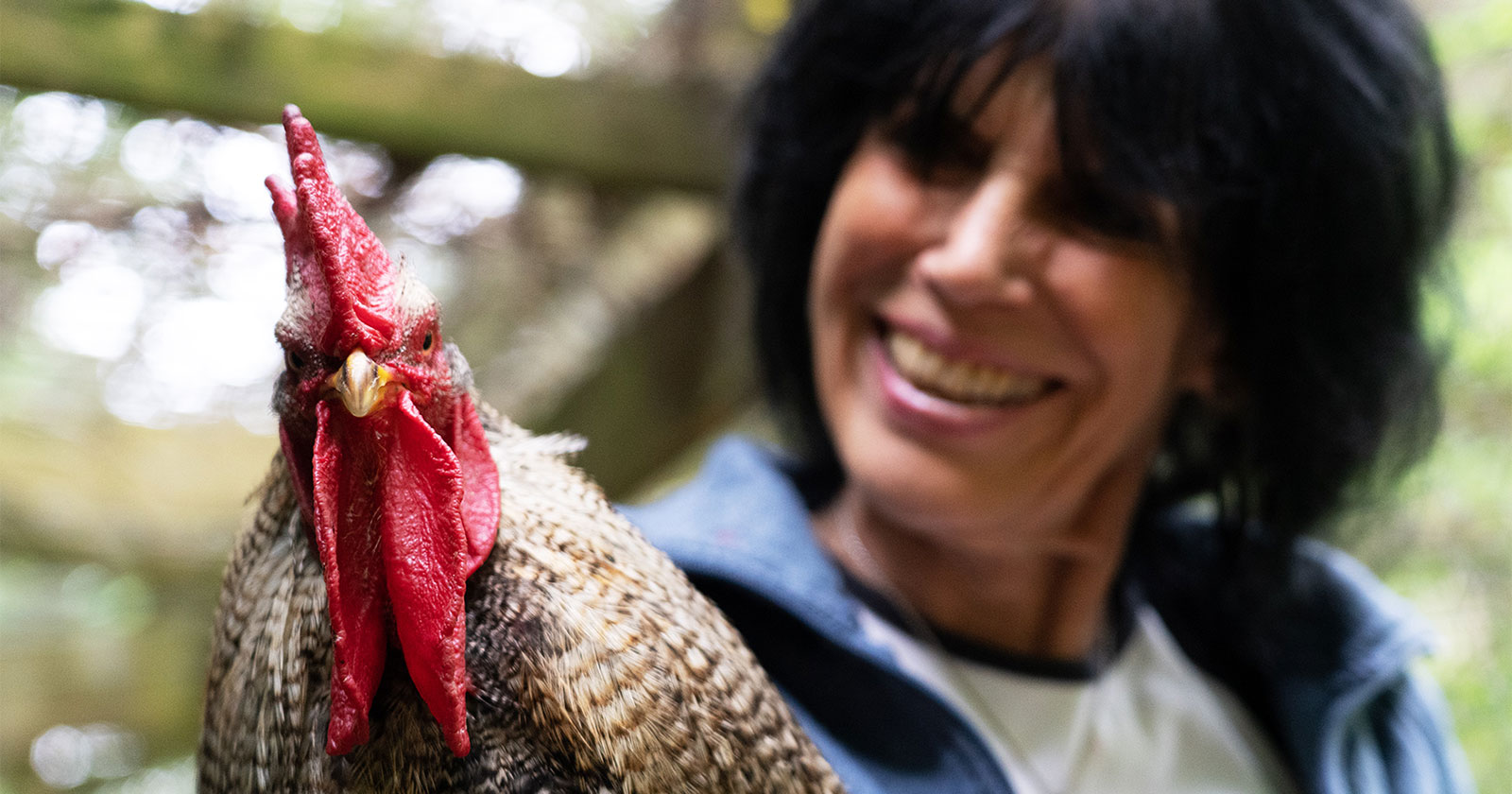
Karen Davis with Rainbow. Photo: Unparalleled Suffering
What Are The Highlights Of Your Journey To Establish United Poultry Concerns?
I grew up eating animals without thinking that meat was the body part of a pig or cow or chicken or a turkey. All children were supposed to drink milk for “strong bones” so that was taken for granted. Eggs meant egg salad sandwiches for lunch and scrambled or fried eggs or hard-boiled eggs for breakfast or picnics. My father hunted rabbits and pen-raised pheasants for sport. This was in Altoona, Pennsylvania. Once I understood something about hunting, at age 13 or so, I began arguing with my father about it over a dinner table laden with meat whose origin did not give me pause.
Not until I read an essay by the Russian writer Leo Tolstoy called “The First Step” in 1974 at age 30 did the origin of meat from animals become a conscious, heart stopping realization. Tolstoy’s description of a Moscow slaughterhouse he visited was so dreadful and sad that I stopped eating meat immediately. Because the suffering of animals killed to be eaten affected me so deeply and completely, I did not miss eating them and never have missed this depressing diet.
In 1983 I quit dairy and eggs. The Cookbook for People Who Love Animals included brief accounts among the vegan recipes of how badly cows are treated to “give” milk that is stolen from them and their calves. Peter Singer’s 1975 book Animal Liberation educated me about all those eggs I had thoughtlessly hard boiled, how they came from hens in wire cages. And then they too, too, and the cows, are slaughtered. I did not want animals to be born for my appetite or convenience anymore. I was glad to be done with all that.
A few times I succumbed to eating crab and flounder at a restaurant, but that ended quickly. Rightfully, I was plagued with guilt.
In 1974 I joined a tour to the Gulf of St. Lawrence to see the newborn harp seals and their mothers on the ice, thinking that the seals were safe from being clubbed to death, an atrocity I had recently learned about. In reality, they were being clubbed to death by the locals. Witnessing the massacre from a distance and seeing bloody ice at my feet was so traumatizing that I stayed away from everything relating to animal abuse until 1983 when I responded to an ad for World Laboratory Animals Day in Washington, DC. Viewing images of animals tortured in laboratory experiments, I determined on the spot that never again would I abandon the animals because I couldn’t bear to know about their suffering. I became that day and have been ever since, a dedicated animal rights activist.
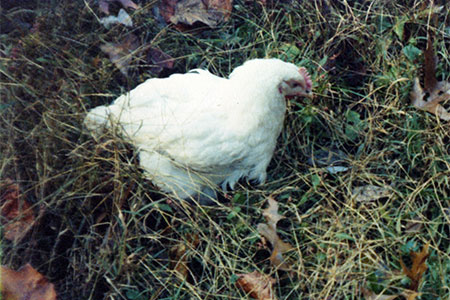
Viva. Photo: Anjali Banerjee
Thereafter I participated in many PETA activities and worked in the mid-1980s as a volunteer at the newly formed Farm Sanctuary, located at the time in Avondale, PA. I was, as I always have been, especially drawn to the birds, although these kinds of birds were new to me: chickens and turkeys, rescued from farming abuse and neglect. I also volunteered for several months at a farmed-animal sanctuary run for a few years by PETA in Washington, DC. Most crucially, in 1985 I met a chicken, a small white, lame hen abandoned in a shed owned by our landlady on the property my husband and I were renting. I brought this hen from the shed into the house, and we named her Viva, because she was the solitary survivor of the little flock our landlady had sent to slaughter.
Viva illuminated my future. Caring for her led me to found a nonprofit organization dedicated to promoting the compassionate and respectful treatment of domesticated birds. In 1990, United Poultry Concerns (UPC) was established.
What Are Some Of UPC’s Greatest Successes And Challenges?
Overall, UPC’s greatest success has been putting chickens on the modern animal advocacy map. In the late 1980s when I decided to start an organization for chickens and turkeys, I was told by a number of fellow advocates that a focus on chickens and turkeys would never succeed financially or otherwise since most people don’t relate to birds compared to mammals and especially not to birds they eat. A statement by one person was: “we can’t even get people to care about whales. How could we ever hope to get people to care about chickens?” Of course, the task of an advocate/activist is to discover and create ways to get people to care.
In the early 1990s I learned about the US egg industry practice of removing all food from egg-laying hens for as long as two full weeks to manipulate the economics of commercial egg production. From 1992 to 2004 we campaigned relentlessly to expose and eliminate this practice with a particular focus on United Egg Producers (UEP), the industry trade group, and the American Veterinary Medical Association (AVMA). The AVMA was worse than UEP in refusing to revise their policy of endorsing forced molting by food deprivation to one of opposing it. The AVMA relented only when I succeeded in getting a huge front-page article in The Washington Post followed by a full-page ad in The New York Times sponsored by UPC and three other national animal advocacy organizations. Once the AVMA saw how damaging their continued support for starving hens was from a public relation standpoint, they revised their forced-molting policy to one of opposition to total “feed withdrawal.”

Esbenshade Farms in Mount Joy, Pennsylvania. Credit: Zoe Weil
We’ve had successes on many fronts – too many individual campaigns to enumerate including getting the annual Bob Evans Farm Festival to eliminate their years-long Chicken-flying Meet which involved shoving chickens off a high platform with a toilet plunger. In addition, UPC introduced the concept and practice of Open Rescue to US activists– in which the rescuers remove suffering chickens and other farmed animals from their horrible conditions and openly declare themselves and their actions in order to bring public attention to the plight of these animals and the willingness of the rescuers to take legal responsibility for their rescue operation.
Our biggest successes are getting people who had never thought about chickens much or at all to enlighten their perspective once they heard me speak or read an essay or a book of mine that opened their mind and heart to chickens. Nothing makes me happier than to be told by someone how hearing me speak or reading my story of Viva and other chickens I have known caused them to stop eating chickens and eggs and on occasion even to adopt a companion chicken.
The biggest challenges are getting people to care about chickens (and other farmed animals) to the extent that they will stop consuming them and their “products.” People who might otherwise choose an animal-free diet are reluctant because eating and mealtime are the happiest part of their day and they don’t want this happiness to be turned into yet another source of stress, anxiety and conflict with family and friends. They fear rejection and ridicule. They worry they will not feel “full” on an animal-free diet, a worry that includes psychological fulfillment and satisfaction.
Then, grievously, there’s the fact that many people simply don’t care about chickens/farmed animals and their suffering, or care enough. Those who say they want farmed animals to be treated “humanely” seldom translate that passive sentiment into personal conduct upon being told why animals raised and killed for food cannot be treated humanely in any meaningful sense. People who say they want “better welfare” for the animals will often choose the cheapest products despite knowing that cheaper means poorer or no “welfare.”
Despite decades of animal activism, thousands of vegan recipes, investigative reports and videos, news of food poisoning from eating poultry and egg products and the environmental consequences of industrialized animal farms, most people still cling to their dietary habits and the psychological disconnection between animals and food. The mainstream media encourages people to NOT choose vegan.
All the more reason why farmed animal activists must persist. More and more people are choosing to be vegan or vegetarian compared to 30 years ago. We must view our challenge as “We’ve only just begun” and fight relentlessly for animal liberation and vegan ethics.
“He felt her beating heart and soft feathers and flesh as a revelation of her reality as a fellow creature, no longer “something to eat.”
The Idea Of “Chicken” As Food As Opposed To Chickens As Sentient Beings With Agency Is Deeply Ingrained In Our Culture. How Do We Change Hearts And Minds?
I believe we change hearts and minds by helping people to perceive chickens and relate to them as individuals who, when they are not mistreated, are full of observable vitality, desires and interests in their own right. I seek to educate people about chickens I have known by writing and talking about them and by sharing photographs and videos and by inviting people to visit our sanctuary and meet our chickens. My essay The Social Life of Chickens has inspired many readers to tell me how much it awakened them to the personalities and feelings and individuality of chickens. A man once told me that when he rescued a hen for the first time and held her in his arms, he felt her beating heart and soft feathers and flesh as a revelation of her reality as a fellow creature, no longer “something to eat.”

Weaver Brothers Egg Farm in Versailles, Ohio. Photo: Mercy For Animals
Chickens Originated In A Vibrant, Lush Environment In Southeast Asia And The Foothills Of The Himalayas. What Are Some Remarkable Attributes Of Chickens In Their Natural Environment?
Chickens in their natural tropical forest environment are flock and family members. They are busy all day doing what they like to do and what they must do in order to thrive, raise their families, protect their chicks and stay safe. Their day begins when they see the infrared light of the rising sun. The roosters start to crow and the flock flutters down from the tree branches to the forest floor to begin foraging for food by scratching the ground vigorously with their claws and pecking for seeds and other morsels with their beaks. They break up into smaller groups comprising a rooster and four or five hens. The roosters in these sub-flocks crow back and forth to one another to communicate where each group is currently located and other vital information.
Hens and roosters alike will fight to the death if need be to protect their chicks.
Just as the chickens spread out to forage and explore in the morning, they reconvene in the early afternoon to sunbathe and dustbathe, then spread out again in the late afternoon for a final foraging before gathering together at dusk for their silent night in the tree branches.
In Contrast, What Are The Most Egregious Harms That We Inflict On Chickens?
Everything done to chickens from the early 20th century up to and beyond this very minute is egregious to the point of being a crime against them and against Nature. They have been stripped of their Earthrights – the right of sentient beings to experience the Earth in which they evolved, and which brings joy and comfort and meaning to their lives. They are incarcerated in huge, filthy sheds thick with excretory ammonia and other toxic gases and dense with toxic microbes including bacteria, viruses, funguses and parasites. They can never escape touching each other’s bodies. The entire world to which they are condemned is alien to them. There is nothing like it in Nature. There is nothing in Nature that resembles the human invention of chronic, abject atrophy and Learned Helplessness and Hopelessness. There is a look in an imprisoned chicken’s eyes and in her or his whole face that does not appear in the natural world: a look of sunken hopelessness.
Since chickens who cannot escape the irritating and abnormal sensation of each other’s bodies around themselves, and since they are deprived of all activity apart from forming and laying eggs, eating powdered “feed” (which they cannot peck grains and seeds out of but can only ingest) and drinking a drop at a time from a plastic nipple drinkers hanging over them, egg-industry hen can be driven to pick and peck at one another because chickens are genetically designed to forage for food with their beaks. They must peck. They must dustbathe and if they do not have an earthy material in which to perform a dust bath, they can be driven to pulling on their cage mates’ feathers as a substitute for the soil that has been denied to them. Because they are driven to abnormally peck and pull at each other’s feathers trapped helplessly as they are, the egg industry painfully burns, lasers or chops part of their sensitive beaks off at the hatchery.
The newborn male chicks of the egg industry are ground up alive – 34,000 per hour in US hatcheries – because they don’t lay eggs and are therefore economically useless apart from petfood and farmed animal “feed.”

Modern chicken house in the United States, Perdue Farms, Delaware. Photo: David Harp
“As the birds hit the scald water you could hear their little voices peeping.”
Chickens bred, raised, and killed for meat are genetically deformed and live their entire short 6-weeks wracked with increasingly torturous joint pain. Bloated with manmade muscle and fat and full of medications to enlarge and speed their growth, especially their massive, hanging breasts, these baby birds are nothing but a site of pure, unrelieved suffering both physically and mentally. Because of how they’ve been bred and continue to be bred, they are congenitally deformed. Their internal organs are in disproportion causing all kinds of biological havoc. Their bones cannot support their body weight forcing them to sit in excrement that is only cleaned out every few years after many flocks have sat in it. As a result of the filthy, pathogenic environment– 20,000 to 50,000 baby birds in a single 600 ft. long metal shed – they suffer from chronic skin diseases, eye and respiratory infections, necrotic intestines, tumorous growths, the list goes on.
That this sick and tortured chicken is currently regarded by most people as a “healthy” food is beyond ludicrous.
All chickens – all “poultry” – in standard commercial slaughterhouses are dragged face down through splashing paralytic electric shock water prior to having their throats partially cut with large rotating blades. The pre-slaughter paralytic shock treatment, falsely called “stunning,” is designed to immobilize the otherwise struggling birds on the disassembly line and to facilitate the removal of their feathers after they are dead. Millions of chickens in US slaughterhouses are scalded to death in tanks after their throats are cut. Their bones break and their eyes burst out of the sockets as they scald. Once years ago I watched a video of the scalding process: As the birds hit the scald water you could hear their little voices peeping.
Overridingly, including all of the above crimes, chickens have suffered Dismemberment. Literally their dead bodies are dismembered into breasts, legs, wings, livers, etc. Rhetorically through commercial advertising they are dismembered into individualized “food” components: nugget, breast, “wings” (shoulder blades), “drumstick.” They are bred, raised and cut up to “become pieces” (“We are no longer selling broilers, we are selling pieces.”) They are dismembered into “Fryers,” “Broilers,” “Layers,” “Breeders,” “Pet Food,” ‘Livestock Feed,” “Human Food.” They are dismembered from their own family life, from other members of their own species of different sexes and ages, and from other animal species and the natural world.
This Is All Horrifying Information, And I Hope It Will Lead To More People Leaving Animals And Animal Products Off Their Plates. You Recently Wrote That You Would Like To See “Less Information And More Implementation.” What Did You Mean By This?
Twentieth century and twenty-first century poultry welfare science, cognitive ethology and sanctuary observations have produced a trove of published information about, and insight into, the life, desires, activities and interests of chickens, not to mention countless articles in industry publications about their suffering and diseases in commercial farming operations. Information about chickens from every standpoint is readily available on the Internet: books, articles, blogs, video footage, photographs, podcasts, lectures.
Although we don’t know everything there is to know about chickens (or anyone else), we have ample information, more than enough about their nature, interests, fears, pleasures and needs to implement living conditions to accommodate who chickens are. A book published in 1995 called The Development of Brain and Behaviour in the Chicken by avian specialist Lesley J. Rogers is an example. Reporting detailed information on chicken embryology, parenting, family life, social life, memory capacity, cognition, behavior, physical sensitivities, and feelings, she concludes: “With increased knowledge of the behaviour and cognitive abilities of the chicken has come the realization that the chicken is not an inferior species to be treated merely as a food source.”
The problem is that poultry industry people do not care about how a chicken feels or what a chicken knows or needs except as these factors must be taken into account to maximize efficiency and profit. In her book Minds of Their Own: Thinking and Awareness in Animals (1997), Rogers writes: “Animals in intensive farms are seen as bodies, to be fattened or to lay eggs. . . . Their higher cognitive abilities are ignored and definitely unwanted. . . . Despite their domestication, chickens have retained complex cognitive abilities. . . . [T]he view of domestic chickens as stupid has more to do with how we think of chickens than with the abilities of the chickens themselves.”

Modern chicken house in the United States, Delaware. Photo: David Hart
The related problem is that most people (“consumers”) don’t care either, or if they do care, it is passively. People will often acknowledge an awareness of the suffering of chickens and other animals on farms while at the same time continuing to purchase and consume chicken and egg products.
A recent article on “The Psychology of Cheap Meat” observes: “It is not only that we are often ignorant of the processes of meat production. We are willfully ignorant. Psychologists have found that, when quizzed, many people explicitly say they do not want to know about animal farming practices, because they recognize that such information might make it more emotionally difficult to purchase and consume meat.
“Even the most conscientious among us are prone to willful ignorance. While most Brits say they care about welfare, 67% concede they dislike thinking about it when purchasing meat, a study published in Appetite, a leading peer-reviewed journal, found. Meanwhile, of those who consider welfare to be ‘highly important,’ only about half actively think about it when buying animal foods in supermarkets or restaurants.”
The only sure way to protect human beings from the danger we might otherwise face from one another is to pass and implement laws including penalties for physical violence toward one another. The concept of Human Rights is an acknowledgement of our need for self-protective laws. Unfortunately and intentionally, farmed animals and laboratory animals (including millions of chickens and other farmed animals subjected to atrocious experiments to benefit animal agribusiness) are excluded from animal cruelty laws.
Basically, farmers and experimenters can do whatever they want to these animals – and they do indeed do whatever they want – so long as the abuse can be rationalized economically and/or as “of potential benefit to society.”
Apart from laws prohibiting “wanton” animal abuse, like a man setting a dog on fire for fun with no economic justification, the majority of all animals everywhere on Earth are unprotected from humans.
Many People Care Deeply About Animals But Are Not Full-Time Activists. They Work In Other Professions. What Can Every Person Do Right Now To Help Animals?
What we can all do to help many animals is to remove them from our plate and treat them as friends, not food. We can “Give a Cluck” and be vegan.
This way, when we say we care about animals, we are turning our care into affirmative action on their behalf. When we stop consuming animal products and choose animal-free food, we feel more confident about our own power to make a difference. When we hear a person making disparaging statements about vegetarianism or chickens for example, we can politely intervene and not let an opportunity to speak up go by. We can carry with us a sheaf of brochures to hand to a person if an opportunity presents itself. I create such opportunities by wearing a “Stick Up for Chickens” button which frequently invites the question, “What does that mean?” “Well,” I say, “it means be kind to chickens and don’t eat them.” It’s surprising how receptive people will be when you respond with a smile and show a readiness for a conversation if the person shows interest, and you can reach into your pocket or bag for a brochure and say, “Here’s some information about chickens and diet that might interest you including a website address for more information, plus delicious animal-free recipes.” There are many variations on such productive encounters.
 Foster mother Ruby with rescued Perdue Farms chicken Ivy. Photo: Jim Robertson
In addition, we can vote and work for political candidates at the federal, state and local level with a record of supporting animal protective legislation. We can join one or more animal advocacy organizations and participate in their campaigns and respond to their action alerts, which often request signing or writing a letter, signing and sharing an online petition, joining a peaceful protest demonstration, fostering or adopting an animal who needs a home – so many things.
Writing a letter to the editor of a newspaper in response to an animal-related article is a great way to reach many readers if the letter is published. Once we get involved and meet people who share our desire to help animals, we are part of a community of likeminded individuals who provide even more ideas about how to help animals. Here are some suggestions on how to fit animal advocacy into your day,
You Once Wrote, “Don’t Let Your Friends, Family And Coworkers ‘Get To You.’…Try To Influence Your Critics By Your Example.” Could You Elaborate On This?
I believe in affirmative action, including the Rhetoric of Affirmation, with respect to animal rights and vegan advocacy. A defensive posture should never be taken, nor should shouting down or lecturing people who challenge or seek to undermine our position. If we have decided to stand up for animals, animal rights, and vegan living, we must then be, and act, confident and happy about our choices and not let ourselves be baited into defensiveness, combativeness, or what I call “the Rhetoric of Apology.” This is the tendency to deprecate ourselves, the animals, and our goals before people who make fun of our decision and in various ways seek to make us feel foolish or weird. UPC has a very good booklet to hand to people who are testy or hostile toward our choice to leave animals and their “products” off our plates: Life Can Be Beautiful-Go Vegan. We can simply say, “This booklet will help you to understand my decision if you would like to know more about why I made it.”
One of the best ways, and perhaps even the best way, to educate people and get them to listen is to offer to tell them briefly why you became vegan and what led you to choose to reach beyond familiar pets, whom you have always loved, to include other animals, other species. By taking this approach, we are defusing tension by telling our story and at the same time telling the story of the animals we have learned about through one or more eye-opening experiences.
In my view, a committed animal advocate needs three important things: facts, confidence, and passion. When we know our subject and can articulate our issues clearly, simply, and with feeling, without lecturing or pomposity, when we can be both friendly and firm, our confidence grows along with our credibility, and we become stronger and more effective each time we speak.
You Mentioned In An Interview That “Producers Will Produce Anything That People Will Buy.” What Is Your Take On The Prospects For Meat Analogues And Cultivated Meat For Alleviating Animal Suffering?
My concern is that without an enormous growth of purchasing animal-free food product purchases, plant-based products will remain a niche market with little or no influence on worldwide animal agribusiness. So far, the mass media’s refrain with few exceptions is that plant-based options are inferior to animal-based options. This morning I posted a comment to an article on the Animals 24-7 website about factory-farming insects and related issues.

From rotting in cages to roosting in branches, former battery hens enjoy life at United Poultry Concerns Sanctuary. Photo: Susan Rayfield
Whatever is true for Nature outside of human beings, within our own species there is a clear moral difference between the harm we bring to other sentient beings inadvertently, like stepping on an insect while walking, and deliberately killing sentient beings to satisfy needless culinary appetites and other needless appetites. There’s a difference between legitimate self-defense and wanton killing. Since we can get all the protein and other nutrients we need to eat directly from plant sources, massacring insects for human food is wanton animal abuse. Animal agribusiness and its mass-media public relations extension is conditioning the public to believe that the only way to meet the rising human population’s “protein needs” (cliché) is by killing more millions and billions of animals and adding new animals to the carnage by factory farming insects, and now, the octopus.
Mass-media, from the NYT to all the little local papers around the US are telling readers that eggs are a “staple,” an absolute necessity for a protein-healthy diet, baking cakes, eating breakfast, etc. The only consumers reporters quote in the echo chambers are those who complain about the price of eggs or the scarcity of eggs and other chants. Not a word about the hell the hens are living in to produce zillions of eggs. Like the wretched carriage horses in New York City, if eggs and all animal flesh and mammary milk disappeared tomorrow from the grocery shelves, after a couple days whining about the loss, the disappearance of these “necessities” would be forgotten, as long as there were satisfying replacements, which there are already in the form of plant-based foods of all kinds, even here in semi-rural Virginia at Walmart and Food Lion.
As long as the mass-media keep telling readers and viewers that plant-based foods are inferior to the taste of animal pain and mouthfuls of animal misery, it will be hard to change people’s food habits. Of course, the problem is not only the media, but the media are a significant contributor to the mass-misery of animal life on the planet.
As for cultivated meat, milk and, perhaps, eggs, the same question applies as to whether cultivated slaughter-free products would ever become cheap, convenient and satisfying enough to animal-product consumers so that they would adopt the cultivated products in such droves that the number of animals born into the global food industry would actually decline. At this early stage, it appears that, like plant-based products, cultivated products would, for a long time at least, remain niche products, just another choice of smorgasbord or buffet offerings for the human omnivore.
I’m ambivalent about the ethics of cultivated products. I expressed my opinion on the Clean Meat Hoax website in 2019. “I do not categorically reject clean meat if it has the potential to prevent countless animals from being born for human consumption. Perhaps separating animals from meat could reduce the millions of sentient individuals who are living and dying in hell every day, while providing an opportunity for humans to relate caringly to other species once the conflict between compassion and cuisine no longer exists. However, if Bruce Friedrich’s portrayal of the rationale for clean meat is the prevailing ethos of the promoters of this technology, then there’s a problem. The separation of animals from ‘meat’ is being promotionally linked with the severance of animals from compassion, respect, fellowship, and ethical activism on their behalf. The human desire for meat is being portrayed as the right of an implacable human ‘nature,’ compared to which animals and ethics and vegan activism are inconsequential, even silly. The promoters of clean meat seem to suggest that until clean meat becomes commercially available, if it ever does, humans have the right, merely as humans, to continue making nonhuman animals suffer unspeakable torture for pleasure and convenience. The assertion that ethical veganism has failed, after a mere 40 or so years of advocacy, is absurd. Centuries of human injustices continue to this day, yet human rights advocates seldom abandon the victims morally and declare justice for humans a failed enterprise.”
In An Interview, You Mentioned That “Promoting Veganism For Strictly Health Reasons Eliminates The Animals From Consciousness, Which Is A Grave And Cruel Betrayal.” How Do We Bring The Discourse Back To A Focus On The Animals?
Through the years the worry that most people will never care about farmed animals, so therefore we should focus our message on environmental and health issues instead, has been aired. At the same time worry has been expressed that the focus on veganism diverts attention from the animals to an interest in food so that both animals and ethics are eliminated from public, and even advocacy, discourse and consciousness. However, if animal advocates decide that the plight of animals raised and slaughtered for food is not a “winnable” issue, this surrender becomes a self-fulfilling prophesy to which animal people are contributors. Once an animal “advocate” decides nobody will ever care about animals, that person ceases to be an advocate and is instead just one more cause for pessimism, despair, and continuing abuse.
If we call ourselves animal advocates, then we must, by definition, advocate for the animals at every opportunity. We cannot succumb to negativity and defeatism and mere hedonism. Whatever our private despair reflecting the harsh reality for animals in this world, in the moment of advocacy we stand ready to make practical use of our knowledge, passion and goals for animals. The last thing animals need from an animal advocate/activist is the negation of hope for them. This does not mean to abandon issues of health and the environment. It means intentionally instilling the visibility of our fellow creatures in the consciousness of others. If we believe that a chicken and a chicken’s experience of being alive, in the flesh and in the world, matters, we must cultivate our ability to convey this fact.
You Mentioned That Colman McCarthy’s Words, “Don’t Worry About Being Successful, Just Be Faithful” Inspire You To Keep Going. What Continues To Inspire You To Keep Faith Today, When Over 10 Billion Animals Are Slaughtered For Food In The US Every Year, Including Over Nine Billion Chickens?
Keeping faith with whom and what you care about most means quitting is not an option. I have no illusions about the difficulty of changing the fate of animals from what it is to what I want to accomplish for animals. Once we understand the situation, the question becomes; what is our response to it. It is hard to face the fact that the endeavors of animal rights activists have no end in sight. While certain atrocities against certain animals will be successfully challenged, the overall picture will not improve much in our lifetime. As things look, it will get worse for farmed animals and laboratory animals and wild animals as genetic engineering, gene editing, and animal factories expand across the planet, and the kinds of animals being “farmed” for human food and used in bizarre experiments increase, and wild habitat is eroded, all of this and more, even as more and more people stop eating animals and choose cruelty-free household products, cosmetics, and so on. We have to prepare ourselves to be faithful foot soldiers in what animal activist-author Norm Phelps called The Longest Struggle – the struggle for animal liberation including our own liberation from our oppressive role on Earth.

Karen with Nicholas and Nathaniel
Even if I believed the cause was hopeless, I would continue to fight for animals, to stand by and with them. As I have said often, our chicken sanctuary will always protect me from giving up and burning out. Seeing the eager, expectant little faces and bright eyes and primal enthusiasms of the hens and roosters we have adopted through the years from miserable conditions, or even from just less happy situations, I am unconditionally motivated to keep helping them and all chickens as best I can for as long as I can.
Seeing one chicken – Viva – I, in effect, saw them all.


 We believe in the free flow of information


 Top Stories