What do elephants, otters and whales have in common? They all increase the amount of carbon that can be stored in their ecosystems. Elephants disperse seeds and trample low vegetation, enabling taller trees to grow. Sea otters eat sea urchins, allowing kelp to flourish. Whales feed at depth and release nutrients as they breathe and rest at the surface, stimulating phytoplankton production.
It isn’t just these three. We are beginning to learn that many species have complex effects on their environments that change the amount of carbon stored by their surrounding ecosystems – ultimately affecting climate change. When the population of wildebeest in the Serengeti plummeted due to disease, they no longer grazed as much, and the uneaten grass caused…
What do elephants, otters and whales have in common? They all increase the amount of carbon that can be stored in their ecosystems. Elephants disperse seeds and trample low vegetation, enabling taller trees to grow. Sea otters eat sea urchins, allowing kelp to flourish. Whales feed at depth and release nutrients as they breathe and rest at the surface, stimulating phytoplankton production.
It isn’t just these three. We are beginning to learn that many species have complex effects on their environments that change the amount of carbon stored by their surrounding ecosystems – ultimately affecting climate change. When the population of wildebeest in the Serengeti plummeted due to disease, they no longer grazed as much, and the uneaten grass caused more frequent and more intense fires. Bringing back the numbers of wildebeest through disease management has meant fewer and smaller fires. And the Serengeti has gone from releasing carbon back to storing it.
These are examples contained in a stunning new paper just published in Nature. It makes the case that animals cause ecosystems to be more effective in storing carbon, through their eating, moving, trampling, digging, defecating and building. Looking across a range of different studies, it concludes that wild animals account for only 0.3% of the carbon in the total global biomass, but can cause anywhere between 15% and 250% difference in how much carbon is stored in a given ecosystem.
We already knew that so-called “nature-based solutions” need to be part of any effective strategy to tackle climate breakdown. Reducing emissions is not going to be enough – we need to use the immense power of nature to remove carbon from the atmosphere and lock it up. But this new research carries important lessons for how we pursue these nature-based solutions.
First, nature works. Specifically, the complex mechanisms that nature has developed are startlingly effective in ways we do not yet fully understand – and we destroy them at our peril. It may well be sensible to try to develop new technologies to capture carbon, but it is definitely not sensible to ignore the proven ways of doing so that nature already gives us. We would do well to be a little less enamoured of our own ingenuity, and a little more respectful of nature’s.
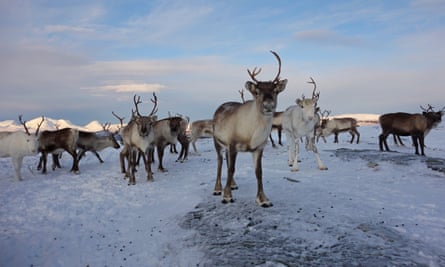
This means avoiding the urge to go for quick and simple fixes of plant monocultures to sequester carbon, devoid of animals. The current emphasis for nature-based solutions is on the plants – restoring mangroves, kelp and seagrasses, for example. They are important, but can only be part of the answer. The Nature paper uses the example of the Arctic, where huge amounts of carbon is stored in the permafrost. Ensuring there are herds of large animals will help keep the carbon there, by compacting the snow, keeping the soil frozen. Restoring populations of reindeer, wild horses, musk ox and American bison is not a nice-to-have tangential to the main effort against climate change, but a key part of that effort.
Reindeer in the Norwegian Arctic. Photograph: Scott Wallace/Getty Images
Second, conservation works. We know that nature can recover when given the chance, and that animal populations can bounce back quickly. We know how to do it – it needs habitats to be protected, interests to be aligned with local communities and the conditions recreated for animal populations to return at scale. We now have numerous examples of conservation’s success, from the return of red kites in England to the recovery of tigers across much of Nepal and India.
This work is the purpose of the organisation I lead, the Zoological Society of London (ZSL). When I took this job, a small part of me worried that working on wildlife was a bit of luxury, given the enormity of the threat from climate change. We know now that the opposite is true. Understanding the role that animals can play in helping nature capture carbon has profound implications for how we do conservation.
We are moving away from the arid old model of conservation through segregation – separating nature from people in order to allow it to flourish. That simply isn’t enough. Instead, our focus is on helping wildlife and people co-exist, by supporting efforts to reduce conflict between them and working with communities who are vital to the health of their wild animals. This has long been the approach that ZSL has taken to conservation, and we know it works.
It was this approach that saw local communities set up their own sanctuaries for pangolins on Palawan island in the Philippines, and it is this approach that is helping to identify conservation solutions for the protection of the critically endangered angel shark off the UK’s coastline. And it is just as true for cities as it is for the Serengeti – as our recent report explains, nature can help mitigate the impact of extreme weather in urban areas as well.
A world in which wildlife thrives is also a world that has the resilience it needs to withstand and mitigate the climate crisis. Our future is inextricably intertwined with the wellbeing of the world’s wild animals. If we want to save ourselves, we need to do better at protecting them.
Matthew Gould is the chief executive officer of the Zoological Society of London (ZSL)
A double whammy of natural climate cycles and human-caused climate change will likely make next year Earth’s warmest on record, climate experts tell Axios.
The big picture:Forecasters now expect that a moderate El Niño, the climate pattern characterized bywarmer-than-usual sea surface temperatures, will develop this summer, bringing sweeping shifts to weather patterns worldwide.
El Niño teams up with human-caused climate change and pushes global average surface temperatures higher.
Even a relatively weak event could lead to new records for the warmest year in 2023 and 2024.
What’s happening:Three straight years of La Niña, which features cooler-than-usual sea surface temperatures in the tropical Pacific, have given way to a rapid transition to an El Niño state.
The National Oceanic and Atmospheric Administration…
It’s been awhile since we have had a good“end of the world”theory sprout up out of the internet.
This latest prediction of the apocalypse apparently found its legs on, of course, TikTok.
According toBolavip.com, “a new conspiracy theory saying that an apocalypse of some sort will happen this Sunday, April 23rd has been gaining traction, especially among Spanish-language users, as the main source seems to be the account@lascapsulasdeltiempo.”
Let’s investigate.
According to this theory, an intense solar storm will take place on Sunday, April 23, 2023.
This won’t come as a surprise to anyone who tried to buy eggs this winter: the most recent outbreak of bird flu was the deadliest the U.S. has ever seen.
It involved more than 58 million birds on farms and more than 6,000 known cases in wild birds. That impacted egg prices, but the big concern is that bird fly could cross over to humans.
Fortunately, that only happened to one person in the U.S. last year. It was a man who was working with sick birds.
However, it has happened more than 860 times in other countries in the past 20 years. The disease killed more than half the people it infected.
Right now, officials are planning to concentrate efforts to fight bird flu on the animals themselves and people who work with them.
The latest breaking updates, delivered straight to your email inbox.Your Email AddressSUBMITPrivacy Notice
A Mexican gray wolf was killed by federal employees after an order for its death was issued, according to the U.S. Fish and Wildlife Service.
The kill order was issued due to the wolf’s alleged involvement in the killings of cattle. This wolf was a part of the Mangas pack that roams western New Mexico near the Arizona state line.
Advertisement
The wolf was killed on April 12 after a kill order was issued on March 29. The issue date came 25 years to the day that the Mexican gray wolf species returned to the wild.
Commercial fisherman Brick Wenzel sounds the alarm on the growing food insecurity crisis.
TheDepartment of Defense (DoD)recently warned that the Biden administration’s lofty offshore wind development goals could significantly impede naval military operations, Fox News Digital has confirmed.
The conflict, which pits President Biden’saggressive climate agendaagainst national security interests, was highlighted in an Oct. 6, 2022 report assembled by the U.S. Navy and Air Force, Bloomberg first reported on Monday. The documents were reportedly circulated with energy industry and state officials earlier this month and include maps highlighting sensitive military zones off the mid-Atlantic coast.
“The initial assessment performed by DoD found complicated compatibility…
There has been a slow but steady decline of hunting and fishing licenses purchased in Missouri.
The number of Missouri hunters and anglers has dropped by more than 4,000 over the past five years, according to the Missouri Department of Conservation, which appears to align with a national trend.
There are more than 654,500 active licenses in Missouri, roughly 5,000 fewer than 2022, according to MDC data. This year’s numbers will likely increase with spring hunting season before a July tally.
Greene County residents have purchased more than 23,000 permits so far this year.
Total licenses in Missouri exceeded well over 1 million in 2011, according to theU.S. Fish and Wildlife Service, a sizable difference from current numbers.
NORTON CO., Kan. (WIBW) – Game Wardens in Kansas have issued appearance notices to two suspects in a case that include accusations of hunting deer and turkey without a permit.
Kansas Game Wardens with theDepartment of Wildlife and Parkssay that on Saturday, April 15, they held a saturation patrol in Norton Co. Here, 18 hunters were checked and one trespassing issue was resolved as a miscommunication.
In an unrelated investigation, Game Wardens also said 11 notices to appear were sent to two suspects for:
Russian state TV guests discussed a plan for world domination after nuclear war with the West during a debate on current global tensions due to the Ukraine war.
State TV hostVladimir Solovyovhas repeatedly called for further escalation of the Ukraine war and aggression against the West as the conflict rages on.
In recent months, theRussian militaryhas struggled to make headway in its invasion of Ukraine and has tried to capture the Donbas city of Bakhmut ahead of an anticipated counterattack by Kyiv.
If Ukrainian forces break through they could reach Russian-occupied Crimea, which one Putin ally warned…