Last summer, the highly contagious strain of bird flu that had been spreading through North American birds made its way into marine mammals, causing a spike in seal strandings along the coast of Maine. In June and July, more than 150 dead or ailing seals washed ashore.
Now a study provides new insight into the outbreak. Of the 41 stranded seals tested for the virus, nearly half were infected with it, scientists reported Wednesday in the journal Emerging Infectious Diseases. It is likely that wild birds introduced the virus to seals at least twice, the researchers concluded. In several seals, the virus had mutations that are associated with adaptation to mammals.
The risk to humans remains low, and the seal outbreak waned quickly, the scientists said.
The avian influenza virus is currently having a large strain outbreak called H5N1, which researchers confirm can infect various species
With the possibility of another pandemic at hand, a global outbreak of avian influenza, mostly from wild birds, has raised concern amongst scientists, who label the H5N1 strain as ‘one of the more deadly strains’.
Concerning egg producers and backyard farmers, the spread of the virus is already affecting higher egg and poultry prices in the west and is raising alarms for fear of another human pandemic.
Causing sporadic outbreaks since the late 1990s, the outbreak of avian influenza H5N1 has led to the disease becoming endemic in some birds, currently spreading to wild and captive mammals and, in some cases, infecting humans also.
How does H5N1 evolve, and whom does it affect?
H5N1 evolves in two ways; one is through a linear series of mutations that makes the virus more efficient at spreading through a particular animal species.
The other is through recombination, which, according to researchers, is when two different strains of the virus affect host cells at the same time and swap genes, leading to greater evolutionary leaps.
The avian influenza virus can be transmitted by contaminated feed, food, and trucks.
The World Organisation for Animal Health noted that a rising number of cases had been reported in mammals in the west, “causing morbidity and mortality” in species such as otters and seals.
How is the H5N1 strain affecting the west?
The H5N1 strain originated in intensive poultry farms in Asia but has already spread around the world.
Now, in both the UK and US, governments have made plans to roll out a bird flu vaccine in poultry. In the UK alone, the disease has had an increasing impact on wild birds over the past two years, with 65 species affected.
In the UK specifically, the government are coming up with more plans for those who own 50 or more birds, such as chicken farmers, who will now have to register their flock with the government.
In France, there are plans to begin vaccinating farmed birds in September. Reports of infections in farmed mink in Spain have also raised concerns due to cases involving large numbers of animals kept close to one another exacerbated the risk of wider transmission.
Elsewhere, Ecuador has also unveiled plans for two million inoculations.
Avian influenza has been detected in the U.S. in crows, storks, robins, ravens, owls, egrets, and many other bird species across 2022 and 2023, according to records kept by the United States Department of Agriculture.
According to Gov.UK, these are the signs of avian influenza and bird flu:
Birds infected with the most serious strain of bird flu, called highly pathogenic avian influenza (HPAI), usually show some (or all) of the following signs.
Sudden death
Swollen head
Closed and runny eyes
Lethargy and depression
Lying down and unresponsiveness
Lack of coordination
Eating less than usual
Lethargy
Sudden increase or decrease in water consumption
Head and body shaking
Drooping of the wings
Dragging of legs
Twisting of the head and neck
Swelling and blue discolouration of comb and wattles
Haemorrhages and redness on shanks of the legs and under the skin of the neck
Breathing difficulties such as gaping (mouth breathing), nasal snicking (coughing sound), sneezing, gurgling or rattling
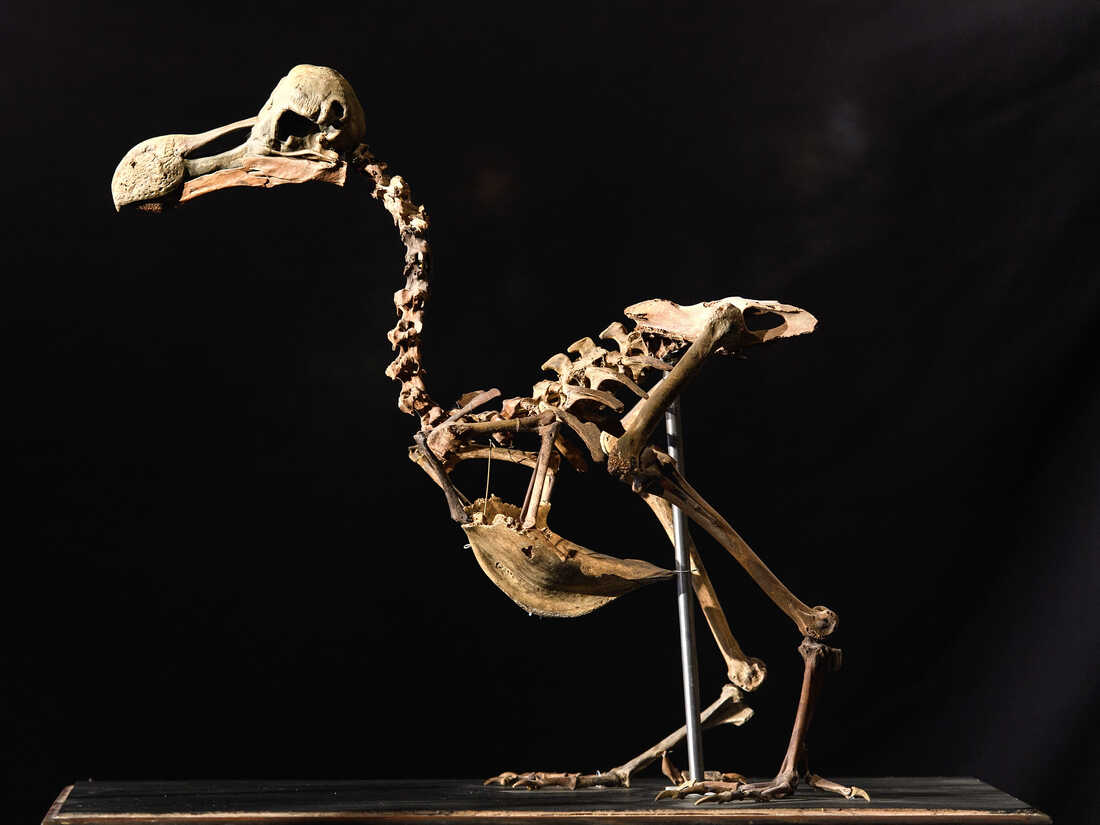
The Summers Place Dodo skeleton dates from around the 16th century.
Leon Neal/Getty Images
Beth Shapiro has been getting the same question ever since she started her research on ancient DNA, more than two decades ago.
“Whenever we would publish a paper, it didn’t matter what the paper was, what the animal was, how excited we were about the ecological implications of our results or anything like that. The only question that we consistently were asked was, how close are we to bringing a mammoth back to life?” she says.
Shapiro is a leading expert on paleogenomics and a Professor of Ecology and Evolutionary Biology at the University of California Santa Cruz. As we explored in yesterday’s episode, she has been in the thick of the field’s recent big advances.
But she still gets that question – she even published a book to try to answer it.
“Once a species is gone, once it’s extinct, it is not possible to bring back an identical copy of that species. But there are technologies that will allow us to resurrect extinct traits, to move bits and pieces of genes that might be adapted to a large animal like an elephant living in the Arctic.”
That is exactly what companies like Colossal Biosciences and Revive and Restore are trying to do, with Beth’s help. Her hope is that the technologies these de-extinction companies are developing will have applications for conservation.
As Beth sets her sights on one major conservation priority, protecting vulnerable species of birds, she’s also leading the effort to resurrect another iconic animal — one she has a special relationship with.
“I happen to have a dodo tattoo,” she says.
In today’s episode we bring you the second part of our conversation with Beth Shapiro: How her initial work mapping the dodo genome laid the groundwork to bring back a version of it from extinction, and how the knowledge scientists gain from de-extinction could help protect species under threat now.
Beth Shapiro’s most recent book, Life As We Made It, explores how humans have been reshaping nature since the very beginning.
A young Dutch political party seeking to push back on the government’s climate agenda achieved a stunning victory Wednesday as it won the most seats for a single party in theDutch Senate.
“This isn’t normal, but actually it is! It’s all normal citizens who voted,” party leader Caroline van der Plas said. “But today people have shown they can’t stay at home any longer. We won’t be ignored anymore.”
The Farmer-Citizen Movement Party, known as BoerBurgerBeweging (BBB) in Dutch, built its victory on the back of protests against the government’senvironmental policies, which aim to slash nitrogen emissions by dramatically cutting back on…
The H5N1 strain of bird fluhas left the U.S. reeling as it tries to manage the deadliest bird flu outbreak in history. The PBS NewsHour’s William Brangham joined Nicole Ellis to explain the significance of this avian flu, the severity of the outbreak, and how it will affect people across the country.
Watch the full conversation in the video player above.
What is the bird flu?
Birds carry flu in their stomachs all the time, Brangham said, and it typically doesn’t cause any problems for them or us. But, “Every now and then, one of those viruses” — like H5N1 — “becomes super contagious amongst birds and becomes deadlier to birds,” Brangham said. This specific strain has been circulating among birds for…
The country’s summer, which technically runs from December to February, was by far the hottest on record, according to Maximiliano Herrara, a climatologist who tracks extreme temperatures across the globe.
And, so far, March has offered no relief.
Temperatures during the first 10 days of March were 8 to 10 degrees Celsius (14 to 18 degrees Fahrenheit) above normal in east-central Argentina, according to the country’s National Meteorological Service.
These temperature anomalies, which have persisted over huge areas, are unprecedented, Herrara…
Hunter Chris Mardles has pleaded guilty to grievous bodily harm after trampling a sab with his horse. Mardles was the whipper-in of the Pytchley with Woodland Hunt when he injured the sab in September 2020.
Mel Broughton, a member of Northants Hunt Saboteurs, suffered from a collapsed lung, six broken ribs, a broken collar bone and a shattered shoulder blade. He had to be airlifted to hospital.
Mardles pleaded guilty to the section 18 GBH offence, meaning that he has admitted to intending to injure the victim. He will be sentenced on 25 April 2023. The maximum sentence for section 18 GBH is life imprisonment.
HB469 won’t just ‘manage’ cougars in Utah. It will exterminate them.
(Francisco Kjolseth | The Salt Lake Tribune) A 4-year-old female mountain lion slowly shakes off the effects of a sedative after researchers from Utah State University and the Utah Division of Wildlife Resources replaced her radio-collar afer being captured in the Oquirrh Mountains recently.
Utah has never exactly been a safe haven for cougars. In fact, hundreds of them are killed every year by trophy hunters here. But wording recently slipped into a seemingly innocuous state bill would turn Utah into a killing field for this carnivore species by allowing year-round trophy hunting and trapping of cougars by any resident or nonresident with a hunting license. Rushed through the Legislature, this bill now sits on Gov. Spencer Cox’s desk, awaiting his signature.
One would think that a bill with such dire implications would cause quite a commotion and it has — not merely from wildlife advocates but also from the hunting community.
The language expanding cougar hunting was added in an eleventh-hour amendment that was never heard before a committee and not subject to any input from the public. A seemingly innocuous bill was amended on the floor of the Senate and passed both chambers within two hours.
The recreational trapping of cougars has long been prohibited — and for good reason. Cougar trapping is inherently cruel and will undoubtedly result in the non-target captures of both wildlife and pets, including working dogs on our public lands. In fact, it’s so awful that only two other states (Texas and Nevada) permit trapping cougars. A year-round season will also harm dependent kittens, leaving them vulnerable to death from starvation, predation and exposure.
If Cox signs this legislation, HB469, cougars will be caught using strangling wire neck snares and painful steel-jawed leghold traps. Animals caught in leghold traps suffer from torn flesh, cut tendons and broken bones, among other injuries. Snares are typically designed to kill through strangulation, but the animal can suffer for days if the snare is incorrectly deployed or irregularly checked.
Hunters in Utah already kill more cougars every year than any other state. The levels of cougar hunting here have been documented by Utah’s cougar biologists as intemperate and unsustainable. In fact, were it not for new cougars coming into the state and a few refuges where hunting is not allowed, it’s likely there would be no Utah cougars at all.
In 2019, Utah’s Division of Wildlife Resources estimated the adult cougar population to be around 2,000 individuals. Yet 667 cougars were killed by trophy hunters in 2021 — a whopping 33% of the population. If trapping is added to the mix, it’s terrifying to think what impact that will have on Utah’s cougar population. HB469 won’t just “manage” cougars in Utah. It will exterminate them.
Cougars serve important ecological roles such as providing more carrion for other species than any other large carnivore, and they indirectly benefit beetles, foxes, birds and bears, thus enhancing biological diversity. A bill liberalizing the killing of this valuable species will have direct impacts on Utah’s ecosystem.
Apart from the harm this will cause to the cougar population and Utah’s ecosystems, increased killing will likely result in unintended consequences to Utah’s livestock producers, too (at least, until cougars are completely extirpated from the state). According to the U.S. Department of Agriculture, only about 1% of cattle losses in Utah are from cougars. But random killing destabilizes cougars’ social structure, leading to more young and inexperienced cougars going into an area and potentially resorting to livestock as an easy meal.
Simply put, kill one resident male cougar, three inexperienced teenagers will show up to his funeral. HB469 blasts the door wide open to future conflict.
Report an ad
According to the Division of Wildlife Resources, “We want to pass along our wildlife heritage to future generations, and we want it to be in better shape than when it was passed to us.”
If that’s true, the division should line up with the rest of us against HB469, which not only undermines that sentiment but also the sound ethical and scientific principles that should undergird our state’s wildlife management.
PINK FLOYD starRoger Watersis so disgusted by Britain’s recent ban on hunting, he refuses to live here anymore and has taken up residence in America.
The veteran rocker now lives in New York’s the Hamptons – famously known as a millionaires’ playground – where he feels more at home than in the English countryside where traditional country pursuit fox hunting, is now outlawed.
He rages, “To slap down a perfectly gentle, fair-minded and honest yeoman-like minority in that way was just disgusting. It is also bloody stupid.”