A group of friends play basketball amid a heat wave, after the national meteorological service confirmed that it recorded the hottest summer in its history, in Buenos Aires, Argentina, March 2, 2023. REUTERS/Agustin Marcarian
BUENOS AIRES, March 3 (Reuters) – Argentina is being hit by a blistering late-summer heat wave, with many places setting record temperatures for March, while residents, tourists and crops swelter in the sun.
Some towns and cities have posted temperatures as high as 40 degrees Celsius (104°F), with Nueve de Julio and Ezeiza breaking records for the month. Buenos Aires itself hit 38 degrees Celsius, breaking a record previously set in 1952.
Advertisement · Scroll to continue
Report an ad
“You can’t walk around, it’s too humid here. It’s tough,” said resident Gabriel Suarez.
Register for free to Reuters and know the full story
For 44 years, satellites have helped scientists track how much ice is floating on the ocean around Antarctica’s 18,000km coastline.
The continent’s fringing waters witness a massive shift each year, with sea ice peaking at about 18m sq km each September before dropping to just above 2m sq km by February.
But across those four decades of satellite observations, there has never been less ice around the continent than there was last week.
“By the end of January we could tell it was only a matter of time. It wasn’t even a…
The Permian-Triassic mass extinction, also known as the Great Dying, was the largest mass extinction in Earth’s history. It occurred about 252 million years ago and wiped out about 90% of marine species and 70% of terrestrial species.
The Latest Permian Mass Extinction (LPME) was the largest extinction event in Earth’s history to date, resulting in the loss of between 80-90% of life on the planet. Despite extensive research, the exact cause of the dramatic changes in climate during this time remains unknown.
A team of international scientists, including Tracy Frank, the Professor and Department Head of theUConn Department of Earth Sciences, and Professor Christopher Fielding, are collaborating to uncover the cause and events of the Latest Permian…
Scientists have carefully simulated conditions on Earth in the earliest part of its history, some 4.6 billion years ago, hoping to unlock a greater understanding of how amino acids brought the first ingredients for life into being.
Together, amino acids form proteins that play many vital roles in organisms. This new study was designed to help establish why a specific group of 20 ‘canonical’ amino acids is used again and again to build proteins when there are so many more of these amino acids to pick from.
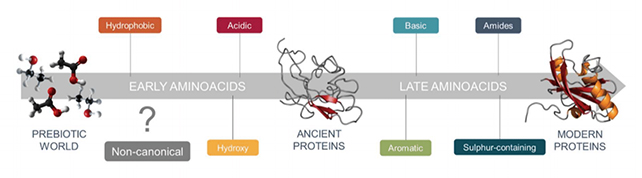
It’s thought that these 20 amino acids are made up of 10 ‘early’ ones picked from the atmosphere and meteorite fragments of early Earth, and 10 ‘later’ ones added on top – but what the selection process for the latter 10 involved isn’t clear.
Canonical amino acids are thought to have been added in two groups. (Makarov et al., Journal of the American Chemical Society, 2023)
“You see the same amino acids in every organism, from humans to bacteria to archaea, and that’s because all things on Earth are connected through this tree of life that has an origin, an organism that was the ancestor to all living things,” says chemist Stephen Fried, from Johns Hopkins University in Maryland. “We’re describing the events that shaped why that ancestor got the amino acids that it did.”
Through a reconstruction of primordial protein synthesis, the researchers showed that ancient organic compounds would have favored the amino acids best at folding proteins, tailoring them for specific functions.
In other words, a process of evolution or natural selection was underway even at this stage: it wasn’t the amino acids that were most readily available that were picked, but the amino acids most suited to a particular job.
If other amino acids had been selected as part of the core group billions of years ago, the scientists determined that the very building blocks of life would not have been as efficient at doing that life-building.
“Protein folding was basically allowing us to do evolution before there was even life on our planet,” says Fried. “You could have evolution before you had biology, you could have natural selection for the chemicals that are useful for life even before there was DNA.”
The team behind the study suggests that the 10 ‘later’ amino acids, in particular, were selected for their protein-folding capabilities, enabling the replication of DNA and the production of proteins that sparked life into being.
This research can teach us more about the potential for microorganisms on other planets and our own: The same amino acids that came to Earth via meteorites can also be found in many other places in the Universe.
“The Universe seems to love amino acids,” says Fried. “Maybe if we found life on a different planet, it wouldn’t be that different.”
Top human rights organizations are calling on theUnited Nationsto intervene over the destruction of abortion rights in the US.
In alettershared in advance with the Guardian and sent on Thursday by nearly 200 organizations and experts, the authors detail how, since the overturning of the federal constitutional right to abortion in June 2022, some 22 million women and girls of reproductive age live in states where abortion access is now either banned or inaccessible.
Among the signatories are the Global Justice Center, Pregnancy Justice, Amnesty International and Human Rights Watch. They are joined by a broader coalition of groups and individual advocates for human rights and racial and economic justice.
Abortion restrictions, the signatories write, deny…
A hunter said he killed and skinned what he thought were two coyotes, but later discovered they were family pets.(File Image | Kaspars Grinvalds via Canva)
Published:Mar. 2, 2023 at 11:48 AM PST|Updated:Mar. 2, 2023 at 12:25 PM PST
DANBURY, Conn. (AP) – A hunter who told authorities he killed and skinned what he thought were two coyotes, but later discovered they were a Connecticut family’s pet German shepherds, has been criminally charged.
During a hearing in Danbury Superior Court on Wednesday that drew dozens of people including the dogs’ owners and animal rights advocates, Michael Konschak, 61, of Carmel, New York, said he was ashamed of what he did.
“Please know that it was never my intent that morning to harm the victims’ pets,” he said.
Police with the Connecticut Department of Energy and Environmental Protection arrested Konschak in February on charges…
UpdatedFeb. 28, 20237:48PM ET/PublishedFeb. 28, 20237:47PM ET
A self-styled Montana huntress is well and truly poached after being sentenced for killing, skinning, and posing with a Siberian Husky, according to a Tuesday report from TMZ.Amber Rose Barnespled no contest to a misdemeanor citation of animal cruelty months after her Facebook post last September about having “smoked a wolf pup” ignited a criminal investigation and an avalanche of online hate. The judge, according to TMZ, slapped her on the wrist with a six-month deferred sentence, mandating that she take an online hunter safety class. Barnes will also be barred from using her hunting rifles for the next half-year. The latter aspect of her punishment barely applies, the outlet correctly pointed out, as the Montana hunting season doesn’t open until September.
A mountain lion isn’t happy to be treed in a photo by Wyoming large carnivore biologist Luke Ellsbury. A new law will allow resident hunters to train their dogs longer during the big cat season.
Legislation allowing mountain lion hunters to continue to train their dogs afield after harvest limits are met was signed Monday by Gov. Mark Gordon.
The bill, Senate File 178, authorizes the Wyoming Game and Fish Department to offer permits to mountain lion hunters to pursue lions until the department’s published last day of the season — as long as the lion is not killed.
Previously, once harvest limits were met, all pursuits of the species were immediately halted. The new law, which takes effect July 1, will allow hunters to continue chasing lions for the duration of published season dates, regardless of harvest limits being…
An Italian tourist who shot and killed his lifelong friend during a pigeon-hunting trip to Scotland has been cleared of culpable homicide.
Franco Moroni bowed to the jury and said ‘grazie’ after they took just 30 minutes to find him unanimously not guilty at the end of a week-long trial.
Moroni – who admitted killing Marco Cavola by blasting a shotgun at his head at point-blank range – wept and embraced a supporter after the jury ruled it was a catastrophic accident.




 (Kampee Patisena/Moment/Getty Images)