For over 90 years, pigs have been transported to the Farmer John slaughterhouse only 10 minutes from downtown Los Angeles.
On February 2nd, 2023 the largest slaughterhouse in the Southwest is finally closing.
For the last 6 years, LA Animal Save and Animal Alliance Network have been bringing compassion and kindness to pigs outside of the slaughterhouse in their final moments.
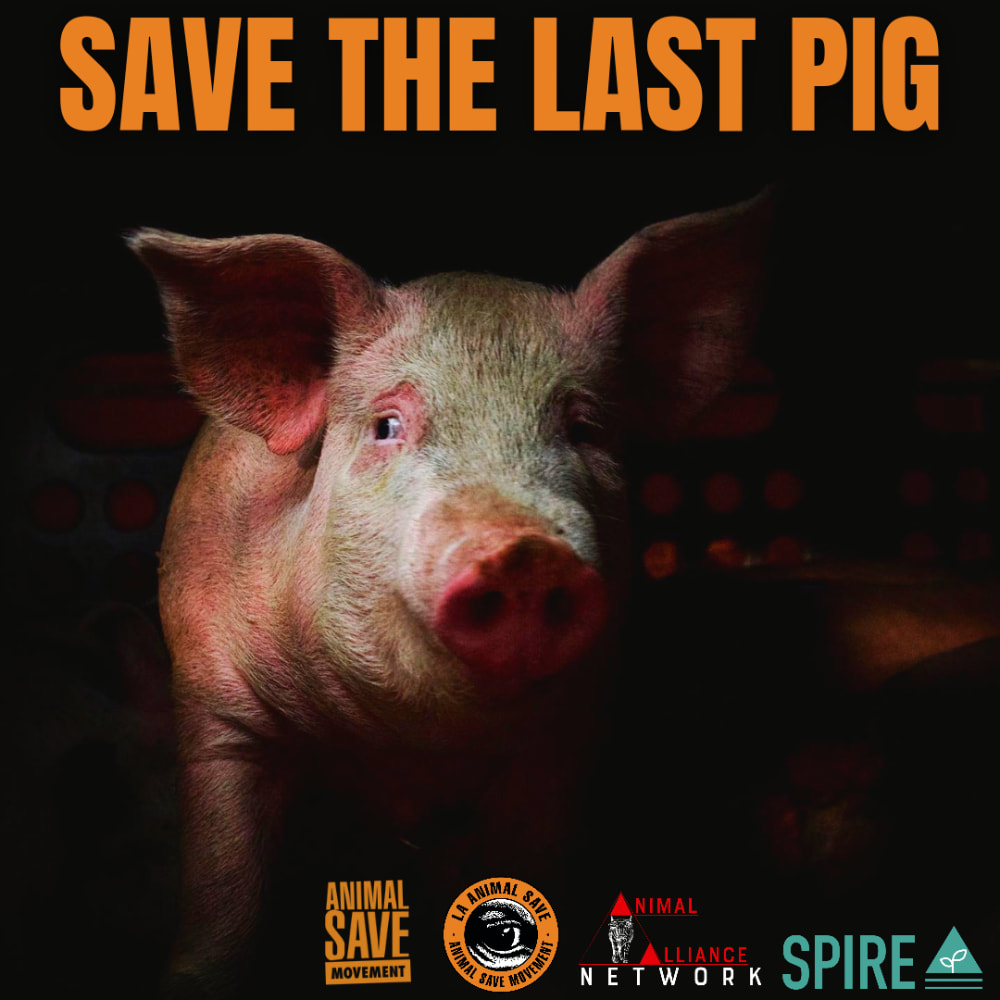
Now both groups, as well as the entire Animal Save Movement, are coming together to make one final and humble request to Smithfield: SAVE THE LAST PIG.
We have made arrangements for a local sanctuary that is happy and able to provide a forever home to a pig (or two!). Immediate transportation from the Farmer John slaughterhouse to the sanctuary is also in place.
All we need is for Smithfield to say YES!
Please sign this petition and share widely asking Smithfield to do the right thing and show kindness to at least one pig. Millions upon millions of pigs have died at Farmer John over the last 90 years. End these decades of needless slaughter with one final act of mercy: SAVE THE LAST PIG!
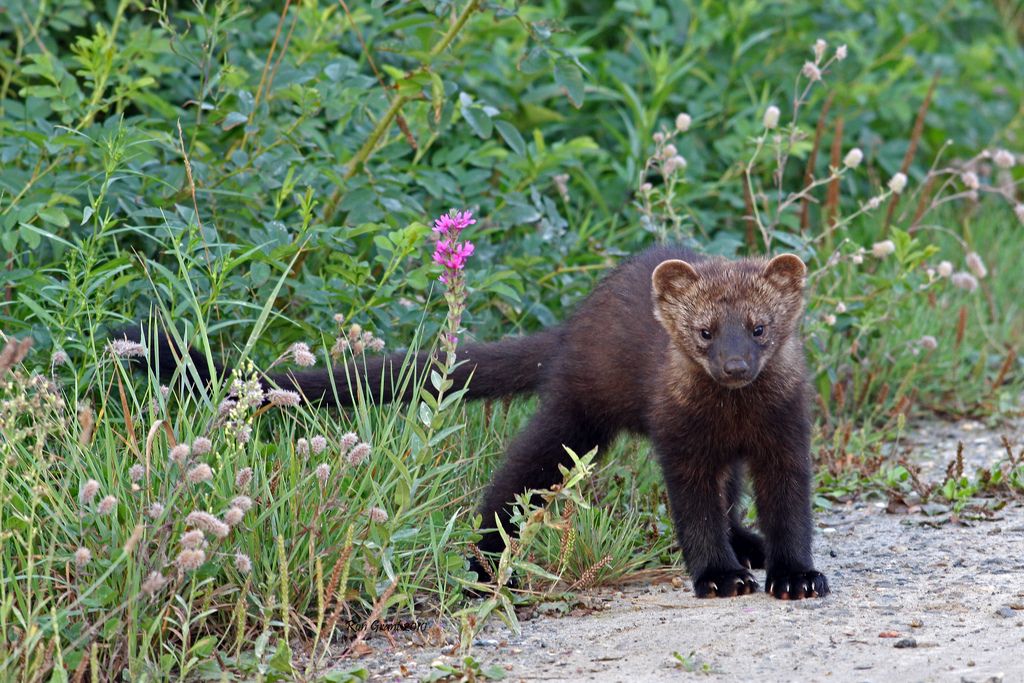
Fishers are one of the most trapped species in Vermont
Vermont Wolf Patrol’s 01/27/23 investigation of traps along the D&H Trail outside of West Pawlet, Vermont.
In June 2022, Act 159 An act relating to best management practices in trapping was signed into law in Vermont. Act 159 directed the Vermont Fish & Wildlife Department (VFWD) to “modernize” trapping in the state and improve animal welfare for the thousands of beavers, fishers, otters and other animals legally trapped each year in Vermont. In January 2023, VFWD presented its Report to the Legislature including recommendations to establish “best management practices” (BMPs) including replacing trappers traps with approved BMP traps.
The effort to establish BMPs for trapping has been the work of the fur industry for decades in an effort to minimize the suffering endured by hundreds of thousands of animals that are trapped for their fur each year. Faced with global…
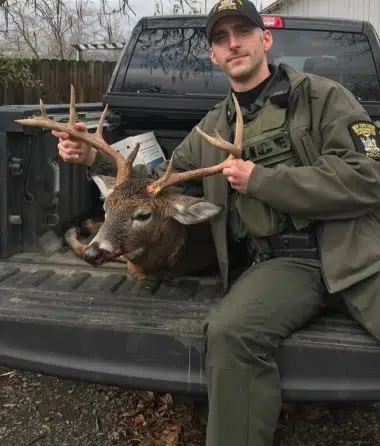
ECO Gross with unlawfully harvested deer in Yates County (photo State DEC)
A hunter recently paid a penalty for illegally taking a deer in Yates County last fall.
On November 12th, a state DEC officer was patrolling in the town of Italy when he observed a young man operating an ATV without a helmet. The Officer stopped the rider and escorted him back to his camp to speak with his parents about the unregistered ATV and the rider not wearing a helmet. Upon entering the camp driveway, the officer observed a small shed with multiple bags of corn and sweet feed inside, as well as a dead 10-point buck in the back of a pickup truck. The hunter, who had harvested the deer…
Researchers believe the bird flu was transmitted across minks in the farm—a troubling mammal-to-mammal spread.
Theoutbreakat the mink farm opens a new worry for health researchers.
Last fall, on a mink farm in Spain, H5N1 (avian influenza) likely spread across the animals. The outbreak resulted in the death or culling of the entire group of 50,000 minks.
Why should you care? Because it may have marked the first known case of mammal-to-mammal transmission of the deadly virus known as the bird flu, according to a new study. And that doesn’t portend anything good for humans.
The bird flu has proven scary enough with its occasional spreads from birds…
The EPA is updating its most powerful climate policy tool: a single number called the social cost of carbon. The new number is more accurate, but is also raising ethical concerns.
SCOTT SIMON, HOST:
The Environmental Protection Agency is updating its most important tool for trying to crack down on greenhouse gas emissions. That tool is a single number called the social cost of carbon. NPR’s Rebecca Hersher reports the new number is simultaneously more accurate and an ethics nightmare.
REBECCA HERSHER, BYLINE: Imagine trying to add up all the human costs of emitting carbon dioxide into the atmosphere – the cost of lost crops and flooded homes and lost wages when people can’t safely work outside, plus the cost of climate-related deaths. That is…
We are losing wetlands three times faster than forests, according to the Ramsar Convention on Wetlands. When it comes to restoring them to their natural state there is one hero with remarkable powers – the beaver.
Wetlands store water, act as a carbon sink, and are a source of food. The Ramsar Convention on Wetlands says they do more for humanity than all other terrestrial ecosystems – and yet they are disappearing at an alarming rate.
The main problems are agricultural and urban expansion, as well as droughts and higher temperatures brought about by climate change.
But if you have a river and a beaver it may be possible to halt this process.
These furry sharp-toothed rodents build dams on waterways to create a pond, inside which they build a “lodge” where they can protect themselves from predators.
Their technique is to chew tree trunks until they fall, and to use the trunk and branches as building materials, along with stones at the base, and mud and plants to seal the dam’s upstream wall.
The dam causes flooding, slows down the flow of water and keeps it on the landscape longer.
“This transforms simple streams into thriving wetland ecosystems,” says Emily Fairfax, an ecohydrologist at California State University.
“The amount of food and water available in their wetlands makes them ideal habitat for many different species. That’s part of why beavers are what’s known as a keystone species.”
IMAGE SOURCE,GETTY IMAGESImage caption,
Beavers chew the base of selected trees until they fall
Over the past 50 years, Canada and several states across the US have reintroduced beavers. Initially this was done to restore beaver numbers, after they were hunted nearly to extinction for their fur and meat in the 19th Century.
But the restoration of wetland ecosystems has also brought huge biodiversity benefits, including the return of many species of frogs, fish and invertebrates.
A study by Finnish researchers in 2018 found that ponds engineered by beavers contained nearly twice as many mammal species than other ponds. Weasels, otters and even moose were all more prevalent.
“Beaver wetlands are pretty unique,” says Nigel Willby, professor of freshwater science at University of Stirling.
“Anyone can make a pond, but beavers make amazingly good ponds for biodiversity, partly because they are shallow, littered with dead wood and generally messed about with by beavers feeding on plants, digging canals, repairing dams, building lodges etc.
“Basically, beavers excel at creating complex wetland habitats that we’d never match.”
Eager beavers
Dams built by beavers can be up to 5m high, and the largest one so far recorded – in Alberta, Canada – is 850m long
While beavers chop down trees, the tree stumps often sprout new shoots instead of dying – effectively the beavers carry out coppicing
The North American beaver and the Eurasian beaver were confirmed to be separate species in the 1970s
A healthy wetland ecosystem also sequesters large amounts of carbon, and by acting as a sponge and soaking up floodwaters it can soften the impacts of climate change, scientists say.
Wetlands store water during wet seasons and release it slowly during drought episodes.
“When you enter a period of drought, all the plants living in a floodplain rely on stored water in the soil to keep green and stay healthy. If they don’t have much water to access they will start to wilt and wither and dry out,” says Dr Fairfax.
IMAGE SOURCE,GETTY IMAGESImage caption,
A beaver dam in Wyoming, USA
She and her team studied 10 different wildfires in five US states between 2000 and 2021 and found in each one beavers and their ecosystem engineering reliably created and preserved wetland habitat, even during megafire events.
“Beaver wetlands have a lot of stored water, so plants in them don’t really feel droughts, they stay green and lush. And when wildfire came through, they were not burnt and we found that they stayed well-watered.”
But experts say beavers are only part of the solution to restore wetlands. Other necessary measures include planting woodland along the banks of lakes and rivers, and restoration of peatland and saltmarsh, says Prof Willby.
And crucially, beavers are only found naturally in North America and Eurasia.
Introducing them to inappropriate places can be counter-productive. This was demonstrated in Argentina and Chile, where beavers introduced from North America in the 1940s multiplied exponentially in the absence of predators, resulting in severe forest loss.
The Global Wetlands Outlook published in 2021 by the Ramsar Convention on Wetlands found the most widespread wetland deterioration in Africa and Latin America and the Caribbean.
IMAGE SOURCE,GETTY IMAGESImage caption,
Lake Chad is a shadow of its former self
The drastic shrinking of Lake Chad, closer to the border of Chad, Cameroon and Nigeria in West Africa is one of the most striking examples.
It has shrunk by 90% since the 1960s mainly due to a steep rise in water demand from a rapidly growing population, unplanned irrigation and now climate-change-induced drought.
“Conflicts, mainly between farmers and cattle-rearers, over the limited remaining water of the lake was already there and now drought is further drying it up and fighting over the water has gone worse” says Adenike Oladosu, a wetland conservation activist in Nigeria.
IMAGE SOURCE,GETTY IMAGESImage caption,
The Rio Negro is the largest wetland protected under the 1971 Ramsar Convention on Wetlands
Barron Joseph Orr, lead scientist with the United Nations Convention to Combat Desertification, says wetlands are often resilient ecosystems, but prolonged droughts now pose a growing threat.
“Climate change projections show increased drought severity in drylands that could compromise wetland resilience and reduce important habitat services,” he says.
In other areas too, drought can damage wetlands, but the beaver can help protect them. There have already been more than 100 successful reintroduction projects in North America and northern Europe.
In Europe the population is believed to have tripled in the last 20 years, according to Prof Willby, with beavers now re-established in most European countries. Sweden, Germany and Austria led the way, according to the Natural History Museum, but the UK followed in the early 2000s.
“The early motivation for bringing beavers back to the UK was mostly about playing a part in restoring a declining species to its native range,” Prof Willby says.
“But the value it could have as a keystone species for other biodiversity and in natural flood management was gaining a lot more traction, and these are the arguments usually put forward now to support the local releases of translocated animals or fenced trials happening in many places.”
EATON RAPIDS, Mich. (WILX) – Eagles are being exposed to lead and it’s killing them. Wildlife experts said it’s incredibly common.
Wildside Rehabilitation in Eaton Rapids said Thursday it was treating three eagles for lead poisoning. Even just a small amount of lead can be deadly for these big, majestic, birds.
“It’s still very sad when you have to euthanize because you know that it was us (people), that caused it to happen in the first place.” said Jonah Wojnar, withWildside Rehabilitation and Education Center.
While eagles are federally protected, wildlife experts said the threat of lead comes from hunting and fishing. If eagles could talk, they might ask you to stop using lead bullets and lead fishing weights.
These photos show Nova, a 3-year-old golden retriever, and the illegally placed body hold trap, commonly referred to as a Conibear trap, that caught her while walking near Outer Point Trail last week. (Courtesy / Jessica Davis)
What was intended to be a relaxing beach walk near Outer Point Trail on a sunny day late last week turned into “one of the worst experiences” for a Juneau dog owner whose pet narrowly survived a near-death experience.
Last Friday, decade-long Juneau resident Jessica Davis and her boyfriend were walking along the beach north of the Juneau Substation when her 3-year-old, 80-pound golden retriever, Nova, who was walking along the brush near the high tide line let out a squeal and growl and began thrashing around.
Upon quickly running to the source of the noise, Davis found Nova lying limp on the ground with her head in a body hold trap, commonly referred to as a Conibear trap. The trap closes with about 90 pounds of pressure and according to Juneau-area biologist Roy Churchwell, the trap was originally developed to be a more humane trapping system meant to kill animals quickly.
“But in a pet situation, a pet in that trap doesn’t live that long and you have to be quick,” he said.
Davis said she panicked, and had no idea how to get the trap off. However, she said thankfully her boyfriend knew what to do and the pair worked together to release the trap, but even then, it was difficult to remove, and they were afraid it was too late.
“In the state of panic, I would have lost her if it was just me — I didn’t know how to get it off,” she said.“I thought she was gone — we both did.”
After a few minutes, the pair successfully released the trap and after attempting CPR, Nova regained consciousness. Upon resting and a visit to the vet, it appeared she only suffered bruising but no major injuries.
According to wildlife officials, incidents like this in the Juneau area are extremely uncommon for many reasons.
“It’s such a rare thing,” said Alaska State Trooper Alisha Seward who was one of the responders to the incident reported by Davis.
Seward said the last time she heard of a trapping incident similar to this in Juneau was back in 2016, but even then it wasn’t a pet that got caught — it was a bird. She said in her experience, the trapping community in Juneau has always been responsible and good at placing traps in legal and appropriate locations which she said makes this incident even more of an outlier.
Seward confirmed the trap was fresh and placed illegally near the area that typically has moderate pedestrian and pet traffic. She said the trap wasn’t staked down, which is something an experienced trapper would typically do, and the trap did not have a marker identifying who owns it.
Prior to 2016, Southeast Alaska trappers were required to have signs marking their trap lines or tags on each trap or snare with their name and address or an identification number. However, the Alaska Board of Game voted to remove that requirement with advocates citing financial burdens and misuse as reasons behind the removal.
In 2019 the board faced a proposal that sought to reinstate the requirement which advocates said was intended to help with the enforcement of trapping regulations and to address problems of pets getting caught in traps. However, the board voted it down and currently there are no requirements to have signs marking traps of owner identification in the region.
“They don’t have to be marked,” she said. “It makes this harder to identify whose trap it is.”
Seward said after speaking with Davis, she along with a Department of Fish and Game hunting biologist walked the area to scan for other potential traps and examined the exact location of the trap, which was found via a geolocation of a photo Davis took of the trap after the incident.
Seward said they are still trying to identify who set the trap, however, currently, she believes the area is now clear of traps and intends to go out again after the recent snow melts for a second scan.
“Right now, I don’t think that there are more out there,” she said.
Seward, Churchwell and Davis said though the rare incident didn’t result in a fatality, they all emphasized that knowing the trapping regulations in the area along with understanding the mechanism to release traps can be life-saving skills to know, like how it was for Nova.
“It’s an infrequent occurrence that something does happen, but just be aware of if it does happen and your animal does get trapped so that you know how to undo the traps,” Seward said. “You know, just learning how traps function and being familiar just in case a freak accident does happen.”
Churchwell said a lot of information on how to identify and release the different varieties of traps legal in Southeast Alaska and around the state can be found on the ADFG website among other online resources like the CBJ website.
Grateful Dogs of Juneau has an entire page dedicated to the trapping locations, seasons and regulations in Juneau along with how to remove traps from pets.
Currently, trapping season for area 1C — which Juneau is in — is open for wolves and coyotes through April 30, wolverine through Feb. 28, beaver through May. 15 and river otter, red fox, lynx, marten, mink, weasel and muskrat through Feb. 15. The 2022-2023 Alaska trapping regulations guidebook can be found at https://www.adfg.alaska.gov/static/regulations/wildliferegulations/pdfs/trapping.pdf
“Reports of illegal trapping are very rare, it happens once every few years or so but there’s always that possibility,” Churchwell said.
Churchwell said the public also has the opportunity each fall to attend a Department of Fish and Game presentation called Sharing the Trails which explains common trapping practices in Juneau, the areas that are trap-free and the different trap removal procedure videos.
“The safest thing to do is to know and go to areas where there are not supposed to be traps,” he said.
Davis said Nova is doing okay and said she hopes her story can encourage other pet owners in Juneau to learn what to do if they find themselves in a similar situation.
“Always be aware, know the dangers and research,” Davis said. “Just try to be as prepared and knowledgeable as you can and know how to handle the situation if it ever arises — we definitely got lucky.”
Booking Carolina Buia’s ski trip this winter is proving more of a challenge than any Black Diamond. “I feel like I’m working as my owntravelcompany, “ says the Palm Beach-based real estate agent. “For March, I’ve booked two places to stay, and I’m paying extra to have the ability to cancel, while I watch the weather.” Buia is planning an annual ski trip to Europe with her financier husband Heath and their four teenagers. The family usually goes toItaly, but the unsettling, unsettled weather this winter made the family reconsider. “We thought aboutskiingin Norway, but it’s just so cold and dark at this time of year,” she explains. Instead, Buia booked two vacations in radically different parts of the country to hedge her bets for…






 Dan Yates

