Nibbling at the Edges of Why Polar Bears are in Sharp Decline

Updated: 3 days ago

https://www.c-ews.org/barrymackayblognibling-at-the-edges-of-why-polar-bears-are-in-sharp-decline
The masses have never thirsted after truth. They turn aside from the evidence that is not to their taste, preferring to deify error, if error seduce them. Whoever can supply them with illusions is easily their master, whoever attempts to destroy their illusions is always their victim. – Gustave le Bon (1841 – 1931)

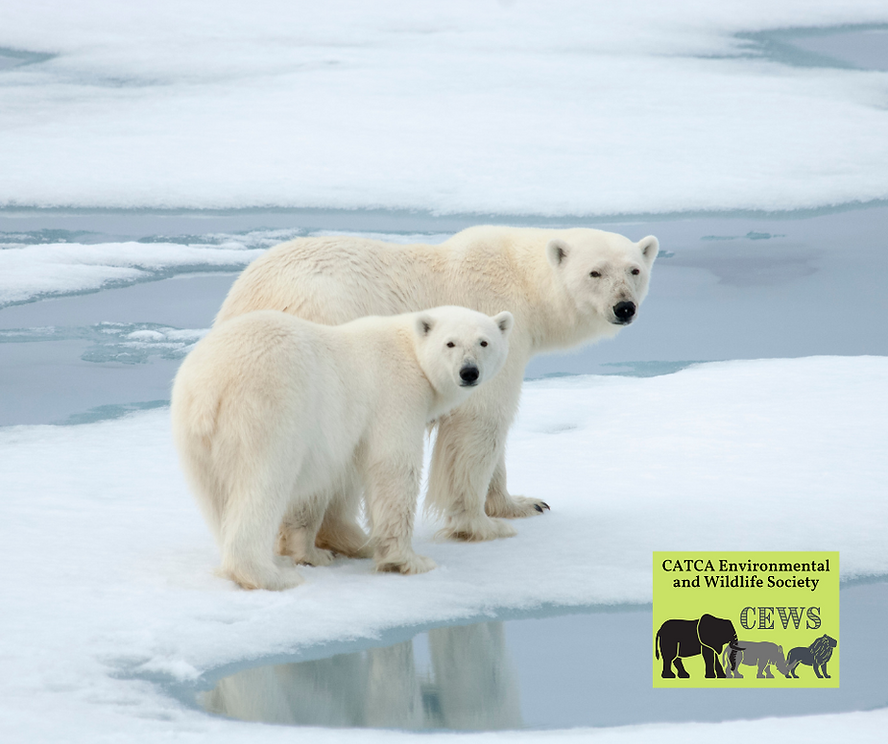
As 2022 drew to a close news media broke a story about yet another study showing how seriously polar bears are declining around western Hudson Bay. Because of the centralized location of the community of Churchill, Manitoba, it is one of the areas where the bears are most studied, and near the southern end of their current range, however, they regularly occur south as far as James Bay, in my own province of Ontario – for now.

The news was that latest figures based on aerial surveys found there were 618 polar bears, down from the last time such a survey was conducted, in 2016, when there were 842 bears.

That is new information, and I am pleased that so much of Canada’s mainstream media (MSM) reported it, but surprised that seasoned bear biologists expressed, according to news reports, amazement at the precipitancy of the decline. If we go back to the 1980s, the number of polar bears in this region has gone down by nearly half. The trend was obvious, there have been no significant changes for the better and

we still kill them, for profit.

The polar bear is an iconic symbol of climate change, itself most associated with overall global warming. Depending on which article you read, the arctic, broadly defined, is warming two to four times faster than the rest of the world. Global warming affects ringed seal populations because they need the sea ice to survive. and the ice is disappearing. Ringed seals are the main food source of female polar bears.*

But as University of British Columbia Professor Emeritus William Reese keeps trying to tell us, climate change, climate chaos, global warming – whatever you want to call it – is a symptom, more than a problem, as he explains here: https://un-denial.com/2021/02/06/by-william-rees-climate-change-isnt-the-problem-so-what-is/. I urge you to listen to him as he gives one of the most important half hour online talks in existence.

Lemmings, bunnies and boom-bust cycles:

I’ll get back to polar bears in a moment, but first consider snowshoe hares and lemmings. Many Canadians informed about the basics of wildlife population dynamics know that both the hares (https://academic.oup.com/bioscience/article/51/1/25/251849) and the lemmings

(https://www.nature.com/articles/news000601-10) are famous for their boom-bust population cycles, wherein their populations increase year after year until a critical mass is reached, and there is an abrupt die-off, often triggered by disease and stress. Their respective populations fall to well below the number the environment can sustain, popularly known as the “carrying capacity,” before starting to work their way back up.

This is called a boom-bust cycle and is often most noticeable in wildlife of the polar and sub-polar regions.

When the animals’ numbers start to soar above the carrying capacity of their environment, approaching the peak – nearing the top of the boom – it is called the “plague phase” of the growth curve, and is followed by the inevitable crash – the bust. Predators benefit from the higher prey numbers, thus experiencing increases in their own populations, boom, and themselves crash when suddenly they have far less food, the bust.

What is happening with humans exactly resembles what happens with other species as they soar upward in numbers to the plague phase, except that we humans, unlike rabbits and rodents, can draw resources from other parts of the world, fueled only in the last tiny fraction of our existence by fossil fuels fed into modern technology. Our numbers can keep going higher, keep depleting essential resources at increasing amounts, racing toward the plague phase and the unavoidable bust.

This ability to delay the inevitable allows some of us to pretend everything is not so bad. But if everyone were to live as well, consuming as much, as North Americans do, we’d need earth to be slightly more than five times larger than it is. We’re doing reasonably well where I live, in southern Ontario, because we can afford to draw food from the rest of the world. But not all of the rest of the world has enough for us all, world-wide. Even so, where I live, we are complaining about food prices and shortages.

Professor Reese’s Zoom talk explains it all far better and more accurately than can I, but the bottom line is that we are entering the plague phase of the “boom” part of the boom-bust cycle – except, it is not cyclic with us. This is a first time ever event, a one-off global population boom, with the peak near, and the bust already manifesting itself in numerous ways, from bare grocery shelves to often deadly immigration surges, wars, famines, disease, vast wildfires, draughts, desertification, floods, and despair.

Of course, all such problems have occurred here and there throughout recorded history, but not at the current, and growing, rates, nor in so many places in such short time spans and at such magnitudes. And all are symptoms of our historically recent, sudden, and overwhelming dependence on fossil fuels.

No single thing we could do would save more species than whatever we might do to flatten the curve that represents increase in fossil fuel use – nothing – and ask yourself what are the governments of the world doing toward that end? In Canada we taxpayers give money to extract and sell more fossil fuels.

And still we kill:

If we go back ten thousand years, when humans started to shift from being nomadic gatherers and hunters to becoming stock herders and settled farmers, we see that about 99 percent of the “mammal biomass”, the entire weight (“mass”) of all mammals in the world, consisted of wild mammals, from bumblebee bats and pygmy shrews to savannah elephants and blue whales, more than 5,400 different species.

Now? The wild mammal biomass is only about 1 percent of all mammal biomass, the rest killed off or displaced by humans, who weigh in at about 32 percent of all mammal biomass, and by the domestic mammals humans use, mostly to eat, which account for about 67 percent of the planet’s mammal biomass.

The exact figures can be disputed by a percentage point or two, yes, but in fact we have nearly wiped out most individual wild mammals, and individual wild birds, too. Domestic poultry, mostly chickens, now account for about 70 percent of the world’s bird biomass. If we factor in fish, reptiles, and amphibians along with the birds and mammals – all the vertebrate animals – it’s the same story, at least among monitored species whose approximate population sizes we know, showing about a 60 percent decline since 1970. Even insects are in serious decline, including those vital to the pollination of plant species of importance both to maintaining what is left of biodiversity, and our own food sources.

And still we displace wildlife, destroy wildlife habitat, kill wild animals directly, or through poisons, traps, or simply crush them under the weight of our destructive presence in their midst.

Canada: The Polar Bear Hunting Capital of the World:

Polar bears don’t recognize international borders, and so the five nations – range states – in which wild polar bears regularly live, Russia, USA, Canada, Greenland, and Norway (Svalbard), comanage them, dividing the world polar bear population into 19 “subpopulations”, of which thirteen are in Canada, host to two thirds of all polar bears.

Canada is also the only country that allows polar bear trophy hunting.

Hunting “management” is supposedly based on “sustainability”. The principal is sometimes expressed in economic terms: the animals allowed to be hunted are superfluous to the population’s need to sustain numbers that the environment can support, and so the offtake is comparable to spending money from the interest earned from the principal in capital investment. You can spend interest or let it build, earning more interest (compounding) to the degree that circumstances (analogous to the environment’s carrying capacity) allow, but you spend the capital at your peril. If the net amount – the combination of capital and interest – is declining, there is no interest to be spent, only capital. In such circumstances

spending capital, unless well invested, only hastens to slide to foreclosure or bankruptcy, analogous to extinction – except somewhere there is always more money. When a species goes extinct, there are no more; none at all and no other place for a species to invest itself; nothing more to borrow.

That’s just an analogy, metaphorical and imperfect, although perhaps less so than you might imagine. We can see that the carrying capacity of the environment for polar bears is limited; if the things they depend on vanish, so do they.

But in our pre-fossil-fuel-use history, even though we exterminated many species, there was (usually, but with some exceptions) alternatives to be had somewhere over the horizon. The world is big, and we posed no great overall threat to most species-wide until fossil fuels allowed us to also enter into our own, first ever boom-bust “cycle”.

Following publication of her new book, Minding the Climate: How Neuroscience Can Help Solve Our Environmental Crisis, recently published by Harvard University Press, Dr. Ann-Christine Duhaime, a pediatric neurosurgeon at Massachusetts General Hospital, was interviewed by the New York Times. She said, “Our brain design evolved primarily for short-term decision-making focused on circumstances related to immediate, tangible survival: I do this action, and I get this food.”

“Climate change,” she continued, “is difficult because it is longer term rather than immediate. It is difficult to perceive directly; we didn’t need to evolve carbon dioxide sensors for survival. The results of our pro-environment actions remain largely invisible. Additionally, the things that cause climate change are rewarding. Fossil fuels have made our lives easier in many ways. They have also made many people wealthy.”

Exactly. Although it was not her intent, Duhaime’s comments succinctly explain why we still kill polar bears; why we eliminate the ecological equivalent of capital. In the tens of thousands of years that humans have hunted arctic wildlife (see Grisly find suggests humans inhabited Arctic 45,000 years ago | Science | AAAS ) whenever there have been large numbers of polar bears seen, it is because there are large numbers of polar bears overall, and that’s been true right up to recent times.

The indigenous people of the far north survived some of the harshest living conditions on earth not by being hesitant about doing what needed to be done in the short term. Doing otherwise did not lead to passing on one’s genes! Not discounting art and craftsmanship, virtually every aspect of traditional, pre-colonial Inuit culture is directed toward survival. That includes heeding traditional lore and elder knowledge. It also includes taking advantage of all aids, which includes, now, the rich visitors who are willing to pay to kill, and keep trophy parts of, polar bears.

Two views:

I speak very generally, but there is a dichotomy of opinion between the Inuit traditionalists and their supporters, and what the science is telling us. On one side, the hunting of polar bears is rationalized because, it is claimed, there are lots of bears. On the other side, science shows us that no, polar bears are going increasingly hungry, and their numbers are in serious species-wide decline. However, they are concentrating at food sources, which are often where humans are also concentrated. What humans waste is often what polar bears, arctic foxes, gulls and ravens and other wildlife will eat.

Whatever those concentrations of bears near Inuit settlements or communities meant in the past, it was a past very different from the current, rapidly changing present, and incredibly different from the future envisioned if we don’t change our practices and policies more than we seem capable of doing. And we now know that the kind of overview not possible until recently, thanks to aircraft and cameras, shows that concentrated numbers of polar bears does not mean more polar bears. The time when it did mean that was not a time of rapid loss of sea ice; of hugely expanded numbers of humans; of toxins now occurring in arctic wildlife (and humans); of high-powered rifles, snowmobiles, and motorboats; of imported food supplementation and health care services; of rapid international travel, melting permafrost, and much else.

In his book, Polar Bears: Beloved and Betrayed, author Morten Jørgensen, equates legal hunting with poaching, pointing out that nearly three polar bears are shot, most legally, every day (and more so in Canada then elsewhere). There are always reasons to kill.

Legal polar bear killing is highly regulated in regions where enforcement of such regulations can range from difficult to impossible, thus non-existent. Those regulations are designed to benefit local people. If the rich and powerful Safari Club International members really need to kill a bear so badly that they’ll pay handsomely to do so, where’s the harm? Apart from the trophy parts, the dead bears are almost completely used locally in communities where other options are limited, and money is more valuable per unit of food purchased than it is here. Our complaints notwithstanding, most of the foods we take for granted cost a fraction of their price in the far north. Of course, Kraft macaroni, Campbell soup, veggie or any other burgers, bread or eggs or granola or much else is often only available at all in the far north, or often in my local grocery store, because of fossil fuels, in a viciously insane spiralling dance of cause and effect ultimately resulting in our mad plunge into humanity’s plague phase, the bust, now unfolding.

And that brings me back to the tranche of MSM articles that ended 2022, on how rapidly polar bears have declined, and are still doing so.

It is, as I said, the “surprise” that “experts” claim that surprised me. In private conversation that I will, with his permission, make public here, Morten Jørgensen said, “Legalities are irrelevant when basic conservation principles are overlooked. There can never, by definition, be a sustainable take from dwindling, depleted or even recovering populations. And if the precautionary principle is not applied and prioritized in management situations where the conservation status is murky, all subsequent legalized exploitation might as well be illegal (poaching). They all know this, of course. Which is one of the reasons they have agreed to meet my books with silence. They have no arguments.”

Exactly. We have in Canada a lot of entirely justified guilt over our often horrific mistreatment (up to the present, to be sure) of indigenous people – people whose ancestors arrived in the western hemisphere many thousands of years earlier than those of most of the people who now write, and enforce, the growing plethora of laws, rules and regulations necessary if we are indeed to define ourselves as something distinctive from all other species whose ancestry we ultimately share. The controls we impose upon ourselves define civilization and civilization defines humanity’s distinctiveness within the world’s population of living beings. Killing wildlife is a bone much more easily tossed to the indigenous people than anything approaching real resolution of concerns caused by that previous, at too many times ongoing, abuse.

Evolution has programmed us to be adaptive. Both Reese and Duhaime, drawing on what we know about human thought processes, agree we can change, but it requires more effort than accomplished to date.

Meanwhile, we have done things that have worked to slow the fiercely accelerated rates of extinction that we have triggered, mostly of little-known species. We have done this by identifying causes and reducing or eliminating them.

What’s killing off the polar bears? Climate change. Okay…working on it, but not getting far. Is there anything easier we can do in the meantime?

Yes. We can stop killing them. We can stop rationalizing the killing of them. We can stop pretending that that killing a species in decline is “sustainable”. And we can stop being surprised that what we saw happening – their decline measured earlier – is still happening.

If we stop climate change, it will take a long time. Will polar bears last that long? They might, but first, stop killing them.

* The mature male polar bear is much larger and stronger than the mature female, thus can access some prey, such as bearded seals, walrus, even beluga whales, not accessible to the female. But the female is solely responsible for raising cubs. Polar bears eat not meat but fat, and for female polar bears through most of their range the best source of necessary fat levels in her diet is the ringed seal. That is because the ringed seal forms snow shelters on ice on water – sea ice – where she nourishes her pup, and have maintain an opening to the water below, where she can try to escape predation, or search for food.

Mother polar bears can break through these shelters to capture the fat-rich seals or their pups, thus acquiring the essential fat when needed to provide milk and energy to raise her cubs. As well, smaller seals can swim, and fish, under sea ice – ice with water under it – but need to come up for air and use “blow holes” to do this. Polar bears (and Inuit) often wait by such holes to kill the seals as they emerge to breath.

And so, loss of sea ice, as is happening at unprecedented rates, is deleterious to the survival potential of sea-ice dependent ringed seals (themselves therefore at risk from climate change; at the moment they are still a common species listed under the “least concern” category by the International Union for the Conservation of Nature — IUCN), thus, polar bears. Sometimes a dead whale or large fish may wash ashore, and provide a good fat source for mother bears, but males usually will chase females and young, even kill cubs, to protect such food sources, although they may be quite amendable to sharing if there is enough to go around. Polar bears congregate at food sources, giving an impression of abundance.

Polar bears are increasingly trying to access other food sources, such as birds’ eggs and young, to the point where they will risk fatal falls by clambering about colonies of birds on cliffs seeking chicks or eggs.

It is possible that the odd individual bear might have a genetically heritable ability to access alternative nutriment sources, and pass that character on – that is, put simply – how evolution works, but not if it is legally (or otherwise) shot. We need to address fossil fuel use, but have not done so, but we can stop killing polar bears.


A vulture died under ‘unusual’ circumstances at a Dallas zoo about a week after a clouded leopard escaped an enclosure with a ‘suspicious’ rip

Story by kvlamis@insider.com (Kelsey Vlamis) • Yesterday 6:10 PM

231283 Comments

INSIDER

A vulture died under ‘unusual’ circumstances at a Dallas zoo about a week after a clouded leopard escaped an enclosure with a ‘suspicious’ rip

Was this content a good use of your time?

Your feedback will help us improve the product

A white-backed vulture sits in his new aviary at Tierpark Berlin, on May 25, 2020. Britta Pedersen/picture alliance/Getty Images© Britta Pedersen/picture alliance/Getty Images

  • The death of an endangered vulture at the Dallas Zoo is not believed to be from natural causes.
  • About a week prior, a clouded leopard at the zoo went missing for several hours before being found.
  • Police said a suspicious cut was made in the leopard enclosure, as well as that of some monkeys.

Police are investigating after a series of strange events at the Dallas Zoo.

First, a clouded leopard escaped from her encampment, which had a “suspicious” tear in it. Next, another cut was found in an enclosure containing langurs, a type of monkey native to Africa and Asia. Now, a vulture has died under what the zoo is calling “unusual” circumstances.

“This weekend, our staff found that one of the endangered vultures in our Wilds of Africa habitats had died. The animal care team is heartbroken over this tremendous loss,” the Dallas Zoo said in a statement on Saturday.

“The circumstances of the death are unusual, and the death does not appear to be from natural causes,” the statement continued, adding: “In the past week, we have added additional cameras throughout the Zoo and increased onsite security patrols during the overnight hours. We will continue to implement and expand our safety and security measures to whatever level necessary to keep our animals and staff safe.”

1 of 10 Photos in Gallery©AP Photo/Aaron Doster

Rose Lavelle whipped out a marvelous back-heel assist to help give Alex Morgan her first goal of 2023

  • US Women’s National Team star Rose Lavelle is virtually unstoppable with the ball at her feet.
  • The midfielder showcased her brilliance with a jaw-dropping assist vs New Zealand on Wednesday.
  • Lavelle whipped out a no-look back-heel pass to help give Alex Morgan an easy first goal of 2023. 

Rose Lavelle is considered one of the most creative playmakers the US Women’s National Team has ever seen.

And Wednesday afternoon in New Zealand, she showed the world exactly why.

The 27-year-old midfielder dished a stunning back-heel assist to Alex Morgan, bamboozling a pair of Ferns defenders and dazzling viewers back home in the process. With Lavelle’s ball leading into a wide-open expanse of the 18-yard box, Morgan easily found the back of the net and doubled the Stars and Stripes’ lead.

Lavelle’s on-ball prowess was among the most striking highlights of the USWNT’s 4-0 victory in Wellington. But when she was asked about her ability to “create havoc” with the ball at her feet, the Ohio native was quick to deflect attention away from herself and offer credit to her teammates instead.

“I have really good players around me that help me look good,” Lavelle said after the game. “I have a lot of good people to get the ball to me and then a lot of good people for me to feed to. It’s a fun group to play with.”

https://platform.twitter.com/embed/Tweet.html?dnt=false&embedId=twitter-widget-2&features=eyJ0ZndfdGltZWxpbmVfbGlzdCI6eyJidWNrZXQiOltdLCJ2ZXJzaW9uIjpudWxsfSwidGZ3X2ZvbGxvd2VyX2NvdW50X3N1bnNldCI6eyJidWNrZXQiOnRydWUsInZlcnNpb24iOm51bGx9LCJ0ZndfaG9yaXpvbl90aW1lbGluZV8xMjAzNCI6eyJidWNrZXQiOiJ0cmVhdG1lbnQiLCJ2ZXJzaW9uIjpudWxsfSwidGZ3X3R3ZWV0X2VkaXRfYmFja2VuZCI6eyJidWNrZXQiOiJvbiIsInZlcnNpb24iOm51bGx9LCJ0ZndfcmVmc3JjX3Nlc3Npb24iOnsiYnVja2V0Ijoib24iLCJ2ZXJzaW9uIjpudWxsfSwidGZ3X3Nob3dfYnVzaW5lc3NfdmVyaWZpZWRfYmFkZ2UiOnsiYnVja2V0Ijoib24iLCJ2ZXJzaW9uIjpudWxsfSwidGZ3X2NoaW5fcGlsbHNfMTQ3NDEiOnsiYnVja2V0IjoiY29sb3JfaWNvbnMiLCJ2ZXJzaW9uIjpudWxsfSwidGZ3X3R3ZWV0X3Jlc3VsdF9taWdyYXRpb25fMTM5NzkiOnsiYnVja2V0IjoidHdlZXRfcmVzdWx0IiwidmVyc2lvbiI6bnVsbH0sInRmd19taXhlZF9tZWRpYV8xNTg5NyI6eyJidWNrZXQiOiJ0cmVhdG1lbnQiLCJ2ZXJzaW9uIjpudWxsfSwidGZ3X3NlbnNpdGl2ZV9tZWRpYV9pbnRlcnN0aXRpYWxfMTM5NjMiOnsiYnVja2V0IjoiaW50ZXJzdGl0aWFsIiwidmVyc2lvbiI6bnVsbH0sInRmd19leHBlcmltZW50c19jb29raWVfZXhwaXJhdGlvbiI6eyJidWNrZXQiOjEyMDk2MDAsInZlcnNpb24iOm51bGx9LCJ0ZndfZHVwbGljYXRlX3NjcmliZXNfdG9fc2V0dGluZ3MiOnsiYnVja2V0Ijoib24iLCJ2ZXJzaW9uIjpudWxsfSwidGZ3X3ZpZGVvX2hsc19keW5hbWljX21hbmlmZXN0c18xNTA4MiI6eyJidWNrZXQiOiJ0cnVlX2JpdHJhdGUiLCJ2ZXJzaW9uIjpudWxsfSwidGZ3X3Nob3dfYmx1ZV92ZXJpZmllZF9iYWRnZSI6eyJidWNrZXQiOiJvbiIsInZlcnNpb24iOm51bGx9LCJ0ZndfbGVnYWN5X3RpbWVsaW5lX3N1bnNldCI6eyJidWNrZXQiOnRydWUsInZlcnNpb24iOm51bGx9LCJ0Zndfc2hvd19nb3ZfdmVyaWZpZWRfYmFkZ2UiOnsiYnVja2V0Ijoib24iLCJ2ZXJzaW9uIjpudWxsfSwidGZ3X3Nob3dfYnVzaW5lc3NfYWZmaWxpYXRlX2JhZGdlIjp7ImJ1Y2tldCI6Im9uIiwidmVyc2lvbiI6bnVsbH0sInRmd190d2VldF9lZGl0X2Zyb250ZW5kIjp7ImJ1Y2tldCI6Im9uIiwidmVyc2lvbiI6bnVsbH19&frame=false&hideCard=false&hideThread=false&id=1615729223192219654&lang=en&origin=https%3A%2F%2Fwww.insider.com%2Fvulture-dead-dallas-zoo-unsusual-circumstances-leopard-missing-police-investigating-2023-1&sessionId=80c09031145f5e226abfa9bc552bb741920276fd&theme=light&widgetsVersion=2b959255e8896%3A1673658205745&width=550px

While that may be true, Lavelle’s answer brushes over just how crucial her dribbling and distributing talents are to unlocking the four-time World Cup champions’ offense. So let’s take a look at how her brilliant assist unfolded in Wednesday’s game — and how Lavelle was key to the play that led to goal No. 2:See More

https://platform.twitter.com/embed/Tweet.html?dnt=false&embedId=twitter-widget-0&features=eyJ0ZndfdGltZWxpbmVfbGlzdCI6eyJidWNrZXQiOltdLCJ2ZXJzaW9uIjpudWxsfSwidGZ3X2ZvbGxvd2VyX2NvdW50X3N1bnNldCI6eyJidWNrZXQiOnRydWUsInZlcnNpb24iOm51bGx9LCJ0ZndfaG9yaXpvbl90aW1lbGluZV8xMjAzNCI6eyJidWNrZXQiOiJ0cmVhdG1lbnQiLCJ2ZXJzaW9uIjpudWxsfSwidGZ3X3R3ZWV0X2VkaXRfYmFja2VuZCI6eyJidWNrZXQiOiJvbiIsInZlcnNpb24iOm51bGx9LCJ0ZndfcmVmc3JjX3Nlc3Npb24iOnsiYnVja2V0Ijoib24iLCJ2ZXJzaW9uIjpudWxsfSwidGZ3X3Nob3dfYnVzaW5lc3NfdmVyaWZpZWRfYmFkZ2UiOnsiYnVja2V0Ijoib24iLCJ2ZXJzaW9uIjpudWxsfSwidGZ3X2NoaW5fcGlsbHNfMTQ3NDEiOnsiYnVja2V0IjoiY29sb3JfaWNvbnMiLCJ2ZXJzaW9uIjpudWxsfSwidGZ3X3R3ZWV0X3Jlc3VsdF9taWdyYXRpb25fMTM5NzkiOnsiYnVja2V0IjoidHdlZXRfcmVzdWx0IiwidmVyc2lvbiI6bnVsbH0sInRmd19taXhlZF9tZWRpYV8xNTg5NyI6eyJidWNrZXQiOiJ0cmVhdG1lbnQiLCJ2ZXJzaW9uIjpudWxsfSwidGZ3X3NlbnNpdGl2ZV9tZWRpYV9pbnRlcnN0aXRpYWxfMTM5NjMiOnsiYnVja2V0IjoiaW50ZXJzdGl0aWFsIiwidmVyc2lvbiI6bnVsbH0sInRmd19leHBlcmltZW50c19jb29raWVfZXhwaXJhdGlvbiI6eyJidWNrZXQiOjEyMDk2MDAsInZlcnNpb24iOm51bGx9LCJ0ZndfZHVwbGljYXRlX3NjcmliZXNfdG9fc2V0dGluZ3MiOnsiYnVja2V0Ijoib24iLCJ2ZXJzaW9uIjpudWxsfSwidGZ3X3ZpZGVvX2hsc19keW5hbWljX21hbmlmZXN0c18xNTA4MiI6eyJidWNrZXQiOiJ0cnVlX2JpdHJhdGUiLCJ2ZXJzaW9uIjpudWxsfSwidGZ3X3Nob3dfYmx1ZV92ZXJpZmllZF9iYWRnZSI6eyJidWNrZXQiOiJvbiIsInZlcnNpb24iOm51bGx9LCJ0ZndfbGVnYWN5X3RpbWVsaW5lX3N1bnNldCI6eyJidWNrZXQiOnRydWUsInZlcnNpb24iOm51bGx9LCJ0Zndfc2hvd19nb3ZfdmVyaWZpZWRfYmFkZ2UiOnsiYnVja2V0Ijoib24iLCJ2ZXJzaW9uIjpudWxsfSwidGZ3X3Nob3dfYnVzaW5lc3NfYWZmaWxpYXRlX2JhZGdlIjp7ImJ1Y2tldCI6Im9uIiwidmVyc2lvbiI6bnVsbH0sInRmd190d2VldF9lZGl0X2Zyb250ZW5kIjp7ImJ1Y2tldCI6Im9uIiwidmVyc2lvbiI6bnVsbH19&frame=false&hideCard=false&hideThread=false&id=1617213730042920961&lang=en&origin=https%3A%2F%2Fwww.insider.com%2Fvulture-dead-dallas-zoo-unsusual-circumstances-leopard-missing-police-investigating-2023-1&sessionId=80c09031145f5e226abfa9bc552bb741920276fd&theme=light&widgetsVersion=2b959255e8896%3A1673658205745&width=550px

 Related video: Clouded leopard found after escaping habitat at Dallas Zoo (CBS Dallas)

you’ve heard about through the day. It’s been missing most of the day

Loaded: 100.00%Play

Current Time 0:05

/

Duration 0:38LQCaptionsFullscreen

CBS Dallas

Clouded leopard found after escaping habitat at Dallas ZooUnmute

0

View on Watch

More videos

The zoo did not provide additional details about the vulture’s death but said it contacted the Dallas Police Department, which is investigating the matter. Dallas Police did not immediately respond to Insider’s request for comment.

The Dallas Zoo first made national headlines earlier this month when a female clouded leopard named Nova was not inside her habitat when staff arrived on the morning of January 13. The zoo said the leopard, which it described as not dangerous, weighed 25 pounds and was “bigger than a house cat and smaller than most bobcats.”

Nova was missing for several hours before she was located near her enclosure and quickly secured. The zoo said she had no signs of injury and quickly settled back into her usual routine.

https://platform.twitter.com/embed/Tweet.html?dnt=false&embedId=twitter-widget-1&features=eyJ0ZndfdGltZWxpbmVfbGlzdCI6eyJidWNrZXQiOltdLCJ2ZXJzaW9uIjpudWxsfSwidGZ3X2ZvbGxvd2VyX2NvdW50X3N1bnNldCI6eyJidWNrZXQiOnRydWUsInZlcnNpb24iOm51bGx9LCJ0ZndfaG9yaXpvbl90aW1lbGluZV8xMjAzNCI6eyJidWNrZXQiOiJ0cmVhdG1lbnQiLCJ2ZXJzaW9uIjpudWxsfSwidGZ3X3R3ZWV0X2VkaXRfYmFja2VuZCI6eyJidWNrZXQiOiJvbiIsInZlcnNpb24iOm51bGx9LCJ0ZndfcmVmc3JjX3Nlc3Npb24iOnsiYnVja2V0Ijoib24iLCJ2ZXJzaW9uIjpudWxsfSwidGZ3X3Nob3dfYnVzaW5lc3NfdmVyaWZpZWRfYmFkZ2UiOnsiYnVja2V0Ijoib24iLCJ2ZXJzaW9uIjpudWxsfSwidGZ3X2NoaW5fcGlsbHNfMTQ3NDEiOnsiYnVja2V0IjoiY29sb3JfaWNvbnMiLCJ2ZXJzaW9uIjpudWxsfSwidGZ3X3R3ZWV0X3Jlc3VsdF9taWdyYXRpb25fMTM5NzkiOnsiYnVja2V0IjoidHdlZXRfcmVzdWx0IiwidmVyc2lvbiI6bnVsbH0sInRmd19taXhlZF9tZWRpYV8xNTg5NyI6eyJidWNrZXQiOiJ0cmVhdG1lbnQiLCJ2ZXJzaW9uIjpudWxsfSwidGZ3X3NlbnNpdGl2ZV9tZWRpYV9pbnRlcnN0aXRpYWxfMTM5NjMiOnsiYnVja2V0IjoiaW50ZXJzdGl0aWFsIiwidmVyc2lvbiI6bnVsbH0sInRmd19leHBlcmltZW50c19jb29raWVfZXhwaXJhdGlvbiI6eyJidWNrZXQiOjEyMDk2MDAsInZlcnNpb24iOm51bGx9LCJ0ZndfZHVwbGljYXRlX3NjcmliZXNfdG9fc2V0dGluZ3MiOnsiYnVja2V0Ijoib24iLCJ2ZXJzaW9uIjpudWxsfSwidGZ3X3ZpZGVvX2hsc19keW5hbWljX21hbmlmZXN0c18xNTA4MiI6eyJidWNrZXQiOiJ0cnVlX2JpdHJhdGUiLCJ2ZXJzaW9uIjpudWxsfSwidGZ3X3Nob3dfYmx1ZV92ZXJpZmllZF9iYWRnZSI6eyJidWNrZXQiOiJvbiIsInZlcnNpb24iOm51bGx9LCJ0ZndfbGVnYWN5X3RpbWVsaW5lX3N1bnNldCI6eyJidWNrZXQiOnRydWUsInZlcnNpb24iOm51bGx9LCJ0Zndfc2hvd19nb3ZfdmVyaWZpZWRfYmFkZ2UiOnsiYnVja2V0Ijoib24iLCJ2ZXJzaW9uIjpudWxsfSwidGZ3X3Nob3dfYnVzaW5lc3NfYWZmaWxpYXRlX2JhZGdlIjp7ImJ1Y2tldCI6Im9uIiwidmVyc2lvbiI6bnVsbH0sInRmd190d2VldF9lZGl0X2Zyb250ZW5kIjp7ImJ1Y2tldCI6Im9uIiwidmVyc2lvbiI6bnVsbH19&frame=false&hideCard=false&hideThread=false&id=1614043285818834947&lang=en&origin=https%3A%2F%2Fwww.insider.com%2Fvulture-dead-dallas-zoo-unsusual-circumstances-leopard-missing-police-investigating-2023-1&sessionId=80c09031145f5e226abfa9bc552bb741920276fd&theme=light&widgetsVersion=2b959255e8896%3A1673658205745&width=550px

Sgt. Warren Mitchell, a public information officer for the Dallas Police said during a press conference held while Nova was missing that “after investigating, it is our belief that this was an intentional act.”

In a follow-up statement, police said they determined “a cutting tool was intentionally used to cut an opening in the fencing of the Clouded Leopard’s habitat.” They also said they were made aware of a “similar cut” made in the langurs’ enclosure, but that all of the monkeys were accounted for.

Police added the investigation was ongoing and that it was not yet clear if the cuts in the leopard enclosure and the langur enclosure were related.

Young whale belonging to one of the rarest species is ‘likely to die,’ after entanglement, NOAA says

CNNWire

https://abc11.com/right-whale-whales-off-nc-coast-endangered-entangled/12721743/

Friday, January 20, 2023 1:23PM

RARE SIGHT: 'Triple breach' of humpback whales off Monterey coast

about:blank

EMBED <>MORE VIDEOS 

Sunny and cool weekend.

The world’s population of North Atlantic right whales has been decimated in recent years by human-caused vessel strikes and rope entanglements, and now another member of this rare species faces the same fate.

A 4-year-old female right whale found heavily entangled about 20 miles east of Rodanthe, North Carolina, is “likely to die,” according to the fisheries division of the National Oceanic and Atmospheric Administration.

An aerial survey team from Florida’s Clearwater Marine Aquarium spotted the whale January 8, noticing several wraps of line around its mouth and tail, and additional line trailing behind it. The entanglement has caused numerous wounds across the whale’s body and allowed tiny parasitic crustaceans known as whale lice to thrive on its head, according to images NOAA Fisheries and its partners reviewed.

The division’s biologists have preliminarily determined these details meet the criteria of a “serious injury,” meaning the whale “is likely to die,” NOAA said in a news release.

SEE ALSO: Endangered weeks-old right whale calf found dead near eastern North Carolina

https://imasdk.googleapis.com/js/core/bridge3.552.0_en.html#goog_1717666185

https://imasdk.googleapis.com/js/core/bridge3.552.0_en.html#goog_1855200705

https://imasdk.googleapis.com/js/core/bridge3.552.0_en.html#goog_798747207Top StoriesSheriff: Man who pointed gun at deputy arrested after brief chase near I-95Actor Jeremy Renner says he broke at least 30 bones in Nevada snowplow accidentParade and pep rally celebrate NCCU's HBCU football national championshipFirefighters extinguish fire at Raleigh buildingFort Bragg soldier going to Super Bowl LVII thanks to JJ WattLate Day Clouds and CoolNCCU hosting celebration after HBCU National Football Championship title winFamed astronaut Buzz Aldrin gets married in LA on his 93rd birthdayWorker shot at McDonald's in RaleighFuture of abortion law lies with NC legislature as Roe v Wade's 50th anniversary nearsElizabeth Holmes booked one-way flight to Mexico following fraud conviction, US prosecutors say1 person in custody in Durham in connection with fatal shootingWorker shot at McDonald’sin Raleigh

Scientists at the New England Aquarium, which manages the North Atlantic Right Whale Catalog tracking the identification and sighting history of right whales, identified the whale as No. 4904, the daughter of an adult female named Spindle (right whale No. 1204). Spindle was recently seen with a new calf off the coast of St. Catherines Island, Georgia. The last known sighting of No. 4904 was in May 2022 in Massachusetts Bay.

When No. 4904 was first spotted this month, entanglement response teams didn’t “mount a response … because it was too late in the day and the whale was too far from shore,” NOAA said. “However, as conditions permit, NOAA Fisheries will work with authorized responders and trained experts to resight her. We will further document the entanglement, and determine if an entanglement response will be possible.”

An ‘unusual mortality event’

In 2017, NOAA Fisheries declared an “unusual mortality event” (UME) as the number of dead, injured or ill North Atlantic right whales in Canada and the United States began to rise – largely due to human interaction, specifically via vessel strikes and entanglements.

No. 4904 is 94th on the list of all right whales affected in any way by this event.

“This is more bad news for this species that has been suffering from many years of ineffective protection,” said Gib Brogan, campaign director at Oceana, an international organization working to protect and restore the world’s oceans. “To hear that there is another entanglement is frustrating, because we know that more needs to be done (to prevent it).”

Today, it’s believed there are probably fewer than 350 right whales remaining worldwide. Right whales impacted by the UME represented 20% of their already endangered population – a significant setback to the recovery of an endangered species in which deaths are outpacing births, NOAA said. Additionally, only about a third of right whale deaths are documented, meaning the situation could be worse than what is known.

The potential death of No. 4904 could exacerbate the strain on the species. Female right whales can’t reproduce until around age 10, and they bear one calf after a year-long pregnancy, according to NOAA.

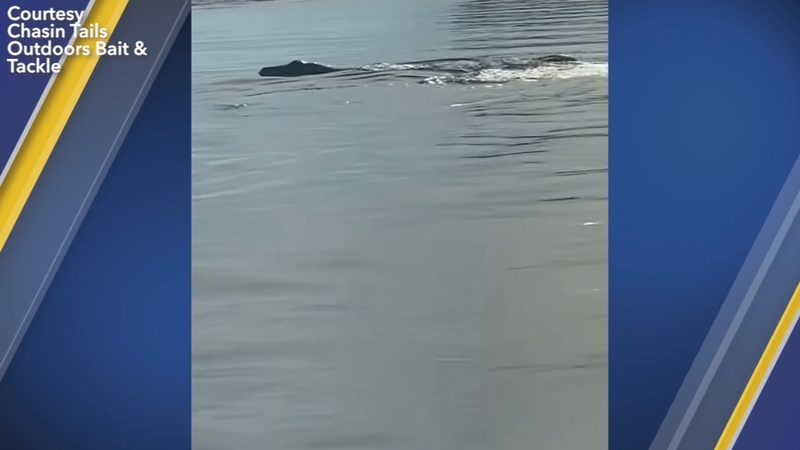
WATCH: Video of unidentified creature seen off NC coast stirs debate online

EMBED <>MORE VIDEOS 

Is it an alligator? Is it a fish? Or could video of some creature off the NC Coast be something completely different?

The normal or healthy interval between right whale births is three years, but these days, the average is every six to 10 years – likely because of stress, insufficient food sources and ocean noise caused by human activities, according to NOAA. Ocean noise can harm right whales’ ability to navigate, identify their surroundings, find food and mates, and detect and avoid predators and human hazards.

There are fewer than 100 known breeding females remaining. While the species would need to reproduce 50 or more calves per year over a period of multiple years to stop the decline and foster recovery, only 57 have been born since 2017. Only 15 right whale calves were spotted during the 2021-2022 calving season.

https://imasdk.googleapis.com/js/core/bridge3.552.0_en.html#goog_1874852607

https://imasdk.googleapis.com/js/core/bridge3.552.0_en.html#goog_1345059024

https://imasdk.googleapis.com/js/core/bridge3.552.0_en.html#goog_2035078624Top StoriesSheriff: Man who pointed gun at deputy arrested after brief chase near I-95Actor Jeremy Renner says he broke at least 30 bones in Nevada snowplow accidentParade and pep rally celebrate NCCU's HBCU football national championshipFirefighters extinguish fire at Raleigh buildingFort Bragg soldier going to Super Bowl LVII thanks to JJ WattLate Day Clouds and CoolNCCU hosting celebration after HBCU National Football Championship title winFamed astronaut Buzz Aldrin gets married in LA on his 93rd birthdayWorker shot at McDonald's in RaleighElizabeth Holmes booked one-way flight to Mexico following fraud conviction, US prosecutors say1 person in custody in Durham in connection with fatal shootingParade and pep rally celebrateNCCU’s HBCU football national championship

North Atlantic right whales’ ill-fated encounters with humans didn’t begin in 2017. By the early 1890s, commercial whalers had hunted them to the brink of extinction, according to NOAA. The species got its name from being the “right” whales to hunt, since they floated when killed. Whaling is no longer a threat due to a 1935 ban on the commercial hunting of North Atlantic right whales, but the species has never recovered to pre-whaling numbers.

And right whales’ decline affects more than just their species.

SEE ALSO: Beached killer whale dies after grounding itself on Florida beach

“As they eat, they will process that food and essentially fertilize the oceans … which is proven to be important to the health of the oceans,” Brogan said. “The oceans produce a tremendous amount of oxygen that we breathe. They moderate climate, they absorb a tremendous amount of heat that’s being produced by humans, and they provide food for billions of people.”

If you see an entangled whale, “please do not intervene, and instead call the experts for the whale’s sake as well as yours,” NOAA said.

Iowa bowhunting couple gets probation, community service for hunting violations in Nebraska

Exposing the Big Game's avatarCommittee to Abolish Sport Hunting Blog

Josh and Sarah Bowmar were accused of illegal hunts in Nebraska

(WCAX)

ByJacob Comer

Published: Jan. 17, 2023 at 9:17 AM PST

https://www.wowt.com/2023/01/17/iowa-business-owners-get-probation-community-service-hunting-violations-nebraska/?fbclid=IwAR3GXwZmghXVQuj3kxdREhIFUXdYR3FOuB8xYHqwYUoXPd5TFaIqG79Eeos

OMAHA, Neb. (WOWT) – Two business owners have been sentenced after allegedly violating the Lacey Act.

Josh Bowmar, 32; Sarah Bowmar, 33; and Bowmar Bowhunting LLC; all from Ankeny, Iowa, were sentenced by Judge Michael D. Nelson on Thursday, Jan. 12, in federal court in Omaha for conspiracy to violate the Lacey Act.

The Lacey Act is a federal law prohibiting the trafficking of wildlife that was taken in violation of a law or regulation.

The Bowmars and their LLC pleaded guilty to violating the Lacey Act and were sentenced to three years of probation and 40 hours of community service each. They must also pay a $75,000 fine, a $44,000 money judgment, and $13,000 in restitution.

As part of their probation, the Bowmars are prohibited from…

View original post 149 more words

Wolves in national parks often killed when they roam outside boundary

Exposing the Big Game's avatarCommittee to Abolish Sport Hunting Blog

Half of the deaths among collared wolves at Minnesota’s Voyageurs National Park are caused by humans.

Voyageurs wolves S
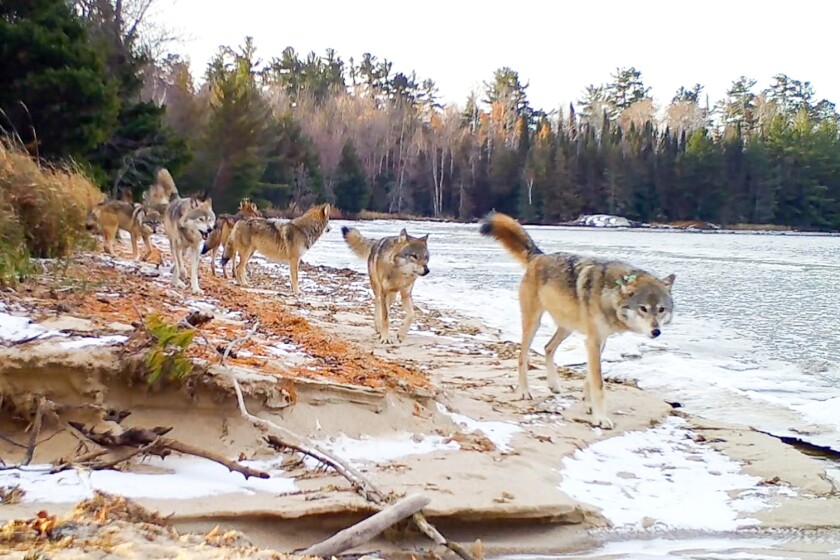
Members of the Shoepack Lake pack of wolves in Voyageurs National Park are captured on a trail camera placed by researchers in the Voyageurs Wolf Project. A new study at five national parks shows humans are a major cause of wolf deaths, mostly when wolves roam outside park boundaries.

ByJohn Myers

January 17, 2023 10:00 AM

SHARE https://www.duluthnewstribune.com/sports/northland-outdoors/wolves-in-national-parks-often-killed-when-they-roam-outside-boundary?fbclid=IwAR3m8VmH1lxNsV9qNjvUoezwnaXOyqX3iG3ndJ0BH-1Wlhg0jCeQ3U1_3AM

We are part of The Trust Project.

DULUTH — Humans were the most frequent cause of death for research wolves that live in five of the nation’s most highly protected places, national parks, and those deaths led to long-term consequences for wolf packs, a new study has discovered.

Some 36% of collared wolves in the five parks included in the study died at the hands of humans, usually when they ventured just…

View original post 1,148 more words

County Commission Shuts Down Resolution Condemning Coyote Hunting Contests

Exposing the Big Game's avatarCommittee to Abolish Sport Hunting Blog

County Commission Shuts Down Resolution Condemning Coyote Hunting Contests

SWEETWATER COUNTY— The Sweetwater County Commission unanimously opposed a resolution during its meeting Tuesday that would have condemned coyote hunting contests in Sweetwater County.

Madhu Anderson, Founder of the Wyoming Wildlife Protection Group, presented the Commission with a resolution “opposing the indiscriminate killing of wildlife in the form of wildlife killing contests”.

The Wyoming Coyote Classic and the Wyoming Best of the Best tournaments that take place in Rock Springs are noted in the resolution, along with several other wildlife hunting contests offering prizes for the killing of bobcats, foxes, coyotes, and other predators.

Advertisement – Story continues below…

The resolution states that “the purposes and goals of many wildlife killing contests are profit or prizes, and not personal consumption, protection of property, or the ethic of conservation.”

It goes on to say, “wild carnivore species, including coyotes, foxes, and bobcats, are an…

View original post 795 more words

RPSO investigating stolen hunting camera from Pineville area

Exposing the Big Game's avatarCommittee to Abolish Sport Hunting Blog

RPSO says a hunting camera was stolen from the Pineville area.
RPSO says a hunting camera was stolen from the Pineville area.(RPSO)

By KALB Digital Team

https://www.kalb.com/2023/01/17/rpso-investigating-stolen-hunting-camera-pineville-area/

Published:Jan. 17, 2023 at 11:50 AM PST

PINEVILLE, La. (KALB) –The Rapides Parish Sheriff’s Office is investigating after a complainant claimed a Covert Hunter Camera was stolen from Pinehill Road in Pineville on January 12.

RPSO said a white man dressed in blue jeans, a camouflage shirt and brown boots, was captured on cellular deer camera footage. The man was carrying a black and gray pump action shotgun with a pistol stock. Once the image was captured, the cellular camera went missing.

The estimated value of the camera is $250.

If you have any information on this investigation, contact RPSO or Crime Stoppers.

Crime Stoppers is a private non-profit organization. Crime Stoppers IS NOT a law enforcement agency and DOES NOT conduct investigations. They never want your name. They just give you a…

View original post 38 more words

Hunting group to sue Gov. Inslee alleging biased commission appointments

Exposing the Big Game's avatarCommittee to Abolish Sport Hunting Blog

Jan. 18, 2023 Updated Wed., Jan. 18, 2023 at 8:41 p.m.

https://www.spokesman.com/stories/2023/jan/18/hunting-group-to-sue-gov-inslee-alleging-biased-co/

The Washington Department of Fish and Wildlife is dedicated to preserving, protecting and perpetuating the state’s fish and wildlife resources, according to the agency’s webpage.  (WDFW)
The Washington Department of Fish and Wildlife is dedicated to preserving, protecting and perpetuating the state’s fish and wildlife resources, according to the agency’s webpage. (WDFW)

By Eric BarkerThe Lewiston Tribune

LEWISTON – A Washington hunting and conservation group said this week it intends to sue Gov. Jay Inslee for failing to maintain a balance of perspectives on the state’s Fish and Wildlife Commission.

Washingtonians for Wildlife Conservation charges that the governor, when selecting commissioners to serve on the nine-member panel, hasn’t followed the direction laid out in Washington code. The group said Inslee’s recent appointments to the commission have made decisions that harm hunters and some wildlife populations, and favor predators and anti-hunters.

“The commission is on solid footing with the environmental groups and the animal rights groups,” said the organization’s president Mark Pidgeon, of…

View original post 449 more words

Montana Dept. of Livestock reminds of deadline for aerial hunting permits

Exposing the Big Game's avatarCommittee to Abolish Sport Hunting Blog


byNBC Montana StaffSunday, January 15th 2023

UserWay icon for accessibility widget

The Montana Department of Livestock requires hunters to obtain an aerial hunting permit to hunt predatory animals from aircraft. (Graphic: Montana Department of Livestock)

The Montana Department of Livestock requires hunters to obtain an aerial hunting permit to hunt predatory animals from aircraft. (Graphic: Montana Department of Livestock)

Facebook Share Icon

Twitter Share Icon

Email Share Icon

MISSOULA, Mont. —The Montana Department of Livestock requires hunters to obtain an aerial hunting permit to hunt predatory animals from aircraft.

Applicants for an aerial hunting permit must complete an application form prior to Jan. 31 and submit a fee.

Permits will be valid from Feb. 1 to Jan. 31.

The following information was released by the Montana Department of Livestock:

This is a Public Notice of requirement to obtain an aerial hunting permit to hunt predatory animals from aircraft.

Pursuant to MCA 81-7-501, a person, except an employee of the state, its subdivisions, or the federal government who is acting within the scope of the person’s employment, may not engage in the aerial hunting of predatory animals, as defined…

View original post 313 more words

Have we reached ‘peak meat’? Why one country is trying to limit its number of livestock

Dutch farms are feeling the squeeze from EU rules and need to make sweeping changes to the farm system – could a huge producer like the US follow suit?

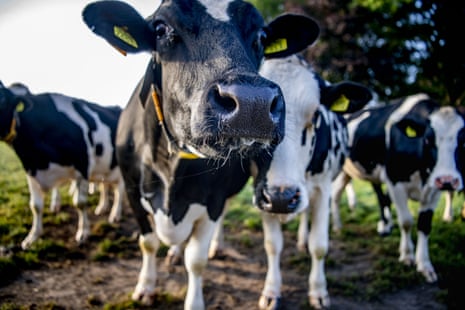
Cows in a meadow at a dairy farm in Zundert, the Netherlands.
Cows in a meadow at a dairy farm in Zundert, the Netherlands. Photograph: Robin Utrecht/REX/Shutterstock

Supported by

11th Hour Project

About this content

Senay Boztas in AmsterdamMon 16 Jan 2023 06.00 EST

Ingrid de Sain is one of thousands of dairy farmers in the Netherlands who says she sometimes lies awake at night. Since a court ruling in 2019 which found the Dutch were breaking European environmental law, her farm of 100 cows in north Holland has been illegal.

Like the other 2,500-plus farmers whose environmental permission was suddenly invalid, she wants a future where she can earn a living and farm legally again.

Fresh produce from 5 Loaves Farm in Buffalo, New York.

The Netherlands is first to face questions scientists believe will soon come to all intensively farmed areas: how can we balance the needs of the environment with the way we farm and grow? Have we reached “peak meat”, like peak oil: so much livestock, so much local pollution, that the only sustainable future is in reduction? They’re questions the US, the world’s largest producer of beef, will also soon have to answer.

In November, the Dutch government announced the first part of a €24.3bn ($26.3bn) plan to buy out up to 3,000 farms and major industrial polluters near protected nature reserves – if necessary, through compulsory purchase, “with pain in our hearts”. It is hugely controversial and only initial outlines have been announced after a year of protests, tense negotiations and a report in October recommending buying out the top 500 or 600 polluters within a year.

The reason is that the emissions of ammonia, nitrogen oxides and nitrous oxide are damaging areas of unique, natural landscape known as Natura 2000 habitats, which the country is bound by EU law to protect. The government says this means reducing local nitrogen compound emissions from between 12% and 70%, including slashing the Netherlands’ 118 million farmed animals by 30% by 2030, according to Netherlands Environmental Assessment Agency projections.

Tjeerd de Groot, a member of the house of representatives in the Netherlands and agriculture spokesman for coalition party D66, advocates halving the numbers of pigs and poultry, raising fewer cows and grazing them on pasture, rather than importing grain and soy for feed. “Everywhere you look, there’s a problem with agriculture,” he said, citing the toll the resulting pollution has taken on biodiversity and water quality. “Yes, we have been a big exporter but now we are paying a big price in the environment.”

The production system of meat and dairy in the Netherlands can no longer be held at this level

Natasja Oerlemans, of the World Wide Fund for Nature Netherlands

Environmentalists believe the Netherlands needs to change all elements of its food system chain to provide a good income for different methods of farming. “All the signs are red,” said Natasja Oerlemans, head of the food team at the World Wide Fund for Nature (WWF) Netherlands. “The production system of meat and dairy in the Netherlands can no longer be held at this level. That’s been clear for years.”

All eyes are on the Netherlands, according to scientists who believe the world needs action to reduce livestock – rather than relying on voluntary pollution reduction or technological measures that may be unproven at scale.

“The major difference to previous measures is a reduction in livestock numbers,” said Dr Helen Harwatt, a senior research fellow at Chatham House and climate policy fellow at Harvard University. In 2019 she led a group of scientists calling for action to ensure livestock declines. “We tend to only see technological approaches to reducing nitrogen at the point of production or reducing leakage to the environment, rather than reducing the amount of agricultural production. It’ll be all eyes on the Netherlands to learn from this transition.”

Livestock – farmed both for meat and for dairy – have major environmental impacts, and Harwatt argues that reductions should be part of a broader green action. “Currently, the aspiration globally is to protect more land for biodiversity, reverse biodiversity loss, reduce greenhouse gas emissions, halt deforestation and increase livestock production,” she said. “There are currently far more livestock on the planet than wild animals, and more than three times the human population. Livestock production is forecast to continue increasing, as diets transition across the world to include more animal products. Something has to give and it shouldn’t be the climate or biodiversity.”

Countries such as Denmark and the US may soon face similar predicaments, according to Pete Smith, professor of soils and global change at Aberdeen University in Scotland. “We demonstrated last year that animal agriculture is responsible for 57% of greenhouse gas emissions from the food system,” he said. “It has a disproportionate effect on the climate. We have too many livestock for the climate to support, and it’s the intensity of farming that’s the issue. I’m not surprised the Netherlands is taking the lead as it has the biggest problem.”

The US, meanwhile, is the world’s largest producer of beef, chicken meat and cow’s milk, and is the second largest producer of pork. “If we compare foods in terms of their nutrient pollution impact per kilogram produced, nothing is higher than beef,” said Harwatt. “Two-thirds of all crop calories produced in the US are used for feed crops. But livestock production contributes less than 1% to US GDP, and at least twice as much food for humans could be produced on land currently used to grow feed crops for farmed animals.”

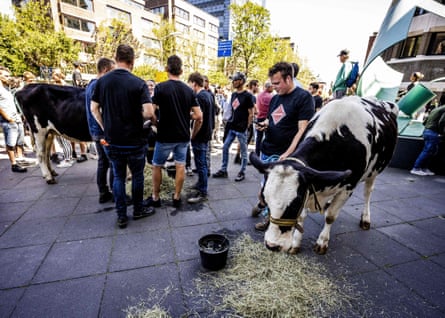
Farmers demonstrate with their cows outside the Dutch house of representatives on 28 June 2022.
Farmers demonstrate with their cows outside the Dutch house of representatives on 28 June 2022. Photograph: Jeffrey Groeneweg/ANP/AFP/Getty Images

The US is set to produce 12,820,000 metric tons of beef and veal this year, according to the United States Department of Agriculture – a slight fall of 6% due to drought conditions, but with increased production of pork and chicken.

Animal farming has been linked to 17,900 US deaths a year from air-based pollution, and the United States Environmental Protection Agency says agricultural runoff is the leading cause of “water quality impacts to rivers and streams, the third leading source of lakes and the second largest source of impairments to wetlands”. One example is the Mississippi River.

While the US has signed treaties such as the G7 2030 Nature Compact, pledging to halt biodiversity loss, and has a new special envoy on biodiversity and water resources, it is not party to the Convention on Biological Diversity – a potential stumbling block to adopting a Dutch-style plan.

Dr Matthew Hayek, assistant professor in environmental studies at New York University, advocates deciding a point of “peak livestock” and aiming for reduction, rather than trusting climate mitigation strategies such as seaweed additives or manure digesters. “They don’t address part of the problem and their technical efficiency hasn’t been shown at levels of scale – especially when you compare with just producing and consuming less,” he said.

“In the United States, in midwestern states especially, there are still way higher levels of nitrogen concentration and ‘impaired waters’ than are federally allowed. But states can carve out exemptions, and this is what has been done across Iowa and a lot of corn- and meat-heavy states. There’s just not the legal mechanisms or social pressure to address them – especially given you have so much social and regulatory capture by the agricultural industries.

“We also have a certain amount of nitrogen pollution that is ‘allowed’. The way that we deal with a lot of ‘point source’ pollution from industrial animal farming is by spreading it out over fields and miraculously turning it into non-point source pollution, which can’t be strictly regulated,” he added.

Hayek believes “soft” policies such as vegan-by-default menus in New York City hospitals could be combined with local regulation, like the 2010 “total maximum daily load” limit to improve water quality in Chesapeake Bay – as well as increasing public awareness. “Often, we are not even choosing to eat meat; we are choosing because we don’t recognise that there’s a choice not to eat meat,” he said. “We’re also not really combining the micro scale with the macro scale in our regulatory frameworks. We’re looking at one farm or one field, but we aren’t asking the question: is that nitrogen load in that watershed higher than that watershed can handle?

In the small, densely populated Netherlands, it might seem easier to address “macro” policy in a country of 17.8 million people.

But political action here is fraught with conflict, competing interests, anger and distrust.

Farmers complain of hanging in uncertainty for years; say pollution sources such as aviation, road travel and industry are scarcely addressed; and assert their sector has made more reductions than any other. “People in the countryside have been innovating for 30 years to reduce nitrogen – there’s no other sector that has done as much,” said Kees Hanse, a farmer and windfarm owner in Zierikzee who is standing in Zeeland elections for the growing BBB Farmer-Citizen Movement. “We don’t want to get ever bigger but we will continue to innovate and keep trying to create safe food resources for people. Nitrogen reductions are not about buying up farmers. It should come from industry, air traffic, shipping, car movements.”

Farmers always followed the rules. If I could make ends meet with 50 cows, why would I milk 100?

Dairy farmer Ingrid de Sain

Meanwhile the idea of suggesting the Dutch should eat less meat was so controversial that it was quietly removed from a 2019 climate awareness campaign by a former agriculture minister.

Some believe that a nitrogen pricing system, part of the new proposals, will help.

“Farmers haven’t done anything wrong: they have just done what the economy dictates,” said MP de Groot. “Because there’s no pricing of pollution, food is too cheap. The damage has been counted by an institute at €7bn a year, in the Netherlands. You should [monetise] that – and then the economy will change.”

Environmentalists like Oerlemans call for scrutiny of other parts of the food chain – including banks and feed producers – as well as help for farmers to transition to better-paid, lower-intensity farming plus services such as nature development, flood plain management and carbon sequestration.

But for dairy farmers like de Sain – one of those the government wants to legalise by making “peak polluters” stop – certainty cannot come soon enough. “Farmers always followed the rules,” she said. “If I could make ends meet with 50 cows, why would I milk 100?”