Bird flu, a virus not known to spread easily among mammals, led to the culling of 50,000 minks in Spain last October. The findings published January 19, 2023 indicated at least one mutation in the virus’ genome, which may make mammal-to-mammal infection easier. Typically, mammals catch the avian influenza directly from infected birds.
The Spanish case study indicates the virus H5N1 is evolving and may be gaining pandemic potential as its mutation is the same mutation that was recorded in the gene of the 2009 pandemic swine-origin influenza A (H1N1) virus, according to the paper in the journalEurosurveillance.
Of the 12 workers at the farm, 11 had come in contact with the minks. While asymptomatic, they were subjected to a nasopharyngeal test…
Maintaining healthy weight through good nutritionContinue watchingRelated content
UP NEXT
02:33Virginia House subcommittee advances transgender athletes bill
02:31RBA reveals scale of Australia’s mortgage crisis in parliamentary hearing
…
…
…
The key to maintaining a healthy weight is not to think of food choices as tools for weight loss but as part of a lifestyle. Cutting back on animal fats can help the body’s insulin functioning, allowing it to burn carbohydrates…
Will Burton, a Weakley County farmer, said the overbearing smell of rotting chicken carcasses is affecting his family: “Just death and rotting carcasses.”(Photo: John Partipilo)
The first sign of something awry was the road closure on the two-lane country road that goes right past Will Burton’s Weakley County farm, his fields, barns and the one-story house he shares with his fiancee and three kids.
White trucks — emblazoned with the seal of the Tennessee Department of Agriculture and “fire and burn” stickers — began rolling past around the same time the family began smelling a terrible, new odor. It was distinct from the smell of chicken waste that has been ever-present since a 16-barn industrial chicken operation, a raw meat supplier for Tyson Foods, moved in two years agoover…
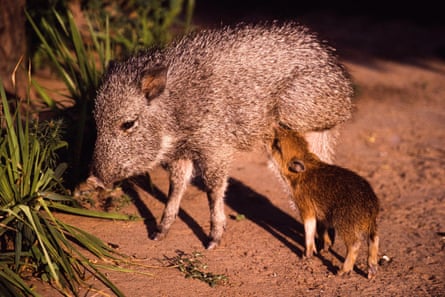
The Chacoan peccary is so elusive that scientists believed it was extinct until its “discovery” in 1975. Today, only 3,000 remain in the inhospitable forests and lagoons of the Gran Chaco region, which stretches across northern Argentina, Paraguay and southern Bolivia, and comprises more than 50 different ecosystems.
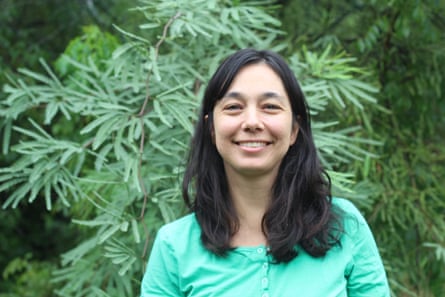
Micaela Camino, who works with the Indigenous Wichí and Criollo communities to protect the animals and their land rights in Argentina, knows how difficult to find they can be. She has only seen one Chacoan peccary, or quimilero, in 13 years since she set up her NGO, Proyecto Quimilero, but has fallen in love with the critically endangered mammal, which looks like a peculiar cross between a boar and a hedgehog.
Micaela Camino, who won a Whitley award in 2022 for her work in helping to protect the Chacoan peccary. Photograph: Whitley Awards
“I was told that the Chacoan peccary was extinct outside protected areas when I first started,” says Camino. “So when we found it, I thought it was great. We set up monitoring to find more in one of the most isolated parts of the dry Chaco. But then the loggers started to come.”
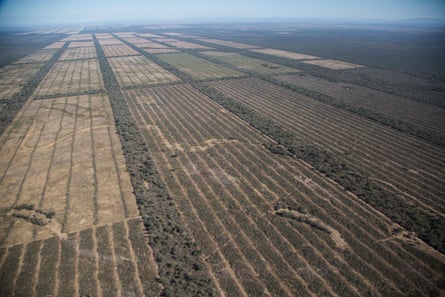
The Gran Chaco, South America’s second-largest forest after the Amazon, is one of the most deforested places on Earth. Every month, more than 133 square miles is lost, cleared for vast soya farms and cattle ranches that export to markets in the US, China and Europe – including UK supermarkets, according to a joint Guardian investigation in 2019. However, the loss is largely ignored on the international stage, receiving little conservation money or celebrity attention in comparison with the Amazon.
In the area where Camino works, the land clearing was turbocharged by Argentina’s 2001 economic collapse. Tree loss highlighted by Global Forest Watch shows the extent of the damage over the past 20 years. The area is home to charismatic species such as the maned wolf, the giant armadillo and the jabiru, many of which are not found anywhere else on Earth.
At current rates of deforestation, the mosaic of life in the Gran Chaco could collapse entirely. The loss of the Chacoan peccary would be guaranteed this time. Unlike the Amazon, there are few academic studies on tipping points and the forest’s waning ability to support itself as the climate changes and land is cleared, but people who live here are seeing the changes.
More than 133 square miles of the Gran Chaco is lost every month to deforestation. Photograph: Nicolás Villalobos/Greenpeace
“The Chacoan peccary cannot survive with such a rapid advance of deforestation. It doesn’t exist anywhere else. Locally, the animal is a good flagship. Jaguars and pumas are charismatic but nobody really likes these animals in the forest,” says Camino.
More than 140 countries, including Argentina and Paraguay, signed an international agreement at the Cop26 climate summit in Glasgow in 2021 to halt and reverse deforestation by 2030. However, economic realities have complicated the picture. Argentina’s economy is collapsing once again, with the annual inflation rate in 2022 hitting its highest level in 30 years, and the country is desperate for dollars, which can be earned by trading commodities such as soy and beef.
“The Gran Chaco has been at a crossroads for a long time,” says Gastón Gordillo, a professor of anthropology at the University of British Columbia. “The 2007 forest law in Argentina did manage to slow some deforestation, but it also created the paradox by establishing legitimate ways of destroying the forest.”
Before the Covid pandemic, civil society organisations teamed up to launch the 2030 initiative to protect what is left of the Gran Chaco in Argentina, the part most affected by land clearing. They called for a change in the economic model of the region, urging local and national governments to move away from extraction, and pushed for greater compliance with forest law. However, a new motorway in Paraguay appears likely to open up more of the region to ranching.
“The agribusiness sector in Argentina is very powerful,” says Gordillo. “We are going through a profound economic crisis. There is a lot of anxiety about what is going to happen. The major concern for the government right now is to get US dollars, and exports from the agribusiness sector are the main source. That means there’s a strong incentive to continue.
“The dichotomy is clear. You either continue destroying forests and the environment or you don’t. But this is an uneven confrontation, unfortunately.”
Camino hopes the Chacoan peccary can become a flagship species to protect the region. Photograph: Andrew Taber/2020 Whitley Awards
For the Chacoan peccary, research indicates there are only 30 years left to save the species, with current deforestation rates meaning all of its habitat outside protected areas will have gone by 2051.
Camino’s conservation efforts, for which she won a 2022 Whitley prize, will focus on priority areas for saving the mammal and helping local people to resist corporate land grabs and stay in their Indigenous lands. She hopes the mammal can become a flagship species to protect the region.
“The only way we can save the Chacoan peccary is by protecting the forest. It represents a unique evolutionary path. It’s an umbrella species for working with the whole ecosystem,” she says.
Hunter Lars Bjork points to fresh tracks in the snow as he lumbers through a whited-out forest in central Sweden, where the biggest wolf hunt in modern times is drawing controversy.
“We have quite a lot of wolves here, we’re actually sitting in a new wolf territory where we are now,” Bjork, a predator expert at the Swedish Hunters’ Association, tells AFP as he settles into a small hunting lodge a few kilometres (miles) outside the town of Vasteras.
This year, Sweden’s hunters are allowed to kill a record 75 wolves — more than twice the number that was allowed to last…
Harry Whittington addresses being shot by Dick Cheney in resurfaced clip
Sign up to our Evening Headlines email for your daily guide to the latest news
SIGN UPI would like to be emailed about offers, events and updates from The Independent. Read ourprivacy notice
Harry Whittington, the prominentTexaslawyer who was shot in the face byDick Cheneyand then infamously apologised to the then-vice president for the accident, has died at the age of 95.
He passed away peacefully at home early on Saturday morning, his wife Mercedes Baker confirmed toThe New York Times.
Whittington grabbed national attention in 2006 when Mr Cheney shot him in a dramatic hunting accident.
Rep. Michael Waltz, R-Fla., joined ‘Fox & Friends First’ to discuss Pakistan-linked militants using American weapons and Biden claiming climate change is a bigger threat than nuclear weapons.
Daniel Aldana Cohen and Samantha Schuyler provided arguments regarding the question “Should We Start Preparing forthe Evacuation of Miami?”in a piece for The Nation on Friday.
Cohen, a UC Berkeley sociology professor, offered the main argument in support of evacuating the major Florida city to both help Floridians and “force municipalities across the United States to get serious about hosting climate migrants in egalitarian ways.”
“It’s urgent for governments and social movements to start…
The top of our atmosphere is about to warm dramatically. The warm-up usually sends a cold blob of air eventually into the eastern half of the U.S. and the Great Lakes region.
The stratosphere is the second layer in our atmosphere and lies about 50,000 feet above Earth. Years ago, researchers discovered what we now call a “Sudden Stratospheric Warming” or SSW for short.
When the stratosphere warms dramatically over the course of a few days, it ripples an influence down into the weather atmosphere, called the troposphere. Think of it as someone jumping on an old school waterbed – the older beds without the baffles. You jumped on the bed and waves traveled across the bed.
For over 90 years, pigs have been transported to the Farmer John slaughterhouse only 10 minutes from downtown Los Angeles.
On February 2nd, 2023 the largest slaughterhouse in the Southwest is finally closing.
For the last 6 years, LA Animal Save and Animal Alliance Network have been bringing compassion and kindness to pigs outside of the slaughterhouse in their final moments.
Now both groups, as well as the entire Animal Save Movement, are coming together to make one final and humble request to Smithfield: SAVE THE LAST PIG.
We have made arrangements for a local sanctuary that is happy and able to provide a forever home to a pig (or two!). Immediate transportation from the Farmer John slaughterhouse to the sanctuary is also in place.
All we need is for Smithfield to say YES!
Please sign this petition and share widely asking Smithfield to do the right thing and show kindness to at least one pig. Millions upon millions of pigs have died at Farmer John over the last 90 years. End these decades of needless slaughter with one final act of mercy: SAVE THE LAST PIG!
Fishers are one of the most trapped species in Vermont
Vermont Wolf Patrol’s 01/27/23 investigation of traps along the D&H Trail outside of West Pawlet, Vermont.
In June 2022, Act 159 An act relating to best management practices in trapping was signed into law in Vermont. Act 159 directed the Vermont Fish & Wildlife Department (VFWD) to “modernize” trapping in the state and improve animal welfare for the thousands of beavers, fishers, otters and other animals legally trapped each year in Vermont. In January 2023, VFWD presented its Report to the Legislature including recommendations to establish “best management practices” (BMPs) including replacing trappers traps with approved BMP traps.
The effort to establish BMPs for trapping has been the work of the fur industry for decades in an effort to minimize the suffering endured by hundreds of thousands of animals that are trapped for their fur each year. Faced with global…


 Photo: iStock
 02:33Virginia House subcommittee advances transgender athletes bill
 02:31RBA reveals scale of Australia’s mortgage crisis in parliamentary hearing