Report at Cop27 shows the world is now deep into the climate emergency, with the 1.5C heating limit ‘barely within reach’
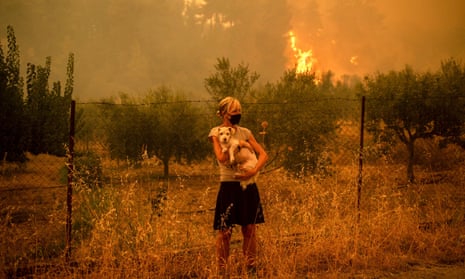
Forest fires approach the village of Pefki on Evia, Greece’s second-largest island, in August during the worst heatwave in decades.Photograph: Angelos Tzortzinis/AFP/Getty Images
The past eight years were the eight hottest ever recorded, a new UN report has found, indicating the world is now deep into the climate crisis. The internationally agreed 1.5C limit for global heating is now “barely within reach”, it said.
The report, by the UN’sWorld Meteorological Organization(WMO), sets out how record high greenhouse gases in the atmosphere are driving sea level and ice melting to new highs and supercharging extreme weather from Pakistan to Puerto Rico.
The stark assessment was published on the opening day of the UN’sCop27climate summit in…
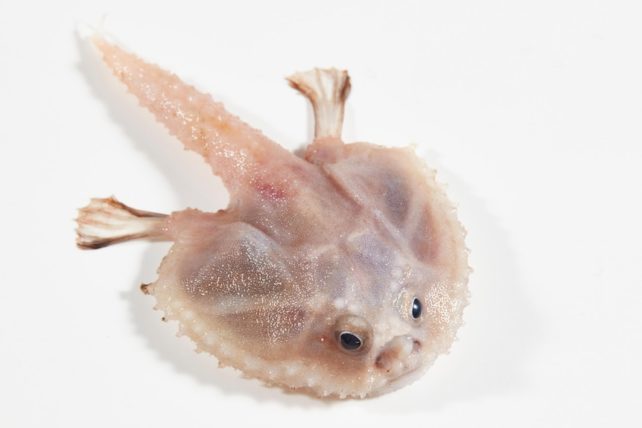
A deep-sea batfish. (Ben Healley/Museums Victoria)
From fish on stilts to creatures of ooze, the strange denizens of the deep uncovered during investigations of two new marine parks located 2,500 kilometers (about 1,500 miles) off Australia’s western coast were a dream come true for researchers.
Even before the expedition departed on 30 September 2022, Museums Victoria (MV) senior curator of marine invertebrates Tim O’Hara anticipated a discovery or two would be made.
“We know the region is covered with massive seamounts formed during the dinosaur era and we know the region sits at a critical juncture between the Pacific and Indian Oceans,” O’Hara said.
“We are really excited about the prospect of discovering new species, perhaps even new branches of the tree of life, which until now have remained hidden beneath the waves in this unexplored region.”
On their way to the new marine park territories that will protect 740,000 square kilometers (about 285,000 square miles) of ocean around Cocos Keeling and Christmas Islands, researchers observed a dazzling array of winged fishes casting themselves into the air.
These animals risk being snapped up by hungry seabirds to escape larger fish, Australian Museum Research Institute fish biologist Yi-Kai Tea explained in a blog post about the voyage.
Using sonar, teams on the research vessel (RV) Investigator mapped the seabed over 35 days of exploration on their 13,000 kilometer voyage, uncovering ancient sea mountains, volcanic cones, canyons and ridges. The extinct volcanoes formed 140 to 50 million years ago.
The sonar revealed Cocos Keeling Islands were twin peaks of a massive sea mountain rising nearly 5,000 meters from the sea floor. A third submerged peak was also identified, 350 meters below sea level.
The crew reported collecting a big treasure haul of species after sampling habitats with small trawl nets from 60 meters down to a depth of 5,500 meters below the surface.
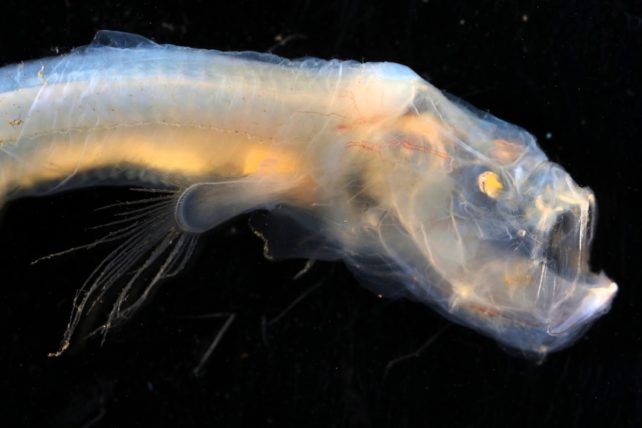
O’Hara estimates up to one-third of these species may be new to science. This includes a potentially new type of blind cusk eel, with loose, gooey see-through skin.
A blind cusk eel. (Ben Healley/Museums Victoria)
“These fish have really reduced eyes. In fact, if you see the picture you’ll find they’re like little golden depressions in the skin. They’ve got really loose, flabby, gelatinous skin and they’re incredibly rare,” MV senior collections manager Dianne Bray told the Australian Broadcasting Corporation.
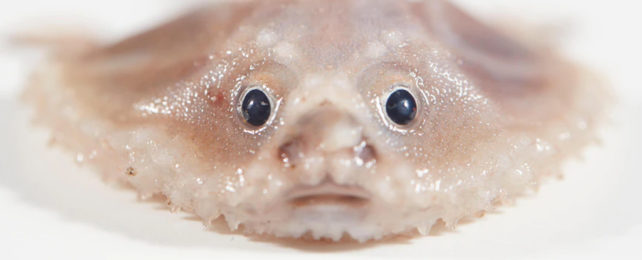
Then there is the adorable deep-sea batfish, which looks like a bit of limbed, well-cooked ravioli with a ‘please love me’ expression on its tiny face. This odd little creature shuffles its way along the seabed on stubby little fin-legs with big ‘feet’.
Deep-sea batfish. (Ben Healley/Museums Victoria)
“These are tiny little anglerfish relatives … they’ve got a tiny little lure that sits in a depression on their snout that they can actually move to attract prey and they essentially walk over the floor on their modified arms and legs,” Bray explains.
Another fish was caught anchored to the ground with bizarrely elongated stilt-fins, with which it can hover effortlessly just above the seafloor, waiting to pounce on unsuspecting prey below.
Once the vessel returns to the mainland, the sampled creatures will be studied by taxonomists who specialize in different animal groups to confirm their identity or describe new species, using DNA extracted from the animals as a vital source of information.
“The research outcomes from this voyage will be invaluable to our understanding of Australia’s deep-sea environments and the impact humans are having on them,” explained MV CEO Lynley Crosswell.
You can catch the latest from this and other RV Investigator expeditions here.
3D rendering of a Neanderthal man. Credit: RaveeCG/Shutterstock
Imagine that you have an unhealthy interest in your neighbors’ lives. Unable to ask them directly, you rifle through their rubbish bins. You find the bones of cooked chickens and try and work out what else they eat.
This is a bit like how archaeologists study the diets of extinct humans such as the Neanderthals and early homo sapiens. This is about more than satisfying curiosity. Understanding our ancestors’ diets may reveal critical clues about their evolutionary success or failure.
A recent study which analyzed zinc from the tooth of a Neanderthal from Spain reveals they were mainly carnivores, wherever they lived. This discovery helps explain why they became extinct.
Neanderthals dominated Europe and western Asia during the last 200,000 years of the Ice Age, while homo sapiens were developing in Africa. Their remains and characteristic stone tools are abundant across Europe and the near East, and in smaller numbers as far east as Tadjikistan (which shares a border with China).
The Neanderthals lived in the heartlands of the Eurasian steppes (the largest grassland in the world, extending from Hungary to China), an area not rich in nutritional vegetables. But surveys of their campsites have revealed they ate nuts, fruits, mushrooms, shellfish and other food that can be easily gathered.
Cut marks left by stone tools on this wing bone of a velvet scoter (sea duck), show that. smaller animals were part of Neanderthals’ diet. Credit: Sabine Gaudzinski-Windheuser, Author provided
Neanderthals were a species constantly on the move who needed a high calorie diet. The butchered remains of horse, reindeer, bison and mammoths that Neanderthals left on their campsites reveal they hunted the most dangerous animals in their world. But that doesn’t tell us whether their diets varied from group to group across their massive range.
For the last two decades, advances in molecular biology have deepened archaeologists’ understanding of early human diets. The cool conditions in northern Europe, such as France and Germany, help preserve collagen in fossil bone. With a technique called stable isotope analysis we can recover minute amounts of carbon and nitrogen from the collagen in early human bones, and find out where the protein they ate came from. Isotopes are groups of atoms belonging to the same element but have different mass. Studies of these bones’ isotopes have shown Neanderthals in northern Europe got 80–90% of their protein from animals. That’s up there with the wolves and hyenas. In the arid southern parts of Europe we’re not so lucky. Collagen in fossil bone easily disintegrates in warmer climates, taking with it the clues to southern Neanderthals’ diets.
But over the last year archaeologists have found that traces of zinc in Neanderthal bones also preserve information about the diet of the ancient person who they belong to.
The impact from a spear on this pelvic bone of an adult fallow deer shows Neanderthals were hunting with bayonet-style spears around 120,000 years ago. Credit: Sabine Gaudzinski-Windheuser., Author provided
Studies over the last few years of zinc isotopes show they have huge potential for unlocking clues about the evolution of life such as the rise of eukaryotes, a group of organism which humans belong to, and the complexity of marine food webs.
Expert hunters
The zinc level in carnivores’ bones is lower than those of their prey. The difference is not affected by age, sex or decay over time. Zinc ratios can be measured from samples as small as 1mg of bone. Even these tiny amounts allow an accurate assessment of an animal’s place in the food chain when they were alive.
The recent study’s analysis of zinc from the tooth enamel of a Neanderthal, who lived and died around 150,000 years ago in the Spanish Pyrenees, gives new insights into the diet of ancient humans. Zinc isotopes were analyzed from 43 teeth of 12 animal species living in a grassland around the Los Moros I cave in Catalonia, Spain. These included carnivores such as wolf, hyena and dhole (also known as mountain wolf), omnivorous cave bears, and herbivores including ibex, red deer, horse and rabbit. The results brought to life a food web of the Pleistocene steppe, a system of interlocking food chains from plants up to the top carnivores. The zinc in the Neanderthal’s tooth had by far the lowest zinc value in the food web, revealing they were a top level carnivore.
Somewhere between 50,000-60,000 years ago Neanderthals used small handaxes such as this to butcher mammoths at Lynford in eastern England. Credit: Mark White, Author provided
The bone heaps on Neanderthal campsites show they hunted big animals in large numbers. These heaps appear even in areas of the landscape where humans would be at a disadvantage, such as at the edge of water courses. Imagine trying to bayonet an adult bison or horse. Both weigh almost a ton. The new isotope study reveals Neanderthals’ main survival strategy was to hunt whatever animals could be found wherever they were in the world. Small animals and vegetables probably amounted to little more than side dishes. Their game plan was to shoot first, and answer questions later.
Broader diets made us more resilient
Isotopes taken from sites across Europe from remains of the Homo sapiens groups who inherited Pleistocene Eurasia from the Neanderthals reveal they had broader dietary range. Plants, birds and fish were main courses for these early humans. The Pleistocene was a the grassland-steppe ecosystem that dominated Siberia during the Pleistocene and disappeared 10,000 years ago. It had a remarkably unstable climate and changed from dry grasslands and wet tundras to coniferous woodlands, constantly shaking up the variety and number of large herbivores grazing there.
So an omnivorous diet would have made these people far more resilient than those who relied on big game hunting. We don’t know much about what happened to Neanderthals when big game populations collapsed. If reindeer failed to show, what could they do? But with rapid progress in biomolecular science, I doubt we will have to wait long to find out.
RURAL EAGLE POINT, Ore. – Jackson County Sheriff’s Office (JCSO) responded to a call for a reported gunshot wound victimtoday at 12:24 p.m.The victim was hunting in the area of Conde Creek Rd. and South Fork Little Butte Creek Rd. with two partners when he was shot in the leg from close range. The victim yelled out and the suspect left the scene. A witness spotted a white Chevy truck with a canopy leaving the area.
Upon preliminary investigation this incident appears to be a hunting accident, further details are unclear at this time. JCSO detectives have assumed the investigation and are following additional leads. U.S. Forest Service Law Enforcement, Bureau of Land Management Law Enforcement, Oregon State Police, JCSO, and Ashland Police Department are attempting to locate the suspect vehicle.
After being shot the victim drove to the intersection of West…
Published:Nov. 5, 2022 at 11:58 AM PDT|Updated:5 hours ago
CASS COUNTY, Texas (KSLA) – A man has been arrested for allegedly accidentally shooting another man with a 12 gauge shotgun while hunting.
On Nov. 5, at 10:30 a.m., the Texas Game Warden was dispatched to a hunting accident at Black Point, on public hunting land in Cass County, Texas.
The accident occurred with Daniel Abston, 57, fired a 12 gauge shotgun in the direction of a sound and movement in the woods. Abston did not identify his target before firing the weapon and accidentally struck Jason Mills, 49.
The victim was airlifted to a hospital in Shreveport, Louisiana.
Abston was arrested and charged with deadly conduct, unlawful possession of a firearm by a felon…
1960s: 1,030 accidents, 142 hunters killed.
1970s: 414 accidents, 49 hunters killed*
1980s: 146 accidents, 45 hunters killed.
1990s: 319 accidents, 29 hunters killed.
2000s: 251 accidents, 17 hunters killed.
[But just wait until we tally up this year (It’s been a crazy one so far… !]
It’s the opening of the regular firearms deer season in our area on Saturday and, like most recent years, the Department of Natural Resources is putting out its annual safety message. I know some folks like to pooh-pooh such things. It’s become fashionable to dismiss those “nanny state” messages as just another example of government overreach. But here’s the thing. All that nanny overreaching has made a huge difference when it comes to your odds of being shot while out in the woods this deer season. In years past, heading out in the woods on the deer opener was akin to entering a war zone and it took a serious toll on hunters. I never realized just how much of a toll until I was paging through one of my mother’s scrap books and found a small clipping from the 1930s, naming one…
If I could find a way to zap a pheasant in the air without killing it, to have a second or two to hold it and look over its feathers and admire their sheen and the length of the tail growing late into the season before it wakes up and takes flight out of my hand, I probably would. However, the hard work of my dog, the limits of our technology afield, and the nature of the hunt itself produce a sense of obligation to pull the trigger, which results in a finality that is both sweet in the form of success and sorrowful in the taking of something so beautiful. That and stunning an animal in such a manner likely crosses a line into wildlife harassment, which as I mull this ethical scenario over on long walks in the field and…
EDDY COUNTY, N.D. (KMOT) – Two North Dakota men are facing criminal charges after a hunting dispute in October.
A game warden said he was called to a section of land in Eddy County on Oct. 21 where 69-year-old Jeffrey Erman, of Bismarck, was involved in an argument with 23-year-old Dustin Wolf, of West Fargo, and group of other West Fargo men.
One of the men, Jacob Sweere, recorded the incident and posted a video on YouTube. The video had 1.8 million views as of Thursday.
In the video, viewers can see Erman driving up to the hunters set up on the boundary line of the field, yelling profanities, and telling them he would call off his “friend” the game warden if they paid him $300.
An affidavit indicates that Wolf told game wardenshe had permission…
November 3, 2022—As bird flu outbreaks in wild birds and poultry continue across the U.S., the country approaches a record number of birds affected compared to previous bird flu outbreaks. Since early 2022, more than 49 million birds in 46 states have either died as a result of bird flu virus infection or have been culled (killed) due to exposure to infected birds. This number is nearing the 50.5 million birds in 21 states that were affected by the largest bird flu outbreak that occurred in 2015. Even so, the number of states affected in 2022 is already more than double the number of states that were affected in 2015. Although the overall risk to the general public from the current bird flu outbreaks remains low, it is important that people…


 A deep-sea batfish. (Ben Healley/Museums Victoria)