Poultry farmers call for birds to be kept inside to combat bird flu

Chicken and egg producers call for housing order for poultry and captive birds to be extended across UK
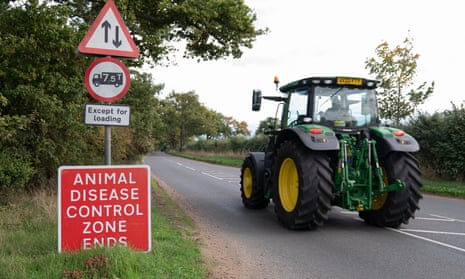
A tractor passes a sign marking the border of an Avian Influenza Prevention Zone near Eccles in Norfolk.
A tractor passes a sign marking the border of an Avian Influenza Prevention Zone near Eccles in Norfolk. Photograph: Joe Giddens/PA

Tom LevittWed 12 Oct 2022 09.16 EDT

https://www.theguardian.com/world/2022/oct/12/poultry-farmers-nationwide-housing-order-combat-bird-flu-uk

Poultry farmers have called for a UK-wide housing order to be brought in as soon as possible, after an upsurge in bird flu outbreaks in the past month.

A compulsory housing order for all poultry and captive birds in Norfolk, Suffolk and parts of Essex came into force on Wednesday. It applies to everyone who keeps birds – both commercial flock keepers and non-commercial premises such as back yards, hobby flocks or pets.

It comes after a significant increase in bird flu cases in the east of England region, with 27 outbreaks in the past month alone across the three counties. Christmas goose producers are among those to have been badly affected.

The UK’s chief vet, Christine Middlemiss, said she expected to see the number of bird flu cases on farms to continue to rise over the coming months as migratory birds return to the UK.

Advertisement

https://b549d63bafc3741d3e90ef358cdda7e6.safeframe.googlesyndication.com/safeframe/1-0-38/html/container.html

In the past month there have also been outbreaks in Somerset, Oxford, Staffordshire, North Yorkshire, Lancashire, Devon and Cheshire.

In November last year, the chief veterinary officers for Wales, England, Scotland and Northern Ireland agreed to bring in a compulsory housing order across the UK. This was only lifted by the chief vets from the four devolved nations in May this year.

Farming groups are calling on for the new regional compulsory housing order to be extended across the whole of the UK as soon as possible.

“The sheer persistence of avian influenza over the past year, coupled with soaring energy and feed costs, has put the whole British poultry sector under huge emotional and financial pressure. Given the recent rise in avian influenza cases and the distress they cause for farming families, the implementation of housing measures in the east of England is a necessary step.

“The number one priority for poultry farmers has always been the health and welfare of their flock … That is why the National Farmers Union is now urging the Department for Environment, Food and Rural Affairs (Defra) to consider expanding the regional housing measures on a national basis to reflect any increase in the levels of risk across the country,” said NFU poultry board chair James Mottershead.

The British Poultry Council said a compulsory housing order for all farmed birds was necessary “as soon as possible to prioritise the wellbeing of our farmers, the viability of their businesses and the safety of all birds”.

UK egg producers also said they would like to see the initial compulsory housing order extended across the UK.

Free-range egg producers said their support was conditional on the UK aligning with EU proposals to allow eggs to continue to be labelled as “free range”, even if the birds are not allowed outside.

The European Commission has put forward plans for scrapping the time limit on the marketing of eggs as free range if chickens are forced to be housed to reduce the risk of outbreaks of bird flu.

Over the last year, the UK has faced its largest ever outbreak of bird flu with more than 160 cases confirmed since late October 2021.

Sign up to First Edition

Free daily newsletter

Archie Bland and Nimo Omer take you through the top stories and what they mean, free every weekday morning

https://www.google.com/recaptcha/api2/anchor?ar=1&k=6LdzlmsdAAAAALFH63cBVagSFPuuHXQ9OfpIDdMc&co=aHR0cHM6Ly93d3cudGhlZ3VhcmRpYW4uY29tOjQ0Mw..&hl=en&type=image&v=vP4jQKq0YJFzU6e21-BGy3GP&theme=light&size=invisible&badge=bottomright&cb=m8oj2qlqd2kwPrivacy Notice: Newsletters may contain info about charities, online ads, and content funded by outside parties. For more information see our Privacy Policy. We use Google reCaptcha to protect our website and the Google Privacy Policy and Terms of Service apply.

“We’ve been seeing unprecedented levels of the virus around the UK this year, and usually numbers increase as winter approaches, so the situation could get even worse,” said Prof Wendy Barclay, head of the department of infectious disease at Imperial College London.

“The outbreak is being closely monitored by the Animal and Plant Health Agency and Defra, but it is clear that farmed birds that are exposed to wild birds are vulnerable,” she added.

Defra said any decision on when to reintroduce national housing measures would be based on the latest scientific and ornithological evidence and veterinary advice.

The UK Health Security Agency continue to advise the risk to public health from the virus is very low and the Food Standards Agency advice remains unchanged, that avian influenzas pose a very low food safety risk for UK consumers. Properly cooked poultry and poultry products, including eggs, are safe to eat.

‘It’s a serious problem’: battle to save Griffon vulture heats up in Cyprus

Eight of the birds of prey are released into wild on island where use of poison bait has left them virtually extinct

A Griffon vulture flies after being released from a holding pen in the highlands of Limassol, Cyprus.
A Griffon vulture flies after being released from a holding pen in the highlands of Limassol, Cyprus. Photograph: Peter Martell/AFP/Getty Images

Helena SmithMon 10 Oct 2022 00.00 EDT

They’re vital for the ecosystem, play a crucial role in reducing greenhouse gas emissions and, for bird lovers, are an ecotourism delight. But in Cyprus, where prolific use of poison bait has made the Griffon vulture virtually extinct, campaigners are taking action.

“Island-wide, we had just eight,” says Melpo Apostolidou at BirdLife Cyprus, which is coordinating the EU-funded life with vultures project to boost what was once a thriving population. “That’s the lowest number of any country in Europe.”

The battle to revive the Mediterranean island’s most threatened bird of prey was turbocharged last week when eight Griffons, imported from Spain, were released into the wild. For ornithologists, the move has not come a moment too late. “There is no time to lose,” says Apostolidou. “Restocking is vital. We released 15 in September and will be bringing in another 15 next month before releasing them as well in the spring.”

A Griffon vulture flies inside a holding pen.
A Griffon vulture flies inside a holding pen before its release in the highlands of the Limassol district, in southern Cyprus. Photograph: Roy Issa/AFP/Getty Images

Changing farming techniques and decreasing staples of available food are partly to blame for the decline of a bird whose scavenging role as a recycler of natural carcasses is deemed essential. So, too, is the loss of natural habitats and collisions with overhead power lines.

In Cyprus, a culture of using banned poisons to reduce perceived pests, especially foxes and dogs, is also seen as the greatest cause of the Griffon becoming critically endangered.

Advertisement

https://c193c34df71ca7301d87728c2868b28e.safeframe.googlesyndication.com/safeframe/1-0-38/html/container.html

Over the past year, numbers have dropped precipitously as the scavengers have fed off poisoned carrion. “It’s a serious problem,” said Nikos Kassinis, a senior officer at the island’s Game and Fauna Service.

Wildlife vet Constantinos Antoniou holds a Griffon vulture outside a holding pen
Wildlife vet Constantinos Antoniou holds a Griffon vulture outside a holding pen before attaching a GPS tracker to it. Photograph: Peter Martell/AFP/Getty Images

After centuries of having Griffon vulture colonies nationwide, there is now only one nesting colony high up in the Episkopi cliffs in the British sovereign base area.

Advertisement

Kassinis said authorities had also stepped in with the Game and Fauna Service setting up feeding stations for the birds. Earlier this year dog units – border collies specially trained to detect poison bait and poisoned victims – began patrolling rural areas.

Replenishment of the species would be good for nature and indicative of the local ecosystem’s overall health, conservationists claim. Recent studies have shown that vultures not only provide what the EU project described as “a cost-effective and environmentally beneficial carcass disposal service,” but play a central role in regulating the spread of diseases such as rabies.

Spain has Europe’s largest population of Griffon vultures, with the latest imports to be released from an acclimatisation aviary in the mountains north of the coastal city of Limassol. “We’ll be monitoring them closely,” said Apostolidou, adding that the Griffon have been tagged with GPS transmitters to track their movements.

Andreas Christoforou, a district officer in the Game and Fauna Service, stands with his dog Sophie, a Border Collie specially trained to search for illegally laid poison, in the highlands of Limassol district in Cyprus
Andreas Christoforou, of the Game and Fauna Service, stands with his dog Sophie, which is specially trained to search for illegal poison. Photograph: Peter Martell/AFP/Getty Images

Advertisement

https://c193c34df71ca7301d87728c2868b28e.safeframe.googlesyndication.com/safeframe/1-0-38/html/container.html

“The Spanish birds are juveniles, and it is very important that they mix and learn from the local birds. So far we’re pleased to report that although it’s still early, some of them are doing just that.”

Tales of the prowess of Griffon vultures are legendary. Ornithologists recorded one bird, named after the wine god Dionysus, watching over the egg of a would-be hatchling in the Greek Rhodope Mountains for 33 days after losing his female mate at the time of incubation. The feat was seen as indicative of the vultures’ parental skills.

In Greece as in Bulgaria, local populations, once also dangerously low, have gradually been restored. But with numbers so down in Cyprus, campaigners say they cannot afford to be sanguine.

“Imagine if we hadn’t brought in any birds at all,” says Apostolidou. “The Griffon vulture would be extinct, but dealing with the poisoning problem must also now be a priority.”

https://www.theguardian.com/environment/2022/oct/10/its-a-serious-problem-battle-to-save-griffon-vulture-heats-up-in-cyprus

Hunter gets impaled by lost arrow in Routt County

Exposing the Big Game's avatarCommittee to Abolish Sport Hunting Blog

by:Dara Bitler

Posted:Oct 10, 2022 / 06:53 AM MDT

Updated:Oct 10, 2022 / 12:50 PM MDT

SHARE https://kdvr.com/news/local/hunter-gets-impaled-by-lost-arrow-in-routt-county/

ROUTT COUNTY, Colo. (KDVR) —Routt County Search and Rescuesays crews rescued a hunter last week who was impaled by a lost arrow.

RCSAR said the incident happened after a hunter traveled off trail. The arrow was presumed to have been released earlier in archery hunting season.Bull moose attacks archery hunter in Larimer County

The injured hunter was rescued by a medical helicopter. The hunter’s condition has not been released.

ADVERTISING

RCSAR said this is the second time a hunter has been impaled by a lost arrow in the last two years in Routt County.

“While we know that it is not always feasible, bow hunters should make every effort possible to find a lost arrow as the razor sharp broadheads pose a very real risk to…

View original post 82 more words

Illinois deer crashes 4th worst in the US, insurer says

Exposing the Big Game's avatarCommittee to Abolish Sport Hunting Blog

by:Jim Hagerty

Posted:Oct 10, 2022 / 06:19 PM CDT

Updated:Oct 11, 2022 / 10:59 AM CDT

SHARE https://www.mystateline.com/news/antler-alert-rockford-drivers-hit-more-deer-during-hunting-season-insurer-says/

ROCKFORD, Ill. (WTVO) — As more hunters hit the woods, more deer are running into Stateline roads.

That means with the start of the 2022 Illinois bowhunting season, deer-versus-car collisions are starting to see an uptick.

Tina Johnson, owner of Alpine Body Shop in Rockford, said she’s already seen a handful of cars that have collided with deer since the hunting season began Oct. 1.

ADVERTISING

Most of the cracked-up cars Johnson has seen so far have had frontend damage that can cost anywhere from $2,000 to $5,000 to fix. But she said it doesn’t take much for that cost to go up.Driver killed in South Beloit racetrack crash

“Especially if it hits the bumper sensor area,” Johnson said. “The sensors and possibly the airbags will go off. If the…

View original post 363 more words

Soon Han: 80-year-old California woman mauled to death by two hunting dogs during morning walk

Exposing the Big Game's avatarCommittee to Abolish Sport Hunting Blog

San Bernardino County Animal Control took custody of the dogs, which were both Dogos Argentinos from a nearby home

By Simran Agarwal
Published on : 00:22 PST, Oct 11, 2022

https://meaww.com/80-year-old-woman-california-kill-two-hunting-dog-morning-walk

California News

Soon Han: 80-year-old California woman mauled to death by two hunting dogs during morning walkThe San Bernardino County Sheriff-Coroner Department said in a news release that deputies found 80-year-old Soon Han unresponsive on roadside (Larry W Smith/Getty Images)

ADVERTISEMENT

https://3774a410bed30267f3f8f2fac249b131.safeframe.googlesyndication.com/safeframe/1-0-38/html/container.html

SAN BERNARDINO COUNTY, CALIFORNIA:ACaliforniawoman named Soon Han wasmauled to deathby two hunting dogs that escaped from a nearby house and attacked her during a morning walk. On Oct 7, a Friday morning, the 80-year-old Han was found dead on the side of the road in the remote Baldy Mesa area of the Mojave Desert.

ADVERTISEMENT

The dogs, known as Dogo Argentinos, were taken to ashelter. Han “suffered major injuries during the attack and was pronounced dead at the scene,” the San Bernardino County coronerreported

View original post 334 more words

Police find body of hunter reported missing near pond in Cohasset, Massachusetts

Exposing the Big Game's avatarCommittee to Abolish Sport Hunting Blog

https://www.wcvb.com/article/missing-hunter-cohasset-massachusetts-lily-pond/41567244#

WCVB

Updated: 5:14 PM EDT Oct 9, 2022Infinite Scroll EnabledPlay VideoSHOW TRANSCRIPT

GET LOCAL BREAKING NEWS ALERTS

The latest breaking updates, delivered straight to your email inbox.Your Email AddressSUBMITPrivacy Notice

COHASSET, Mass. —

The body of a Massachusetts man was found more than 12 hours after he was reported missing from a hunting trip in Cohasset.

Cohasset police Chief William Quigley said law enforcement located the body of 56-year-old Joseph Whooley, of Quincy, shortly before 11 a.m. Sunday near Lily Pond.

https://e094be206ba14b29411b2fac529c8534.safeframe.googlesyndication.com/safeframe/1-0-38/html/container.html

Advertisement

Whooley was reported overdue and missing by family members Saturday evening, which is when authorities began an exhaustive air and ground search.

At 11:50 a.m. Sunday, the Cohasset Police Department tweeted that Whooley had been located and that “the situation has resolved itself.”

“We extend our deepest condolences to the family of the deceased and thank our mutual aid partners for their assistance with the…

View original post 51 more words

Michigan hunter survives after Alaskan moose hunt adventure ends with plane crash

Exposing the Big Game's avatarCommittee to Abolish Sport Hunting Blog

Susan Bromley

Hometownlife.com https://www.hometownlife.com/story/life/2022/10/10/michigan-man-on-alaskan-moose-hunt-adventure-survives-bush-plane-crash/69520773007/

View Comments

0:00

0:47

https://imasdk.googleapis.com/js/core/bridge3.539.0_en.html#goog_1657372683

The float plane carrying Casey West and Cal Stefanko crashed in Alaska on Sept. 18. The Michigan friends sustained minor injuries, while their pilot escaped with cuts to his head requiring 17 stitches.

Casey West left Michigan and headed into the Alaskan wild for an unforgettable adventure.

He feels lucky to have gotten out alive after it ended in a plane crash.

“It was an experience,” West, a 36-year-old Brandon Township resident, said. “Hopefully I never have this exact experience again, but it was an adventure.”

West, a nurse at Ascension Genesys Hospital in Grand Blanc, was excited and worry-free as he set out on his lifetime dream of an Alaskan moose hunt.

This was a stark contrast to his wife, Samantha, who increased her husband’s life insurance policy ahead of the trip. She was concerned over the safety of a bush plane, the biggest risk of such a trip, with about 10 crashes per season.

“That is the only way to get around out there — flying by bush plane,” West said.

https://84db99445782ec09fc4b21bcbd5c498d.safeframe.googlesyndication.com/safeframe/1-0-38/html/container.html

View original post 1,045 more words

State Wildlife Dept. says check your county’s burn ban status before heading out for hunting season

Exposing the Big Game's avatarCommittee to Abolish Sport Hunting Blog

by:Katelyn Ogle/KFOR

Posted:Oct 10, 2022 / 10:48 AM CDT

Updated:Oct 11, 2022 / 10:55 AM CDT

SHARE https://kfor.com/news/local/state-wildlife-dept-says-check-your-countys-burn-ban-status-before-heading-out-for-hunting-season/

OKLAHOMA CITY (KFOR) – It is deer archery season in Oklahoma. With the dry conditions across the state, Oklahoma wildlife experts want you to be extra careful with campfires.

“One of the great things about deer camp is having a campfire,” said Lance Meek, an education specialist with the Oklahoma Department of Wildlife Conservation.Twin Lakes fire station reopens after devastating fire last year

Right now, Oklahoma deer hunters are planning their hunting trips – packing up their bows and arrows, and dreaming about gathering around a nice warm campfire.

ADVERTISING

However, Meek said if they’re camping out in one of the 44 counties under a burn ban…

“You cannot have a campfire,” said Meek. “Even in a designated fire pit or any of that, you can’t have a…

View original post 266 more words

Minnesota boy, 12, dies from gunshot wound in hunting accident

Exposing the Big Game's avatarCommittee to Abolish Sport Hunting Blog

The Cass County Sheriff’s Office updated the condition of the boy who was shot Sunday, Oct. 9, in Moose Lake Township, north of Motley.

Cass County Sheriff's logo.
Contributed

ByDispatch staff report

October 11, 2022 11:23 AM

SHARE https://www.bemidjipioneer.com/news/minnesota/minnesota-boy-12-dies-from-gunshot-wound-in-hunting-accident

We are part of The Trust Project.

MOTLEY — A 12-year-old boy was shot and killed while squirrel hunting with family members near Motley, Minnesota.

The boy died Sunday, Oct. 9, at a Twin Cities-area hospital, the Cass County Sheriff’s Office reported on Tuesday. An autopsy is scheduled with the Hennepin County Medical Examiner’s Office.

Sheriff’s deputiesresponded to the shooting incident, reported at 8:19 a.m. Sunday in Moose Lake Township, north of Motley. According to a news release from Cass County Sheriff Tom Burch, a family from St. Paul was hunting squirrels on public land in the area when a 12-year-old boy was accidentally shot by his 47-year-old uncle…

View original post 102 more words

US supreme court to hear case on California’s ban on extreme confinement crates

McDonald’s allows its suppliers to confine pigs in gestation crates like these at factory farm operations.
McDonald’s allows its suppliers to confine pigs in gestation crates like these at factory farm operations. Photograph: Humane Society of the United States

A ruling against the state’s Prop 12 animal welfare law could affect a range of regulations across the country

Supported by

11th Hour Project

About this content

Marina BolotnikovaMon 3 Oct 2022 06.00 EDT

Next week, the US supreme court will hear oral arguments in a case that could put climate, public health and animal welfare regulations across the country on the chopping block – from California’s ban on gas-powered cars by 2035 to state bans on food packaging that contains BPA or lead.

The case will consider the constitutionality of California’s Proposition 12, a law that bans the sale of meat and eggs from animals raised using certain kinds of extreme confinement. The pork industry has been fighting Prop 12 since it passed by ballot measure in 2018 – with more than 62% of the vote and the backing of animal advocacy groups like the Humane Society of the United States – because it bans gestation crates: metal enclosures where pregnant pigs are kept for most of their lives that are so small that they can’t turn around or stretch their limbs.

The crates are standard practice in the pork industry even though, according to a supreme court brief filed by 378 veterinarians and animal welfare scientists, they “cause profound, avoidable suffering and deprive pigs of a minimally acceptable level of welfare”. According to a brief by the American Public Health Association, the Infectious Diseases Society of America and other groups, they can also contribute to disease spread to humans.

All of the pork industry’s legal challenges to Prop 12 so far have been unsuccessful, but in March, the supreme court agreed to hear its case. The US Department of Justice has since filed a brief backing the pork industry, a move that surprised many observers, especially since a group of 15 Democratic and independent senators previously urged the solicitor general to support Prop 12. (The Trump administration also briefed in favor of the pork industry when the case was being considered by a lower court.)

In this 2014 file image, pregnant sows are housed in crates at a pig farm in Dalhart, Texas.
In this 2014 file image, pregnant sows are housed in crates at a pig farm in Dalhart, Texas. Photograph: Richard Tsong-Taatarii/Minneapolis Star Tribune/Zuma Press Inc/Alamy Stock Photo

A decision is expected between December and next June.

Russia-Ukraine war live: Nato ‘closely monitoring’Russia’s nuclear forces; Zelenskiy says Russia trying to draw Belarus directly into war

https://imasdk.googleapis.com/js/core/bridge3.538.0_en.html#goog_63979558

https://imasdk.googleapis.com/js/core/bridge3.538.0_en.html#goog_1345626171

https://imasdk.googleapis.com/js/core/bridge3.538.0_en.html#goog_1751371923

At issue is whether Prop 12 violates the constitution’s “dormant commerce clause” by imposing an unreasonable burden on interstate trade. While several states ban gestation crates within their borders, California’s law takes the added step of banning the sale of pork produced with gestation crates anywhere in the world. The National Pork Producers Council and the American Farm Bureau Federation, the two lobby groups that brought the case, argue that because California imports almost all the pork it consumes from other states, Prop 12 would force the industry to overhaul its practices to cater to Californians.

Neither organization provided comment for this story.

That the supreme court took up the case at all surprised some court watchers, because the pork industry’s argument breaks with past precedent. “The constitution does not guarantee the right to pork producers to have an uninhibited national market,” said Kelsey Eberly, a legislative policy fellow at Harvard law school. “The whole idea behind the commerce clause is to prevent discrimination on interstate commerce,” she said; if, for example, California were holding out-of-state pork to a different standard than pork raised in-state, which is not the case with Prop 12.

Advertisement

This could signal the court’s interest in putting stricter limits on states’ ability to regulate commerce. “A lot of the time, the United States supreme court hears cases not so much to resolve the dispute between these particular parties, but to announce doctrine,” said Mark Rosen, a professor at the Chicago-Kent College of Law, who co-authored a brief defending the constitutionality of Prop 12.

It’s common for state and local laws to regulate the sale of goods produced in other states, which means that if Prop 12 goes, these too could be at risk of invalidation. According to a recent Harvard Law School report by Eberly, these could include low-carbon fuel standards, state bans on carcinogenic ingredients in personal care products, and lead and BPA in food containers, among others. California’s planned ban on gas cars would also be at risk, as well as animal welfare laws, like California’s ban on fur sales and hundreds of cities’ bans on selling animals bred in puppy mills.

Lobby groups for other industries have filed briefs urging the supreme court to overturn Prop 12, including the pharmaceutical industry and producers of foie gras – a meat product made by force-feeding ducks to engorge their livers, which has been banned in California and New York City.

Part of the pork industry’s case relies on the argument that Prop 12 would force big changes throughout the entire industry, not just on farms producing pork for California, because, it argues, “it is impracticable, in the complex, multi-stage pork production process, to trace a single cut of pork back to a particular sow housed in a particular manner.”

But many observers have cast doubt on this claim, including the UC Davis agricultural economists Richard Sexton and Daniel Sumner, who have studied the economic impacts of Prop 12 with funding from the National Pork Board. “Not only are [the industry’s] arguments flawed as a reflection of basic economic incentives, but they are factually implausible,” Sexton and Sumner wrote in a brief to the supreme court.

Some pork sold nationwide is already labeled crate-free, a claim that requires tracing. “That’s modern agriculture,” Sexton said. “Products are being differentiated in a whole variety of ways: organic, GMO-free, different properties related to animal welfare, antibiotic-free.”

Less than 10% of North American pork production will need to convert to crate-free to satisfy California’s demand, Sexton said. “So it’s a much smaller infringement in reality on commerce and pork production in the US than is being claimed.”

While the pork lobby claims that Prop 12’s requirements are unreasonably onerous, large pork companies have told their investors a different story, indicating that they would be able to comply without difficulty. In a 2020 earnings call, the Tyson CEO, Donnie King, said Prop 12 represents only 4% of its production and that the company “can do multiple programs simultaneously, including Prop 12”. Hormel said in a statement that it “faces no risk of material losses from compliance with Proposition 12”. Smithfield, the country’s biggest pork producer, stated in its 2021 sustainability report that it would comply with Prop 12 and a similar law passed in Massachusetts. A representative from the California department of food and agriculture confirmed the “relatively straightforward” process of pig tracing after visiting pork producers across the country.

Pork products displayed on a shelf at a Safeway store in San Francisco, California.
Pork products displayed on a shelf at a Safeway store in San Francisco, California. Photograph: Justin Sullivan/Getty Images

Advertisement

Sexton and Sumner’s research found that California retail pork prices would increase about 7.2% as a result of Prop 12, but would slightly decrease elsewhere in North America. The law applies only to whole, uncooked pork cuts, like bacon and pork chops, not ground pork, combination products like hotdogs and pizzas, or pre-cooked products like deli meats. Pork products not covered by the law won’t see price increases.

While the supreme court’s pro-business inclination has made many advocates worried about Prop 12, the outcome is unpredictable. Two of the court’s conservative justices, Neil Gorsuch and Clarence Thomas, don’t believe the dormant commerce clause is appropriate doctrine, Rosen said, “and there may be others who haven’t yet declared themselves”.

“I’m hoping that the court, once it gets to oral argument, is rethinking the wisdom of granting this petition,” Eberly said. “Because the arguments on the pork producers’ side are just exceptionally weak.”