SISSONVILLE, W.Va. — Investigators with the West Virginia Natural Resources Police say a fatal accident in Kanawha County Friday wasn’t considered a hunting incident, but it was hunting related.
A man, age 69, fell while in the process of building a homemade tree stand. The victim, whose name was not released, was found dead by a relative at an area along Broad Tree Run Road near Sissonville just before 6:30 p.m.
Investigators said it’s unclear if he was killed by the fall or perhaps suffered some other medical emergency which caused his death and then the fall. The man’s body has been sent to the state Medical Examiner’s office to determine the cause of death.
According to the NRP the tree stand was about 20 to…
DefaultMono SansMono SerifSansSerifComicFancySmall CapsDefaultX-SmallSmallMediumLargeX-LargeXX-LargeDefaultOutline DarkOutline LightOutline Dark BoldOutline Light BoldShadow DarkShadow LightShadow Dark BoldShadow Light BoldDefaultBlackSilverGrayWhiteMaroonRedPurpleFuchsiaGreenLimeOliveYellowNavyBlueTealAquaOrangeDefault100%75%50%25%0%DefaultBlackSilverGrayWhiteMaroonRedPurpleFuchsiaGreenLimeOliveYellowNavyBlueTealAquaOrangeDefault100%75%50%25%0%
Deadly poultry virus found in Fayette Co. flock, officials say
ByWKYT News Staff
Published:Oct. 7, 2022 at 11:21 AM PDT
LEXINGTON, Ky. (WKYT) – A case of avian influenza has been detected in a backyard flock of birds in Fayette County, according to federal and state authorities.
Kentucky State Veterinarian Dr. Katie Flynn said the United States Department of Agriculture’s (USDA) National Veterinary Services Laboratory confirmed the presence of highly pathogenic H5N1 avian influenza in samples taken from a bird submitted from the premise.
“The Kentucky Department of Agriculture and the Office of the State Veterinarian is working alongside animal health officials at both the federal and state government to contain this incident of avian influenza,” Agriculture Commissioner Ryan Quarles said. “Bird producers across the…
Gray whale population off western U.S. continues to decline
by GENE JOHNSON Associated PressFriday, October 7th 2022
FILE – In this May 24, 2019, photo, teachers and students from Northwest Montessori School in Seattle examine the carcass of a gray whale after it washed up on the coast of Washington’s Olympic Peninsula, just north of Kalaloch Campground in Olympic National Park. U.S. researchers say the number of gray whales off western North America has continued to fall over the last two years, a decline that resembles previous population swings over the past several decades. According to an assessment by NOAA Fisheries released Friday, Oct. 7, 2022, the most recent count put the population at 16,650 whales — down 38% from its peak in 2015-16. (AP Photo/Gene Johnson, File)
SEATTLE (AP) — U.S. researchers say the number of gray whales off western North America has continued to fall over the last two years, a decline that resembles previous population swings over the past several decades.
According to an assessment by the National Oceanic and Atmospheric Administration Fisheries released Friday, the most recent count put the population at 16,650 whales — down 38% from its peak in 2015-16. The whales also produced the fewest calves since scientists began counting the births in 1994.
An increase in the number of whales washing up on West Coast beaches prompted the fisheries agency to declare an “unusual mortality event” in 2019. Researchers are still investigating the die-off, but they say climate change and its effects on sea ice and prey availability and location are likely factors. Many, but not all, of the whales that washed up appeared malnourished.
The population recovered from the days of commercial whaling before a similar population drop of 40% occurred in the late 1980s and early 1990s. Gray whales were removed from the endangered species list in 1994.
The population rebounded before a spike in whales washing up on beaches prompted the declaration of another “unusual mortality event” in 1999 and 2000, when the number of whales fell by a quarter.
Scientists say that although the current population swing so far fits within historical patterns, it’s nevertheless concerning.
“We need to be closely monitoring the population to help understand what may be driving the trend,” said David Weller, director of the Marine Mammal and Turtle Division at the Southwest Fisheries Science Center in San Diego.
Researchers count the whales as they return from their summer feeding grounds in the Arctic to the Baja Peninsula lagoons where they nurse their calves in the winter. Typically, the counts are conducted over a two-year period, but to better monitor the population, NOAA Fisheries is adding a third year to the current survey, counting the whales as they pass the central California coast from late December to mid-February 2023.
The calves are counted as the whales head north to the Artic. There were 217 calves in the count that finished in May, down from 383 the year before.
Gray whale population off western U.S. continues to decline
by GENE JOHNSON Associated PressFriday, October 7th 2022
FILE – In this May 24, 2019, photo, teachers and students from Northwest Montessori School in Seattle examine the carcass of a gray whale after it washed up on the coast of Washington’s Olympic Peninsula, just north of Kalaloch Campground in Olympic National Park. U.S. researchers say the number of gray whales off western North America has continued to fall over the last two years, a decline that resembles previous population swings over the past several decades. According to an assessment by NOAA Fisheries released Friday, Oct. 7, 2022, the most recent count put the population at 16,650 whales — down 38% from its peak in 2015-16. (AP Photo/Gene Johnson, File)
SEATTLE (AP) — U.S. researchers say the number of gray whales off western North America has continued to fall over the last two years, a decline that resembles previous population swings over the past several decades.
According to an assessment by the National Oceanic and Atmospheric Administration Fisheries released Friday, the most recent count put the population at 16,650 whales — down 38% from its peak in 2015-16. The whales also produced the fewest calves since scientists began counting the births in 1994.
An increase in the number of whales washing up on West Coast beaches prompted the fisheries agency to declare an “unusual mortality event” in 2019. Researchers are still investigating the die-off, but they say climate change and its effects on sea ice and prey availability and location are likely factors. Many, but not all, of the whales that washed up appeared malnourished.
The population recovered from the days of commercial whaling before a similar population drop of 40% occurred in the late 1980s and early 1990s. Gray whales were removed from the endangered species list in 1994.
The population rebounded before a spike in whales washing up on beaches prompted the declaration of another “unusual mortality event” in 1999 and 2000, when the number of whales fell by a quarter.
Scientists say that although the current population swing so far fits within historical patterns, it’s nevertheless concerning.
“We need to be closely monitoring the population to help understand what may be driving the trend,” said David Weller, director of the Marine Mammal and Turtle Division at the Southwest Fisheries Science Center in San Diego.
Researchers count the whales as they return from their summer feeding grounds in the Arctic to the Baja Peninsula lagoons where they nurse their calves in the winter. Typically, the counts are conducted over a two-year period, but to better monitor the population, NOAA Fisheries is adding a third year to the current survey, counting the whales as they pass the central California coast from late December to mid-February 2023.
The calves are counted as the whales head north to the Artic. There were 217 calves in the count that finished in May, down from 383 the year before.
NOAA wants to restrict speeds to 10 knots for 100 miles offshore for boats as small as 35 feet.
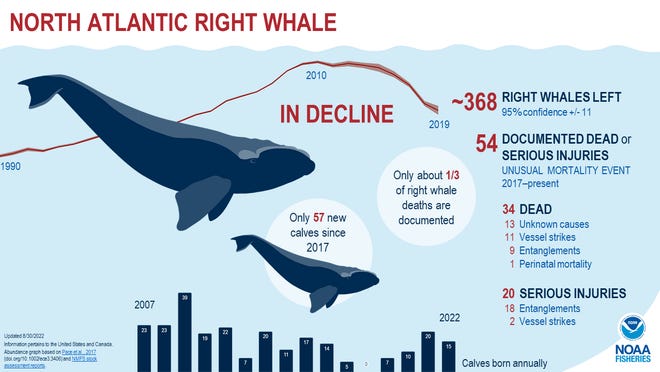
There are about 350 right whales left, and only 100 females capable of reproducing.
Critics say the chance of a small boat fatally striking a right whale is one in a million.
A proposed stricter speed limit to protect the critically endangered North Atlantic right whale is finding opposition from boaters who say it will cripple the recreational boating and fishing industry while providing little protection to right whales.
The new vessel strike reduction rule, which is in the National Oceanic and Atmospheric Administration’s public comment period that ends Oct. 31, would include smaller 35- to 65-foot vessels and stretch from the coast out to 100 miles in some areas. The zones cover almost the entire length of the Atlantic seaboard, from Massachusetts to Florida.
After Oct. 31, NOAA will then consider drafting the measure, which could go into effect next year.
Previously these smaller boats were exempt from the speed rules, first established in 2008, and the zones were kept to 10 seasonal management areas on the coast, primarily near ports where boat traffic is heaviest.
Boats would be restricted to 10-knot speeds in the new zones from Nov. 1 to to May 30. That is when the whales are know to migrate from their summer foraging grounds in the Gulf of Maine to their winter calving grounds in the South Atlantic Bight, from North Carolina to Florida. That is the only known calving place for the whales, NOAA reports.
While party boats, the large 65- to 125-foot vessels that carry crowds of people, typically travel between 10 to 20 knots, charter and private sport boats can hit top speeds of 60 knots.
“This is probably the biggest maritime regulation ever proposed on the recreational boating industry. It impacts the most number of boats, the most number of states and the most number of fisheries. It’s a big issue for us,” said John Depersenaire, director of government affairs and sustainability for Viking Yachts, which builds boats between 33 and 90 feet.
Depersenaire said the industry did not have any input on the drafting of the rule. He said New Jersey has several active fisheries in the late fall, winter and spring that will be impacted by the speed rules if adopted.
Desperenaire said the boats operate more effectively and are more fuel-efficient when they’re planing, which happens when the boats hit about 15 knots. Planing makes use of hydrodynamic lift.
The for-hire fleet also operates on a time schedule and 10-knot speeds would limit where they could fish in a day, Desperenaire said.
Violators of the current speed laws are subject to substantial monetary fines, sometimes exceeding $50,000. NOAA uses electronic tracking, such as the Automatic Identification System, or AIS, to calculate and chart a vessel’s speed over its entire route.
NOAA said the North Atlantic right whale’s situation is dire. There is believed to be fewer than 350 North Atlantic right whales left, out of which just 100 are adult females capable of reproducing. The whales were depleted by the commercial whaling and, despite protection from commercial harvest since 1935, have not recovered.
Following two decades of growth between 1990 and 2010, the species has since been in decline due to a combination of increased human-caused mortality and decreased reproductive output. NOAA said right whale mortality is exceeding its birth rate.
Vessels less than 65 feet in length have accounted for five of the 12 documented lethal strikes to right whales in U.S. waters since 2008, when speed restrictions were first put in place. One of the incidents was off Long Branch in June 2020, when the carcass of a male calf was spotted floating with several propeller wounds.
“The rule is definitely going to cause some hardship for people because they’re going to have to slow down,” said Bob Schoelkopf, director, Marine Mammal Stranding Center, in Brigantine.
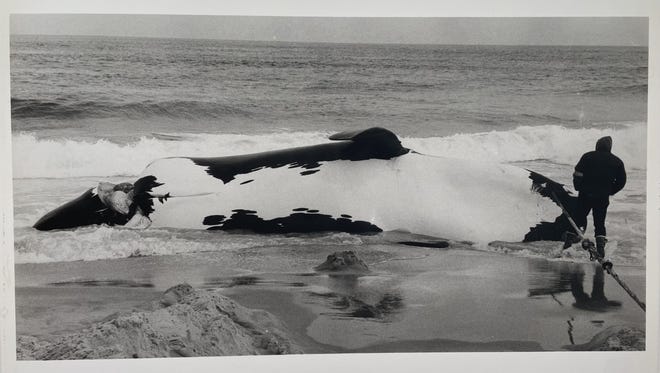
He said the center has responded to a couple of stranded right whales in its 40-plus years of operation. One was in 1983 at Island Beach State Park, where a calf washed ashore dead after its tail was severed by a ship strike.
The boating industry is calling for NOAA to pause on the rule and redesign it so it lessens the potential impact on the recreational industry.
A coalition of trade groups representing the industry complied an analysis of National Marine Fisheries Service data, the fisheries arm of NOAA, and that found approximately 5.1 million recreational fishing trips were taken in the proposed zones by vessels 35 to 65 feet in length since 2008. Assuming all five right whale strikes during that time were from recreational vessels, and that all these vessels were on fishing trips, the chance of a 35- to 65-foot recreational vessel striking a right whale during a fishing trip is less than one-in-a-million, the group argued.
“NOAA’s proposed rule unfortunately underestimates the very real economic impacts on the recreational boating and fishing industry, the largest contributor to the nation’s $689 billion outdoor recreation economy. The rule will bring the vast majority of boating and fishing trips along the Atlantic Coast to a screeching halt, impacting millions of Americans who go boating each year,” said Frank Hugelmeyer, president of the National Marine Manufacturers Association.
Watch: Zelensky warns Russians are being prepared for nuclear warfare
By Hugo Bachega and John Simpson
BBC News, Kyiv
Ukraine’s President Volodymyr Zelensky says Russian officials have begun to “prepare their society” for the possible use of nuclear weapons, but added he does not believe Russia is ready to use them.
In an interview with the BBC, President Zelensky denied having urged strikes on Russia, claiming that an earlier remark had been mistranslated.
“You must use preventive kicks,” he said, referring to sanctions, “not attacks”.
In recent weeks, the Ukrainian army has recaptured large swathes of territory in a successful counter-offensive that has forced Russian troops to abandon long-held positions. In what Kyiv describes as Moscow’s response to its defeats, President Vladimir Putin has incorporated four partially occupied regions of Ukraine.
The annexations, widely dismissed as illegal, have raised…
This May, nine wild birds (Eight Canada geese and one turkey vulture) were found dead of avian flu in Grand County. Colorado Dept. of Agriculture/Courtesy Image
Gov. Jared Polis has issued an Executive Order declaring a state of disaster emergency due to the Highly Pathogenic Avian Influenza rising among birds in Colorado. The emergency declaration will allow state agencies to coordinate together to mitigate the spread of the disease.
Also known as H5N1 or the avian flu, the disease affects both wild and domestic birds. It has a mortality rate of over 90%.
“Cases of Highly Pathogenic Avian Influenza are on the rise again across the country as migratory birds start their seasonal movement south. Right now, it’s critical that Colorado’s backyard and commercial poultry flock owners keep up the biosecurity measures they have been implementing since the beginning of the outbreak this spring,” said Colorado State Veterinarian Dr. Maggie Baldwin.
“(Avian flu) is a disease with high mortality that can wipe out entire domestic poultry flocks in less than 72 hours. The most important thing bird owners can do right now is limit interaction between their flocks and wild birds,” she added.
Cases of avian flu have affected commercial farms, domestic flocks and wild birds across the U.S. In Colorado, avian flu has struck 17 counties, including Grand County.
This May, Colorado Parks and Wildlife removed nine dead wild birds who had contracted avian flu locally.
“A word of advice, do not approach if you see dead birds. Please contact professionals to investigate the situation,” said Grand County Director of Public Health Abbie Baker after the incident.
In Colorado, there has been one case of an individual contracting avian flu from an infected bird. The case occurred in Delta County this April, when an individual came in direct contact with diseased poultry by doing culling at a commercial farm. The individual did not experience any severe symptoms, and there was no other transmission following this.
For a person to catch the avian flu, they must be in direct contact with a diseased bird. The virus can enter someone’s system through their eyes, nose, or mouth, so proper protection is necessary.
“Colorado Parks and Wildlife will use (personal protective equipment) to remove deceased birds, including masks, eye googles, and gloves in order to retrieve these birds,” said Baker.
So far, there has been no sign of a person contracting the disease in Grand County. Overall, the risk of humans catching avian flu is very low.
One of the area’s most popular family attractions will be closed on Thursday because of bird flu. The avian influenza virus was discovered in geese at the Deanna Rose Children’s Homestead in Overland Park.KCTV
OVERLAND PARK, Kansas (KCTV) — One of the area’s most popular family attractions will be closed on Thursday because of bird flu.
The avian influenza virus was discovered in geese at the Deanna Rose Children’s Homestead in Overland Park.
The hands-on, early 1900s, farm life experience closed two hours early on Wednesday. They’ll be using the time Wednesday to drain ponds, sanitize enclosures and quarantine the animals most at risk.
Parents and children flooded out to the sound of an intercom announcement apologizing for closing early. The announcement didn’t say why. Some were bewildered. Many were…
The proposal would see the same rules on drinking apply to hunters and motorists
A proposal to ban French hunters from drinking while out in the fields provoked a furious response from the country’s hunting lobby. Legislation proposed on October 3 aims to reduce hunting accidents which resulted in seven deaths last year.
The proposal was drafted based on the findings of an inquiry. The inquiry was held in response to petitions demanding tighter hunting regulations after 25 year old British Morgan Keane was accidentally killed by a hunter in 2020. During the inquiry, a cross-party committee investigated French laws on hunting and gun ownership, and observed a hunt before devising a proposal.
Legislation would subject hunters in France to the same rules as drivers on blood alcohol levels. Penalties for intoxicated hunters would be the same as for motorists.
Greater white-fronted geese are among the migratory birds in Oregon. (Oregon Department of Fish and Wildlife)
The July 5 trip was routine: From the deck of an airboat, two wildlife biologists scanned the cattail marsh — one of many seasonal wetlands in the Sacramento National Wildlife Refuge — on their weekly lookout for sick or dead birds. In the summer months, avian botulism is a major concern in California’s Central Valley, and removing carcasses can stem its spread. But this year, there was added worry: A new and devastating strain of highly pathogenic avian influenza (HPAI) had been creeping West across the continent since December 2021, affecting millions of poultry and countless wild birds.
That day, the biologists carefully collected several carcasses, including two Canada geese and two American white pelicans, and sent the remains on to the U.S. Geological Survey’s National Wildlife Health Center lab for routine testing. Days later, the lab and then the U.S. Department of Agriculture confirmed: The avian flu’s H5N1 strain had finally reached California.
This year’s avian flu epidemic — the first in North America since 2015 — is caused by a version of this virus unlike any that virologists and wildlife managers have ever seen. “It’s behaving by a different set of rules,” said Bryan Richards, emerging disease coordinator at the National Wildlife Health Center. For the first time, it’s spreading widely among wild birds, which has far-reaching implications for wildlife and human health.
Wildlife already face unprecedented stressors, from drought to wildfire to habitat loss. Now, emerging and widely infectious forms of avian influenza are yet another new and serious threat — one that wildlife biologists say requires a new approach to disease management on farms, refuges and landscapes nationwide. “We are in the midst of a completely unprecedented wildlife disease outbreak in North America,” said Rebecca Poulson, a University of Georgia research scientist who’s been studying bird flus for 15 years. “We’ve never seen anything like this.”
BEFORE 1996, it was widely assumed that highly pathogenic avian influenzas only infected commercial poultry farms: These were virulent but contained outbreaks caused by on-farm mutations of a wild-bird-origin flu virus. While devastating to those farms, the mutated strains seemed unable to spread back into wild birds. This made outbreaks simple to manage with biosecurity prevention, isolation of exposed flocks, and swift culls.
In 1996, virologists first detected the H5N1 strain in domestic geese in Guangdong, China. That virus received global attention in 1997 when it sickened 18 people in Hong Kong, killing six. The outbreak prompted international fears of a human pandemic, but the virus never mutated in a way that enabled human-to-human transmission. International media paid less attention to the fact that, by 2002, H5N1 had acquired the ability to move from domestic flocks back into wild birds. The virus has been evolving ever since.
Today, several variants of HPAI are associated with “sporadic mortality events” in wildlife. In Newfoundland and Labrador in 2021, the current strain emptied seaside cliffs of thousands of gannets, puffins and murres. This August, it killed 700 black vultures at a Georgia sanctuary. Waterfowl, shorebirds, raptors and scavengers are at the highest risk. In Western states most recently hit by the virus, such species include threatened and endangered birds like the California condor and snowy plover, though agencies have not yet documented infections in either species. Common urban and suburban-dwelling Canada geese and corvids and nationally symbolic bald eagles are also at risk, as are the hundreds of millions of waterfowl whose migrations are beginning to peak now in Northern states and will continue south through late October.
I think we’re just at the tip of the iceberg. We’re just sort of holding our breath to see what’s going to happen.
– Rebecca Poulson, University of Georgia research scientist
The last major outbreak — caused by a related strain, H5N8 — reached North America in 2014, causing $3 billion in losses to U.S. farmers, who had to cull 50 million chickens, turkeys and waterfowl. This year’s outbreak has so far affected a similar number of commercial birds, but it is orders of magnitude larger in wild landscapes. Via wild-bird transmission, it has reached nearly 10 times the number of backyard poultry, and while the 2014-15 outbreak was documented in just 18 wild bird species across 16 states, this year it’s been confirmed in at least 108 wild bird species, with cases in nearly every state. In another unusual development, many mammal-crossover cases and deaths have been confirmed, too, in foxes, skunks, opossums, raccoons, bobcats, minks, harbor seals, a juvenile black bear and one bottlenose dolphin. Labs are so overwhelmed that wildlife officials say they’ve stopped submitting carcasses of species that have already been documented in their county. They’re also only submitting a few birds per mortality event, making the official wild bird death figures a gross underestimate.
The next few months could be even worse. Flocks across the continent are migrating now toward Central and South America, home to the largest diversity of bird species on Earth. “I think we’re just at the tip of the iceberg,” Poulson said. “We’re just sort of holding our breath to see what’s going to happen.”
AMONG WESTERN STATES THIS FALL, California is most likely to feel the brunt of the impacts: It’s one of the nation’s largest egg producers, and commercial poultry meat is the state’s sixth-largest commodity, worth $1 billion annually. California’s Central Valley provides essential migration and wintering grounds for wild birds: The Sacramento National Wildlife Refuge Complex alone is visited by tens of millions of migrants each fall. It supports nearly 40% of the continent’s northern pintails (one of the most numerous duck species in the world), and hosts a total overwintering population of some 1.5 million birds.
This year’s drought means wintering flocks may be both unusually crowded and especially mobile, heightening the risk of viral spread, said Michael Derrico, the refuge’s lead wildlife biologist. Since the refuge’s wetlands are half their normal size, birds will be forced into closer proximity and may move frequently to find resources, which Derrico thinks may also push birds farther south.
Once a disease becomes established in a free-ranging population, then you really lose the upper hand.
– Bryan Richards, emerging disease coordinator at the National Wildlife Health Center
Derrico’s concern for birds in the Pacific Flyway is somewhat tempered by the fact that, so far, the country’s westernmost migratory channel doesn’t seem to have as much of the virus as other regions do. But he and other wildlife managers are also very limited in what they can do to mitigate potential impacts.
“Once a disease becomes established in a free-ranging population, then you really lose the upper hand,” said Richards, from his USGS home office near Madison, Wisconsin. “We’re really, really good at documenting disease on the landscape, but we’re less good at altering disease outcomes.” Instead, he said, “some of us are beginning to pivot towards a conversation of wildlife health as opposed to wildlife disease.”
Left, Adriaan Dokter/BirdCast, Cornell Lab of Ornithology; Right, National Wildlife Health Center/USGS
For Derrico, at the Sacramento refuge complex, promoting health instead of preventing disease might involve investing more in wetland management to ensure that birds have access to the largest habitat possible, and minimizing human disturbance to prevent scattering birds to new areas. In many parts of the country, bald eagles and other raptors are already experiencing widespread mortality from lead poisoning by bullets and fishing tackle, and Richards said that addressing that issue might be a better use of resources.
“That’s something we can control, right?” he said. Combined with improving biosecurity measures on farms, by tackling environmental factors that are within human reach, Richards believes wildlife managers may be able to increase bird resilience even in the face of deadly new diseases.
The pressure to change wildlife disease management is only increasing. “When you look globally at emerging infectious diseases, we’ve seen some pretty interesting trends,” Richards said. “We have seen more new diseases, larger disease outbreaks, more frequently, and with larger impacts.” That includes some with the potential to cause species extinction, and, as seen recently with COVID-19, ones that could mutate to become widely infectious and transmissible in humans. Virologists believe the risk of that happening in this H5N1 strain is low, but recommend that hunters, farmworkers and other bird handlers take extra precautions this year anyway. Of all the emerging diseases that threaten people, Richards said, a majority have originated in wildlife.
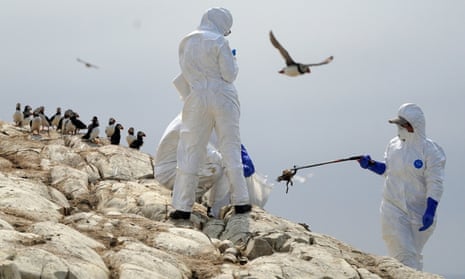
Dead birds being cleared from Staple Island, off Northumberland, where bird flu is devastating one of the UK’s most important seabird colonies, July 2022.Photograph: Owen Humphreys/PA
Catastrophic declines in the number of birds and other wildlife are likely if countries do not act urgently to change the way animals are farmed, wildlife health scientists have warned.
The unprecedented die-off of seabirds from highly pathogenic avian flu (HPAI) being witnessed in breeding colonies across Europe, North America and Africa has been traced back to a commercial goose farm in southern China where a relatively mild bird disease mutated into a killer in 1996.
After spilling into wild bird populations in 2007, HPAI has spread around the…