Hunting clubs, rhino hunter sue Delta over trophy ban

Hunting clubs and a man who paid $350,000 for a license to hunt a black rhino in Namibia have sued Delta Airlines, saying its ban on transporting some big game hunting trophies hurts conservation efforts and violates its global obligations.

In a lawsuit filed in federal court in Texas on Thursday, the hunter of the endangered black rhino, Corey Knowlton, along with the Dallas Safari Club, the Houston Safari Clubs and others said that the transport of the trophies is allowed under a strict systems of global permits and Delta must abide by its obligations.

“Tourist hunting revenue is the backbone of anti-poaching in Africa. If there are fewer users, as Delta’s embargo envisions, there are fewer boots on the ground and reduced security for elephant, rhino and other at-risk wildlife,” the lawsuit said.

Delta officials were not immediately available for comment.

Delta was one of three U.S. airlines in August that banned the transport of lion, leopard, elephant, rhino or buffalo killed by trophy hunters, in the fallout from the killing of Zimbabwe’s Cecil the Lion about a month earlier.

Delta is the only of the carriers with direct service between Johannesburg and the United States and its decision was seen as carrying the most weight.

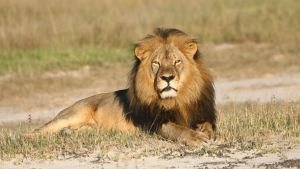
There has been an international outcry against trophy hunting among animal lovers since it emerged that American dentist Walter Palmer killed Cecil, a rare black-maned lion that was a familiar sight at Zimbabwe’s Hwange National Park.

Eleven African countries issue lion hunting permits. Of them South Africa’s hunting industry is the biggest, worth $675 million a year, according to the Professional Hunters Association.

Hunting groups argue the money generated from the legally sanctioned hunts bolster the coffers for conservation in emerging African countries that want to use their limited finances for social programs.

In the middle of this year, the cargo division of South Africa’s national carrier, SAA, lifted an embargo that had been in place since April on the transport of legally acquired hunting trophies of African lion and elephant, rhinoceros and tiger.

“It should be remembered that hundreds of legally acquired wildlife specimens, such as hunting trophies, pass through our main ports of entry and exit monthly without incident. Penalizing an entire industry for the illegal actions of the few is not in the country’s best interests,” South Africa’s Environment Minister Edna Molewa said at the time.

(Reporting by Jon Herskovitz; Editing by Sandra Maler)

Humans: Uniquely Unique or Chronic Rationalizers?

10418292_778659628825562_4081410081902108848_n

As far as the rights and welfare of all other species of animals are concerned, human arrogance—narcissistic notions of human supremacy over nonhumans—is the root of all evil.

Ever since my youngest days, I’ve always instinctively known that the “us and them” cultural given was wrong-headed, and that having two sets of laws, one for our species and one for all others, is absurd at best.

This has been backed up by much that I have read over the years. In an effort to counter centuries of long-accepted dogma intended to instill anthropocentric attitudes, philosophers like Peter Singer, with his Animal Liberation, and scientists like Jared Diamond and Richard Leaky, in The Third Chimpanzee and The Sixth Extinction respectively, have devoted sections of their books to debunk outdated beliefs of human preeminence and superiority.

To further put humans in their rightful place, the following is something I happened on last night in the late John A. Livingston’s 1994 book, Rogue Primate:

“Few exercises in rationalization have involved quite so much intellectual pretzel-bending as the task of demonstrating absolute human uniqueness. Our obsession with this is revealing. It’s not enough that every individual, and every species, is a unique, one-time-only, event. Fanatical humanism demands more. All species are unique, we may acknowledge, but one species is uniquely unique. Which reveals a good deal more than bizarre English usage.

“Thanks to studies in ethology and behavioral ecology, the religion of human uniqueness has sustained a series of notable setbacks in our lifetime. We have had to abandon a substantial list of ‘unique attributes’: tool using, tool making, language, tradition and culture, abstraction, teaching and learning, cooperating and strategizing, and others, less inflammatory, such as caring and compassion. There’s not a lot left. But the ultimate fallback position, the central jewel in the human imperial crown, hadWashoe_chimpanzee always been self-awareness. Then along came little Washoe.
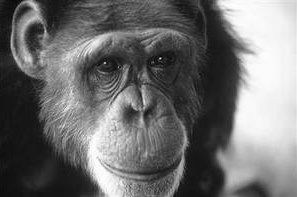
“Washoe, a chimpanzee, was raised by humans, Allen and Beatrice Gardner. She became famous as the first non-human being to learn the hand-sign language of the deaf and mute, a mode of communication seen by the Gardners as more useful to a chimpanzee (because of its anatomy) than human sounds. While still very young she became extraordinarily adept at signing, which of itself generated concern in some quarters. An ape was not only ‘speaking,’ but also, apparently carrying on conversations with her human mentors. But Washoe’s historic bombshell was kept in abeyance for a time. She had been supplied with various toys and other miscellaneous items, and had also become used to all manner of human household hardware, such as mirrors. One day, while she was looking into a mirror, she was asked ‘Who is that?’ ‘Me, Washoe,’ she signed back.

“Washoe was ‘self-aware.’ This was flabbergasting. And for many people it was deeply unsettling. We seem to be witnessing the collapse of the last bastion of human uniqueness. Something had to done about Washoe. Human brows furrowed in thought. Then came the answer. Of course! How blindingly obvious! Washoe was not aware that she was self-aware. One can almost feel the collective sigh of relief. We could not know this, of course, but it was fundamental to the shoring-up of the collective self-esteem that we asserted. Now if it were somehow demonstrated that a non-human animal was, in fact, aware of its self-awareness, then no doubt, the claim would be made that it was not, like us, aware of its awareness of its self-awareness. This could go on forever, and probably will.

“The problem of self-awareness (or rather, the problem of our unrepentant claim, in spite of Washoe and others, that beings who are not human do not have it) confuses a number of issues pertaining to the human treatment of other animals. It appears consistently in defense of vivisection, for example. ‘Sentience’ is much used as a synonym for self-awareness, or, sometimes, consciousness. Non-human animals are not sentient (consciously self-aware); therefore, it is ethically permissible to do as we please with them. Such reasoning is mystifying. Even if the living, captive individual beings (both wild and domesticated) upon whom the vivisectors visit their incomprehensible acts were not self-aware, how would that justify cruelty? No one denies that they have central nervous systems (that is one of the important reasons they are used) that they feel pain (another reason), that they entertain fear (still another). Fear without self-awareness is gibberish.

“Vivisection has its own strange ethical code, but it is not the only such structure to depend ultimately on the concept of self. Ethics rests on moral philosophy. Moral philosophy rests primarily on the individual. Presumably the concept of the individual rests ultimately on the concept of self. It used to be generally assumed that non-human beings were incapable of thinking or behaving ethically because, among other limitations, they lack the concept of self. That was pre-Washoe.

Many humanists attempt to handle the problem of self-identity in a chimpanzee by asserting that the animal lacks the capacity for reason, and therefore could never conceive of moral or ethical rights and obligations. That the animal lacks reason could be debated (there is ample evidence in many species of problem solving, which could only be conceptual). What animals very probably do lack is the power of rationalization, which would appear to be a uniquely human attribute.”

________________________

It seems, while our technological advancements and mechanical understandings may be growing rapidly, if not hastily, our acceptance of non-human awareness, and in fact, our own moral evolution, is still crawling at a snail’s pace. As it is for global warming, denialism about animal awareness is an agenda-driven form of rationalization.

KOKO-C-02AUG00-MN-HO--Koko the gorilla and her kitten. PHOTO CREDIT: RON COHN/GORILLA FOUNDATION Ran on: 02-18-2005 Koko the Gorilla seems to smile as she looks at a kitten. Koko has had many pets during her years at the Gorilla Foundation. Ran on: 02-18-2005 Koko and friend Ran on: 02-26-2005 Koko is shown in 2000 holding a kitten, one of many pets the gorilla has had in her years at the Gorilla Foundation. Ran on: 12-02-2005 Koko the gorilla is claimed to have a nipple fetish.

1546263_10152866804715932_4014807999575359152_n

Zimbabwe will not charge U.S. dentist for killing Cecil the lion

http://www.msn.com/en-us/news/world/zimbabwe-will-not-charge-us-dentist-for-killing-cecil-the-lion/ar-AAfmVFd?ocid=ansmsnnews11

“We approached the police and then the prosecutor general, and it turned out that Palmer came to Zimbabwe because all the papers were in order,” Muchinguri-Kashiri told reporters.

Muchinguri-Kashiri said Palmer would be free to visit Zimbabwe as a tourist in the future but not as a hunter. The implication was that Palmer would not be issued the permits a hunter needs.

The environment minister’s comments immediately drew the ire of the animal conservation group Zimbabwe Conservation Task Force, which maintained that Palmer had committed a crime and said it planned to pursue legal action against him in the United States.

Palmer could not be reached for comment on the environment minister’s statement to reporters.

The 55-year-old dentist had closed his practice in late July after he was publicly identified as the hunter who killed Cecil, drawing widespread criticism on social media and a large demonstration by animal rights advocates at his office in Bloomington, Minnesota, a Minneapolis suburb.

The practice reopened in mid-August without him. Palmer returned to work in early September to a handful of protesters and some public support from patients.

“The fact is the law was broken,” said Johnny Rodrigues, the head of the Zimbabwe task force, which first reported news of Cecil’s killing. “We are going to get our advocates in America to actually see what they can do to bring justice to him.”

The U.S. Fish and Wildlife Service has said it was investigating the killing of the lion.

Two more people still face charges related to Cecil’s killing. Both allegedly were involved in using bait to lure the lion out of his habitat in Hwange National Park so he could be killed.

Theo Bronkhorst, a professional hunter in Zimbabwe, is charged with breaching hunting rules in connection with the hunt in which Cecil was killed. A game park owner is also charged with allowing an illegal hunt. Both have denied the charges.

Bronkhorst is expected to appear on Thursday in a Hwange court where a magistrate will rule on a request by his lawyers that his indictment be quashed.

Parks officials said prosecutors would bring Cecil’s head, which the hunters took as a trophy, to court as an exhibit if the trial goes ahead.

Palmer has previously said that the hunt was legal and no one in the hunting party realized the targeted lion was Cecil, a well-known tourist attraction in the park.

Wildlife hunting, which earned $45 million last year, is an important source of money for Zimbabwe, which is still recovering from a catastrophic recession between 1999-2008.

Zimbabwe will not charge American dentist Walter Palmer for killing its most prized lion in July because he had obtained legal authority to conduct the hunt, a cabinet minister said on Monday.

Palmer, a lifelong big-game hunter from Minnesota, stoked a global controversy when he killed Cecil, a rare black-maned lion, with a bow and arrow outside Hwange National Park in Western Zimbabwe.

But Palmer’s hunting papers were in order, Environment Minister Oppah Muchinguri-Kashiri said on Monday. Consequently, he could not be charged.

“We approached the police and then the Prosecutor General, and it turned out that Palmer came to Zimbabwe because all the papers were in order,” Muchinguri-Kashiri told reporters.

Dentist Walter Palmer, who returned to his practice, Tuesday, Sept. 8, 2015, in Bloomington, Minn., arrives back to his office following a lunch break.© AP Photo/Jim Mone Dentist Walter Palmer, who returned to his practice, Tuesday, Sept. 8, 2015, in Bloomington, Minn., arrives back to his office following a lunch break. Muchinguri Kashiri said Palmer was free to visit Zimbabwe as a tourist but not as a hunter. The implication was he would not be issued the permits a hunter needs.


Two more people still face charges related to Cecil’s killing. Both allegedly were involved in using bait to lure Cecil out of his habitat in Hwange National Park so he could be killed.

Theo Bronkhorst, a professional hunter in Zimbabwe, is charged with breaching hunting rules in connection with the hunt in which Cecil was killed. A game park owner is also charged with allowing an illegal hunt. Both have denied the charges.

Bronkhorst is expected to appear in a Hwange court on Thursday where a magistrate will rule on a request by his lawyers that his indictment be quashed.

Palmer, 55, has previously said that the hunt was legal and no one in the hunting party realized the targeted lion was Cecil, a well-known tourist attraction in the park.

Palmer could not be reached immediately for comment on the environment minister’s statement to reporters. (Reporting by MacDonald Dzirutwe, additional reporting by David Bailey in Minneapolis; Editing by James Macharia)

Hundreds of wild animals to be slaughtered in Limpopo, South Africa

http://www.telegraph.co.uk/news/worldnews/africaandindianocean/southafrica/11848103/Hundreds-of-wild-animals-to-be-slaughtered-in-Limpopo-South-Africa.html


New hunting controversy – two months after Cecil the lion was shot – which will see animals shot from specially erected platforms rekindles debate on big game hunting

In what is known as a “driven hunt”, the animals will be corralled into a two kilometre (1.2 mile) stretch of land close to the town of Alldays

In what is known as a “driven hunt”, the animals will be corralled into a two kilometre (1.2 mile) stretch of land close to the town of Alldays Photo: Alamy

Animal welfare groups in South Africa on Monday failed to prevent the opening of a week-long “driven hunt”, in which foreign hunters pay to shoot wildlife that is herded past them for easy dispatch.

More than 20 Belgian and Dutch hunters took part in the hunt on a farm near the town of Alldays, in the northern province of Limpopo.

Taking aim from purpose-built platforms overlooking a bush strip, hunters are able to shoot at hundreds of wild animals including baboons, warthogs and antelope as they pass.

Just two months after the global furore surrounding the slaughter of Cecil the lion in Zimbabwe, the hunt has rekindled controversy over the killing of wildlife for sport.

Cecil greets one of the lionesses in the Linkwasha Camp, within the Hwange National Park Cecil greets one of the lionesses in the Linkwasha Camp, within the Hwange National Park   Photo: Brent Staplecamp

Such was the anger over the death of Cecil, who was being tracked by Oxford University as part of a research project, that the hunter – Walter Palmer, a dentist from Bloomington, Minnesota – was forced into hiding, emerging only this week to make a public statement.

The National Council of SPCAs, the South African animal welfare group, appealed for the driven hunt to be stopped.

Ainsley Hay, the group’s manager of wildlife protection, said that it was trying to obtain a warrant to prevent the hunt from the magistrates court in the town of Louis Trichardt.

“Our team is trying to get the warrant, but the hunters are there already and the shooting is about to start,” she said.

Later reports said 18 animals were killed on Monday.

She said an indigenous community in the area had claimed the land and was renting it out to “individuals” who were hosting the hunt as a way of earning income.

“They have built platforms that line the bush for the hunters to stand on and have employed locals to walk in a straight line beating metal drums to chase the animals into the slaughter strip.

“The hunters then take pot shots at the animals. The animals have no chance of evading the onslaught and the hunters have no way of ensuring a clean shot or a humane death.

“From past hunts like these we have seen that much of the kill can’t be eaten or used as trophies because the dead animals are so full of bullets.”

The hunt, at Braam Farm outside Alldays, is due to last for one week. Hundreds of animals could be killed each day.

Hermann Meyeridricks, president of the Professional Hunters’ Association of South Africa, said he did not have enough information about the hunt to comment.

“There is a media frenzy around hunting at present and we don’t know enough about this this kind of hunting, which has been going on for centuries in Europe.

“I have no mandate to investigate activities of citizens of this country.”

More: http://www.telegraph.co.uk/news/worldnews/africaandindianocean/southafrica/11848103/Hundreds-of-wild-animals-to-be-slaughtered-in-Limpopo-South-Africa.html

Dentist Walter Palmer Returns to Work With Police Escort Amid Cecil the Lion Protests

http://abcnews.go.com/US/dentist-walter-palmer-returns-work-police-escort-amid/story?id=33602439

Palmer returned to his dental clinic in Bloomington, Minnesota, with a police escort at around 7 a.m. today.

A few protesters gathered outside his office and yelled “Extradite Palmer,” saying he should face punishment in Zimbabwe.

The dentist was named in late July as the hunter who killed Cecil, a lion that had been fitted with a GPS collar as part of research for Oxford University. Palmer has said he did not know he was killing a beloved animal when he followed his hunting party guide, and he believed he acted legally. The 13-year-old Cecil was the biggest dominant male black-maned lion in Hwange National Park in Hwange, Zimbabwe.

Today, Bloomington Police Deputy Chief Mike Hartley said police will keep a presence at Palmer’s office for as long as they are needed, mostly to manage blocking off the street for media. There were about 10 officers on the premises this morning. Hartley said he is not concerned for Palmer’s safety at this point, and Palmer has employed his own security.

Zimbabwean authorities have reportedly paused an effort to extradite Palmer due to possible fears that doing so would hurt Zimbabwe’s hunting business, the Associated Press reported. The Zimbabwean professional hunter who helped Palmer was charged with “failure to prevent an illegal hunt,” while the man whose property on which the killing took place faces a charge of allowing the hunt to occur on his farm without proper authority. They allegedly lured the lion out of the national park with an animal carcass.

11892112_1656581097897064_2430590251208988900_n

Lion kills safari guide in home of Cecil the lion

Sea Shepherd anti-whaling ship Bob Barker refused entry to Faroe Islands
http://www.theguardian.com/environment/2015/aug/25/sea-shepherd-anti-whaling-ship-bob-barker-refused-entry-to-faroe-islands
“Denmark’s autonomous Faroe Islands announced on Monday that they had
refused entry to a ship carrying 21 activists from the militant
conservation group Sea Shepherd who were trying to disrupt traditional
whale hunts.”

Lion kills safari guide in home of Cecil the lion
http://www.grindtv.com/wildlife/lion-kills-safari-guide-in-home-of-cecil-the-lion/#hauJp2eYyzyK24r3.97
“Quinn Swales, 40, a fully qualified and experienced Zimbabwean
professional guide, was leading a group of tourists on a photographic
safari when a male lion unexpectedly charged the group, according to
Camp Hwange Zimbabwe, the company for which he worked.”

AP_Cecil_mm_150730_16x9_992

Cecil the lion’s killer ‘captured’: Walter Palmer pictured for the first time since Zimbabwe hunt

http://www.telegraph.co.uk/news/worldnews/northamerica/usa/11806856/walter-palmer-cecil-the-lion-killer-first-pictures.html

Exclusive: The Telegraph obtains first images of Walter Palmer in Minnesota since beloved lion was killed

Facebook
2K
Twitter
295
Pinterest
3
LinkedIn
0
Share
2K
Email

Walter Palmer, the man responsible for killing Cecil the lion

Walter Palmer, the dentist responsible for killing Cecil the lion Photo: Richard Beetham/The Telegraph/Splash News

These are the first images of Walter Palmer, the American dentist, back in his home town after it was revealed by The Telegraph last month that he was responsible for the death of Cecil the lion.

Pictured for the first since the hunt in Minnesota, Mr Palmer has been in hiding since the worldwide furore surrounding the death of the beloved lion in one of Zimbabwe’s national parks.

His return to normal life coincided with a letter announcing that the dental practice he owns was reopening – but without the embattled hunter.

“Today, River Bluff Dental employees and dentists are beginning to serve our loyal patients,” the firm said in a letter dated Monday. “Dr Palmer is not on site.”

The dental practice website was still offline, but the news was announced on a Twitter account claiming to belong to the practice.

The account, which was started after the news of Cecil’s killing was announced, has been used to rally support for the practice since The Telegraph named Dr Palmer as the man responsible for the animal’s death on July 28.

“A smile takes but a moment, but the memories of it last forever. Happy #WorldLionDay!” they tweeted on August 10, with a photo of two lions bearing their teeth.

“Don’t understand why people are so angry. What’s done is done. The practice WILL be open again! Promise!!!”

Last week they tweeted: “The practice is still closed even though people care less and less about #CecilTheLion day after day. Fickle people.”

Mr Palmer is believed to have paid £35,000 to shoot and kill the 13-year-old lion with a bow and arrow. The animal was wearing a radio collar because he was part of an academic study by Oxford University.

Walter Palmer the man responsible for killing Cecil the lionWalter Palmer, the dentist responsible for killing Cecil the lion  Photo: Richard Beetham/The Telegraph/Splash News

The animal was shot on July 1 in Hwange National Park. There have been calls for Mr Palmer to be extradited to face charges in Zimbabwe – something highly unlikely to happen.

Walter Palmer, the dentist responsible for killing Cecil the lionWalter Palmer, the dentist responsible for killing Cecil the lion  Photo: Richard Beetham/The Telegraph/Splash News

The professional hunter who accompanied the American, Theo Bronkhorst, is facing charges of carrying out an illegal hunt.

Last week, Robert Mugabe, the Zimbabwean president, blamed his own people for allowing Cecil to be killed by the dentist, telling them they “failed to protect” a national resource from foreign “vandals”.

More: http://www.telegraph.co.uk/news/worldnews/northamerica/usa/11806856/walter-palmer-cecil-the-lion-killer-first-pictures.html

The myth of sport hunting as a solution to conservation

An open letter to Mozambique by Josphat Ngonyo,  founder,  Africa Network for Animal Welfare

On behalf of Africa Network forAanimal Welfare (ANAW), a network of organizations and individuals interested in promoting humane treatment of animals in Africa while working with communities and governments, I write to you Sir, with the aim of engaging with you, on the most recent development in your country, the World Bank’s International Development Association (IDA) approving $40 million grant to your country, to fund conservation efforts that include strengthening the country’s program of selling the rights to hunt wild animals.

I write to your government to request you to reconsider this grant in light of the unmistakable negative effects this would have on wildlife conservation in Mozambique and the rest of Africa at large.

Read more: