Exposing the Big Game

Forget Hunters' Feeble Rationalizations and Trust Your Gut Feelings: Making Sport of Killing Is Not Healthy Human Behavior

Exposing the Big Game

wikileaks exposes gov’t knowledge of illegal hunting

There is hypocrisy all around this brutal hunting industry. The US government purports to be horrified at Palmer’s illegal activity, and there is talk of extradition.
What a farce!
Wikileaks documents show that the US government has been well aware all along of the illegal and unethical practices of US hunters in Zimbabwe (and elsewhere in Africa) – and deliberately chose not to act on this knowledge, hoping it would never become public.
Featured Image -- 10032

Dr. Palmer Should Die

For the crimes he committed against Cecil the half-tame Lion—luring, baiting, impaling and pursuing him for 40 long hours. For being a sadistic, narcissistic, psychopathic bow-hunter willing to put another sentient animal through sheer hell for a trophy, Walter Palmer DDS should die. And his accomplices—the guides, along with whoever shot another lion today–should join him on the gallows.

They should all be dragged into a court of law and sentenced to death ASAP. But unfortunately, that won’t happen. Walter Palmer and his ilk, his cohorts in crime, will probably live out their long lives and get off with a slap on the wrist; a fine, a public service sentence and possibly have their hunting licenses revoked for a while.

Why? Because they’re human beings—the most sacred of God’s creatures; the pinnacles of evolution and the reason it’s all here (sarcasm intended)—and a lion is just a lion. An animal: ours to do with as we see fit.

It’s the self-imposed law of the land, and there’ll be no justice for animals as long as speciesism rules.

Featured Image -- 10026

Cecil the lion’s brother, Jericho, is also illegally killed in Zimbabwe, official says

Updated 3:28 PM ET, Sat August 1, 2015

(CNN)The brother of slain Cecil the lion, named Jericho, was killed Saturday in Hwange National Park in Zimbabwe, a senior park official told CNN.

Jericho was gunned down by a hunter operating illegally, said Johnny Rodrigues, head of the Zimbabwe Conservation Task Force.

Cecil was also killed illegally, provoking an international outrage because he was a protected animal, and Zimbabwe is seeking the extradition of American dentist Walter Palmer on accusations that he and others illegally hunted the lion, authorities said.

<img alt=”Cecil the Lion's brother, 'Jericho,' killed by hunter” class=”media__image” src=”http://i2.cdn.turner.com/cnnnext/dam/assets/150801145733-cecil-the-lions-brother-jericho-shot-dead-in-zimbabwe-corwin-intv-nr-00003826-large-169.jpg”>

cecil the lions brother jericho shot dead in zimbabwe corwin intv nr_00003826

Cecil the Lion’s brother, ‘Jericho,’ killed by hunter 

Cecil the Lion’s brother, ‘Jericho,’ killed by hunter 04:57
PLAY VIDEO

“It is with huge disgust and sadness that we have just been informed that Jericho, Cecil’s brother has been killed at 4pm today,” Zimbabwe Conservation Task Force said Saturday on Facebook.

“We are absolutely heart broken,” the Task Force added.

Jericho was considered to be caring for and defending Cecil’s cubs, but the survivability of those cubs wasn’t immediately clear in the aftermath of Jericho’s death.

Some of the cubs may have been Jericho’s, said David Macdonald, director of Oxford’s Wildlife Conservation Research Unit, who has been studying Cecil.

Male coalitions, often between brothers, oversee prides of females in lion society and protect the prides from threats posed by outsider male lions, the scientist said.

Opinion: Can Zimbabwe have lion’s killer extradited?

American Public Roars After It Gets a Glimpse of International Trophy Hunting of Lions

http://blog.humanesociety.org/wayne/2015/07/cecil-lion-killed-by-trophy-hunter.html?credit=web_hpfs1-cecil-072915_id93480558

Cecil the lion is dead because Walter Palmer the dentist is a morally deadened human being.Featured Image -- 9991

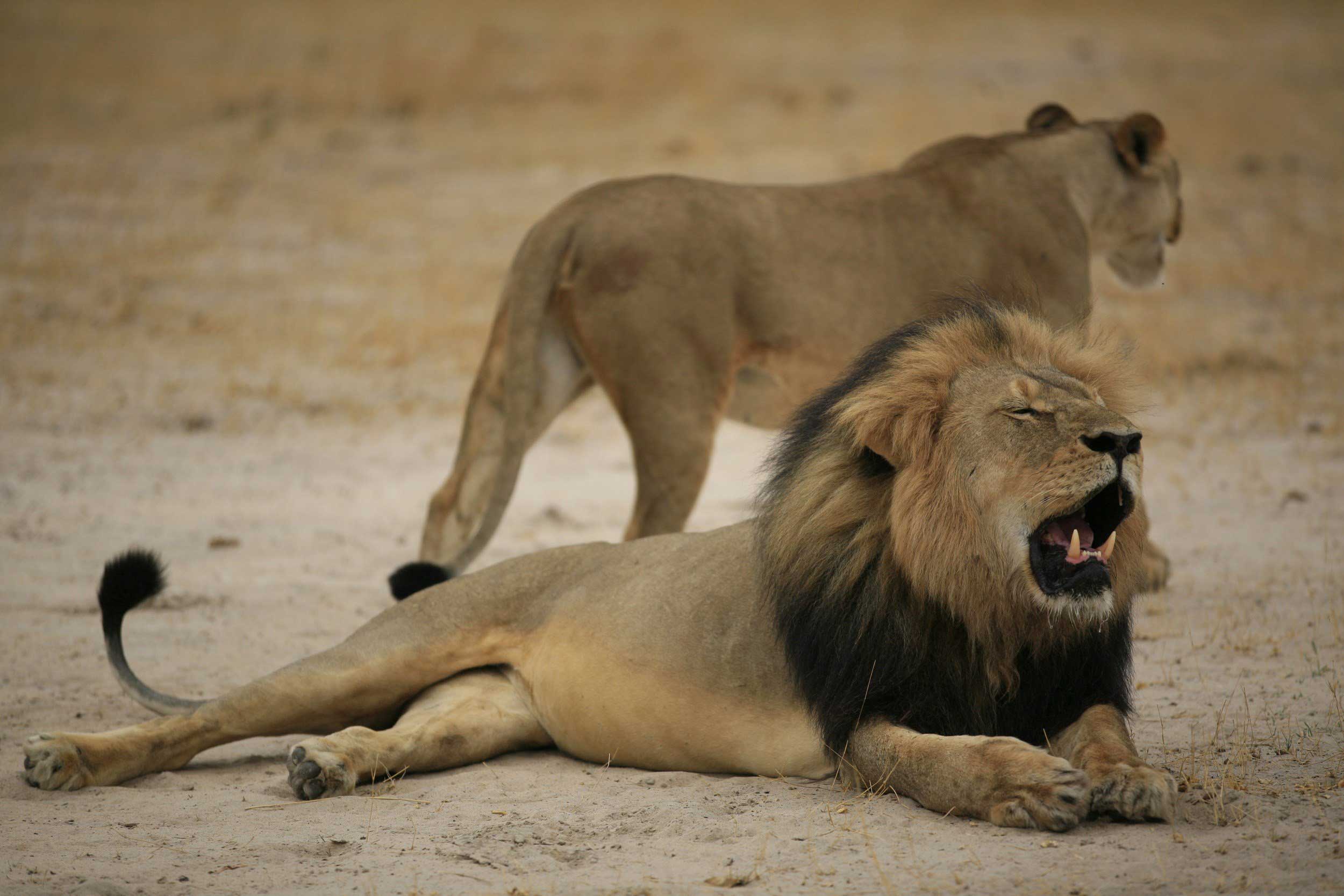
The man traveled clear across the world – from the suburbs of Minneapolis into the pay-to-slay world of Zimbabwe, where dictator Robert Mugabe sells off hunting rights and other natural resources to the highest bidders – for the chance to kill the king of beasts. In this case, the victim was a lion who has been widely photographed and somewhat habituated to a non-threatening human presence in Hwange National Park. The hunt was a “guaranteed kill” arrangement, where Palmer paid about $50,000 to hire professional guides to help him complete the task. The local guides knew exactly what they were doing. In the dark of night, they lure a famed, black-maned lion from an otherwise protected area, with a dead carcass as bait. Palmer then stuck Cecil with an arrow.

Even though he’s used that weapon to kill countless other rare animals all over the globe – from leopards to black bears to Argali sheep – Palmer didn’t deliver a killing shot. He wounded the animal, and because he did it at night, I bet he didn’t have the courage to track the animal at that time. So he waited, while the lion tried to live minute to minute and hour to hour after receiving the stab wound from the arrow. At some point, Walter and the professional guides resumed the chase. It took them nearly two days to find him, and then they apparently shot him with a firearm. The killers then removed a radio collar nestled around his neck – because Cecil was also the object of a study by Oxford researchers. Some reports say they tried to disable the signal from the collar, unsuccessfully. The team took the customary pictures of the westerner guy standing atop a beautiful, muscled animal, and then they decapitated and skinned him, as keepsakes for Palmer’s global crossing in order to conduct a pointless killing.

The lion is one of Safari Club International’s Africa Big Five, along with elephants, rhinos, leopards, and Cape buffalo, and the idea of killing each of them motivates thousands of wealthy people to do it. It’s one of more than 30 hunting achievement and “inner circle” awards you can get if you become a member of Safari Club – including Cats of the World, Bears of the World, and Antlered Game of North America. If you win all of the awards, and there are plenty people who do, you have to shoot more than 320 different species and subspecies of large animals. In the process, you spend millions of dollars, in addition to spilling an awful lot of blood and spreading a lot of death.

Partly because of the dramatic decline in lion populations, and also to stop heartless and selfish people like Palmer from meting out so much pain and suffering, The HSUS and HSI filed a petition four years ago to protect lions under the terms of the U.S. Endangered Species Act. Last October, the U.S. Fish and Wildlife Service, to its credit, proposed a rule to list the lions as threatened.

The United States is the world’s largest importer of African lion parts as hunting trophies and for commercial purposes. Between 1999 and 2013, the United States imported about 5,763 wild-source lions just for hunting trophy purposes; and the last five years of this period averages to 378 wild-source lions per year. Worse, this number has increased in recent years. That’s a lot of Walter Palmers doing ugly things.

The Oxford University study Cecil was part of was looking into the impact of sports hunting on lions living in the safari area surrounding the national park. The research found that 34 of 62 tagged lions died during the study period. Of these, 24 were shot by sport hunters.

When we think of Bengal or Siberian tigers, we think of big cats nearing extinction. We should think the same way about lions, since their populations have been plummeting. They are in danger of extinction in the foreseeable future.

For most of us, when we learn they are in crisis, we want to help — to protect them from harm, because we empathize with their plight.

But for one subculture in the U.S., when wildlife are rare, that means they want to rush in and kill them precisely because they can do something that few others can.  It’s like the rush of trophy hunters to Canada to shoot polar bears when the United States announced it planned to list them. “Let me shoot a polar bear before they are all gone!” They want to distinguish themselves from others who live in the world of competitive hunting.

Sadly, Cecil’s story is not unique – American hunters kill hundreds of African lions each year and are contributing to the steady decline of the species.  Today we sent a letter to the U.S. Fish and Wildlife Service, which recently took steps to protect chimpanzees and African elephants, urging the agency to make final its regulation to upgrade the legal status of lions, to restrict people from trekking to Africa and bringing back their parts for no good reason. Not for food.  For vanity. For ego gratification. And because they are morally deadened.

Ask the U.S. Fish and Wildlife Services to protect African lions from extinction »

Editor’s note: This version has updated numbers on wild-source lions trophy-hunted each year.

Also from Wayne: Miss Cecil the lion? End trophy hunting

White House says will review ‘Cecil the Lion’ petition

http://www.msn.com/en-us/news/politics/white-house-says-will-review-cecil-the-lion-petition/ar-AAdJtmH

WASHINGTON, July 30 (Reuters) – The White House said on Thursday that it will review the public petition to extradite the American dentist who allegedly killed “Cecil,” a Zimbabwean lion.The petition has exceeded the required 100,000 signatures, and the White House has said it will respond to all petitions that meet that level.

White House spokesman Josh Earnest said it is up to the Justice Department to respond to an extradition order.

In this frame grab taken from a November 2012 video made available by Paula French, a well-known, protected lion known as Cecil strolls around in Hwange National Park, in Hwange, Zimbabwe.© Paula French via AP In this frame grab taken from a November 2012 video made available by Paula French, a well-known, protected lion known as Cecil strolls around in Hwange National Park, in Hwange…The incident is currently being investigated by Zimbabwean authorities and the U.S. Fish and Wildlife Service.

What Could Happen to Walter Palmer and Hunters?

http://www.nbcnews.com/news/world/cecil-lion-what-could-happen-walter-james-palmer-hunters-n400461

What is the legal case against the guides?

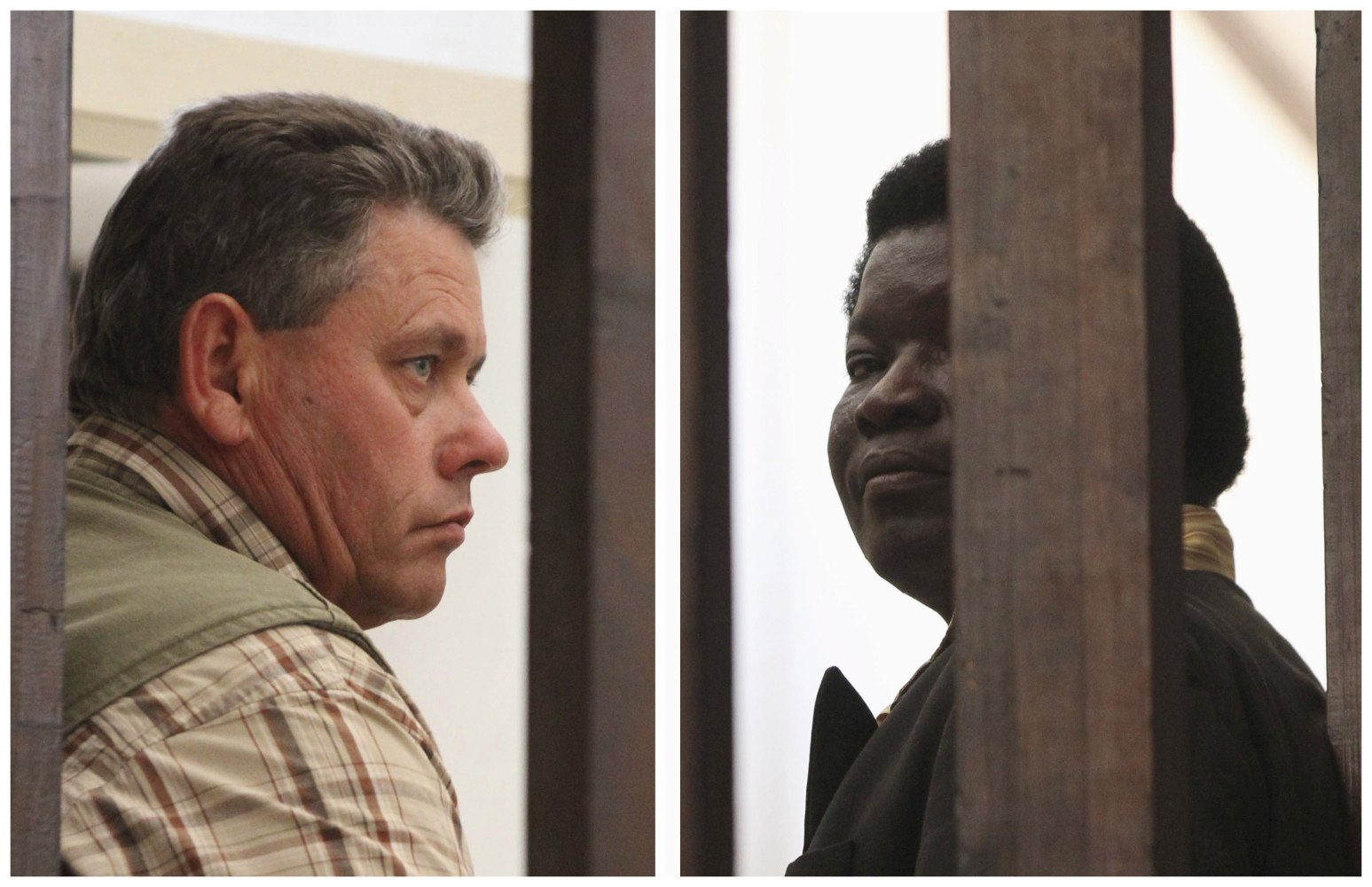
The two Zimbabweans — professional hunter Theo Bronkhorst and farmowner Honest Ndlovu — were in court to face poaching charges. Authorities say they did not have the valid hunting permits.

<img class=”img-responsive img_inline” src=”http://media4.s-nbcnews.com/j/newscms/2015_31/1146066/lion-hunters-ejo-072915_d2c2ca3b3a964dcae3fe0d3df2ed6126.nbcnews-fp-360-360.jpg” alt=”Image: A combination photo shows Zimbabwean safari operator Ndlovu and fellow countryman and hunter Bronkhorst waiting to appear in Hwange magistrates court” title=”Image: A combination photo shows Zimbabwean safari operator Ndlovu and fellow countryman and hunter Bronkhorst waiting to appear in Hwange magistrates court” itemprop=”image”/> Image: A combination photo shows Zimbabwean safari operator Ndlovu and fellow countryman and hunter Bronkhorst waiting to appear in Hwange magistrates court
A combination photo shows Zimbabwean safari operator Honest Ndlovu (rigjt) and fellow countryman and hunter Theo Bronkhorst waiting to appear in Hwange magistrates court on July 29, 2015. PHILIMON BULAWAYO / Reuters

Wildlife officials accuse the men of taking $50,000 from Palmer in order to coax Cecil out of the Hwange National Park and onto private land, where he was beheaded and skinned.

Johnny Rodrigues, chairman of the Zimbabwe Conservation Task Force, said Palmer is the one who fatally shot the creature.

Bronkhorst has been stripped of his license while he faces criminal charges, according to a joint statement from the Zimbabwe National Parks and Wildlife Authority and the Safari Operators Association.

Bronkhorst’s bail was set at $1,200 and he’s due back in court in one week. If found guilty, he and Ndlovu could be fined $20,000 and get a sentence of up to 10 years in jail.

What charges could Palmer face — and could he be extradited?

Police would like to question the 55-year-old trophy hunter for his role in the killing, but have not commented on any possible charges.

He may not face any charges depending on the circumstances, according to the U.K.-based charity LionAid, which advocates for the animal’s protection. The group says it is legal to bait lions in Zimbabwe, and even to kill them using a bow and arrow outside of national parks during private hunting trips. Whether or not they’re wearing a radiocollar — Cecil was — also doesn’t matter, the group says.

But the landowner in this case allegedly never obtained a “quota” for the number of lions that could be killed on his property, making it illegal, LionAid said.

Palmer, meanwhile, was merely the “client” and entrusted his guides — a defense that could get him off the hook for any charges, the group added.

Palmer said in a statement Tuesday that he had “no idea” who the lion was and the legalities of the hunt. He added that he has not been contacted by Zimbabwean authorities.

The U.S. does have an extradition treaty with Zimbabwe that covers crimes punishable for more than a year in jail. Minnesota Congresswoman Betty McCollum has asked the U.S. Attorney’s Office and U.S. Fish and Wildlife Service to investigate whether any American laws were violated.

Palmer in 2008 pleaded guilty to making false statements to U.S. wildlife officials about a black bear he had fatally shot in western Wisconsin.

Why was Cecil so celebrated?

The black-maned beast was a fixture of Hwange National Park, making him a local favorite among parkgoers and wildlife researchers. He was named after Cecil Rhodes, a British businessman who was also the namesake for the former southern African territory of Rhodesia, now Zimbabwe.

Since 2008, Cecil was being studied by an Oxford University research program. “The lion, Cecil, was a remarkable individual. Remarkable particularly because we have studied him for so long,” Professor David MacDonald, founding director of the Wildlife Conservation Research Unit at Oxford University, told NBC News.

What could happen to Cecil’s cubs?

Although the exact number of cubs that 13-year-old Cecil fathered is unclear, researchers believe about eight to 10 of them could wind up dead. That’s because in a lion’s social circle, when one male dies, incoming males in a new coalition typically kill the cubs of the old incumbents, MacDonald said.

“The death of one male lion can cause a cascade of effects that leads to other lions being killed,” he said, adding, “We are working hard to follow the consequences of Cecil’s death.”

More: http://www.nbcnews.com/news/world/cecil-lion-what-could-happen-walter-james-palmer-hunters-n400461

Two Zimbabweans freed on bail in death of Cecil the lion

http://www.cnn.com/2015/07/29/africa/zimbabwe-cecil-the-lion-killed/

(CNN)Two men arrested in the death of Cecil the lion — a case in which an American dentist has also been accused, unleashing a torrent of anger online — were released Wednesday by a court in Zimbabwe on $1,000 bail each.

Theo Bronchorst, a professional hunter, and Honest Trymore Ndlovu, a land owner, both Zimbabweans, said through their attorney that they were innocent of poaching charges, which officials said could bring a sentence of 10 years in prison.

Zimbabwean authorities said that Walter J. Palmer, a dentist from Minnesota, paid at least $50,000 for the hunt. Palmer has said he relied on the expertise of local guides “to ensure a legal hunt.”

But the lion that he and his local guides killed wasn’t just any lion, according to Zimbabwean officials.

He was Cecil, a major tourist draw at Zimbabwe’s Hwange National Park.

The 13-year-old lion, recognizable by the black streaks in his mane, suffered a slow death, according to the Zimbabwe Conservation Task Force.

The hunters lured him out of the sanctuary of the park with a dead animal on top of a vehicle, the conservation group said.

Palmer, officials said, then shot the lion with a crossbow, a method for which he is known. But Cecil survived another 40 hours until the hunters tracked him down and shot him with a gun.

Walter J. Palmer, left, a U.S. hunter wanted in the killing of Zimbabwe's Cecil the lion, poses with a dead ram.

<img alt=”Walter J. Palmer, left, a U.S. hunter wanted in the killing of Zimbabwe's Cecil the lion, poses with a dead ram.” class=”media__image” src=”http://i2.cdn.turner.com/cnnnext/dam/assets/150728212459-03-walter-james-palmer-large-169.jpg”>

Cecil was skinned and beheaded, and the hunters tried to destroy the GPS collar that Cecil was wearing as part of research backed by Oxford University, the group said.

“I had no idea that the lion I took was a known, local favorite, was collared and part of a study until the end of the hunt,” Palmer said Tuesday in a statement. “I relied on the expertise of my local professional guides to ensure a legal hunt.”

Torrent of anger online

His alleged role in Cecil’s death brought a wave of online anger crashing down on him.

The Yelp page for his dental practice in Bloomington, Minnesota, was inundated with reviews posted by people irate over his lion hunting.

Only four northern white rhinos are left

<img alt=”Only four northern white rhinos are left ” class=”media__image” src=”http://i2.cdn.turner.com/cnnnext/dam/assets/150728201741-northern-white-rhino-large-169.jpg”>

Only four northern white rhinos are left

MUST WATCH

Only four northern white rhinos are left 01:10
PLAY VIDEO

“Shame on you, killing a majestic creature,” wrote a user named Charmie P.

The website for Palmer’s business, River Bluff Dental, appeared to have been taken down.

A torrent of outrage flowed on social media, with celebrities such as Sharon Osbourne lambasting the dentist.

“I hope that #WalterPalmer loses his home, his practice & his money,” Osbourne tweeted. “He has already lost his soul.”

At least $50,000 allegedly paid for hunt

Investigations suggest the killing of Cecil was illegal because the land owner “was not allocated a lion on his hunting quota for 2015,” said a statement from the Zimbabwe Parks and Wildlife Management Authority and Safari Operators Association of Zimbabwe.

The dentist said in his statement that no authorities in Zimbabwe or the United States had contacted him but that he would assist them in any inquiries.

“I deeply regret that my pursuit of an activity I love and practice responsibly and legally resulted in the taking of this lion,” Palmer said.

#WalterPalmer: Internet seeks revenge for Cecil the lion

At least $50,000 allegedly paid for hunt

Investigations suggest the killing of Cecil was illegal because the land owner “was not allocated a lion on his hunting quota for 2015,” said a statement from the Zimbabwe Parks and Wildlife Management Authority and Safari Operators Association of Zimbabwe.

The dentist said in his statement that no authorities in Zimbabwe or the United States had contacted him but that he would assist them in any inquiries.

“I deeply regret that my pursuit of an activity I love and practice responsibly and legally resulted in the taking of this lion,” Palmer said.

Dentist’s enthusiasm for hunting with bow and arrow

But Cecil’s killing doesn’t appear to be the first time Palmer has got into trouble while hunting.

A man by the same name and age, and from the same town, illegally killed a black bear in Wisconsin several years ago, according to court documents.

That individual pleaded guilty to making false statements knowingly to the U.S. Fish and Wildlife Service, and was sentenced to one year on probation and ordered to pay a fine of nearly $3,000, records show.

A New York Times article in 2009 that profiled Palmer and his hunting methods said he had served a year of probation over the false statements case.

Palmer, right, poses with a dead black-tailed deer. The dentist said he "deeply" regrets killing Cecil the lion.

<img alt=”Palmer, right, poses with a dead black-tailed deer. The dentist said he "deeply" regrets killing Cecil the lion.” class=”media__image” src=”http://i2.cdn.turner.com/cnnnext/dam/assets/150728212457-02-walter-james-palmer-large-169.jpg”>

The Times article detailed Palmer’s skill and enthusiasm for using archery rather than firearms to slay animals.

He is “said to be capable of skewering a playing card from 100 yards with his compound bow,” it said, recounting his killing of a large elk with an arrow in Northern California.

More: http://www.cnn.com/2015/07/29/africa/zimbabwe-cecil-the-lion-killed/

When is it hunting and when is it poaching?

http://www.bbc.com/news/world-africa-33699347

Cecil the lion was a renowned figure in Zimbabwe’s Hwange National Park.

Earlier this month, however, American dentist Walter Palmer paid roughly $50,000 (£32,000)for the chance to kill the popular animal, although he says he was unaware of Cecil’s fame and reputation.

That prompted revulsion from many on social media, with tens of thousands signing a petition calling for Cecil’s killer to be brought to justice.

But what is the difference between hunting an animal and poaching?

What is poaching?

The crucial distinction to be made between poaching and hunting is where each sits in the eyes of the law. Put simply, poaching is hunting without legal permission from whoever controls the land.

Hunting lions is not prohibited per se in Zimbabwe, and indeed in many other countries in Africa. Hunting is regulated by the government, and hunters must obtain permits authorising them to kill certain animals.

Tourists who wish to hunt in the country may do so. Where and what they hunt, and what type of weaponry they use, is all the subject of regulation.

Foreigners hunting in Zimbabwe must be accompanied by a licensed professional hunter, and tour operators which sell hunting packages to tourists are regulated by the government.

Browsing online, it is possible to find package hunting trips in Zimbabwean game reserves for around $50,000 – about the same amount Mr Palmer says he paid for the hunt which has earned him global infamy.

The dentist who has attracted numerous unwanted headlines over the last couple of days, has insisted that he believed “everything about this trip was legal and properly handled”, prior to killing Cecil the lion.

Why do people poach?

Some animals, such as elephants and rhinos, attract poachers because selling their tusks can prove extremely lucrative.

Earlier this year, Kenya’s president set fire to a pile containing 15 tonnes of seized elephant ivory with an estimated value of more than $30 million (£19 million).

Uhuru Kenyatta lamented that the tusks had been taken from elephants which had been “wantonly slaughtered by criminals”.

Rhino and elephant tusks are routinely exported to Asia, where ivory is used to make ornaments, and in traditional medicines.

For some, like Walter Palmer, however, the act of hunting itself is the attraction. That, and the prospect of a “trophy”, such as a lion’s head, after the kill is made.

Since he acknowledged having killed Cecil, photographs of the hunter with the carcasses of other animals have been widely shared online.

He has expressed regret that “my pursuit of an activity I love” had resulted in the death of such a popular animal.

It is estimated that more than 650 lion carcass “trophies” are exported from Africa each year.

What are the effects of poaching?

The main argument against unauthorised hunting is the effect it has on the numbers of animals living in the wild.

The level of public outcry when a case such as the slaying of Cecil the lion comes to the fore is accentuated by the fact that poachers often target some of the planet’s most impressive and treasured creatures.

The Born Free Foundation estimates that between 30% and 50% of Africa’s lion population has been wiped out over the course of the last two decades. Just 32,000 of the animals remain in the wild.

Can hunting have a positive impact?

Hunting big game in its natural habitat is undoubtedly an attractive prospect for some tourists – and something many are willing to pay tens of thousands of dollars to experience.

Emmanuel Fundira, president of the Safari Operators Association of Zimbabwe, has described Cecil’s killing as a “tragedy” for tourism in Zimbabwe.

Critics say the money paid by trophy hunters rarely reaches those most in need
Critics say the money paid by trophy hunters rarely reaches those most in need….
More: http://www.bbc.com/news/world-africa-33699347 

Zimbabweans in lion hunt in court; kill was “unethical”

July 29 at 12:45 PM

HARARE, Zimbabwe — Two Zimbabweans arrested for illegally hunting a lion appeared in court Wednesday. The head of Zimbabwe’s safari association said the killing was unethical and that it couldn’t even be classified as a hunt, since the lion killed by an American dentist was lured into the kill zone.

A professional hunter identified by the Zimbabwe Parks and Wildlife Management Authority as Theo Bronkhorst and his co-defendant, farm owner Honest Trymore Ndlovu, are accused of helping Walter James Palmer hunt the lion. Zimbabwean police said they are looking for Palmer, the American dentist who reportedly paid $50,000 to track and kill the animal.

Zimbabwean prosecutors’ documents accuse Bronkhorst of failing to “prevent an unlawful hunt.” Court documents say Bronkhorst was supervising while his client, Palmer, shot the animal.

During the nighttime hunt, the men tied a dead animal to their car to lure the lion out of a national park, said Johnny Rodrigues, chairman of the Zimbabwe Conservation Task Force. The American is believed to have shot it with a crossbow, injuring the animal. The wounded lion was found 40 hours later, and Palmer shot it dead with a gun, Rodrigues said.

Using bait to lure Cecil the lion is deemed unethical by the Safari Operators Association of Zimbabwe, of which Bronkhorst is a member. The association has since revoked his license.

“Ethics are certainly against baiting. Animals are supposed to be given a chance of a fair chase,” Emmanuel Fundira, the association’s president, said on Tuesday. “In fact, it was not a hunt at all. The animal was baited and that is not how we do it. It is not allowed.”

Palmer, a dentist living in the Minneapolis suburb of Eden Prairie, said in a statement that he was unaware the lion was protected, relying on local guides to ensure a legal hunt.

“I had no idea that the lion I took was a known, local favorite, was collared and part of a study until the end of the hunt. I relied on the expertise of my local professional guides to ensure a legal hunt,” Palmer said in statement through a public relations firm.

More: https://www.washingtonpost.com/world/africa/zimbabweans-linked-to-illegal-lion-hunt-appear-in-court/2015/07/29/bb8c9232-35e5-11e5-ab7b-6416d97c73c2_story.html

Voices: Cecil the lion’s death is everyone’s loss

http://www.usatoday.com/story/news/world/2015/07/29/cecil–lion-death/30826405/

 LONDON — Growing up in Zimbabwe in southern Africa, I was always awestruck by the country’s majestic wildlife, and I am opposed to hunting purely for sport.

Elephants, rhinos, zebras and various species of antelope were regular sights on visits to game parks on school trips and on family outings.

I’ll never forget the day when my elementary class visited the local vet to see an injured wild dog that had been brought in for treatment — a rare event in the country’s second-largest city, Bulawayo.

So like many others…More: http://www.usatoday.com/story/news/world/2015/07/29/cecil–lion-death/30826405/