Extinction of your favorite animal more real than you realize

Extinction of your favorite animal more real than you realize

This week a study published in Science Advances has suggested that the extinction of some of the world’s most beloved animals is a clear and present danger. Fourty-four of the 74 largest terrestrial herbivores are now threatened with extinction, 12 of them “critically endangered” or extinct in the wild. Many of the species in decline, suggests the study, “are poorly known scientifically, and [are] badly in need of basic ecological research.” Not only will they die unless we do something, we’ll never know what they are all about in the first place.

Below you’ll see a set of two maps. The map at the top shows areas where large herbivore species exist. The cool colors show places where large herbivores exist, but only a handful of species.

The warmer the color, the more species of large herbivore exist.

F1.large-1

The second map shows where large herbivores are threatened. Save South America, most areas with very few large herbivore species seem to be less threatened.

The following species are currently threatened:
• African elephant (VU)
• Asian elephant (EN)
• Hippopotamus (VU)
• Pygmy hippopotamus (EN)
• Eastern gorilla (EN)
• Western gorilla (EN)
• Malayan tapir (VU)
• Baird’s tapir (EN)
• Lowland tapir (VU)
• Mountain tapir (EN)
• Philippine warty pig (VU)
• Oliver’s warty pig (EN)
• Visayan warty pig (CR)
• Palawan bearded pig (VU)
• Bearded pig (VU)
• Indian rhinoceros (CR)
• Javan rhinoceros (CR)
• Sumatran rhinoceros (CR)
• Black rhinoceros (CR)
• Grevy’s zebra (EN)
• Mountain zebra (VU)
• African wild ass (CR)
• Przewalski’s horse (EN)
• Asiatic wild ass (CR)
• Sambar (VU)
• Barasingha (VU)
• Père David’s deer (EW)
• White-lipped deer (VU)
• Bactrian camel (CR)
• Indian water buffalo (EN)
• Gaur (VU)
• Kouprey (CR)
• European bison (VU)
• Wild yak (VU)
• Banteng (EN)
• Takin (VU)
• Lowland anoa (EN)
• Tamaraw (CR)
• Mountain nyala (EN)
• Scimitar-horned oryx (EW)
• Mountain anoa (EN)
• Sumatran serow (VU)
• Walia ibex (EN)

This study shows three of the best-known species whose populations are contracting as we speak. These herbivores are the African Elephant, the Common Hippopotamus (not common for long), and the Black Rhinoceros.

F3.large

The most recent range polygons for the rhino are not shown here because of “recent poaching pressure.”

The change in population and possibility of extinction in all of these areas is due largely to one (or more) of four elements. Exploitation (hunting), Livestock (problems therein), Land-use change, and Conflict – as in Civil Unrest between warring human factions.

oops

Above you’ll see the percentages of large herbivore species threatened based on these four major threat categories.

NOTE: The total here adds up to more than 100% because each large herbivore may have more than one existing threat.

Photo Credits: Elephant and hippopotamus (K. Everatt), rhinoceros (G. Kerley).

You can see the full study in Science Advances 01 May 2015: Vol. 1, no. 4, e1400103. Code DOI: 10.1126/sciadv.1400103. Authored by William J. Ripple, Thomas M. Newsome, Christopher Wolf, Rodolfo Dirzo, Kristoffer T. Everatt, Mauro Galetti, Matt W. Hayward, Graham I. H. Kerley, Taal Levi, Peter A. Lindsey, David W. Macdonald, Yadvinder Malhi, Luke E. Painter, Christopher J. Sandom, John Terborgh, and Blaire Van Valkenburgh.

The title of the paper this information comes from is “Collapse of the world’s largest herbivores”. This paper is available now for further review – again, from Science Advances.

Airline Takes On Big Game Hunters to Protect Rhinos, Lions, and Elephants

Africa’s largest airline bans the shipment of endangered animal trophies on its flights.

An elephant head with ivory tusks and other hunting trophies in a taxidermy store in Bulawayo, Zimbabwe. (Photo: Robert Caputo/Getty Images)

April 30, 2015

Taylor Hill is TakePart’s associate environment and wildlife editor.

It just got harder for big game hunters to bring endangered animal trophies back home from South Africa to hang on their wall.

That’s because South African Airways, the continent’s largest airline, has banned the transport of endangered rhinos, elephants, and lions aboard its passenger and cargo flights.

“SAA will no longer support game hunters by carrying their trophies back to their country of origin,” SAA country manager Tim Clyde-Smith told the South African media on Wednesday. “The vast majority of tourists visit Africa in particular to witness the wonderful wildlife that remains. We consider it our duty to work to ensure this is preserved for future generations and that we deter activity that puts this wonderful resource in danger.”

The news broke April 25, when the Professional Hunters Association of South Africa posted internal documents from SAA revealing its embargo plans. The airline then issued a statement announcing that the embargo had gone into effect April 21 on all of its flights. No exceptions will be made, even if the hunter holds a valid permit “issued by the relevant authorities” to transport the animal, the airline said.

SAA spokesperson Tlali Tlali said in an email that a recent incident influenced the airline to establish the embargo. “Early in April 2015, a shipment lodged as machinery spare parts was discovered in Australia whilst in transit to Kuala Lumpur. The shipment contained elephant tusks and was seized. We were issued with a notice of seizure.”

“We recognize that this decision could impact several stakeholders,” Tlali added. “SAA Cargo remains committed to playing a significant role in curbing the illegal transportation of all animal species while positively contributing to national and international conservation efforts.”

Conservation groups are touting the move as a step in the right direction, helping curb the hunting of Africa’s endangered animals and limiting options for illegal wildlife traffickers who might otherwise transport wildlife products under the guise that the goods were obtained via legal hunts.

“We see this as a bold and positive move on South African Airways’ part to limit human-induced mortalities,” said African Wildlife Foundation spokesperson Kathleen Garrigan. “It’s especially impactful given that [SAA] services a major sport-hunting destination.”

With SAA taking the first step, the question is whether other international airlines will follow suit. Delta Airlines, the only U.S.-based airline with direct flights to South Africa, did not immediately respond to a request for comment regarding SAA’s embargo.

If other airlines jump on board, trophy hunting might not be so appealing to big game hunters if they can’t bring evidence of their kills home. American hunters are already facing restrictions on what African animals they can go after.

U.S. Fish and Wildlife officials banned ivory trophy imports from Tanzania and Zimbabwe last year and are considering listing the African elephant as an endangered species—which would effectively ban all ivory trophy and elephant skin imports from legal hunts.

“This move will likely not deter hunters from hunting, but it may deter them from choosing South Africa as a destination for sport hunting,” Garrigan said.

_________________________

Also see:  With conditions: Carolinas regulators approve first federal permits for offshore oil surveys

http://www.foxbusiness.com/markets/2015/05/04/with-conditions-carolinas-regulators-approve-first-federal-permits-for-offshore/

Tell Craigslist to end ivory sales on its sites!

1924891_10152211828561061_1647642544_n
Jobs, used bikes, apartments, ivory trinkets. They’re all available on Craigslist, but only one comes from the gruesome slaughter of elephants.
But here’s the thing: Craigslist’s own policy prohibits the sale of animal parts, including ivory on its sites. And yet, right now, the sale of ivory is rampant on Craigslist. Do they know that all ivory comes from dead elephants?
Craigslist’s policy is humane and simply the right thing to do. But they need to follow through and enforce their own rules.
We just conducted a joint investigation with our friends at the International Fund for Animal Welfare and what we found was shocking. A sample of Craigslist sites in cities both large and small yielded hundreds of postings for ivory – valued at well over one million dollars! And this was only examining a small percentage of what is available on the 420 sub-sites that make up Craigslist.
We’ve sent multiple letters to Craigslist leadership drawing attention to this issue. They have taken a first step by explicitly adding ivory to their list of prohibited items.
It’s a start, but we need them to take it further and enforce the rules.
So now we’re turning to you, our elephant-lovers (and many Craigslist users!), to help turn up the heat.
To be clear, what Craigslist is doing isn’t illegal. Many of the listings say that the ivory is antique, imported to the U.S. before the bans in the 1970s and 1980s and in compliance with state and federal law. But they offer no documentation proving this authenticity, and it’s incredibly difficult to tell the difference between ivory that’s decades old and ivory that came from an elephant poached 6 months ago. Even experts can be duped.
That’s exactly why eliminating all ivory sales is necessary. If we’re going to save African forest elephants from extinction, we need to drive down demand for ivory. That means enacting bans on the federal and state levels and then securing the resources to enforce those bans. Persuading corporations to enact and enforce their own bans is another critical piece of the puzzle.
Craigslist is one of the most popular online classified companies in the world. Taking a stand for elephants would be a huge step forward on this issue and make it easier for other companies to follow in their footsteps.
Together, we can win this! We’ve helped enact bans in New York and New Jersey. We convinced PBS’s Antiques Roadshow to stop appraising ivory on-air. Here’s to the next big win.
Sincerely,
John F Calvelli
John F. Calvelli
Executive Vice President for Public Affairs
Wildlife Conservation Society
Director, 96 Elephants

Wikipedia on Bush”meat”

http://en.wikipedia.org/wiki/Bushmeat

The term bushmeat, also called wildmeat and game meat, refers to meat from non-domesticated mammals, reptiles, amphibians and birds hunted for food in tropical forests.[1] Commercial harvesting and the trade of wildlife is considered a threat to biodiversity.[2]

Bushmeat also provides a route for a number of serious tropical diseases to spread to humans from their animal hosts.[3][4] Bushmeat is used for sustenance in remote areas, while in major towns and cities in bushmeat eating societies it is treated as a delicacy.[5]

Nomenclature[edit]

Today the term bushmeat is commonly used for meat of terrestrial wild or feral mammals, killed for sustenance or commercial purposes throughout the humid tropics of the Americas, Asia, and Africa. In West Africa (primarily Ghana, Ivory Coast, and Nigeria), Achatina achatina a giant African snail, is also gathered, sold, eaten, and monitored as part of the bushmeat trade.[6][7][8] To reflect the global nature of hunting of wild animals, Resolution 2.64 of the IUCN General Assembly in Amman in October 2000 referred to wild meat rather than bushmeat. A more worldwide term for terrestrial wild animals is game. The term bushmeat crisis tends to be used to describe unsustainable hunting of often endangered wild mammals in West and Central Africa and the humid tropics, depending on interpretation. African hunting predates recorded history; by the 21st century it had become an international issue.[9]

Extent[edit]

The volume of the bushmeat trade in West and Central Africa was estimated at 1-5 million tonnes per year at the turn of the century.[10] According to the Center for International Forestry Research (CIFOR) in 2014, approximately 5 million tonnes were still being consumed per year in the Congo Basin.[5]

For the people of this region, bushmeat represents a primary source of animal protein in the diet, making it a significant commercial industry. According to a 1994 study in Gabon, annual sales were estimated at US$50 million. The study found that bushmeat accounted for more than half of meat sold in local markets, with primates representing 20% of the total bushmeat.[11]

Dynamics[edit]

Two Malagasy hunters stand near a stream, one holding a gun, the other holding a lemur with a white head.

Endangered species, including lemurs from Madagascar are killed for bushmeat despite this being illegal.

Bushmeat is often smoked prior to consumption.

Logging penetration of forests[edit]

Logging concessions operated by companies in African forests have been closely linked to the bushmeat trade. Because they provide roads, trucks and other access to remote forests, they are the primary means for the transportation of hunters and meat between forests and urban centres. Some, including the Congolaise Industrielle du Bois (CIB) in the Republic of Congo, have partnered with governments and international conservation organizations to regulate the bushmeat trade within the concessions where they operate. Numerous solutions are needed; because each country has different circumstances, traditions and laws, no one solution will work in every location.[12]

Overfishing[edit]

In the case of Ghana, international over-exploitation of African fishing grounds has increase demand for bushmeat. Both EU-subsidized fleets and local commercial fleets have depleted fish stocks, leaving local people to supplement their diets with animals hunted from nature reserves. Over 30 years of data link sharp declines in both mammal populations and the biomass of 41  wildlife species with a decreased supply of fish.[13]

Public preference[edit]

In the case of Liberia in West Africa, bushmeat is widely eaten and is considered a delicacy.[14] A 2004 public opinion survey found that bushmeat ranked second behind fish amongst residents of the capital Monrovia as a preferred source of protein.[14] Of households where bushmeat was served, 80% of residents said they cooked it “once in a while,” while 13% cooked it once a week and 7% cooked bushmeat daily.[14] The survey was conducted during the last civil war, and bushmeat consumption is now believed to be far higher.[14]

Role in spread of diseases[edit]

The transmission of highly variable retrovirus chains causes zoonotic diseases. Outbreaks of the Ebola virus in the Congo Basin and in Gabon in the 1990s have been associated with the butchering of apes and consumption of their meat.[15] Bushmeat hunters in Central Africa infected with the human T-lymphotropic virus were closely exposed to wild primates.[16]

HIV[edit]

Results of research on wild chimpanzees in Cameroon indicate that they are naturally infected with the simian foamy virus and constitute a reservoir of HIV-1, a precursor of the acquired immunodeficiency syndrome (AIDS) in humans.[17] There are several distinct strains of HIV, indicating that this cross-species transfer has occurred several times.[18] Researchers have shown that HIV originated from a similar virus in primates called simian immunodeficiency virus (SIV); it is likely that HIV was initially transferred to humans after having come into contact with infected bushmeat.[19]

Animals used as bushmeat may also carry other diseases such as smallpox, chicken pox, tuberculosis, measles, rubella, rabies, yellow fever and yaws.[20] African squirrels (Heliosciurus, Funisciurus) have been implicated as reservoirs of the monkeypox virus in the Democratic Republic of the Congo.[21] The bubonic plague bacteria can transfer to humans when handling or eating prairie dogs.[22]

In many instances, catching the diseases mentioned above often occurs due to the cutting of the meat, in which animal blood, and other fluids may wind up on the people cutting it, thereby infecting them. Another way that people get infected is due to the fact that some portions of the meat may not be completely cooked. This often occurs due to the type of heating source employed: open fires over which the meat is simply hung.[23] Improper preparation of any infected animal may be fatal.[24]

Ebola[edit]

The Ebola virus, for which the primary host is suspected to be fruit bats, has been linked to bushmeat. Between the first recorded outbreak in 1976 and the largest in 2014, the virus has transferred from animals to humans only 30 times, despite large numbers of bats being killed and sold each year. In Ghana, for instance, 100,000 bats are sold annually, yet not a single case of transmission has been reported in the country. Primates may carry the disease, having contracted the disease from bat droppings or fruit touched by the bats. Like humans, it is often fatal for the primate.[5]

Although primates and other species may be intermediates, evidence suggests people primarily get the virus from bats. Since most people buy pre-cooked bushmeat, hunters and people preparing the food have the highest risk of infection. Hunters usually shoot, net, scavenge or catapult their prey, and studies indicate that most hunters handle live bats, come in contact with their blood, and often get bitten or scratched.[5]

In 2014, the Ebola outbreak in West Africa originated in Guéckédou in south-eastern Guinea and was linked to bushmeat after it was learned that the first case came from a family that hunted two species of fruit bat,[5] Hypsignathus monstrosus and Epomops franqueti.[25] A two-year-old child from that family, dubbed “Child Zero”, died from the disease on December 6, 2013. Despite the risk, surveys pre-dating the 2014 outbreak indicate that people who eat bushmeat are usually unaware of the risks and view it as healthy food. In Western Africa, bush meat is an old tradition, associated with proper nutrition. Because livestock production is minimal, people often consume bushmeat in a way comparable to how European societies consume rabbit or deer meat. Media coverage of the 2014 outbreak and its link to bushmeat has been criticized because it has failed to focus on the primary risk of infection, which is person-to-person.[5]

This was exemplified when a major Nigerian newspaper implied that eating dog meat was a healthy alternative to bush meat.[26] However, as human populations grow, the interactions between humans and wildlife will increase, making events like the 2014 outbreak more likely.[5]

Impact upon animal species[edit]

Pygmy hippos are among the species illegally hunted for food in Liberia.[27] The World Conservation Union estimates that there are fewer than 3,000 pygmy hippos remaining in the wild.[28]

The consumption of bushmeat threatens a wide range of species, including species that are endangered and threatened with extinction. For example, a range of endangered species are hunted bushmeat in Liberia.[27]

Species hunted for food in Liberia include elephants, pygmy hippopotamus, chimpanzees, leopards, duikers, and other monkeys.[27] Forest rangers in Liberia say that bushmeat poachers will kill any forest animal they encounter.[27]

Effect on great apes[edit]

A gorilla in the DR Congo, 2008. The use of buckshot has helped bushmeat hunters target gorillas by allowing them to more easily kill the dominant male silverback.

The great apes of Central and West Africa—gorillas and chimpanzees—are nearly ubiquitously sold as bushmeat throughout the region, and a study from 1995 suggests that the off-take is unsustainable.[11] With the exception of a 1995 report from Cameroon, where gorillas were considered a target species for hunters, Central and West African hunters do not appear to target them.[29] Historically, poachers have favored hunting chimpanzees because they flee when one is shot. Gorillas, however, only became easy targets when chevrotine ammunition became available, allowing the hunters to more easily kill the dominant male silverback whose role it is to defend his troop.[11]

Generally, great apes constitute a minor portion of the bushmeat trade. Although a 1996 study indicated that approximately 1.94% of animal carcasses sold and consumed in Brazzaville in the Republic of the Congo belonged to great apes, it accounted for 2.23% of the biomass of the meat sold, which is significant for ape populations relative to their ecosystem. Furthermore, these numbers may not have accurately represented the extent of the problem for the following reasons:[29]

  1. Vendors may not have admitted the sale of great ape meat because it is illegal;
  2. The carcasses are large, and may therefore have been consumed locally rather than been transported to large markets;
  3. Great ape hunting usually peaks when new forest areas are made accessible as they are unwary when unfamiliar with humans, but later hunting declines;
  4. It is nearly impossible to visually distinguish the meat source when it has been smoked;
  5. Secondary effects, such as unintended deaths from traps are not represented in market data.

During the time interval between a study from 1981–1983 and another study between 1998–2002 in Gabon, ape population density fell 56%, despite the country retaining nearly 80% of its original forest cover.[30] This decline was primarily associated with the transformation of the bushmeat trade from subsistence level to unregulated, commercial hunting, facilitated by transportation infrastructure intended for logging purposes.[11][30] Unsustainable hunting practices along with habitat loss makes the extinction of these endangered primates more likely.[31]

Wildlife Activist Disappears in Zimbabwe


WE ARE DEVASTATED

WAR AMBASSADOR DISAPPEARS WHILE FLEEING ZIMBABWE

Rob Grinham, WAR ambassador and wildlife activist was taken from Lusaka airport last night in what seems to be a coordinated effort by both Zambian and Zimbabwean authorities.
All inquiries into his whereabouts result in a denial by the authorities of him ever having been there.

He was traveling by bus to Lusaka after his house in Harare was invaded and searched by Zim police.

Rob was doing research into the illegal ivory trade and poaching activities and sharing information about WAR projects.
Did he stumble on sensitive information? Did he become a threat to corrupt officials?

We fear for his life.

Please share and post this all over social media. If you have seen him anywhere since last night please get in touch with us.

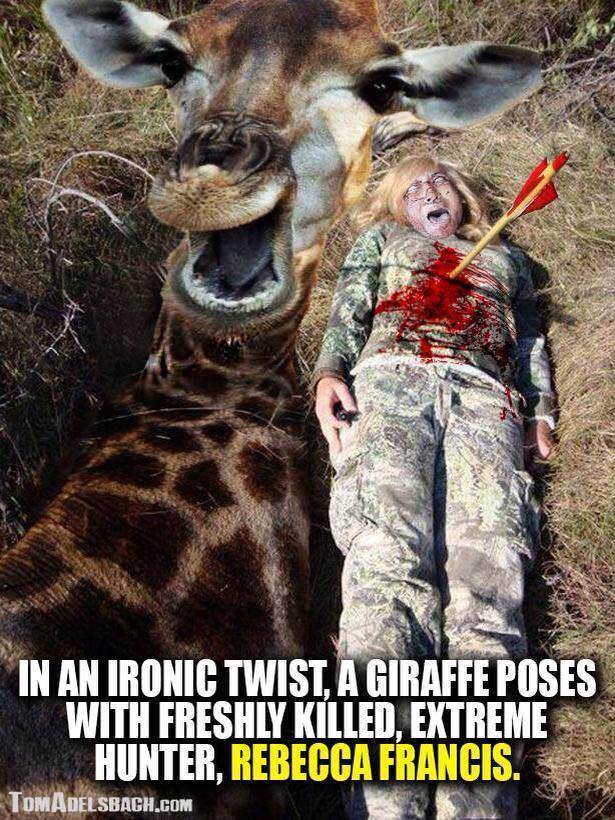
Footage of Rebecca Francis killing a giraffe in Africa

From Change.org

Apr 20, 2015 — This video shows Rebecca Francis hunting the giraffe from the picture. Although she made a rebuttal to Ricky Gervais last week, the video shows just had deceptive she was being.
https://www.youtube.com/watch?v=RmkslPmo1vU&feature=youtu.be

Footage of Rebecca Francis killing a giraffe in Africa
Here is footage of the hunt in which Rebecca Francis kills a giraffe with a bow and arrow in Africa which has caused outrage. Francis like all trophy hunters has claimed she killed the animal to feed local…

“You know that feeling of joy someone gets when they put an arrow through a giraffe’s eye…..No, me neither”*

*Recent Tweet by Ricky Gervis

More: http://www.oregonlive.com/today/index.ssf/2015/04/ricky_gervais_vs_rebecca_franc.html

Rebecca Francis has been famous in hunting circles since 2010, when the photogenic Utah native won the obscure reality show “Extreme Huntress.”

But now she’s famous in the wider world as well, thanks to comedian Ricky Gervais.

Last week, Gervais, a dedicated animal-rights activist with more than 7 million Twitter followers, came upon a photo of Francis posing next to a giraffe she had just killed, a big smile spread across her face. The result: a tweet heard ’round the world.

CCdg2FaWgAAHhrY

“What must’ve happened to you in your life to make you want to kill a beautiful animal & then lie next to it smiling?”

Ricky Gervais         @rickygervais

People outraged by Francis’ apparently cavalier attitude toward killing wildlife expressed their disgust on social media and beyond.

Stunned by the criticism, Francis struck back, accusing Gervais of sexism. “Ricky Gervais has used his power and influence to specifically target women in the hunting industry and has sparked thousands of people to call for my death, the death of my family and many other women who hunt,” she said in a statement. She added: “I repeat I will never apologize for being a woman who hunts as I know that my passion for hunting and conservation is making a direct difference on the ground for wildlife.”

In the wake of Gervais’ giraffe tweet, a few people on Twitter did call for violence toward Francis. Some of Francis’ supporters have also suggested violence is the answer. One hunting enthusiast tweeted: “@rickygervais a real hunter would shoot idiots like you for the greater good of society.” Gervais retweeted it.

On her website, Francis boasts of having “taken” bears, moose, sheep, zebra and many other animals with both bows and rifles, and of mentoring other women who are interested in hunting. “For me, there is nothing more empowering than sharing that special moment of success with another female who is chasing her dreams,” she writes.

Gervais responded to Francis’ sexism claim by tweeting as if he were Francis: “I kill lions, giraffes & bears with guns and bows and arrows then pose grinning. Why don’t people like me? Must be because they’re sexist.” He then highlighted male hunters too, employing his usual un-PC humor.

Such as Tweeting, “Maybe he was hungry,” under this photo:

CCySocvXIAE93eY

Francis has gone quiet in recent days, but Gervais, whose Twitter feed often features his house cat Ollie, gives no indication that he’s done.

Elephant kills professional big game hunter in Zimbabwe

10671222_10202527690853624_1897035803926677117_n

Professional hunter tracking a lion for American client crushed to death by young bull elephant in Zambezi Valley

By Peta Thornycroft, Johannesburg

17 Apr 2015

A young bull elephant killed professional hunter Ian Gibson early on Wednesday as he tracked a lion for an American client in a rugged part of north-east Zimbabwe.

Mr Gibson, 55, one of Zimbabwe’s best known big game hunters, died scouting for prey in the Zambezi Valley after a young bull elephant charged, then knelt on him and crushed him to death.

“We don’t yet know the full details of how ‘Gibbo’ as we called him, died, as the American client and the trackers are still too traumatised to give us full details,” said Paul Smith, managing director of Chifuti Safaris’ which employed Mr Gibson for the hunt.

The American hunter was on his first trip to Zimbabwe, and only has one leg, but was “fit and strong” and had already shot a leopard. Mr Gibson was scouting for lions when he encountered the elephant.

Mr Gibson’s trackers said the young bull had been in a musth period, which means it was producing much more testosterone then usual.

“We know ‘Gibbo’ shot it once, from about 10 yards away, with a 458 [rifle]. He would never have fired unless he had no alternative. He was a hunter, yes, but he was also a magnificent wildlife photographer and conservationist.

“He was so experienced and this is a most unexpected tragedy.” …

Mr Smith said the young bull elephant appeared not to be a natural target for any hunter as its tusks were too small.

“In most years someone is usually killed on a hunt somewhere in Africa, and that is why it is called ‘dangerous game hunting‘ but we are very shocked that it was ‘Gibbo’,” said Mr Smith.

Mr Gibson began his wildlife career in Zimbabwe’s department of national parks, but left to become a hunter about 25 years ago.

He was well-known in the US, where the Dallas Safari Club is paying his funeral expenses.

More: http://www.telegraph.co.uk/news/worldnews/africaandindianocean/zimbabwe/11546066/Elephant-kills-professional-big-game-hunter-in-Zimbabwe.html

Hunter Ian Gibson Trampled To Death By Elephant He Was Tracking To Kill For Ivory

http://www.huffingtonpost.co.uk/2015/04/17/hunter-ian-gibson-trampled-death-elephant-tracking-kill_n_7085374.html?ncid=fcbklnkushpmg00000063

A professional game hunter has been trampled to death by an elephant he was attempting to kill.

Ian Gibson was leading a hunt in Chewore North in the lower Zambezi Valley of Zimbabwe, when the bull elephant “began a full charge. ”

In an online note on the website of his employers Safari Classics, the company explained Gibson had been tracking the elephant for five hours with a client when they stopped for a rest.

ian gibson

Ian Gibson was killed by a charging African bull elephant

It adds: “Feeling he was quite close to the elephant, Ian and his tracker Robert continued to follow the tracks in hopes of getting a look at the ivory as the client stayed with the game scout.”

SEE ALSO:

Gibson’s tracker indicated the elephant was in “musth” – a condition where the animal’s urge to mate goes into overdrive and it becomes overly aggressive, but Gibson continued.

The note continues: “They eventually caught up with the bull, spotting him at about 50-100 metres. The bull instantly turned and began a full charge.

bull elephant zimbabwe

The animal was in a state of ‘musth’ making it aggressive (file picture)

“Ian and Robert began shouting in order to stop the charge. At very close range, Ian was able to get off one shot before the bull killed him. The scene was very graphic.”

It is not known if the animal was injured or killed in the incident.

Gibson is paid tribute to as “a fine man and one of the most experienced professional hunters on the African continent.”

The same company lost a staff member in 2012 when Owain Lewis was killed by a buffalo, NewZimbabwe reports.