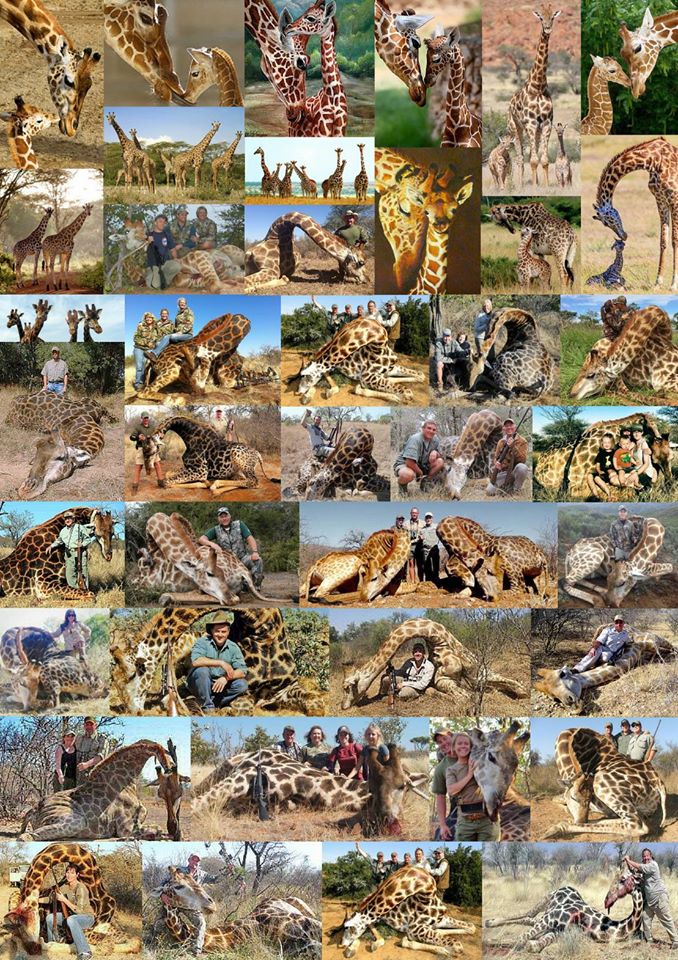
Hunter’s selfie with dead giraffe has ignited Internet fury
7

http://africageographic.com/blog/hunter-killed-bull-elephant-musth/
Ian Gibson, a professional hunter for Chifuti Safaris, was killed by an elephant bull while guiding an elephant hunt in Chewore North in the lower Zambezi Valley.

A message shared on africahunting.com by Safari Classics said:
“It is with deep sadness to announce the passing of Chifuti Safaris professional hunter Ian Gibson. Ian was tragically killed by an elephant bull earlier today while guiding and elephant hunt in Chewore North (lower Zambezi Valley).
The details are just starting to emerge as we write this. However it appears that Ian and his client had been on the tracks of an elephant bull for approximately five hours when they decided to take a break and allow the client to rest. Feeling he was quite close to the elephant, Ian and his tracker Robert continued to follow the tracks in hopes of getting a look at the ivory as the client, stayed with the game scout to rest. Robert indicated the bull was in musth. They eventually caught up to the bull, spotting him at about 50-100 meters. The bull instantly turned and began a full charge. Ian and Robert began shouting in order to stop the charge. At very close range, Ian was able to get off one shot before the bull killed him. The scene was very graphic.”
– See more at: http://africageographic.com/blog/hunter-killed-bull-elephant-musth/#sthash.u6QkEGCu.dpuf

http://www.11alive.com/news/article/312002/40/Western-black-rhino-officially-declared-extinct
LONDON (CNN) — Africa’s western black rhino is now officially extinct according the latest review of animals and plants by the world’s largest conservation network.
The subspecies of the black rhino — which is classified as “critically endangered” by the International Union for Conservation of Nature’s (IUCN) Red List of Threatened Species — was last seen in western Africa in 2006.
The IUCN warns that other rhinos could follow saying Africa’s northern white rhino is “teetering on the brink of extinction” while Asia’s Javan rhino is “making its last stand” due to continued poaching and lack of conservation.
“In the case of the western black rhino and the northern white rhino the situation could have had very different results if the suggested conservation measures had been implemented,” Simon Stuart, chair of the IUCN species survival commission said in a statement.
“These measures must be strengthened now, specifically managing habitats in order to improve performance, preventing other rhinos from fading into extinction,” Stuart added.
The IUCN points to conservation efforts which have paid off for the southern white rhino subspecies which have seen populations rise from less than 100 at the end of the 19th century to an estimated wild population of 20,000 today.
Another success can be seen with the Przewalski’s Horse which was listed as “extinct in the wild” in 1996 but now, thanks to a captive breeding program, has an estimated population of 300.
The latest update to the IUCN Red List of Threatened Species reviews more than 60,000 species, concluding that 25% of mammals on the list are at risk of extinction.
Many plants are also under threat, say the IUCN.
Populations of Chinese fir, a conifer which was once widespread throughout China and Vietnam, is being threatened by the expansion of intensive agriculture according to the IUCN.
A type of yew tree (taxus contorta) found in Asia which is used to produce Taxol (a chemotherapy drug) has been reclassified from “vulnerable” to “endangered” on the IUCN Red List, as has the Coco de Mer — a palm tree found in the Seychelles islands — which is at risk from fires and illegal harvesting of its kernels.
Recent studies of 79 tropical plants in the Indian Ocean archipelago revealed that more than three quarters of them were at risk of extinction.
In the oceans, the IUCN reports that five out of eight tuna species are now “threatened” or “near threatened,” while 26 recently-discovered amphibians have been added to the Red List including the “blessed poison frog” (classified as vulnerable) while the “summers’ poison frog” is endangered.
“This update offers both good and bad news on the status of many species around the world,” Jane Smart, director of IUCN’s global species program said in a statement.
“We have the knowledge that conservation works if executed in a timely manner, yet, without strong political will in combination with targeted efforts and resources, the wonders of nature and the services it provides can be lost forever.”
This blog is living proof that, as the media tells us, “we’re bored with climate change” (The BBC suggests today that we’ve moved on from caring about climate change because we’re tired of it). It’s not that there’s nothing new to learn about the issue of whether we, and the Earth, will survive to see another century.
An overview, Melting Accelerates in Antarctica: So Far, 2015 Is Hottest Year Yet, in Truthout.org by Dahr Jamail posted just last night spells out what’s new, and will fill you in on what you may have missed. If you haven’t read the latest reports on anthropogenic climate disorder (or even if you have), I highly recommend it: http://truth-out.org/news/item/30063-melting-accelerates-in-antarctica-so-far-2015-is-hottest-year-yet It can begin to give you an appreciation of the magnitude of this dire situation.
Coincidentally, on April 7th I wrote a semi-satirical post about the lack of interest in climate change and how business as usual will bring it on, entitled, “C’mon Nature, Show Us a Sign!” https://exposingthebiggame.wordpress.com/2015/04/07/cmon-nature-show-us-a-sign/ As if to prove my point, so far it’s been read by only 31 people. That could almost make one wonder if overpopulation itself is just a hoax. How can there be 7 and a quarter billion people on the planet when only 31 read that post?
Meanwhile the post, “Chorus of Outrage as Obama Administration Approves Arctic Drilling for Shell Oil” only received 23 views.
Now, compare those figures to the 53,436 people so far (6,652 on the first day, followed by 15,094 the next) who have read the article I posted on April 1 about a woman who hunts poachers in Africa.
(Note to anyone writing to spread the word about climate change: You might want to include a photo of a lady cradling a machine gun in front of an American flag, they seem to attract an awful lot of interest.)

Kinessa Johnson is a US Army veteran who served for 4 years in Afghanistan, this week she arrived in Africa to take on a different kind of enemy. Her new mission is, as she puts it, “We’re going over there to do some anti-poaching, kill some bad guys, and do some good.” She is now enlisted with Veterans Empowered To Protect African Wildlife (VETPAW) as an anti-poaching advisor. VETPAW is a not-for-profit organization that employs US Veterans to help protect African wildlife from being illegally hunted and captured.
Ms. Johnson and her team of fellow Vets arrived in Tanzania on March 26th and began their work. She has already noticed a decrease in poaching activity in her team’s immediate area because their presence is known. Which is easy to understand, who would want to fight it out with a battle proven warrior like Johnson? Her team’s primary focus will be training park rangers and patrolling with them to provide support. African park rangers are in serious need of assistance, as she mentions, “they lost about 187 guys last year over trying to save rhinos and elephants.” The training they will provide includes marksmanship, field medicine, and counter-intelligence.
Johnson joined VETPAW because she loves animals and protecting endangered species is close to her heart. Africa has the largest populations of rhinos and elephants in the world, making it the frontline for defending these endangered species that are top targets for poachers. Additionally, revenue from the sale of products from poached animals is often used to fund war and terrorism in Africa. She says that after the obvious first priority of enforcing existing poaching laws, educating the locals on protecting their country’s natural resources is most important overall.
Ms. Johnson has taken to social media to help raise money and awareness for the cause and she now has over 44,000 followers on Facebook and Instagram. Checkout her profiles where she has some amazing photos of exotic African animals and updates on what her team is doing. While we all don’t have the skills to take up arms to combat poaching, you can support Johnson and her team by donating to VETPAW and sharing their mission. Soon you’ll be able to watch Johnson and her team on a new show on the Discovery Channel.
It’s really awesome to see men and women like Johnson who have served their country now serving the world by protecting some of its most precious resources. When asked if her or her team had killed any poachers yet in a Q & A on Reddit she stated, “We don’t operate with the intent to kill anyone.” The African poachers would be well advised no to test this All-American badass on that though.
Watch the video below where Johnson announced her new mission! (She starts discussing at mark 1:23)
Read more at http://tv.bamargera.com/this-woman-hunts-poachers/?r04tWymQ1JVmsl4g.99
Read more at http://tv.bamargera.com/this-woman-hunts-poachers/?r04tWymQ1JVmsl4g.99
It’s easy to spot Columbus. He’s not only the biggest and strongest gnu among the dozens grazing on a South African plain, he also sports a golden-hued coat, a stunning contrast to the gray and black gnus around him.
Finding Columbus in the wild would be a stroke of amazing luck. More than 99.9 percent of all wild gnus, also called wildebeest, from the Afrikaans for “wild beast,” have dark coats. But this three-year-old golden bull and his many offspring are not an accident. They have been bred specially for their unusual coloring, which is coveted by big game hunters.
These flaxen creatures are the latest craze in South Africa’s $1 billion ultra-high-end big-game hunting industry. Well-heeled marksmen pay nearly $50,000 to take a shot at a golden gnu — more than 100 times what they pay to shoot a common gnu. Breeders are also engineering white lions with pale blue eyes, black impalas, white kudus, and coffee-colored springboks, all of which are exceedingly rare in the wild.
“We breed them because they’re different,” says Barry York, who owns a 2,500-acre ranch about 135 miles east of Johannesburg. There, he expertly mates big game for optimal — read: unusual — results. “There’ll always be a premium paid for highly-adapted, unique, rare animals.”


Left: A standard lion. Photographer: Getty Images
Right: Letsatsi, the white lion. Photographer: Arno Meintjes/Getty Images
This kind of selective breeding to create exotic animals has raised howls from conservationists and more traditional hunters, who dismiss the practice as little more than creating mutants for profit. “These animals are Frankenstein freaks of nature,” says Peter Flack, a hunter and conservationist and former chairman of gold mining company Randgold Resources. “This has nothing to do with conservation and everything to do with profit.”
No one disputes that there’s money to be made in rare big game. Africa Hunt Lodge, a U.S.-based tour operator, advertises “hunt packages” to international clients traveling to South Africa that include killing a golden gnu for $49,500, a black impala for $45,000, and a white lion for $30,000. For the money, hunting tourists typically get a seven- to 14-night stay in a luxury lodge, gourmet food with an emphasis on meat dishes, and hunting permits. (Taxidermy costs extra.)
Operators don’t guarantee kills, yet to leave hunters disappointed is generally seen as bad business, says Peet van der Merwe, a professor of tourism and leisure studies at South Africa’s North-West University. Killing lions was the biggest revenue generator for the country’s hunting industry in 2013, followed by buffalo, kudu, and white rhinos.
As the hunting industry has grown, so have the numbers of large game animals that populate South Africa’s grasslands. In other parts of Africa, including Kenya and Tanzania, the opposite has been true: Large mammal populations have been decimated as farms and other human activities encroached on wild areas. But South Africa is one of only two countries on the continent to allow ownership of wild animals, giving farmers such as York an incentive to switch from raising cattle to breeding big game. ‘‘My first priority is to generate an income from the animals on my land, but conservation is a by-product of what I do,” York says.


Left: A standard golden impala Photographer: Villy Yovcheva/Getty Images
Right: A White Flanked Impala at Phala Phala Wildlife in Bela Bela Source: Phala Phala Wildlife
At 66, York has been involved in breeding and hunting for decades. After he emigrated from his native Zimbabwe in 1980, he bred prize cattle for beef in South Africa’s northern grasslands. He also organized hunts, which gave him the occasion to see his first golden gnu in 1986, when a client killed one. “It was the most beautiful animal I had ever seen,” he says.
In 2007, York bought a farm in Limpopo Province that had previously been used for crops. His plan was to raise beef cattle. That turned out to be a costly mistake. The cows languished, unable to gain weight and poorly adapted to the ticks and other pests prevalent on the hot plains. York found himself shelling out a steady stream of cash for expensive vaccines and veterinary fees. At that rate, “I’d be broke in a year or two,” he says.
York recalled the beautiful golden gnu he had seen more than 20 years earlier and hatched a plan. He figured that, as a native species, gnus were better adapted to the South African grassland than cattle. He would be able to sell them for both hunting and meat, and if he could breed some with exotic coloring, they would command a premium.
His timing was good. The switch coincided with a rise in popularity of big game hunting, and prices for rare variants were soaring. Since 2005, the average price at auction for a golden gnu has more than quadrupled to 404,000 South African rand ($33,000).


Barry York Photographer: Dean Hutton/Bloomberg
Today, York has roughly 600 gnus. He keeps the best — the most fertile and beautiful, with the biggest horns — for breeding. The next tier goes to auction, mostly for sale to other breeders. Animals that don’t make the grade for breeding are sold to hunting ranches, which are typically bigger and more scenic than York’s, giving hunters the feel of the wild African bush.
More: http://www.bloomberg.com/graphics/2015-hunting-mutant-big-game-in-south-africa/

Stop trophy hunting giraffes
http://www.thepetitionsite.com/929/929/857/stop-trophy-hunting-giraffes/
…
Stop hunting giraffes for sport
http://forcechange.com/12033/stop-hunting-giraffes-for-sport/
Stop any kind of safari hunting in South Africa
https://www.causes.com/actions/1742571-stop-any-kind-of-safari-hunting-in-south-africa
Stop the savage and sickening trophy and sport hunting
http://www.thepetitionsite.com/1/stop-the-savage-and-sickening-trophy-and-sport-hunting/
Complete ban on trophy hunting in South Africa and a full census
http://www.gopetition.com/petitions/complete-ban-on-trophy-hunting-full-census-carried-ou.html?
Stop the legal killing of wildlife in trophy hunting
http://www.gopetition.com/petitions/stop-the-legal-killing-of-wildlife-stop-hunting/sign.html
End WWF partnership with pro-hunting lobby
https://secure.avaaz.org/en/petition/Yolanda_Kakabadse_is_WWFs_International_President_and_USAID_WWF_End_your_partnership_with_the_USA_ProHunting_Lobby_Group/
Ban lion farming and trophy hunting
http://www.thepetitionsite.com/147/069/549/ban-lion-farming-and-trophy-hunting/?cid=FB_TAF
Stop the canned hunting of large cats in South Africa
https://www.change.org/p/ms-lakela-kaunda-stop-the-canned-hunting-of-large-cats-in-south-africa
USF&WService save the lions from mass extinction
https://secure.avaaz.org/en/petition/US_Fish_and_Wildlife_Service_Save_African_Lions/?sfmqQib
Zambian tourist board: to reinstate ban on hunting lions and leopards
https://secure.avaaz.org/en/petition/
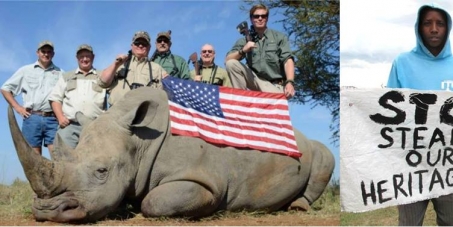


More poachers shot dead;
Two poachers were killed in an encounter with forest guards in the Bagori Range area of Assam’s Kaziranga National Park on Thursday.
A…ccording to officials, five to six poachers had entered the park in order to carry out rhino poaching. Except the two who were killed, all others escaped during the encounter. On Wednesday, a female Rhino was killed by poachers at the park located in Assam’s Sonitpur district. An Assam Home Guard, part of the force that guards rhinos at National Parks, was also killed by the poachers.
Poachers have killed and de-horned nearly 200 rhinos in Assam over the past 13 years; in 2014, 20 rhinos were killed. A few years ago, the Assam government set up a special task force to guard rhinos. Last year, there was a proposal to use drones for surveillance at the Kaziranga National Park, but nothing has been done yet in this regard.
In 2014 , the Assam forest department killed 22 poachers in the state. Assam is home to the world’s largest population of one-horned rhinos, an endangered species.
Picture – One of two Rhino poachers this year captured by forest guards.

 Exposing the Big Game