Botswana is moving towards culling elephants by lifting its wildlife hunting ban after a group of the country’s ministers endorsed the idea, but the proposal has drawn heavy criticism. Botswana’ is planning to cull elephants and sell them as pet food wins ministerial approval.
The southern African country’s President Mokgweetsi Masisi had previously tasked a government subcommittee with reviewing the hunting ban – which had been put in place by his predecessor Ian Khama in 2014.
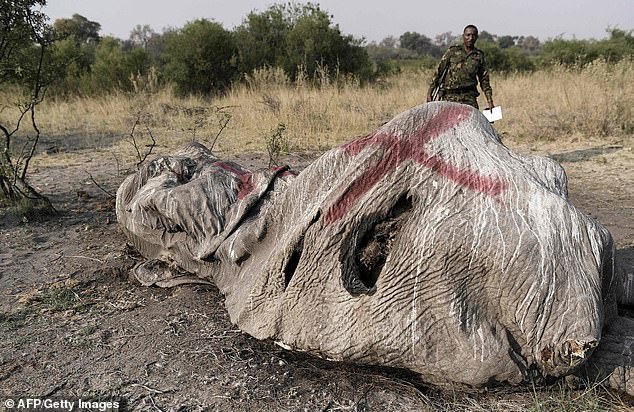
A Botswana Defence Force colonel near the marked remains of an elephant killed in the Chobe national park area
The committee decided to recommend lifting the ban last Thursday, and the country’s minister of local government and rural development Frans Solomon van der Westhuizen advocated ‘regular but limited elephant culling’, NPR reports.
Elephant meat canning – including for pet food production purposes – was also recommended by some.
Konstantinos Markus, a Member of Parliament who spearheaded efforts to eliminate the ban, argued that the ‘expansion of the elephant population in Botswana has impoverished communities.’
According to reports Markus said rural citizens of Botswana have grown hostile toward elephants, especially in the north where he said the animals have cut maize yields by nearly three-quarters.
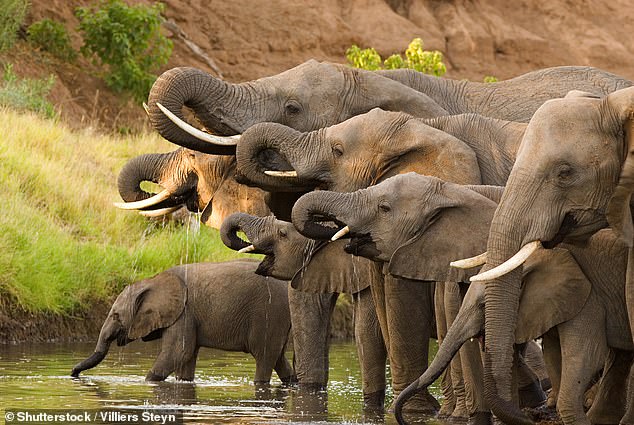
Botswana is reportedly home to 130,000 elephants, according to the Great Elephant Census, but concern has been rising regarding the ‘growing conflict between humans and wildlife’.
The country’s Government has also said pinpoiting the precise elephant population is difficult partly because herds can roam across borders into other countries.
Botswana’s consideration of lifting the ban has drawn heavy criticism.
The Telegraph reported that an elephant conservationist who works with the country’s government called the proposed cull ‘short sighted’.
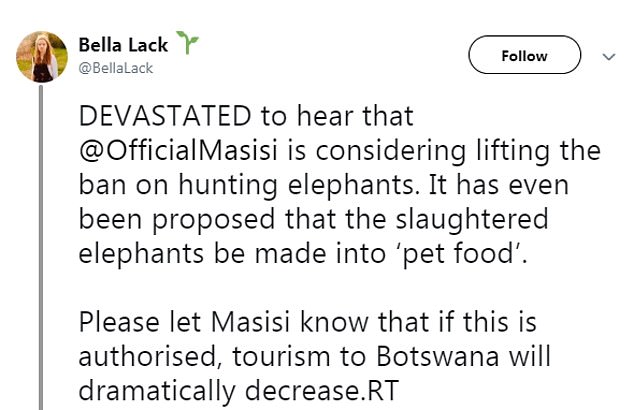
One Twitter user said she was ‘devastated’ to hear that the country was considering lifting the ban
The conservationist, who spoke on condition of anonymity, told the paper: ‘Botswana does have too many elephants, and there is huge elephant human conflict.
‘But this is not economically viable and it doesn’t take into account the reputational damage to the country. Better exploitation of sustainable tourism is a far better model.’
Online campaign group Elephants DC, which advances anti-poaching and anti-smuggling policies and has 35,000 Facebook folloewers, said: Botswana in the news for all the wrong reasons.
America should help NOW defend future impending poaching slaughters of the elephants. This nation is largest last haven of African elephants, many now whom are refugees after fleeing conflict elsewhere, in the world.’
One Twitter user said: ‘DEVASTATED to hear that @OfficialMasisi is considering lifting the ban on hunting elephants. It has even been proposed that the slaughtered elephants be made into ‘pet food’.
‘Please let Masisi know that if this is authorised, tourism to Botswana will dramatically decrease.’
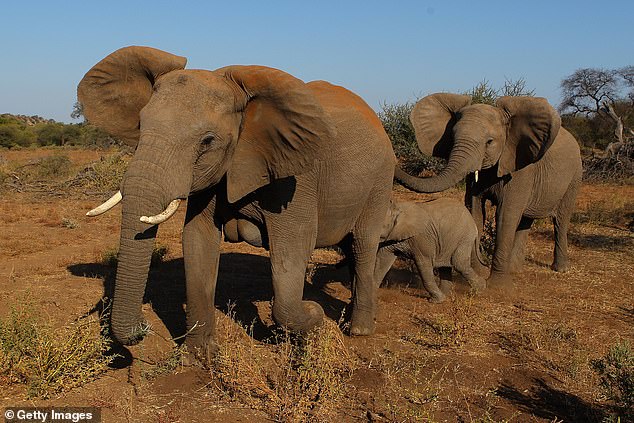
African bush elephants in Botswana may lose their protection from the 2014 law
Regarding the idea that the African democracy could be set to cull the animals, one Twitter user said: ‘Conservationists around the world must join forces to ensure that this ludicrous idea never happens.
Elephants are the most majestic of creatures. Thousands have been slaughtered for their ivory, now this shocking development. Elephants will become extinct.’
Another said: ‘Guys gonna pls stop the savagery against the elephants… everybody likes elephants – they connect us into the history of life itself. The Queen and Prince Philip like to feed them bananas too. Cheers.’
But one social media user took a different approach, saying: ‘Do you know the struggle of someone in Shakawe who’s has to face this animals every other day? Have you ever had you crops completely erased by elephants. What really is your mandate?’
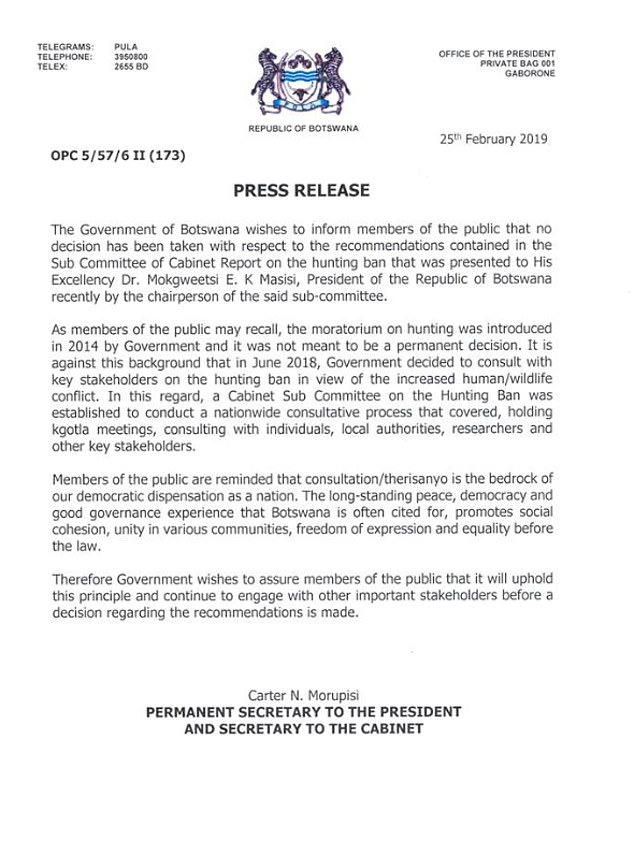
The country’s Government published a press release clarifying that ‘no decision has been taken’ regarding the hunting ban
Last year, Sir Ranulph Fiennes, Bill Oddie, Peter Egan, and a cross-party group of MPs rallied against proposals to lift the ban, claiming that allowing hunting could force the species to the point of extinction.
When the 2014 ban was imposed, the government had said it was moved to act after indications of ‘several species in the country’ showing declines.
The ban permitted hunting in registered and private game ranches. Some have argued that the rules may have been a detriment to the animals and people alike.
NPR reports that a spokesperson for conservationist non-profit organisation Elephants Without Borders said: ‘Some people are worried that elephants have recovered in greater numbers than the environment can sustain, and there is significant concern over increasing human-elephant conflict.
‘During the past 20 years the elephant range in Botswana has expanded by 53%, causing increasing concern about the impact of elephants on biodiversity, the viability of other species and the livelihoods and safety of people living within the elephant range.’
Botswana’s Government published a statement on Twitter outlining how it had not taken a decision regarding the committee’s recommendations.
It read: ‘The Government of Botswana wishes to inform members of the public that no decision has been taken with respect to the recommendations contained in the Sub Committee of Cabinet Report on the hunting ban that was presented to His Excellency Dr. Mokgweetsi E. K Masisi, President of the Republic of Botswana recently by the chairperson of the said sub-committee.
Conservationists set Botswana’s elephant population at 130,000, but lawmakers claim the actual figure is much higher than this
‘As members of the public may recall, the moratorium on hunting was introduced in 2014 by Government and it was not meant to be a permanent decision. It is against this background that in June 2018, Government decided to consult with key stakeholders on the hunting ban in view of the increased human/wildlife conflict.
‘In this regard, a Cabinet Sub Committee on the Hunting Ban was established to conduct a nationwide consultative process that covered, holding kgotla meetings, consulting with individuals, local authorities, researchers and other key stakeholders.
‘Members of the public are reminded that consultation/therisanyo is the bedrock of out democratic dispensation as a nation. The long-standing peace, democracy and good governance experience that Botswana is often cited for, promotes social cohesion, unity in various communities, freedom of expression and equality before the law.
‘Therefore Government wishes to assure members of the public that it will uphold this principle and continue to engage with other important stakeholders before a decision regarding the recommendations is made.’
The statement was attributed to Carter N. Morupisi, Permanent Secretary to the President and Secretary to the Cabinet.
Botswana, which is roughly the size of France, has a population of around 2.3 million people and contains vast tracts of remote wilderness that make it a magnet for foreign tourists who want to view wildlife.
International tourism could generate £160m for Botswana this year, rising to £280m by 2021 – more than trophy hunters spend across the whole of southern Africa.
AMBATONDRAZAKA, MADAGASCARIndris, at two feet tall the largest of Madagascar’s lemurs, are big sleepers. The primates awaken two or three hours after sunrise, forage for leaves high in the canopy during the day (amid frequent naps), and choose their spot for the night well before dark.
Lemur Calls
Photographer Adriane Ohanesian recorded calls of the indri—the largest of Madagascar’s scores of lemur species—on the trail between between the mining community of Ambodipaiso and Antsevabe, which serves as the access point to sapphire mines in the Ankeniheny-Zahamena Corridor.
00:15
/
00:00
On our trek into the Ankeniheny-Zahamena Corridor, a protected area known by its French acronym, CAZ, photographer Adriane Ohanesian, translator-guide Safidy Andrianantenaina, and I often heard their calls. The sound, a bit like someone blowing a trombone for the first time, can carry up to a mile through the dense forest.
Left: Mine boss Laurence Asma shows gemstones the team of about 20 men she employs found in the Ankeniheny-Zahamena Corridor (CAZ).
Right: Red fabric tied around a tree on the trail leading to a mining site marks a doany, a
… Read More
PHOTOGRAPH BY ADRIANE OHANESIAN, NATIONAL GEOGRAPHIC
Laurence Asma, 41, stands with her pet common brown lemur outside a miner’s home at the main gem site in the CAZ, known as Tananarive.
PHOTOGRAPH BY ADRIANE OHANESIAN, NATIONAL GEOGRAPHIC
We were hiking deep into the CAZ, a 1,470-square-mile stretch of rainforest joining two national parks that enables lemurs and other animals to mingle their populations, maintaining the genetic diversity that’s essential to their survival. Our goal was to witness firsthand the effects of illegal gem mining on some of the last remaining habitat for wild lemurs.
Get more of the inspiring photos and stories we’re known for, plus special offers.
By signing up for this email, you are agreeing to news, offers, and information from National Geographic Partners and our partners. Click here to visit our Privacy Policy. Easy unsubscribe links are provided in every email.
–– ADVERTISEMENT ––
Our immediate destination, though, was the makeshift village of Ambodipaiso, a staging place for illegal sapphire mines that have turned parts of the CAZ into scarred, treeless wastes. Sapphires were discovered here seven years ago, and by 2016, tens of thousands of Madagascans had flooded in, illegally uprooting trees and diverting streams in hopes of finding gemstones to help lift them out of poverty. (Madagascar ranks 161 in the world in human development, according to the United Nations Development Programme, and 70 percent of its people live in poverty.)
Men carry a sieve, used to wash away dirt and reveal gold and gems, through the makeshift village of Ambodipaiso, a few miles from Tananarive.
PHOTOGRAPH BY ADRIANE OHANESIAN, NATIONAL GEOGRAPHIC
A hundred million dollars’ worth of sapphires and other gems were smuggled out of Madagascar in 1999 alone, according to the World Bank. (This remains the most reliable study; recent estimates suggest the value today is about $150 million a year.) Most of the gem mining is done illegally in reserves, says Christoph Schwitzer, co-vice chair of the Madagascar primate specialist group with the International Union for the Conservation of Nature (IUCN), the organization that sets the conservation status of animals and plants. The CAZ and other reserves, he says, “don’t receive anywhere near adequate protection on the ground.”
Madagascar has the third-highest rate of biodiversity on Earth, after Brazil and Indonesia. Eight of every 10 of its plants and animals are endemic. It has 300 species of reptiles and 300 of amphibians, 99 percent of them found nowhere else. Chameleons: 62 species. And along with the nearby Comoro Islands, Madagascar is the only place on the planet that’s home to wild lemurs—fully 113 species, the newest identified just last year.
The charismatic animals are a magnet for roughly 250,000 visitors a year who directly account for more than 6 percent of the country’s GDP and 5 percent of its jobs. Yet nearly all the lemur species are endangered—38, including indris, critically—and 17 have already gone extinct. Now conservationists and primatologists are gravely concerned about the effects of gem mining on remaining lemur habitat, as much as 90 percent of which has been lost to tree clearing and human incursion.
“Gems mining can be a significant driver of habitat loss,” Schwitzer says. “It can break a protected area relatively quickly.”
“People don’t care if it’s a strict protected area,” Jonah Ratsimbazafy, Schwitzer’s co-vice chair with the IUCN’s Madagascar primate specialist group, told me before I arrived in the country. “They just go—and massively—to extract stones, and nobody can stop them. It’s linked with corruption and poverty, and the laws are not really enforced. Without forest,” he added, “the lemurs cannot survive. There is no long term.”
Left: The tree canopy in Ranomafana National Park is home to 12 species of lemur, including one, the golden bamboo lemur, found only here.
Right: An indri, the largest of the remaining lemur species, clings to a tree in
… Read More
PHOTOGRAPH BY ADRIANE OHANESIAN, NATIONAL GEOGRAPHIC
Government protections for Madagascar’s forests date to the 1700s, when King Andrianampoinimerina outlawed cutting live trees for firewood. But beginning in the late 1800s, French colonists began intensive logging to make way for export crops. Within several decades, some 75 percent of the country’s old-growth forest had been razed. In 1927, the French banned lemur hunting and created the first nature reserve in the African region, but by 1990, 30 years after Madagascar’s independence, half the remaining forests had gone.
In 2003 then President Marc Ravolamanana began a dramatic expansion of protected areas, quadrupling their acreage by 2016. Nevertheless, the eastern rainforest that encompasses the CAZ, with its indris and many other lemur species, kept contracting. From its original prehuman 27 million acres, it had shrunk to less than 10 million acres by 1985. Since then, according to research by Lucienne Wilmé, national coordinator for Madagascar at the World Resources Institute, a Washington, D.C.-based research organization, deforestation in some parts has been accelerating.
FOREST LOSS
Antsiranana
Madagascar is one of the world’s most biodiverse countries. But its more than 100 species of lemurs, along with countless other endemic animals and plants, are threatened by forest clearing for gem mining, logging, and farming. In some protected areas, illegal mines are squeezing lemurs into ever shrinking rainforest patches.
AFRICA
Tree cover loss,
2000-17
Tree cover
MADAGASCAR
100 mi
100 km
Mahajanga
INDIAN
OCEAN
Area Enlarged
Ambatondrazaka
Ankeniheny-Zahamena Corridor (CAZ)
Moramanga
Antananarivo
Andasibe
Lakato
Mozambique Channel
Indri
(Indri indri)
Kianjavato Ahmanson Field Station
Ambatondrazaka
(trading hub for gems from the CAZ)
Ankeniheny- Zahamena Corridor
TROUBLE FOR LEMURS
Ambolotara
Already some 90 percent of lemur habitat in Madagascar has been lost. Lemurs need contiguous forest for their populations to mingle, crucial for genetic robustness and long-term survival. Fragmentation of the Ankeniheny-Zahamena Corridor (CAZ), which connects surrounding parks and protected areas, by unlawful sapphire mining puts indris and other species at risk.
Tananarive mine
Ambodipaiso
Ilakaka
Bemainty
Toliara
CLARE TRAINOR, TAYLOR MAGGIACOMO, NG STAFF
SOURCES: PROTECTED PLANET; GLOBAL FOREST WATCH;
HANSEN/UMD/GOOGLE/USGS/NASA
In 2012, Madagascar’s government, acknowledging that it didn’t have either the money or the manpower for effective environmental protection, engaged Conservation International, a Virginia-based environmental nonprofit, to manage the CAZ. Although clearing of old-growth trees for agriculture, logging, and mining has been banned since 2015, half of one percent of Madagascar’s vestigial protected forests are disappearing every year, according to Eric Rabenasolo, director general of forests for Madagascar’s Ministry of the Environment, Ecology, and Forests.
Exactly how much clearing is for gemstone mining isn’t knowable because it occurs almost entirely under the blanket of the “informal economy”—jobs and activities not regulated by government. Gem deposits are shallow and easily uncovered, making identifiable industrial-scale operations unnecessary.
Local people switch opportunistically among mining, farming, and other kinds of work, so it’s impossible to ascertain how many people are involved in illegal mining. One estimate, published a decade ago in The Journal of Modern African Studies, by Rosaleen Duffy, professor of politics at the University of Sheffield, in the United Kingdom, put the figure at as many as half a million. That would make illicit gemstones Madagascar’s second largest employer after agriculture.
AMBODIPAISO
It was shortly before dusk when we arrived in Ambodipaiso. Although the village is far from any public water supply, power line, or cell phone tower, hundreds live here, providing goods and services for area miners, portering gear, and themselves digging for gemstones.
Left: Items for sale at a small shop in Ambodipaiso include beans, grains, and dried fish. Porters heft goods—including 110-pound bags of rice—14 miles over steep, muddy trails to supply the hundreds of miners in the area.
… Read More
PHOTOGRAPH BY ADRIANE OHANESIAN, NATIONAL GEOGRAPHIC
A common brown lemur named Bridola (left) and a black-and-white ruffed lemur, Roki, are kept as pets and tied up in the back of a shop and restaurant near the village of Ambodipaiso.
PHOTOGRAPH BY ADRIANE OHANESIAN, NATIONAL GEOGRAPHIC
That night Andrianantenaina and I bunked in a tiny shelter made of sticks, and Ohanesian slept in a tent. Before dawn I was roused by crowing roosters, banging pots, and a crying baby. I wondered if these sounds bothered the snoozing indris. When the darkness lifted, I emerged to see a woman feeding two lemurs a banana.
Méline said she bought them from a hunter who had killed their mother for meat. She’d named one, a common brown lemur, Bridola, and the other, a black-and-white-ruffed lemur, Roki. The IUCN lists brown lemurs as “near threatened.” Black-and-white ruffed lemurs are “critically endangered.”
Méline runs a shop with her husband, selling everything from rice and garlic to ramen and amoxicillin. “I have maybe four customers a day,” she said. “We don’t make any profit.”
In the forest, her lemurs would be eating young leaves, flowers, fruit, and insects, but Méline feeds them mostly bananas and rice. I noticed that the fur on their tails was sparse, indicating a dietary deficiency, according to Patricia Wright, a professor of anthropology at Stony Brook University, in New York State, and executive director of the university’s Institute for the Conservation of Tropical Environments. That bad diet would cause their premature death, Wright said.
Deforestation from mining, said Wright, is “a cascading problem” for lemurs, because “if they’re in a small fragment of forest, they’re not going to have enough to eat.” A family group of two to five indris needs about 20 acres of forest, and groups of other lemur species need up to a hundred acres to survive. For lemur populations to remain stable, the forest must be contiguous—lemurs are largely arboreal and won’t cross broad stretches of open ground to connect with other groups to find mates. They rely on various trees for food, and removing just one tree species can cause other trees and vegetation in the area to die off.
As more trees are cleared, lemur groups come into contact with one another, sparking fights for resources—another ledge in Wright’s cascade. And, she said, mine clearings make lemurs even more vulnerable because people don’t have to go so far into the forest to hunt them.
One man I spoke to in Ambodipaiso, Banjindray Elys D’Antoine, said he used to eat lemur when he worked in mines south of the CAZ. The meat is tough, he said, and must be boiled for a long time, then fried. I asked him how it tastes. “Like a cat,” he replied.
From Ambodipaiso, Ohanesian, Andrianantenaina, and I—accompanied by two off-duty police officers hired for security—set off on the seven-mile trek to the largest gem mining area in the CAZ. Local people jokingly call the site Tananarive, the French name for Madagascar’s capital, Antanarivo.
Within half an hour we heard the now familiar whoop of indris. Orchids grew in profusion beneath the thick canopy of trees, some as tall as a hundred feet, and on the path, we saw giant millipedes and a worm as long as my arm.
Four miles on, we came to Bemainty, where some 80 people live with no running water, electricity, sanitation, health care, or communications. Village leader Randriamatody (who like many Madagascans uses one name) told us about the night in 2016 when criminals attacked the village, stealing money that had been collected as fees from passing miners and killing Bemainty’s previous headman.
“Nothing like this happened here before the mine,” said a woman named Farah, who told us she’d been injured in the attack. Mining in the area, she said, brought the village “no advantage. All I got was this scar on my forehead.”
TANANARIVE
After two more hours on the trail, we came down a hill, and Tananarive opened up before us—a wasteland of mud, small shacks, and holes in the ground. Evidently, most of the sapphires here had already been extracted. Many miners, we were told, had returned home or gone to Ilakaka, a mine site some 400 miles to the southwest near Isalo National Park; others had gone to a new mine in the CAZ about 80 miles away near the village of Lakato. But some artisanal mining was still under way at Tananarive.
ILLEGAL GEMSTONE MINING THREATENS ENDANGERED LEMURS IN MADAGASCARMen, some wearing rice bags to protect them from splashing mud, work in a chain to dig a mine where they hope to find sapphires.
After a patch of trees is cleared, a log is laid across a nearby stream to divert it toward the target area. Water washes away the top layer of dirt, and a team of four or five miners gets to work digging. It can take several weeks to excavate a pit perhaps 30 feet in diameter and 12 feet deep. When the hole is about three feet deep, groundwater rushes in and is suctioned out with a mechanical pump. The excavated soil is washed through a sieve, which traps small stones that are examined for gems.
We met three young men, Mbola, 30, Soasite, 25, and Zanry, 20, who were noisily engaged in this final task. Soasite shoveled dirt from a pile onto a screen atop a wooden supporting structure. A hose attached to a pump in the diverted stream spewed water onto the dirt. The other two then shoveled the mud back up to the hose to be washed through the screen again. Mbola and Zanry wore empty rice bags with cut-out armholes to protect their clothes from the splashes. Mud covered their faces. The trio laughed constantly, and Andrianantenaina explained that they were having fun at the foreigners’ expense. During the half hour or so that we watched them work, they found no sapphires.
Almost none of the thousands-of-dollars-a-carat value of sapphires goes to the miners.
On the slope above, a woman called out to us. It was Laurence Asma, wearing leggings under a denim skirt, flip-flops with a U.S. flag motif, and a long-sleeved t-shirt that read “precious lovey dovey” in sequins. Her pet common brown lemur, Ani, crouched on her shoulder.
Asma said she’d moved here two years ago from Toliara, a city in the southwest. She said she runs several small mines at Tananarive that employ 20 men, down from the hundred miners who worked for her in 2016, at the peak of the sapphire rush.
“Too much stones here before,” she said. “Now, little.” Nevertheless, she said she intended to stay in Tanarive a bit longer. “I wait. I wait for Allah. Sometimes he bring me big stone, and I take to my village.” Her biggest find so far had been a sapphire that earned $3,500, a fortune in a country where the per capita income in 2016 barely nudged above a dollar a day. She split the proceeds evenly among the team of four or five who found it.
Left: Gem dealer Mohammed Murshid displays uncut sapphires in his home in Ambatondrazaka, the center of the trade in precious stones from the CAZ.
Right: A mud-splattered man holds part of a plastic jerrycan used to remove mud and
… Read More
PHOTOGRAPH BY ADRIANE OHANESIAN, NATIONAL GEOGRAPHIC
Asma said she has a Sri Lankan backer in Antananarivo who sends money over the Orange mobile money network to buy rice for her employees and fuel for her three pumps. Every few weeks she travels to the capital to sell him the gemstones her team has found. The Sri Lankans, she said, “sell to Thai people, Dubai people.” Somebody, she added, gets a good price, but, no, she doesn’t, she said with a laugh.
Sri Lanka has been a source of sapphires for 1,500 years, and Sri Lankans, who have developed unrivaled expertise in grading, cutting, polishing, and trading the gems, dominate the trade in Madagascar. Murshid Mohammed, 29, is a dealer in Ambatondrazaka, the nearest substantial city to the CAZ and the main trading center for sapphires mined there. He says a high-quality blue sapphire of 25 carats from Tananarive costs him 300,000 Madagascar ariary—about $90.
A few months ago I saw a five-carat sapphire, cut and polished but not heat treated, listed online by a Florida jeweler for $19,600. Because of the way the international gem market works, almost none of the thousands-of-dollars-a-carat retail value of sapphires goes to the miners of Tananarive, and very little to local mine bosses like Asma.
Meager though her take is, Asma considers herself lucky to be running a relatively successful operation. “Too many people no eat three times” a day, she said. “You have no stone, no job.” She blames the government for failing to attend to the needs of Madagascans. “My president no good,” she said, referring to Madagascar’s leader at the time, Hery Rajaonarimampianina, who was voted out of office last November.
“I WAS ANGRY”
Given both the seriousness of the threats to wildlife in Madagascar’s protected areas and the government’s lack of capacity for robust enforcement, grassroots groups have stepped into the breach. Elected members of volunteer community-based forestry organizations known as VOIs are now managing protected areas under the aegis of Conservation International and other environmental nonprofits.
Police in the town of Andasibe plan a raid on a nearby village to arrest men suspected of lemur poaching. By the time they could borrow a motorcycle to reach the village—far up an unpaved track—the suspects had fled.
PHOTOGRAPH BY ADRIANE OHANESIAN, NATIONAL GEOGRAPHIC
After saying goodbye to Asma, we hiked back to the village where we’d left our car and drove to Moramanga, 70 miles to the southwest. We wanted to talk to Jean Yves Ratovoson, a VOI vice president accused of killing 10 critically endangered lemurs—nine indris and one diademed sifaka—in the CAZ. Police arrested Ratovoson, 51, early last year at a hunting camp near Andasibe, and he was in prison in Moramanga awaiting trial. If convicted, he faces four years in prison.
Ratovoson and I talked in the prison warden’s office. This was his first arrest, he said. He was a farmer, and he and his wife, a schoolteacher, have nine children.
He said he went on the hunt because he was angry. He had stood for election to the post of vice president of the Firaisankina VOI “to improve my community,” he said. But during patrols of the portion of the CAZ under the VOI’s stewardship, Ratovoson discovered that large-scale illegal logging was occurring, and he couldn’t get anyone to do anything about it. “Five trucks a day were coming out loaded with wood,” he said. “Pretty much the whole [area] was cut.”
Charged with lemur poaching, Jean Yves Ratosovon is held in the prison in Moramonga, awaiting trial.
PHOTOGRAPH BY ADRIANE OHANESIAN, NATIONAL GEOGRAPHIC
He said he reported the logging to Conservation International’s director of the CAZ, Hantanirina Ravololonanahary. “They came to the forest to see but did nothing,” Ratovoson said. He paused, then said, “Why are people cutting trees not sent to jail like me? The law is the same.”
So when an acquaintance approached Ratovoson proposing that he join a lemur hunt in the CAZ, he said he figured, why not? “I thought, if they can [cut trees], then I will not have any problem. I knew hunting lemurs is bad, but I was angry about this situation.”
A letter Conservation InternationaI’s Ravololonanahary sent to Joanita Ndahimananjara, Madagascar’s environment minister at the time, describing action the organization took following the arrest makes no mention of the illegal logging report Ratovoson said he’d sent Ravololonanahary before the alleged lemur hunt.
Conservation International told me that Ravololonanahary wasn’t available for an interview and instead referred me to Tokihenintsoa Andrianjohaninarivo, the organization’s regional biodiversity scientist in Toamasina, a city on the east coast. I phoned and asked what happens when a report of tree cutting comes to Conservation International from VOI officials.
“We report to local authorities and organize a patrol to see the facts,” she replied. Then I asked about Ratovoson’s allegation that Conservation InternationaI’s director of the CAZ knew about his report of tree cutting and failed to act.
There was a long pause.
“Conservation International is the manager of the protected area but has not the ability to put people in jail,” Andrianjohaninarivo said. “All we have the right to do is talk to the forest service, and then they have to react. We have reported to authorities every infraction, but most of the time they’re not able to respond for lack of budget, or their people are somewhere else. If we don’t have the support of the authorities, we can’t do anything.”
When pressed, spokesperson Jenny Parker McCloskey later acknowledged that Conservation International had received a report of logging from members of the VOI with which Ratovoson was involved but that Ratovoson was not among those who made the report. She said Ravololonanahary referred the matter to officials in the forest service, who did not respond to repeated requests to verify that they had in fact received Conservation InternationaI’s report.
Andrianjohaninarivo’s explanation seems plausible. Police who arrested Ratovoson hoped to go after his accomplices, who’d fled during the raid, but the police chief, Yvan Randriamiarana, told me they lacked the necessary resources. The village where the suspects lived was some way up a dirt path, and they had no means of getting there, he said. “We don’t have a car or motorcycle. We have 10 gendarmes in Andasibe, and we should have at least 15 because the area is vast and the population is high.”
Given that the alleged lemur crime was by a VOI leader, says Steig Johnson, professor of anthropology at the University of Calgary and co-vice chair of the IUCN’s Madagascar primate specialist group, this incident “is particularly demoralizing. There’s a fundamental lack of adequate training and engagement with some of these communities. Nobody wins just if someone is prosecuted for the crime—we need to get at the root cause of this kind of wildlife crime in these communities.”
I asked a VOI volunteer, Abraham Rajotonirina, how the CAZ can be protected if its protectors themselves are hunting lemurs? It was Rajotonirina who, during one of the regular patrols he conducts looking for signs of illegal activity, had come across Ratovoson’s hunting camp. He reported it to a VOI vice president, Toto Jean Etienne, leading to Ratovoson’s arrest.
“Maybe someone needs to pay us to protect the forest,” he replied. “We’re working for free, but we do that because we love the forest. We need a better road so tourists can come and love the forest also.” With money, he said, the community would be able to pay “people to go out as scouts.” (A similar program in Tanzania, called TACARE, is showing results, bolstering local communities while conserving vital chimp habitat.)
“FAKE NEWS”
After returning to the United States, I spoke with Vincent Pardieu, a gemologist who in 2016 brought the Tananarive sapphire rush to the industry’s attention with a presentation at the Gemological Institute of America, in Carlsbad, California. The institute identifies and evaluates stones and trains gemologists. Since 2012, Pardieu has been spreading the messageto the gem industry that illegal mining in Madagascar is not harmful to lemur habitat.
“Fake news” was how he characterized reports emphasizing sapphire mining’s ill effects.
“I could hear lemurs every morning—that’s proof lemurs are still alive,” he said, referring to a trip he took to Tananarive in 2017. “If lemurs are being attacked by miners, I don’t think you’ll hear them.” He insisted that despite news reports of deforestation around the site, “miners are not destroying the forest. They’re too busy mining—why would they go chop the forest? Again, a very good example of fake news.”
People in Madagascar are really suffering, and mining is a huge part of their livelihood.
A sobering 15-month study on the declining population of the southernmost
herd of African elephants has determined only one elephant, a mature female,
is free-roaming in the Knysna forest in South Africa.
The analysis – titled And Then There Was One – was recently published in the
African Journal of Wildlife Research.
For the study, researchers set up camera trap across the whole elephant
range from July 2016 to October 2017 and concluded upon analysis that the
female elephant, estimated at 45 years old, was by herself.
“Because elephants move along defined elephant pathways, we placed our
cameras on these paths and covered the elephant range evenly, with spaces
between camera traps no larger than the smallest range recorded for
elephants,” one of the study’s authors Lizette Moolman, a South African
National Parks scientist, explained in an article posted to the park’s
website.
“In other words, an elephant would not reside in a gap area, between camera
trap locations, for the duration of the survey. The cameras were all active
for 15 months, and during this time the same female elephant was identified
in 140 capture events, always by herself. No other elephants were
photographically captured.”
Fellow researchers behind the study were shocked to find only one elephant
left in Knysna, as the gentle giants historically roamed the area in the
thousands.
“The brutal reality is there is no longer a population of Knysna elephants,”
study co-author Graham Kerley of the of Centre for African Conservation
Ecology at Nelson Mandela University, told Business Day. “All the mystique
of the Knysna elephant is reduced to a single elephant left in rather tragic
circumstances.”
Their numbers have declined dramatically over the past three centuries due
to hunting as well as human encroachment that has forced the elephants from
their natural habitats and squeezed them into smaller and smaller areas. The
Knysna forest was previously a site for rampant timber exploitation.
While the solitary elephant appears in relatively good shape, Kerley
explained to Business Day that she has swollen temporal glands with
excessive temporal streaming, suggesting she might be stressed from being
alone.
According to the National Elephant Center, female African elephants are
social creatures and usually roam in herds with a number of related female
adults and male and female offspring.
The maximum lifespan for females is more than 65 years, so the lone Knysna
elephant could be by herself for two more decades.
As for capturing her and moving her to other elephant populations, Kerley
noted that “would be dangerous for her and we don’t know if it would even be
of any value to her as she knows the forest and she might not be able to
settle into another area with other elephants.”
Images of her show that her breasts are undeveloped and her mammary glands
are shriveled, meaning she has likely never been pregnant or has not given
birth in a long time, according to Business Day. Artificially inseminating
her would be too risky to attempt, Kerley said.
“Considering all these factors, the debate about how we have allowed this
population to go functionally extinct and how to manage the last elephant is
very emotional and very serious as she is a symbol of how we are treating
biodiversity as a whole,” Kerley told the publication.
Connecticut does not have clean hands when it comes to pushing Africa’s Big 5—elephants, lions, leopards, rhinos and giraffes—closer to extinction. The state is supplying customers to the grave, immoral trophy hunting industry.
From 2005-2015, 59 trophy hunting permits were issued to Connecticut residents by the U.S. Fish and Wildlife Service so people could hunt and kill leopards for their trophies. Six additional permits were provided to Connecticut residents to kill African elephants in Botswana, Tanzania and Zimbabwe. And from 2005-2016, Connecticut residents killed 39 lions and one giraffe and imported their trophies.
The Connecticut communities that have been issued the most permits for trophy hunting are: Greenwich, North Haven, Norwalk, Berlin, Stamford, Westport, Weston, Easton, Southington and Middletown.
As soon as you put a price tag on these threatened, vulnerable and endangered animals, you send a mixed message about whether they need to be protected at all, and that’s detrimental to actual conservation. Shooting animals full of bullets does not increase their population or expand their habitat. Trophy hunters are just poachers with permits.
However, Connecticut is one step closer to banning the importation of the trophies of Africa’s Big 5 during the 2019 legislative session because the Environment Committee has approved and sent to the Senate floor SB20, which would ban the importation, sale, possession and transportation of Africa’s Big 5 and their body parts in Connecticut. The bipartisan bill is co-sponsored by Senate Majority Leader Bob Duff and state Rep. Brenda Kupchick and drafted by Friends of Animals.
The importance of SB20 is that it recognizes legal trophy hunting as one of the main reasons that Africa’s Big Five face extinction. SB20 sends a strong message that trophy hunting needs to be stopped, as these species are already fighting for their lives because of poaching and habitat loss.
It’s more crucial than ever for states to take action because when it comes to trophy hunting, federal law is not protective enough.
On Dec. 21, 2015, U.S. Fish and Wildlife Service listed two lion subspecies as threatened and endangered under the Endangered Species Act. But overall the listing continues to promote trophy hunting because it allows for the importation of the body parts of the sport-hunted threatened lion species.
Additionally, while the July 6, 2016 near-total ban on commercial trade in African elephant ivory that went into effect in the U.S. looks good on paper, it still allows for two sport-hunted elephant trophies per hunter per year.
The only difference between poachers and trophy hunters is wealth and public perception. While poachers are willing to slaughter magnificent animals to make a buck, well-heeled vainglorious trophy hunters spend lots of money to hunt for bragging rights and prizes.
The newest data reveals that trophy hunting is economically useless. While the Safari Club boasts that revenues from hunting generate $200 million annually in remote areas of Africa, most of the money goes to trophy hunting operators/outfitters and government agencies, many of which are corrupt. The most recent study reveals that a measly 3 percent of expenditures actually goes back to African communities.
So, if the reason for trophy hunting is “conservation,” but it is not contributing to conservation, it’s time for Connecticut to stop supporting a useless industry.
Priscilla Feral is President of Darien-based Friends of Animals.
LAHORE: The Punjab Park and Wildlife Protection Department has decided to crack down on those involved in illegally hunting rare birds and animals in the province.
Two special squads have been formed to take indiscriminate action against poachers. Constituted under the supervision of wildlife officials, each squad will have one an inspector, four watchers and a driver.
The decision was taken a few days after influential people of the Qadirabad area in Gujranwala district illegally hunted wild ducks and harassed wildlife department staff.
Reportedly, wildlife staff caught Danish Azeem Butt, who was previously nominated as honorary district game warden in Gujranwala, illegally hunting ducks at Head Qadirabad Game Reserve. Butt also threatened staff with dire consequences while brandishing a weapon and escaped with the birds he had hunted down.
Punjab Parks and Wildlife Protection Department Director General Sohail Ashraf called an emergency meeting over the weekend. During the meeting, it was decided that special squads will be formed to curb illegal hunting in the province.
Further, it was decided that Lahore Zoo Director Hassan Ali Sukhera will head both the squads. In addition, he will also submit a weekly report to the wildlife director general, detailing the action taken against poachers.
The director general stated that field officials across the province have been directed to cooperate with the squads. “The district wildlife officers and deputy directors will be penalised for incompetence if the squads conduct an operation against those illegally hunting in their area,” he stressed.
In the past, the department’s negligence and its employees were the major causes of illegal hunting of animals and birds in the province.
Every year, the department issues hunting licenses which rake in a revenue of approximately Rs15 million.
The licenses issued by the department allow the hunting of pheasants, houbara bustards, partridges, ducks and Chinkara deer. A large number of national and international hunters regularly participate in the events organised by the department.
Several well-known individuals have been caught hunting illegally during recent months. Former Punjab chief minister Ghulam Mustafa Khar was among them. Meanwhile, close companions of Punjab Chief Minister Sardar Usman Buzdar also face illegal hunting charges in Dera Ghazi Khan.
One of the last elephant sanctuaries in Africa has “a significant elephant-poaching problem”, according to the final results of an aerial wildlife survey in Botswana seen by the BBC.
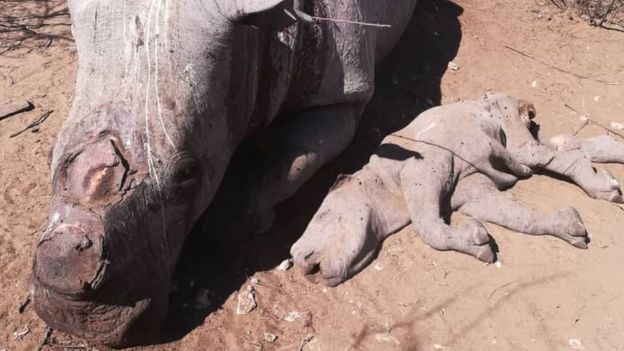
Elephants Without Borders, which conducted the four-yearly survey with the government, said there was a six-fold increase in the number of “fresh” or “recent” elephant carcasses in northern Botswana amid “obvious signs” of poaching.
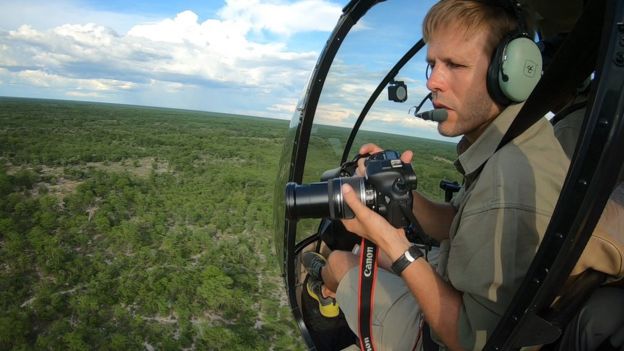
Mike Chase, the scientist who carried out the survey, sparked a fierce debate in the country when he went public half-way through his study in August last year with accusations there was a poaching problem and alleging the authorities were ignoring him.
Media captionDozens of dead elephants have been discovered in poaching hot spots in Botswana, Africa
He told the BBC at the time that while flying over northern Botswana, he had discovered 87 recently killed elephants in one “hotspot” area – a number now revised to 88 – and 128 overall.
The government called his figures “false and misleading” and criticised “unsubstantiated and sensational media reports”.
He received death threats and has since had one of his two research licences suspended by the government.
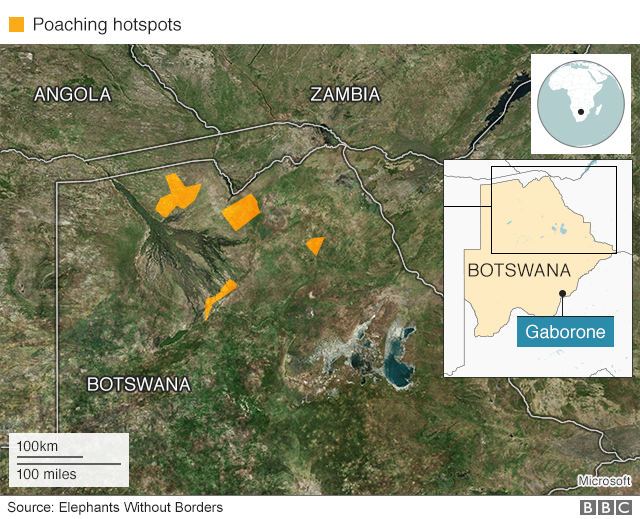
Poaching hotspots
President Mokgweetsi Masisi at the time described the allegations as the “biggest hoax of the 21st Century” and denied there had been a spike in poaching in the country.
But the final report identifies four poaching hotspots, provides photographic evidence from ground surveys and has been peer-reviewed by nine international elephant experts.
“The response from… various people was to try and deny or whitewash – label me a traitor and a liar – without having actually verified the evidence we bore witness to,” said Mr Chase.
Image captionMike Chase said he found a six-fold increase in the number of “fresh” carcasses in northern Botswana
The government didn’t respond to the BBC’s request for an interview about the final report, but issued a statement criticising the methods used in carrying out the survey.
The statement from Thato Raphaka, permanent secretary of the Ministry of Environment, Natural Resources Conservation and Tourism, said it was “regrettable” the report showed an “astonishing number of pictures of dead elephants”.
It was critical of some of the scientific details in the report and requested the raw data to be submitted to the elephant specialist group at the International Union for Conservation of Nature for further independent review.
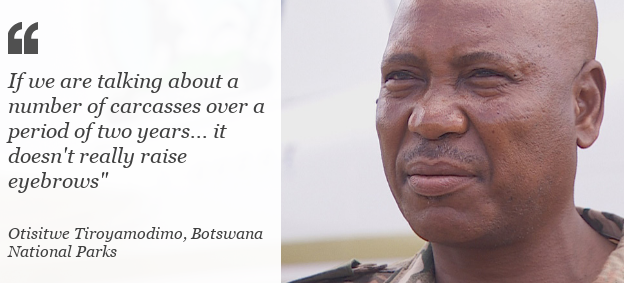
Otisitwe Tiroyamodimo, the director of the Department of Wildlife and National Parks, said the government acknowledged there was a poaching problem.
“Nobody can deny that elephants are being killed in Botswana,” but those reported by Mr Chase had mainly died “from natural causes and retaliatory killings.”
“We went there and we couldn’t find the 87 carcasses,” said Mr Tiroyamodimo.
Tusks missing
The authorities flew with Mr Chase but admit they spent only two days trying to verify carcasses seen over two months.
The BBC was given permission by the government to have access to the coordinates of one of the four areas identified as a “poaching hotspot” by the research team, and we visited the sites of 67 elephant carcasses.
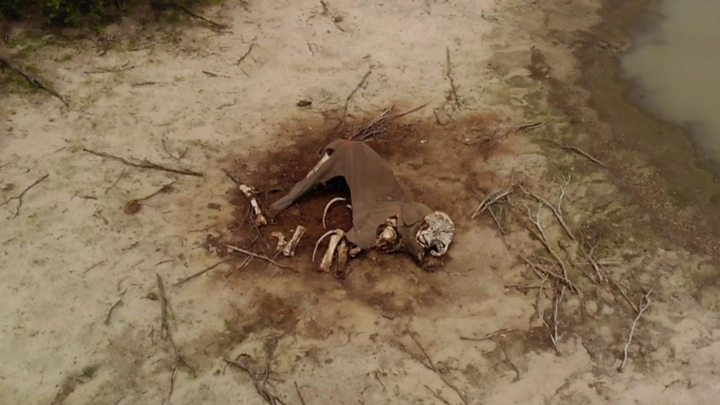
A few had apparently died of natural causes, but most had the characteristics associated with being poached: tusks were missing and branches had been used to cover the bodies to prevent them being found.
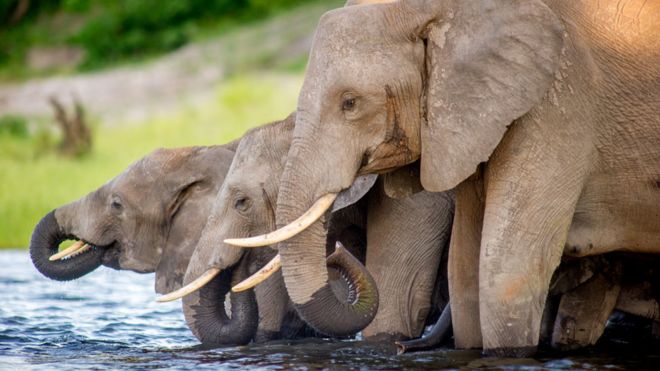
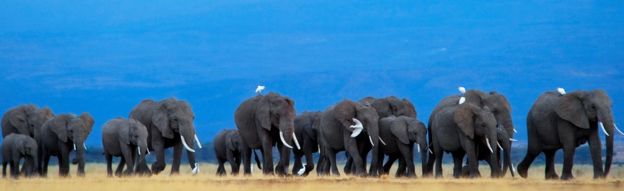
But Botswana is home to 130,000 elephants – a third of the total number in Africa – and it is an obvious target for poachers.
Even when extrapolating poaching figures from the sample found in the survey, the numbers killed will not have a major impact on such a large population.
“If we are talking about a number of carcasses that have accumulated over a period of two years, given the population of elephants in Botswana it doesn’t really raise eyebrows,” said national parks director Mr Tiroyamodimo.
This was not satisfactory for Mr Chase.
“At what point do we say we have a problem?” he asked.
“Is it at 10? 50? 100? 150? 1,000? Lessons have taught us – when we look at Tanzania that lost 60% of its elephant population in five years – that’s how quickly poaching can settle into a population.
“We saw with our own eyes 157 confirmed poached elephants. We estimate that the total poached in the last year is at least 385 and probably far more because that is based on what we actually saw and have not had time or finances to visit all carcasses on the ground.”
But the storm over the reported spike in poaching appears to have more to do with Botswana’s bitter and complicated new politics than its wildlife.
Political feud
President Masisi was vice-president until April 2018, when then-President Ian Khama handed power over to his deputy.
Since then the two men have fallen out.
The new president has his own vision on a number of issues, among them conservation, and has reversed some of the previous policies.
Hunting was banned under President Khama and Botswana was known for a zero-tolerance approach to poachers.
It was reported that in 2015 alone 30 Namibians, 22 Zimbabweans and an unknown number of Zambians were shot on suspicion of poaching.
Humans v elephants
Image copyrightGETTY IMAGES
Elephants can be very destructive when they encroach on to farmland and move though villages – destroying crops and sometimes killing people. Many rural communities believe the number of elephants is increasing, even though there is no evidence of this from scientific surveys.
But their “range” – how far the elephants travel – is expanding for a number of different reasons and that is increasing conflict between wildlife and humans. Many people believe this worsened after hunting was banned in 2013, and want it to be re-introduced.
The government has to balance lifting the hunting ban to win votes against the impact it may have on Botswana’s international reputation as a luxury safari destination.
Image captionThirteen rhinos have also been killed by poachers in the last year
Botswana is also now backing regional efforts to lift a ban on the ivory trade.
The two men are locked in a political feud ahead of a party congress which will choose a new leader, with national elections due later in the year.
Mr Chase has a close relationship with the former president, so the timing of his allegations has been seen by some as a political attack on the new president – even if the final report provides evidence that poaching was going on before Mr Masisi took office.
Botswana attracts high-end tourists from across the world because of its international reputation for successful conservation.
But with the continuing political storm – and a dependency on government permits to run high-end safaris – few of the big safari operators would comment on how big a problem poaching has become.
‘Don’t shoot the messenger’
Thirteen rhinos have been killed by poachers in the last 12 months – an unprecedented number.
David Kays, who owns Ngamiland Adventure Safaris in the Okavango Delta, said it was time to admit there was a poaching problem and work together to deal with it.
“I think the government has been hiding it for a while, and now that it’s been brought out into the open, we’re now realising how serious the problem is, and these big poachers have actually infiltrated further than we expected them to be.”
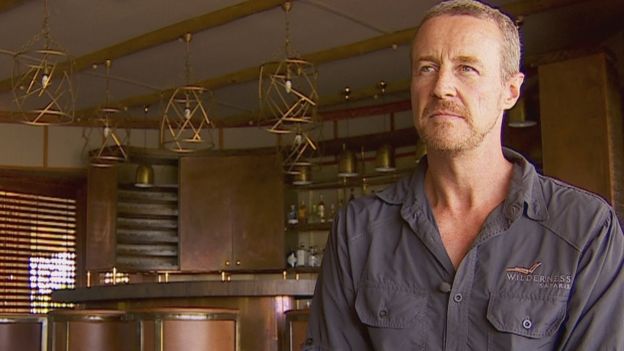
Image captionKim Nixon from Wilderness Safaris says all cases of poaching are reported
Wilderness Safaris operates luxury lodges in one of the concessions where some of the 88 carcasses were found.
Its chief executive Kim Nixon rejected any suggestion there was a denial of the problem.
“Whenever poaching has occurred in any of our concession areas, each and every incident has been reported as a criminal case,” he said.
“We’re not in any way mandated or allowed to do any anti-poaching – our role at best is monitoring.”
Mr Chase says “don’t shoot the messenger” adding: “I think it requires all stakeholders working together – government, private, public sectors, the NGOs.”
Botswana is still the safest place in the world to be a rhino or an elephant, but with a continuing demand for ivory in Asia, it is now firmly in the poachers’ sights.
Livestock are a leading source of the rise in methane levels. Photograph: Alamy
Dramatic rises in atmospheric methane are threatening to derail plans to hold global temperature rises to 2C, scientists have warned.
In a paper published this month by the American Geophysical Union, researchers say sharp rises in levels of methane – which is a powerful greenhouse gas – have strengthened over the past four years. Urgent action is now required to halt further increases in methane in the atmosphere, to avoid triggering enhanced global warming and temperature rises well beyond 2C.
“What we are now witnessing is extremely worrying,” said one of the paper’s lead authors, Professor Euan Nisbet of Royal Holloway, University of London. “It is particularly alarming because we are still not sure why atmospheric methane levels are rising across the planet.”
Methane is produced by cattle, and also comes from decaying vegetation, fires, coal mines and natural gas plants. It is many times more potent as a cause of atmospheric warming than carbon dioxide (CO2). However, it breaks down much more quickly than CO2 and is found at much lower levels in the atmosphere.
During much of the 20th century, levels of methane, mostly from fossil fuel sources, increased in the atmosphere but, by the beginning of the 21st century, it had stabilised, said Nisbet. “Then, to our surprise, levels starting rising in 2007. That increase began to accelerate after 2014 and fast growth has continued.”
Studies suggest these increases are more likely to be mainly biological in origin. However, the exact cause remains unclear. Some researchers believe the spread of intense farming in Africa may be involved, in particular in tropical regions where conditions are becoming warmer and wetter because of climate change. Rising numbers of cattle – as well as wetter and warmer swamps – are producing more and more methane, it is argued.
This idea is now being studied in detail by a consortium led by Nisbet, whose work is funded by the Natural Environment Research Council. This month the consortium completed a series of flights over Uganda and Zambia to collect samples of the air above these countries.
“We have only just started analysing our data but have already found evidence that a great plume of methane now rises above the wetland swamps of Lake Bangweul in Zambia,” added Nisbet.
However, other scientists warn that there could be a more sinister factor at work. Natural chemicals in the atmosphere – which help to break down methane – may be changing because of temperature rises, causing it to lose its ability to deal with the gas.
Our world could therefore be losing its power to cleanse pollutants because it is heating up, a climate feedback in which warming allows more greenhouse gases to linger in the atmosphere and so trigger even more warming.
See How Intelligent Storage Can Help You Find Valuable Insights Powered By AI-Driven Data Management. Check It Out.
In 2016, in Paris, nations agreed to cooperate to hold global temperature rises to 2C above preindustrial levels and, if possible, to keep that rise to under 1.5C. It was recognised that achieving this goal – mainly by curbing emissions of CO2 from fossil fuels – would always be difficult to achieve. Accelerating increases in a different greenhouse gas, methane, means that this task is going to be much, much harder.
This point was backed by Martin Manning of Victoria University of Wellington in New Zealand. “Methane is the gas … that keeps us to a 2C rise in global temperatures. And even more significantly, we do not really know why.”
If nothing can be done about this, he added, then even more cuts will have to be made in CO2 emissions. Continued increases in methane levels will only make this situation worse, he said.
This point was backed by Nisbet. “It was assumed, at the time of the Paris, agreement, that reducing the amount of methane in the atmosphere would be relatively easy and that the hard work would involve cutting CO2emissions.
“However, that does not look so simple any more. We don’t know exactly what is happening.
“Perhaps emissions are growing or perhaps the problem is due to the fact that our atmosphere is losing its ability to break down methane.
“Either way we are facing a very worrying problem. That is why it is so important that we unravel what is going on – as soon as possible.”
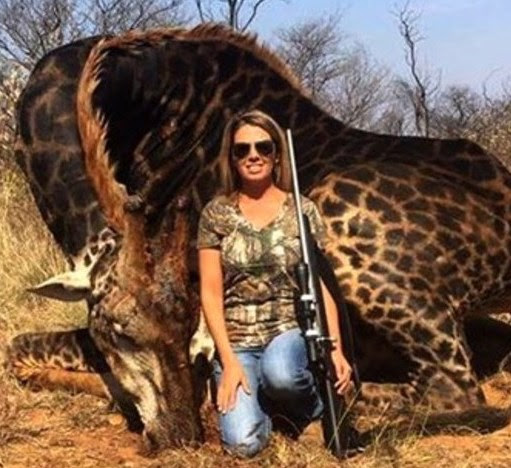
Tess killed this giraffe for fun. She smiles in front of his dead body and calls it a “dream hunt”! But we NOW have an unprecedented chance to help stop more vulnerable giraffes from being killed — starting by winning them international protection at a crucial wildlife summit in weeks! Sign now and share this with absolutely everyone to get our leaders’ attention!
She smiles in front of his dead body and calls it a “dream hunt”! It’s simply unexplainable why someone would be allowed do this. But we NOW have an unprecedented chance to help stop more vulnerable giraffes from being killed.
In weeks, countries from across the world are meeting for a crucial global wildlife summit. And for the first time ever, five African countries have proposed to put giraffes onto the list of protected species. This would be a game-changer and wake the world up to give giraffes the protection they deserve. And it’s urgently needed because the giraffe population is already down by 40%.
No one should murder animals just for fun, but we have a plan that could finally get giraffes the safety they need. Let’s all sign on now and then let’s make sure we share this with everyone we know!
Here’s how Tess explains the rightness of her action: “Animals have no rights as they are animals not humans. Therefore you can’t murder them.”
She says that, likely knowing that giraffes are highly intelligent, emotional animals — who spend their evenings humming to each other to communicate. It’s time for all of humanity to see our animal friends as possessing rights, and being treated with dignity.
So if you disagree that they should be shot for fun, and believe that they should actually be protected from irresponsible game hunts, poaching, and habitat loss — then join us and let’s win them protection at this year’s CITES summit in May, the most important global conference on this issue. This will act as the first step in our Africa-wide giraffe protection plan!
So far, giraffes have gotten little attention, but with their population continuously dropping — it’s high time we ring the alarm bells, make this petition go viral, and have our governments act on our behalf!
Life on Earth is so precious. And yet, some still think it’s all just a game and it’s the right thing to go and shoot animals for fun. The Avaaz community has stood up together when Cecil the Lion was killed or when Donald Trump tried to re-open the import of animal trophies — let’s do it once again for the giraffes!
With hope and determination,
Christoph, Sarah, Martyna, Risalat, Joseph, Rosa, Jenny and the rest of the Avaaz team
People queue to wash their hands with chlorine water to prevent Ebola contamination at a symbolic polling station on December 30, 2018, in Beni, Congo. Alexis Huguet/AFP/Getty Images
But it could get worse: Health officials this week are concerned that Ebola appears to be spreading in the direction of Goma, a major population center in DRC.
Just this week, DRC’s health ministry confirmed four cases of the deadly virus in Kayina, a town in North Kivu, where fighting among rebel and militia groups has repeatedly interrupted the painstaking work of health workers who are responding to the outbreak.
Kayina happens to be halfway between Butembo, currently one of the outbreak’s most worrisome hotspots, and Goma, where a million people live.
So far, the outbreak has not affected DRC’s biggest cities. But Ebola in Kayina “raises the alarm” for Ebola reaching Goma, Peter Salama, the head of the new Health Emergencies Program at the World Health Organization, told Vox on Friday.
Goma is a major transportation hub, with roads and highways that lead to Rwanda. “These are crossroad cities and market towns,” Salama added. People there are constantly on the move doing business, and also because of the insecurity in North Kivu. Ebola in Goma is a nightmare scenario WHO and DRC’s health ministry are scrambling to prevent.
Together, they’ve deployed a rapid response team, including a vaccination team, to Kayina. And if the virus moves on to Goma, Salama says Ebola responders are ready. They’ve already mobilized teams there, set up a lab, and prepared health centers where sick people can be cared for in isolation.
But as Ebola expert Laurie Garrett wrote in Foreign Policythis week, Ebola in Goma could also trigger a rare global public health emergency declaration by WHO, escalating the severity of an already dangerous outbreak.
An Ebola vaccine has been no match for DRC’s social and political chaos
When Ebola strikes, it’s like the worst and most humiliating flu you could imagine. People get the sweats, along with body aches and pains. Then they start vomiting and having uncontrollable diarrhea. They experience dehydration. These symptoms can appear anywhere between two and 21 days after exposure to the virus. Sometimes patients go into shock. In rare cases, they bleed.
The virus is spread through direct contact with the bodily fluids, like vomit, urine, or blood, of someone who is already sick and has symptoms. The sicker people get, and the closer to the death, the more contagious they become. (That’s why caring for the very ill and attending funerals are especially dangerous.)
Because we have no cure for Ebola, health workers use traditional public health measures: finding, treating, and isolating the sick, and breaking the chains of transmission so the virus stops spreading.
They mount vigorous public health awareness campaigns to remind people to wash their hands; that touching and kissing friends and neighbors is a potential health risk; and that burial practices need to be modified to minimize the risk of Ebola spreading at funerals.
They also employ a strategy called “contact tracing”: finding all the contacts of people who are sick, and following up with them for 21 days — the period during which Ebola incubates.
In this outbreak, there’s also an additional tool: an effective experimental vaccine. Since the outbreak was declared in August, more than 61,000 people have been vaccinated.But while the vaccine has tempered Ebola’s spread, it hasn’t overcome the social and political chaos in DRC, which has been called the world’s most neglected crisis.
“The brutality of the conflict is shocking,” Jan Egeland, head of the Norwegian Refugee Council, told the Thomson Reuters Foundation, “the national and international neglect outrageous.”
Presidential elections have “ratcheted up” the tension in an already tense situation
On December 30, after years of delays, voters went to the polls to elect a new president. In the days leading up to the election, tensions in North Kivu “ratcheted up,” Salama said. Protesters stormed Doctors Without Borders treatment centers in Beni, a recent outbreak hotspot, shutting them down for several days.
In January, the country’s electoral commission announced interim election results suggesting opposition leader Felix Tshisekedi had likely won the election. But leaked data and external analyses show there are irregularities with the voter count that point toward election fraud.
“All the outside observers — the African Union, the European Union, the Catholic Church — say the results of the election have been rigged,” and the people actually voted in Martin Fayalu for president, said Severine Autesserre, a political science professor at Barnard College, and author of the bookThe Trouble with the Congo. When the final results are announced in the coming days, more protests and riots are likely to follow.
But though the political instability isn’t making the Ebola response any easier, the war in Congo’s eastern provinces is a far bigger challenge. The 25-year-long conflict has displaced more than a million people, and made the already dangerous work of an Ebola response even more deadly, Autesserre said.
Between August and November, Beni had experienced more than 20 violent attacks, which put the outbreak response there on pause for days at a time. That meant cases had gone uncounted, and Ebola continued to spread.
But there’s also some more encouraging news, according to Salama: The outbreak of more than 200 people in Beni, a North Kivu town marred by decades of violence, has been brought under control.
“Many people would have been extremely skeptical that the outbreak in Beni could be controlled as quickly given force of infection we were seeing in November and December, and the fact that we’ve had nothing but volatility and insecurity since then,” Salama said. “But the fact that Beni has had only one confirmed case in two weeks is giving us a lot of hope and optimism.”
As of Friday, the two biggest hotspots in the outbreak were Butembo, with 51 cases, and a neighboring city, Katwa, with 119 cases. But the outbreak is geographically dispersed. There are active Ebola cases in 12 of the country’s “health zones,” the districts around which the DRC’s health system is organized. Because of the insecurity and difficulty reaching people, only 30 to 40 percent are coming from known contact lists, Salama said. That means the virus might already be in places no one’s discovered yet.
IT’S NOT JUST ELEPHANTS THAT ARE THREATENED BY PEOPLE’S DESIRE FOR IVORY. AS PART OF OUR ELEPHANTS IN CRISIS CAMPAIGN, BORN FREE’S HEAD OF POLICY DR MARK JONES EXAMINES THE OTHER ANIMALS AT RISK
Ending the ivory trade is key to securing a future for the world’s elephants, more than 20,000 of which are killed by poachers each year for their tusks. The international community is finally waking up to this theat. The USA and China have already introduced near-total bans. France has tightened up its legislation. Taiwan and Hong Kong have committed to act. In the UK, the Ivory Bill is currently working its way through Parliament.
These measures are encouraging, and while much remains to be done, they bring hope that one day the slaughter may end.
But it’s not just elephants that are threatened by people’s desire for ivory. The teeth from several other species, including hippos, walruses and narwhals, are also on the traders’ and traffickers’ wish lists.
Common hippos are much less common than elephants – as few as 115,000 remain across their rapidly reducing range in sub-Saharan Africa. Yet more than 38,000 individual teeth, 26 tonnes of teeth by weight, 6,550 hippo tusks, almost 6,500 ‘carvings’, and various other hippo products were legally traded between countries in the 10 years to 2016 – many destined for EU Member States.
Walruses are also in demand for their ivory. Between 2007 and 2016, more than 150,000 carvings, 12,500 items of ‘jewellery’, and various other walrus items including teeth and tusks were declared to have been traded internationally.
The distinctive long helical ‘tusk’ of the male narwhal, which is actually an elongated canine tooth, is also coveted. More than 2,500 tusks, 2,100 carvings and various other products from these toothed whales were traded commercially between countries in the decade to 2016.
Other species such as warthogs are also targeted for their teeth, although because they are not currently classified as threatened, data on international trade is lacking.
While the international community is rightly focused on protecting elephants, we must not forget that the trade in ivory for trinkets and carvings also threatens several other species. Some UK traders have already flagged increasing interest in hippo ivory as a replacement for elephant ivory to maintain the value of some objects from which the ivory has been lost or broken, or as a means of getting around a future ban on elephant ivory.
The UK’s Ivory Bill is very welcome, but it currently only covers elephant ivory. Thanks to Born Free’s efforts, the Government has committed to consulting on extending the ban to other ivory-bearing species once the Bill becomes law. For the sake of hippos, walruses, narwhals and others, we must hold them to this commitment, so the UK can act as an example to the rest of the world.
These precious and diminishing wild animals will only be safe once we end the demand for, and trade in, all ivory products for good.








/cdn.vox-cdn.com/uploads/chorus_image/image/62871800/GettyImages_1075872430.0.jpg)
:no_upscale()/cdn.vox-cdn.com/uploads/chorus_asset/file/13700632/Screen_Shot_2019_01_18_at_4.20.49_PM.png)
 Exposing the Big Game