Exposing the Big Game

Forget Hunters' Feeble Rationalizations and Trust Your Gut Feelings: Making Sport of Killing Is Not Healthy Human Behavior

Exposing the Big Game

Alaska’s national refuges are not private game reserves

The Times Editorial Board

March 18, 2017 5 am

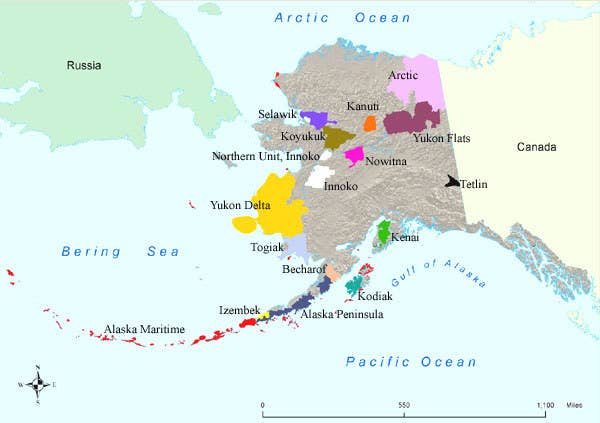
The 16 national wildlife refuges in Alaska span the state from the remote Arctic on the northern edge to the volcanic Aleutian islands southwest of Anchorage. Across the refuges’ nearly 77 million acres, animal diversity abounds — ice worms and seabirds, black bears and grizzly bears, wolves, moose, caribou, predators and prey. There is one guiding principle behind the U.S. Fish and Wildlife Service’s management of all the species on these refuges: Conserve the natural diversity of wildlife as it is. In essence, let them be, and let humans enjoy the spectacle of nature on these refuges.

But at these particular enclaves, that also means letting humans hunt — within limits. It’s difficult to believe that any wildlife refuge isn’t truly a refuge from hunters. That’s the way the national system of refuges started, but over the last quarter century, many have been opened up to regulated hunting.

 And herein lies the problem. The state of Alaska shares the responsibility for managing the refuges’ wildlife, and it has its own goal: Making sure there are plenty of animals to hunt. In an effort to maximize the number of moose, caribou and deer, the state authorized in some areas more efficient but brutal methods to kill the wolves and bears that prey upon those popular hunting targets.

Concerned that the state’s predator control campaign could become widespread enough to disrupt the refuges’ ecosystems, the U.S. Fish and Wildlife Service issued a rule that bars hunters and trappers in the refuges from killing wolves and their pups in their dens, killing bear cubs or sows with cubs, baiting brown bears, shooting bears from aircraft, or capturing bears with traps and snares. The rule took effect in September.

Alarmingly, Alaska’s congressional delegation is pushing hard to get rid of these ecologically sound and humane restrictions, and Republican lawmakers are responding. A joint resolution revoking the rule has passed the House and is expected to come up for a vote in the Senate the week of March 20. It is misguided and should be hunted down and killed.

Let’s be clear on a few things. The federal rule prohibits only these gruesome methods of hunting on national wildlife refuges. It does not apply to hunting in state-owned wilderness or to rural Alaskan residents who hunt for subsistence. And it’s doubtful that killing huge numbers of wolves and bears would automatically drive up the number of moose and caribou. “The best available science indicates that widespread elimination of bears, coyotes and wolves will quite unlikely make ungulate herds magically reappear,” wrote 31 biologists and other scientists to then-Secretary of the Interior Sally Jewell last year when the rule was still being studied.

In other words, the Alaskan government sought to allow types of hunting that probably would not accomplish what it wants to accomplish, but would end up killing brown bears who’d been lured with bait, slaughtering helpless cubs and wolf pups, and allowing bears to languish in excruciating pain for unknown hours in steel-jawed traps. This is unconscionable.

And this is not a case of states’ rights being usurped by the federal government. If anything, the congressional measures would subvert the federal government’s decades-long statutory authority over federal lands in Alaska. The national refuges are not Alaska’s private game reserve. That wilderness belongs to all of us. The Senate should stop this bill from going any further.
Trump Just Lifted A Ban On Shooting Bears And Wolves From Airplanes In Alaska

https://www.buzzfeed.com/salvadorhernandez/trump-just-lifted-a-ban-on-shooting-bears-and-wolves-from?utm_term=.dtVExXm7AZ#.hjE5KB39XE

An Obama-era rule prohibited the hunting of predator animals like bears and wolves in Alaska’s national wildlife refuges.

Posted on April 3, 2017, at 7:57 p.m.

Senate votes to lift limits on hunting Alaska grizzlies and wolves on federal land

 https://www.washingtonpost.com/news/energy-environment/wp/2017/03/21/senate-votes-to-lift-limits-on-hunting-alaska-grizzlies-and-wolves-on-federal-land/?utm_term=.6baf206d0e36
March 22

The Senate voted Tuesday to abolish a rule restricting specific hunting practices on national wildlife refuges in Alaska — including trapping, baiting and aerial shooting — on the grounds that state officials should be able to set the terms for wildlife conservation on public land within their own borders.

The 52-to-47 vote, which was almost entirely along party lines, represented the latest instance of Republicans using a powerful legislative tool — the Congressional Review Act — to eliminate regulations that President Barack Obama’s administration finalized before he left office in January. Independent Sen. Angus King (Maine) joined Republicans in backing the measure, and the measure needs only President Trump’s signature to become law.

With Trump’s support, congressional Republicans are working systematically to undo several environmental, labor and financial safeguards the previous administration put in place toward the end of Obama’s term. Under the 1996 law, any rule wiped off the books cannot be reinstated in a “substantially similar” form.

Although a disproportionate number of the regulations that have come under fire address energy and the environment, the larger debate has focused on whether the federal government has the right to establish sweeping rules Americans must live by or whether power should be devolved to the states.

During a sometimes-emotional debate Tuesday, Republicans and Democrats sparred over how best to define sportsmanship as well as state sovereignty.

Sen. Lisa Murkowski (R-Alaska) noted that the issue of managing wildlife “is something in Alaska that we take very, very seriously.” Recalling how she watched her grandparents and parents lobby for Alaska to become a state, she added, “It was all about fish, it was all about salmon. That’s one of the reasons we fought for statehood.”

But Sen. Martin Heinrich (D-N.M.), who spoke just before Murkowski, said the idea of allowing the killing of mother bears and cubs as well as denning wolves and pups would be putting “the federal stamp of approval on methods of take that the public views as unethical.”

“I don’t think that’s standing up for hunters,” he said. “I fear that it is endangering something that is critical to our culture and a way of life.”

Heinrich added that he had recently taken his 13-year-old son, Carter, on his first elk hunt, where “he soon learned that the hard work comes after you pull the trigger.” As his son painstakingly stripped the meat of the elk they had shot, the senator said, “Anything less would be unethical, and disrespectful to that magnificent wild animal.”

The National Rifle Association backed overturning the rule, as did the Alaska Department of Fish and Game and the Alaska chapter of Safari Club International. In mid-January the state of Alaska challenged the regulation, along with an earlier hunting rule issued by the National Park Service, in federal court.

Environmental and animal welfare groups, by contrast, lobbied against the measure.

For years the Alaska Department of Fish and Game and the U.S. Fish and Wildlife Service had negotiated on an annual basis how to establish hunting and fishing regulations for national wildlife refuges in the state, which encompass tens of millions of acres. But in 2013 the Alaska Board of Game, which is made up of political appointees, rejected the Fish and Wildlife Service’s proposed rules and instructed the state fish and game agency to write the regulations on their own.

In a statement after Tuesday’s vote, Sen. Dan Sullivan (R-Alaska) said that in his state, “many hunt for survival, both personal and cultural. Alaskans have been able to maintain these strong and life-sustaining traditions through a rigorous scientific process that allows for public participation and ensures we manage our fish and game for sustainability, as required by the Alaska Constitution.”

 But Ashe and other defenders of the rule said some of the changes envisioned by state officials, such as allowing people to fly into a place where grizzlies or caribou had gathered and begin hunting that day, could disrupt the natural predator-prey balance in the wild. Ashe warned that while some hunters may want to decrease the number of bears and wolves so that the numbers of other popular game species, such as moose and caribou, rise, there will be unintended ripple effects.

“There’s a natural tension between what the state wants to do, and what the federal law compels the Fish and Wildlife Service to do,” he said.

Congress Rolls Back Obama-Era Rule On Hunting Bears And Wolves In Alaska

A pair of brown bears play in a pond at the Alaska Wildlife Conservation Center in Portage Glacier, Alaska, in 2009.

Saul Loeb/AFP/Getty Images

By a largely party-line vote Tuesday, the Senate approved a bill that repeals Obama-era hunting restrictions on national wildlife refuges in Alaska. The House already voted last month to abolish those restrictions — which were instituted by the Fish and Wildlife Service in 2016 to protect predator species from hunters — and so the bill now heads to the desk of President Trump, who is widely expected to sign it.

The FWS rule facing repeal explicitly prohibited many kinds of “predator control” on the 16 federally owned refuges in Alaska. That prohibition included a ban on the aerial hunting, live trapping or baiting of predators such as bears and wolves — as well as killing those predators while near their dens or their cubs.

Alaska Rep. Don Young, the Republican sponsor of the bill passed Tuesday, says these restrictions represented federal overreach.

“Not only does this action undermine Alaska’s ability to manage fish and wildlife upon refuge lands,” Young said, “it fundamentally destroys a cooperative relationship between Alaska and the federal government.”

Republican Sen. Dan Sullivan, also representing Alaska, echoed those concerns Tuesday, saying the restrictions changed the state’s relationship with FWS “from one of cooperation to subservience,” The Associated Press reports.

“This rule is about Alaska,” he said.

Others, like Democratic Sen. Maria Cantwell of Washington, were not convinced.

“This isn’t about states’ rights,” she said, according to the wire service. “It’s not about prohibiting hunting. … It’s about how we can manage these wildlife refuges to the degree that agencies believe are necessary for the preservation of these wildlife heritage areas.”

As the Alaska Dispatch News points out, this debate gets to the core of a long-running dispute:

“At the heart of the disagreement between state and federal wildlife managers is what each group thinks should guide its purpose. The federal government has argued that the goal on refuges and in parks should be biodiversity. The state Board of Game has an interest in ensuring maximum sustained populations for hunting.”

Ensuring the “maximum sustained populations” of commonly hunted prey species like elk, moose and caribou often means reining in the populations of their predators — namely, bears and wolves. In the 2016 restrictions, federal regulators argued that the Alaskan Board of Game had gone too far in prioritizing the populations of prey species over predators.

It was an argument pursued by several Democratic senators, including New Jersey’s Cory Booker, and environmental groups who were opposed to the rollback.

“This isn’t hunting — it’s slaughter,” Brett Hartl, government affairs director at the Center for Biological Diversity, said in a statement. “Killing wolves and bears in this cruel, unsportsmanlike fashion is outrageous, especially in national wildlife refuges that belong to all Americans.”

He added: “Repealing these protections also undermines the critical role predators play in healthy ecosystems.”

Still, Sen. Lisa Murkowski (R-Alaska) says these objections come from activists unfamiliar with Alaska, where “state management of fish and wildlife is practically sacrosanct.”

“Opponents will allege that the repeal of this rule will legalize brutal predator control practices,” Murkowski said, according to the Dispatch News. “The Senate should know that it is already illegal for hunters to use certain practices — gas against wolves, traps to bears. You can’t do this in national wildlife refuges in Alaska.”

In working to repeal the FWS rule, Republican lawmakers turned again to the Congressional Review Act, a measure they also used to great effect last month in rolling back another Obama-era regulation.

As we explained then, the CRA is a means to review and cancel regulations issued in the final days of an outgoing administration: “The move allows the Senate to proceed with a simple majority, thus enabling GOP senators to avoid a filibuster by Democrats.”

A savage attack on predators

https://www.abqjournal.com/969229/a-savage-attack-on-predators.html

WASHINGTON – In its zeal to repeal, the U.S. House of Representatives recently voted to overturn a U.S. Fish and Wildlife Service rule forbidding the baiting, trapping and “denning” of bears and wolves in Alaska’s national wildlife refuges.The Senate is poised to consider the resolution as soon as next week.

Distilled to its essence, Alaska’s politicians want to reduce bear and wolf populations so hunters will have more moose and caribou to kill. Alaska’s full congressional delegation – Rep. Don Young and Sens. Lisa Murkowski and Dan Sullivan (all Republicans) – is behind the push.

Arguing for passage of H.J. Res. 69, Young told of entering wolf dens and killing mother and pups back when he worked as a bounty hunter of predators. Presumably, this was intended to impress his fellow legislators, as are his office walls, which are bedecked with animal trophies.

This isn’t an anti-hunting column. I’m on record supporting humane hunting for food, and I recognize that without hunters, many of whom are ardent conservationists, many wetlands would have been drained for commercial development. This is a plea for common sense, compassion and conservation. What are wildlife refuges, after all, if not refuges for wildlife?

The underlying so-called principle behind the resolution is the GOP’s promise to reduce job-killing regulations. While zealous regulation has led to some corporate outsourcing – and responsible tweaks can be made here and there – not one job is protected nor one dime saved by overturning the wildlife agency’s rule.

One could even argue that Young’s move is anti-business. Alaska’s greatest resource second only to oil is tourism. People go to Alaska to hunt but also to visit the parks and see the animals. Watching animals, in fact, brings Alaska more tourism dollars than hunting does, according to Alaska’s Department of Fish and Game.

The sheer savagery of what would become lawful if the Senate falls prey to its companion resolution (S.J. Res. 18) should give pause to anyone with a heartbeat.

Hunters could scout grizzlies from the air and then be deposited on the ground to kill them. (Aerial shooting is still forbidden.) They could hunt wolves during denning season, either shooting a mother wolf, thus dooming her babies, or entering the den and killing all, frequently with gas. Hunters could also bait, trap or snare, causing an agonizing death usually exacerbated by freezing temperatures. The traps are steel-jawed. A snare is a wire that wraps around an animal’s neck, then tightens as it pulls away.

These enhanced methods would target animals at their most vulnerable, in other words, and cause maximum suffering for no tenable reason. Moreover, artificially reducing the number of predators winnows down diversity essential to a healthy ecosystem, which can lead to unintended and disastrous consequences.

Of hunters, one must ask: Where is the sportsmanship in all of this? To Young and his like-minded colleagues, such a query is beside the point. Ultimately, they say, this is a states’ rights issue. There it is, the love Republicans can’t quit. In fact, no law grants state land managers authority to overrule federal land managers’ decisions related to federal land – for good reason.

Without the National Park Service, we might have had mining in the Grand Canyon, noted Wayne Pacelle, president and CEO of the Humane Society of the United States (where my son works), in a telephone interview. “Without federal protections, what’s to stop Wyoming from authorizing hunting grizzlies in Yellowstone?

“States’ rights simply don’t apply when you have a federal category of lands authorized by Congress,” he said. “This is really our Serengeti.”

As a humane matter, there’s no defending House Joint Resolution 69. As a regulatory issue, it defies logic. As an economic concern, protecting wildlife from cruel hunting practices makes sense.

Senators should vote to leave the protective rule in place – not only to protect our wildlife from politicians’ predatory practices but also to reassure Americans that the chamber still has a conscience.

Bill Would Allow Killing Of Bears And Wolves Again On Alaska Wildlife Refuges

Time to end the era of aerial gunning of wolves

http://blog.humanesociety.org/wayne/2017/02/time-end-era-aerial-gunning-wolves.html

Time to end the era of aerial gunning of wolves

by Wayne Pacelle

February 9, 2017 

One of the most despicable acts against animals in contemporary times is the aerial gunning of wildlife – chasing down these animals in aircraft and then strafing them with bullets, mainly as a way to wipe out local populations and artificially boost populations of moose and caribou for hunters to shoot at a later time. It’s not only a scrambling of intact ecological systems, but it is barbaric, and it’s been sanctioned by some Alaska politicians and their appointees at the Board of Game in Alaska for years, even though voters in the state time and time again have tried to ban it by ballot initiative.

In 2015 and 2016, the National Park Service and the U.S. Fish and Wildlife Service said “not on our lands,” and adopted rules to forbid aerial scouting, landing, and then shooting of wolves and grizzly bears; killing of hibernating black bear mothers with cubs; and denning of predators on national preserves and national wildlife refuges. It was a long overdue pair of policies, and broadly supported by so many Alaskans and by people throughout the nation.

Now these rules are facing a double-barreled attack – in the federal courts and in Congress.

The HSUS joined several national and local conservation groups this week to challenge an attempt by trophy hunting interests to reopen some of the cruelest hunting practices on federal lands in Alaska. Lawsuits filed last month by the state of Alaska and Safari Club International seek to nix the regulations. And next week, in the U.S. House of Representatives, Alaska’s sole Congressman, Don Young, will offer a resolution to strike the rule, under a law known as the Congressional Review Act. The CRA allows Congress, by simple majorities in the House and Senate and with the signature of the president, to strike any recent rule of the prior administration in the first few months of a new Congress.

These are our federal lands, and the National Park Service and the U.S. Fish and Wildlife Service are the primary managers. Those attacking these rules are attacking the professional wildlife managers who developed these policies on the ground in Alaska. At field hearings conducted in the run-up to the final rulemaking actions, significant numbers of Alaskans testified in favor of adopting the rules. It’s false framing for Rep. Young and anyone else to say Alaskans oppose these rules and support these unsporting and barbaric practices. In fact, voters have put the issues of aerial gunning of wolves on the ballot three times, and passed two of the measures (still lawmakers, violating the wishes of their own constituents, overturned those laws).

Congress created national wildlife refuges and national preserves so people can enjoy these magical places, but also to allow wildlife to thrive. We now know too much about wolves and grizzly bears to treat them like a curse and to try to decimate them. They play an essential role in balancing ecosystems, and have a cascade effect to benefit species up and down the food chain and even to help forest and stream health. It also is a proven truth that wolves and grizzly bears are the biggest draws for tourists who trek to Alaska and spend over $2 billion annually to see these creatures in their native habitats. Wildlife-based tourism creates thousands of jobs and commerce for Alaska – particularly for rural gateway communities. The FWS has reported that, in Alaska, wildlife watchers number 640,000 compared to 125,000 hunters and spend five times more ($2 billion) than hunters ($425 million) for wildlife recreational opportunities.

The state officials who brought these lawsuits, and the federal lawmakers from Alaska who are pushing their resolutions to repeal these new federal rules, are working against the economic interests of their state in advocating for more killing and maiming of wolves and grizzly bears. The U.S. Fish and Wildlife Service and the National Park Service were right to draw a line and say these activities cannot occur on federal lands set aside for wildlife. Wolves and bears are the best ambassadors for these land holdings, and no one has to pay them a dime or provide an ounce of food or a drop of water. They just need to be left alone.

But those rules are in jeopardy unless you act. Contact your federal lawmakers and urge opposition to the Young CRA joint resolution (H.J. Res. 69) and a similar effort in the Senate, advanced by Alaska Sens. Dan Sullivan and Lisa Murkowski (S.J. Res. 18).

It’s time to raise your voice if we want to ground the aerial gunships revving up to kill wildlife on some of America’s most extraordinary wild lands and ecosystems.

Support Denali Wolves

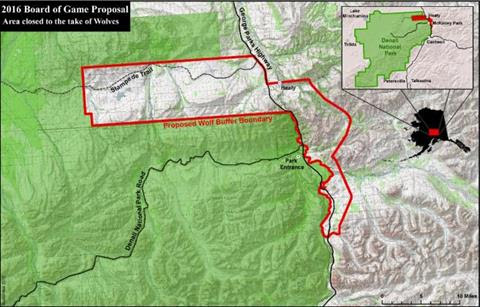
During their Region III meetings February 17-25 in Fairbanks, the Alaska Board of Game will take up Proposal 142, authored by Denali Citizens Council and the Alaska Wildlife Alliance. This proposal brings back to the Board the idea of precluding hunting and trapping of wolves on distinct areas of state land adjacent to Denali National Park and Preserve, game management units 20A and 20C.

Proposal 142 is on the agenda at the Region III Alaska Board of Game meeting, scheduled for February 17-25, 2017. This is the first time since 2010 that a proposal supporting closed areas next to the national park will be heard by the Alaska Board of Game.

The Board previously approved no-take areas for wolves in these same locations in 2001 and 2002 when the Park wolf population was much higher than the record-low numbers that have persisted in recent years. While research has shown that hunting and trapping do have a real affect on the park’s wolf population, it is, of course, one of many factors that contribute to changes in population size.

We, the owners of Camp Denali and North Face Lodge, fully support Proposal 142. Whether or not increased protection from human predation will right away result in a higher wolf population in Denali and increased view-ability of park wolves is unknown. We do know, however, that the buffer zone will ease one of the known human-caused factors for wolves’ population decline. And we know that the experience of viewing wolves in the wild is a powerful and meaningful one for park visitors. It is an opportunity that ought to be in the best interest of all Alaskans.

Read Proposal 142 here.

Please consider sending your written comments—brief or lengthy—to the Alaska Board of Game for the Region III meeting before February 3, 2017. Identify your interest in the issue, your familiarity with Denali National Park, and your support for increased protection of wolves through the measures identified in Proposal 142.

HOW TO SEND A COMMENT
Click on the link below to visit the Board of Game Comment Page, where you can submit a short or long comment for the Region III meeting by February 3, 2017. Be sure you choose the Interior/Northeast Region meeting from the dropdown menu.

http://www.adfg.alaska.gov/index.cfm?adfg=process.comments

Below are some additional suggested talking points from Denali Citizens Council:

– Highlight the vulnerability of wolves to hunting and trapping when they cross the park boundary onto state land.

– Identify the international importance of Denali’s wolves to tourism and science.

– Identify the importance of intact, diverse animal populations to the regional and state economy. Of greater benefit to the State of Alaska are the revenues from tourism to Denali National Park than the hunting and trapping licenses sold for the take of wolves on adjacent state lands.

– Remind the Alaska Board of Game that it is their responsibility and authority to conserve the wilderness and wildlife in this region.

– Include any relevant personal expertise or experience you have.

Calgary man banned from hunting, fined for importing Alaskan brown bear carcass

The Canadian Press

A Calgary man has been banned from hunting anywhere in the world for a year and fined thousands of dollars for illegally importing the carcass of an Alaskan brown bear.

READ MORE: Video of hunter killing Alberta bear with spear draws death threats, provincial ban coming

 Environment Canada says Jason John Clemett was found guilty in June and was ordered to pay $13,500 for violating the Wild Animal and Plant Protection and Regulation of International and Interprovincial Trade Act.
Wildlife Photography ©Jim Robertson

Wildlife Photography ©Jim Robertson

Horse Killed For Wolf Bait in Denali

Old news, but still “legal”:

https://www.psychologytoday.com/blog/animal-emotions/201205/horse-killed-and-legally-used-bait-and-kill-wolves

Following up on the good news about the release of two dolphins into the wild, I learned this morning about a most heinous and perverse situation in Alaska. Healy, Alaska trapper Coke Wallace “apparently walked a horse out to an area off the Stampede Trail near the boundary of Denali National Park – an area made famous by the 1996 book Into the Wild – shot the horse, and set snares all around the area hoping to catch wolves attracted to the carcass. Wolves from Denali National Park were drawn to the dead horse, resulting in the killing of a primary reproductive female wolf from the Grant Creek (also called Toklat West) pack from the park, along with at least one other wolf. It is unknown how long the two wolves were alive in the snares before being killed and collected by the trapper. The Grant Creek wolf pack has been one of the three packs most often viewed in Denali National Park.”

All of this happened in a former buffer area where wolves were protected from 2002-2010 when the Alaska Board of Game eliminated the protected area. The loss of these wolves puts the fate of this long-lived and long-studied pack in jeopardy. Observations began on this pack back in the 1930s. Of course, the loss of any wolves due to killing another animal to use as bait is reprehensible, legal or not.

This kind of hearltess slaughter must not be tolerated and it’s important to call attention to it and to protest it loudly and clearly. While “the incident does not violate state law, the Alaska Department of Environmental Conservation (ADEC) is looking at potential violations of state water quality regulations, which prohibit discarding carcasses in surface waters of the state.”


copyrighted-wolf-argument-settled