I feel sad for the planet that people are so straight-jacketed and tongue-tied against ever whispering a word about the human overpopulation crisis.
People won’t hesitate to speak up if a non-human animal species becomes overpopulated (usually because humans have changed its environment and/or killed off its natural predators), but they continue to tiptoe around the issue of their own species overpopulation…
There’s way too many of us to be telling people, ‘just consume less and we’ll be fine.’ As popular as that might be to some of us, the human footprint is much too deep and heavy to get off so lightly.
Like cows in search of greener pastures, we’ve worn an indelible trail to our own demise. We’ve come so far on this narrow trail that it’s getting too late to turn back now…
I’m reading a true story wherein the main character/victim is a mother who, though she has 2 kids already and then had her tubes tied, re-marries and wants to have more babies with her new husband. One of her eggs is in-vitro fertilized and she ends up having quadruplets (in addition to the 2 she already had). After she is murdered by her ex-husband, her younger sister (who has 4 kids of her own) helps take care of them…
Anyway, long story short, there’s too many humans now to just say. ‘Just buy a little less’ and we’ll all be ok’. That’s an oversimplification sort of like Gorge W. Bush telling people to go out shopping after 9-11. Good for the 7-11s in the world maybe, but not the full answer the Earth really needs right now.
In other words, until we address the overpopulation of humans, we may as well tell people to just go out and go shopping.
Until humans come down from their pedestal and decide that we are animals, beholden to the same laws of nature as any others, we’ll never escape the mess we’re in…
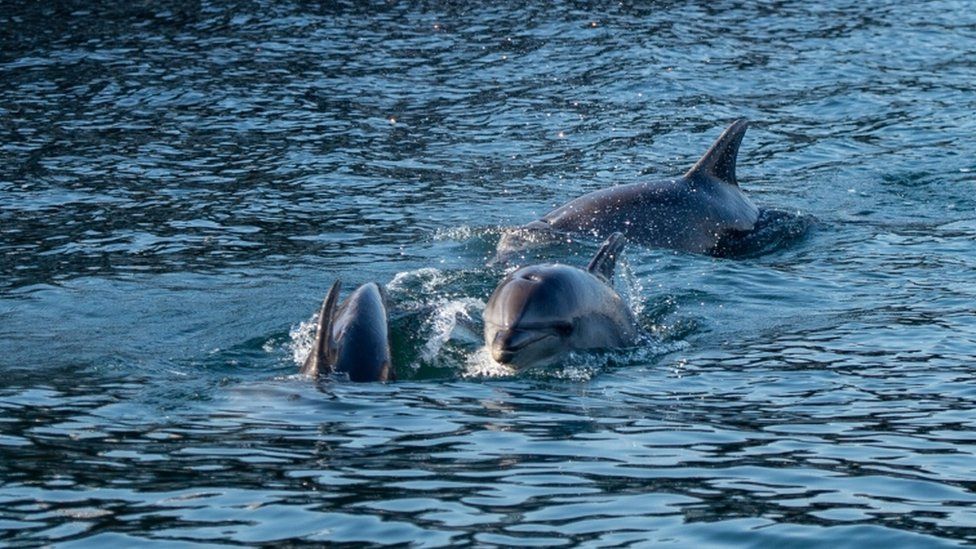
Image copyrightAFPImage captionThree types of dolphins including bluenose can be found in the Bosphorus, Istanbul
Coronavirus lockdowns globally have given parts of the natural world a rare opportunity to experience life with hardly any humans around.
Animals in urban areas are exploring emptied streets and waterways, and delighting human inhabitants along the way.
While many of these are not unique sightings, the human restrictions due to the coronavirus pandemic seem to have given animals the confidence to go deeper into our cities and stay for longer.
Others are enjoying having nature reserves and parks all to themselves, and some authorities report a boom in wildlife while tourists are away.
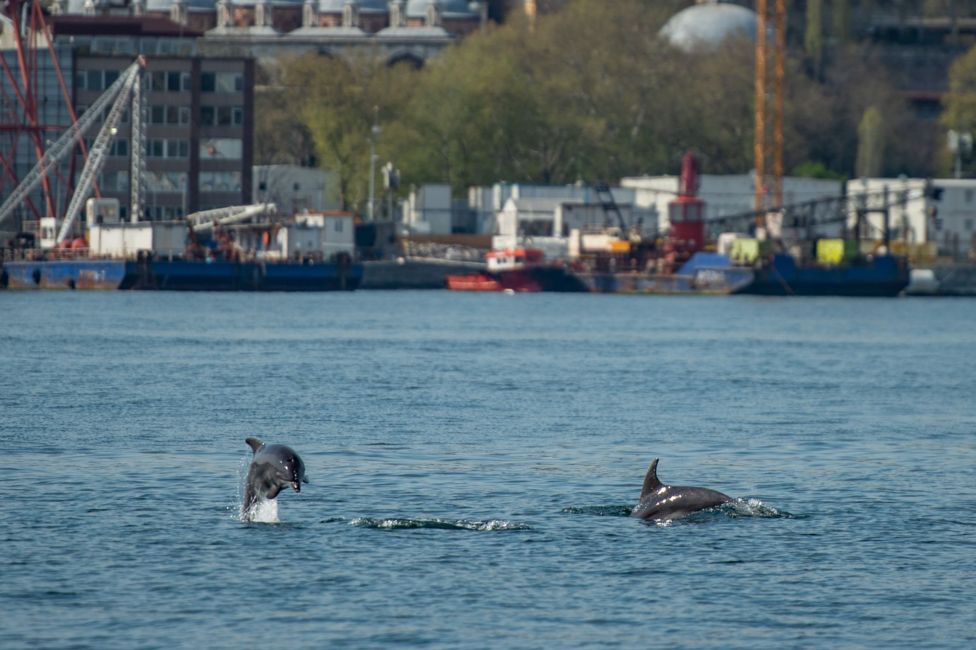
Image copyrightAFPImage captionResidents of Istanbul say dolphins are coming further up the Bosphorus than usual
The Bosphorus in Istanbul, Turkey is normally one of the world’s busiest marine routes. Huge tankers, cargo ships and passenger boats criss-cross the straits that cut the city in half 24 hours a day.
Now, with a lull in traffic and fishermen staying at home during the city’s lockdown, dolphins are swimming and jumping in the waters.
It’s not uncommon to spot the tell-tale dots of a dolphin from the city’s quays, far away in the distance. But videos posted by residents of the animals swimming near the banks show how much closer to the city they’re happy to come now.
Dolphins “are coming closer to the edge of the water as the terror of uncontrolled anglers on the shoreline has temporarily stopped,” a ship spotter who has photographed dolphins in the past told AFP.
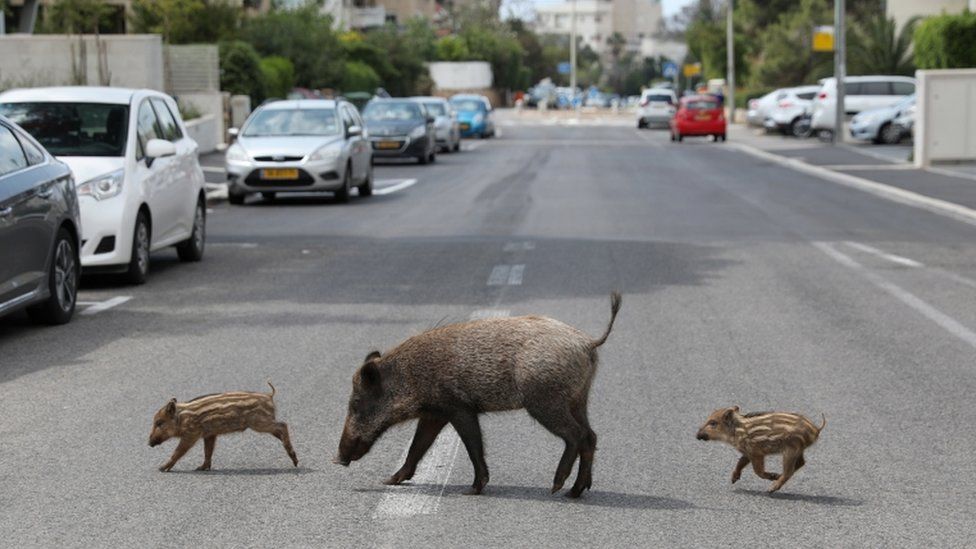
Image copyrightEPAImage captionWild boar in Haifa, Israel are enjoying food left in resident’s rubbish bins
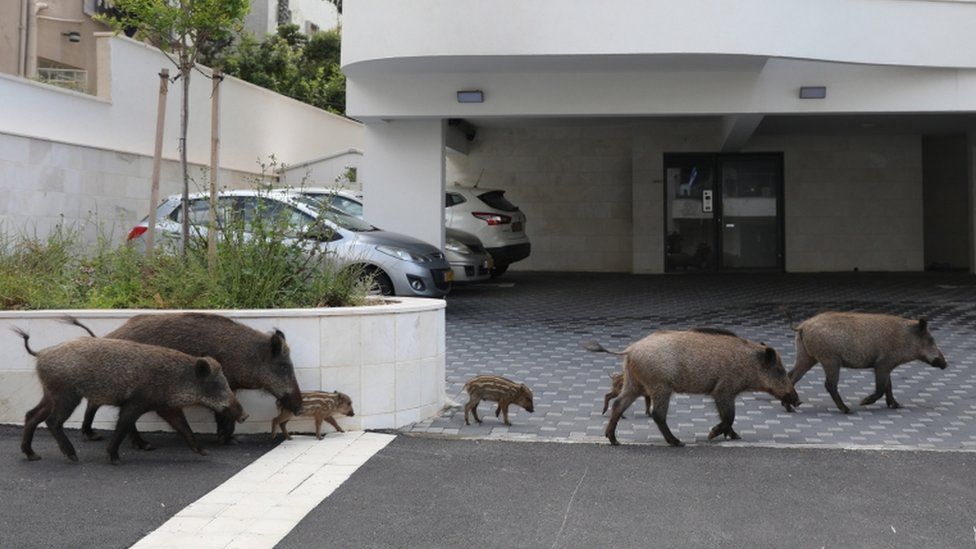
Boars were seen snuffling and foraging for food around the city of Haifa before the pandemic, but the absence of humans has encouraged them further, residents say.
Image copyrightEPAImage captionSome groups feed the boar, but others want them to be removed
The issue is now so serious that local officials held a Zoom meeting to discuss the expanding population.
“I’m scared that after the coronavirus passes, the boars will have gotten used to coming every day, every night, every hour,” Yaron Hanan who is campaigning for a crackdown on the animals told Reuters.
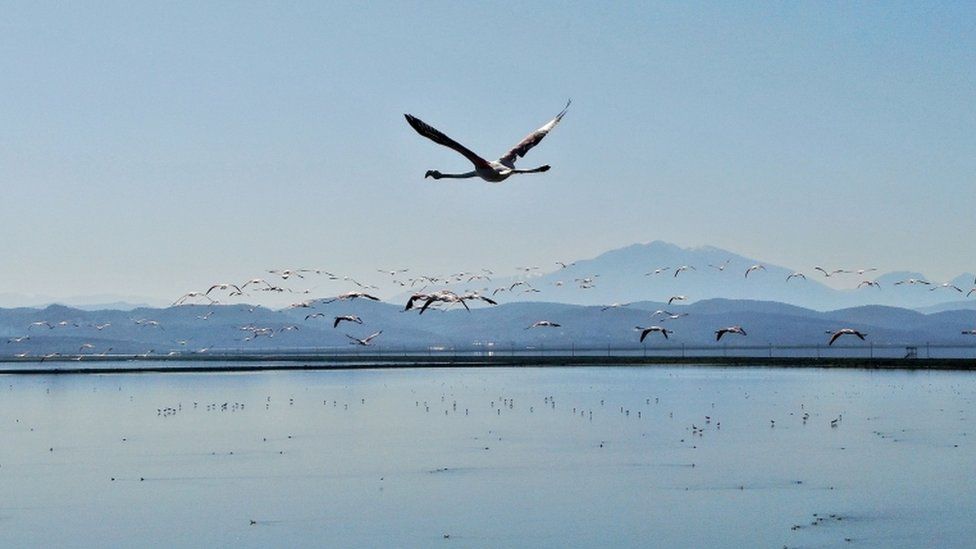
Image copyrightAFPImage caption“It’s time for love,” an environmental expert said about flamingos arriving in Albania to mate
However some species are enjoying solitude in previously busy natural reserves or parks.
In Albania, pink flamingos are flourishing in lagoons on the country’s west coastline, where numbers have increased by a third to 3,000, park authorities told AFP.
Thousands have been seen soaring over the waters at Narta Lagoon where they go to mate after flying from Africa and the southern Mediterranean.
Nearby olive oil and leather processing factories that have been accused of polluting the waters are closed, and the traffic that usually congests a road 500m away is absent, creating quiet for the birds.
Couples have been “moving a little further into the lagoon and are now starting courtship rituals,” said Nexhip Hysolakoj, the head of the Vlora protected area.
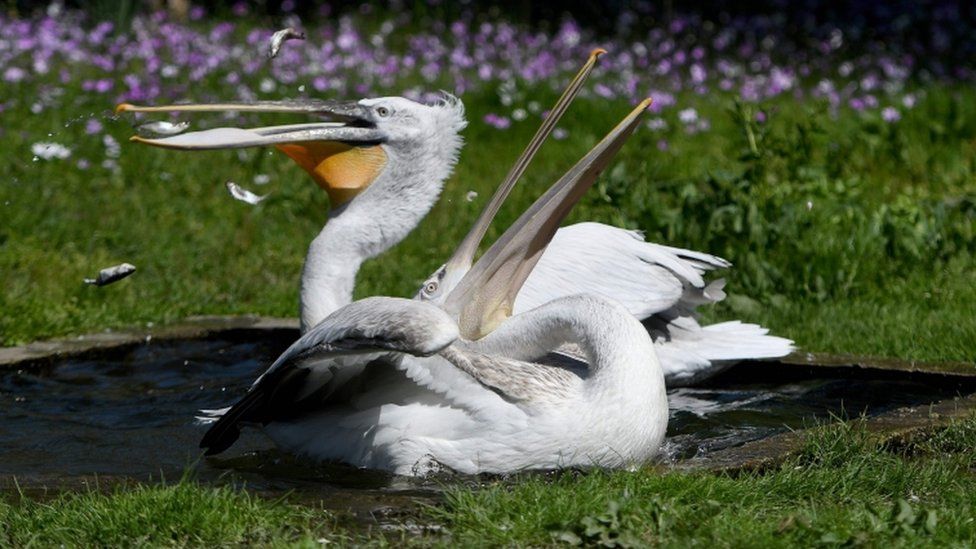
Image copyrightAFPImage captionDalmatian or curly pelicans are known for the ruffle of feathers on their heads
And in Divjaka National Park, 85 pairs of curly pelicans are nesting. The usual 50,000 monthly tourists are keeping away, creating quiet in the area where officials hope a population boon will now happen.
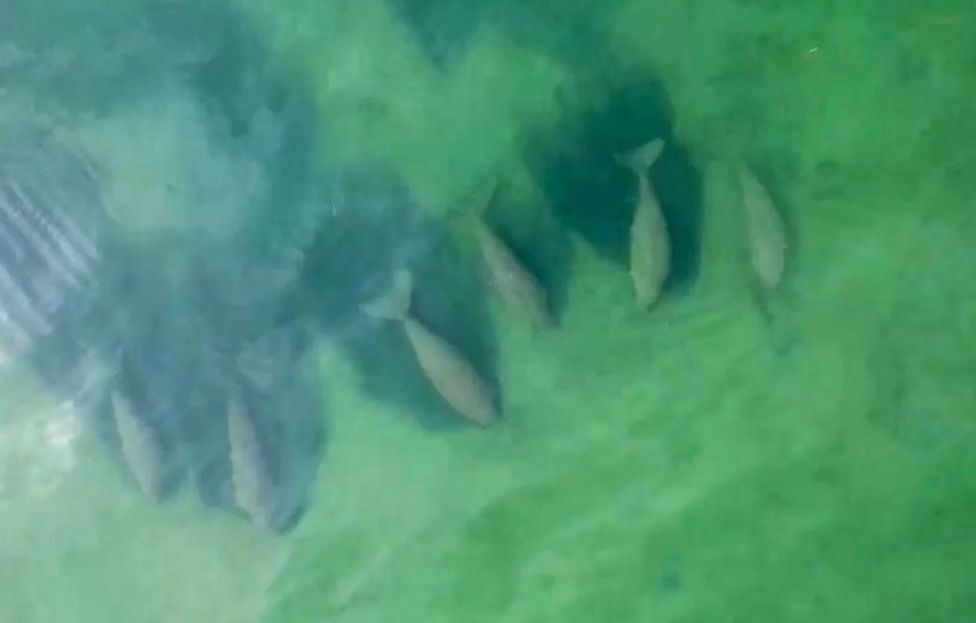
Image copyrightAFP/ THAILAND’S NATIONAL MARINE PARKImage captionThe Hat Chao Mai National Park caught a herd of dugong on video
The dugong, also known as sea cow, is classed as a vulnerable species and can often fall victim to fishing nets or suffer due to water pollution.
The national park has been posting videos on Facebook of large swarms of fish and other species, and says there has been a revival in wildlife since the pandemic began.
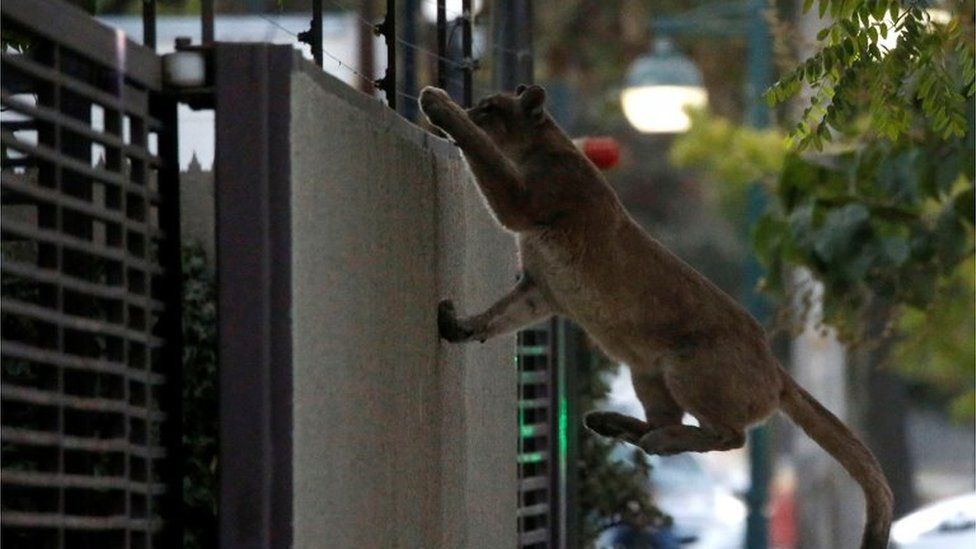
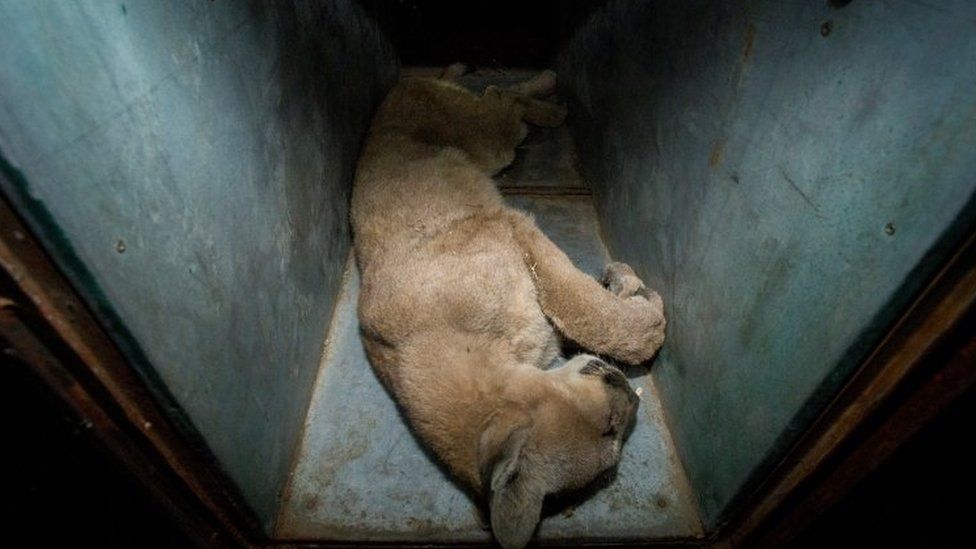
Image copyrightREUTERSImage captionThe first cougar to be spotted in Santiago was snapped jumping onto a wall
However some animals enjoying new adventures aren’t able to stay around for long.
“They sense less noise and are also looking for new places to find food and some get lost and appear in the cities,” Horacio Bórquez, Chile’s national director of livestock and agriculture service, said of the animals.
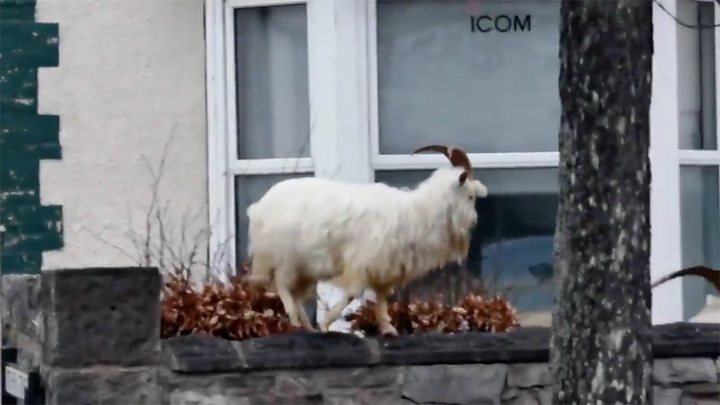
Media captionThe curious goats have been spotted eating flowers and hedges in people’s gardens
And who could forget the famous Kashmiri goats of Llandudno?
They enjoyed the deserted town in Wales and had a scamper around last month. Some even helped themselves to garden flowers and hedges.
But not all creatures are benefitting from the coronavirus lockdown.
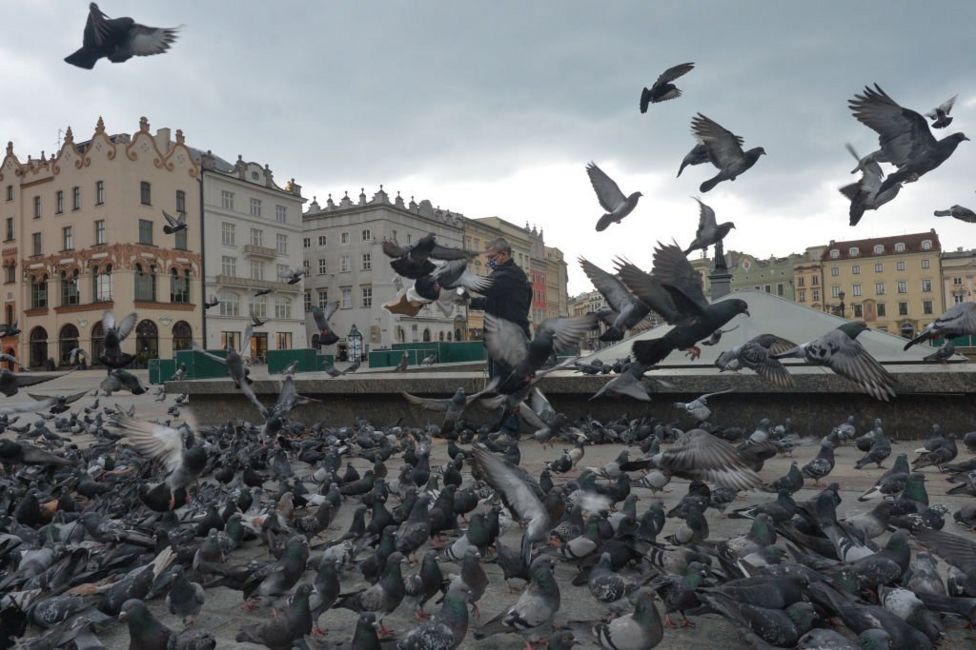
Image copyrightGETTY IMAGESImage captionMembers of Krakow’s Animal Welfare Organisation are feeding the city’s pigeons daily
Europe’s pigeons risk starvation, warns an animal rights group in Germany. That’s because the humans who normally feed them or drop morsels of food on the streets are stuck at home. The group, while acknowledging that pigeons are a problem for many cities, says they should not be allowed to die a painful death.
In Krakow, Poland, one animal welfare organisation is coming out specially to feed the flocks abandoned for the time being.
A geoscientist calls the unearthed fossils, including the bodies and trails left by an ancient animal species, the most convincing sign of ancient animal mobility, dating back about 550 million years.
In a remarkable evolutionary discovery, a team of scientists co-led by a Virginia Tech geoscientist has discovered what could be among the first trails made by animals on the surface of the Earth roughly a half-billion years ago.
Shuhai Xiao, a professor of geosciences with the Virginia Tech College of Science, calls the unearthed fossils, including the bodies and trails left by an ancient animal species, the most convincing sign of ancient animal mobility, dating back about 550 million years. Named Yilingia spiciformis — that translates to spiky Yiling bug, Yiling being the Chinese city near the discovery site — the animal was found in multiple layers of rock by Xiao and Zhe Chen, Chuanming Zhou, and Xunlai Yuan from the Chinese Academy of Sciences’ Nanjing Institute of Geology and Palaeontology.
The findings are published in the latest issue of Nature. The trails are from the same rock unit and are roughly the same age as bug-like footprints found by Xiao and his team in a series of digs from 2013 to 2018 in the Yangtze Gorges area of southern China, and date back to the Ediacaran Period, well before the age of dinosaurs or even the Pangea supercontinent. What sets this find apart: The preserved fossil of the animal that made the trail versus the unknowable guesswork where the body has not been preserved.
“This discovery shows that segmented and mobile animals evolved by 550 million years ago,” Xiao said. “Mobility made it possible for animals to make an unmistakable footprint on Earth, both literally and metaphorically. Those are the kind of features you find in a group of animals called bilaterans. This group includes us humans and most animals. Animals and particularly humans are movers and shakers on Earth. Their ability to shape the face of the planet is ultimately tied to the origin of animal motility.”
The animal was a millipede-like creature a quarter-inch to an inch wide and up to 4 inches long that alternately dragged its body across the muddy ocean floor and rested along the way, leaving trails as loing as 23 inches. The animal was an elongated narrow creature, with 50 or so body segments, a left and right side, a back and belly, and a head and a tail.
The origin of bilaterally symmetric animals — known as bilaterians — with segmented bodies and directional mobility is a monumental event in early animal evolution, and is estimated to have occurred the Ediacaran Period, between 635 and 539 million years ago. But until this finding by Xiao and his team, there was no convincing fossil evidence to substantiate those estimates. One of the recovered specimens is particularly vital because the animal and the trail it produced just before its death are preserved together.
Remarkably, the find also marks what may be the first sign of decision making among animals — the trails suggest an effort to move toward or away from something, perhaps under the direction of a sophisticated central nerve system, Xiao said. The mobility of animals led to environmental and ecological impacts on the Earth surface system and ultimately led to the Cambrian substrate and agronomic revolutions, he said.
“We are the most impactful animal on Earth,” added Xiao, also an affiliated member of the Global Change Center at Virginia Tech. “We make a huge footprint, not only from locomotion, but in many other and more impactful activities related to our ability to move. When and how animal locomotion evolved defines an important geological and evolutionary context of anthropogenic impact on the surface of the Earth.”
Rachel Wood, a professor in the School of GeoSciences at University of Edinburgh in Scotland, who was not involved with the study, said, “This is a remarkable finding of highly significant fossils. We now have evidence that segmented animals were present and had gained an ability to move across the sea floor before the Cambrian, and more notably we can tie the actual trace-maker to the trace. Such preservation is unusual and provides considerable insight into a major step in the evolution of animals.”
The study was supported by the Chinese Academy of Sciences, the National Natural Science Foundation of China, the U.S. National Science Foundation, and the National Geographic Society.
[Some of this stuff is wtf way out of line, like suggesting that the animals think we were gracious “Hosts”, that the animals got along with homo erectus, or Plestocene age humans, but most of this is timely and right on:]
So you’ve probably heard about the new report saying human-caused climate change is putting about a million different species of animals and plants at risk of extinction, and we just wanted to pop on over and say that it’s true, a lot of us are on our way out the door.
Bye!
Seriously, look at the time! We can’t believe it’s been hundreds of thousands of years already! That’s a pretty long time, when you think about it, and you can’t go on coexisting as humans and animals on the same planet forever. And you know what they say: It’s better to burn out than to fade away. We’re gonna take our cue here and get out of your hair pretty soon. So arrivederci, and adios!
We’ve had some really good times, us and you humans. Who can forget the crazy days of the Pleistocene epoch? Sure, the Ice Age was no picnic, but it was honestly pretty great later on hanging out and watching y’all evolve. We’ve had this whole symbiotic thing going where animals and Homo erectuscould live side by side. Over the years, we’ve gotten to migrate with you as you’ve moved around and really had a chance to find ourselves and flourish in new places. It was paradise. It would’ve been awesome if life could’ve stayed that way forever, you know?
We’re not trying to flake or anything, believe us. Look, you guys are obviously busy with your machines and your wars and your relentless pursuit of profit. Sometimes, people and animals grow apart. And that’s okay. We’ve always been pretty chill with what you guys are doing, so don’t worry, it’s totally cool. A flourishing ecosystem that supports all of Earth’s creatures isn’t going to be everyone’s thing. It’s your habitat now, after all, and you’ve been gracious hosts to us for a long time. So thanks!
Since we’ve got you here, we do want to mention that it hasn’t been all fun and games. If we’re being honest, we’re still not totally keen on poaching, pollution, zoos, deforestation, or raising us in terrible conditions for the express purpose of slaughtering and eating us. Those things are kind of a buzzkill. Don’t get us wrong, we’re not trying to be overly critical, since you obviously have your reasons. We just wanted to get that off our chests before we get going.
Also, it’s sort of weird you breed some of us as pets. Just saying.
Do we wish we could stick around longer? Sure, a little. When the dodo peaced out back in the late 1600s, we were like, really? Already? The party’s just getting started! But now when we look around—the oceans are heating up, the food’s running out, and most of our natural environments are gone—we wonder if maybe the dodo was right to take off when it did. The vibe isgetting kinda weird in here. Not that the last couple hundred years of rapid industrialization have been all bad for us, but let’s just say the Earth’s not quite as fun for us as it used to be.
We don’t want to belabor our departure—no one likes a guest who overstays their welcome—so we’ll just do a quick soundoff of who’s heading out soon so you can say a quick toodle-oo: the Bengal tiger, Amur leopard, hawksbill sea turtle, Chinese giant salamander, Javan rhinoceros, Sumatran rhinoceros, black rhinoceros, giant panda, vaquita, eastern gorilla, Sumatran orangutan, Borean orangutan, saola, gharial, Asian elephant, Philippine crocodile, Chinese pangolin, Malayan tiger, mountain pygmy possum, Andaman shrew, western swamp turtle, Philippine forest turtle, Ploughshare tortoise, Cross River gorilla, eastern lowland gorilla, saola, South China tiger, pika, giant otter, red wolf, Tasmanian devil, peppered tree frog, northern tinker frog, mountain mist frog, armored frog, Eungella torrent frog, Sumatran elephant, African wild donkey, Saiga antelope, giant muntjac, addax, bowhead whale, beluga whale, Balkan lynx, Asiatic cheetah, gloomy tube-nosed bat, Armenian whiskered bat, Hill’s horseshoe bat, Thongaree’s disc-nosed bat, Aru flying fox, central rock rat, pygmy hog, Gilbert’s potoroo, Allan’s lerista, Carpentarian rock rat, Kangaroo Island dunnart, Darwin’s fox, Peruvian black spider monkey, the red wolf, spoon-billed sandpiper, Siberian crane, Bengal florican, regent honeyeater, orange-bellied parrot, great Indian bustard, sociable lapwing, white-billed heron, whooping crane, red-vented cockatoo, Himalayan quail, Hainan black-crested gibbon, Bulmer’s fruit bat, Philippine naked-backed fruit bat, Fijian monkey-faced bat, Northern white-cheeked gibbon, indri, Andohahela sportive lemur, Manombo sportive lemur, Sahamalaza sportive lemur, all the other sportive lemurs, Celebes crested macaque, Pagai Island macaque, Sarawak surili, kipunji, hirola, tamaraw, wild Bactrian camel, white-rumped vulture, red-headed vulture, Indian vulture, slender-billed vulture, longcomb sawfish, Ganges shark, red-finned blue-eye, finless porpoise, squatina, northern river shark, Pondicherry shark humphead wrasse, orphan salamander, cloud forest salamander, Monte Escondido salamander, El Cusuco salamander, Zarciadero web-footed salamander, Cerro Pital salamander, blue whale, black-footed ferret, Yangtze finless porpoise, Zapotec salamander, and basically everyone from the wetlands.
We’re definitely missing a bunch who are just slipping out really quickly without saying farewell. We hope that’s okay. You probably won’t even notice they’re gone! We’re not all leaving yet. Just a lot of us.
But we don’t want to go out on a bad note. We have so many wonderful memories of the pre-Anthropocene era, and we don’t want those fond recollections of vibrant, life-sustaining forests and jungles and prairies to be forgotten. But it’s time for us to mosey on out down the dusty trail. Sayonara!
Oh, and we hope you don’t mind, we’re taking most of the plants with us too.
Anna Pippus is a Vancouver-based lawyer and director of farmed animal
advocacy at Animal Justice
Earlier this year, 95 per cent of Canadians said
<http://www.newswire.ca/news-releases/new-poll-finds-97-percent-of-canadians
-support-stronger-federal-transport-protections-for-farmed-animals-572368961
.html> it is important to ensure farmed animals are treated humanely, even
if it costs more. This is quite possibly the one issue we can actually agree
on <http://angusreid.org/canada-values/> . Although most Canadians eat
animals, we are united in having no appetite for animal suffering.
Animal transport regulations, in particular, have been a political
battleground for animal welfare advocates and the meat industry.
While the government does not regulate farm conditions – choosing instead to
finance and endorse industry-created codes of practice – it does get
involved in regulating transport and slaughter because of the food safety
and interprovincial trade dimensions.
If the government is going to do something, we want them to do it
competently.
But Canada’s transport regulations have been criticized
<http://www.animaljustice.ca/blog/weak-transport-regulations-sentence-millio
ns-farmed-animals-suffer-die/> as the worst in the Western world, lagging
behind the transport welfare laws of the European Union, Australia, New
Zealand and the United States.
Transportation is incredibly stressful. For animals that have never left the
controlled conditions of indoor modern farms, being crowded into a truck
with strangers, deprived of food and water for long periods of time, and
exposed to extreme weather is one of the worst ordeals of their abbreviated
lives.
It is so stressful, in fact, that millions of animals do not survive the
journey to the slaughterhouse. Dropping dead during transportation is so
common that law enforcement will not even investigate a truck of chickens
from an egg farm, for example, unless at least 4 per cent
<http://humanefood.ca/maple_lodge.html> are dead on arrival.
The Canadian Food Inspection Agency this week published much-anticipated
amendments to the Health of Animals Regulations after more than a decade of
lobbying from animal welfare advocates, humane societies, veterinarians,
animal lawyers and other experts in animal protection.
The proposed regulations are disappointing, barely improving some key areas
and entirely failing to address others. A CFIA statement
<http://www.gazette.gc.ca/rp-pr/p1/2016/2016-12-03/html/reg2-eng.php> says
98 per cent of shipments are already compliant with the new regulations – in
other words, not much is changing.
For example, exposure to extreme weather is a major source of stress, injury
and mortality. Animals are shipped <http://humanefood.ca/maple_lodge.html>
every day of the year, regardless of weather, which means that in open-sided
trucks they are directly exposed to that day’s precipitation, temperature,
wind and humidity at top highway speeds.
Yet the proposed regulations simply reword the old weather exposure
provision, retaining wishy-washy language that would, in practice, mean
animals will continue to be <http://humanefood.ca/maple_lodge.html>
transported in inadequate trucks every day regardless of weather.
There is no reason we cannot require common-sense technological improvements
and accountability for non-compliance, following in the footsteps of the
European Union. There, vehicles are required to have forced air and heating
ventilation systems that keep trucks between five and 30 degrees Celsius.
Monitoring systems must alert the driver when temperatures reach either
limit, and the data from these systems must be accessible to law
enforcement.
Moreover, Canada’s proposed new regulations would continue to allow animals
to be transported without access to food, water or rest for inexcusably long
periods of time, despite this being a main source of international concern.
On-board watering systems – a simple retrofit – would not be required. Pigs
and horses could be in transit for up to 28 hours; cows for up to 36 hours;
and chickens for up to 24 hours.
Fortunately, it is not too late for the government to get its act together –
there’s a 75 day comment period
<http://e-activist.com/ea-action/action?ea.client.id=1990&ea.campaign.id=602
28> before these bleak regulations become law. Let’s hope they will hear
the 95 per cent of us who want to shed the dubious honour of having the
worst animal transportation standards in the Western world.










 Exposing the Big Game