Japan: Queen guitarist condemns dolphin hunting

http://www.thenational.scot/world/japan-queen-guitarist-condemns-dolphin-hunting.22762

BRIAN May has condemned Japan’s dolphin hunting, saying the slaughter of animals should end in the same way society has turned against slavery or witch-burning.

The Queen guitarist and animal rights campaigner said: “Every species, and every individual of every species, is worthy of respect.”

May, in Tokyo for Queen’s sell-out concerts at Budokan arena, added: “This is not about countries. It’s about a section of humanity that doesn’t yet understand that animals have feelings too.”

Protesting against the dolphin hunt in the small Japanese town of Taiji, documented in Oscar-winning film The Cove, has become a cause for celebrities including Sting and Daryl Hannah.

Taylor McKeown, a silver medalist swimmer in the Rio Olympics, who has long been fascinated with dolphins, is now in Taiji to monitor the hunts.

Ric O’Barry, the dolphin trainer for the Flipper TV series and who stars in The Cove, started the protests against the Taiji dolphin kill, which depicts a pod of dolphins being herded into an inlet and getting bludgeoned to death, turning the water red with blood.

The hunters in Taiji and their supporters defend the custom as tradition, although eating dolphin is extremely rare in Japan. The Tokyo government also defends whaling as research.

May, who founded the Save Me Trust in 2009 to lobby governments on wildlife policy, said he opposes cruelty against all animals, including foxhunting and bullfighting. Both are also defended as tradition, but that is just an excuse, he said.

“I know Japanese people, so many. They’re decent, they’re kind, they’re compassionate, but they don’t know this is going on,” he said of the dolphin killing. “These are mammals, highly intelligent, sensitive creatures, bringing up their children like we do, and they are being slaughtered and tortured.”

Should veganism come with a mental health warning?

12 June 2014

by Clare Mann

As a psychologist with over 20 years’ experience, I admit that I have a mental health disorder.

Some professionals might say I have an eating disorder because I am vegan. Others would show concern that I regularly feel anxious, depressed, experience panic attacks and even post-traumatic stress symptoms at what I have and continue to see in society’s abuse of animals.

I say this because, in the past year I have seen an increase in GPs referring people they believe are suffering from mental illness, particularly eating disorders. However, upon meeting them, I find that these preliminary diagnoses follow these patients explaining that they are vegan.

What if their associated symptoms were not signs of mental illness at all, but instead signs of extreme anguish, grief, betrayal and the madness of speciesism?

So if you are reading this and are actively involved in animal advocacy and consider yourself to be an ethical vegan, then perhaps you should be issued with a health warning?

Not a physical health warning because with the proper nutritional advice, your health will positively improve by adopting a plant based diet, but with a mental health warning.

Once you lift the veil on what is going on behind our speciesism, you will most likely reach the same conclusion – that it is a form of madness but not your madness.  The madness of how our society thinks speciesism – our unspoken superiority over the animal kingdom and differing treatment of different species – is ok.

More: http://www.thescavenger.net/social-justice-to-all/social-justice-for-animals/943-should-vegans-be-issued-with-a-mental-health-warning.html

After Losing Half A Beak, Grecia The Toucan Becomes A Symbol Against Abuse

src="https://www.npr.org/player/embed/491372643/491613617" width="100%" height="290" frameborder="0" scrolling="no" title="NPR embedded audio player">

Enlarge this image

On display at ZooAve Animal Rescue in Alajuela, Costa Rica, Grecia, the chestnut-mandibled toucan, can now eat on its own and sing with the new beak. Grecia was in rehabilitation for months after receiving a 3-D-printed nylon prosthesis. Carrie Kahn/NPR 

On display at ZooAve Animal Rescue in Alajuela, Costa Rica, Grecia, the chestnut-mandibled toucan, can now eat on its own and sing with the new beak. Grecia was in rehabilitation for months after receiving a 3-D-printed nylon prosthesis.

Carrie Kahn/NPR

Remember the toucan in Costa Rica who had its upper beak hacked off by a perpetrator who was never found?

Well, here’s an update to a story we first told you about last year. And, spoiler alert — it has a happy ending.

Local residents brought the bird to a nearby animal rescue center. And thanks to its dedicated workers, amazing doctors and engineers, the toucan now has a prosthetic beak.

That new beak and Grecia, as the bird’s called, went on public display just this last week at ZooAve, a private animal rescue center about 30 minutes outside Costa Rica’s capitol.

Nine-year-old Leonardo Jimenez was thrilled to finally see the bird.

“This is the third time I’ve tried to see Grecia,” he says.

Jimenez started following Grecia’s plight ever since the bird was brought here in January, 2015. Nearly its entire top beak was cut off.

“She was really bad off,” says ZooAve caretaker Ronald Sibaja. “All that was left of the top beak was a jagged bloody stump”.

Sibaja refers to Grecia as “she,” although no one knows its gender. It would have to take a blood test to determine its sex, an added stress Sibaja says the injured bird didn’t need.

Enlarge this image

Visitors enter the front gate of ZooAve Animal Rescue, Grecia the toucan’s permanent home. Carrie Kahn/NPR hide caption

toggle caption Carrie Kahn/NPR

Visitors enter the front gate of ZooAve Animal Rescue, Grecia the toucan’s permanent home.

Carrie Kahn/NPR

“When the veterinarian did that first exam we all thought she would have to be euthanized,” says Sibaja.

Toucans need their beaks for everything from eating to regulating body temperature. But he says you could tell Grecia wanted to live. She sang as best she could and would try to eat.

Sibaja says he had read about eagles and ducks getting prosthetic beaks and suggested one for Grecia.

When the decision was made to get the bird a new beak, news of Grecia and her prosthesis campaign went viral. A 3-D printing company from the U.S. with partners in Costa Rica signed on to make the beak.

Filmmaker Paula Heredia documented Grecia’s year-long recovery for Discovery Channel’s Animal Planet.

More: http://www.npr.org/sections/parallels/2016/08/27/491372643/after-losing-half-a-beak-grecia-the-toucan-becomes-a-symbol-against-abuse

Animal Rights Activist On Trial In Canada For Giving Water To Pigs

An animal rights activist is being tried in Canada on charges of criminal mischief because she gave water to pigs bound for the slaughterhouse.

Anita Krajnc faces a maximum of six months in jail or a $5,000 fine if convicted, and she has pleaded not guilty, according to the CBC. The pigs were on their way to Fearman’s Pork Inc. in Ontario last summer.

Animal rights group Toronto Pig Save posted a video, which you can watch here:

First, it shows Krajnc approaching a truck full of pigs and asking the driver to give one of the pigs some water.

He replies: “Don’t give him anything. Do not put water in there!” She says, “Jesus said if they are thirsty, give them water.”

His response: “No, you know what, these are not humans, you dumb frickin’ broad!” He threatens to call the cops as she repeatedly says, “Have some compassion.” When she attempts to insert the water bottle through a slot in the trailer for the pigs to drink, he threatens to slap it out of her hands.

Speaking outside the courthouse, Krajnc told reporters that this trial is about “putting pigs in the spotlight. … We want people to see them as individuals and not property.”

She told The Washington Post that her defense lawyers will argue she was not breaking the law but acting in the public good.

The trial opened this week and held two sessions. On Thursday, animal welfare expert Armaiti May testified in court that “in all likelihood they were in severe distress,” the CBC reported. May said she couldn’t be sure: “I was not there to examine the pigs, and they’ve been slaughtered now.”

Toronto Pig Save, which Krajnc founded, regularly holds “vigils” in front of Fearman’s and other local slaughterhouses to “bear witness” to the animals’ final moments,according to the group.

The driver, Jeffrey Veldjesgraaf, and hog farmer Eric Van Boekel maintained “the pigs were watered and transported according to industry standards,” as the CBC reported.

Veldjesgraaf testified that “his main concern was over what was in the water that Krajnc’s group gave the pigs, and whether it might contaminate the livestock,” CBC reported.

As the Star reported, Van Boekel told the court that he had other safety concerns: “One of my biggest fears — and it’s not if it’s going to happen, it’s when it’s going to happen — is one of the protesters has their arm in the slat, and the driver pulls away, they’ll get (dragged) under the truck.”

Defense lawyer Gary Grill told the broadcaster that he hopes “Justice David Harris will wear the [virtual reality] gear to experience what it’s like being an animal in a slaughterhouse,” which “will be instrumental in helping Harris understand Krajnc’s viewpoint as an animal rights activist, and why she gives water to pigs outside slaughterhouses.”

The trial will continue on Oct. 3, when Krajnc is expected to testify.

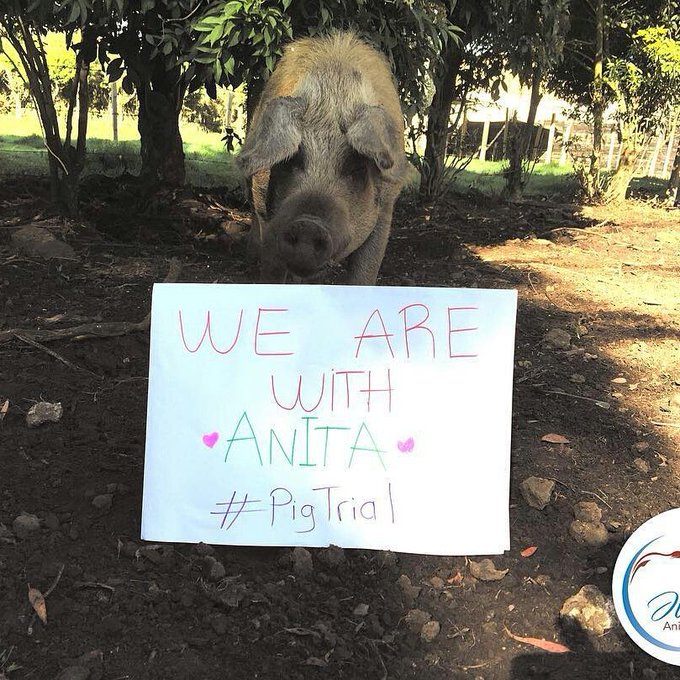
The case has attracted the attention of other animal rights activists, who are tweeting messages of support using the hashtags #PigTrial and #StandWithAnita.

WE ARE WITH ANITA! STAND TALL YOU ARE IN THE RIGHT AND YOU HAVE MILLIONS OF PEOPLE BEHIND YOU! ❤❤❤❤

Secret video prompts Tyson to retrain chicken plant workers

http://www.usatoday.com/story/money/2016/08/10/facing-animal-abuse-allegations-tyson-foods-retrain-poultry-workers/88544680/?siteID=je6NUbpObpQ-WaBLFQgv9cPz_WtFr4a.ig

Secret video shows animal abuse at Tyson Foods

Animal advocacy group Compassion Over Killing presents an undercover investigation into cruelty at Tyson Foods chicken farms. Video courtesy of Compassion Over Killing

In the face of new allegations of ghastly animal abuse by its employees, Tyson Foods says it’s retraining all of its live poultry workers on the company’s animal welfare policies.

The move by one of the world’s largest meat producers came as the animal rights groupCompassion Over Killing released secretly-recorded footage on Thursday that shows Tyson workers stomping, kicking and suffocating breeder chickens at facilities in three Virginia counties. Tyson says it has fired ten workers who can be seen in the video, and a senior company executive, Christine Daugherty, described the employees’ actions as “disgusting.”

“The people shown in the video by Compassion Over Killing were all trained in proper animal handling, yet chose to ignore it and failed to alert management about the despicable treatment on these farms,” said Daugherty, vice president of sustainable food production for Tyson Foods.  “Animals in our care deserve to be treated humanely. It’s our responsibility to ensure that everyone who works for our company behaves properly. Our management team is dedicated to continue fostering a culture of proper animal handling.”

The latest video marks at least the fifth time in roughly 13 months that advocates for various animal rights groups have been able to infiltrate Tyson-connected facilities and secretly record footage of workers abusing chickens and cramped living conditions for chickens before they are slaughtered. The activists typically apply for work at the facilities and are able to surreptitiously record the footage.

In the video released Thursday, a Tyson worker is caught on tape warning the undercover investigator that “you can’t let nobody see you do that” as he stepped on a chicken’s head, suffocating it.

“You don’t know if he’s working for the animal rights,” the worker says. “It is inhumane standing on his head and let them suffocate. They’ll take you to court for that.”

The footage also shows workers punching, kicking and roughly tossing birds.

In the past, the company has responded to the abuse seen in such videos as inexcusable, while stressing that the abusers were not reflective of Tyson’s institutional commitment to animal welfare.

But with the latest video, Tyson said in a statement,we believe we haven’t gone far enough and must do more to stop this inexcusable behavior.” The company, which made more than $10 billion in poultry sales last year, says it is now evaluating further steps it can take to ensure animal well-being procedures are being followed throughout its operations.

The new video has also spurred Tyson to discontinue the practice of inserting plastic tubes in rooster’s beaks, something known as beak modification, that helps chicken growers prevent males from eating females’ feed.

Compassion Over Killing, which is headquartered in Washington, D.C., said it recently made formal complaints about the abuse to prosecutors and animal control officers in Mecklenburg, Lunenburg and Buckingham counties. No charges had been filed as of Wednesday.

“We believe that Tyson as a company needs to be held accountable,”  Erica Meier, the group’s executive director, told USA TODAY. “This is too common of a problem being documented for Tyson’s to be pushing this aside as a few rogue workers or bad apples. This is a systemic problem.”

Worth Sparkman, a Tyson spokesman, said the company has also been in touch with local authorities about the video, but declined to say whether the company wants to see the employees charged.

He said that the retraining will impact hundreds of Tyson’s employees working in live chicken production.

Tyson said in a statement that it has begun meeting with every employee in its chicken operations that handles live birds “to aggressively re-emphasize the importance of proper animal handling and the consequences of not complying with the company’s animal welfare policies.”

The company also said it conducted a video conference on Thursday in which Tyson’s senior management will discuss handling of live birds with managers at the company’s facilities.

“We take animal well-being very seriously, and we are going to get to the bottom of this,” Daugherty said.

Follow USA TODAY Chicago correspondent Aamer Madhani on Twitter: @AamerISmad

Animals Aren’t Commodities

“If Animals Matter Morally, Then We Cannot Treat Them As Commodities”

A conversation with animal rights advocate Gary Francione

Gary L. Francione is a controversial figure in the modern animal rights movement, known for his “abolitionist approach” towards animal rights. A professor of law and philosophy at Rutgers University, Francione believes that we cannot morally justify using animals as mere resources and that we should abolish all animal use. He argues that any being that feels pain has a right to not be used as property and that veganism should be the moral underpinning of the animal rights movement. As he puts it, “To not be a vegan is to participate directly in animal exploitation.”

photo of Gary Francione Photo by Vegano Siempre

Francione was the first person to teach animal rights in an American law school when he began teaching a course on animal rights and law at Rutgers in 1989. He has focused nearly four decades of academic scholarship in forwarding a theory of animal rights that posits that sentience alone (and not just cognitive intelligence as defined by humans) qualifies a being for the fundamental right of not being considered the property of another. He links the struggle for animal rights with other social movements and argues that the animal rights movement is the logical progression of the peace movement.

Francione has written multiple books and countless articles on animal ethics and animal law, and is particularly well known for his critical view of the animal welfare movement, which he says serves primarily to make people feel better about animal exploitation. His latest book, Eat Like You Care: An Examination of the Morality of Eating Animals (2013), co-authored with his partner and fellow Rutgers professor Anna Charlton, answers all the “but” questions that any non-vegan could possibly ask about transitioning to a vegan lifestyle.

I recently spoke with Francione via Skype and email about his latest book, his philosophy on animal rights, and his thoughts on both the animal welfare and animal personhood movements.

What event in your life caused you to become an animal rights activist?

In the late 1970s, I visited a slaughterhouse. It changed my life overnight. It became clear to me that our use of nonhumans as human resources presented a most serious moral question that was, for the most part, being ignored.

What is your philosophy concerning animal rights?

My position is that if animals matter morally at all — and I believe that most people believe that they do matter morally — then they must have at least one right: The right not to be used exclusively as human resources. The right not to be chattel property.

Interests can be protected in one of two ways. We can protect an interest only to the extent that to do so maximizes desirable consequences. Or we can protect that interest irrespective of consequences. The latter way of protecting an interest is what we describe as involving a right. To say that I have a right of free speech is simply to say that my speech will be protected even if other disagree with and think that my speech generates undesirable consequences.

If the interest in not being chattel property is not protected by a right, then that interest will be ignored when it is beneficial to do so. We recognize this where humans are concerned. We protect the interest that humans have in not being slaves with a right. We recognize that if humans are going to be members of the moral community, they must have the right not to be chattel slaves. If they are chattel slaves, they exist outside the moral community. They are things and not persons.

The same analysis holds true where nonhumans are concerned. If they are going to matter morally, they must have the right not to be property. If they are property, they are just things that have only extrinsic or external value, and do not have inherent or intrinsic value.

If we recognize this one right, then we are morally committed to abolishing the institutionalized exploitation of nonhuman animals. It’s not a matter of improving the treatment of animals. It’s a matter of abolishing the use of animals.

One of the key tenets of your philosophy is veganism. Could you explain why you think it’s important?

Veganism means that we do not eat, wear, or otherwise use animals.

I maintain that there is veganism and there is animal exploitation: There is no third choice. To not be a vegan is to participate directly in animal exploitation. That is, if we eat animals or animal products, wear wool, leather, fur, etc., or use products made from animals, we are treating animals as things with no morally significant interests.

As an abolitionist, I promote veganism as a moral baseline or a moral imperative and as the only rational response to the recognition that animals have moral value. If animals matter morally, then we cannot treat them as commodities and eat, wear, or use them. Just as someone who promotes the abolition of slavery should not own slaves, an abolitionist with respect to animal slavery should not consume animal products. As far as I am concerned, veganism is a fundamental matter of justice.

Advocating veganism as a fundamental principle of justice is not something that requires large, wealthy animal charities and “leaders.” It is something that we all can do and must do as a grassroots movement. Each of us must be a leader.

Let me say that there is no difference between meat and other animal products. Animals used for dairy and eggs are also treated horribly and they all end up in the same slaughterhouse as their “meat” counterparts. If you do not eat meat but you eat dairy and eggs, you are still directly responsible for animal suffering and death.

Your view on animal rights, particularly your views on animal welfare, has been criticized by some sections of the animal-protection movement, who say that animal welfare does provide some interim protection to animals until their rights can be established. How do you respond to such criticism?

Animal welfare is problematic for moral and practical reasons.

From a moral perspective, if animal use cannot be morally justified, then it is morally wrong to promote supposedly “humane” exploitation. Think about it in a human context. If slavery is wrong, then promoting “humane” slavery is not the answer. The only morally acceptable solution is to promote the abolition of slavery.

From a practical perspective, because animals are chattel property, and because it costs money to protect their interests, we protect animal interests generally only when we get an economic benefit. For example, we have laws that require animals to be stunned at the moment of slaughter because animals who are not stunned can injure workers and they incur carcass damage. Worker injuries and carcass damage cost money. For the most part, welfare reforms make animal exploitation more efficient. They are measures that, for the most part, industry will take anyway because it is beneficial for industry to do so.

As far as I am concerned, the primary purpose of animal welfare measures is to make humans feel better about continuing to exploit animals.

Do you think human society is at a point where it’s receptive to the idea of animal personhood, which would bestow animals with the basic rights to life and liberty?

Absolutely. I believe that most people already accept the idea that nonhumans are not things and are beings with moral value. Most people accept that it is wrong to inflict unnecessary suffering on nonhuman animals. Most people become outraged when they hear about “animal cruelty” cases precisely because they object to the infliction of unnecessary suffering.

The challenge is to get them to see that if they are not vegan, then they are morally no different from the “abusers” they criticize. It is not necessary to eat animal products in order to have optimal health. Indeed, mainstream health care professionals are increasingly recognizing that animal products are detrimental to human health. The best justification we have for inflicting suffering and death on billions of land animals and trillions of sea animals is that they taste good. That is no better a justification than maintaining that the enjoyment of watching a bullfight justifies bullfighting.

I am very optimistic about the future. I think the abolitionist vegan movement — a grassroots movement of people all over the world — is really gathering a great deal of momentum.

Given that you believe that sentience is the only characteristic required for personhood, what are your thoughts on the Nonhuman Rights Projects efforts to get certain animal species like chimpanzees and elephants declared nonhuman persons?

Sentience is subjective awareness. A sentient being is someone who perceives and experiences the world. A sentient being has interests; that is, preferences, wants, or desires. If a being is sentient, then that is necessary and sufficient for the being to have the right not to be used as a means to human ends. The recognition of this right imposes on humans the moral obligation not to use that being as a resource. It is not necessary for a sentient being to have humanlike cognitive characteristics in order to be accorded the right not to be used as property.

Intelligence and humanlike cognition may be relevant for some purposes, but they are not relevant for the basic right not to be used as property. As far as that one right is concerned, there is no difference between a chimpanzee and a mouse. We should not use either exclusively as a human resource.

Again, think about it in the nonhuman context. There are all sorts of differences between a human who is brilliant and a human who is severely mentally disabled. Those differences may be relevant for certain purposes, but we should not use either human as a forced organ donor or as a non-consenting subject of a biomedical experiment.

So if not through incremental efforts, such as getting one species at a time recognized as persons with rights, how do we get around to establishing the abolition of animal exploitation?

We get to the abolition of animal exploitation through creative, nonviolent vegan advocacy. We need to stop the demand for animal exploitation. And we can do that. Assume that we have 1 million vegans in the US. That’s a very low estimate. If every one of those people educated one other person to become vegan in the next year, there would be 2 million vegans. If the process repeated itself every year, the United States would be vegan in eight years.  Each of us can play a role in bringing about a vegan world!

How do you feel about the killing of Harambe the gorilla? Do you think the killing was inevitable, that the zoo had no choice?

A child got into the enclosure. The gorilla was a piece of property. If Harambe had injured the child, the legal liability of the zoo would have been astronomical. So I am not surprised that the zoo had Harambe killed. I object to zoos. And although I thought it was tragic that Harambe was killed, it’s no more tragic than the killing of millions of “food” animals every day. There is no moral difference between Harambe and the nameless chicken that people consumed for dinner last night.

What are you working on at the moment?

Anna Charlton, my co-author on Eat Like You Care, and I are working on a handbook about abolitionist vegan advocacy.

If you had one message to give to all animal lovers, what would it be?

Loving animals is not consistent with harming them. If you love animals — if you believe that animals matter — then stop participating directly in the exploitation of animals. It’s morally wrong. Go vegan!

http://www.earthisland.org/journal/index.php/elist/eListRead/If_animals_matter_morally_we_cannot_treat_them_as_commodities/

BULLFIGHTING: THE FACTS

http://www.stopbullfighting.org.uk/facts.htm

THE MYTH

BanderillasIt seems hard to believe that in this so-called civilised age, a most vicious and cruel spectacle of blood continues to flourish in Spain and certain other countries. Bullfighting is barbaric and should have been banned long ago, as bear-baiting was. It is difficult to understand how crowds of people will pay money and take pleasure in watching one lone creature – who has never done them any harm — getting hacked to death. How can anyone with an ounce of compassion, cheer and chant olé as a banderilla or lance is thrust into the animal’s pain-racked body?

Bullfighting has a very glorified public image — it is presented as a contest between the brave matador, who boldly risks life and limb to tackle a mad and ferocious beast. The matador is always dressed in a traditional costume of brilliant colours: the bullfight is seen by many as the mysterious ritual between man and beast, which is an integral part of Spanish culture and custom. For this reason, many tourists who visit Spain feel that seeing a bullfight is a necessary part of their holiday, just as tourists visiting Britain go to see the Tower of London.

However, after witnessing the sheer horror of this sickening slaughter, only the most hardened and callous would consider a second visit to the bullring. The purpose of this booklet is to fully explain what the bull has to endure, both during his last hour of life in the ring, and also the other side of the bullfight not commonly known to the vast majority of people: the pre-bullfight treatment.

THE PRE-FIGHT TREATMENT

PicadorsThe bull is not an aggressive animal, and the reason he is angry and attempts to charge at the matador whilst in the bullring is mainly because he has been horrendously abused for the previous two days. In fact, what spectators see is not a normal, healthy bull, but a weakened, half-blinded and mentally destroyed version, whose chances of harming his tormentors is virtually nil. The bull has wet newspapers stuffed into his ears; vaseline is rubbed into his eyes to blur his vision; cotton is stuffed up his nostrils to cut off his respiration and a needle is stuck into his genitals. Also, a strong caustic solution is rubbed onto his legs which throws him off balance. This also keeps him from lying down on the ground. In addition to this, drugs are administered to pep him up or slow him down, and strong laxatives are added to his feed to further incapacitate him. He is kept in a dark box for a couple of days before he faces the ring: the purpose of this is to disorientate him. When he is let out of the box, he runs desperately towards the light at the end of the tunnel. He thinks that at last his suffering is over and he is being set free — instead, he runs into the bullring to face his killers and a jeering mob.

THE “FIGHT”

Strictly speaking, a bullfight is composed of 3 separate “acts”, and the whole thing is supposed to last for 20 minutes, though in actual fact it varies. The opening of a bullfight begins with a tune being played on a trumpet — the tune is the special, signa lure Rifle which characterises the beginning of the horror. Upon entering the ring, bulls have been known to collapse through exhaustion alter their pre-fight ordeal — they have been dragged to their feet by the bullfighter’s assistants.

The Picadors

The sequence of events begins when the bull faces the picadors — these are the men on horseback, whose purpose it is to exhaust the bull. They cut into his neck muscles with a pica. This is a weapon of about 6-8 inches long, and 2 inches thick. Once it is thrust into the bull it is twisted round and a large, gaping wound appears. The bull then starts bleeding to death.

The Assistant Matadors

After the picador has finished his sordid business, the assistant matadors then get to work with the banderillas (sharp, harpoon-like barbed instruments). These are plunged into the bull’s body, and he may also be taunted by capes. Up to six banderillas may be used. When the banderillas strike the bull stops in his tracks and bellows madly.

Main matadorThe Kill

A trumpet signals the final “act” — in fact, during the whole nightmare, strange, slow tunes are played throughout. It is, of course, during the final act that the bull is killed (and hopefully goes onto a better life). The kill should last 6 minutes, and is done by the main matador. If he has any difficulties (which is an extremely rare occurrence), the others immediately rush in to his aid and finish off the bull.

THE FINAL DEGRADATION

The matador is supposed to sever the artery near the heart with one thrust of the sword — in fact, this never happens. It often takes 2-3 times before the creature is mercifully released by death. By this time, the bull’s lungs and heart will be punctured and he always vomits blood. Miraculously, he sometimes attempts to rise again, and gets up on his knees, only to receive further mutilation at the hands of his tormentors. He finally gives up, goes to his knees and lies down. Even then, he is not allowed a little dignity to leave this world in peace, his ears and tail are cut off (often when he is fully conscious), and his broken, bleeding body is dragged around the ring by mules, to which he is attached by an apparatus made of wood and chains. Not content with his suffering, which must be too horrible to describe by words, the crowds boo and jeer him. They even throw empty beer cans at him. His body is then taken away to be skinned, and even then he may not be dead when this happens.

HORSES

A horse being gored by a bullThe bull is not the only animal to suffer in the ring — hundreds of horses die long and agonising deaths as they are gored by the pain-crazed bull. Horses have their ears stuffed with wet newspaper, they are blindfolded and their vocal chords are cut so they are unable to scream in pain. It is not an uncommon occurrence for horses to stumble upon their own entrails after being badly gored. After a horse has been wounded it is led out of the ring, given crude surgery, and sent back in. Horses used in bullrings sweat and tremble from fear — they are forced to return to the ring time and time again. The picador’s horses are generally animals whose working life is over, and which are, therefore, old, infirm and docile. Their reward for serving mankind faithfully is to end their days in the bullrings. They are kept in poor conditions between fights, arid, not surprisingly, their life expectancy is short.

ARGUMENTS IN DEFENCE OF BULLFIGHTING

“But it’s part of their culture’ is the argument commonly used to defend bullfighting, but this argument is also used to defend female circumcision (genital mutilation). It could also have been used to defend witch-burning, bear-baiting and a multitude of other evils, “Culture” is not a magic word, and simply labeling something as such doesn’t make it right and above criticism. Also, the word “culture” suggests the enhancement and enrichment of people or a society, and watching animals being tortured to death doesn’t fall into this description.

Death“Get your own house in order” is another argument put forward, with reference to our own bloodsports such as hunting and harecoursing. Well, there is no reason why we can’t support the Spanish Animal Rights movement as well as fighting animal abuse in our own country. An animal doesn’t regard itself as being Spanish when it is being tortured to death — rather it is a member of the anima[ kingdom being tortured to death by humans. The Animal Rights movement is a worldwide one and should not be restricted by boundaries.

As has been mentioned previously, bullrings are largely sustained by tourists who visit out of curiosity and a misguided belief that if they fail to visit this unique part of Spanish culture, their visit to Spain will not be complete.

The vast majority of tourists are appalled by what happens at a bullfight and leave after they see what happens to the first bull (three separate bulls are killed at bullfights, but spectators are not allowed to leave until the first one has ended).

However, the purchase of their ticket keeps the bullrings open.

Spain is a popular holiday destination for British tourists, so for this reason a campaign in this country to educate people about what really happens at bullfights is a necessary and vital step towards closing down the bullrings.

Frank Evans from Manchester who runs a bedroom and kitchen showroom in Eccles called “Ladyline” is a bullfighter who regularly travels to Spain to torture bulls to death. This is another reason why bullfighting is an issue for the British Animal Rights movement.

The Anti-Bullfighting Committee, P.O. Box 175, Liverpool L69 8DX has started a campaign against Evans by demonstrating and leafletting outside his shop and his house. Anyone interested in joining this campaign should contact this address. Also, anyone wishing to express their views on Evans’ activities should write to him at:

19 Monks Hall Grove,
Eccles, Manchester

Also, please write to:

The Spanish Ambassador,
The Spanish Embassy,
24 Belgrave Square,
London SW1

There are now serious moves to have bullfighting banned as Spain is a fairly recent member of the European Economic Community, and has been under severe pressure from campaigning Animal Rights groups.

Dragged awayHowever the powerful lobby of bullbreeders are intent on evading this. In 1989 33,000 bulls died the death previously described, and this means profit for the bullbreeders.

A boycott of Spanish produce i.e. wine, sherry, fruit and vegetables would help persuade the Spanish Government to outlaw bullfighting.

Also, a boycott of Spanish holidays would be an excellent form of economic pressure as Spain relies heavily on the tourist industry.

The Spanish Green Party has announced its intention to ban bullfighting, if it were elected to Parliament.

In recent years, there has been a sustained press interest in the atrocities involved in bullfighting and fiestas involving animal abuse. This media focus has been not only in Britain but has caused worldwide concern. This has deeply embarrassed the Spanish Government who are under extreme pressure to change their laws. Also, it has made people in general more aware of the cruelties involved in bullfighting and the fiestas, and therefore less likely to visit bullrings.

It is only a matter of time before this abomination has ended, and bulls are allowed to live their lives in peace.

The Montana Trap-Free Public Lands Initiative, I-177, has qualified for the November 8, 2016 ballot!!

PRESS RELEASE FOR IMMEDIATE RELEASE….June 30, 2016

CONTACT

TIM PROVOW,tprovow@gmail.com;406-360-6332

CONNIE POTEN,406-274-4791,rattlefarm@gmail.com

 The Montana Trap-Free Public Lands Initiative, I-177, has qualified for the November 8, 2016 ballot.  Montana Trap-Free Public Lands is a ballot initiative committee based in Missoula and supported by volunteer coordinators statewide. Volunteer and hired signature gatherers gathered more than 24,175 qualified signatures required for the ballot.

Members of Footloose Montana, a non-profit corporation supporting trap-free public lands, formed the ballot initiative committee.

Montana Trap-Free Public Lands missed qualifying a similar initiative in 2010 by about 1,500 signatures.   I-177 will end commercial and recreational trapping on public lands.  People, pets and wildlife will be free of indiscriminate, hidden and baited traps.

Trapping to protect livestock and property, for health and safety will continue if non-lethal methods have tried and failed.   Trapping for wildlife management such as reintroduction and medical needs are allowed in I-177.

The Attorney General’s summary of I-177:

I-177 generally prohibits the use of traps and snares for animals on any public lands within Montana and establishes misdemeanor criminal penalties for violations of the trapping prohibitions.  I-177 allows the Montana Department of Fish, Wildlife, and Parks to use certain traps on public land when necessary if nonlethal methods have been tried and found ineffective. I-177 allows trapping by public employees and their agents to protect public health and safety, protect livestock and property, or conduct specified scientific and wildlife management activities. I-177, if passed by the electorate, will become effective immediately.

Some Things I Wish Someone Had Told Me When I Was New to Activism

From All-Creatures.org Animal Rights Activism Articles Archive

by Veda Stram as posted on All-Creatures.org
June 2016
Download PDF

…And some things I have learned the hard way and some things other activists have told me have helped their activism. And some questions I have found it useful to reconsider from time to time. Imagine a bowl of cherries. This is not about the cherries/animal activism in the bowl, but rather it’s about the bowl where all the cherries/animal activism live.