Foundation removes 5,667 lost fishing nets from Puget Sound

http://www.komonews.com/news/local/Foundation-removes-5667-lost-fishing-nets-from-Puget-Sound-321765361.html

MOUNT VERNON, Wash. (AP) – The Northwest Straits Foundation has reached a milestone in its efforts to remove lost fishing nets from Puget Sound.

The foundation reported this week that it has retrieved 5,667 of the so-called “killer nets.”

About 260 species of marine animals were found in the nets, including 65 mammals, 1,092 birds and 5,659 fish. Many died while trapped in the nets, including porpoises, seals, otters, diving birds, sharks, salmon, crab and octopuses, the Skagit Valley Herald reports.

Foundation director Joan Drinkwin says between the time the program was launched in 2002 and the work was completed June 30, net removal restored 812 acres of marine habitat.

The organization is working with the fishing industry to prevent nets from becoming derelict. The organization also hopes to eventually recover lost fishing gear from deeper water.

“If humans disappeared tomorrow, the world would thrive and prosper”

http://www.huffingtonpost.com/2015/06/15/morrissey-animals_n_7588034.html?ir=Entertainment%3Fncid%3Dnewsltushpmg00000003

Morrissey Says ‘The Only Perfect World For Animals Is A World Without Humans’

Morrissey thinks you are an evil pest, but don’t take it personally. He thinks all humans are evil pests, and “the only perfect world for animals is a world without humans.”

“If humans disappeared tomorrow, the world would thrive and prosper,” he wrote to The Huffington Post in an email. “Humans destroy everything, and for the most part they actively enjoy torturing animals.”

“The fact that the slaughterhouse or abattoir exists is the most obvious example of human evil,” he continued, explaining why he has used his platform to be a voice for animal rights. (Note: Abattoir is a fancy/Morrissey-esque word for “slaughterhouse.”)

Morrissey has been speaking out on the issue for over 30 years, if you count the February 1985 release of “Meat Is Murder” as the debut of his activism. He’s continued to spread awareness through his music and a number of collaborations with PETA.

“The slaughterhouse is the dead end for humanity, and as long as it exists we can’t possibly have any hope for the human race,” he said. “If you’ve seen abattoir footage then you cannot possibly think that humans are anything other than evil pests.”

Of course, this is not the most radical thing Morrissey has said in regard to the cause. In January of last year, he participated in a Q&A on the fan site True To You, inciting backlash when he compared eating meat to pedophilia. “They are both rape, violence, murder,” he said.

Now, before you, evil human pest, accuse dear Morrissey of ranting, know that you would be wrong. “If your views threaten any form of establishment interests, you are usually ignored or silenced or said to be ‘ranting,'” he told HuffPost. “I have never ranted in my life.”

The Huffington Post will run a longer interview with Morrissey after his June 27 show at Madison Square Garden. If you’re a fan looking to share why you love Moz or what his impact has been on you, please contact Lauren Duca at lauren.duca@huffingtonpost.com.

Trophy Hunting Deserves the Attention it Does Not Want

11825758_10153384818490861_9149004585855556291_n

http://www.bornfreeusa.org/weblog_canada.php> Born Free USA Canadian Blog by Barry Kent MacKay 07 Aug 2015

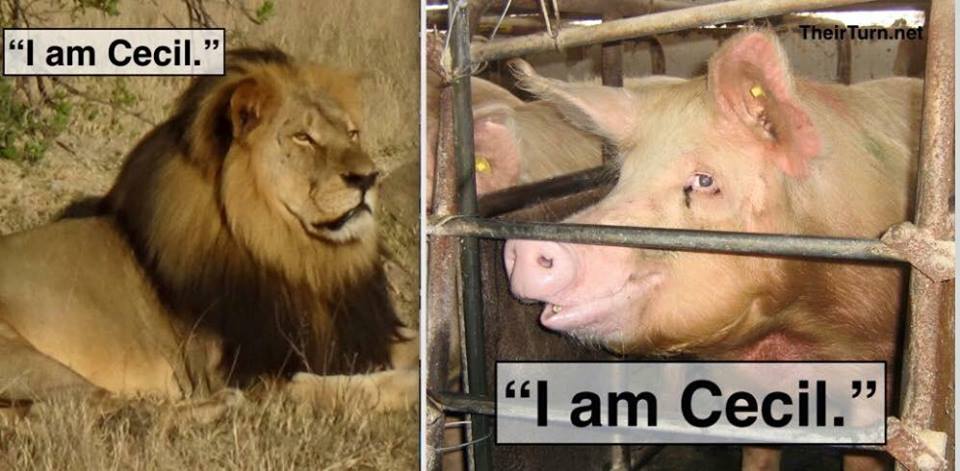
As most folks now know, after suffering for 40 hours, wounded by an arrow, an African lion given the name “Cecil” was shot again—this time fatally—with a rifle.

His tormentor was a dentist named Walter Palmer, from Minnesota, who had paid tens of thousands of dollars, travelling to distant Zimbabwe to kill animals: something he admits he loves to do. Cecil had been lured from a national park, which is illegal to do in Zimbabwe.

And, the world took note. Cecil was wearing a radio tracking collar. His body was skinned, the head removed.

Palmer’s guide was charged with poaching and so was the owner of the ranch where this outrage occurred.

Now, Zimbabwe wants to extradite Palmer from the U.S. to face similar charges. Palmer has been the subject of outrage, all the more so for having poached before, when he lied about where he had shot a black bear in the U.S. His life has been threatened, his property vandalized, his business closed for now, and he has fled into hiding, hounded by relentless vitriol and images of him posted on social media posing with various beautiful animals he has killed. He looks so pleased; the animals look so dead.

If there is a positive outcome to this situation, it may be to the degree that trophy hunting has received attention it would rather avoid.

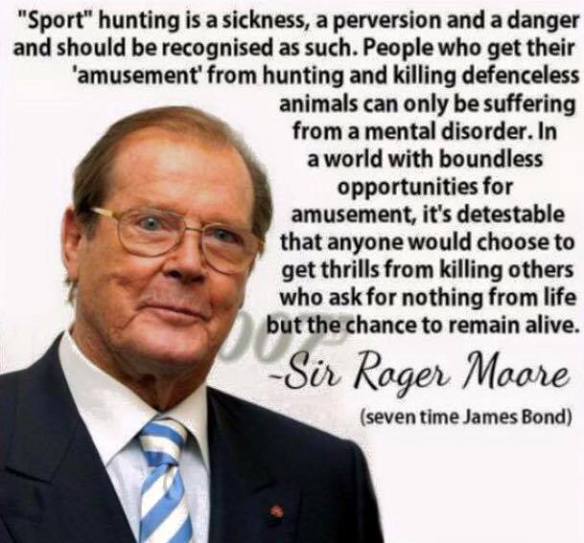
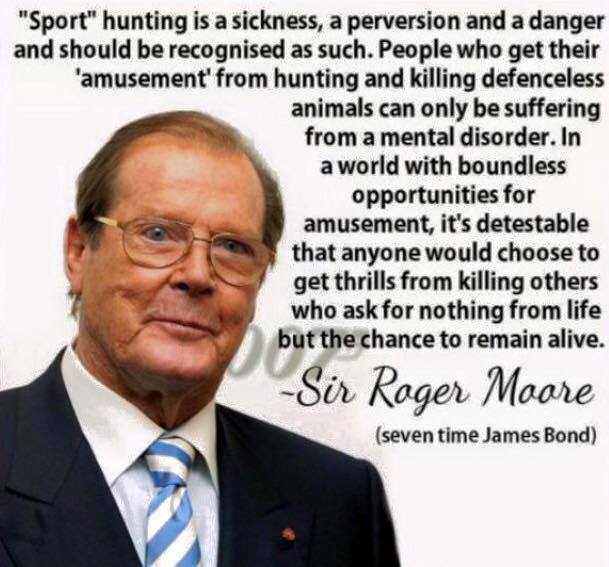
I am personally inclined to agree with British actor Sir Roger Moore, who said, “‘Sport’ hunting is a sickness, a perversion, and a danger and should be recognized as such… We know that we should protect the most vulnerable and helpless in society, not destroy them—much less derive pleasure from doing so.

Thankfully, those of us with a conscience are appalled by the idea of gunning down animals for the sake of a thrill or a photo. Interest in hunting in Great Britain and elsewhere is steadily declining, since decent people prefer to hike, take photographs, kayak, and generally enjoy the outdoors without killing other beings.”

Palmer had already scored the “super grand slam” of North American trophy hunting by killing all of the “top 29” North American species and subspecies.

And then, there is Sabrina Corgatelli, an American accountant who defended her own love of killing animals on a national TV show, saying, “There is a connection to the animal, and just because we hunt them doesn’t mean we don’t have a respect for them. Giraffes are very dangerous animals. They could hurt you seriously, very quickly.” This last comment was likely in reference to disgusting images of her posing triumphantly with a giraffe she had just killed. In her Facebook account of this event, she wrote, “I got an amazing old giraffe. Such an amazing animal!!!! I couldn’t be happier.”

There are hunters I’ve met who have no respect for the category of hunting known as “trophy” hunting, or even of baiting animals to lure them into range. Cecil was lured from the park refuge by the smell of a dead animal tied to a vehicle, at night, and shot when caught in the glare of a spotlight. We would never know but for the radio collar, put there by scientists from Oxford University studying lions in the nearby park. We have learned of other such lions being shot for the same reason. Indeed, lions are in serious decline, heading toward extinction.

Killing animals for trophies continues day after day around the world. It seems even reminiscent of those serial killers who take some trophy of their victims—some hair or a piece of clothing, perhaps—as if wanting to have a souvenir to aid memory of the event. Except, trophy hunting for animals is, too often, quite legal.

And, while they may not be able to admit it to themselves, I think that, at some rudimentary level, trophy hunters realize that their love of killing is an aberration to other people. Thus, they may try to excuse it with rationales that, thanks to Cecil’s sad plight, are now being held up to scrutiny. No giraffe threatens you, me, or Corgatelli. Even Cecil never bothered or threatened humans.

The more sophisticated defense is that trophy hunting brings essential revenue to places like Africa, to be used for conservation. But, it does no such thing. We have found that <http://www.bornfree.org.uk/animals/lions/projects/trophy-import-ban/> revenue from trophy hunting is a fraction of what tourism brings to Africa, and people travel to such places mostly to see (not kill) live (not dead) animals.

It is almost as if the trophy hunter somehow thinks that, with access to the art of taxidermy, the grace, beauty, power, and elegance of beautiful creatures can be possessed and owned as a reflection of their own competency. They don’t “get” how pathetic they are in the eyes of other people.

Some argue that trophy hunting removes geriatric animals who are past being able to contribute to the survival of the species. However, that was not true of Cecil, nor Corgatelli’s “old giraffe,” nor most other animals: often prime individuals. (That’s the whole idea.). And, at any rate, the slaughter still begs the question of “Why?” Why do you want to kill anything?

To shoot a warthog? A walrus? A giraffe? How can a person kill something so wonderfully alive and so evocative of the high plains and big skies as a pronghorn—for fun? No. I just don’t want to do that. Most people don’t. Those who do are the aberrant ones: the misfits, the insecure, the outright strange.

They are a minority… but not enough of a minority. They are killers in a world that’s in desperate need of protectors.

And, at Born Free, and in our offices everywhere—including mine up in Canada—that’s why we’re here.

“I am Cecil”

11825732_10153390282711508_1843680943326951608_n

Every day we can make a choice to save animals who want to live just as much as Cecil did. https://www.facebook.com/veganoutreach

“…most the friends ive seen talking about cecil are meat eaters and it feels crazy that one animal being killed is outrageous because its “majestic”, “pretty” and “exotic” and yet another animals being killed in the thousands daily is totally fine” Emma Smithies

Judge clears barred owl removal study

http://www.dailyastorian.com/news/20150727/judge-clears-barred-owl-removal-study?utm_source=Daily+Astorian+Updates&utm_campaign=93d3c034b9-TEMPLATE_Daily_Astorian_Newsletter_Update&utm_medium=email&utm_term=0_e787c9ed3c-93d3c034b9-109860249

By Mateusz Perkowski

Capital Press

Published:July 27, 2015 7:26AM

Barton Glasser/The Herald

<!–

–>

A barred owl removal study doesn’t violate environmental laws, a federal judge ruled.

Killing barred owls to study the potential effects on threatened spotted owls does not violate federal environmental laws, according to a federal judge.

Populations of the northern spotted owl, which is protected under the Endangered Species Act, have continued to decline in recent decades despite strict limits on logging.

Federal scientists believe the problem is partly due to the barred owl, a rival species that’s more adaptable, occupies similar habitats and competes for food.

In 2013, the U.S. Fish and Wildlife Service authorized an experiment to remove 3,600 barred owls over four years, typically by shooting them, to see if spotted owl recovery improves.

Friends of Animals and Predator Defense, two animal rights groups, filed a complaint last year accusing the agency of violating the National Environmental Policy Act by failing to evaluate alternatives to lethal removal of barred owls.

They also claimed the Fish and Wildlife Service’s study is contrary to the Migratory Bird Treaty Act, under which the U.S. and other countries agreed to protect migratory birds.

U.S. District Judge Ann Aiken has rejected these arguments, finding that the agency wasn’t obligated to undertake other “recovery actions” for the spotted owl that didn’t call for removal of barred owls.

The agency took a sufficiently “hard look” at the study’s effects, including the possibility that it may disrupt an “equilibrium” between the two owl species in some areas, Aiken said.

The experiment also falls within an exception to the Migratory Bird Treaty Act which permits birds to be killed for “scientific research or educational purposes,” she said.

From the Fish and Wildlife Service’s perspective, the judge’s opinion validates the significant amount of time and effort the agency spent studying the issue, said Robin Bown, biologist for the agency.

“I think we made our case,” she said. “We feel we did very inclusive work on this.”

Undecided about appeal

The plaintiffs are still undecided whether to challenge Aiken’s ruling before the 9th U.S. Circuit Court of Appeals, said Michael Harris, director of Friends of Animals’ wildlife law program.

Habitat loss remains the primary culprit for the decline of spotted owls, he said. “The amount of old growth habitat hasn’t increased.”

Spending millions of dollars by shooting barred owls in the Northwest year after year isn’t feasible but it is cruel to the birds, Harris said.

It’s possible that the two owl species will find niches and coexist over time, he said.

Fish and Wildlife officials are rushing to judgment to blame barred owls to escape making tough decisions about forest management, Harris said. “You’re just taking a shortcut by scapegoating the barred owl.”

The U.S. Fish and Wildlife Service disagrees with this perspective.

Invaded territory

Biologists initially hoped the two species would be able to occupy different habitats, but the barred owl has consistently invaded the spotted owl’s territory since the 1970s, said Bown.

As soon as the barred owl took over riparian areas, it “began marching up the hillsides” to upland territory favored by the spotted owl, she said.

“There is no evidence of any environment where spotted owls can outcompete barred owls,” Bown said.

While the removal study costs $1 million a year, that includes costs related to the scientific analysis, she said.

“When you’re doing a study, it costs more than operational activities,” she said.

If removal proves effective at protecting spotted owls, other less-costly methods of controlling the barred owl’s population growth may become available in the future, Bown said.

So far, 71 barred owls were removed during the first year of the study and 54 were removed during the second year, both at a site in Northern California.

The Fish and Wildlife Service expects the removals to begin in at least two new sites in Oregon and Washington during the autumn of 2015.

Data collected during the first two removal periods is insufficient to indicate whether the removals are helping spotted owls, Bown said. “It’s hard to look for a trend with only two points.”

‘There is no evidence of any environment where spotted owls can outcompete barred owls.’

— Robin Bown

biologist, U.S. Fish and Wildlife Service

Don’t Allow Whales to be Slaughtered off the Washington Coast!

Don't Allow Whales to be Slaughtered off the Washington Coast!

The National Marine Fisheries Service (NMFS) is considering an appalling plan to allow gray whales to be slaughtered off the Washington coast. Allowing a hunt would set a dangerous precedent that undermines the global moratorium on whaling.

Please submit your public comment opposing the hunting of gray whales off the coast of Washington.The risks of a hunt are significant. Proponents suggest that “only a few” whales will be killed for subsistence and cultural reasons. But even one whale is too many, regardless of who hunts them. Scientific evidence makes it clear these magnificent, sentient creatures are under grave threats from far too many sources.

The threats to gray whales are vast — from navy sonar and other underwater noise, to climate change, ocean acidification, ship strikes and pollution. The impact of this hunt on delicate gray whale populations has the potential to be huge. Not to mention, there are only a few individuals left in some populations, and there is a virtual certainty that whales from these populations will be killed because it’s nearly impossible to tell the difference between them during a hunt.

Please sign the petition today to submit your public comment to NFMS opposing the hunting of gray whales off the coast of Washington.

PETITION CLOSED

This petition is now closed. You can still make a difference in the Care2 community by signing other petitions today.

BROWSE PETITIONS ▸

Don’t Allow Whales to be Slaughtered off the

25,053

30,000

we’ve got 25,053 signatures, help us get to 30,000 by July 31, 2015

The National Marine Fisheries Service (NMFS) is inappropriately considering allowing gray whales to be slaughtered off the coast of Washington. Pierced with harpoons and riddled with numerous bullets, these magnificent creatures will suffer extreme pain if NMFS permits the hunt.

The hunt threatens not only a recovering population of Eastern North Pacific gray whales, but the few remaining individuals left in the endangered Western North Pacific and also the Pacific Coast Feeding Group populations. There is a very strong chance that whales within these smaller groups will be killed because it is virtually impossible to tell the difference between the populations, particularly given that hunts are often chaotic and conducted in tumultuous ocean conditions.

There is far too much scientific uncertainty about the impact a hunt would have on gray whales and the environment. Additionally, NMFS is not adequately considering the cumulative impacts of all the other threats to gray whales – such as navy sonar and other underwater noise, climate change, ocean acidification, oil and gas development, ship strikes and pollution.

The proposed hunt in Washington is just the first step toward a dangerous precedent that would undermine the global moratorium on whaling. Whale watching is a meaningful and economically lucrative alternative that helps maintain the gray whale’s iconic role in numerous cultures.

Gray whales have been known to migrate up to 22,000 kilometers, nearly 14,000 miles, crossing the jurisdictions of multiple countries. So this is an issue of international concern.

Please sign this petition to submit your official public comment opposing the hunt of gray whales and requesting that NMFS deny any permits to hunt gray whales in Pacific Coast waters.  less

The National Marine Fisheries Service (NMFS) is inappropriately considering allowing gray whales to be slaughtered off the coast of Washington. Pierced with harpoons and riddled with numerous bullets, these magnificent creatures will suffer extreme pain if NMFS permits the hunt.

The hunt threatens not only a recovering population of Eastern North Pacific gray whales, but the few remaining individuals left in the endangered Western North Pacific and also the Pacific Coast Feeding Group populations. There is a very strong chance that whales within these smaller groups will be killed because it is virtually impossible to tell the difference between the populations, particularly given that hunts are often chaotic and conducted in tumultuous ocean conditions.

There is far too much scientific uncertainty about the impact a hunt would have on gray whales and the environment. Additionally, NMFS is not adequately considering the cumulative impacts of all the other threats to gray whales – such as navy sonar and other underwater noise, climate change, ocean acidification, oil and gas development, ship strikes and pollution.

The proposed hunt in Washington is just the first step toward a dangerous precedent that would undermine the global moratorium on whaling. Whale watching is a meaningful and economically lucrative alternative that helps maintain the gray whale’s iconic role in numerous cultures.

Gray whales have been known to migrate up to 22,000 kilometers, nearly 14,000 mil… more

Rod Stewart sparks outrage after wearing ‘vile’ sealskin coat ahead of concert in Canada

http://www.express.co.uk/news/showbiz/591092/Rod-Stewart-sparks-outrage-wearing-sealskin-coat-concert-Canada

ROCKER Rod Stewart has been blasted by a protest group after he posed for photos wearing a sealskin coat ahead of a concert in St John’s, Canada.

PUBLISHED: 08:00, Wed, Jul 15, 2015 | UPDATED: 15:34, Wed, Jul 15, 2015

Rod Stewart FACEBOOK

Rod Stewart sparked outrage after he posed wearing a sealskin coat

The 70-year-old crooner has been branded “vile” after he was snapped wearing the jacket at a furrier called Always in Vogue.

Rod angered animal activists worldwide with his apparent support of the Canadian sealing industry.

Most seal products are banned in Europe and the US over cruelty concerns when baby seals are clubbed to death.

The fur shop shared a picture of employee Darren Halloran posing with Rod, clad in the coat, on their Facebook and Twitter accounts after he reportedly had the controversial garment custom-fitted for him.

Puppy dies in hot backyard

July 9, 2015, 2:42 p.m.

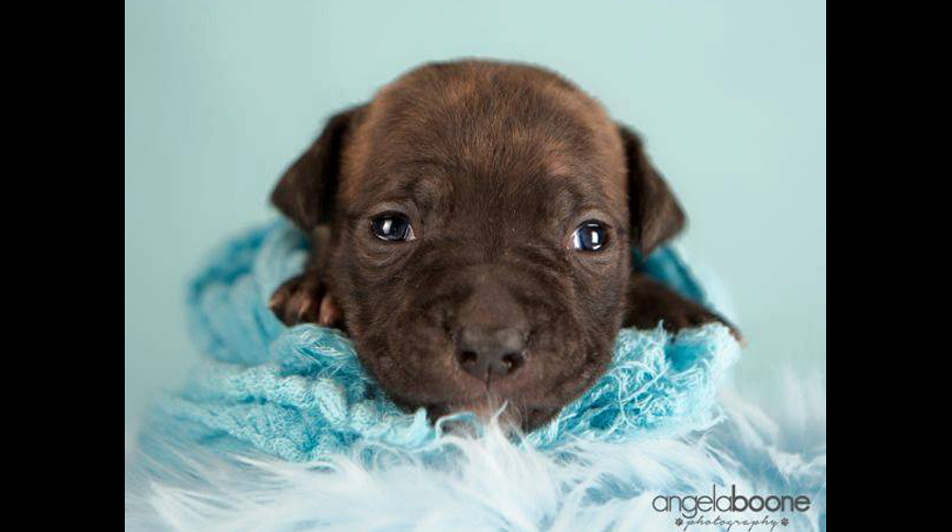
WENATCHEE — A puppy died earlier this month after it was left tied up outside in 100-degree-plus temperatures, authorities say.

“This poor pup. There was no shade, no water. It was just awful,” said Sgt. Jody White with Wenatchee Valley Animal Control.

More: Featured Image -- 9087http://www.wenatcheeworld.com/news/2015/jul/09/puppy-dies-in-hot-backyard/