Texas game warden wounded while illegally hunting avoided felony charges, kept job

http://www.dallasnews.com/news/state/headlines/20150705-texas-game-warden-wounded-while-illegally-hunting-avoided-felony-charges-kept-job.ece

AUSTIN — A Texas Parks and Wildlife game warden who was illegally hunting when he was shot in 2013 was allowed to keep his job and face a fine rather than felony charges, according to a newspaper report Sunday.

Off-duty Game Warden Chris Fried was bow hunting without a permit when he was shot in December 2013. But he had also hunted without permits at least three times during the 2013-2014 license year, an investigation by the Austin American-Statesman found.

Instead of facing felony charges or dismissal upon his shooting, though, Fried got a ticket for about $800.

That’s because a Parks and Wildlife Department-led investigation found Fried transitioned “into a game warden law enforcement mode” just before he was shot. That let him file for workers’ compensation for the injury.

The state agency that issues workers’ compensation won’t say whether Fried received money. However, state rules say an insurance carrier isn’t liable for an injury suffered during off-duty recreational activity.

Two men from Illinois were charged in connection with Fried’s shooting, but their lawyers say it was an accident.

Parks and Wildlife Department spokesman Josh Havens said the agency “stands by the accuracy of its internal investigation.” He said Fried didn’t receive preferential treatment.

Fried disclosed his violation of hunting rules while still hospitalized and recovering from the shooting. Last fall, he got a reprimand from his Parks and Wildlife Department superiors.

In a response from last July to state inquiries about why he violated hunting rules, Fried wrote, “I have no excuses for my actions.” Among his hunting violations: killing a white-tailed buck on public land without a permit, which is punishable as a state jail felony.

Instead, authorities filed misdemeanor charges against Fried that resulted in a fine of $769.88. Havens said that’s consistent with how Texas typically prosecutes illegal hunting.

Over the past five years, there have been 10 charges filed for hunting on public lands without the proper permit that also involved the illegal taking of a deer. And all were misdemeanors that required restitution to be paid for the illegal harvest of dear.

State officials also eventually directed that Fried be suspended without pay for 30 days and be made ineligible for promotion or pay increases for two years. He also was banned from hunting on any Texas wildlife management area as long as he remains a Texas Parks and Wildlife employee. But the workers’ compensation wasn’t addressed.

This past January, Fried also was ordered to attend the ethics class at the game warden training academy as part of continuing discipline for his hunting violations.

Police reports say the shooting occurred when the men arrested were in the barn at a private ranch and one of them fired a rifle at a sign attached to the boundary fence separating the private property from the state wildlife management area. Just then, Fried was making his way through the woods.

The shooter, initially charged with a felony, eventually received two years of deferred adjudication, but only for damage to the fence. Other charges were dismissed, attorneys said.

The shooter’s friend still faces a misdemeanor charge of not reporting the accident.

‘Pawesome’ tips to help keep pets safe on July Fourth

http://www.komonews.com/news/local/Pawesome-tips-to-help-keep-pets-safe-on-July-Fourth-311584121.html

'Pawesome' tips to help keep pets safe on July Fourth»Play Video
Charlie and Waffles of Snohomish. Photo courtesy YouNews contributor Victoria S.
SEATTLE, Wash. – Fourth of July fireworks routinely make July 5th one of the busiest days of the year for animal shelters across the country.

That’s why Seattle-based Pet Hub is declaring all of July “National Lost Pet Prevention Month.”

Dogs and cats frightened by fireworks often escape yards in the course of the evening. Some even manage to slip out through doors or open windows.

“Make sure your pet has an external I.D. tag,” says Pet Hub’s Lorien Clemens. “It’s the number one way lost pets get home quickly.”

Pet Hub’s mission is to help reunite lost pets with rightful owners. Pet Hub’s digital I.D. tag can store an owner’s name, address, and phone number. It can even include information on the pet’s medications and personality. The tag can be read by a smartphone, putting important information right at the finger tips of those who find a missing pet.

But even a traditional tag with a simple name and current phone number is better than nothing, Clemens says, adding that microchips are also good, as long as contact information is kept current.

Owners can also help pets adjust by planning ahead for the day. Create a safe space in your home, perhaps in an interior room or on a lower floor, that allows your pet to feel sheltered from the loud noises. For crate-trained pets, their kennel may be their safe spot. For others, it may be a closet or on the couch next to their owner.

For families planning to go out for the night, consider asking a friend or relative to pet-sit.

Exercise early in the day can also help by burning off some energy and helping your pet relax.

“Take them to the lake or the park,” Clemens says. “Throw things around. Get them exhausted and they won’t even care it’s the fourth.”

Alaska’s Seal Hunt Lasted Only a Few Days Because It’s So Hot

By Julia O’Malley

July 01, 2015

KOTZEBUE, Alaska-In this Far North village, no animal provides more protein
to fill freezers than the bearded seal. A single seal can supply hundreds of
pounds of meat, enough to feed a large, extended family for a winter.

For generations, every late June and early July, native hunters like Ross
Schaeffer and his niece Karmen Schaeffer Monigold have motored through the
broken sea ice of Kotzebue Sound in northwestern Alaska, looking for seals
basking on frosty rafts. But this year, temperatures were close to 70
degrees, there was no ice in sight, and the seals had already migrated
north.

This seal-hunting season was the shortest in memory, lasting less than a
week, compared with the usual three weeks.

Schaeffer and Monigold did manage to get a few animals, but the conditions
were nothing like Schaeffer, 68, had seen before. By the third week in June,
when Monigold would usually be dressed for cold, she drove out to check on
her drying seal hide wearing flip-flops and shorts.

“Every year we’ve gone out, it’s getting harder and harder because the ice
is so rotten by the time it’s time to go hunting that the seals are hard to
find,” Monigold says.

Pictures of ice melting in Kotzebue, Alaska from a helicopter
< http://news.nationalgeographic.com/content/dam/news/2015/07/02/sealhunting/
02sealhunting.ngsversion.855e78e69274979c8008eed13c1e1a3d.adapt.1900.1.jpg>

The amount of ice near Kotzebue, Alaska, changed dramatically between May,
2015, (on the left) and June (on the right.) This May was the warmest on
record in Kotzebue.

Photographs by Katie Orlinsky, National Geographic

In Kotzebue, as temperatures and ice become increasingly unpredictable,
hunters worry their children and grandchildren will no longer be able to
participate in the traditional seal hunt. Kotzebue is among the largest of
roughly 40 Alaska Native communities on the coast between Bristol Bay and
Kaktovik that rely on bearded seal.

< http://news.nationalgeographic.com/content/dam/news/rights-exempt/nat-geo-s
taff-maps/2015/07/Alaska_Kotzebue_Sound/MAP_News_KotzebueSound_Alaska.ngsver
sion.4ceafa8a7ae3c316be4efd0cb84acb55.adapt.352.1.jpg>

NG MAPS

Kotzebue’s changing seal season is part of another chapter of Alaska’s
accelerated climate change story, which is threatening the food, economics,
and culture of Native communities.

The longtime patterns of many animals are changing. For example, the timing
of caribou migration
< http://www.adfg.alaska.gov/static/home/library/pdfs/wildlife/caribou_trails
/caribou_trails_2014.pdf> has been later, which scientists say may be linked
to warmer temperatures. And in the Bering Sea, wild weather and unusual sea
ice patterns have hampered
< http://www.fws.gov/alaska/fisheries/mmm/walrus/pdf/influence_of_wind_ice_sp
ring_walrus_hunting_success_2013.pdf> walrus hunting, causing serious food
shortages in some villages.
< http://www.wsj.com/articles/SB10001424052702304795804579101440469640728>

An Alaska Hotspot

The winter of 2014 was the warmest ever measured
< https://www.climate.gov/news-features/event-tracker/%E2%80%9Cwinter%E2%80%9
D-alaska> across Alaska, and this summer has so far followed a similar
pattern, according to the National Weather Service, with hot, dry conditions
fueling hundreds of wildfires. It was the warmest May ever recorded in
Kotzebue– 8 degrees warmer than usual.

“It started raining, and it rained every night for about four or five
nights. It rained hard. That rain is so warm it just seeps right through the
ice and the ice pops up and it’s all rotten already,” says Schaeffer, who
has been hunting for about 60 years. “It’s not like it used to be.”

Picture of Ross Schaeffer
< http://news.nationalgeographic.com/content/dam/news/2015/07/02/sealhunting/
07sealhunting.ngsversion.e15d54a4493b81342e33af8471e49ae3.adapt.676.1.jpg>

Ross Schaeffer, 68, who has been participating in subsistence hunts since he
was a child, says the ice conditions In Kotzebue Sound last month were
unlike any he has ever seen before. “It’s not like it used to be,” he says.

Photograph by Katie Orlinsky, National Geographic

Picture of children in Alaska swimming
< http://news.nationalgeographic.com/content/dam/news/2015/07/02/sealhunting/
03sealhunting.ngsversion.025dd26c5adc79d5e36f126813d1d845.adapt.1190.1.jpg>

Children swam in the sea on a warm day in June in Kotzebue, Alaska.
Temperatures hit as high as 80 degrees.

Photograph by Katie Orlinsky, National Geographic

Kotzebue in particular is a hot spot in the state. Six of the ten warmest
winters in the village on record have occurred since 2000. Climatologists
say the village is likely to have more unusual heat this summer and into the
fall.

Above-average sea surface temperatures contributed to Alaska’s abnormally
warm winter when increased southerly winds flowed over the ocean and spread
inland. Next winter could be cooler, but over the long term, experts say
that warmer and wetter weather could become more common.

“The decades-long trend seems pretty clear: less and less sea ice,” says
Rick Thoman, climate science and services manager for the National Weather
Service in Alaska.

Ice coverage in Kotzebue Sound has been shrinking steadily since the 1950s,
with acceleration in recent years.

Related Content

< http://video.nationalgeographic.com/video/seal-hunt-dickman>

< http://video.nationalgeographic.com/video/seal-hunt-dickman>

1. Watch A Seal Hunt
< http://video.nationalgeographic.com/video/seal-hunt-dickman>

“There is open water in the Chukchi Sea, almost up to Barrow now, which is
remarkably early,” Thoman says.

Seals Follow the Ice

Bearded seals, called ugruk in the Inupiaq language, migrate up and down
Alaska’s northwest coast, from the Bering Sea to the Chukchi and Beaufort
seas, following the ice as it advances in winter and retreats in summer,
says Peter Boveng, polar ecosystems program leader at NOAA’s Alaska
Fisheries Science Center.

Scientists estimate there are roughly 300,000 bearded seals in the Bering
Sea breeding population and an unknown number of others that breed in the
Chukchi and Beaufort seas in Alaska, he says. As the sea ice patterns
change, there could be changes in the places where the animals spend time,
he says.

During Kotzebue’s traditional hunting season in late June, bearded seals are
hauling out on ice. They depend on the ice to give them platforms for
basking, he says, which raises their skin temperature and stimulates hair
growth to fill out their coats. That’s what complicated the hunting; seals
will only stay in the waters near Kotzebue as long as the ice conditions are
right.

Picture of a child holding a rope attached to a dead walrus in Alaska
< http://news.nationalgeographic.com/content/dam/news/2015/07/02/sealhunting/
04sealhunting.ngsversion.c8f32155e837cce302fec0ae84b1c0f4.adapt.1190.1.jpg>

Inupiat families from Barrow, Alaska, hunted for walrus instead of bearded
seal when melted sea ice ended the seal hunt abnormally early in June.
Walrus this close to town during this time of year is rare. The hunters
bring their catch to stable sea ice to butcher it and then haul it back to
town by boat.

Photograph by Katie Orlinsky, National Geographic

“If the animals are really in the peak of their molt, they will probably
want to stay with the ice. And if the ice goes out earlier in Kotzebue
Sound, Kotzebue really could see be a big decline in the number of animals
visiting that area on their way north,” Boveng says.

There is no evidence so far that the changes in the ice patterns are harming
seals. However, if they can’t find ice of the quality they need, scientists
say they might not be able to grow adequate coats, which protect their skin
from abrasions and infections, Boveng says. (Read about weird changes in
other ocean life linked to global warming.
< http://news.nationalgeographic.com/2015/04/150411-Pacific-ocean-sea-lions-b
irds-climate-warming-drought/> )

In 2011, several species of ice-dependent Alaska seals, including bearded
seals, were part of an unusual die-off
< https://alaskafisheries.noaa.gov/protectedresources/seals/ice/diseased/> .
Animals turned up dead or sick with abnormal coats, among other symptoms, he
says. It is unclear whether there was a link between the event and climate
change, however.

There was once a time when Kotzebue relied on beluga whales for much of its
subsistence, says Alex Whiting, an environmental specialist for the Native
Village of Kotzebue. But then, in the 1980s, many belugas stopped coming
into the sound for reasons not entirely understood. Hunters are adaptable,
he says, and will find ways to get their seals, even if the animal patterns
change.

Picture of a person cutting seal meat in Alaska
< http://news.nationalgeographic.com/content/dam/news/2015/07/02/sealhunting/
05sealhunting.ngsversion.9e7034c718a90a99bb7d0f4130f5638a.adapt.1190.1.jpg>

A woman prepared bearded seal for an annual feast in Point Hope, Alaska.

Nutritious and Spiritual6-4Hansens-trophy-goat

Pound for pound, caribou is the most important wild food source in Kotzebue,
followed closely by bearded seal, a nutritious, lean protein rich in omega
3s.

“Large adult bearded seals in particular provide singular types of meat and
oil products that are not replaceable,” Whiting says. “If the window to
harvest them is missed, it will be another year before the opportunity
arises again.”

Monigold says her main concern with the changing seal season is spiritual.
Taking children in the village to hunt instills in them a sense of purpose
and connects them to culture. When they take a bearded seal, for example,
she teaches her sons to put fresh water in the mouth to release the spirit
into the ocean, a gesture meant to bring more seals back the next year.
Sharing the meat teaches them respect and gives confidence.

Picture of people walking after returning from a seal hunt in Alaska
< http://news.nationalgeographic.com/content/dam/news/2015/07/02/sealhunting/
06sealhunting.ngsversion.0161ee38e417d29ab4cdfe3804d10223.adapt.1190.1.jpg>

Because of melting sea ice, Inupiat men and boys from Barrow, Alaska,
returned to town after hunting bearded seal. The season was disappointing:
It ended early in June as the seals migrated north in search of ice.

Photograph by Katie Orlinsky, National Geographic

Schaeffer worries that if the warming trend continues, his grandchildren
will eventually lose the opportunity to hunt bearded seals in the sound. His
grandparents traveled by dogsled and relied entirely on food they caught and
gathered but so many of their traditions have been lost in a relatively
short time. Technology was the first agent of change; now it’s climate.

Seal is a soul food for indigenous Alaskans. When Monigold goes without it
and other native foods while traveling, she feels listless and looks forward
to a meal at home.

“As soon as I take a bite, it’s like all of a sudden I’m me again,” she
says.

This reporting was supported by a grant from the
< http://pulitzercenter.org/> Pulitzer Center on Crisis Reporting.

__________________________–

Understanding Labels & Loopholes

http://humanefacts.org/labels-loopholes/

humanely-raised-vealWhat is the difference between Certified Humane and American Humane Certified? What’s the difference between free-range and cage-free?

Unfortunately, consumers who care about animals are being misled by deceptive marketing schemes.

Producers have learned that if a label contains buzzwords such as “happy,” “free,” “humane,” or “animal welfare,” concerned customers will often buy their products (with higher prices) without actually understanding their practices.

The result is a confusing proliferation of packaging labels pertaining to farmed animal welfare. But what do these labels really mean?


To start, it’s important to know that there is no legal definition of “humane.”1

Under USDA-approved welfare labels, farms and producers decide independently what practices they will call “humane.” The USDA merely verifies that the company follows its own arbitrary standards.

Some private humane certification labels require third-party auditors to verify compliance with their standards, but even among these programs the term “humane” is not consistently defined or enforced.

Piglet restrained for scalpel castration

For example, Animal Welfare Approved does not allow debeaking, but considers castration and ear notching without pain relief “humane.”

On the other hand, American Humane Certified permits debeaking, but does not allow ear notching and requires anesthesia for castration of some animals.

Furthermore, not only do terms like “humane” and “free-range” mean different things to different producers; they also mean different things depending on the kind of animal.

For instance, while free-range beef cows must have spent some time on pasture, free-range chickens commonly spend their entire lives crammed inside windowless sheds with thousands of other birds.


Free-Range

Pigs can be confined in manure-laden barns like this one and still be sold as free-range pork. Image: freerangefraud.com

The term “free-range” is not regulated by the USDA, except for use on chickens and turkeys raised for meat (which only requires “access” to outdoors).

Its use for cows and pigs is neither regulated nor enforced.

Often, free-range labels refer to animals packed into warehouse-style sheds with no access to the outdoors.

This is far from the rolling pasture that the term “free-range” conjures in most people’s minds.

All that is required for free-range labeling of poultry is that the birds have “access” to the outdoors for an unspecified amount of time.

Thousands of birds may be confined inside a warehouse facility with a single exit the size of a cat door, and the door may be opened for a few minutes. This still qualifies as free-range.2

The layers of excrement and urine in which these birds are forced to stand, day after day, cause severe flesh and eye burns, and fill the air with so much ammonia that many birds suffer from respiratory disorders.

Conditions on many free-range operations are so bad that most birds are not even aware of outdoor access, or they are too crowded, ill, or weak to move that far.

Debeaking is standard procedure on free-range poultry farms. Free-range claims on eggs are completely unregulated.


Cage-Free

Under misleading welfare labels, confinement operations like this one sell their eggs as “cage-free.” Photo: Sally Ryan, New York Times

Cage-free labels refer to hens used for eggs and mean only that the chickens are not in cages.

Cage-free egg-laying hens are typically crowded into windowless sheds or warehouse facilities, with thousands of birds on the floor and on stacked wire platforms, with little or no access to the outdoors and no room to perform natural behaviors.

The ammonia laden air is so noxious that hens commonly suffer respiratory disorders, severe flesh and eye burns, and even blindness.

Debeaking is routine and permitted. There is no third-party auditing.

perdue-cage-free

Cage-free labels should only appear on egg packages, as egg-laying hens are the only farmed animals kept in cages. (Veal calves and breeding sows are confined in crates.)

When cage-free labels appear on chicken or turkey meats (as shown in this photo of Harvest Land chicken meat), consumers are being deliberately misled.

Even on factory farms, chickens and turkeys raised for meat are not kept in cages, but are severely confined indoors inside massive sheds.


Grass-Fed

Typical feedlot.

Cows raised for beef eat grass for at least the first six months of life, then most are shipped to crowded, barren feedlots and fattened (“finished”) on grain to reach slaughter weight more quickly.

Some producers market feedlot-finished beef as higher priced grass-fed beef even though their cows are intensively confined for the last year or more of life.

USDA certified grass-fed animals must have access to pasture from early Spring to late Fall, but may otherwise be confined to pens or sheds.

All of the standard mutilations including castration, dehorning, and branding are permitted without pain relief under generic and USDA grass-fed labels. Hormones and antibiotics are also allowed.


Humanely Raised

The term “humanely raised” is not regulated or verified, meaning animals can be raised in confinement and mutilated without painkiller.3

Unfortunately, virtually any producer can slap a “humanely raised” label on their animal product, which renders the term nearly meaningless. Even on higher welfare farms, the term is often used deceptively.

Niman Ranch is a useful example, considered by many to be a model of humane pig farming. Their website shows images of happily roaming pigs, and their pork labels read, “Humanely raised on sustainable farms.” The labels also say, “Raised outdoors or in deeply bedded pens.”

That “or” is a loophole that means that Niman Ranch could get away with confining up to 100% of their pigs indoors. According to one writer, they currently confine around 75% of their pigs in warehouse-style barns with straw floors.

The welfare of pigs not given access to the outdoors is markedly lower than that of grazing pigs, yet Niman Ranch enjoys the celebrated reputation of a “pastured pork” operation.


Humane Dairy & Happy Cows

Real cheese from Happy Cows label
Happy Cow Creamery label
Laughing Cow label

Despite all the feel-good labels to the contrary, happy dairy cows are a myth. The basis of all dairy production is sexual violation and the destruction of motherhood.

These are not overstatements. It is a matter of fact that in order to produce milk, female cows must be impregnated (usually via invasive artificial insemination), carry their babies for nine months (like humans), and give birth.

Also inherent to dairy production is the separation of calves from their mothers in order for humans to take their milk.

This breaking of the mother-calf bond happens on small farms, humane label farms, and factory farms alike. According to the USDA, 97% of dairy calves are permanently removed from their mothers within just the first 12 hours of birth.4

Many humane label farms remove the calves in the first hour, claiming that the longer mother and calf are permitted to bond, the more stressful the separation.

Most calves spend their first 2 to 3 months of life in constant confinement in cramped, individual hutches, and never know the nurturing or warmth of their mother’s care.

Regardless of farm type, male calves of dairy cows are sold to be killed for veal or cheap beef.

When they are no longer optimally productive, dairy cows are slaughtered for cheap beef, usually around five years of age.

See also:

  • Learn more about “humane” dairy at our Happy Cows? page.
  • Our Practices page for detailed explanations of standard procedures.


Specific Packaging Labels


Certified Organic

USDA Organic label

For animal products, the organic label mainly distinguishes animals raised without hormones and antibiotics, which are prohibited under organic standards. Animal feed must also be organic.

Animals must have “access” to the outdoors, with cows, sheep and goats given some access to pasture, but the amount, duration, and quality of outdoor access is undefined.

Organic standards do not provide protection against routine mutilations, severe confinement, rough handling, long transport, or brutal slaughter of animals. Tail-docking, dehorning, debeaking, and castration without painkiller are all permitted.


American Grass-Fed Certified

American Grassfed label

While the USDA’s grass-fed label allows for confinement of animals, American Grassfed Certification requires continuous access to pasture and a diet of 100 percent forage. Hormones and antibiotics are also prohibited.

However, routine mutilations such as castration, tail docking, branding and dehorning are all permitted without pain relief.

No standards are in place regarding the treatment of breeding animals, animals during transport, or animals at slaughter.


American Humane Certified

American Humane Certified label

One of the worst certified labels. Access to the outdoors is not required for any animals, and indoor space requirements are the lowest of all the main humane certification programs.

AHC is the only third-party audited welfare program to permit cage confinement of egg hens. The killing of male chicks, debeaking, and tail docking without pain relief are permitted.

Some standards extend to the treatment of breeding animals, animals during transport, and animals at slaughter.


Animal Welfare Approved

Animal Welfare Approved label

The Animal Welfare Approved certification is a program of the Animal Welfare Institute. They claim to have “the most rigorous standards for farm animal welfare currently in use by any United States organization.”

As proof of this claim, their website includes a useful chart comparing the various practices and provisions of each certified humane label. While there is bias in favor of AWA in the chart and guide, we include them here for reference.

The AWI boasts that the AWA is the only USDA-approved third-party certification program, but as with other humane labels, egregious cruelties are still permitted.

On the upside, animals have “access” to the outdoors and are able to engage in “some” natural behaviors. No cages or crates may be used, and growth hormones and antibiotics are prohibited. Debeaking is also not allowed.

However, the killing of male chicks born to egg-laying hens is permitted, as are other painful mutilations performed without painkiller, including ear notching and castration.

Standards include breeding, transport, and slaughter of animals.


Certified Humane

Certified Humane label

There is no requirement for outdoor access for birds used for meat, egg-laying hens, or pigs. However, minimum space allowances and indoor environmental enrichments are stipulated.

Feedlots are permitted for beef cattle. Killing of male chicks born to egg-laying hens is allowed.

Debeaking of hens and turkeys, tail docking of pigs, dehorning of goats without painkiller, and rubber ring castration without painkiller are all permitted.

Standards include the treatment of breeding animals, animals during transport, and animals at slaughter.


Global Animal Partnership

Global Animal Partnership label

GAP is a step-based rating program used by Whole Foods.

Producers receive one of six ratings, from Step 1 to Step 5+. Step 1 permits industrial style (factory farm) confinement of animals and merely prohibits crates and cages. Feedlots are allowed for beef cattle through Step 4. Debeaking and tail docking are permitted through Step 3.

Standards consider the treatment during transport, but not breeding or slaughter.


Process Verified

Process Verified label

Warning: this industry label is intentionally misleading.

The USDA currently allows producers enrolled in its Process Verified Program (PVP) to label their products “humanely raised.”

In reality, producers decide independently what practices they will call “humane,” and the USDA merely verifies that the company follows its own arbitrary standards.

Under such a scheme, industrial producers running large scale confinement operations can simply submit their current practices as “humane,” and display the “Process Verified” and “humanely raised” labels.

Read more about this marketing scheme here and here.


United Egg Producer Certified

United Egg Producers Certified label

Warning: this industry label is intentionally misleading.

UEPC permits battery cage confinement of egg-laying hens and other routine inhumane factory farm practices.

Hens in these barren cages have 67 square inches of cage space per bird (less than a sheet of paper), and cannot perform any of their natural behaviors, including perching, nesting, foraging, or even spreading their wings. Debeaking is permitted and routine.


See also:

More fireworks stands close due to fire danger

co2_trend_gl

http://www.wenatcheeworld.com/news/2015/jul/01/more-fireworks-stands-close-due-to-fire-danger/

July 1, 2015,

WENATCHEE — More fireworks stands are closing as a result of widespread fireworks bans, tinder-dry fire conditions, and some outward community concern for fire safety.

Throngs of Independence Day revelers would normally be lining up this time of year to buy their annual dose of sparklers, rockets, Roman candles and firecrackers.

But tents and trailers offering fireworks for sale are either closed or shy of business this year. Those that are open have had far fewer sales than their proprietors have had harassments. The only flag waving seen, they say, is with middle fingers.

As a result, several more stands agreed to close Wednesday afternoon.

With everything going on, and in the name of fire safety, TNT is voluntarily deciding to let local organizations shut down. It’s the right thing to do,” said Greg Burger, an area manager assistant for TNT Fireworks. The company provides fireworks, often a tent and insurance to organizations and individuals who want a share of the profits, often for local fundraisers.

The change is a response to the devastating loss of homes during the Sleepy Hollow Fire, widespread firework bans and tinder dry fire conditions throughout the region.

Several fireworks stands previously decided not to open. The Church of the Nazarene, the Wenatchee Valley Appleaires and the Douglas County Republicans earlier decided not to open stands in East Wenatchee. The new TNT decision will close four stands in Wenatchee and two others in East Wenatchee.

Most of the stands that remained open were run by organizations bound by contract. Sales at the stands had been far from sparkling.

Wenatchee Eagles had one such stand near the organization’s auxiliary hall at 1202 N. Wenatchee Ave. They planned to open another stand today at Coastal Farm & Home in East Wenatchee.

Eagles member Dena Saylor said the group signed a contract with TNT Fireworks last October. Saylor said the Eagles used profits from last year’s sales to pay organizational property taxes and to give to local charities. One was to help fire victims from last year’s Carlton Complex fires.

Member Christine Farley said the Wenatchee stand had only nine sales in the first two days they’ve been open.

But we’re getting harassed quite a bit. A couple of people seemed really over the edge. I didn’t know what they were going to do,” she said.

Farley and Saylor said they weren’t forcing anyone to buy fireworks. They told them they can’t shoot them off in Wenatchee and most parts of Chelan County and to be cautious if they did. Burger, the TNT assistant stopped by Tuesday at the same time as a Chelan County fire marshal, and that’s when an agreement was made to shut down, Farley said.

WENATCHEE — More fireworks stands are closing as a result of widespread fireworks bans, tinder-dry fire conditions, and some outward community concern for fire safety.

Throngs of Independence Day revelers would normally be lining up this time of year to buy their annual dose of sparklers, rockets, Roman candles and firecrackers.

But tents and trailers offering fireworks for sale are either closed or shy of business this year. Those that are open have had far fewer sales than their proprietors have had harassments. The only flag waving seen, they say, is with middle fingers.

As a result, several more stands agreed to close Wednesday afternoon.

With everything going on, and in the name of fire safety, TNT is voluntarily deciding to let local organizations shut down. It’s the right thing to do,” said Greg Burger, an area manager assistant for TNT Fireworks. The company provides fireworks, often a tent and insurance to organizations and individuals who want a share of the profits, often for local fundraisers.

The change is a response to the devastating loss of homes during the Sleepy Hollow Fire, widespread firework bans and tinder dry fire conditions throughout the region.

Several fireworks stands previously decided not to open. The Church of the Nazarene, the Wenatchee Valley Appleaires and the Douglas County Republicans earlier decided not to open stands in East Wenatchee. The new TNT decision will close four stands in Wenatchee and two others in East Wenatchee.

Most of the stands that remained open were run by organizations bound by contract. Sales at the stands had been far from sparkling.

Wenatchee Eagles had one such stand near the organization’s auxiliary hall at 1202 N. Wenatchee Ave. They planned to open another stand today at Coastal Farm & Home in East Wenatchee.

Eagles member Dena Saylor said the group signed a contract with TNT Fireworks last October. Saylor said the Eagles used profits from last year’s sales to pay organizational property taxes and to give to local charities. One was to help fire victims from last year’s Carlton Complex fires.

Member Christine Farley said the Wenatchee stand had only nine sales in the first two days they’ve been open.

But we’re getting harassed quite a bit. A couple of people seemed really over the edge. I didn’t know what they were going to do,” she said.

Farley and Saylor said they weren’t forcing anyone to buy fireworks. They told them they can’t shoot them off in Wenatchee and most parts of Chelan County and to be cautious if they did. Burger, the TNT assistant stopped by Tuesday at the same time as a Chelan County fire marshal, and that’s when an agreement was made to shut down, Farley said.

We are telling them about the fireworks show at the park and set them off New Year’s Eve,” Farley said about her few customers. “But when people come in and start yelling and screaming at us, that’s not cool. It’s not like we don’t care about fire victims. We do.”

WENATCHEE — More fireworks stands are closing as a result of widespread fireworks bans, tinder-dry fire conditions, and some outward community concern for fire safety.

Throngs of Independence Day revelers would normally be lining up this time of year to buy their annual dose of sparklers, rockets, Roman candles and firecrackers.

But tents and trailers offering fireworks for sale are either closed or shy of business this year. Those that are open have had far fewer sales than their proprietors have had harassments. The only flag waving seen, they say, is with middle fingers.

As a result, several more stands agreed to close Wednesday afternoon.

With everything going on, and in the name of fire safety, TNT is voluntarily deciding to let local organizations shut down. It’s the right thing to do,” said Greg Burger, an area manager assistant for TNT Fireworks. The company provides fireworks, often a tent and insurance to organizations and individuals who want a share of the profits, often for local fundraisers.

The change is a response to the devastating loss of homes during the Sleepy Hollow Fire, widespread firework bans and tinder dry fire conditions throughout the region.

Several fireworks stands previously decided not to open. The Church of the Nazarene, the Wenatchee Valley Appleaires and the Douglas County Republicans earlier decided not to open stands in East Wenatchee. The new TNT decision will close four stands in Wenatchee and two others in East Wenatchee.

Most of the stands that remained open were run by organizations bound by contract. Sales at the stands had been far from sparkling.

Wenatchee Eagles had one such stand near the organization’s auxiliary hall at 1202 N. Wenatchee Ave. They planned to open another stand today at Coastal Farm & Home in East Wenatchee.

Eagles member Dena Saylor said the group signed a contract with TNT Fireworks last October. Saylor said the Eagles used profits from last year’s sales to pay organizational property taxes and to give to local charities. One was to help fire victims from last year’s Carlton Complex fires.

Member Christine Farley said the Wenatchee stand had only nine sales in the first two days they’ve been open.

But we’re getting harassed quite a bit. A couple of people seemed really over the edge. I didn’t know what they were going to do,” she said.

Farley and Saylor said they weren’t forcing anyone to buy fireworks. They told them they can’t shoot them off in Wenatchee and most parts of Chelan County and to be cautious if they did. Burger, the TNT assistant stopped by Tuesday at the same time as a Chelan County fire marshal, and that’s when an agreement was made to shut down, Farley said.

We are telling them about the fireworks show at the park and set them off New Year’s Eve,” Farley said about her few customers. “But when people come in and start yelling and screaming at us, that’s not cool. It’s not like we don’t care about fire victims. We do.”

The Seal Army, The Seals Of Nam and Ricky Gervais condemns Namibia Seal Hunt

http://www.thesealsofnam.org/ricky-gervais-condemns-namibia-seal-hunt/

Subject: Ricky Gervais condemns Namibia Seal Hunt

On Wednesday 1 July 2015, the activist organization The Seals Of Nam partnered with social media experts from The Seal Army in a global outcry against the Namibian seal hunt. The online protest set social media ablaze with hash tags #Namibia and #sealhunt trending in 5th place on Twitter. At the latest count, over 13 000 tweets condemning the annual slaughter were sent, peaking at over 6 000 tweets per hour.

Ricky Gervais Namibia seal hunt

The “Tweet Storm” received a further boost when UK celebrity Ricky Gervais, known for his stance against cruelty to animals, joined in. Gervais posted links on both Facebook and Twitter with the comment “RIP the 80 000 seals to be savagely slaughtered in Namibia.”

Ricky Gervais Namibia Seal Hunt

This is not the first time The Seals Of Nam has garnered the attentions of A-list celebrities in their online campaign against the hunt. In a similar event held earlier this year, celebrity George Lopez also took to Twitter in reply to a tweet, asking what people could do to help with the cause.

The Namibian seal hunt is fast gaining international notoriety, with calls for a consumer boycott having a negative impact on tourism. The ripple effect is expected to be further impacted to include Namibian fisheries when The Seals of Nam release a cell-phone app later this month. The app has a barcode scanner and will tell European consumers the background of the fish and the relation to the Namibian seal hunt.

This app could have devastating effects, particularly since over 95% of Namibia’s fisheries harvest is exported to the EU where produce from the seal hunt is banned. Speaking on behalf of the organization, Pat Dickens said the ethical reasons of the app have been translated into European languages. A series of emails targeting fish mongers, restaurants, hotels and catering outfits will be sent out once the app is released.

The Namibian government claims the slaughter is a population management control measure necessary to protect dwindling fishing stocks. This claim is rubbished by Dickens who points to bribery, corruption, incompetence and mismanagement of the resource.

Namibia is the only country in the world to slaughter seal cubs still on the teat. The slaughter is regarded by scientists as the cruelest massacre of animals on earth and amounts to the largest slaughter of wildlife in Africa.

Hollywood’s long history of animal cruelty

10999110_1609525825948983_7501551319274198003_n

“Luck’s” horse injury-related cancellation shows how far the film industry has come in treating non-human stars

When HBO’s “Luck” was canceled after a third horse died during production, it was natural to ask what was going on. Were animals being abused? Were people being careless?

The truth was nothing was that simple or savage. Apparently the horses were being treated well, with greater care than actual working racehorses. The third horse was reportedly in good health and high spirits the day it died. It was in such spirits that it reared up as horses sometimes do. This time it fell over backward, and landed on its head. Just an accident. All you can blame is the fragile frame of the thoroughbred horse, which was created for racing.

But that didn’t keep the show from being canceled – or critics from speaking out. Even before the third horse death, PETA charged that “two dead horses in a handful of episodes exemplify the dark side of using animals in television, movies, and ads.” Like all filming in the U.S., “Luck” was shot under supervision of the American Humane Association’s Film & TV Unit, the people who certify that “No animal was harmed in the making” of a film or TV show. (That’s a statement about animal welfare, not animal rights. If you don’t think animals should be filmed for entertainment at all, you’re not going to like AHA. Founded in 1877, it also promotes the welfare of children.)

Moreover, this latest incident shows just how much the treatment of animals has changed in Hollywood since the motion picture industry began.

The early days were rough. Take Thomas Edison’s elephant electrocution as a starting point. Topsy, like the producers of “Luck,” was charged with causing three deaths. The third was a cruel trainer who tried to feed her a lighted cigarette. Naturally, she killed him. Edison electrocuted Topsy with alternating current to show how dangerous it was, part of his feud with Nicola Tesla, and released “Electrocuting an Elephant” (1903). This seems unfair and crass to most people today, but the idea was to find the most merciful way to kill Topsy.

Beginning in the 1920s the motion-picture industry boomed, developing new genres as it went. In those days you could do almost anything to an animal (or an actor, for that matter). As many as 100 horses died in the making of the 1926 version of “Ben Hur.” Early Hollywood was an anarchic world, with upstart production companies launching grandiose projects on every side. Filmmakers did whatever struck them as a great idea.

With the advent of sound in 1927 profits took off. The studio system arose, concentrating filmmaking in a handful of dictatorially efficient corporations employing thousands and turning out movies at a tremendous rate. Animal actors were part of the process. Dramas, comedies, adventure stories, musicals, biographies – all would use animals, but the genre that used the most was the western.

The popularity of westerns was particularly hard on horses. Westerns were a staple in ’20s and ’30s Hollywood, and then boomed in the 1940s. In the early days, people were more familiar with horses, more attuned to the dangers of a runaway team, or the dangers of a horse and rider falling. Directors showed lots of falls. They used pitfalls, or tripwires to make horses fall, and there were also some stunt horses, who would fall at a signal. Trained horses jumped through windows or through flames. They leapt over wagons. They rampaged through saloons. All this was at the regular cost of injury or death.

Sometimes individual horses became known, and they were protected because of their fame, and because the actors loved them. Western star William S. Hart had a famous pinto, Fritz. Beautifully trained, Fritz would fall on command, lie down to act as a shield in a gunfight, even play scenes with a monkey. “Singer Jim McKee” (1924) had a scene in which Hart rode Fritz off a cliff into a gorge, but the actor didn’t want to risk Fritz, or a stunt horse, so a fake Fritz was constructed. Hart was filmed galloping to the edge on Fritz, at which point, on cue, the horse did a fall to one side. Then he was led away and replaced by the fake Fritz, held up with wire. When the wires were cut, the two toppled into the gorge. Hart was “badly shaken” by the fall, wrote Petrine Day Mitchum in “Hollywood Hoofbeats,” but once edited, the footage of falling man and “horse” was chillingly spectacular – so much so that the Motion Picture Producers and Distributors Organization, aka the Hays Office, called Hart in to explain why he had been so cruel to Fritz.

Fritz was one of the exceptions to the rule. Most Hollywood horses were less famous, less recognizable, and often disposable. In 1939 two horses were killed in the filming of “Northwest Mounted Police” and two more in “Jesse James.” The horses in “Jesse James” were wearing movie blinkers with eyes painted on them. Unable to see, the horses had no idea they were running off a 75-foot cliff over white water until it was too late. The footage was impressive, the stuntman was well-paid, and the horses were dead.

This was the single biggest turning point in the history of Hollywood’s treatment of animals. Word about the deaths got out and there was a tremendous furor. In reaction to the outcry, the Hays Office worked with the AHA to write guidelines for animal performances. Starting in 1940, the AHA was granted access to sets. The Hays Office, well known for prissy extremes such as insisting that marital bedrooms feature twin beds and that Betty Boop dress more modestly, also banned apparent animal cruelty. Films were submitted to the office before release to get a certificate of approval and often changes were demanded before a certificate was issued.

In 1968 the Hays Code was dumped, mostly because it was ridiculous. Now you could have actors curse. You could ridicule the clergy. Married couples could be shown in the same bed. It was good news for the movies, but not for animal welfare. The end of the Hays Code contributed to the rise of the New Hollywood, a golden age of moviemaking. Younger filmmakers were creating realistic and daring movies, with more subtlety and less dependence on formula, contributing to a cinematic renaissance and a move toward realism and location shooting — and, sadly, more problems with animals.

More: http://www.salon.com/2012/04/02/hollywoods_long_history_of_animal_cruelty/

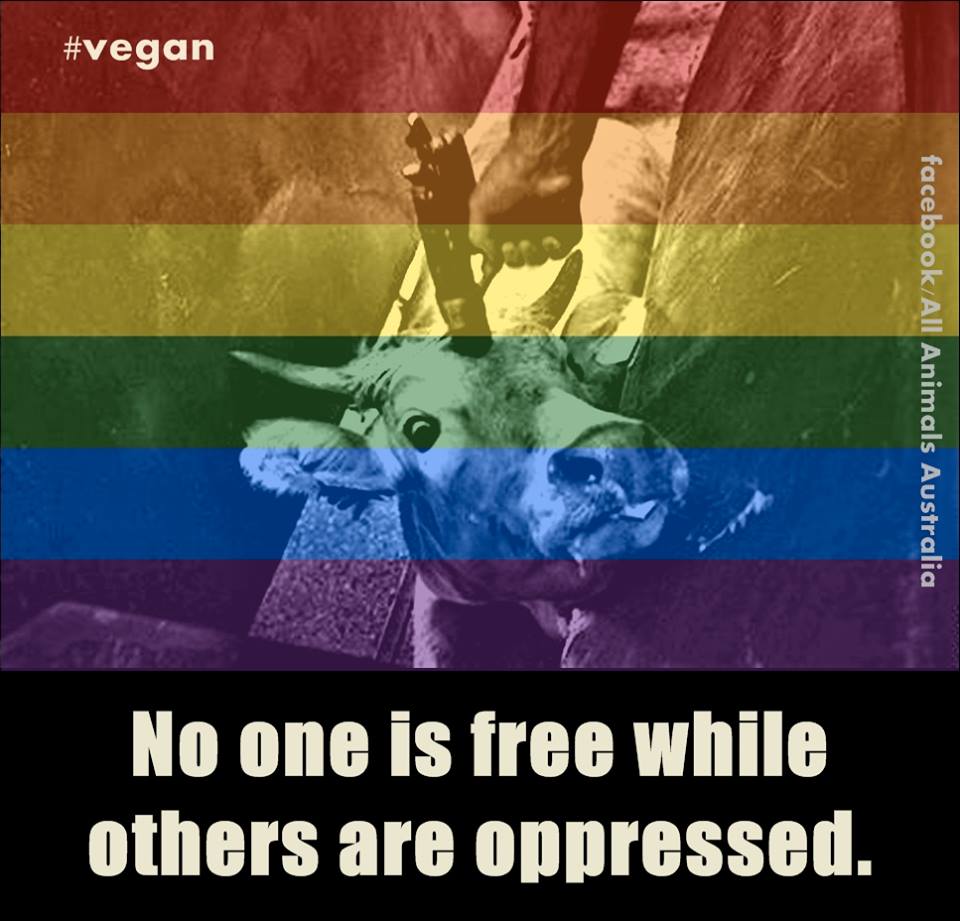
No One is Free While Others Are Oppressed

11038570_798220036943254_8928612153015243868_n

Written by Jace Kai

Congrats to gays in America- you’re now able to endure the plight of marriage and serve the flesh of tortured animals at your wedding like every other entitled American. So glad your ‘suffering’ is over. And before everyone gets all whiny pissy pants on me, let me remind all that since the dawn of this country and even before, every human being has had a far better life than that of the ones suffered by animals due to human interaction and cruelty, and while everyone is dancing around in their rainbow undies, animals are sinking deeper into hell. Every black, white, asian, hispanic, male, female, gay, straight, transgender, jewish, muslim, christian and atheist; every fat person, skinny person, healthy person, sick person, free citizen and even incarcerated prisoner has been able to live with far more rights and freedoms at their lowest than animals have ever had the luxury of at their highest. Even the most sadistic of serial killers in solitary confinement are able to turn around and move their own limbs should they wish to do so, but that is not the case for billions of innocent animals born into humanity’s evil grasp. We turn their skin into shoes that we walk through the mud with. We turn their fat into soap to wash our asses with. We turn their menstruation into breakfast to slowly clog our arteries. We turn their fur into ridiculous looking coats to keep us warm. We turn their newborn babies into nothing more than a midnight snack. Have lesbians ever had to endure being skinned alive and turned into jerky for some redneck trucker to snack on? I think not. Billions upon billions of animals are born into slavery every year. Billions of animals as loving and intelligent as any dog or human child are born into a world where they are raped and beaten and viciously killed within a fraction of their natural life. Billions of animals who never once know the warmth of sunshine on their face or the softness of grass under their feet. Billions of animals who have their babies stolen and beaten to death right before their very eyes, all to satisfy the stupidly ego driven blood lust of humanity. And yet every day there is still some human complaining about THEY don’t have enough rights. The world will stop what they’re doing to protest the waving a flag, or unite to march in a parade to wave more flags and still the stomping of the feet never ends. We’re living in a country that is actively making and vehemently enforcing new laws which protect animal abusers and criminalize the few people who risk their own safety to bring such crimes to light. We’re living in a country that promotes the continued slavery, torture and slaughter of billions of animals every year in order to keep it’s own people sick and unhealthy while destroying the land, sea and air we all need to survive. We’re living in a country that keeps it’s people stupid in order to make them more easily misled by every lie thrown at them, particularly in the dietary department. We’re living in a country where an individual smoking a plant gets thrown in jail for 10+ years but a corporation that brutally rapes and slaughters millions of animals every week gets government subsidies like they’re heroes. Humans are all about ‘me me me’ and never ‘them them them’, and it’s that ego that makes America, as well as every other country far more shit than sunshine. The death of eight humans turns the country upside down but the death of billions of animals is just ‘business as usual’. Has a life with the inability to legally say “I do” or cast a vote for your favorite crooked shitmouthed politician really been comparable to even ONE day of living in the sick hell that factory animals endure? It’s all about the human ego wanting whatever it can get its hands on and then when they do, they want something more, like a kid who constantly gets new toys then gets bored with it by the next day and cares nothing for those who’ve never and will never have any toys at all. Mind you, this has nothing to do with me being a straight white male either because like many people who actually give a damn like myself, my entire existence is pure shit from dusk till dawn, and that’s fine. I speak only for the animal rights, not for my own. Go ahead and take away my ‘right to vote’ , because I can’t think of the last time there was ever a candidate worth voting for and elections are as fixed as a carnival bottle game anyway – take away my ‘right to get married’, because monogamy is about as natural as a 10 pound GMO tomato and almost always ends up in divorce, resentment or just giving up & settling either through sheer laziness or ‘for the kids’ – but don’t blow this happy “love wins” victory smoke up my ass while the only living beings in this country that don’t belong behind bars are the overwhelming majority that are – the animals. Gay or straight, a person knows nothing of love or compassion while there’s a corpse on their plate and I will continue to have zero ‘respect’ for any person, of any race, of any gender, of any sexual orientation, that willingly contributes their money towards the evil human empire over the innocent animal kingdom. I’m sure the 10,000 pigs who were stabbed in the eye with a pitchfork since I started writing this statue give a good god damn that Joe & Bob can have that festive wedding they always wanted now, maybe even catered with their flesh. Any non-vegan holding up a sign for ‘gay rights’ or ‘feminist wawa’ or ‘save the environment’ needs to sit down and take a good look at just how good they have actually have it and maybe try putting a little more effort into being a voice the the voiceless first and foremost, because as Leo Tolstoy said, “As long as there are slaughter houses there will always be battlefields.” Even if caring about non-humans is too much to ask of most shitty humans, remember that factory farming is the number one polluter and destroyer of the environment, so when all the water is too filthy to drink and the air is too polluted to breathe and the land is too toxic to yield crops, don’t expect that ring on your finger to save you.

The day some fuckin’ barbarians cooked her dog for dinner

The day my dog was cooked for dinner

  • 28 June 2015
  • From the section Magazine
Dogs for sale in Yulin
Dogs for sale at the Yulin at the dog-meat festival

This week about 10,000 dogs and a number of cats were killed at an annual dog-meat festival in south-western China, to celebrate the longest day of the year. For the BBC’s Juliana Liu it was a reminder of one of the most traumatic days of her childhood, in the Chinese city of Changsha.

When I was three years old, after months of begging, my parents finally gave in to my pleas for a puppy.

The day that my uncle, a lorry driver, brought me a fuzzy yellow mongrel from my grandmother’s mountainous, faraway home was the happiest of my young life.

I named him “Doggie”, and we immediately became inseparable.

As an only child born in 1979 at the beginning of China’s one-child policy, I had always been alone, and Doggie became my best friend. He loved running around outside our one-room flat, gobbling up left-over rice and snuggling near the coal fire.

But these halcyon days did not last. After just one winter, my parents told me Doggie had to go.

In Chinese cities in the early 1980s owning a pet was considered highly undesirable, bourgeois behaviour. None of my neighbours had one. It was also not entirely legal. There was no access to animal vaccines or vets, so pets could pose a public health risk.

One day, my mother announced we were going shopping – and when we returned a few hours later Doggie was no more. He had been strung up by the legs in our communal yard, and was soon turned into a stew, complete with herbs and hard-boiled eggs.

No-one paid any attention to my tears. I heard the neighbours say I would soon forget the whole thing.

They, on the other hand, were in a celebratory mood. In the years before China’s economic boom, when some food was still rationed, it was rare to have the chance to feast on a whole animal.

I refused to eat the stew – and I have never eaten dog in my life.

null
Men eating dog at the Yulin dog-meat festival, June 2015 © Reuters

In China, the tradition of dog-eating goes back far beyond written history.

Along with pigs, oxen, goats, horses and fowl, dogs are one of the six animals domesticated during the Stone Age.

On the other hand, it is not the kind of thing that is eaten every day. It is a speciality meat, commonly believed to confer strength, vigour and virility on the eater.

null

How dog is eaten

Chinese food expert Fuchsia Dunlop writes:

Judging by the sporadic waves of outrage about dog-eating in China, you might think it was one of the pillars of the Chinese diet. Actually, however, the consumption of dog meat is extremely marginal: it’s seldom seen in markets and on restaurant menus, and most Chinese people eat it rarely, if at all.

Dogs, like pigs, have been reared for their meat in China since the Neolithic age, but in modern times their flesh is regarded as a delicacy in just a few areas, such as Hunan and Guizhou. Even in these places, it tends to be eaten only occasionally, and in certain seasons. According to traditional Chinese medicine, dog is a “heating” meat which can offer a useful energy boost in midwinter, but is best avoided after the lunar new year.

In culinary terms, dog meat is normally blanched or soaked before cooking to dispel the earthier, heavier aspects of its flavour. It is then, typically, made into slow-cooked soups and stews seasoned with ginger, spring onion, rice wine and spices, although it may also be roasted, or served cold as an appetiser. The tender meat of puppies is favoured over that of older dogs.

In the course of many years of studying Chinese cuisine, I’ve only eaten dog meat on a handful of occasions. The first time, it reminded me of pork; the second, in a fiendishly spicy Hunanese stew, it recalled the taste of lamb.

null

About 716 million pigs are slaughtered in the country every year, and 48 million cattle. The number of dogs slaughtered is far lower – one animal rights group puts the figure at about 10 million.

But where do these dogs come from? According to some researchers, many are pets – like Doggie, except they have been stolen from their owners.

As dogs were arriving for the dog-meat festival at Yulin in Guangxi province this week, Peter Li of Humane Society International saw no animals with quarantine inspection certificates to indicate they had been farmed.

“All of them can be suspected to be stolen urban pets, rural guard dogs and stray dogs and cats,” he says.

null
Dogs for sale at a market in Yulin © AFP

A four-year inquiry into the dog-meat industry by Animals Asia also concluded that most dogs eaten in China are stolen.

“During the entire investigation, we found no evidence of any large-scale breeding facilities, where 100-plus dogs were bred and raised,” says the report published earlier this month.

“The difficulty of large-scale breeding of dogs for food and the greed for profit give rise to stealing, snatching from the streets and even poisoning of dogs.”

But Li says there is mounting pressure on Chinese authorities to take action against the eating of pets – and that society is turning against the idea of eating dog altogether.

There were far fewer stalls selling dog and cat meat at the Yulin festival this year than in 2014, he says.

“The overall attitude is against dog eating. China has 130 million dogs, of which 27 million are urban pets. That’s a big number of pet owners.

“The younger generation, born in the 1990s, is not tolerant of animal cruelty.”

null
A protester shouts slogans condemning the slaughter of dogs at the Yulin festival © AFP
null
null
Activists gave a dog a basket with the message “Child for sale” © AFP

In 2014, animal rights activists intercepted 18 lorries carrying dogs intended for eating, resulting in the rescue of some 8,000 animals, he says.

The Chinese media often carries stories of such rescues, in which activists force vehicles to stop and pool money to purchase the animals.

He dates the rise of animal protection activism in China to 2011, the same year when, for the first time ever, more people lived in cities than the countryside.

City dwellers, he says, view dogs and cats more as pets, rather than as working animals – guard dogs, for example – or sources of meat.

In May, on a visit to Shanghai, I saw a sight that delighted me.

While strolling on the Bund, I stopped a young tourist named Yang Yang who was carrying her tiny, fox-like dog in a sling on her chest, the way I normally carry my human baby.

“Oh, this way I can take him into restaurants and on airplanes,” she explained. “Otherwise, he wouldn’t be allowed in with me. Where I go, he goes.”

All three of us posed for a photo in front of Shanghai’s iconic skyline.

null

How I wish more people had taken this attitude three decades ago.

My parents, now utterly embarrassed about having allowed my pet to be cooked, generally avoid the topic entirely.

But when I was five years old, my father left China to study abroad and the very first gift he sent me was a fuzzy, yellowish stuffed puppy.

I named him Doggie.

To this day, wherever I go, he is with me.

null