Everything You Do Leaves an Impact, so You Might as Well Be an Ass-teroid

One of hunters’ favorite fallacies these days is some form of the (il)logic that everything you do affects something in some way so you might just as well hunt down big “game.” It’s the same school of thought as, you can never be completely vegan so what’s the point in choosing not to eat animals?

Apparently some folks, with nothing better to do, have been staying up nights wracking their brains to come up with as many ways imaginable that non-hunters, or even vegans, might inadvertently kill animals. Not because these spin-doctors really care about anything except themselves, but because it’s easier to try to break down someone else’s resolve than to look at ones’ own intentional acts of—or collaboration in—cruelty.

After all, nature’s cruel, so you might as well be the cruelest, right? And as long as someone eats who you kill, it’s almost sacred, or something, isn’t it? (But, as PETA put it, “Did the fact that Jeffrey Dahmer ate his victims justify his crimes? What is done with the corpse after a murder doesn’t lessen the victim’s suffering.”)

It’s like saying, you’ll never be Jesus so what’s the point of trying to live the best life you can? Sort of a variation of Lucifer’s “…better to lead in Hell…” credo.

How’s that working out, Satan? Hot enough for you down there?

10672309_494957377273705_7847204821097280177_n

Proof That Barbaric Traditions like Hunting and Trapping Can Change: Indian court bans animal sacrifice

http://www.theguardian.com/world/2014/sep/02/india-court-bans-animal-sacrifice-hindu-temples

Agence France-Presse in Shiml

theguardian.com, Tuesday 2 September 2014 06.03 EDT


Goat vendor in India

The court questioned the reasons for animal sacrifices, saying such rituals ‘must change in the modern era’. Photograph: Piyal Adhikary/EPA

A court in remote northern India has banned a long tradition of sacrificing animals for religious reasons, deeming the practice cruel and barbaric.

The high court in Himachal Pradesh has asked police and other officials to enforce its ban on the slaughter, mainly of goats in Hindu temples throughout the state.

“No person will sacrifice any animal in any place of worship. It includes adjoining lands and buildings,” the two-judge bench of the court ruled late on Monday.

“A startling revelation has been made … thousands of animals are sacrificed every year in the name of worship,” the court said.

“Sacrifice causes immense pain and suffering to innocent animals. They cannot be permitted to be sacrificed to appease a god or deity in a barbaric manner,” it said.

The court also questioned the reasons for animal sacrifices, saying such rituals “must change in the modern era”.

The court was ruling on a petition brought by animal rights activists, who applauded the move on Tuesday as long overdue.

“We welcome this ban on animal sacrifice as it will end centuries of cruelty to animals in the name of religion,” local activist Rajeshwar Negi told AFP.

But state lawmaker Maheshwar Singh defended the practice, saying: “This judgment is against the age-old beliefs and customs of many people.”

Goats and sometimes sheep are often sacrificed at the start of winter in temples across Himachal Pradesh with the aim of pleasing Hindu deities.

Animals are symbolically offered to the deity and later taken home by villagers and their guests for eating during the Himalayan state’s bitterly cold winter.

Some of the sacrifices at festivals, including those of “shaand” and “bhunda”, involve large numbers of animals killed using a knife at the entrance of the temples.

Soaring Meat Production Threatens Global Environment, Warns Report

http://www.businessweek.com/articles/2014-08-27/too-much-meat-says-worldwatch-institute

By August 27, 2014

The world is eating too much meat, and that’s bad news for the earth’s forests, arable land, and scarce water. That’s the conclusion of a report released yesterday by the Washington-based Worldwatch Institute.

Global production of meat hit a new high of 308.5 million tons last year, up 1.4 percent, according to the United Nations Food and Agriculture Organization (FAO), the report notes. “In response to growing purchasing power, urbanization, and changing diets, meat production has expanded more than fourfold over just the last five decades. Even more startlingly, meat production has grown 25-fold since 1800,” says a news release accompanying the report, entitled “Peak Meat Production Strains Land and Water Resources.”

While average consumption of meat in 2013 reached 42.9 kilograms per capita, many people still consume far less, which means production growth is unlikely to stall soon. People in developing countries are eating less than half the quantity of meat consumed by those in developed nations—33.7 kg. as compared to 75.9 kg., the report points out.

Not surprisingly, Asia, home to the fast-growing, populous countries of China and India, has already become the world’s largest meat-producing region. In 2013, it produced 131.5 million tons of meat, about 43 percent of world output. Europe, by contrast, accounted for 58.5 million tons, North America, 47.2 million, and South America, 39.9 million. “China single-handedly accounted for nearly half of global pig meat production,” the report says.

Raising all that livestock requires lots of land and water. More than two-thirds of all agricultural land is used for animal pasture, with an additional 10 percent used to grow feed grains consumed by meat- and dairy-producing animals. Agriculture overall consumes about 70 percent of the world’s fresh water; a third of it goes to grow feed grain. Particularly resource-intensive is beef production: Raising cattle requires up to five times as much land as that needing to produce pigs or chickens—for the same amount of protein.

“Industrial methods in the livestock sector cut down forests to expand grazing lands and use large quantities of water. Production uses grains (such as corn or soybeans) for animal feed and relies on heavy doses of antibiotics in animals,” writes Worldwatch Institute Senior Researcher Michael Renner. “Limiting these environmental and health impacts requires not only a look at how much meat people eat, but also at the kind of meat that they consume worldwide.”

Pasture Raised Eggs: The Humane, Sustainable Fiction

Walker_house_and_farm, Pasture Raised Eggs farm

Pasture Raised Eggs: the Humane, Sustainable Fiction

by Robert Grillo

n a recent article in Civil Eats by author Brie Mazurek, a farmer named Nigel Walker of Eatwell Farm in Dixon, California gets a chance to puff up his more humane vision for pasture raised eggs. His solution? For one thing, in response to his customers’ frequent concerns over the killing of male chicks at the hatcheries which supply nearly all egg farms, from factory farms to backyard hen keepers, Walker now breeds his own birds instead.

To this end, he is asking his supporters — consumers seeking truly humane, sustainable egg products — to fund this project. But we did a bit of detective work and found that, contrary to his sustainability and “ecosystem” rhetoric, Walker appears to be living in a sprawling McMansion as shown in the aerial photograph from Google Maps. More on the “ecological” and “sustainable” claims he makes about his farm later in this article.

In the following, I’ve addressed several points and claims made by both Mazurek and Walker.


Civil Eats: “…many conscientious eaters go out of their way to purchase pasture-raised eggs laid by happy chickens, …”

Red jungle fowl Photo: Goldy RS

My response: Many conscientious eaters would do well to learn that a pasture is nothing like a natural habitat for chickens. Chickens originate from, and still inhabit, tropical rainforests where they have evolved “happily” for millions of years. Their brains, behaviors and natural instincts have been shaped by one of the most complex, diverse and dynamic ecosystems on the planet. A largely tree-less, open farm “pasture” is an artificial, foreign environment in which chickens feel vulnerable and exposed to predators. Pasture-raised chickens frequently exhibit heightened cortisol levels (a stress hormone) indicating a sense of being in danger. In fact, it is the pasture farmers themselves who are so often complaining about the number of chickens they’ve lost to predators. In contrast, chickens in their natural rainforest habitat create their own social order that collectively — and very successfully — thwarts predators, with the help of abundant trees. Some studies have shown that chickens successfully survive a predator attack 90% of the time in their natural environment.

Moreover, forcing animals to live in an environment that is foreign to them and that places them in harm’s way — and breaking up their natural social order so that we can exploit them for their eggs and flesh — is neither “conscientious” nor “natural.” Finally, to do so contradicts what most of us claim to already believe, that it is wrong to harm animals unnecessarily and when we could so easily avoid it.

Civil Eats: “ ‘We are on a mission to put the old breeds of poultry back to work,’ he [Walker] says. While such birds may produce fewer eggs and put on pounds more slowly than modern breeds, they tend to be more healthy, resilient, and productive in the long run.”

My response: The “old” breeds are still manipulated to reproduce an unnatural number of eggs. By contrast, wild chickens lay only a few clutches of eggs, or 10 to 15 eggs per year. Like all birds, they lay eggs only during breeding season and only for the purpose of reproducing. (1) Painful and often fatal reproductive disorders and diseases resulting from this history of invasive genetic manipulation for overproduction of eggs are still commonly reported in so-called heritage breeds as well.

pasture raised

Civil Eats: “As the flock grows, the birds must be carefully tracked. Each time a hen goes to lay an egg, a door closes behind her (in what is called a trap nest) so that the bird and her egg can be recorded by Eatwell staff. The best of the best will be selected for hatching.”

My response: There is essentially no difference in the intent and practice of breeding chickens for specific traits in Walker’s method described above, and the selective breeding methods used by industrial hatcheries that farmers like Walker already claim to oppose. Both rely on dominating and exploiting the female reproductive system, weeding out “inferior” animals in favor of those with “superior” traits, with the goal of increasing productivity and profit. The end goal is still one of more efficient exploitation. If we were to apply this same mentality and methodology to our treatment of certain groups of human beings, we would be looking at something like the Nazi scientists and ideologues who promoted a vision of an “optimal” Aryan race. If it’s immoral to dominate and manipulate human animals in such a manner, then how can it possibly be moral to control and modify non human animals in this way, particularly when the latter have no way of consenting? Arbitrary prejudice is the basis for both instances of breeding and manipulating sentient beings.

Civil Eats: “The males will be raised to maturity and processed for meat, providing additional income for the farm.”

kill cone_cropped_650

My response: How does the farmer define “maturity?” What does that mean for a bird with a natural lifespan of 8 to 15 years? How many weeks is he allowed to live past the mere seven weeks of life of a typical “broiler” chicken on an industrial farm? A few more weeks, perhaps? If so, he is hardly “mature” at this point, but rather still in his infancy. Walker pretends he’s doing the male chicks a favor by letting them “mature” into slightly older infants before he needlessly butchers them for meat.

Civil Eats: “Chickens play an invaluable role in the farm’s ecosystem, having eliminated the need for compost and external fertilizers.”

My response: Since when is a farm a “natural ecosystem”? And why would you want to eliminate compost, nature’s own free fertilizer, and replace it with excrement from domesticated “invasive” species? I checked in with our seasoned sustainability expert, Will Anderson, to get more answers. He wrote: “At Eatwell Farm, chickens may be indispensable to the egg and chicken meat business, but not to an ecosystem. In the far more limited sense, chickens do cycle nutrients back to the soil, but those nutrients required the artificial addition of more energy and water intensive inputs in the form of 30 tons of organic wheat grown specifically to feed the chickens (see http://www.cuesa.org/seller/eatwell-farm). Eatwell’s agroecosystem does not increase biomass for the ecosystem, but removes much of it when sold as food and the chickens are taken to slaughter.”

pasture raised

Civil Eats: “The real core issue here is getting animals back on farms and out of these confinement operations,” says Walker. “Yes, we want their eggs, and the meat is great, too, but the reason we have our chickens is that they eat the pasture and fertilize the ground. All our organic vegetables are grown with fertility from cover crops and chickens.”

My response: Again I defer to Will Anderson: “Veganic agriculture provides the compost for crops minus the waste of wheat [used for chicken feed] and loss of chicken and dairy lives while using less energy, land, and water. Like others who celebrate animal agriculture, Nigel Walker seems not to ask what could be better. As a result, they overlook the fact that these practices are not sustainable given the extent of global ecosystem destruction, and, more obviously, are not needed as food.”

According to agricultural and plant pathology expert Dr. Steve Savage, “Manure is also a non-ideal fertilizer in many ways.” “The animals didn’t ‘make’ any of those nutrients [needed to fertilize crops]. For instance, the ~2% nitrogen in cow manure came from whatever they ate (grass, corn, soybeans…) …The cow is just passing a bit of that along.” Using manure as a fertilizer has the added disadvantage of creating more greenhouse gases and wasting more water and feed inputs to produce the same crop yields. (2)

As for the scale of such an operation, where does all the land needed to give animals a “natural” farm life come from?, asks author and program director of United Poultry Concerns, Hope Bohanec. “At any given time, there are 100 million head of cattle and 70 million pigs alive in the U.S. Currently, only about 9 percent of all livestock is pasture raised. How would we ever have the land to pasture raise them all? To give all farmed animals the space they need to have even a semblance of a natural life, we would have to destroy millions more acres of wild areas, forests, prairies, and wetlands to accommodate them. There is not enough land on the planet, or even two planets, to free-range all the billions of pigs, sheep, turkeys, ducks, and chickens. We would need closer to five planet Earths. It simply cannot be done. Free-ranging animals for food can never be more than a specialty market for a few elite buyers.” (3)

Civil Eats: “We’re trying to find a bird that can live outside, where it can express all of its chickenness…”

My response: Where can chickens actually express “all of their chickenness?” Well, we can turn to sanctuaries who have rescued these birds from the farming industry and who value them, not as units of production, but for their intrinsic value as autonomous individuals who have names and unique personalities. We can also turn to recent scientific research that confirms what many who have observed chickens closely for years have long known to be true. What we’ve learned about the avian brain and behavior in just the last 15 years contradicts hundreds of years of misinformed views about chickens and other birds. Much of what was previously thought to be the exclusive domain of human / primate communication, brain and cognitive function, and social behavior is now being discovered in chickens and other birds. (4)

chickens-in-tree

Farms, whether pasture-based or not, value animals only to the extent that they provide a resource to that farm. That will never change. Animals regarded as pieces of property are treated as property, regardless of whatever feel-good fictions are used to mask this reality. It is anthropocentric and prejudicial to claim that animals desire or deserve to be used and killed as our resources. Quite the opposite is true and easy to conclude from simple observation. Animals regularly and clearly demonstrate an interest in staying alive and living freely and, like us, in avoiding pain, suffering and death — all of which interests are denied them when they are exploited for their flesh, eggs and milk.

(1) 12 Egg Facts the Industry Doesn’t Want You to Know

(2) Dr. Steve Savage , No, Cows Don’t Make Fertilizer

(3) Hope Bohanec, The Humane Hoax

(4) Robert Grillo, Chicken Behavior: An Overview of Recent Science

– See more at: http://freefromharm.org/animal-products-and-ethics/pasture-raised-eggs/#sthash.U8ic4Vo5.SYMDH2HG.dpuf

Bobcat fur farm wants to move to Montana

GREAT FALLS – The owners of a commercial bobcat fur farm are looking to
relocate from the bustling oilfield region in western North Dakota to a
quieter area in central Montana.

Montana Fish, Wildlife and Park is taking public comments on the proposed
150-foot-by-140-foot animal facility where bobcats would be housed in
separate pens inside the facility near Roy in Fergus County.

Larry Schultz, who owns the business with his wife, says the facility would
raise bobcats for their furs, which would be sold in the commercial fur
industry worldwide.

Schultz says that bobcat fur is used for trim, hats and coats in some
countries.

Schultz says noise and dust from oil drilling near their farm in Arnegard in
western North Dakota isn’t good for raising bobcats.

http://www.kxlf.com/news/fwp-asks-for-public-comment-on-bobcat-fur-farm-prop
osal/

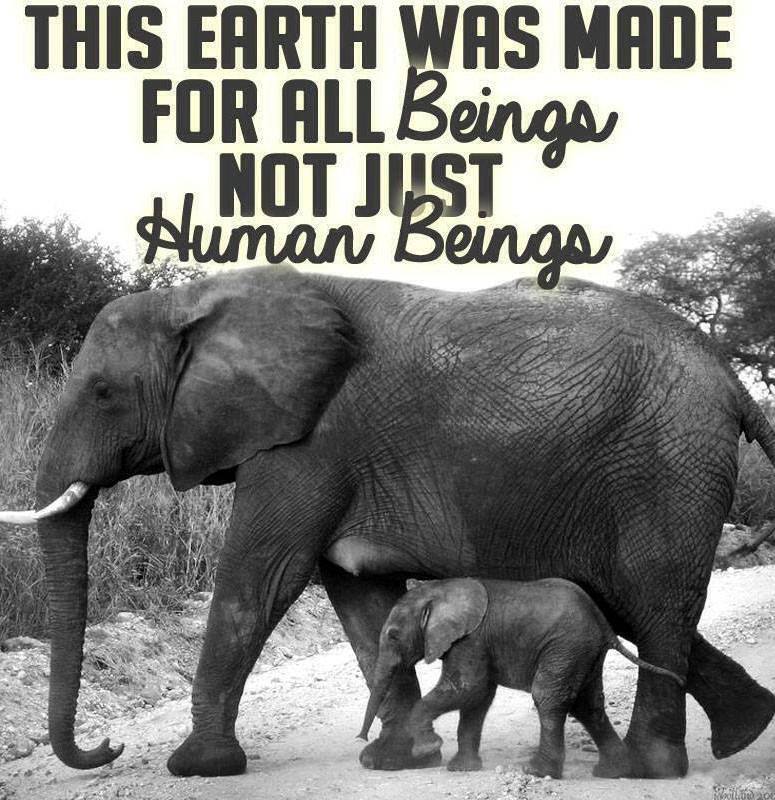
So Not Like an Elephant

Find and prosecute the cruel men who kicked a squirrel off the edge of the Grand Canyon

Petition byJaya Bhumitra  http://www.change.org/petitions/find-and-prosecute-the-cruel-men-who-kicked-a-squirrel-off-the-edge-of-the-grand-canyon


On August 2, 2014, news outlets reported that two men (French-speaking) lured a squirrel to the edge of the Grand Canyon with treats — only to then cruelly kick the innocent and unassuming creature over the edge. 

At its highest point, the Grand Canyon is 6,000 feet high.

This heinous act was premeditated: the men carefully placed the food in a manner to entrap the squirrel, before one of the men deliberately put on his sneaker in order to punt the squirrrel off the landing.

Not only is this act completely callous to the squirrel who no doubt experienced total terror while finding herself in free fall for thousands of feet and at hundreds of miles per hour before her likely death, but this type of consciously planned animal abuse has been reported as typical sociopathic behavior, which sometimes leads to serial killing (both of non-human and human animals).

The men responsible MUST be found and prosecuted for their actions. No tourist nor American citizen should be permitted to harm an animal in any circumstance, particularly in a national park where the environment and animals in it are officially protected by the state.

Sign the petition now to ask both the National Park Servce and Interpol to find these abusers and bring them to justice!

(YouTube has removed the video due to the disturbing content, though you can see it in this Huffington Post article. Photo credit to YouTube and The Daily Mail article).

BREAKING: Facebook removes hunting photos of Texas teen that raised ire

Featured Image -- 6409

http://www.chicagotribune.com/news/sns-rt-us-usa-texas-hunting-facebook-20140702,0,2940032.story

Reuters

July 2, 2014

DALLAS (Reuters) – Facebook has removed some photographs of a Texas teenager posing with freshly killed animals she hunted during a recent safari in South Africa that had been criticized by users as inappropriate, the company said on Wednesday.

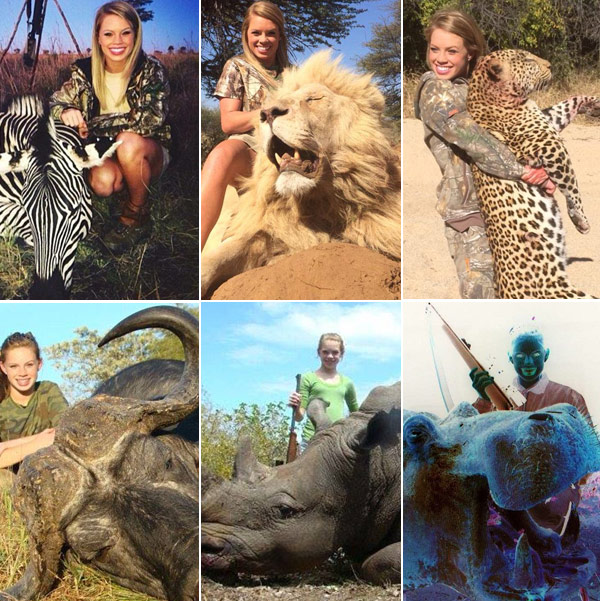
Kendall Jones, 19, a cheerleader at Texas Tech University in Lubbock, set off a social media storm after she posted a series of photos of animals she killed, smiling in one picture as she hugs a lifeless leopard hanging limply from her arms.

Facebook said some photos were deleted from her page because they violated its policies regarding animal images.

“We remove reported content that promotes poaching of endangered species, the sale of animals for organized fight or content that includes extreme acts of animal abuse,” the company said. It did not provide specific information about the photos removed.

Comre Safaris, a company in South Africa that organizes licensed hunts, said the number of animals killed by Jones fell within a quota set by the country’s wildlife department.

Jones defended her actions, saying in a Facebook post she took inspiration from former U.S. President Theodore Roosevelt, a hunter and conservationist.

“How can it be possible that someone can love the earth, and take from the earth in the name of conservation? For some folks, they’ll never understand. For the rest of us … we were born that way. God Bless Teddy,” Jones said.

But criticism was heavy, with one post branding the hunts barbaric garnering 20,000 comments. More than 130,000 people signed an online petition asking Facebook to remove Jones’ photos, saying they promoted animal cruelty.

“You can see the thrill in her expression and eyes from these photos that she enjoyed the KILLING of these animals,” read one post.

Many cash-strapped African governments allow a small number of big game animals to be killed each year, using the money from the sale of hunting licenses for conservation.

The hunts are held under international guidelines meant to ensure they do not adversely affect overall species numbers.

Animal rights campaigners outraged as Texas cheerleader poses in dozens of photos alongside the rare animals she hunts on African safaris

http://www.dailymail.co.uk/news/article-2675807/Animal-lover-outrage-blonde-Texas-cheerleader-smiles-dozens-photos-alongside-rare-big-game-hunts-African-safaris.html

  • Kendall Jones, 19, is posting the photos on Facebook, where some believe the shots should be taken down
  • Jones has posted shots of herself posing with dead elephants, hippos and lions among others that she’s killed across Africa
  • Jones claims her kills come after a ‘fair chase,’ but thousands are demanding that Facebook remove the posts
  • Jones is a cheerleader at Texas Tech and is gunning for a reality show about her African adventures

By Joshua Gardner

Global animal lovers are up in arms over a teenage Texas girl’s love of killing big African game, so much so that they’re even demanding she be banned from posting pictures of herself smiling alongside her trophies online.

Nineteen-year-old Kendall Jones claims photos of dead hippos, elephants, lions and other beasts on Facebook are a testament to her hunting skills and dedication to game preservation.

But critics are appalled by the teen’s beaming social media and are calling Kendall sick and depraved for killing the rare animals and boasting about it online.

Scroll down for video

Conserving by killing? 19-year-old Texas cheerleader Kendall Jones really likes to kill rare animals in Africa. While she pays for her legal hunts, her critics says she's not the conservationist she claims to be

Conserving by killing? 19-year-old Texas cheerleader Kendall Jones really likes to kill rare animals in Africa. While she pays for her legal hunts, her critics says she’s not the conservationist she claims to be


Loves to hunt: Jones faces criticism over her claims that she's a conservationist. The Texas Tech cheerleader's smiling poses alongside dead rare African animals have won her particular ire

Loves to hunt: Jones faces criticism over her claims that she’s a conservationist. The Texas Tech cheerleader’s smiling poses alongside dead rare African animals have won her particular ire


An online petition to force Kendall to remove her page because it promotes animal cruelty had gained over 40,000 signatures in just a week.

‘For the sake of all animals,’ reads the petition as it implored animal lovers to sign, ‘especially the animals in the African region… where hunters are going for fun just to kill an animal!’

Jones, whose Facebook indicates she ‘is looking to host a TV show in January 2015,’ maintains she is doing what’s best for the preserves, where there isn’t always space for even threatened species like elephants or lions.

‘Controlling the male lion population is important within large fenced areas like these,’ Jones writes. ‘Funds from a hunt like this goes partially to the government for permits but also to the farm owner as an incentive to keep and raise lions on their property.’

Jones’s photos show her posing with bagged zebras, hugging a dead leopard, and smiling beside elephants she’s killed.

One particular photo, in which she’s posing alongside a an extremely endangered rhinoceros, has her critics especially steaming, but the Texas Tech cheerleader says it was alive and well.

‘The vet drew blood, took DNA samples, took body and head measurements, treated a leg injury and administered antibiotics. I felt very lucky to be part of such a great program and procedure that helps the White Rhino population through conservation,’ she wrote.

Big 5: Jones says her first kill was a rare African white rhino, part of her quest to bag the Big 5 African game animals (rhino, elephant, Cape buffalo, leopard and lion)

Big 5: Jones says her first kill was a rare African white rhino, part of her quest to bag the Big 5 African game animals (rhino, elephant, Cape buffalo, leopard and lion)

Read more: http://www.dailymail.co.uk/news/article-2675807/Animal-lover-outrage-blonde-Texas-cheerleader-smiles-dozens-photos-alongside-rare-big-game-hunts-African-safaris.html#ixzz36MD3myI2

and if you haven’t read enough about her yet, here’s a link to all 226 articles that come out today: https://news.google.com/news/story?pz=1&cf=all&ned=us&hl=en&ncl=dud2BbJ6yB4ChAMWM48-BLgzTe7YM