See the Hunting Pictures a Texas Cheerleader Posted on Facebook That Have Some Calling Her ‘Scum’ and Demanding They Be Removed

A Texas Tech University cheerleader’s Facebook page is causing an uproar for photos she posted showing her with large game animals she hunted in Africa.

At the time of this posting, more than 44,000 people have signed a petition to have Facebook remove Kendall Jones’ page “for the sake of all animals.” The petition was started on June 22.

“Remove the page of Kendal [sic] Jones that promotes animal cruelty!” the petition reads.

Image source: Kendall Jones/Facebook

Image source: Kendall Jones/Facebook

When Jones started her Facebook page earlier this year, calling it “Kendall Takes Wild,” she didn’t hide what it was all about.

“I grew up in the small town of Cleburne, Texas where my hunting career started,” she wrote in the about section of her Facebook page. “As a child I would go with my dad on all of his hunting adventures watching him on our ranch, as well as, traveling to Africa to see him take his Big 5. I took my first trip to Zimbabwe in Africa with my family in 2004 (age 9) and watched my dad bring many animals home. As badly as I wanted to shoot something I was just too small to hold the guns my dad had brought…”

More: http://www.theblaze.com/stories/2014/07/01/see-the-hunting-pictures-a-texas-cheerleader-posted-on-facebook-that-have-some-calling-her-scum-and-demanding-they-be-removed/?utm_source=facebook&utm_medium=story&utm_campaign=ShareButtons

Punish Instructor for Butchering Dog

Share on gmail Gmail  Share on yahoomail Yahoo  Share on care2 Care2  More Sharing Services More

E95688ABF88792AE42A8914230F586_h316_w628_m5_cBUxDElwb

Target: Rubén Saavedra, Defense Minister for Bolivian Military

Goal: Criminally charge military instructor who slaughtered a live dog to desensitize trainees

Up until 2009, Bolivian military instructors regularly slaughtered live dogs during training exercises. Meant to “toughen up” and desensitize new cadets, this brutal practice finally became outlawed after tireless protests by the People for the Ethical Treatment of Animals (PETA). Recently, however, an instructor barbarically killed another dog, earning only a four-day suspension following the criminal act.

The New York Times reports the instructor “gutted a 2-year-old mixed breed dog” and “smeared its blood on students’ faces.” He ruthlessly butchered a helpless animal, and in doing so, he also brazenly violated Bolivian law. The ban, or “Resolution 217,” purports to enforce punishments for such violations. Nonetheless, the instructor has only been temporarily suspended, which is an insultingly insufficient penalty. Suspension is typically reserved for minor acts of insubordination, such as mouthing off to a superior officer. This soldier cut open and bled out an innocent creature. Perhaps the scariest part of this story is the idea that he will be allowed to return to the academy. One can’t help but wonder if the Bolivian military only enacted this law to appease protestors while secretly continuing to kill dogs.

There’s a reason butchering live animals desensitizes people: It is inherently cruel and traumatic. If the Bolivian military wants to harden its soldiers, it should use virtual simulations or old war footage to do so. Slaughtering dogs is both illegal and wildly unnecessary. In addition, instructors should earn more than a “slap on the wrist” for violating the ban. Sign the following petition to demand justice for this innocent animal that was brutally killed for the sake of “instruction.”

PETITION LETTER:

Dear Minister of Defense Rubén Saavedra,

In 2009, you approved Resolution 217, which prohibits the abuse or mistreatment of animals in military training exercises. Nevertheless, a military instructor recently slaughtered a two-year-old dog for the sake of instruction. Though Resolution 217 assures punishment for violations of this ban, the instructor has only earned a four-day suspension. This punishment is not only inadequate, it is profoundly unjust.

The “penalty” you have issued sends a clear message that you do not take your ban on animal abuse seriously. More importantly, it conveys that you value a soldier’s training more than the life of an innocent creature. A temporary suspension is not a punishment; it is a slap on the wrist that is commonly enforced for minor acts of misconduct. Employing such a measure in this instance is grossly disproportionate to the crime, and ultimately displays a lack of empathy on the Bolivian military’s part.

This instructor violated official regulation and he should be penalized accordingly. Not only has he senselessly killed an animal, he has directly disobeyed an order. Please seek true justice for the crimes that have been committed, and bring the soldier before a court to answer for his barbaric actions.

Sincerely,

[Your Name Here]

Photo credit: Kristin Miranda

Sign the Petition

  • First & Last Name*
  • Email*
  • Your email will not be published. By signing you accept the ForceChange terms of service and may receive updates on this and related petitions.

“The Deadly Link” Between Animal Abuse and Domestic Violence

The Deadly Link Trailer 6.11.2014

A new trailer for “The Deadly Link” documentary film on the connection between animal abuse and domestic violence/child abuse. Please support our project by donating at http://www.thedeadlylink.com or on…
00:03:47
Added on 6/12/14
61 views

They want to kill 175 per minute

Photo Jim Robertson

Photo Jim Robertson

Faster Lines Mean Further Abuse

The government is considering new rules that would allow the poultry industry to kill even more birds on each slaughter line every minute. When workers slam these birds into shackles, the chickens’ leg bones often shatter. If workers are forced to shackle even more birds per minute, they will handle the animals even more roughly, leading to more animal suffering.

Please call Rep. Jaime Herrera Beutler (202) 225-3536 begin_of_the_skype_highlighting (202) 225-3536 FREE  end_of_the_skype_highlighting right now and politely say “As a constituent, I’m calling to express my concern that the USDA’s proposed poultry slaughter rules would result in higher rates of food contamination, animal suffering and worker injury. Please support Congresswoman DeLauro’s Agriculture Appropriations bill amendment prohibiting the USDA from spending any funds to implement the ‘Modernization of Poultry Slaughter Inspection’ rule.”

After you call, please remember to send a follow-up message.

“It Was Raining Pigeons”: Millions Die in Taiwan Sea Races

https://secure.peta.org/site/Advocacy?cmd=display&page=UserAction&id=5467

More than a million homing pigeons die every year during Taiwan’s seasonal pigeon races, grueling sets of seven races over open ocean from ever-increasing distances. Young birds—not even a year old—are shipped out to sea, released in the middle of the ocean and forced to fly back home even in the midst of typhoon-strength winds. Most often, less than 1 percent of these highly intelligent birds complete each seven-race series; many drown from exhaustion, perish in the storms, or are killed afterward for being too slow.


PETA investigators went undercover at the largest pigeon-racing club in southern Taiwan from June to October 2013. They infiltrated this secretive industry, obtaining access to racing lofts, to “shipping night” (when the birds are registered and put in cargo crates), and even to a ship from which the pigeons were released. Investigators recorded officials and participants as they admitted to the millions of dollars in illegal bets and the massive losses of birds in this ruthless “sport.”

pigeon
Click here to see more pigeon-racing images. 

Top racers and high-ranking club officials admitted to deadly conditions for the birds, who fly with untreated injuries, without enough rest between races, and through heavy rainstorms. PETA investigators captured video of a race in which tens of thousands of birds disappeared in a matter of hours and were presumed to have drowned. Even birds who survive these extreme conditions may be killed or discarded by their owners if they do not make the qualifying time for the next race in the series. Pigeons are smart, gentle, and loyal birds. They bond for life and can live more than 20 years. Yet almost all of the birds who begin their lives as racing pigeons in Taiwan perish in their first year of life.

“It was raining pigeons—literally. I’ve never seen such a scene. Every one of them crashed onto the boat. … Some crashed into the ocean. … About one hour after the pigeon rain, you could see the whole surface of the ocean filled with dead pigeons.”
—Taiwanese fishing boat captain

Money—not just entry fees, but vast illegal wagers—fuels the multibillion-dollar pigeon-racing industry in Taiwan. Wealthy racers pay upwards of $100,000 for imported breeder birds, and top flyers admitted to making millions on a single race. “Prizes” such as refrigerators are listed on gambling sheets as a cover for the cash bets that are the main draw for these events. Racers boasted that government law enforcement “can’t catch us.” The chance to win staggering sums leads to extortion, drugging of birds, the kidnapping of birds for ransom, and the use of rigorous anti-cheating systems that involve RFID tags, multiple stamps on birds’ wings for identity, covering their leg ring numbers, and meticulously comparing photographs of the birds’ feathers.

An international web of commerce supports Taiwanese pigeon racing: Breeder birds are bought and sold for tens of thousands of dollars from U.S. and international dealers, then kept as “prisoners,” constantly reproducing while their offspring are serially exterminated in race after race. A prominent U.S. racer and breeder who is currently facing felony charges as a result of a previous PETA undercover investigation is involved in selling birds to Taiwan. Bieche Lofts, another top U.S. breeder, recently sold a prize-winning bird to a Taiwanese racer for an undisclosed price. An Idaho company called Dynamite is even producing a specialized pigeon feed for the Taiwanese pigeon-racing market. Millions of dollars fly in this business, but for the pigeons it’s always a losing bet.

You can add your voice to protest the cruel use of pigeons for gambling by asking Wang Cho-chiun, director-general of the National Police Agency, to investigate the cruelty and the billions of dollars in illegal bets and un-taxed winnings associated with pigeon racing in Taiwan.

Sign sample letter here: https://secure.peta.org/site/Advocacy?cmd=display&page=UserAction&id=5467


Why do American farmers need some of the strongest anti-whistleblower laws in the land?

http://www.slate.com/articles/news_and_politics/politics/2014/05/ag_gag_laws_idaho_is_criminalizing_muckraking_to_protect_farmers.html

Hogs are raised on the farm.
Should taking this picture without permission be illegal?

Photo by Scott Olson/Getty Images

Over several weeks in 2012, an animal rights activist secretly filmed workers at an Idaho dairy farm kicking and punching cows in the head, jumping up and down on their backs, sexually abusing one, and dragging another behind a tractor by its neck. The Mercy for Animals-made video—one of roughly 80 that activists say they’ve recorded over the past decade—prompted the owners of Bettencourt Dairies to fire five workers and install cameras in their barns to prevent future abuses. A police investigation, meanwhile, ended with three of the fired employees charged with animal cruelty. It was a clear victory for those groups that have made it their mission to expose animal cruelty and criminal wrongdoing on modern American farms.

It will also be their last, if the agriculture industry and its allies in state government have their way.

Earlier this year, Idaho became at least the seventh state to pass a law aimed specifically at thwarting such undercover investigations, and roughly a dozen similar bills are currently winding their way through statehouses around the country. While the specifics vary, so-called ag-gag laws generally make it illegal to covertly record animal abuse on farms, or to lie about any ties to animal rights groups or news organizations when applying for a farm job. Idaho’s law is the strictest of those currently on the books. It threatens muckrakers with up to a year in jail and fines up to $5,000—a sentence, it should be noted, that’s the same as what someone convicted of animal abuse faces.

The laws specifically target animal rights groups like the Humane Society of the United States, People for the Ethical Treatment of Animals, and similar organizations that have increasingly turned to clandestine video in their battle with Big Ag. But the way many of the laws are tailored, they also could ensnare journalists, whistleblowers, and even unions in their legal net, in the process raising serious concerns about the legal impact on everything from free speech to food safety. A wide-ranging coalition of organizations, including the American Civil Liberties Union and the Center for Food Safety, has joined animal rights groups in challenging the Idaho law, along with a similar one in Utah, in federal court. The lawsuits also have the backing of the Government Accountability Project, the AFL-CIO, and a host of media organizations, including NPR.

“They can dress these laws up however they want, but ultimately the rationale here is pretty clearly self-interest on the part of the industry,” says Michael McFadden, the general counsel at Farm Forward, an advocacy group that’s leading the charge against such laws. The industry and their statehouse allies don’t necessarily disagree. State Sen. Jim Patrick, a lead sponsor of the Idaho legislation and a farmer himself, explained the rationale behind his bill: “It’s not designed to cover up animal cruelty, but we have to defend ourselves.”

The way Patrick and his like-minded colleagues see things, farmers in their state are under attack by activists who will stop at nothing to paint what happens on factory farms in the worst possible light. “Terrorism has been used by enemies for centuries to destroy the ability to produce food and the confidence in food safety,” the Idaho Republican told his fellow lawmakers while advocating for his bill several months ago. He struck a similar note during our conversation, comparing groups like Mercy for Animals, which has made a name for itself legally capturing wrongdoing on camera, with more extreme groups like the Earth Liberation Front, an eco-terrorist organization known for setting fire to ski resorts and lumber mills.

Farmers and their allies are quick to brush off the unsanctioned animal rights investigations as craven attempts to manipulate the public and undermine the meat and dairy industry as a whole. “Their goal wasn’t to protect the animals,” Patrick said of the Mercy for Animals investigation at Bettencourt. “Their goal was to put the farmer, or in this case the dairyman, out of business.” That, the activists admit, is largely true. After investigations uncover inhumane or illegal practices on big farms, the groups have a history of applying public pressure to any corporation it can tie to that particular farm. In the case of the Idaho dairy, Mercy for Animals publicized an indirect link to Burger King—complete with a still-active webpage, BurgerKingCruelty.com—and successfully pressed the fast-food giant to stop topping its burgers with cheese made from the dairy’s milk. While that didn’t put Bettencourt, one of the nation’s largest dairies, out of business, it certainly hurt its bottom line.

The industry concedes that abuses do happen on farms—how could it not when there is video evidence one Google search away?—but largely dismisses them as the work of bad actors that are the exception to the industry rule. The industry says reporters and the public are welcome behind closed barn doors—just as long as farmers are there to give context and explain the unsightly details. “We have no intent to stop journalists, but we do want them to ask permission first,” Patrick said, noting that he and his colleagues intentionally left their law as broad as they could.

There are plenty of problems with that logic as far as the public good is concerned. For starters, Upton Sinclair didn’t rely on official tours of Chicago’s slaughterhouses before sitting down to write The Jungle, the 1906 novel that was based on his undercover trips into meatpacking facilities and a work that is widely credited with driving widespread regulatory reform. Likewise for the Pulitzer Prize-winning reporting of the New York Times’ Michael Moss, who used confidential company records in 2009 to raise questions about the effectiveness of injecting ammonia into beef to remove E. coli.

The AFL-CIO warns that the effort could have a chilling effect on unions by making it more difficult for undercover organizers to land positions at companies where they are unwelcome, a practice known as “salting.” Ditto for whistleblowers, who in theory could be charged under the law if they were to record evidence to back up their allegations, according to the Government Accountability Project, a whistleblower protection and advocacy organization. State lawmakers behind the efforts often voice fears that activists could easily stage abuse where there is none, leaving farmers convicted in the court of public opinion without a chance to defend themselves—although Patrick couldn’t cite any examples of that ever happening.

There’s also the arguably more pressing matter of the laws’ main target: camera-toting activists on farm factory floors. While the industry might not like what it sees in the videos, it can’t make a convincing case that the footage has no value. In the last three years alone, activists have taped stable workers in Tennessee illegally burning the ankles of horses with chemicals, employees in Wyoming kicking pigs and flinging piglets into the air, and farmhands in Iowa burning and snapping off the beaks of young chickens. Those actions went undiscovered, or at least unreported, by the farm owners and government regulators before they were caught on camera by muckraking activists.

What they capture on film can go far beyond animal cruelty, too. The footage is capable of shifting the debate from one about the welfare of livestock to that of humans, a topic much more likely to hit home with consumers. The most damning investigation in the past decade occurred in Southern California, where an undercover Humane Society operative caught workers illegally pushing so-called downer cows, those cattle that are too sick or weak to stand on their own, to slaughter with the help of chains, forklifts, and high-pressure water hoses at the Westland/Hallmark Meat Co. The U.S. Department of Agriculture has deemed those cows potential carriers of mad cow disease, salmonella, and E. coli. As a result, the video prompted the recall of 143 million pounds of beef—the largest meat recall in U.S. history—large portions of which were destined for school lunch programs and fast-food restaurants. That investigation would have likely never happened if laws like Idaho’s had been on the books in California.

Both sides are set to get their day in court later this summer when a federal judge hears the suit against the Idaho law. But even if the law is ultimately struck down, the fight will continue. “If it fails, we’ll revise it,” Patrick said. “I know we did the right thing.”


Cats in Traps fuels new Animal Cruelty debate

http://wtaq.com/news/articles/2014/may/12/cats-in-traps-fuels-new-animal-cruelty-debate/

Undated (KELO-AM) Animal rights groups are shocked by reports of traps in the Black Hills being baited with live cats.

State game officials have heard from hikers that have stumbled upon traps baited with small cats.

Sheri Kosel with South Dakotans Against Animal Cruelty says she was shocked and then disgusted by the stories. Kosel says there may be a loophole on traps in South Dakota’s first animal cruelty law passed by the legislature this year.

State Game officials  and trapping groups are now both calling for a ban on baiting traps with live animals in South Dakota. Kosel says closing the loophole or a separate outright ban would be alright with her.

Also see: http://rapidcityjournal.com/news/local/reports-of-using-live-animals-as-bait-in-trapping-prompt/article_29e84521-a98b-50f1-92e2-812e95a64746.html

HPIM1320

PETA offers up to $5,000 for info about seal-killing

http://www.chinookobserver.com/free/peta-offers-up-to-for-info-about-seal-killing/article_4a3a31c7-34ca-5421-8a9b-96c8d1d3ec30.html

Thu May 8, 2014 By Natalie St. John ChinookObserver.com

OCEAN PARK, Wash. — A prominent animal-rights group is offering as much as $5,000 for information leading to the arrest and conviction of the party responsible for an April incident that led to the mortal injury and subsequent euthanization of a mother seal, and the disappearance of her newborn seal pup.

In a press release today, Sophia Charchuck, a spokesperson for People for the Ethical Treatment of Animals, wrote, “Officials have yet to make any arrests. That’s why PETA is offering up to $5,000…”

The incident occurred some time on the morning of Sunday,
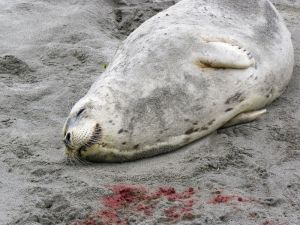
A mother harbor seal, who had recently given birth, was found dead on the beach north of the Ocean Park beach approach last week, thought to have been a victim of an intentional vehicular killing.  Photo by SUZY WHITTEY / Chinook Observer

A mother harbor seal, who had recently given birth, was found dead on the beach north of the Ocean Park beach approach last week, thought to have been a victim of an intentional vehicular killing.
Photo by SUZY WHITTEY / Chinook Observer

April 20, just hours after the mother seal had given birth. Herb McClintock, an Ocean Park retiree and volunteer who searches local beaches for injured wildlife on a near daily basis had placed warning signs around the animals, but it appears that a speeding driver plowed through the area, severing the mother’s tail. By the time McClintock returned around 8:30 that morning, the mother seal was near death, and the baby had vanished. Experts say there were no clues that hinted at the pup’s fate, but surmised that it could have been carried off by an animal, swept out to sea, or abducted by the assailants.

“It’s such an example of cruel callousness – I think a lot of people would be shocked by it,” Kristin Simon, a Senior Cruelty Caseworker with PETA said in a phone interview Thursday afternoon.

According to Simon, PETA has offered rewards for a variety of abuse, neglect and abandonment cases, but they prioritize violent crimes against animals, because studies have indicated that people who abuse one animal are likely to continue hurting animals, and may escalate to violence against human beings.

“People who abuse animals rarely do so only once and almost never stop there,” Simon said. The organization tends to offer rewards in instances where police investigations have stalled out, due to a lack of witnesses.

“We offer rewards generally in cases of unsolved cruelty to animals where police feel the reward could help bring someone to justice. When they don’t have those leads and just don’t have enough information to pursue the case, that’s where we step in,” Simon said. “Whoever can harm an animal, especially in this way has a level of callousness, and is very likely to share it with someone else … I think it’s highly likely someone knows something.”

Simon said the strategy has proven successful, and PETA has paid out “quite a few” rewards, which they fund through donations and the sale of merchandise.

“Our rewards are very successful because it is a lot of money. Who out there couldn’t use $5,000, just for doing the right thing?” Simon said.

This afternoon, NOAA enforcement officer Kevin Mitchell confirmed that his agency is actively investigating the incident, but declined to discuss the details of the investigation.

“There was some evidence, but I can’t discuss it any further. I can’t discus how great – or not great – it was,” Mitchell said.

According to him, acts of apparently intentional cruelty toward marine life are relatively rare on local beaches.

“I’ve been based out of Astoria now for two years and while I’ve worked other incidents that involved prohibited human interaction with marine mammals, this is the first case that I know of like this.”

Mitchell said he welcomed the reward.

“Any time a reward is offered, it can certainly help an investigation. A lot of times, with incidents that NOAA investigates, they occur in very rural areas without a lot of evidence left behind,” Mitchell said, “The best thing we can hope for is witnesses to the event or after the fact coming forward.”

Anyone with information about this case is encouraged to contact the National Oceanic and Atmospheric Administration’s Office of Law Enforcement toll-free at 1-800-853-1964 .

© 2014 Chinook Observer.