Hissy Fit
1


https://cosmosmagazine.com/biology/how-the-octopus-got-its-smarts
In 2008 the staff at Sea Star Aquarium in Coburg, Germany, had a mystery on their hands. Two mornings in a row, they had arrived at work to find the aquarium eerily silent: the entire electrical system had shorted out. Each time they would reset the system only to find the same eerie silence greeting them the next morning. So on the third night a couple of staff members kept vigil, taking turns to sleep on the floor.
Sure enough the perpetrator was apprehended: Otto, a six-month-old octopus.
He had crawled out of his tank and, using his siphon like a fire hose, aimed it at the overhead light. Apparently it annoyed him or maybe he was just bored. As director Elfriede Kummer told The Telegraph, “Otto is constantly craving for attention and always comes up with new stunts… Once we saw him juggling hermit crabs in his tank”.
Anecdotes of the mischievous intelligence of octopuses abound. Individuals have been reported to solve mazes, screw open child-proof medicine bottles and recognise individual people. Keepers are inclined to give them names because of their personalities.
Problem solving, tool use, planning, personality: these are hallmarks of the complex, flexible intelligence that we associate with back-boned animals, mostly mammals.
But a squishy octopus?
Some researchers who study the octopus and its smart cousins, the cuttlefish and squid, talk about a ‘second genesis of intelligence’ – a truly alien one that has little in common with the mammalian design.
While the octopus has a large central brain in its head, it also has a unique network of smaller ‘brains’ within each of its arms. It’s just what these creatures need to coordinate the mind-boggling complexity of eight prehensile arms and hundreds of sensitive suckers, which provide the octopus with the equivalent of opposable thumbs (roboticists have been taking note). Not to mention their ability to camouflage instantly on any of the diverse backgrounds they encounter on coral reefs or kelp forests. Using pixelated colours, texture and arm contortions, these body artists instantly melt into the seascape, only to reappear in a dazzling display to attract a mate or threaten a rival.

“They do things like clever animals even though they’re closely related to oysters,” says neuroscientist Clifton Ragsdale, at the University of Chicago. “What I want to know is how large brains can be organised not following the vertebrate plan.”
So how did evolution come up with this second genesis of intelligence or what film-maker Jacques Cousteau referred to as ‘soft intelligence’ back in the 1970s?
Cousteau inspired many a researcher to try and find answers. But it has been hard to advance beyond Technicolor screenshots and jaw-dropping tales – what zoologist Michael Kuba at Okinawa Institute of Science and Technology (OIST) refers to as “YouTube science”.
For decades the number of octopus researchers could be counted on one hand. They were poorly funded, and their valiant efforts were held in check by notoriously uncooperative subjects and inadequate tools. “You really had to be a fanatic,” says Kuba.
In the last few years, with more and more researchers lured to these enigmatic creatures, the field appears to have achieved critical mass. And these newcomers are the beneficiaries of some powerful new tools. In particular, since 2015 they’ve had the animals’ DNA blueprint, the genome, to pore over. It has offered some compelling clues.

Octopus are famous escape artists.
It turns out the octopus has a profusion of brain-forming genes previously seen only in back-boned animals. But its secret weapon may not be genes as we know them.
A complex brain needs a way to store complex information. Startlingly, the octopus may have achieved this complexity by playing fast and free with its genetic code.
To build a living organism, the decoding of the DNA blueprint normally proceeds with extreme fidelity. Indeed it’s known as ‘the central dogma’. A tiny section of the vast blueprint is copied, rather like photocopying a single page from a tome. That copy, called messenger RNA (mRNA), then instructs the production of a particular protein. The process is as precise as a three-hat chef following her prized recipe for apple pie down to the letter.
But in a spectacular example of dogma-breaking, the octopus chef takes her red pen and modifies copies of the recipe on the fly. Sometimes the result is the traditional golden crusted variety; other times it’s the deconstructed version – apple mush with crumbs on the side.
This recipe tweaking is known as ‘RNA editing’. In humans only a handful of brain protein recipes are edited. In the octopus, the majority get this treatment.
“It introduces a level of sophistication and complexity we never thought of. Perhaps it’s related to their memory,” says Eli Eisenberg, a computational biologist at the University of Tel Aviv. Though he quickly adds, “I must stress this is complete speculation”.
Jennifer Mather, who studies squid and octopus behaviour at the University of Lethbridge in Alberta, Canada, suggests it might go some way to explaining their distinct personalities.

Pigment filled sacs on octopus skin are called chromatophores.
There’s no doubt that linking octopus intelligence to RNA editing is the realm of fringe science. The good news is it’s a testable hypothesis.
Researchers are now gearing up with state-of-the-art tools such as the gene-editing technology CRISPR, new types of brain recorders and rigorous behavioural tests to see whether RNA editing is indeed the key to octopus intelligence.
Some 400 million years ago, cephalopods – creatures named for the fact that their heads are joined to their feet – ruled the oceans. They feasted on shrimp and starfish, grew to enormous sizes like the six-metre long Nautiloid, Cameroceras, and used their spiral-shaped shells for protection and flotation.
Then the age of fishes dawned, dethroning cephalopods as the top predators. Most of the spiral-shelled species became extinct; modern nautilus was one of the few exceptions.
But one group shed or internalised their shells. Thus unencumbered, they were free to explore new ways to compete with the smarter, fleeter fish. They gave rise to the octopus, squid and cuttlefish – a group known as the coleoids.
Their innovations were dazzling. They split their molluscan foot, creating eight highly dexterous arms, each with hundreds of suckers as agile as opposable thumbs. To illustrate this dexterity, Mather relates the story of a colleague who found his octopus pulling out its stitches after surgery.
But those limber bodies were a tasty treat to fish predators, so the octopus evolved ‘thinking skin’ that could melt into the background in a fifth of a second. These quick-change artists not only use a palette of skin pigments to paint with, they also have a repertoire of smooth to spiky skin textures, as well as body and arm contortions to complete their performance – perhaps an imitation of a patch of algae, as they stealthily perambulate on two of their eight arms.
“It’s not orchestrated by simple reflexes,” says Roger Hanlon, who researches camouflage behaviour at the Marine Biological Laboratory in Woods Hole, Massachusetts. “It’s a context-specific, fast computation of decisions carried out in multiple levels of the brain.” And it depends critically on a pair of camera eyes with keen capabilities.
It takes serious computing power to control eight arms, hundreds of suckers, ‘thinking skin’ and camera eyes. Hence the oversized brain of the octopus. With its 500 million neurons, that’s two and a half times that of a rat. But their brain anatomy is very different.
A mammalian brain is a centralised processor that sends and receives signals via the spinal cord. But for the octopus, only 10% of its brain is centralised in a highly folded, 30-lobed donut-shaped structure arranged around its oesophagus (really). Two optic lobes account for another 30%, and 60% lies in the arms. “It’s a weird way to construct a complex brain,” says Hanlon. “Everything about this animal is goofy and weird.”
Take the arms: they’re considered to have their own ‘mini-brain’ not just because they are so packed with neurons but because they also have independent processing power. For instance, an octopus escaping a predator can detach an arm that will happily continue crawling around for up to 10 minutes.
Indeed, until an experiment by Kuba and colleagues in 2011, some suspected the arms’ movements were independentof their central brain. They aren’t. Rather it appears that the brain gives a high-level command that a staff of eight arms execute autonomously.
“The arm has some fascinating reflexes, but it doesn’t learn,” says Kuba, who studied these reflexes between 2009 and 2013 as part of a European Union project to design bio-inspired robots.
And then there’s their ‘thinking’ skin. Again the brain, primarily the optic lobes, controls the processing power here. The evidence comes from a 1988 study by Hanlon and John Messenger from the University of Sheffield. They showed that blinded newly hatched cuttlefish could no longer match their surroundings.

They were still able to change colour and body patterns but in a seemingly random fashion. Anatomical evidence also shows that nerves in the lower brain connect directly to muscles surrounding the pigment sacs or chromatophores.
Like an artist spreading pigment on a pallet, activating the muscles pulls the sacs apart spreading the chromatophore pigments into thin discs of colour. But the octopus is not composing a picture. Hanlon’s experiments with cuttlefish show they are deploying one of three pre-existing patterns – uniform, mottled or disruptive – to achieve camouflage on diverse backgrounds.
As far as detailed brain circuitry goes, researchers have made little progress since the 1970s when legendary British neuroscientist J.Z Young worked out the gross anatomy of the distributed coleoid brain. Escaping Britain’s dismal winter for the Stazione Zoologica in balmy Naples, Young’s research was part of an American Air Force funded project to search for the theoretical memory circuit, the ‘engram’.
“They were ahead of their time,” says Hanlon, who experienced a stint with Young in Naples. Nevertheless they were limited by the paucity of brain-recording techniques that were suited to the octopus.
It’s a problem that has continued to hold back the understanding of how their brain circuits work. “Is it the same as the way mammals process information? We don’t know,” says Ragsdale.
It’s not for want of trying, as Kuba will tell you. In the 1990s, he joined the lab of neuroscientist Binyamin Hochner at the Hebrew University of Jerusalem. Hochner was a graduate of Eric Kandel’s lab, the Nobel laureate who pioneered studies on how the sea slug Aplysia learns.
All the action takes place in the gaps between individual neurons, the ‘synapse’. The synapse may look like an empty gap under the microscope but it’s a crowded place. It’s packed with over 1,000 proteins that assemble into a pinpoint-size microprocessor. If each neuron is like a wire, it’s up to this microprocessor to decide whether the signal crosses over from one wire to the next. When the sea slug learns a lesson, for instance withdrawing its gill in response to a tail shock, that’s because new computations at the synapse rerouted the connections.
Kuba, however, found an octopus to be far less obliging than a sea slug. Whatever electrical probe he stuck into its brain was rapidly removed thanks to all those opposable thumbs. Ragsdale also had his share of frustration. “We have a technical problem with sharp electrodes. For example, if you put an electrode into the optic lobe, the neurons will fire for about 10 to 20 minutes and then become silent.”
Kuba, who is now based at the Okinawa Institute of Science and Technology, hopes that a new kind of miniature brain logger that sits on the surface of the brain, hopefully out of reach of prying suckers, will kick-start the era of octopus brain-circuit mapping.
“There’s a lot of technical challenges, but they are surmountable,” agrees Ragsdale.
The irony is that the first insights into how the vertebrate brain sends signals came from a squid. In 1934 Young identified a giant squid nerve cell that controlled the massive contractions of its mantle, the bulbous muscular sac behind the eyes that both houses the organs and squeezes water through the siphon with such great effect!
Like mammalian neurons, the most distinctive feature of the squid cell was its wire-like axon, but with a diameter of around one millimetre, it was 1,000 times fatter than those of mammals. The colossal size allowed researchers to insert a metal electrode and measure the changing electrical voltage as a nerve impulse travelled along the axon.
All this foundational knowledge shed light on vertebrate brains, but the detailed circuitry of the squid brain was largely left in the dark.

Octopus are body artists that use skin colour, texture and arm contortions for their disappearing acts.
It was another frustrated neuroscientist who opened the latest front into the understanding of soft intelligence.
In the early 1990s, Josh Rosenthal, based at William Gilly’s lab at Stanford, was making use of the time-honoured giant squid motor axon. But with a new purpose. Rather than measure its electrical properties, Rosenthal wanted to isolate one of its key components: the ‘off’ switch. It is a protein called the potassium channel.
The squid neuron made this protein according to a recipe carried by its DNA blueprint, which is cached in the cell’s nucleus. To access the recipe, the cell makes a mRNA transcript, rather like transcribing a single recipe from a recipe book. Rosenthal wanted to isolate these transcripts and read the code sequence for the protein channels.
But he had a problem. Every time he read the sequence for the potassium channel, it was slightly different. Was it just an error? If so, it was highly consistent. The changes were not random. They always occurred at one or more precise positions in the code. And, invariably, the letter A was always changed to the letter G.
For instance, imagine a recipe for apple pie was supposed to read: Place the crust around the pie. Instead it was being edited to: Place the crust ground the pie. Such a change might instruct the modern-day deconstructed apple pie rather than the traditional crusted version.
Unbeknownst to Rosenthal, Peter Seeburg at the University of Heidelberg was puzzling over a similar glitch in a recipe for a human brain protein, the glutamate receptor. When Seeburg’s paper was published in 1991, Rosenthal recalls, “everyone got excited”.
Clearly editing brain recipes was important for humans and squid. But why?
In the human (or mouse), editing the glutamate receptor changed how much calcium could flow into brain cells. In mice, failure to edit was lethal, as it allowed toxic levels of calcium to stream in. There’s also evidence that failure to edit the same receptor in humans is associated with the neurodegenerative disease Amyotrophic Lateral Sclerosis.
An enzyme called ADAR2 carried out these crucial edits to the RNA recipe. Just why evolution hasn’t gone ahead and ‘fixed’ the DNA source code of the glutamate receptor remains a mystery.
As for the squid potassium channel, Rosenthal had a hunch. After an electrical signal has passed through a neuron, it needs a ‘reset’ for the next signal. The potassium channel plays a crucial part. In cold temperatures, the reset might take longer, making the animal a bit sluggish. Could RNA editing be a way of fine tuning the system in response to temperature? Rosenthal tested his idea by spending several years collecting octopuses that live in either tropical, temperate or polar climates. It was indeed the polar octopuses that were the most avid editors of their potassium channels.
Potassium channels turned out to be just the tip of the iceberg. Rosenthal teamed up with computation geek Eli Eisenberg at Tel Aviv University to trawl through mRNA databases and find out just how much recipe tweaking was going on with squid genes. In humans, tweaking is rare – restricted to a handful of brain gene recipes. In the squid, the majority of brain recipes received this treatment. Many of them were related to proteins found at the synapses, the microprocessors for memory and learning.
Could this extemporising with brain protein recipes be important for soft intelligence? It’s a tantalising idea. “Coleoids show it. Nautilus – the stupid cousin – does not, it’s like any other mollusc,” says Eisenberg.
“Coleoids are editing the same proteins that we know are involved in learning and memory. By editing them or not, it’s not a stretch to hypothesise that they are adding flexibility and complexity to the system,” says Rosenthal.

Cuttlefish have an impressive capacity to learn. These Australian giants are learning about the birds and the bees at Whyalla, South Australia.
Over in Chicago, Cliff Ragsdale, another frustrated octopus neuroscientist, was also turning his interest to octopus DNA.
In 2015, working with Daniel Rokhsar and Oleg Simakov of OIST, the Ragsdale laboratory managed to read the genome of the California two-spot octopus.
It turns out that the octopus has more genes that we do: 33,000 compared to our 21,000. But gene number per se doesn’t bear much relation to brain power: water fleas also have about 31,000. In fact most of the genes in the octopus catalogue were not all that different to those of its close relative – the limpet, a type of sea snail. But there were two gene families that stood out like a sore thumb. One was a family of genes called protocadherins. This family of ‘adhesion’ proteins are known to build brain circuits. Like labels on the tips of growing neurons, they allow the correct types of neurons to wire to each other — so neuron 370 connects up to neuron 471 at the right time and the right place. Limpets and oysters have between 17-25 types of protocadherins. Vertebrates have 70 types of protocadherins plus over 100 different types of related cadherins. These circuit builders have long been thought to be the key to vertebrate braininess.
So it was stunning to find that the octopus has a superfamily of 168 protocadherins. Ragsdale says the squid genome, also now being sequenced, shows it is similarly equipped with hundreds of circuit-building genes.
The other stand-out in the octopus genome was a family of genes called ‘zinc fingers’. They get their name because the encoded proteins have a chain structure that is cinched by zinc atoms into a series of fingers. These fingers poke into the coils of DNA to regulate the transcription of genes.
Limpets have about 413 of these zinc fingers. Humans have 764. Octopuses have 1,790! Perhaps this profusion of octopus zinc fingers is involved in regulating the network of brain genes?

So far, the octopus has revealed three big clues as to how it generates brain complexity: it has multiplied its set of circuit-building protocadherin genes and its network-regulating zinc fingers. It has also unleashed RNA editing to generate more complexity on the fly.There may also be a fourth mechanism at work.
Genes are supposed to stay put. But ‘jumping genes’, which are closely related to viruses, have a tendency to up anchor and insert themselves into different sections of the DNA code. That can scramble or otherwise change its meaning. Imagine if the words ‘jumping gene’ just started appearing randomly in this text. Fred Gage’s group at the Salk Institute in San Diego has found that during the development of the nervous system in mice and humans, jumping genes start jumping.
What this means is that each individual brain cell ends up with slightly different versions of its DNA code. Gage speculates that this may be a way to generate diversity in the way neurons wire up. Perhaps it goes some way to explaining why twins, born with the same DNA, nevertheless end up with different behaviours.
“If you believe that theory,” says Ragsdale, “you’ll be struck by the fact that we also found a high number of jumping genes active in the brain tissues of the octopus.” Testing the theory
Unravelling the details of how octopus and squid are using and abusing the genetic code is generating iconoclastic hypotheses about how they generate their complex brain circuitry.
And researchers are not blind to the problems of dogma-breaking. For one thing, playing fast and free with the genetic code creates an astronomical number of possible proteins, most of which would be toxic to the animal, says Eisenberg. “It’s very troubling; one hypothesis is that this may explain their short lifespan of one to three years.”
Troubling or not, Rosenthal and colleagues at Woods Hole are moving full speed ahead to test the role of RNA editing in the coleoids by bringing together researchers with different expertise. “There’s a lot of moving pieces,” says Rosenthal.
For starters, their Woods Hole team is cultivating four species of small squid and cuttlefish that reach sexual maturity in two to three months. The goal is to manipulate the squid’s genes using the genetic engineering tool, CRISPR. To see if they can get CRISPR working, they will try to ‘knock-out’ the pigment genes. If they’re successful they should see the result on the squid bodies. “It’s a beautiful in-built test,” says Rosenthal.
If that works, they will try the big experiment. Does impairing the ability to edit proteins at the synapse (by knocking out the ADAR2 gene responsible for RNA editing) tamper with learning and memory?
Meanwhile, collaborator Alex Schnell, a behavioural biologist based at the University of Cambridge in the UK, is developing rigorous tests for complex learning and memory in cuttlefish. In particular, she is testing their capacity for “episodic memory”, a detailed weaving together of memories once thought to be a strictly human attribute.
For instance, it’s thanks to your episodic memory that you recall exactly where you were and what you were doing on 11 September 2001. Since the late 1990s, we know that animals like great apes, crows and jays also have that capacity. Maybe cuttlefish do too. Schnell’s initial results show that cuttlefish can learn and memorise complex information about their favourite food, such as when and where it is likely to be found.
With other teams around the world pursuing similar strategies, it seems likely that after decades of awe and wonder, the mystery of soft intelligence may soon yield to hard science.
This article appeared in Cosmos 80 – Spring 2018 under the headline “Alien intelligence”

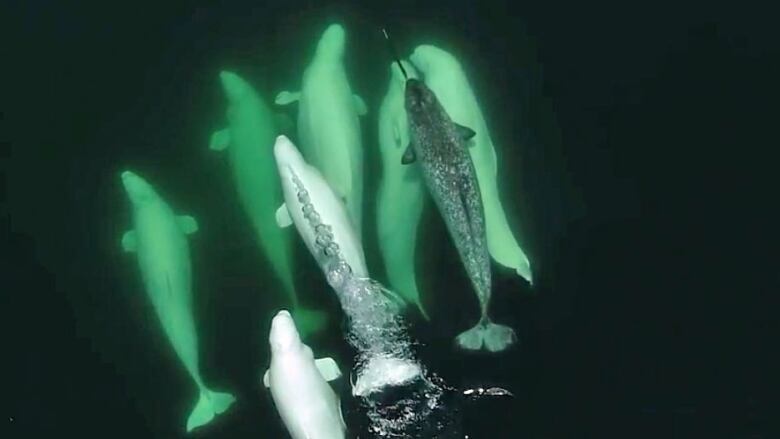
Drone footage captured by the Group for Education and Research on Marine Mammals (GREMM) shows a narwhal with a group of belugas in the St. Lawrence River in July 2018. (GREMM)
An unusual visitor has been hanging out in the St. Lawrence River for the past three years: A narwhal, more than 1,000 kilometres south of its usual range.
But the lone narwhal is not alone — it appears he has been adopted by a band of belugas.
The narwhal — thought to be a juvenile male because of its half-metre-long tusk — was filmed in July playing among a pod of young belugas, thought to be mostly or all males.
The video was taken by the Group for Research and Education on Marine Mammals (GREMM), a non-profit group dedicated to whale research, conservation and education based in Tadoussac, Que.
“It behaves like it was one of the boys,” said Robert Michaud, the group’s president and scientific director.
In the drone footage captured by GREMM researchers and posted on their website Whales Online, a pod of nine or 10 belugas swim closely together near the surface, rolling and rubbing against each other.
“They are in constant contact with each other,” Michaud said. “It’s a like a big social ball of young juveniles that are playing some social, sexual games.”
The interactions between the narwhal and the belugas appear to be identical to those among just the belugas, suggesting the narwhal has been fully accepted as part of the group.
Narwhals live in the icy waters of the Arctic, including those surrounding parts of Canada, Norway, Greenland and Russia. They typically don’t range any farther south than northern Quebec’s Ungava Bay, located south of the southern tip of Baffin Island.
One was previously spotted in the St. Lawrence estuary by the Department of Fisheries and Oceans in 2003, according to GREMM.
But sightings are rare enough that there was a bit of a buzz when the researchers aboard GREMM’s boat, Le Bleuvet, spotted one on July 29, 2016, among a pod of 60 to 80 belugas.
The researchers reported that it behaved like the belugas, even blowing bubbles from time to time, and drawing no special attention, except from one curious juvenile beluga.
The same narwhal — identified from photographs of its unique markings — was spotted again the following year, in 2017, and three times this year, likely with the same population of belugas, some of whom are identified and named by GREMM.
The group tracks and studies the whales from June to October, but loses track of them in the winter, when ice prevents GREMM from getting out in the research boat.
The narwhal itself hasn’t been named, Michaud said, as the group doesn’t tend to name “vagrants” — “because we don’t know when they will leave.”
So how did the narwhal end up in the St. Lawrence in the first place?

The narwhal was first spotted among the belugas of the St. Lawrence in 2016. (GREMM)
Michaud said it’s not unusual for young whales to wander into strange habitats. Young belugas, for example, have wandered as far as New Jersey and Nova Scotia.
Some, unable to find their own kind, end up trying to make friends with boats and humans, and get fatally injured by propellers.
“That little narwhal that made a similar trip was very lucky,” Michaud said. “Because he found almost normal buddies.”
Kristin Laidre, a University of Washington researcher who has studied narwhals and other Arctic marine mammals for nearly two decades, said she’s surprised that a narwhal has been spotted so far south — and interacting so closely with belugas.

These beluga whales were spotted off Ingonish, N.S., earlier this year. Young whales are known to wander.(Submitted by Levon Drover)
While beluga and narwhal habitats overlap in many parts of the Arctic, they’re not observed interacting very often, and tend to be in different places at different times, especially in the summer.
“Narwhals and belugas, though closely related, are pretty different,” she said.
Narwhals are good divers that hunt deepwater fish and more comfortable in areas that are covered in dense ice in the winter. Belugas prefer coastal, shallower waters with less ice, and prefer fish like salmon and capelin that swim close to the surface.
But there are some similarities: they’re both very social species, although few details are known about their social structures. And little is known about how similar their communication may be; both make a variety of clicks and chirps.
There is some evidence that interaction takes place between belugas and narwhals from time to time.
A study published in 1993 described the skull of what was believed to be a narwhal-beluga hybrid, with teeth somewhat similar to both, although that was never confirmed with DNA testing.

The narwhal was spotted three times by GREMM researchers this year. (GREMM)
The study was co-authored by Randall Reeves, a Canadian scientist and consultant with Okapi Wildlife Associates in Hudson, Que., who has been studying whales for 40 years.
He, too, said belugas and narwhals tend to “stick to their own kind” when they encounter one another in the north.
But Martin Nweeia, a researcher at Harvard University who has been studying narwhals for nearly two decades, said given how social both species are, he thinks they’d be similarly capable of caring and compassion. (Although he agreed not much is known about their social structures.)
Nweeia, who has worked with Inuit in the Canadian Arctic and Greenland to gather traditional knowledge about narwhals and belugas, says there’s an Inuit legend that puts a narwhal among belugas. In it, a woman hunting belugas falls into the water and her hair twists into a narwhal horn.
Nweeia’s research team has also “observed the opposite,” he said, spotting belugas swimming among narwhals in Arctic Bay, Nunavut.
“I don’t think it should surprise people,” he said. “I think it shows … the compassion and the openness of other species to welcome another member that may not look or act the same. And maybe that’s a good lesson for everyone.”

Here’s part of a comment I received from a hunter the other day: “I love animals, but fully understand that all living things have their place in God’s plan and on His Earth. He gave us domain over animals. Read Genisis [sic] and wake up!”
How convenient. But do people really still believe that kind of crap?
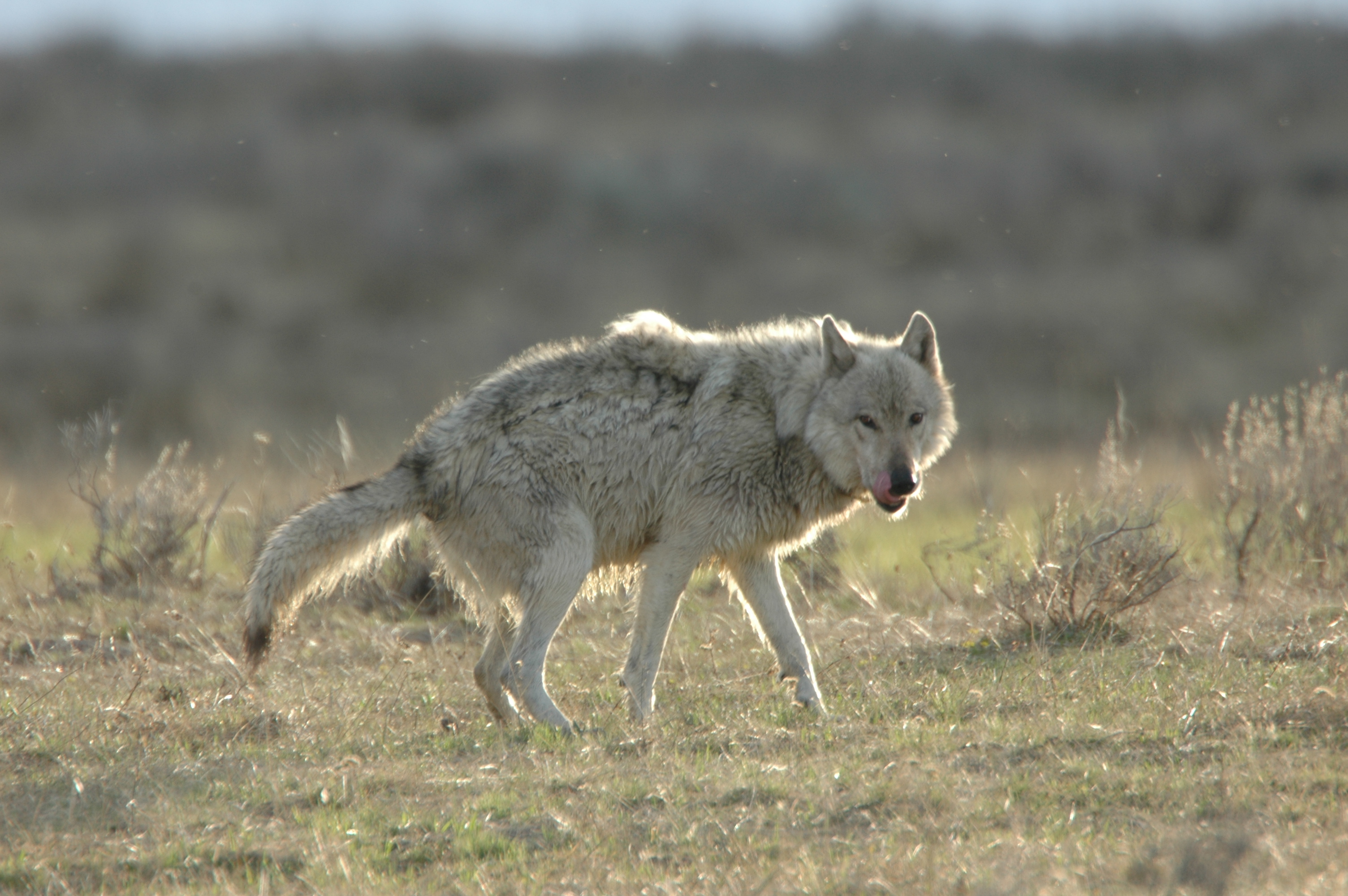
Sadly, the answer appears to be yes.
A staggering 46% of Americans believe that god created humans in their present form within the past 10,000 years, according to a USA Today/Gallup survey conducted this year from May 10th to the 13th. Not only has that number not changed much in the past 30 years since Gallup first asked the question on Creationism vs Evolution, it’s actually gone up 2%, from 44% in 1982 to 46% in 2012!
Gallup’s Frank Newport told CNN, “Despite the many changes that have taken place in American society and culture over the past 30 years, including new discoveries in biological and social science, there has been virtually no sustained change in Americans’ views of the origins of the human species since 1982. All in all, there’s no evidence in this trend of a substantial movement toward a secular viewpoint on human origins.”
So, why do I care what people believe? Why won’t I just let them have their fun?
Because such dogma can directly affect how non-humans are treated.
The literal belief that humans have some kind of god-given authority over every other species of animal bestows undeserved power into unreliable hands. Creationist claptrap that favors one species over another perpetuates speciesist doctrine devised to demean and control our fellow animals in the same way that notions of racial superiority were used against our fellow humans.
The second most common view of those polled—held by 32% of respondents–is that humans evolved with god’s guidance. Again, a very convenient conviction that can be used to put humans on top.
Newport goes on to say, “It would be hard to dispute that most scientists who study humans agree that the species evolved over millions of years, and that relatively few scientists believe that humans began in their current form only 10,000 years ago without the benefit of evolution. Thus, almost half of Americans hold a belief [in creationism] that is at odds with the preponderance of scientific literature.”
To their benefit, and to the detriment of every other living thing on the planet, I might add.
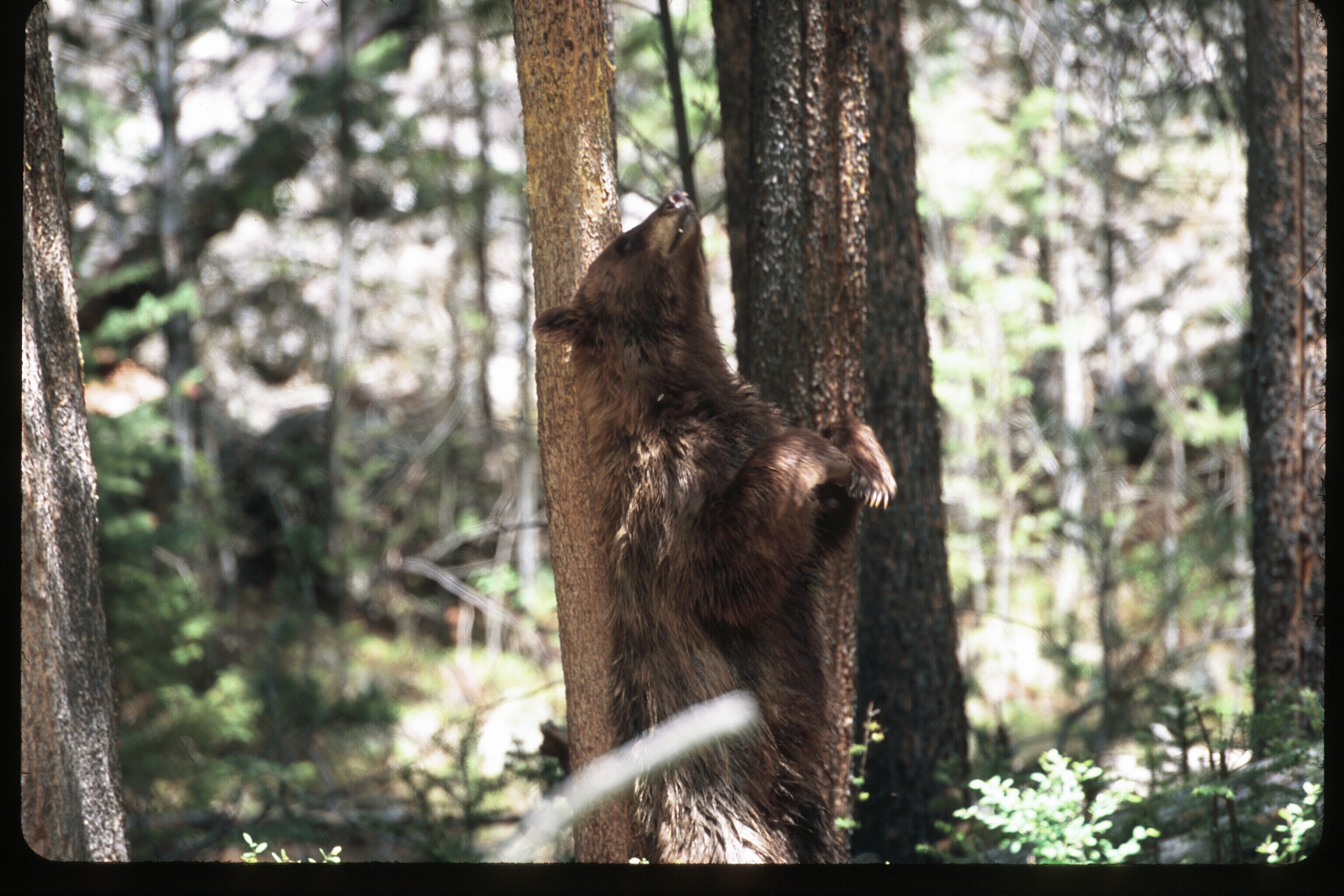
Wildlife Photography Copyright Jim Robertson
Michael Milstein, a spokesman with NOAA Fisheries, says researchers on Wednesday spotted the 20-year-old whale known as J35 carrying her dead young off the tip of Washington’s Olympic Peninsula.
The calf died July 24 and the image of the mother whale clinging to the dead calf has struck an emotional chord worldwide.
Milstein says researchers with Fisheries and Ocean Canada also spotted another member of the same pod — the 3 ½-year old whale J50 that is emaciated. The ailing orca was swimming with her mom Wednesday.
A team of experts led by NOAA Fisheries have been searching for the young whale to assess her health and potentially give her medication.

Mother orca J-35 has been balancing body of its dead calf on its nose for more than a week. (Soundwatch NMFS Permit #21114/Whale Museum )
Listen6:00
Members of a pod of endangered killer whales now appear to be taking turns floating the body of a newborn calf that died more than week ago.
As It Happens reported on Friday about J-35, a mother orca from B.C.’s endangered killer whale population that has been balancing her dead calf on her nose near San Juan Island, Wash.
It’s now been more than a week and the mother whale is still carrying the calf’s remains — sparking concerns among researchers that she’ll tire herself out.
“We do know her family is sharing the responsibility of caring for this calf, that she’s not always the one carrying it, that they seem to take turns,” Jenny Atkinson, director of the Whale Museum on San Juan Island, told As It Happens guest host Piya Chattopadhyay.
“While we don’t have photos of the other whales carrying it, because we’ve seen her so many times without the calf, we know that somebody else has it.”
The Whale Museum released an audio recording on Monday of the mother communicating with her pod.
“You’re hearing them communicate with one another. They’re using a series of calls and whistles to communicate. And then you’ll hear a clicking noise. That’s echo-location,” Atkinson said.
“They use it to pick up their food source as well as map their underwater environment.”
The Whale Museum recorded the sound of the killer whale pod communicating to each other off San Juan Island, using geo-location to alert each other to potential obstacles and food sources. 0:20
She said it’s possible the sounds are related to their mourning of the calf — but researchers can’t know for sure.
“We picked up some calls earlier in the week and we hear things that sounded more like a very urgent call,” she said. “If you think of going to a wake for a family, things can go on for multiple days and the grief is still deep, but the emotions kind of soften.”
That’s exactly what Atkinson believes the whales are doing with the calf — holding their own version of a wake or a funeral.
“Ceremonies can go on for days to honour and mourn the loss of a loved one,” she said. “I think that what you’re seeing is the depth of importance of this calf and the grief of the mother and the family.”

This July 25 photo shows the orca mother, J-35, balancing her dead baby on her nose trying to keep it afloat. (Ken Balcomb/Centre for Whale Research)
Anthropologist Barbara King, who studies animal emotion, agrees the whale’s behaviour is likely a display of grief.
There is a body of evidence that shows whales and dolphins mark the passing of their dead, King told CBC’s On The Coast.
Sometimes they will surround dead companions, showing curiosity or exploration, King said. Other times, it goes further: they keep vigils around the bodies of dead podmates or keep them afloat.
“It’s not anthropomorphic to use this label for them,” King said. “Grief and love are not human qualities. They’re things we share with some other animals.”
The southern resident killer whale population consists of three orca pods that live around the coast of Oregon, Washington and Vancouver Island.
Their numbers are dwindling and they haven’t have a successful birth since 2015.
After the death of a 23-year-old orca June, the total number of southern resident killer whales is down to 75, the lowest it’s been since the early ’80s. The population has dropped by eight since 2016.
 CBC News
✔@CBCNews
This orca mother has been holding her dead calf afloat for more than a week in a “heartbreaking” ritual.
Read more at http://www.cbc.ca/1.4731063?cmp=FB_Post_News …
Their decline is attributed largely to a lack of available chinook salmon, their primary food source.
Researchers are already worried that another young whale in the pod — J-50 — could be the next to die. The four-year-old is becoming increasingly emaciated.
“I don’t see how she can survive,” Dave Ellifrit of the Center for Whale Research, told the Seattle Times.
In May, Canada’s federal government announced plans to cut the allowable catch of chinook by 25 to 35 per cent.
In June, it announced further measures to help the endangered population, including reducing underwater vessel noise and better monitoring of pollution.
Atkinson said it’s not hard to see why people have had such visceral reactions to images of J-35 and her calf.
“Watching what she’s going through, most people have been through some level of grief and have had some situation that this touches, because they can understand losing a child, losing a calf, and how heart-wrenching that is,” she said.
“And then not to be able to do anything when humans like to take action. We like to be able to do stuff. Sometimes the hardest thing is just to sit back and give respect and be a witness to a situation.”
Written by Sheena Goodyear. Interview with Jenny Atkinson produced by Samantha Lui.
https://komonews.com/news/local/mourning-orca-mother-carries-dead-calf-for-fifth-day

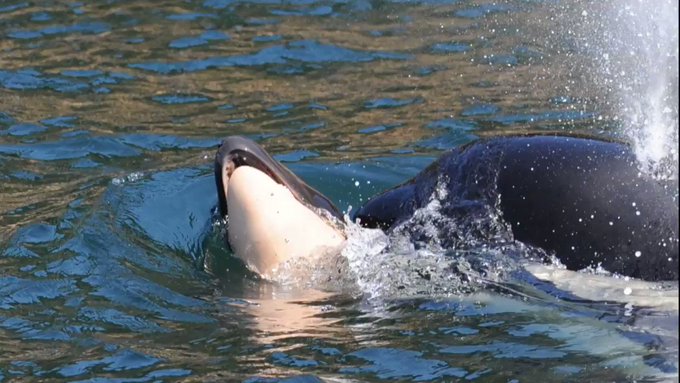
The mother of an orca calf that was born and died Tuesday carries her baby, unwilling to let it go. It is another in a series of unsuccessful pregnancies for the southern-resident orcas. (Ken Balcomb, Center for Whale Research)
A mourning orca whale continued to carry her dead calf for a sixth straight day on Saturday.
J35, a member of the critically endangered southern resident family of orcas, gave birth to her calf Tuesday only to watch it die within half an hour.
Since then, she’s been carrying the calf’s body around on her nose, diving to pick it up again when it falls off. She was last sighted in the early evening on Saturday in Canadian waters.
Scientists have documented grieving behavior in other animals with close social bonds in small, tightly knit groups, observed carrying newborns that did not survive.
Seven species in seven geographic regions covering three oceans have been documented carrying the body of their deceased young, including Risso’s dolphin in the Indian Ocean; the Indo-Pacific bottle-nosed dolphin and the spinner dolphin in the Red Sea; and pilot whales in the North Atlantic.
But more than 24 hours of grieving is a rare occurance, says Deborah Giles, research scientist for University of Washington Center for Conservation Biology and research director for the nonprofit Wild Orca.
“It is horrible. This is an animal that is a sentient being,” Giles told the Associated Press. “It understands the social bonds that it has with the rest of its family members. She carried the calf in her womb from 17 to 18 months, she is bonded to it and she doesn’t want to let it go. It is that simple. She is grieving.”
J35’s news came just as researchers were also tracking a 4-year-old in the southern residents that is emaciated, and whose survival may be in doubt due to loss of body fat.
Researchers have been growing more concerned about the fate of the southern residents, who face three major challenges to their survival as a species: toxins, vessel traffic and lack of adequate food (their primary food source being chinook salmon).
The most recent census of the orcas has found that they number just 75 in the area, across three southern resident pods. For the last three years there have been no new calves born to the shrinking killer whales in the Pacific Northwest.
For researchers who work closely with the southern residents, their continued decline is painfully apparent.
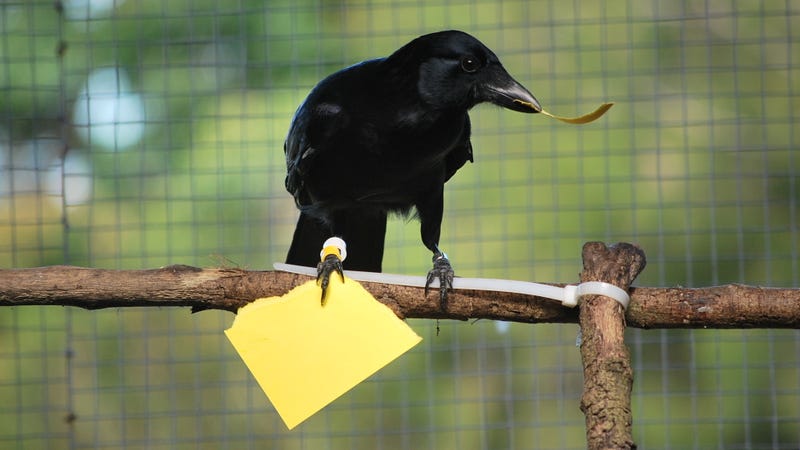
New research shows that crows can recreate tools from memory, a capacity previously thought impossible for birds.
Crows are super smart—we knew that already. In addition to understanding causality and analogies, they can remember human faces, plan ahead, and hide their food from others. But crows are also known for their amazing tool-building skills, which they use to construct sticks, hooks, and barbs from plant material. New research published today in Scientific Reports suggests this ability, at least among New Caledonian crows (a particularly intelligent species of corvid), is more sophisticated than we thought, and that these birds are able to construct tools from memory.
In human societies, cultural evolution and tool building is an iterative process, whereby social traditions improve over time due to teaching, language, and imitation. But among New Caledonian crows, it’s not clear if their tool-making skills are the result of imitation, or an ability acquired through the passing down of cultural traditions. A going hypothesis is that tool designs are in fact culturally transmitted, and that it’s done through a process known as “mental template matching.”
“Under the mental template matching hypothesis, New Caledonian crow tool designs could be passed on to subsequent generations if an individual used or observed the products of tool manufacture (such as their parents’ tools), formed a mental template of this type of tool design (a mental representation of some or all of the tool’s properties), and then reproduced this template in their own manufacture,” explain the authors in the new study.
Researchers Russell Grey from the University of Auckland, New Zealand, Sarah Jelbert from the University of Cambridge, along with colleagues from several other institutions, conducted an experiment that now provides the first evidence in support of this assertion.
The researchers trained eight crows to drop bits of paper into a vending machine, which the birds did to receive food rewards. The crows later learned that only cards of a specific size, either large pieces measuring 40 x 60 mm or small pieces measuring 15 x 25 mm, were rewarded. Once the crows were trained to recognize which sizes of paper tools resulted in a food reward, the scientists took all paper pieces away and replaced them with a single large sheet of paper that didn’t fit into the dispenser. Incredibly, the birds tore up the large card to create pieces that matched the size of the paper they previously used to earn rewards. The researchers called it “manufacture by subtraction.”
Importantly, the birds did not have visual access to any of the previous scraps of paper. The experiment suggests the birds held a mental image of the desired tool in their minds, which they used to construct the new tool. It also means some species of birds may have the ability to improve tools over time (something not proven in the study, but alluded to as a possibility), which they could do by recreating and then adjusting other designs they’ve seen and memorized. That’s an important consideration, because the ability to modify items from memory is typically associated with tool-making cultures, such as humans and some nonhuman primates.
Edward A. Wasserman, an experimental psychologist and brain scientist at the University of Iowa who wasn’t involved with the new research, says the study is an important addition to our understanding of avian intelligence, and that the conclusions were “clear and compelling.” That said, he wasn’t surprised by the results.
“The prime limitation on our appreciation of avian intelligence is the lack of creativity in our own experimental methods,” Wasserman told Gizmodo. “Birds keep looking smarter as we conduct more ambitious and assiduous experiments.”
Wasserman was also keen to point out that crows aren’t the only intelligent birds.
“Pigeons, parrots, and jays have all been found to exhibit remarkable abilities to learn and remember a wealth of challenging tasks,” he said. “This evidence has come from both naturalistic observations and controlled laboratory experiments. The fact that the last common ancestor of birds and mammals lived 300 million years ago raises a profound question: was that ancestral species also smart or did intelligence evolve independently? That will be a hard question to answer.”
/https://public-media.smithsonianmag.com/filer/ba/6b/ba6b1209-f295-414b-a7f7-f8fc81bef30f/ertnwj.jpg)
As a mathematical concept, the idea of zero is relatively new in human society—and indisputably revolutionary. It’s allowed humans to develop algebra, calculus and Cartesian coordinates; questions about its properties continue to incite mathematical debate today. So it may sound unlikely that bees—complex and community-based insects to be sure, but insects nonetheless—seem to have mastered their own numerical concept of nothingness.
Despite their sesame-seed-sized brains, honey bees have proven themselves the prodigies of the insect world. Researcher has found that they can count up to about four, distinguish abstract patterns, and communicate locations with other bees. Now, Australian scientists have found what may be their most impressive cognitive ability yet: “zero processing,” or the ability to conceptualize nothingness as a numerical value that can be compared with more tangible quantities like one and two.
While seemingly intuitive, the ability to understand zero is actually quite rare across species—and unheard of in invertebrates. In a press release, the authors of a paper published June 8 in the journal Science called species with this ability an “elite club” that consists of species we generally consider quite intelligent, including primates, dolphins and parrots. Even humans haven’t always been in that club: The concept of zero first appeared in India around 458 A.D, and didn’t enter the West until 1200, when Italian mathematician Fibonacci brought it and a host of other Arabic numerals over with him.
But animal cognition researchers at the RMIT University of Melbourne, Monash University in Clayton, Australia and Toulouse University in France had a hunch that honey bees might just be one of the few species able to grasp the concept. Despite the fact that they have fewer than one million neurons in their brain—compared to 86,000 million in a human brain—the team recognized their cognitive potential.
“My lab was starting to accumulate some evidence that bees could do some advanced cognitive tasks, such as tool use, playing ‘soccer’—manipulating a ball to get a reward—and learning to encode information in human faces,” says Adrian Dyer, a postdoctoral student at RMIT University of Melbourne and co-author on the study. “We were aware that this animal model was very capable of learning complex things … it was the right time to formalize an experiment to see if the bee brain could process the concept of zero.”
To test this hypothesis, the team first taught the bees the concepts of “greater than” and “less than,” which previous research suggested the bees would be able to do. The researchers figured that if the bees could successfully show they understood that zero was less than various positive numbers, this would demonstrate the insects’ understanding of zero’s numerical value.
To do this, they first lured two groups of 10 bees each to a wall where two white panels containing different numbers of black shapes were displayed. They decided to teach half the bees “less than” and the other half “greater than,” using food rewards to train the bees to fly toward the panel with fewer or more shapes, respectively. When comparing two white panels with positive numbers of shapes in each, bees quickly learned to fly toward the correct one.
The real challenge, however, came when one of the panels contained no shapes at all. In several trials, the “less than” bees flocked to the empty panel, and the “greater than” bees to the panel with shapes. Despite the study’s small sample size, the researchers believed the bees were exhibiting zero processing capability.
The bees’ success at zero processing was much better when the blank panel was compared with a panel with many shapes—say, four or five—than when it was compared with a panel containing fewer. In other words, the further the comparison number got from zero, the better the bees were at determining which panel had fewer shapes. Interestingly, this is consistent with the results that researchers have found in human children using a similar experimental design, says Dyer. He says that this similarity in bees’ and humans’ development of zero processing capability suggests that bees and humans are likely conceptualizing zero in analogous ways.
Other bee cognition experts, however, doubt that this experiment definitively proves bees get the zero concept. Clint Perry, a research fellow at the Queen Mary University of London who has spent much of his career studying bee cognition, says that there likely could be other explanations for the bees’ behavior that make him “not convinced” that bees truly are understanding the concept of zero.
“The more parsimonious explanation for the results is the bees were using ‘reward history’ to solve the task—that is, how often each type of stimulus was rewarded,” Perry says. It’s possible the “less-than” bees, for example, were truly just learning that the blank panel earned them a reward 100 percent of the time, the one-shape panel 80 percent of the time, and so on. In other words, they were simply playing the best odds they could with the panels they were shown, without necessarily understanding the concept.
“I could see [bees’ zero processing] as a possibility—being able to count and being able to evaluate the value of numbers could give an adaptive advantage for survival,” says Perry. “I don’t see why [bees] couldn’t. But these experiments should be repeated and the interpretation verified to get at that.”
Dyer remains optimistic about the validity of his team’s results. He also says that this research suggests that the ability to conceptualize zero could be more common than we think—ancient humans, he postulates, likely had the potential for zero processing, cognitively speaking.
“We had some human ancient cultures which appear not to ever have used the concept of zero… but as we look across animal species, we see that their brains are capable of processing this information,” says Dyer. “So ancient civilizations had brains that for sure could process zero. It was just something about how their culture was set up; they were not so interested in thinking about number sequences.”
One practical implication for the research lies in the development of artificial intelligence; Dyer thinks reverse-engineering how the brains of animals like bees work could help us improve the abilities of artificial minds. But the first step is investigating the brain processes behind this ability.
“We’re at the dawn of trying to understand the concept of zero and how our brains might encode it,” he says. “This study produced high-quality behavioral data, and from that you can make some inferences. But we don’t know the exact neural networks at play—that is future work we hope to do.”
Read more: https://www.smithsonianmag.com/science-nature/bees-may-understand-zero-concept-took-humans-millennia-grasp-180969282/#UG6ksM62RUMAOtDz.99
Give the gift of Smithsonian magazine for only $12! http://bit.ly/1cGUiGv
Follow us: @SmithsonianMag on Twitter
A common raven, Corvus corax principalis, pictured at the Los Angeles Zoo. Though they share many similarities, ravens and crows differ in some physiological features and social behaviors.
PHOTOGRAPH BY JOEL SARTORE, NATIONAL GEOGRAPHIC PHOTO ARK
An American crow, Corvus brachyrhynchos, at the Sutton Avian Research Center. There are around 40 distinct species of crow.
PHOTOGRAPH BY JOEL SARTORE, NATIONAL GEOGRAPHIC PHOTO ARK
A Congo grey parrot, Psittacus erithacus erithacus, pictured at the Dallas Zoo. African grey parrots are famous mimics.
PHOTOGRAPH BY JOEL SARTORE, NATIONAL GEOGRAPHIC PHOTO ARK
Citron crested cockatoos, Cacatua sulphurea citrinocristata, pictured at Jurong Bird Park. These members of the parrot family are mainly found in Australia and several Pacific islands.
PHOTOGRAPH BY JOEL SARTORE, NATIONAL GEOGRAPHIC PHOTO ARK
An adult male great-tailed grackle, Quiscalus mexicanus, perches on a branch on Coiba Island, Panama. 10 different species of this highly social bird live throughout North and South America.
PHOTOGRAPH BY JEFF MAURITZEN
Until the 21st century, birds were largely dismissed as simpletons. How smart can you be with a brain the size of a nut?
And yet the more we study bird intelligence, the more those assumptions are breaking down. Studies have shown, for instance, that crows make tools, ravens solve puzzles, and parrots boast a diverse vocabulary.
Birds make good use of the allotted space for their tiny brains by packing in lots of neurons—more so than mammals, in fact. (Read: “Think ‘Birdbrain’ Is an Insult? Think Again.”)
But what actually qualifies a bird as smart? The definition should be broader than it is, scientists say.
“Being able to fly to Argentina, come back, and land in the same bush—we don’t value that intelligence in a lot of other organisms,” says Kevin McGowan, an expert on crows at the Cornell Lab of Ornithology in Ithaca, New York. “We’ve restricted the playing field to things we think only we can do.”
But if we’re talking about standard intelligence—ie. mimicking human speech or solving problems—“it always comes down to parrots and corvids,” McGowan says.
Members of the corvid family (songbirds including ravens, crows, jays, and magpies, to name a few) are among the most intelligent birds, though common ravens may have the edge on tackling tough problems, according to McGowan.
A study published in 2017 in the journal Science revealed that ravens even pre-plan tasks—a behavior long believed unique to humans and their relatives. (Related: “We Knew Ravens Are Smart. But Not This Smart.”)
In the simple experiment, scientists taught the birds how a tool can help them access a piece of food. When offered a selection of objects almost 24 hours later, the ravens selected that specific tool again—and performed the task to get their treat.
“Monkeys have not been able to solve tasks like this,” Mathias Osvath, a researcher at Sweden’s Lund University, said in a previous interview.
While crows do nearly as well as ravens solving intelligence tests, McGowan stresses that crows have an uncanny memory for human faces—and can remember if that particular person is a threat.
“They seem to have a good sense that every person is different and that they need to approach them differently.”
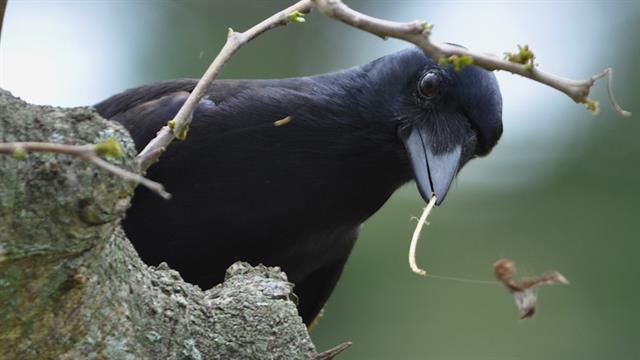
For instance, crows are warier of new people than ravens are—but conversely are more comfortable with humans they had interacted with before, according to a study published in 2015 in the journal Behavioral Ecology and Sociobiology.
“The crows around here, they know my face,” says McGowan. While at first the birds living near the lab seemed to dislike McGowan for approaching their nests, they love him now that he’s started leaving the birds healthy treats. (Read more about how ravens hold grudges against humans.)
“They know my car, they know my walk, they know me 10 miles away from where they’ve ever encountered me before. They’re just amazing that way.”
In a now well-known study published in 2015 in the journal Animal Behaviour, researchers donned masks and, while holding dead, taxidermied crows, laid out food in areas frequented by crows in Washington State.
Almost universally, the crows responded by scolding the people—and even alerting other crows in the vicinity. When the researchers returned weeks later wearing the same masks, but empty-handed, the crows continued to harass them and were wary of the area for days after. (Read: “Do Crows Hold Funerals for Their Dead?”)
While many species of parrots have a penchant for human speech, the African grey parrot is the most accomplished.
“There’s a lot going on in those little walnut brains of theirs,” says McGowan. “And they live so long that they can amass a lot of intelligence and a lot of memories.”
In the 1950s, Harvard comparative psychologist Irene Pepperberg began teaching an African grey parrot, Alex, English sounds. Before he died prematurely in 2007, Alex mastered roughly a hundred words, could use them in context, and even grasped the concepts of same, different, and zero.
Now Pepperberg is working with another African grey, Griffin, at Harvard University. Griffin can label shapes and colors, and is working on the concept of zero.
Cockatoos are the first animal observed making musical instruments.
When courting, male palm cockatoos of Australia use twigs and seed pods to create drumsticks. Each male has a unique musical style—a rhythm of his own that he creates by beating the tools against hollow trees.
Though palm cockatoos don’t dance while drumming, other species have exhibited a gift for boogying to a beat.
Video of Snowball, a captive sulphur-crested cockatoo, jamming to the Backstreet Boys took the Internet by storm a few years ago. (Watch:
“Snowball the Cockatoo Can Dance Better Than You.”)
Snowball’s performance is a delight to watch, but it also helped scientists discover that birds can follow a beat. By speeding the song up and down, they determined that Snowball actually does have a sense of tempo and rhythm.
Though corvids and parrots get most of the credit for being brainy, McGowan says, “There are sleeper birds out there” that we haven’t fully appreciated.
Great-tailed grackles, for instance, belong to the same family as blackbirds and orioles—a group not often considered particularly smart.
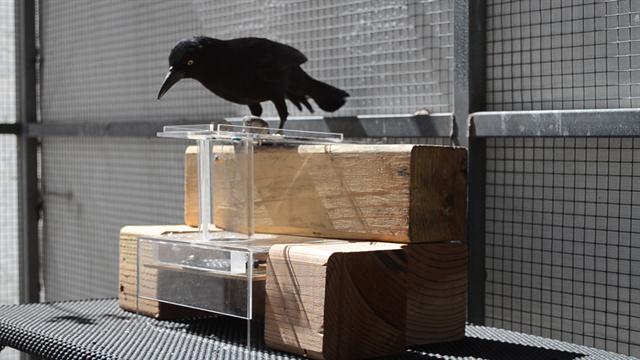
Yet when presented with classic tests given to crows and ravens, great-tailed grackles passed with flying colors. (Read: “Watch Clever Birds Solve a Challenge from Aesop’s Fables.”)
According to the study, published in 2016 in PeerJ, the grackles were given puzzles containing food as a prize. Not only did they learn to solve the problem, when the rules of the puzzle changed, the birds nimbly adapted their strategies.
What’s more, each grackle approached the puzzle in a different way, demonstrating individual styles of thinking—a quality they share with us humans.
In 1918 Congress passed the Migratory Bird Treaty Act to protect birds from wanton killing. To celebrate the centennial, National Geographic is partnering with the National Audubon Society, BirdLife International, and the Cornell Lab of Ornithology to declare 2018 the Year of the Bird. Watch for more stories, maps, books, events, and social media content throughout the year.

 Exposing the Big Game
/https://public-media.smithsonianmag.com/filer/ba/6b/ba6b1209-f295-414b-a7f7-f8fc81bef30f/ertnwj.jpg)