Dr. Goodall Applauds China’s Action to End the Domestic Sale of Ivory

Monday, June 1, 2015 – 11:53am
In a statement from today, Dr. Jane Goodall congratulates China on their announcement to end the domestic sale of ivory. Dr. Goodall and the Jane Goodall Institute appluad the government’s destruction of 1,500 pounds of their ivory stocks, expressing their commitment to supporting the international action against the poaching of elephants and rhinos.

If we could stop the demand from the world’s two largest ivory markets – China and the United States – we could turn the tide on illegal poaching. Illegal poaching has taken 64 percent of Central Africa’s elephants in the last decade alone. The only way we will put an end to this senseless slaughter is to put an end to the market for ivory. I applaud China’s action and urge them to do more in hopes that other countries will follow their lead, both in banning ivory and in cracking down on its illegal trade.
Sincerely,
Jane Goodall, Ph.D., DBE
Founder, the Jane Goodall Institute &
UN Messenger of Peace
the Jane Goodall Institute-USA Headquarters
1595 Spring Hill Road | Suite 550 | Vienna, VA 22182

Phone 703.682.9283 | Fax 703.682.9312

Liberemos a Paul Watson de la persecución de las Mafias de la Pesca Ilegal

This petition is awaiting approval by the Avaaz Community
Liberemos a Paul Watson de la persecución de las Mafias de la Pesca Ilegal
100,000
82,123

82,123 signers. Let’s reach 100,000

The greedy interests of the very few who enrich themselves ravaging the life seas have turned his main defender, captain Paul Watson, a fugitive from the supposed “justice”. They are using no other than the courts of the country that boasts itself as “environmentalist”, which chase him for nearly thirteen years with a judicial cause invented by illegal shark fishermen and supported by illegal fishing mafias who kill marine wildlife in cold blood and without restrictions. It’s time to say “ENOUGH” to such injustice!

https://secure.avaaz.org/en/petition/Fiscalia_CR_Liberemos_a_Paul_Watson_de_la_persecucion_de_las_Mafias_de_la_Pesca_Ilegal/edit

Petition for a California Water “Meat, Dairy and Eggs Tax”

264431_455824994498980_1177070538_n

http://petitions.moveon.org/sign/california-water-meat.fb51?source=s.icn.fb&r_by=13178783

California Water “Meat, Dairy and Eggs Tax” (fee)

To be delivered to The California State House, The California State Senate, and Governor Jerry Brown

Petition Statement

Due to the California Water Crisis it is time for a California Water “Meat, Dairy and Eggs Tax” (fee) to be established at time of purchase.

There are currently 304 signatures. NEW goal – We need 400 signatures!

Petition Background

This is a proposal for a ‘Water Consumption Tax’ when purchasing meat, dairy and eggs. A person consuming meat, dairy and eggs is responsible for massive amounts of water usage for the production of the animal products, far more than a person living a plant based lifestyle. In some cities, households are limited to only 50 gallons of water usage per person a day and fined if they exceed that amount. The same should apply to omnivores who eat animal products without consequence for the water crisis. The standard diet of a person in the United States requires 4,200 gallons of water per day (for animals’ drinking water, irrigation of crops, processing, washing, cooking, etc.). A person on a vegan diet requires only 300 gallons a day. It takes approximately 660 gallons of water to produce one quarter pound hamburger patty. At those numbers, it takes 2640 gallons of water to produce one pound of beef. Using that estimate it would take 6,600,000 gallons of water to produce one ton of beef; which would be equivalent to filling a 40 gallon bathtub 165,000 times. It is time for people who are consuming animal products to pull their own weight and to start being responsible for their impact to California’s water crisis.

Petition: http://petitions.moveon.org/sign/california-water-meat.fb51?source=s.icn.fb&r_by=13178783

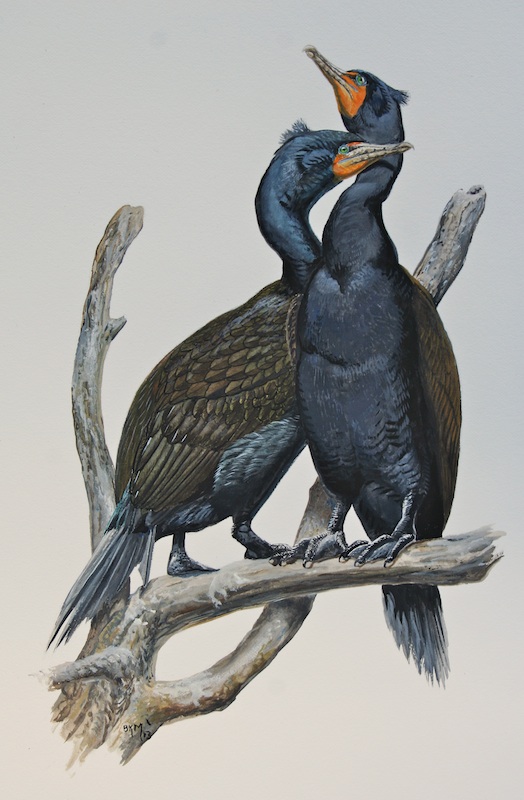
One cormorant’s plea to stop the slaughter

Painting Courtesy Barry Kent McKay

Painting Courtesy Barry Kent McKay

https://wordpress.com/post/35261376/new/

The Corps, the Cormorants, and the Cull

One cormorant’s plea to stop the slaughter

The U.S. Army Corps of Engineers recently approved a culling of the large mixed seabird colony on East Sand Island, near the mouth of the Columbia River. The plan aims to reduce the number of double-crested cormorants to 5,600 breeding pairs from roughly 13,000 by 2018, through a combination of hazing, oiling the eggs in 15,000 nests, and shooting approximately 11,000 individuals. The cull is necessary, says the Corps, because cormorants eat an average of 11 million young salmon and steelhead each year—up to 20 percent of hatchery releases—as the smolts migrate out to sea.

During the drafting of the environmental impact statement, the Corps received more than 150,000 public comments, of which about 98 percent opposed its plan. Here is one such letter, dredged up from the very bottom of the pile.

To Whom It May Concern:

I realize the comment period may be over, and that as of March 19, your plan has received the blessing of the necessary higher-ups. But I feel I have to speak out.

To begin, I admit that we are not the most beloved of birds. People kill more than 40,000 of us each year all over the country. And I get it. We have a taste for fish, and an enviable talent for catching them. When you make said fish freely available to us by raising great numbers of them all in one place and sending them downstream, we simply can’t help helping ourselves. (I am pretty sure that if you happened upon an all-you-can-eat buffet you would tuck in, too.) True, we sometimes drive out animals more couth than ourselves. We poop so much that trees sometimes die. But it is natural for us to travel in large groups, and make ourselves at home as we see fit. This is a behavior with which you, as part of the U.S. Army, are familiar, I think? But I’m just speculating here.

In any case, this brings me to the present circumstance. I don’t want to embarrass you, but you, people of the Corps, do remember that you created East Sand Island for birds, right? Back in the 1990s, thousands of Caspian Terns nested on Rice Island, a few miles upriver. They, too, ate millions of young salmon and steelhead. So you drove the terns to this island, which you had created out of sand. Once they settled in, they shifted their diet to other small fishes. (Terns are agreeable like that, bless their hearts.)

But we cormorants showed up, too. We took a look around and thought, Hey, nice island! What better place to pluck out the young hatchery fish sent out every year in tremendous, naïve waves to the sea! (You’ve dammed up so many other streams and rivers that there are few ways left for them to get around us. Thanks!) Our numbers increased. We started eating the—excuse me—your salmon. And yes, we eat a lot of them. So you tried to thwart our voracious appetites. You tried to make the island less homey. You confined us to ever-smaller areas, and surrounded us with walls, fences, and observation towers. Our colony now looks like a prison camp! But we didn’t leave. Indeed, we persevered in spite of your best efforts. What can I say? We are a hardy folk.

I can see how this might be frustrating for you. And by “this” I mean the nuances of ecology and all of its unintended consequences, its unforeseen contingencies. You are the Corps of Engineers, after all. You have a proud history of seeing the world as a place where Tab A goes into Slot B, just so. You see: salmon. You see: cormorants. You see: cormorants eating salmon. Subtract: cormorants. Problem: solved. Or so you assume. (Never mind that most of those extremely tasty smolts wouldn’t have made it back to their native hatcheries; that states like Montana and Washington actually consider hatchery steelhead and salmon harmful to wild genetic stocks.)

I can’t help but admire your resolve. Your decision-making has the solidity of concrete. Rest assured, I don’t write to critique the relative merits of your plans. I’ll leave that to others more qualified than I, such as the several biologists—including the one you yourself hired to study my comings and goings for nearly 20 years—who say you both misinterpret and misrepresent the data and therefore are not making the correct use of the best available science.

Granted, we do eat a lot of fish. Mea culpa. And I know it is easier and—and let’s be honest here—more viscerally satisfying to blast away at me and few thousand of my kin than it is to confront the full range of ecological complications for which you are responsible. (We are a far ranging species—we remember Katrina.) Yet I must remind you: Cormorants can’t build dams. It is not thanks to us that well over half of the Columbia salmon and steelhead runs are threatened or endangered. But now that you’re confronted with what to you seems a distasteful side effect of your work (to us it is glorious!), you go all ballistic. It hardly seems fair. We’re just doing what nature intended us birds to do.

Thank you for considering these comments. Perhaps we could discuss the issue one day over a little (wild) salmon. I hear Cabezon up in Northeast Portland serves a nice fillet.

From one rampant consumer to another,

DCCO

P.S. To all you sea lions yukking it up at the East Mooring Basin in Astoria: Stop laughing. Your time will come.

Update: On Monday, April 13, the U.S. Army Corps of Engineers received the necessary permits to proceed with the cull. The plans will wipe out 15 percent of the Double-crested Cormorants west of the Rocky Mountains. The Audubon Society of Portland plans to sue the Army Corps of Engineers, according to an April 14 press release. “We are deeply disappointed in the U.S. Fish and Wildlife Service for issuing these permits,” Audubon Society of Portland conservation director Bob Sallinger said in the release. “The pubic looks to the Fish and Wildlife Service to protect wild birds, not to permit wanton slaughter.”

Learn more about how you can help.

Media Coverage of California Water Shortage Omits Biggest Culprit — Animal Agriculture

http://theirturn.net/2015/04/07/animal-agriculture-water-shortage

April 7, 2015 by

In its extensive coverage of the California drought, the New York Times has consistently focused on the cultivation of crops without so much as mentioning animal agriculture, which is far more water intensive.

The glaring omission has sent readers the message that fruits, vegetables and nuts  – not beef and dairy – are responsible for the state’s grave water shortage. Following are excerpts from the NY Times over the past three days.

April 6th: “Even as the worst drought in decades ravages California, . . . millions of pounds of thirsty crops like oranges, tomatoes and almonds continue to stream out of the state and onto the nation’s grocery shelves.”

April 5th: “The expansion of almonds, walnuts and other water-guzzling tree and vine crops has come under sharp criticism from some urban Californians.”

April 4th: ”There is likely to be increased pressure on the farms to move away from certain water-intensive crops — like almonds.”

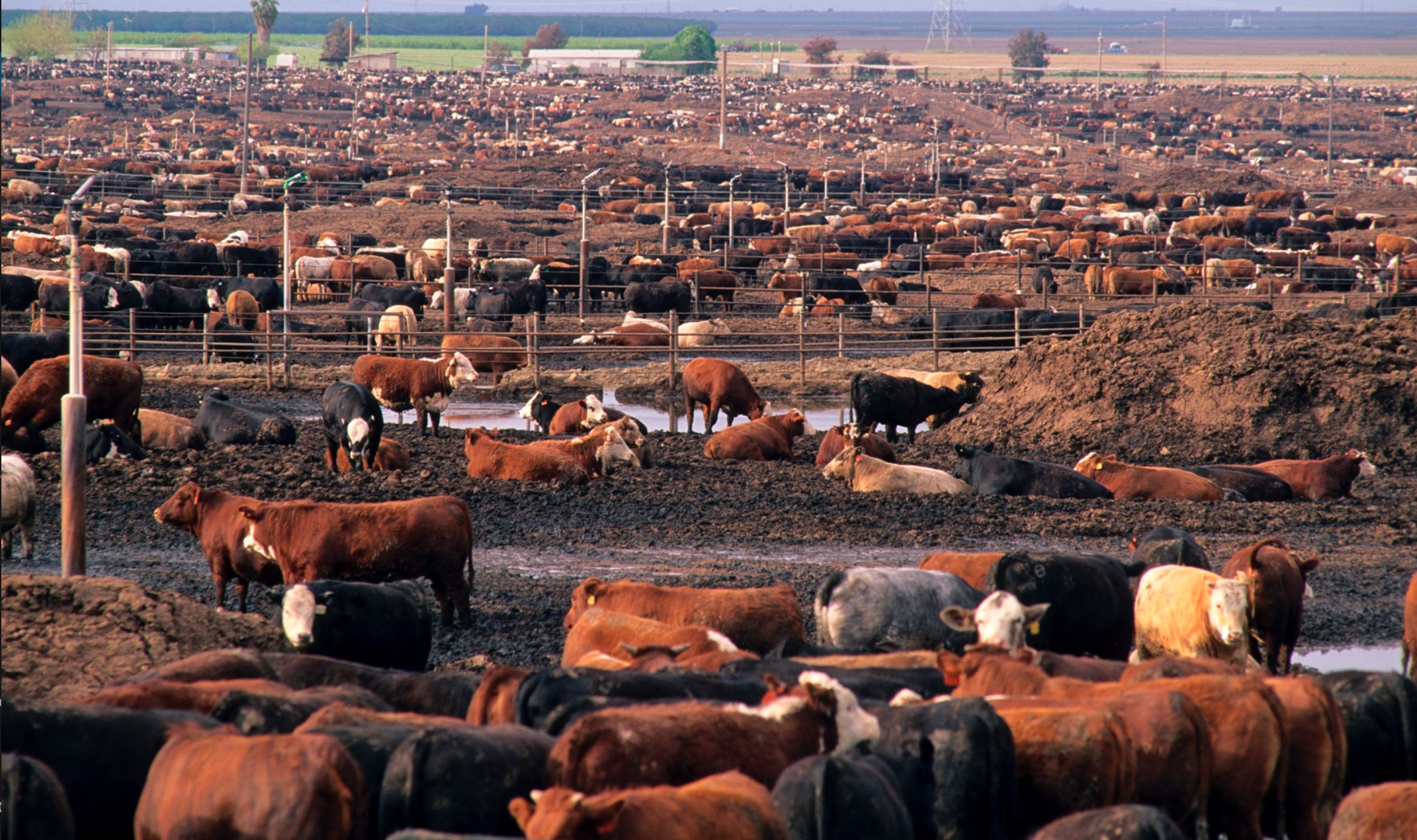
Cultivating crops might be be water intensive, but it uses a fraction of the water consumed in animal agriculture. On California’s factory farms, which house tens of millions of chickens, pigs and cows, water is used not only to hydrate these animals but also to grow their feed and clean the facilities and slaughterhouses where they are raised and killed.

Cows in a California feedlot

Eliminating animal agriculture, which inefficiently uses of a scarce resource and is altogether unnecessary, would undoubtedly help to curb California’s water shortage.

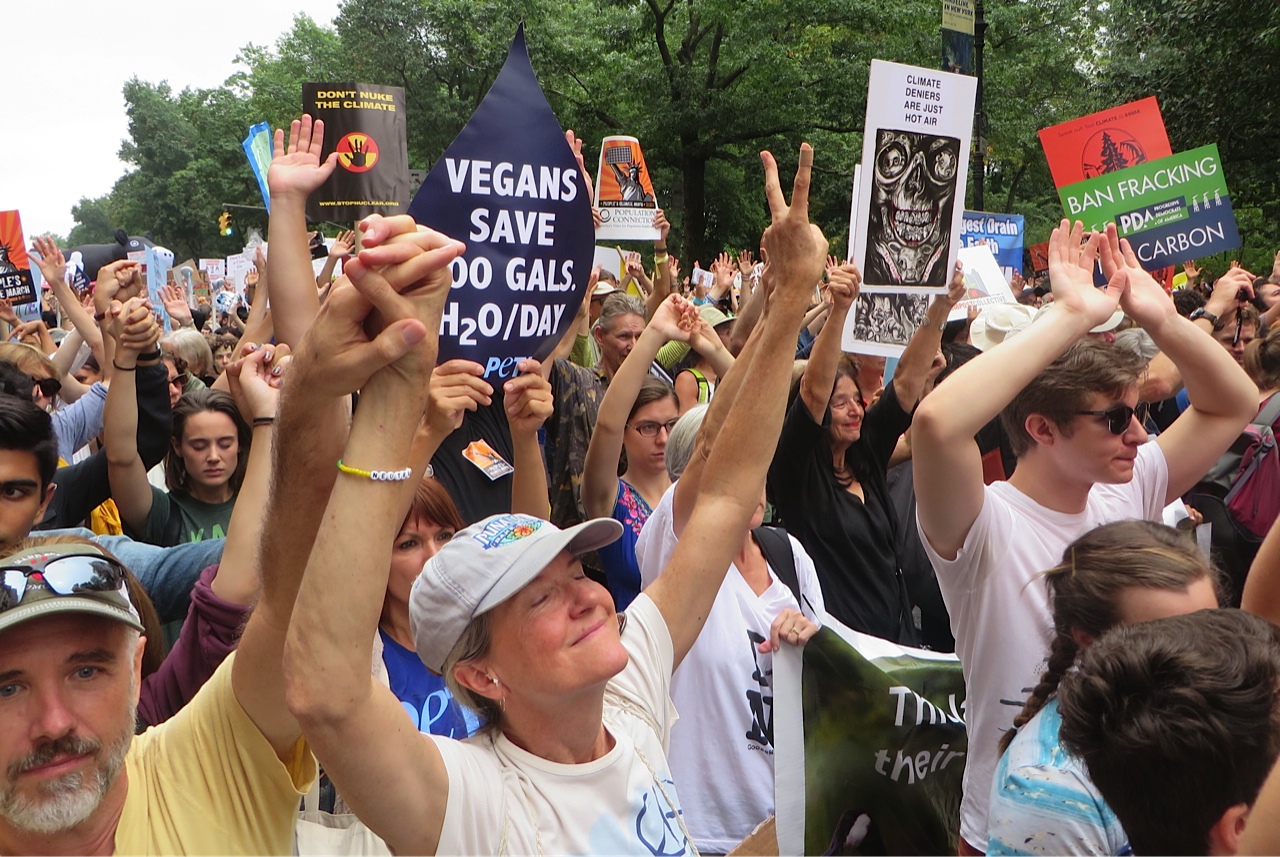
2014 Climate March participants highlighted impact of animal agriculture on water supply

Following are just a few statistics that demonstrate the impact of animal agriculture on the water supply:

  • 2,500 gallons of water are used to produce one pound of beef compared to 100 gallons for a pound of wheat.
  • Vegetables use about 11,300 gallons of blue* water per ton. Pork, beef and butter use 121,000, 145,000 and 122,800 gallons per ton respectively. (*Blue water is water stored in lakes, rivers and aquifers.)
  • Each day, cows consume 23 gallons of water; humans drink less than one.
  • The amount of water needed to produce a gallon of milk is equivalent to one month of showers.
  • 132 gallons of water are used every time an animal is slaughtered.

One year ago (March, 2014), the NY Times published an op-ed, Meat Makes the Planet Thirsty, that included statistics comparing the amount of water used for crops and animals. So why is it omitting this vital information in its current coverage of the drought? Could it be a mere oversight? Or is it something more sinister?

2014 Climate March participants highlighted the the amount of water used in animal agriculture.

Reward Offered in Astoria, Oregon Sea Lion and Harbor Seal Shootings

Photo @ Jim Robertson

Photo @ Jim Robertson

May 28, 2015

The Humane Society Wildlife Land Trust

The National Oceanic and Atmospheric Administration is investigating the deaths of approximately ten California sea lions and one harbor seal found floating in the waters near Astoria, Oregon, over the past two months. The Humane Society of the United States and the Humane Society Wildlife Land Trust are offering a $5,000 reward for information leading to the identification, arrest and conviction of the person or persons responsible.

According to NOAA, multiple expended shell casings of various calibers were found during the months of April and May on the causeway at the East End Mooring Basin and at the water’s edge at the foot of 9th Street in Astoria. The deceased sea lions and harbor seal were found floating in the vicinity. The locations of the shell casings are known haul-out areas for marine mammals. The cause of death for the animals was determined to be gunshot wounds.

A recent rash of sea lion killings is coinciding with a die-off of sea lions in Southern California that has seen stranding response centers in California scrambling to rescue over 2,000 starving young animals.

Scott Beckstead, Oregon state director for The HSUS, said: “It is ironic that, on one hand we see humans reaching out to help suffering animals at the same time that others are breaking the law and killing them. Shooting sea lions and harbor seals is a violation of the Marine Mammal Protection Act and is punishable by criminal penalties up to $100,000 and one year of imprisonment. Civil penalties up to $11,000 per violation may also be assessed. The HSUS is grateful for NOAA’s work to investigate this crime and hope someone comes forward with information.”

Anyone with information concerning the shootings is asked to call NOAA’s Office of Law Enforcement in Astoria, Oregon, at 503-325-5934 or the NOAA Enforcement Hotline at 1-800-853-1964. Callers may remain anonymous.

Media Contact: Naseem Amini: 301-548-7793; namini@humanesociety.org

Sneak preview of new documentary from creators of “Forks Over Knives”

T. Colin Campbell PhD, co-author of the extraordinary China Study, and his son Nelson Campbell, are hosting a sneak preview of the new documentary “PlantPure Nation.” They are on a multi-city tour before the movie premieres in July.  “PlantPure Nation” was written and produced by the same team that made the acclaimed documentary “Forks Over Knives.”

“PlantPure Nation” sneak preview
Tuesday, June 2
7:00 PM – 9:00 PM
Regal Meridian 16 movie theater
501 7th Ave, Seattle, WA  98101
Here is a link to the website with a 2-minute short about the movie:

Federal hunters prepare to kill salmon-eating birds

By JEFF BARNARD

Associated Press

Published:May 25, 2015 12:00AM
Last changed:May 25, 2015 10:04AM

Steve Ringman/The Seattle Times via AP
Double[breasted cormorants on East Sand Island in the Columbia River near Ilwaco, Wash., in 2011. Government hunters have begun scouting an island at the mouth of the Columbia River as they prepare to shoot thousands of hungry seabirds to reduce the numbers of baby salmon they eat.

 <!–

–> Wildlife Services is slated to file a plan with the corps next week before starting to kill the birds.

Government hunters have begun scouting an island at the mouth of the Columbia River as they prepare to shoot thousands of hungry seabirds to stop them from eating baby salmon.

U.S. Army Corps of Engineers spokeswoman Diana Fredlund said hunters from the U.S. Department of Agriculture’s Wildlife Services agency went to a small uninhabited island off Ilwaco, Wash., Thursday to survey the land before carrying out plans to reduce the population of double crested cormorants from about 14,000 breeding pairs to 5,600 pairs by 2018.

Double crested cormorants are large black birds with long necks, hooked bills and webbed feet that dive beneath the surface to eat small fish.

Wildlife Services is slated to file a plan with the corps next week before starting to kill the birds.

An environmental impact statement calls for them to shoot adult birds, spray eggs with oil so they won’t hatch, and destroy nests. Carcasses of dead birds will be donated to educational and scientific institutions, or otherwise disposed of through burial or incineration.

Biologists blame the cormorants for eating an average 12 million baby salmon a year as they migrate down the Columbia to the ocean. Some of the fish are federally protected species.

The cormorant population on East Sand Island near Ilwaco, Wash., has grown from about 100 pairs in 1989 to some 14,000 pairs now, making it the largest cormorant nesting colony in the West. Soil dredged from the bottom of the Columbia to deepen shipping channels was dumped on the island over the years, expanding the area available for nesting.

Conservation groups failed in a bid to get a federal judge to stop the killing, arguing dams on the Columbia kill far more young salmon than the birds do.

Bob Sallinger, conservation director of the Portland Audubon Society, said Wildlife Services and the corps should hold off for this year after getting started two months later than recommended. The late start would increase the suffering of the birds by producing more chicks that starve to death after their parents are killed.

“I think this demonstrates a remarkable level of indifference and ineptitude,” he said.

Cormorants are the latest birds targeted for eating baby salmon. Biologists pushed Caspian terns off Rice Island in the Columbia, and created nesting habitat in lakes in eastern Oregon and San Francisco Bay to draw them away from the mouth of the Columbia.

The Oregon Department of Fish and Wildlife also has been shooting and harassing cormorants on coastal rivers to protect salmon.

Sea lions are also killed to reduce the numbers of adult salmon eaten as they wait to go over the fish ladder at Bonneville Dam in the Columbia.

http://www.dailyastorian.com/Free/20150524/government-hunters-prepare-to-kill-salmon-eating-birds?utm_source=Daily+Astorian+Updates&utm_campaign=49c7ba6e39-TEMPLATE_Daily_Astorian_Newsletter_Update&utm_medium=email&utm_term=0_e787c9ed3c-49c7ba6e39-109860249#

Couple caught trying to smuggle 400 rare turtles from Japan

May 25, 2015

By AYAKO TSUKIDATE/ Staff Writer

TOKONAME, Aichi Prefecture–Customs officers stopped a couple from boarding a flight out of Japan with hundreds of rare turtles, which are high valued in China for their medical properties and as pets.

In the incident in early May, officers at Chubu Airport here confiscated
400 or so Asian brown pond turtles and Japanese pond turtles.

Trans-border transactions of the creatures have been regulated by the Convention on International Trade in Endangered Species of Wild Fauna and Flora (CITES), also known as the Washington Convention, since 2013.

The turtles, packed in suitcases, were bundled in pairs with their bellies facing each other and stuck inside socks.

The couple’s nationality and their destination have not been disclosed.

Under the Washington Convention, government permission is required to export the turtle species. The Environmental Ministry effectively banned the export of Asian brown pond turtles from Japan in April.

Nagoya Customs are investigating the case as an attempted violation of the Customs Law’s ban on the unauthorized export of regulated products.

Customs officers at the airport also caught a passenger attempting to export 80 or so rare turtles, including Asian brown pond turtles, without permission in April.

The Asian brown pond turtle is a subspecies that inhabits rice paddies on Ishigaki, Iriomote and Yonaguni islands in the southernmost island chain of Okinawa Prefecture. The first ever survey conducted by the Environment Ministry in 2014 estimated the population of Asian brown pond turtles on the islands at 33,000.

Approval was granted for the export of 1,000 and 5,214 Asian brown pond turtles in fiscal 2013 and 2014, respectively. The ministry banned exports in April based on its concern that the species could become extinct within just eight years if the turtles continued to be captured at this pace.

Japanese pond turtles, which are indigenous to Japan, widely inhabit rivers and other waterfronts in the Honshu, Shikoku and Kyushu islands.
A total of 3,850 turtles were exported from Japan in fiscal 2013, followed by 11,155 in fiscal 2014, mainly to China.

According to a turtle hunter based in Aichi Prefecture, who also exports his catches to China, Asian brown pond turtles are highly valued in China as an ingredient for “turtle jelly” that is widely eaten for its supposed health and cosmetic benefits.

The turtle’s shell and bones are also ground up and used as ingredients for traditional Chinese herbal medicines.

Japanese pond turtles are also cherished as pets, as their yellow and orange shell patterns are viewed as harbingers of good financial fortune under traditional feng shui philosophy.

The two species are traded at 2,000 yen to 8,000 yen ($16.45 to $66) in Japan but fetch twice to 10 times those prices in China.

While export of the turtles are regulated by the Washington Convention, capturing or possessing them is not legally prohibited in Japan.

This means that customs authorities may have to return the confiscated turtles to their owners, depending on the outcome of their investigation.

http://ajw.asahi.com/article/behind_news/social_affairs/AJ201505250031

1451324_650954518277931_1616731734_n

WS Killls Thousands of Protected Birds Killed Annually

Excerpts from:

Shot and Gassed: Thousands of Protected Birds Killed Annually

Sunday, 24 May 2015 00:00
Written by 
Rachael Bale and Tom Knudson By Rachael Bale and Tom Knudson, Reveal from The Center for Investigative Reporting

http://www.truth-out.org/news/item/30956-shot-and-gassed-thousands-of-protected-birds-killed-annually

-Even in the best of times, migratory birds lead perilous lives. Today, with climate change and habitat loss adding to the danger, wildlife advocates say the government-sanctioned killing is a taxpayer-funded threat that the birds should not have to face, one that is hidden from the public and often puts the needs of commerce ahead of conservation.

-The total body count for a recent three-year period came to 1.6 million, including more than 4,600 sandhill cranes. Four populous species – brown-headed cowbirds, red-winged blackbirds, common grackles and Canada geese – accounted for two-thirds of the mortalities.

But many less common birds were killed, too, including 875 upland sandpipers, 479 barn owls, 79 wood ducks, 55 lesser yellowlegs, 46 snowy owls, 12 roseate spoonbills, three curlew sandpipers, two red-throated loons and one western bluebird.

-California, where American coots were killed by the thousands to protect golf courseimagesQB1DEJIT greens and fairways. Usually the birds are shot, but sometimes they’re fed bait laced with a chemical that makes them fall asleep. Then they’re rounded up and killed in portable carbon dioxide chambers in the backs of pickup trucks. In California, some robins also were killed to protect vineyards.

No. 3 was Arkansas, where more than 22,000 double-breasted cormorants and thousands of other fish-eating birds were killed at fish hatcheries and aquaculture facilities.

Most of the killing is carried out without public notice. Even many conservationists are unaware of it. But those who are familiar with the permit program mostly don’t like it. They say that nonlethal options – such as scaring birds away or making the landscape less bird-friendly – are not given enough consideration and that lethal action is too often the default option.

“Nonlethal methods should always be given preference in these kinds of situations,” said Mike Daulton, vice president of government relations for the National Audubon Society, one of the nation’s oldest and most powerful conservation organizations. “The Migratory Bird Treaty Act is one of America’s most important wildlife conservation laws, and it should be strongly and reasonably enforced to maintain healthy wild populations of America’s native birds.”

Allen at the Fish and Wildlife Service said allowing the killing of nuisance birds protected by the Migratory Bird Treaty Act isn’t antithetical to the service’s mission of conserving wildlife populations.

See the data: Birds killed under depredation permits in the United States

Birds and humans have clashed for generations, of course. That’s why farmers put out scarecrows. But as cities and agriculture have grown, the scope of the conflicts has expanded. Today, even green industries sometimes kill birds. The government estimates that wind farms will take the lives of 1 million birds every year by 2030. To make that legal, the Fish and Wildlife Service is considering a new permit system for the “incidental” killing of birds protected by the Migratory Bird Treaty Act.

That act, a cornerstone of U.S. conservation history, grew out of an era of excess and slaughter at the turn of the 20th century. Many of North America’s migratory birds were being decimated, not for food but for feathers and other body parts that were used to make ladies’ hats, which had become signs of luxury and sophistication. In 1916, the United States and Great Britain, on behalf of Canada, signed the Migratory Bird Treaty Act. It became illegal to kill or capture migratory birds, as well as to buy or sell them.

The U.S. government, however, later made an exception. If a migratory bird is causing economic damage (such as destroying crops), posing a risk to humans (airports) or doing some other type of damage, a landowner can ask the Fish and Wildlife Service to approve the “lethal take,” or killing, of the problem birds.

For generations, Wildlife Services has long specialized in killing wildlife – including migratory birds – that are considered a threat to agriculture, commerce and the public. In recent years, the agency’s practices have drawn volleys of criticism from wildlife advocates and some members of Congress, who say they are scientifically unsound, heavy-handed and inhumane.

The agency relies on traps, snares and poison that kill indiscriminately. In 2012, the Sacramento Bee reported that Wildlife Services had killed more than 50,000 animals by mistake since 2000, including federally protected bald and golden eagles; more than 1,100 dogs, including family pets; and several species considered rare or imperiled. The investigation also noted that a growing body of science has found the agency’s killing of predators “is altering ecosystems in ways that diminish biodiversity, degrade habitat and invite disease.”

The U.S. Department of Agriculture’s Office of Inspector General now is conducting an audit to determine if the agency’s lethal control is justified and effective.

“Wildlife Services depends on killing predators and depredating migratory birds for its existence. When that’s what you do for a living, you tend to encourage people to adopt that solution,” said Daniel Rohlf, an environmental lawyer and professor at Lewis and Clark Law School in Oregon.

When landowners do get a permit to kill birds, Wildlife Services often is contracted to do the work. That contributes to a tendency to look to lethal control, rather than find more creative, nonlethal solutions, Rohlf said.

More: http://www.truth-out.org/news/item/30956-shot-and-gassed-thousands-of-protected-birds-killed-annually

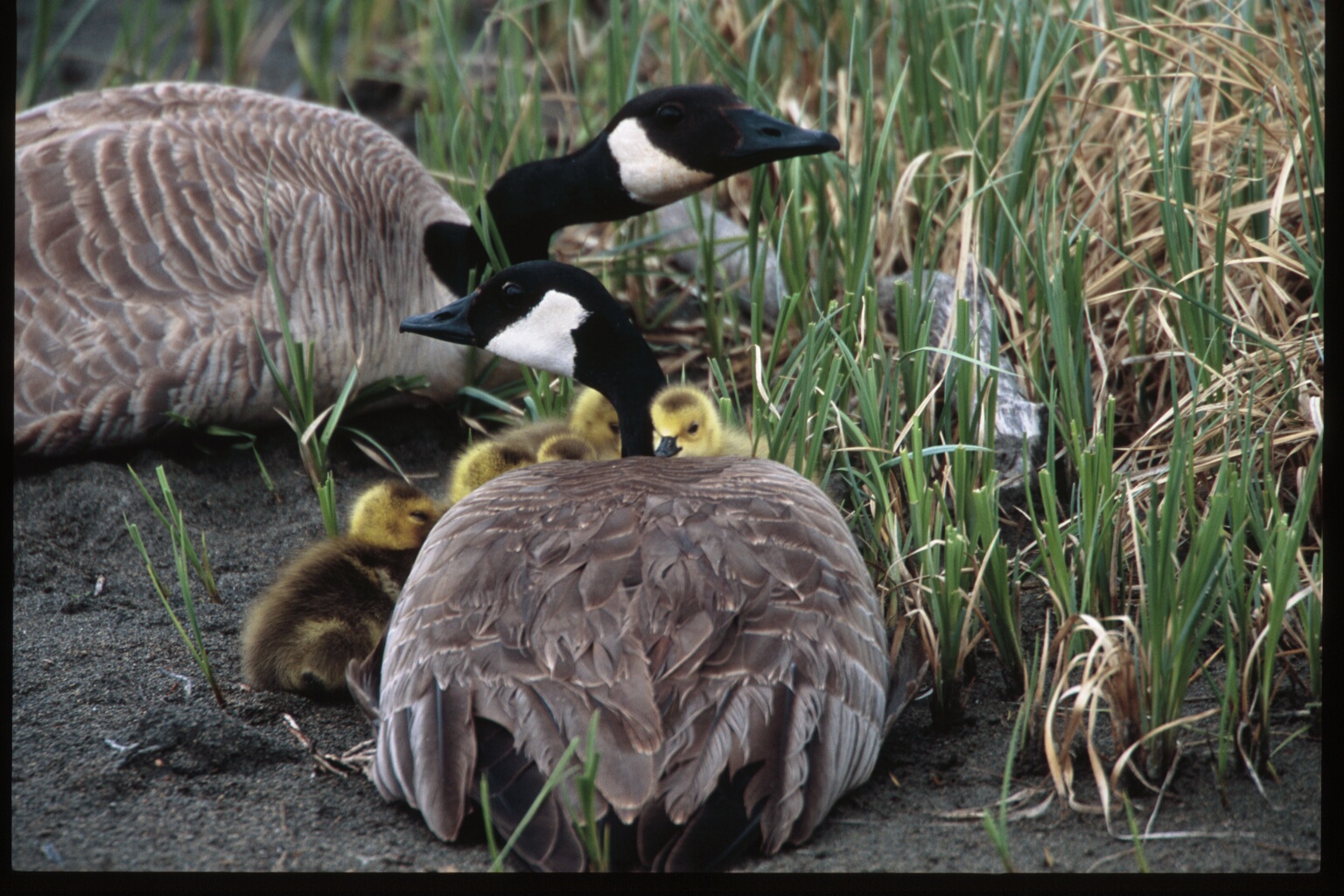
Wildlife Photography ©Jim Robertson

Wildlife Photography ©Jim Robertson