Exposing the Big Game

Forget Hunters' Feeble Rationalizations and Trust Your Gut Feelings: Making Sport of Killing Is Not Healthy Human Behavior

Exposing the Big Game

‘My life ended’ Friday: Regan Russell’s supporters want justice, Bill 156 overturned

‘I’ll fight it the rest of my life,’ says Regan Russell’s husband, Mark Powell

Samantha Craggs · CBC News · Posted: Jun 26, 2020 12:55 PM ET | Last Updated: June 26

https://www.cbc.ca/news/canada/hamilton/regan-russell-1.5627216

Regan Russell, says friend Julie Maue, “taught me how to have long friendships. How lucky am I?” (Agnes Cseke)

As far as Mark Powell is concerned, his life ended last Friday when his wife, Regan Russell, was hit and killed by a transport truck during a Burlington animal rights protest.

Now he’ll spend the rest of his days, he says, trying to get rid of the bill that haunted her.

Powell, a west Hamilton contractor, says there’s been an international outpouring over Russell’s death, from artwork to YouTube tributes, and it’s helped make the grief a little lighter. His wife was deeply rattled by Bill 156, which creates “animal protection zones” that prohibits animal rights activists from “interfering or interacting with the farm animals in the motor vehicle.” 

He’s hired a lawyer for two reasons: to see justice in her death, and to try to get the new bill repealed. 

“I’ll fight it the rest of my life,” he said. “My life ended on Friday, so for as long as I’m left here, we have to pick up the torch, and we have to fight things like Bill 156.”

The notion of Russell having a legacy is comforting to Powell and others who knew her. The 65-year-old activist often protested in front of Fearman’s Pork Inc. as part of Toronto Pig Save. The group gives a last gulp of water to pigs packed into hot trailers, moments before they’re slaughtered.

That’s what she was doing at 10:20 a.m. June 19. Somehow, witnesses say, she ended up being hit by the transport truck.

Regan Russell (left) and Katherine Wightman are shown as young models in the photo on the left. In the more recent photo, Russell is on the right. “I’ve lost my right arm,” Wightman says. (Katherine Wightman)

Halton Regional Police Service said Thursday that the collision reconstruction unit is doing a “thorough investigation.” 

“A determination on charges will be made by the collision reconstruction unit once the investigation is complete,” said Const. Steve Elms in an email. “At that time, investigators will issue a media release to update the community.”

Russell was also a women’s rights and Black Lives Matter supporter and attended a rally days before her death, says close friend Katherine Wightman. She believed strongly, Wightman says, that all beings are equals, and that informed her activism.

Russell often posted her thoughts on Facebook, most recently about Bill 156. “Bill 156 has passed,” she wrote on the day before she died. “Now, any time an animal is suffering on a farm in Ontario, no one, not even an employee, has the right to expose it.”

Animal rights activists have been rallying against the Security From Trespass and Protecting Food Safety Act, 2019  since January. 

The bill was introduced in the Ontario legislature late last year. Agriculture Minister Ernie Hardeman said it’s in response to complaints from farmers about animal rights groups trespassing on their private property. 

Friends and community, including Russell’s parents and husband, gathered for a vigil last weekend. (Jo-Anne McArthur / We Animals)

The bill, he said, is a “bio-security” measure. It increases the fines for anyone caught trespassing on farms or food processing plants, and makes it illegal to gain access to a farm under “false pretenses,” which effectively makes undercover filming an offence.

The Ontario Federation of Agriculture rallied support for the bill, saying it “protects our farms, families, livestock and food supply” from increasingly aggressive tactics from animal rights groups.

“Ontario farms have come under increasing threat from trespassers and activists who illegally enter property, barns and buildings, breaching biosecurity protocols,” president Keith Currie said in a June 12 media release

“Once peaceful protests have now escalated to trespassing, invasions, barn break-ins, theft and harassment.”

There’s precedent, however, to what Powell is considering. In Idaho, Iowa and Utah, courts have struck down similar “Ag-Gag” laws as being unconstitutional. That’s led Ontario animal rights activists to consider whether Ontario’s law could be struck down in court.

“She was dynamic,” friend Julie Maue says of Russell. “She was confident. She always made you feel like you were as beautiful as her.” (Toronto Pig Save)

Powell has retained Anandi Naipaul at Ross & McBride LLP. Russell’s family has also launched a fundraising campaign “to continue Regan’s work and assist the family.”

Powell says it’s the best way he knows to honour his wife’s life. Russell’s activism began when she was 24, he says, and living in Winnipeg. She made her own sign that said “Stop the seal hunt” and stood outside a downtown government building on a frigid winter day. After several hours, she thought she’d instigated some change.

“She went home, freezing cold,” Powell said. “She took a hot bath and thought, ‘There, that’s done. What’s next?'”

Russell was born and raised in Hamilton, Powell said, and moved to Moose Jaw and then Winnipeg. In Winnipeg, she became a model, an occupation that continued until 2002. She also enjoyed spending time with the family’s seven rescue cats, which Russell warned Powell about when they started dating. 

“She said, ‘You have to understand there will be cats, plural,'” he recalled. “I accepted that, and it’s grown to a family of seven cats.”

Animal activists embrace at the scene on June 19. (Andrew Collins/CBC)

In 1985, Powell says, she read Animal Liberation: A New Ethics for Our Treatment of Animals by Peter Singer, which changed her life, and she became vegan. She gave her dad Bill, now 89, the book, and he became an animal rights activist too. The pair protested together at Marineland, Powell says, and also at a 2017 Bill Cosby show in Hamilton.

Wightman met Russell as a teenage model in Winnipeg, and “she was instantly like a big sister.” The pair talked on the phone as often as five times a day. Wightman called Russell’s cell phone on June 19, not knowing Russell had died until Powell answered it and told her. 

Now, “it feels like I’ve lost my right arm,” Wightman said. Their last conversation, she said, was about Bill 156. “She said, ‘I am so tired. Do you realize now the work that lies ahead of me?'”

If there is a bright spot, she said, it’s that “the word has become global about who she is and what she stood for.”

Russell’s friend Julie Maue says the last time she saw her friend, they went to the office of Hamilton West-Ancaster-Dundas MPP Sandy Shaw to talk about Bill 156. Russell, Maue says, was compassionate, intelligent and logical.
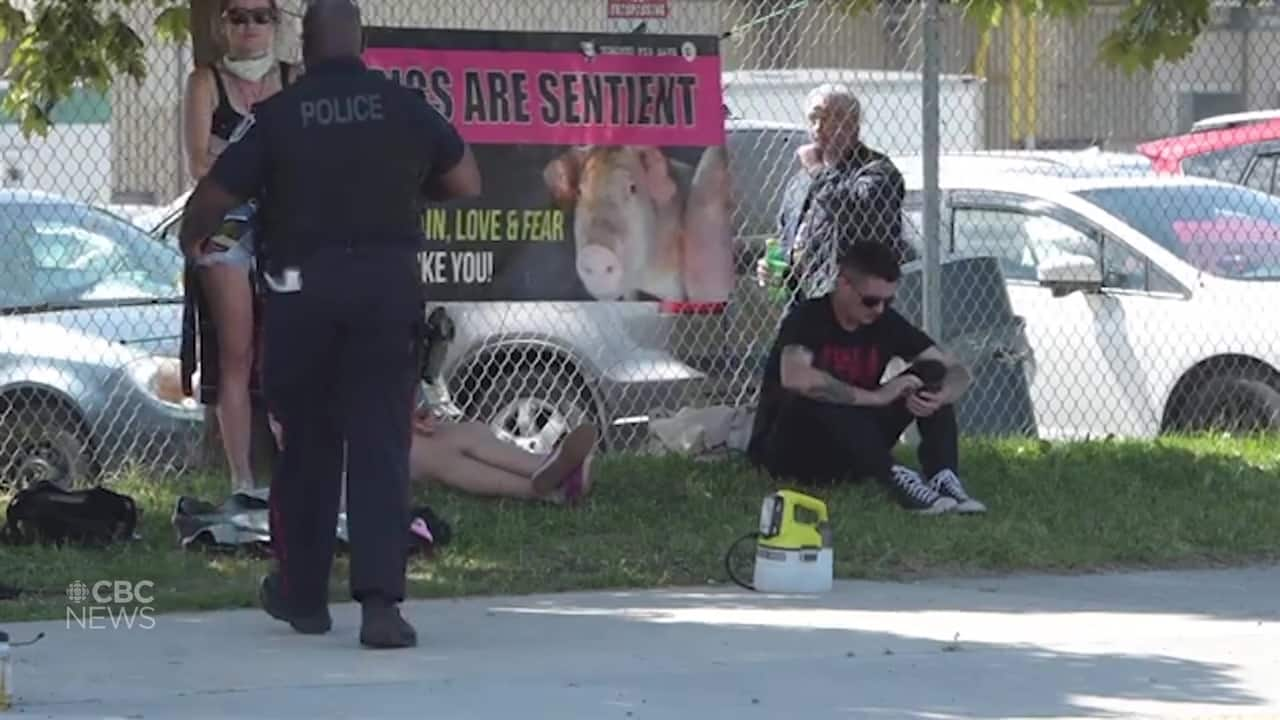
Watch

Activist killed after being struck by vehicle during Burlington pig plant protest

  • 8 days ago
  • 0:54

A animal activist protest in Burlington has turned deadly after Halton police say a vehicle struck and killed one of the activists. 0:54

“She was dynamic,” Maue said. “She was confident. She always made you feel like you were as beautiful as her.”

Anita Krajnc, founder of the Save movement, says Russell’s death has inspired vigils in multiple countries. She wants to keep the momentum going.

Krajnc made headlines at the Burlington plant in 2016 when she was charged with mischief for giving water to pigs. She was ultimately found not guilty after a lengthy trial that included slaughterhouse footage and testimony from a variety of experts. Russell attended the trial.

“I wake up multiple times a night, and I’m instantaneously thinking about her,” Krajnc said. Then “I go online and I watch the vigils.”

“I believe that site where Regan was killed, there will one day be a plant-based facility. I truly believe that.”
Understanding Euthanasia: When Life and Words Become Worthless

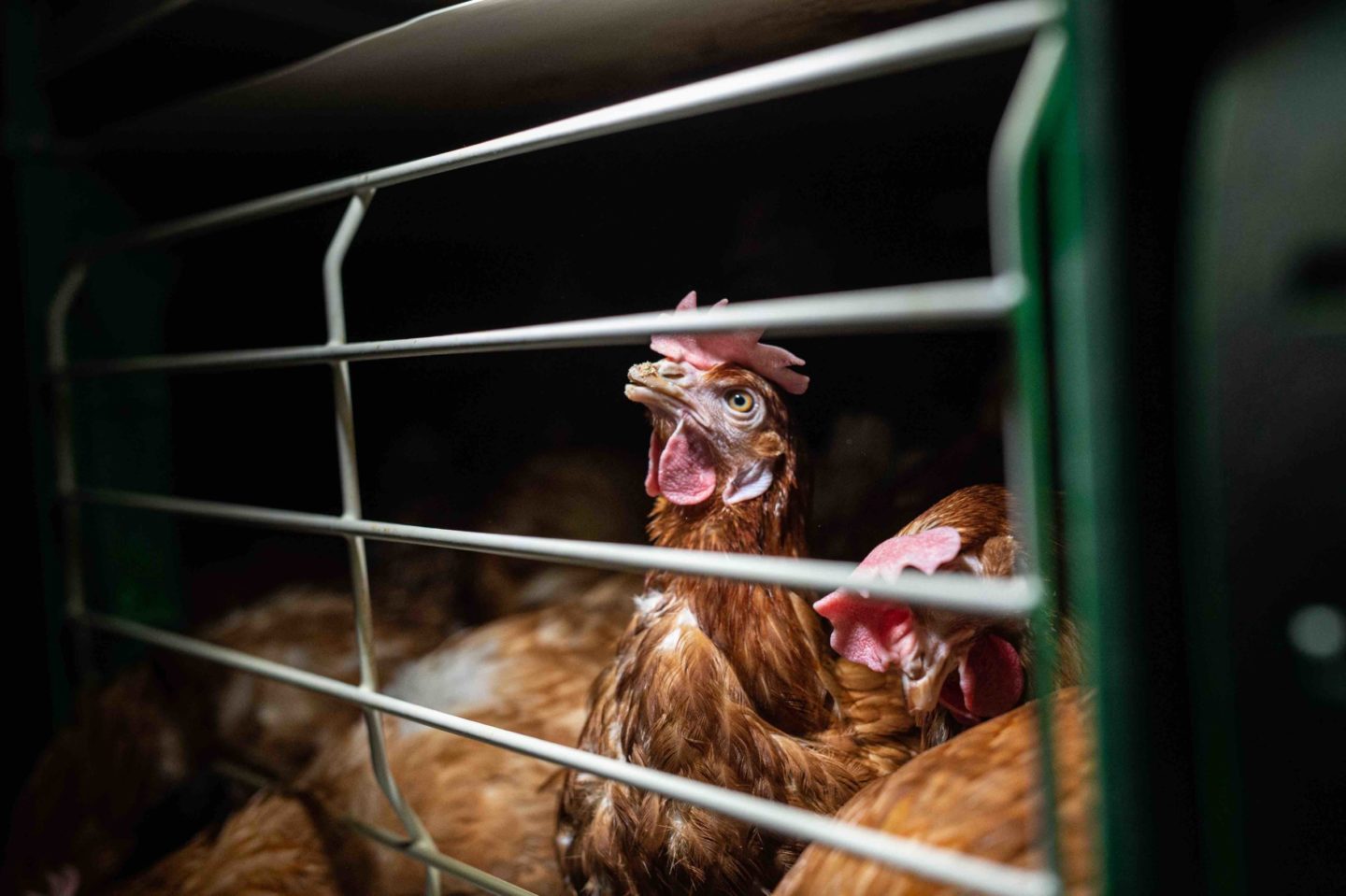
Animals subjected to “euthanasia” often die by carbon dioxide poisoning, ventilation shutdown, and other mass-killing techniques that prolong suffering for minutes, even hours.Reading Time: 4 minutes

hen cage animal
Jo-Anne McArthur/Animal Equality

The American Veterinary Medical Association’s Guidelines for the Euthanasia of Animals rightly defines euthanasia as a “good death.” But the Guidelines make all kinds of exceptions for situations in which the inhumane killing of animals—a very bad death—may be considered “euthanasia.”

People take their beloved companion animals reluctantly to the veterinarian to be euthanized, not to get rid of an inconvenience or for some other selfish purpose, but because their pet’s suffering is profound, cannot be alleviated, and will only worsen. Euthanizing a hopelessly suffering nonhuman animal or human being is an act of mercy. In such cases, the decision-makers implicitly understand the true meaning of euthanasia. The sufferer is not going to die slowly and painfully with an infusion of, say, carbon dioxide gas (CO2), or be baked to death “humanely,” as described in “How to Kill Half a Million Chickens at Once” and in “Pigs Roasted Alive in Coronavirus Mass-Extermination, Probe Uncovers” where the investigators errantly refer to the killings as “euthanizing.”

This verbal corruption confounds our discourse when, instead of a companion animal or human sufferer, the subject is a chicken, a pig, a turkey, or a mouse on a farm or in a laboratory. In these settings, the individual is one of the hundreds, thousands, or millions of captive individuals who exist solely for human use. They are born to be harmed—injured, infected, killed—for human “benefit.” When the researcher or the farmer decides in the interest of expedience to kill them, by whatever means, the term that is used to characterize the procedure is “euthanasia.”

An example appears in the Iowa State University College of Veterinary Medicine publication, Water-Based Foam for Poultry Depopulation, which cites the American Veterinary Medical Association (AVMA) in support of the mass-suffocation of poultry under rolling carpets of chemically irritating fire-fighting foam:

Euthanasia of large numbers of birds in a quick, efficient manner with welfare consideration. The process is used to control disease spread or end the suffering of dying birds during a disease outbreak or natural disaster situations.

Though decades of research have confirmed that exposure to CO2 gas causes pain, panic and slow suffocation in mammals and birds, who will desperately seek to escape a CO2-filled chamber, the AVMA Guidelines 2020 equivocate, as in this directive for killing small animals in experimental settings:

In addition to humane outcomes, an important consideration in the choice of method for euthanasia of laboratory animals is the research objectives for the animals being euthanized.

For small animals like mice and rats in laboratories: Carbon dioxide, with or without premedication with halogenated [inhaled] anesthetics, is acceptable with conditions for euthanasia of small rodents.

In other words, a “humane outcome”—a manner of death that is painless, swift, and compassionate—may be sacrificed to “research objectives” and still be called “euthanasia,” and even absurdly at times, “humane euthanasia.”

Appallingly, the AVMA has fostered a language of impunity for agribusiness and the animal research industry to the point of elevating, in public and industry discourse, the opposite of what euthanasia and humane treatment literally mean. This fraudulent usage is a perfect example of Orwellian “newspeak,” which Merriam-Webster defines as “propagandistic language marked by euphemism, circumlocution, and the inversion of customary meanings.”

It’s easy for the public and for animal advocates to get lulled into a sense of complacency when all around us the authorities use terms like “euthanasia” to not only characterize but endorse the mass killings of farmed animals and animals in laboratories by asphyxiating, baking, or engulfing them in deadly chemicals with fire-fighting foam. Animals subjected to the cruelties of carbon dioxide, fire-fighting foam, and ventilation shutdown can take up to ten minutes, even hours, to die while struggling together in agony; and many survive these automated, crude procedures only to be trashed, buried or bulldozed, alive.

Where does this leave us—the animal advocacy community—in confronting the massive, unrelenting, painful carnage of living, breathing beings? Do we ignore it because the problem is too big for us to change? Do we justify our position because, as even animal advocates have said on occasion, fraught with frustration that can degenerate into apathy, “They’re going to die anyway”?

Of course, we’re all going to die, but when it comes to our own species and our beloved companion animals, we do not invoke our mortal fate as an excuse for abuse. The conundrum in the case of laboratory animals and farmed animals isn’t simply that they are “going to die anyway.” It’s that they are going to die inhumanely in a slaughterhouse or as part of an experiment, or in the inhumane circumstances that surround slaughter and experimentation—transportation, neglect, rough handling, overwhelming stress, fear, and learned helplessness.

There is no quick or easy answer because if there were, animal advocates would champion it. But this much we know: Silence and euphemisms like “euthanasia” are not the answer. We may be uncomfortable with a problem that is so immense and seemingly intractable, but we need to speak up—and speak accurately—even if we feel we’re shouting in the wind.

As animal advocates, we cannot allow animal exploiters to define the conversation for us, lull us into false rhetoric, or determine how we regard animals. Succumbing to these pressures, we degrade the lives of the animals down to the level at which the exploiters abuse them. By submitting to linguistic subterfuges, we accommodate virtually any mistreatment of animals as acceptable. This is the moral downslide that allows agribusiness and animal researchers to inflict pain, torment, and death on animals unfazed. It’s the type of “convenience” that debased language facilitates. As advocates for animals, let us not call the brutal mass-extermination of innocent, defenseless creatures for the sake of human convenience, “euthanasia.”

For the animals’ sake, we cannot let ourselves, or the public, be “put to sleep.”

Karen Davis, PhD is the President and Founder of United Poultry Concerns, a nonprofit organization that promotes the compassionate and respectful treatment of domestic fowl including a sanctuary for chickens in Virginia. She is the author of numerous books, essays, articles, and campaigns advocating for these birds. Her latest book is For the Birds: From Exploitation to Liberation: Essays on Chickens, Turkeys, and Other Domesticated Fowl (Lantern Books, 2019).

Barbara Stagno is the President and Founder of Citizens for Alternatives to Animal Research & Experimentation (CAARE). Since 1995, Barbara has worked to oppose the exploitation of animals, especially the use of animals in experiments. She founded CAARE in 2014 to disseminate information about the power of emerging science to end the use of animals in research, while also raising awareness of their immense suffering. Before starting CAARE, Barbara was a campaign director for a national animal protection organization.

Lewis Hamilton Urges Fans To Watch New Vegan Documentary On Amazon Prime

‘Please watch this. We need to find compassion in our hearts to see what we are doing to this world’MARIA CHIORANDO6 HOURS AGO

https://www.plantbasednews.org/culture/lewis-hamilton-urges-fans-watch-new-vegan-documentary

lewishamilton

Lewis Hamilton has urged his fans to watch a new pro-vegan documentary.

The film, created by leading animal protection agency Viva!, is called HOGWOOD: a modern horror story. It will be available to stream on Amazon Prime, Apple TV and Google Play Movies from tomorrow (June 25).

Hamilton said of the movie: “Please watch this. We need to find compassion in our hearts to see what we are doing to this world.”

Exposé

The film centers around Viva!’s four undercover investigations into Hogwood Farm. According to the organization, ‘we recorded a catalogue of cruelty including extreme overcrowding, routine mutilation, sick and dying pigs abandoned in gangways, painful lacerations and live cannibalism’.

The farm was eventually dropped by supermarket Tesco and food verification organization Red Tractor – but it took years of campaigning. Now the film goes beyond its investigation to explore the reasons behind factory farming and expose the negligence and inaction by government bodies and corporations alike.https://www.instagram.com/p/CB0PLguAUbw/embed/captioned/?cr=1&v=12&wp=658&rd=https%3A%2F%2Fwww.plantbasednews.org&rp=%2Fculture%2Flewis-hamilton-urges-fans-watch-new-vegan-documentary#%7B%22ci%22%3A0%2C%22os%22%3A17420.819999999367%2C%22ls%22%3A16394.29999998538%2C%22le%22%3A16443.28999996651%7Dhttps://fb51260ad01f7304469310c0d56d7300.safeframe.googlesyndication.com/safeframe/1-0-37/html/container.html

‘A gripping tale’

In a statement sent to Plant Based News, Viva said: “The conspiracy unfolds as we fight against some of the most powerful players in the animal agriculture industry. This is a gripping tale of negligence, greed and inaction, and our unrelenting fight to help the pigs trapped in Hogwood Farm.

“Join us as we take you through our battle for justice against Hogwood Farm, a Red Tractor approved farm who were supplying supermarket giant, Tesco, supposedly representing some of the highest animal welfare standards in the world.

“This is a huge milestone for us and we could not have done it without your support. You helped us show the demand for this film to be made and now, it will be screened to the masses from June 25.”

HOGWOOD: a modern horror story

The film, which has a running time of just over 30 minutes, is presented by actor Jerome Flynn.

Speaking about the movie, Flynn said: “”It is an honor to be presenting this very important film. After seeing the horrendous conditions and animal abuse that is happening behind Hogwood’s walls I had to do something. The pigs of Hogwood aren’t just meat products, they are sensitive, emotionally aware beings just like us and they deserve better than this.”https://www.youtube-nocookie.com/embed/v_kHNUwm3Yw

‘Harrowing’

Director Tony Wardle added: “I have been producing investigative documentaries for many years and no film has been more harrowing than HOGWOOD. The name ‘a modern horror story’ could not be more apt; there are modern horror stories taking place each day in the British countryside. 

“Not only are these horrors hidden from sight, but they are endorsed by huge corporations and the government. That is why this film had to be made – because the public has a right to see what takes place beyond the factory farm walls.”

Viva! adds: “We realized that Hogwood is part of a bigger story, one that aims to end factory farming for good — and so we created HOGWOOD: a modern horror story. Now we need your help to get this film seen by the masses.”

You can find out more about the film here

Animal activist died trying to expose what Bill 156 will hide


JS

By Jessica Scott-ReidContributor

Tue., June 23, 2020timer2 min. read

Late last week an Ontario woman was run over and killed by a semi-truck
outside of Fearmans Pork slaughterhouse in Burlington. Details surrounding
the incident have yet to be revealed, but what is known now is that Regan
Russell, 65, was a long-time animal and human rights activist who was there
to bear witness to the pigs on that truck. She was there because the secrecy
enshrouding meat, dairy and egg production, and lack of legal oversight
concerning farmed animal welfare forced her to be there. She was there
because it is only outside of those trucks that concerned citizens can gain
a mere moment of interaction with the animals, to document their conditions,
and to show compassion before they are trucked off into the darkness. On
this day in particular, Russell was there because soon, the newly passed
Bill 156 will make it illegal to do so, and soon that darkness will grow
much darker.

Russell witnessed animals used and abused in awful ways for many years, says
Jenny McQueen, a well-known Toronto activist and friend of Russell. Russell
was absolutely committed to speaking up on behalf of the animals and showing
that, week after week, people need to do the right thing. Russell attended
slaughterhouse vigils regularly, participated in a recent Black Lives Matter
protest, and was a strong women’s rights advocate. There are so many
instances when she was standing up for the oppressed, McQueen says.

Vigils have been held outside of Fearmans Pork for several years, organized
by international animal rights group The Save Movement, which originated in
Toronto. Typically, peaceful activists stand outside of slaughterhouses on
public land, and, when trucks hauling live animals pull up, drivers are
asked to stop for two minutes to allow activists to provide water, document
conditions, and offer some words of apology, love and comfort. Vigils are
extremely powerful, says McQueen. If you go, and connect, and look an animal
in the eye, in person, it’s life-changing.

With the passing of Bill 156, the Security from Trespass and Protecting Food
Safety Act, however, individuals who interact with animals in this way could
soon be fined up to $15,000.

Tensions between vigil participants and some truck drivers have been
bubbling for years, but for the most part the requested two minutes is
usually provided without incident. Since the passing of Bill 156 just days
before Russell’s death, though, activists can’t help but wonder if the
industry, including that truck driver, may be feeling emboldened.

In Canada, there are no laws overseeing the daily treatment of animals on
farms. An accepted form of on-farm euthanasia for piglets is bashing their
heads into concrete. Pigs are transported in open-sided,
non-climate-controlled trucks for up to 36 hours without food, water or
rest, regardless of the weather. Fearmans Pork kills approximately 10,000
young pigs every single day. These are things Russell would want you to
know. These are the things she was trying expose with her activism. These
are the things Bill 156 will drive further away from the public eye, further
into the darkness.

Plant-based meat is a trend investors should not ignore

https://futuretv.in/plant-based-meat-is-a-trend-investors-should-not-ignore/

CNBC’s Jim Cramer said Wednesday that investors cannot ignore the rising popularity of plant-based meat products.

“This movement is happening. You’ve got to get on the bus or … get left behind,” Cramer said on “Squawk on the Street.”

Cramer acknowledged there are not huge sales just yet for a company like Beyond Meat, which after-the-bell Tuesday reported quarterly revenue of $97.1 million, a 141% increase from a year ago.

“It starts like this. It doesn’t begin with a billion dollars. This is not blockbuster drug, but watch this trend,”  Cramer said. “I think it’s very exciting for investors.”

Shares of Beyond Meat were up about 17% on Wednesday morning to around $118 each.

Beyond Meat, at a $7.2 billion market value, has been at times one of Wall Street’s hottest stocks but also one of the most volatile since its May 2019 initial public offering. Priced at $25 per share, the stock saw a meteoric rise to nearly $240 by last July. But come December, it had lost about 70% of its value. In the early part of this year, the stock rebounded before falling off a cliff, bottoming at about $48 in mid-March. Since then, the stock has more than doubled.

On Tuesday evening, in addition to strong revenue, Beyond Meat posted quarterly net income of $1.8 million, up from a net loss of more than $6 million last year. It did warn of a hit to its restaurant business due to the coronavirus pandemic.

However, the “Mad Money” host said he believes the plant-based meat industry may ultimately be beneficiaries of the Covid-19 crisis.

Meatpacking plants across the U.S. have seen significant virus outbreaks, forcing some to slow down production or temporarily close as workers became sick. The developments ignited concerns about the country’s food supply, although President Donald Trump signed an executive order last week requiring the plants to remain open during the coronavirus pandemic.

“I think there are people who are getting appalled by what’s happened at the meat packers. … I think these stories make you become not necessarily vegetarian but to think twice about beef,” Cramer said. “If you think twice about beef and then you try to Beyond, you kind of realize it’s very, very similar.”

While plant-based meat options have typically been more expensive than traditional meat, Cramer said the rising costs of beef, in particular, due to the coronavirus represents an opportunity for alternative producers.

One of Beyond Meat’s chief rivals in the plant-based meat category, Impossible Foods, is not publicly traded. But it is widely available as well. Grocery store chain Kroger also has launched private-label beef options.

Cramer noted that food giant such as Nestle have entered the plant-based burger market. He said the plant-based meat industry is “a really important ethos, not a hobby.”

Coronavirus Cases Prompt ‘Meat Kills’ Billboard

PETA Points Out That Animal Markets, Transport, and Slaughter Are Linked to All Flu-Like Viruses

For Immediate Release:
February 21, 2020

Contact:
David Perle 202-483-7382

Omaha, Neb. – As 11 patients with coronavirus are now quarantined at the University of Nebraska Medical Center, PETA plans to place a billboard near the hospital that warns, “Meat Kills—Go Vegan,” and lists a litany of public health threats associated with using animals for food. The coronavirus is known to have originated in a market in Wuhan, China—a “wet market” where live and dead animals are sold for human consumption. In this case, pangolins and bats were sold for soup, but it’s not the first time such viruses have been traced back to live animals—most commonly pigs and chickens—who were confined, shipped, killed, and eaten.

“Filthy factory farms, slaughterhouses, and meat markets threaten the health of every human being on the planet by providing a breeding ground for deadly diseases like coronavirus, SARS, bird flu, and others,” says PETA President Ingrid Newkirk. “PETA urges everyone to take the message seriously and protect themselves from fatal conditions such as heart attacks, strokes, high blood pressure, and others by avoiding meat like the plague.”

In addition to carrying a high risk of contamination from pathogens—including E. coli, campylobacter, and salmonella—meat contains no fiber and is packed with artery-clogging saturated fat and cholesterol. According to the Academy of Nutrition and Dietetics, vegans are far less prone to suffering from heart disease, diabetes, obesity, and cancer than meat-eaters are.

Calves and ‘cries of anguish’: why Joaquin Phoenix decried the dairy industry


The best actor Oscar winner gave a speech about humanity’s treatment of cows, shining a light on the harsher realities of milk production.

https://www.theguardian.com/food/shortcuts/2020/feb/10/calves-and-cries-of-anguish-why-joaquin-phoenix-decried-the-dairy-industry

Not milk? Joaquin Phoenix at the Oscars.
 Not milk? Joaquin Phoenix at the Oscars. Photograph: Étienne Laurent/EPA

The dairy industry used to get a free pass, even from many animal rights campaigners. But with the mainstream emergence of veganism, more people are becoming aware of practices that are normal in milk production. Now, they are even talking about it at the Oscars.

In his acceptance speech for the best actor award, Joaquin Phoenix spoke of our “egocentric world view” and how we “plunder” the natural world for its resources. Turning to dairy, he said: “We feel entitled to artificially inseminate a cow and steal her baby, even though her cries of anguish are unmistakeable. Then we take her milk that’s intended for her calf and we put it in our coffee and our cereal.”

The reality of dairy farming can be shocking for people who have always assumed milking a cow is harmless. From the age of 15 months, female cows are artificially inseminated with semen drawn mechanically from a bull. Once born, the calf will usually be taken away within 36 hours. This is so farmers can take the milk the mothers are making. Experts say that a strong bond is formed quickly after birth and the separation is traumatising for both cow and calf.

If the calf is male, he will be considered a byproduct and either killed immediately or sold on to be raised as veal, which postpones his death for a few months. If it’s female, she will follow her mother in the cycle of forced pregnancies until she is too old to carry on, after which she will be killed.

The rise of veganism is hitting dairy bosses hard. Sales of plant-based milks are soaring. Last year it was revealed that almost a quarter of Britons are consuming non-dairy milk alternatives. Meanwhile, the average person’s milk consumption in the UK has fallen by 50% since the 50s.

Phoenix linked the oppression of animals with the oppression of humans. The “cries of anguish” from mother cows are finally being heard.

MIYOKO’S FOOD TRUCK TO GIVE AWAY 15,000 VEGAN GRILLED CHEESE SANDWICHES IN CROSS-COUNTRY TOUR

VegNews.MiyokosCheeseTruck

The vegan cheese brand will promote its vegan grilled cheese sandwiches—made with Miyoko’s new allergen-friendly vegan cheese and butter—in 17 major cities across the country.

https://vegnews.com/2020/2/miyoko-s-food-truck-to-give-away-15-000-vegan-grilled-cheese-sandwiches-in-cross-country-tour?utm_source=fan+actions&utm_medium=email&utm_term=fast+action+network&emci=b9073641-fd49-ea11-a1cc-00155d03b1e8&emdi=18d32722-014a-ea11-a1cc-00155d03b1e8&ceid=7056009


47,402 Shares    

On March 4, vegan cheese company Miyoko’s Creamery will begin a food truck tour across the United States to promote the brand’s new nut-free vegan cheddar and pepper-jack cheeses (created from oats, potatoes, and legumes) and cultured vegan oat-based butter. Miyoko’s food truck will give away approximately 15,000 free grilled cheese sandwiches made with the new products. The tour will begin at Natural Products Expo West in Anaheim, CA and make 17 tentative city stops, including in Los Angeles, CA; Oakland, CA; San Francisco, CA; Portland, OR; Seattle, WA; Biose, ID; Denver, CO; Austin, TX; New Orleans, LA; Atlanta, GA; Washington DC;  Philadelphia, PA; New York, NY; Boston, MA; Cincinnati, OH; Chicago, IL; and Minneapolis, MN. “We believe our new cheddar and pepper jack are game-changing and will do for cheese what Beyond and Impossible did for burgers by expanding the audience for vegan cheese to omnivores and flexitarians,” Miyoko Schinner, CEO of Miyoko’s Creamery, told VegNews. “What better way to prove that than by allowing people to taste the product first-hand—our Grilled Cheese Nation food truck tour is a fun way to get that done while building excitement and anticipation for our April product launch.” In December, Miyoko’s shocked hundreds of unsuspecting cheese lovers at a grilled-cheese sandwich pop-up in San Francisco, where the brand served free sandwiches made with its vegan cheese and butter without telling customers they were vegan. In June, the brand is set to launch the cultured vegan oat-based butter in sea salt and garlic parm flavors and allergen-friendly cheeses in blocks, shreds, and slices.

Germany, France push to end male chick ‘shredding’ in European Union

France and Germany are calling for an end to male chick culling.
 France and Germany are calling for an end to male chick culling. Canadian Press
Descrease article font size

A

Increase article font size

A+

Germany and France are teaming up to push for the end of male chick shredding in the European Union by the end of 2021.

Agriculture ministers Julia Klöckner of Germany and Didier Guillaume of France announced their plans to help press this issue further during a Monday meeting in Germany.

“It’s time to end the shredding of chicks. France and Germany should be the European motor to advance on this issue,” Guillaume said, according to France24.

Shredding refers to the act of killing male chicks shortly after they hatch. This practice occurs in many poultry businesses because male chicks don’t produce eggs and generate less meat than their female counterparts.

READ MORE: New York City passes bill banning sale of foie gras [2019]

The two European countries hope to bring together industry groups, companies, researchers and campaign groups to “share scientific knowledge” and “implement alternative methods,” France24 reports.

STORY CONTINUES BELOW ADVERTISEMENT

“We welcome this scheme and the fact that non-governmental organizations are involved, but we expect clear regulatory commitments,” Agathe Gignoux of CIWF, a French NGO, said.

In 2009, the Associated Press reported U.S. egg producers euthanize 200 million male chicks per year. According to AP, Chicago-based animal rights organization Mercy for Animals videotaped male chicks being ground up alive while undercover in Iowa hatchery Hy-Line North America that same year.

The same practice appears to occur in Canada, too, though the Canadian government has announced recent changes in an effort to minimize this waste.

Jean-Michel Laurin, president and CEO of the Canadian Poultry and Egg Processors Council, told Global News that the industry has been working towards eliminating the euthanizing of male chicks.

READ MORE: ‘It’s a cold scary trip’: Tabby cat travels more than 80 km hiding in truck engine

“This requires a great deal of research, which has been occurring worldwide and includes Canadian-based research which has been active for about 10 years,” he said. “Currently, stakeholders in Canadian industry have made significant investments to bring us beyond the research trial phase.”

“Our industry is committed to continually improving practices. Farmers, hatcheries and others in the supply chain have demonstrated, over generations, their desire to improve and to respond to change.”

STORY CONTINUES BELOW ADVERTISEMENT

He added that the National Farm Animal Care Council’s (NFACC) Code of Practice for the Care and Handling of Chickens, Turkeys and Breeders lists several methods to euthanize day-old chicks and emphasizes that in all circumstances, the termination of life must be instantaneous.

2:36
Toronto Chick-fil-A launch draws customers and demonstrators

Toronto Chick-fil-A launch draws customers and demonstrators

In 2018, then-Agriculture and Agri-Food Minister Lawrence MacAulay announced an $844,000 investment would go towards developing an electronic scan to determine a bird’s sex and fertility of eggs prior to hatching, Poultry World reported.

This would mean male eggs could be sold before hatching, which would increase capacity and efficiency of Canadian hatcheries and ultimately end male chick culling.

“The Canadian egg industry is driving our economy and creating good jobs,” he said in a statement. “The government of Canada is produce [sic] to support the Egg Farmers of Ontario for this first-of-its-kind study that will make Canada a world leader in animal welfare.

“This investment will help pilot a solution that will be welcomed in Canada and around the world and will keep the egg industry strong and growing.”

READ MORE: London animal rights activist ‘targeted’ by aggressive driver due to bumper stickers

The Canadian egg industry contributes over $1 billion a year to the national economy and employs more than 17,000 people.