MFWP Sued Over Lynx Trapping

Today the Missoulian reported that:

– Three conservation groups filed a federal court lawsuit Thursday against Montana Fish, Wildlife and Parks commissioners and Director Jeff Hagener for allowing trapping and snaring in Canada lynx habitat.

The Friends of the Wild Swan, the WildEarth Guardians and the Alliance for the Wild Rockies say FWP reported at least nine incidents since 2000 of lynx being caught in traps set for other species; and say four of those animals died. They alleged that this violates the federal Endangered Species Act, which lists lynx as a threatened species and warranted for protection, and want the trapping prohibited in lynx habitat.

“In one instance, a young female lynx was found in a pool of her own blood, with extensive muscle damage, and an empty stomach — all from lingering far too long in a cruel, steel-jawed trap,” Wendy Keefover, carnivore protection program director for WildEarth Guardians, said in a news release. “Montana allowed this unnecessary death, which impedes lynx recovery, especially when it involves potential breeding animals.”

The lawsuit outlines some of the cases in which lynx were caught and died, including one that starved to death. 

Yes, you read that right, a lynx STARVED TO DEATH in a trap! Obviously there’s no 24 hour trap check required for species like bobcat or whoever trappers are “legally” targeting. How many more precious animals have to bleed to death, lose limbs or starve in traps before the world wakes up and trapping ends for good?

525140_440817092654544_311118433_n

“Game” Laws Are the Ultimate In Moral Schizophrenia

People like to think we live in a civilized society; after all, we no longer condone slavery, human sacrifice, cannibalism, lethal gladiator games or a host of other outdated cruelties. But in reality, we’re living in a time when the accepted treatment of non-human animals has never been more morally schizophrenic.

Take, for example, the following excerpt from a UK Mirror article about a criminal case of animal abuse that could easily be confused with a perfectly “legal” bird hunt…

Locked up: Yob shot dead 18 ducks and posted pictures of rampage on Facebook
The cruel 18-year-old went on the rampage up a canal bank and when caught told police he only killed the birds ‘for a bit of fun’
12 Jan 2013
A lout who shot dead 18 ducks and posted pictures of their corpses on Facebook was locked up for eight weeks yesterday.
Cruel 18-year-old Michael Prince went on the rampage up a canal bank and when caught told police he only killed the birds ‘for a bit of fun.’
The sick gunman caused armed police to be deployed to the scene to reel him in and his friend who was also armed with a gun at the waterside.
Animal welfare bosses described Prince’s actions as ‘senseless cruelty’ as he was sent to a young offenders’ institution for eight weeks.
Prince and his pal shot birds while others they had just targeted lay flapping their wings in agony and even took aim at horses in nearby fields in Stoke-on-Trent, Staffordshire.
Cops managed to catch the brainless teen when he stupidly posted photographs of his macabre exploits on the internet. …

A “bit of fun” eh? That sounds eerily reminiscent of a case of senseless animal cruelty I covered in an earlier blog post entitled, “Just Out For a Bit of Fun.”
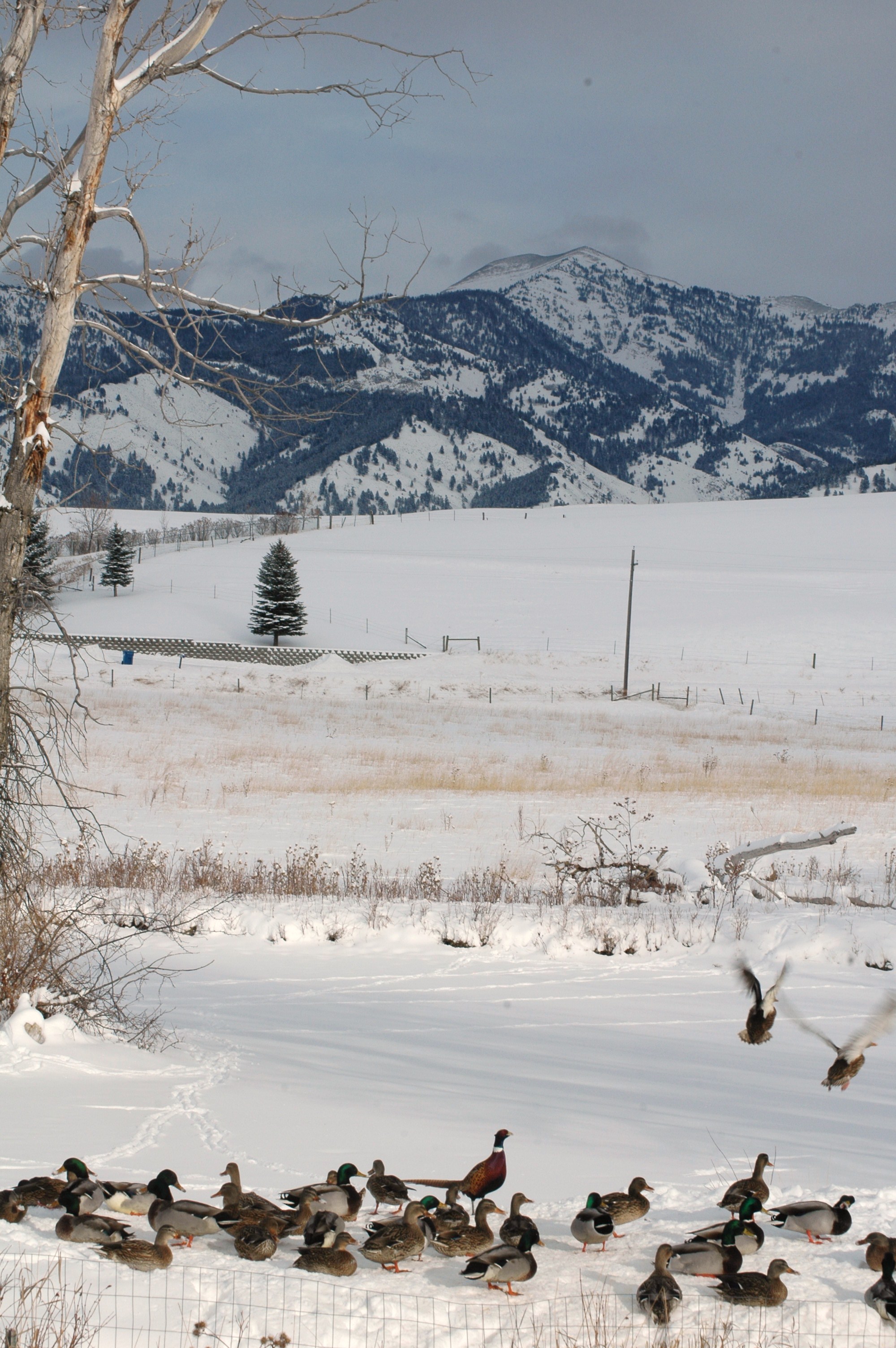
It’s good to know that crimes like these are prosecuted (though the punishments for crimes against animals are seldom more than a slap on the wrist). The question is how does the shooting of ducks “for a bit of fun” differ from the legalized blasting of birds in the name of sport? Depending on the species, the shooting of 18 ducks can be well within the “bag limit” set by local “game” departments. And leaving ducks winged and wounded is standard practice for the average bird hunter.

DSC_0082

Remember, Tuesday Is Soylent Green Day

As with Christmas, Thanksgiving has become a rather hedonistic holiday these days. You’d have to pin your ears back, with empty cornucopias held tightly against them, to hear even a faint reference to the giving of thanks through the din of loud chatter about seemingly more important things like football, where to get the best deals on Black Friday, or how to deep fry a turkey. But any thanks you heard would be to “the lord above,” rather than to the victims of the decadent feast.

Completely lost in the hype of “tradition” and “Turkey-day” is any mention of giving even a passing “thank you” to the birds who suffered more indignities than space would allow me to mention here. Indignities that include the fact that turkeys on factory farms receive less than three square feet of personal space. And after they hatch, their beaks are cut off—a standard practice for chickens as well. No anesthesia or painkiller is used for either species. This process, which is known as “debeaking”, has been compared to having the ends of your fingers sliced off. It deprives birds of one of their most important sources of sensory input.

A debeaked bird cannot eat properly or explore his or her environment fully, nor can they preen themselves or their flockmates.  They may also experience acute and chronic pain in their beak, head, and face. In addition to being debeaked, turkeys also have the ends of their toes and their snoods cut off, often with nothing more than a pair of scissors (and as with debeaking, performed without anesthesia).

According to Liberation BC, both chickens and turkeys on modern factory farms have been genetically engineered and pumped with antibiotics; as a result they grow much faster than ever before. For example, in the 1960’s, it took a turkey 32 weeks to reach slaughter size, but now it takes only 13-16 weeks. In the 1950’s, it took a chicken 84 days to reach five pounds. Today, it takes 45 days, meaning that they are not even old enough to cluck yet when they die.

And PETA adds, their unnaturally large size also causes many turkeys to die from organ failure or heart attacks before they are even 6 months old. According to an investigative report in the Wall Street Journal on the miserable conditions on turkey farms, “It’s common in a rearing house to find a dead bird surrounded by four others whose hearts failed after they watched the first one ‘fall back and go into convulsions, with its wings flapping wildly.

Factory farm operators walk through the shed to kill the slow-growing turkeys (so that they don’t eat any more food), such as those who fall ill because of the filthy conditions or become crippled under their own weight.

In Canada, turkeys and chickens can legally be transported for up to 36 hours without food, water, or rest, and there are no limits as to the length of the journey. They are transported in open-air crates, resulting in high mortality as the birds are exposed to all sorts of weather.  Each bird is worth so little, however, that it is cheaper overall for the industry to use open-air crates.  Every year in Canada, 2 million broiler chickens and 20,000 turkeys are already dead when they arrive at slaughterhouses.  An additional 8 million broiler chickens and 200,000 turkeys arrive so diseased or injured that they are considered “unfit for human consumption”.
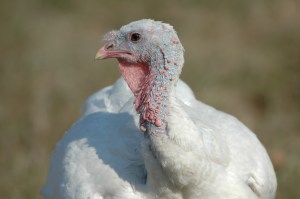
The surviving birds are handled roughly at the slaughterhouse, where they are unloaded by forklift and dropped onto a conveyor belt. With thousands of birds to be processed every hour, there is no reason for employees to stop and pick up the individual birds who miss the belt and fall to the ground.

When it comes time to slaughter the birds, they are hung by their feet on a moving rail and dragged through the stunning tank, an electrified water bath meant to stun and immobilize them. These are often set lower than is necessary to truly render the birds unconscious out of concerns that high voltage might damage the carcass and therefore diminish its value.

They are then carried past the tank to have their throats cut either by a mechanical blade or a plant employee. Often, struggling birds are cut improperly. As a result they are moved, fully conscious, to the scalding tank, where they are boiled alive.  Estimates place the number of affected birds at about one in twenty; at any rate, this occurrence is so common that the industry has a term for it: “redskins.”   …

Clearly, nobody gives much in the way of thanks to the “most important guest” at the table (as a recent Safeway ad described the turkey carcasses they were selling). You’d be damned lucky to overhear even a cursory mention of the miserable existence their edible “guest” underwent prior to the killing and plucking process. There is scarcely a sign that the hundreds of millions of Americans who gorge on the bodies of 45 million turkeys each year give a whit about whether these amazing and impressive birds had—prior to “harvest”—a life that allowed even a modicum of the freedom they would have experienced before the grossly over-populated human world made them their food-slaves.

Appropriately, I watched the timeless 1970s movie Soylent Green last night. Set in 2022, the film opens with a slide show of earlier eras, back when the Earth was covered with forests and open fields, and there were only a few scattered settlements of people who travelled in horse-drawn wagons.

As the images pass quickly by, we see the first automobiles (tail pipes spewing toxic carbon gases), followed by a massive blacktop parking lot jam packed with Model Ts. The pictures begin to flash almost more rapidly than we can focus, but we catch glimpses of factories with smokestacks billowing and crowds of people barely able to

move without trampling one another. (Come to think of it, what we are witnessing looks a lot like the inside of an average modern-day poultry barn, where Thanksgiving turkeys are forced to live out their lives in intense confinement.)

The first scene of action takes place in a cramped little New York City apartment, the dwelling of the film’s two main characters, Thorn, a semi-corrupt detective, and his elderly room-mate and research partner, Sol, who is constantly going on about the good old days—a world that Thorn can’t possibly envision or relate to.

They are among the lucky few; most people sleep on the stairways or in the hallways or anywhere they can find shelter from the oppressive heat caused by an out of control greenhouse effect. We overhear a program on their worn out old TV which is an interview with the governor of New York, touting a new food product called “Soylent Green,” ostensibly made from the ocean’s plankton. (Everyone in that day and age knows that the land is used up, but they’re told the oceans can still provide for them).

Food in this depressing, human-ravaged world comes in the form of color-coded wafers, distributed under strict government supervision. Hordes of people stand in line for their ration of Soylent yellow or blue made from soy, or other high protein plants grown behind the fortress-walls of heavily guarded farms.

Signs remind the throng that “Tuesday is Soylent Green day.”

The multitudes are exceptionally unruly on Tuesday. Brimming with anticipation, they can’t wait to obtain a ration of the special new product. When they get out of hand, “scoops” (garbage trucks fitted with backhoe-like buckets on the front) are called in to scoop them up and haul them off…

Spoiler Alert:

To make a long story short, by the end of the film, Thorn learns that the oceans are dead and the actual ingredients of Soylent Green are something a bit harder to stomach than plankton. In the final scene, a mortally-wounded Thorn is carried away on a stretcher as he desperately tries to tell skeptical onlookers, “Soylent Green is People!” “They’re making our food out of people. Next thing, they’ll be breeding us like cattle for food!”

Could it ever happen? Could the human race ever stoop so low? If the scenario seems too hard to swallow­, consider this: the conditions animals are forced to endure on today’s factory farms would have seemed unimaginable to people living a hundred years ago.
­­

The Last “Traditional” Thanksgiving

In the beginning, God created turkeys…well, that’s not exactly true—turkeys evolved in North and Central America somewhere in the neighborhood of twelve million years ago, during the Miocene/early Pliocene epoch—but it makes for a good story.

Turkeys are intelligent, highly social and easily distressed when isolated or kept from their familiar surroundings. Adults can differentiate between friends and possible foe, and have been known to go into attack mode to drive off outsiders. Benjamin Franklin described the turkey as “a Bird of Courage, and would not hesitate to attack a Grenadier of the British Guards who should presume to invade his Farm Yard with a red Coat on.”

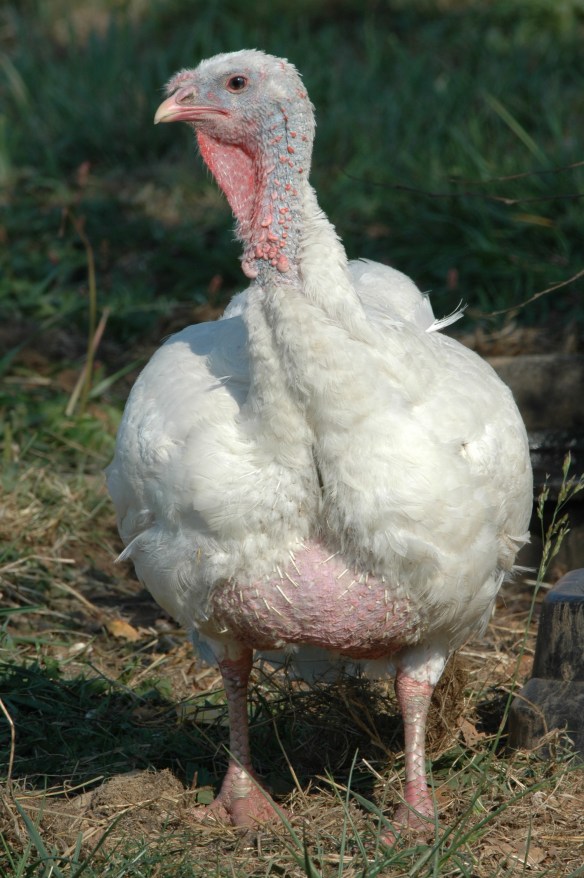
Their size, showy feathers and territorial disposition make turkeys an easy target for anyone with a weapon and an unwholesome urge to kill. Native Americans have a long history of feasting on turkeys that began well before the first Thanksgiving—the California turkey was hunted to extinction over 10,000 years ago. Meanwhile, modern human’s industrialized abuse of turkeys is nothing short of barbaric. Man has become so proficient at playing God with the turkey that nowadays the once proudly feathered bird is hardly recognizable. The vast majority of domesticated turkeys are bred to have white feathers because their pin feathers are less visible to the feaster when the carcass is “dressed” (glib jargon meaning butchered and mechanically plucked).

Any compassionate creator would be appalled by the unimaginable scale of institutionalized abuse of turkeys on factory farms or even on pseudo “free range” feel-good farms. Yet, each year turkeys are depicted—appearing at ease or even pleased with their plight—in inane commercials meant to soothe any holiday shopper who may have inadvertently stumbled onto the ugly truth about the suffering and cruelty inherent in the meat industry.

If you’re feasting on the flesh of one of the 45 million turkeys slaughtered this Thanksgiving season, please take a minute to consider the unnecessary suffering your meal caused and make this your last “traditional” Turkey-kill Day. Next year, try celebrating the life of the turkey while you feast on Tofurky or Field Roast, cranberries, candied yams, mashed potatoes, dressing, pumpkin pie and all the other tasty non-animal fixin’s. You may end up stuffed, but at least a bird won’t have to be.

Text and Wildlife Photography ©Jim Robertson, 2012. All Rights Reserved

.

Call Today! The “Sportsmen’s” Act of 2012 Must Fail

URGENT!  Before you read another line, pick up your phone, call your Senators and tell them to OPPOSE S 3525 (the so-called, “Sportsmen’s” Act of 2012)! You can find the contact numbers for your senators at the following web page: http://www.senate.gov/

Though the threat of having to watch bowhunter Paul Ryan by crowned Vice President has passed, the specter of sport hunting still haunts the halls of Congress. Under the cunning guise of “conservation,” the Sportsmen’s Act of 2012, S 3525, is a Senate version of the House’s ridiculous “Sportsmen’s Heritage Act” (what will they think of next, a Serial Murderer’s Heritage Act?).

No animal should be reduced to the level of mere object only to be “harvested” at the casual whim of jaded trophy seekers out for a diversion from their meaningless lives.

For the sake of wildlife, public lands and unspoiled wilderness nationwide, we must stop this absurd act from becoming law.

Of course, the animal’s enemies are lining up behind it. According to a new post in Outdoor Life (a popular “sportsmen’s” magazine that actually promotes outdoor death) entitled, “Must-Pass Legislation: Sportsmen’s Act of 2012,”

“The fight for the Sportsmen’s Act isn’t over. The NRA, National Shooting Sports Foundation, Theodore Roosevelt Conservation Partnership, Boone and Crocket Club, Congressional Sportsmen’s Foundation, and a host of other national, regional and local groups are calling all hands to lobby their Senators for passage.”

Make no mistake, those of us who truly care about wildlife wouldn’t want to see this pass even if it were a painfully annoying kidney stone. The Sportsmen’s Act of 2012 is a must-fail piece of legislation.


Thanks to the Animal Welfare Institute for the following action alert:

On November 13, their first day back in session following the recent election, the U.S. Senate will resume consideration of The Sportsmen’s Act of 2012 (S. 3525). Please call and urge your Senators to oppose S. 3525.

If enacted, S. 3525 will have substantial and direct adverse impacts on wildlife, public health and existing conservation efforts. This bill would weaken protections offered by laws such as the Marine Mammal Protection Act, Toxic Substances Control Act and Endangered Species Act. Included in the bill’s language are provisions that would:

•Eliminate the Environmental Protection Agency’s authority under the Toxic Substances Control Act to regulate hazardous substances—including lead, a dangerous neurotoxin—released by ammunition and sport fishing waste.

•Encourage federally-funded construction and expansion of public shooting ranges on state and federal land, including land managed by the U.S. Forest Service and the Bureau of Land Management.

•Amend the Marine Mammal Protection Act to permit importation of polar bear carcasses taken before the species was listed as “threatened” under the Endangered Species Act in 2008—including those taken despite multiple warnings of an imminent ban on imports.

This legislation, if enacted, will interfere with important statutory protections affecting animal welfare, human health, and the environment.

The Senate is moving quickly on this bill, so your help is urgently needed TODAY.  Please contact your Senators by phone, email, or fax and tell them to oppose S. 3525!

You can identify your Senators and their contact information here.

Sample Message:

As one of your constituents, I urge you to help protect human health, wildlife and public lands by voting against S. 3525. This legislation, if passed, will undermine provisions of existing conservation statutes including the Marine Mammal Protection Act and the Toxic Substances Control Act. It will also interfere with the exercise of authority by federal agencies responsible for managing federal lands and protecting public health. Please oppose S. 3525, and help to protect wildlife, habitat and the public.

Thank you,