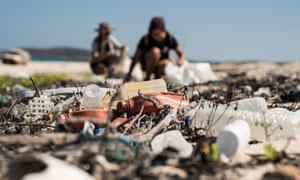
Plastic waste strewn on Djulpan beach in Arnhem Land, in Australia’s Northern Territory. Photograph: Rebecca Griffiths/Sea Shepherd
Further evidence that plastic does not discriminate as it spreads across the planet: the marine conservation organisation Sea Shepherd said it is washing up in large quantities on a remote Australian beach.
Sea Shepherd joined Indigenous rangers in picking up more than seven tonnes of marine plastic pollution on a two-kilometre stretch of Djulpan beach, in northeastern Arnhem Land.
The clean-up of Djulpan beach, about 2 1/2 hours drive from the township of Nhulunbuy on the western side of the Gulf of Carpentaria, was conducted over two weeks last October. There is no road to the beach. The rangers from Dhimurru Aboriginal Corporation cut a 4WD track through scrub to reach it.
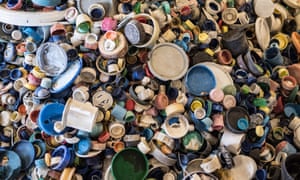
A collection of the bottle tops removed from Djulpan beach during the clean-up. Photograph: Rebecca Griffiths/Sea Shepherd
Liza Dicks, from Sea Shepherd Australia, said it was the worst case of plastic rubbish the group had found in more than 600 clean-up exercises at mainland Australian beaches.
About two-thirds of the debris were consumer items: water bottles, cigarette lighters, ice block wrappers, shoes, thongs, toys and toothbrushes. The rest was 72 types of discarded fishing net, some of which contained turtle bones.
Jennifer Lavers, a marine biologist at the University of Tasmania who led the Cocos (Keeling) Islands study and helped Sea Shepherd analyse what it found at Djulpan beach, said much of the rubbish was single-use and disposable. Some of the plastic appeared to be decades old.
“It is likely this waste came from southeast Asia, but we know at the same time Australia’s waste is going over to somewhere else,” she said.
“It is incredibly commonplace, but for the average ordinary person it’s probably pretty shocking to learn that these remote pristine places have such a high density of plastic. This is not some untouchable thing. It is a thing we can do something about.”
Last month the prime minister, Scott Morrison, vowed to do more to stop Australian plastic ending up in oceans. He won in principle backing from state and territory leaders to boost the struggling local recycling industry and ban the export of recyclable material.
Our mark on Earth is so profound that some argue it’s time to bid goodbye to the current geological time period — the Holocene — in favor of a new one: the Anthropocene.
By Ramin Skibba 01.22.2018
In the thousands of years that modern humans have trod the Earth, we have wreaked stunning changes on the planet — the rising CO2 levels fueling climate change, novel and long-lived radioactive particles from nuclear activity, depleted water resources, toxic waste buildup, desertification and more. To reflect our impact on the globe, some geoscientists and biologists have advanced the concept that we are living in a new geological time period: the Anthropocene, or the epoch of humankind.
The current geological epoch, the Holocene, began 11,700 years ago, after the last major ice age. But in the last 15 years, geologists and other Earth scientists have debated whether we have left enough of a mark on the world that it makes sense to bid the Holocene goodbye.
This conversation has been edited for length and clarity.
What’s your definition of the Anthropocene?
It’s a term for a new geological epoch that signifies an age where the planet is dominated by human influence. But others wouldn’t agree. They say any significant modification of the environment would count — it doesn’t have to be complete domination.
And so one big debate is whether the Anthropocene is recent, say, starting in the mid-twentieth century, or whether it’s been going on for centuries or even millennia. The debate pivots on whether it’s a continuation of a process where humans have been altering the environment since we started using fire, or with early farming, or whether something dramatic has happened more recently where we started dominating and rupturing the environment in fundamental ways. Something so significant that it’s altering geological records.
For example, the spread of wet rice farming in Asia thousands of years ago may have increased global concentrations of methane, and this may have delayed the onset of the next ice age. Others argue that the extinction of megafauna, like mammoths, in which human hunters probably played a role, may have caused reflective and snow-covered high-elevation grasslands to be replaced by dark, heat-absorbing forests, leading to local warming. These would suggest human alteration of planetary processes, but not the domination of them that we’re seeing today.
What more recent changes would you point to that argue for a distinct Anthropocene epoch now?
The underlying issue is that human activity is so large because there’s so many humans and because of how active they are in consumption and waste production. We’re over-harvesting fisheries and the ocean, and we’re converting large parts of land from natural ecosystems to croplands or pasturelands. Part of it comes from our waste products. Climate change comes under that, through excess CO2 in the atmosphere, swamping the natural capacity of the carbon cycle to absorb it.
Humans have always affected local environments, depleting resources or putting too much waste into it. There’s little evidence that early civilizations were more sustainable than contemporary ones; they just worked on a smaller scale. The challenge now is that we’re a global, interconnected civilization, so our activities are starting to alter planetary functioning.
Are there geological arguments against formally designating our current period as the Anthropocene?
Some geologists question whether geological time scales are the best forum for what is essentially a political framing or advocacy term. It’s also a challenge that a mid-twentieth-century start date is so recent that a clear stratigraphic signal is hard to distinguish.
The working group has converged on a starting date of the Anthropocene in the mid-twentieth century, often termed the “great acceleration,” and the group is spending the next few years building up a strong stratigraphic case for this. If you look at concentrations of atmospheric CO2, the amount of tropical deforestation, numbers of rivers dammed, the amount of fish harvested, as well as the total human consumption of food and raw materials, they all show an increase over time but an uptick in the mid-twentieth century.
Would you say the Anthropocene concept has been more useful for scientists or in a public, cultural sense, drawing attention to the impact we’re having on the planet?
I think both. The Anthropocene provided for the sciences a unifying framework that didn’t exist before, drawing together multiple fields to describe the processes changing the Antarctic, tropical forests, the climate, biodiversity, and the ozone layer.
Culturally, it’s even more useful than framing issues just around climate change because it brings in the underlying issue: the metabolic signs of humanity. Our activities, relative to the size of the planet, have become so large that they’ve changed the way we think about ourselves and our history and future. That’s got a huge cultural and political resonance. It’s the zeitgeist, it’s hit a raw nerve of something people felt was there, but needed a way to describe it.
The Anthropocene framing recognizes the world is finite. A century ago, when London and the river Thames were polluted, it led to the realization that the river isn’t infinite, you can’t just dump waste and forget about it. It comes back to bite you. With climate change, if you keep pouring waste into the atmosphere, at some point it feeds back.
This is a way to think about the world around you in a really fundamental way. That’s where you can start imagining different futures. It leads to challenges like, how can an economic model built on perpetual growth fit within a finite planet?
When you’re thinking of global problems, like climate change or species extinctions, which ones could cause the most damage?
It depends on what you think is a threat. For human civilization, I’d say it’s climate change. If we pass some threshold, like if we see Antarctic ice sheets melting and other irreversible tipping points, that would have a huge negative impact on much of humanity.
For the biosphere, the acidification of oceans could prove critical. On land, it’s the loss of large areas of forests, especially tropical forests.
Have you thought about global solutions, whether it be changing consumption patterns in industrial countries, or things like geoengineering to tackle climate change?
There’s a whole gamut of solutions. For me, an ideal mix includes changes in the fundamental economic model, the mass consumption society, coupled with behavioral change at the societal level, along with redesigning our energy systems — with renewables replacing the fossil-fuel economy. Technology plays a role, but also rethinking our priorities as a society.
I’m cautious about geoengineering. It may be necessary at some stage, but it presumes we know more about Earth’s systems than we do. It carries a bit of hubris around it. We could inadvertently do more damage, rather than reverse it.
Are there sociological or moral criticisms you’ve come across of the concept of the Anthropocene?
Some argue that the Anthropocene is a broader environmental concept that concerns us all, rather than just a geological one. It’s about how we think about our relationship with the natural world, how we manage living on a human-dominated planet.
There are criticisms within the social sciences. Political scientists ask, what is this “anthropos”? It creates a sense of all of humanity in this together as a force altering nature, and the term’s ignoring that only a subset of humanity caused the Anthropocene. People outside the West and industrialized Asia played little role in creating it. It diffuses responsibility away from the core that’s responsible.
Others argue that it creates a sense of inevitability, like this geological age was going to come to pass, ignoring that perhaps political or economic decisions, such as the creation of the capitalist world system, lie behind this, by creating a resource-intensive exploitation of the world.
What are the next steps for research on the Anthropocene?
The really interesting questions are not how we define the Anthropocene, but how do we navigate it?
I’ve been reading work on “doughnut economics” by Kate Raworth, who describes herself as a “renegade economist.” She thinks about how we can reach this goal of getting enough people out of deprivation — the hole of the doughnut is the inner circle of deprivation — while staying within the outer ring. It’s this challenge of reconciling human improvement and welfare while maintaining the environmental stability of the planet and leaving enough space for other organisms that live on it. How do we stay in that doughnut? It’s a mixture of research and policy action.
Will the Anthropocene just continue indefinitely?
At least for some time in the future. We’re currently in the Cenozoic Era, which started with the asteroid that killed the dinosaurs. That was planet-altering. Perhaps the alterations we’re doing now, if they played out for a century, if we pushed climate change beyond tipping points so that it accelerates, then “Anthropocene” — an epoch — is too modest a designation. People argue that what’s happening now is so substantial and profound it should be something like the “Anthropogene” [a period] or the “Anthropozoic” [an era], since the scale of the change may be so large that “epoch” is too low in the geological hierarchy of time scales to be appropriate. It’s too soon to decide that.


 Exposing the Big Game