Polarized Wolf/Anti-Wolf groups battle with billboards

http://www.spokesman.com/outdoors/stories/2015/jan/11/polarized-wolf-groups-battle-with-billboards/

The Defenders of Wildlife launched a pro-wolf billboard campaign in the Spokane area this month to counter anti-wolf billboards.

2 / 2
Show captions

Opposing views of gray wolf recovery in Washington are on display in a Spokane-area battle of the billboards.

The Defenders of Wildlife, a national wildlife advocacy group, has contracted for nine billboard posters that appeared this month. The message responds to a similar outdoor advertising campaign initiated in November by an anti-wolf group called Washington Residents Against Wolves.

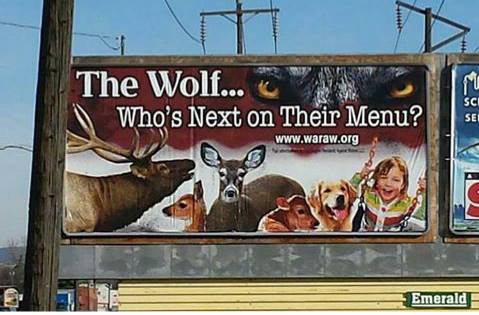
Four of the eight WARAW billboards feature photos of a deer, an elk, a calf, a dog and a young girl on a swing with the text: “The Wolf – Who’s Next on Their Menu?”

“What we want is for people to ask very serious questions about the presence of wolves in Washington State before the reality confronts them,” said WARAW spokesman Luke Hedquist in a media release introducing the campaign.

In response, Defenders has put up nine billboards with the headline “Reality Check! What’s More Dangerous?” Four images help answer the question based on average deaths per year in the United States: “Lightning 33. ATVs 413. Elevators 26. Wolves 0.”

“We just want to cut through the myths to the facts,” said Shawn Cantrell, Defenders Northwest director based in Seattle.

Gray wolves remain under state endangered species protections in Washington as they naturally reoccupy their native range in the state.

More: http://www.spokesman.com/outdoors/stories/2015/jan/11/polarized-wolf-groups-battle-with-billboards/

Science and Sentiment Say Wolf Trophy Hunting Doesn’t Wash

Anti-wolf billboard, Spokane, WA

Anti-wolf billboard, Spokane, WA

http://www.huffingtonpost.com/wayne-pacelle/science-and-sentiment-say_b_6278208.html?utm_hp_ref=green

W

Science and Sentiment Say Wolf Trophy Hunting Doesn’t Wash

 12/05/2014

If policy makers stick to their guns and continue allowing trophy hunters to kill  wolves in six states in the Great Lakes and Northern Rockies regions, they will be defying both science and, generally speaking, the will of voters.

Folks, the recent weeks of 2014 have brought us to a turning point. So let’s turn. It’s time to turn away from the past and catch up with the future in the way we manage predators in the wild.

The right decision now, after what we have learned, is to suspend trophy hunting and trapping programs for the small, recovering wolf populations just recently taken off the federal list of endangered species – with the knowledge that it’s the right thing to do on so many levels.

One compelling reason is science. Underlying the growing number of wolf hunts in the United States is the wrongheaded, but long-standing, belief that trophy hunting and trapping programs for wolves reduce the threat that wolves pose to cattle, sheep, and other free-ranging livestock.

Well, that theory is now in doubt. And it’s not just me who says so.

The first serious study of that theory has been released and it found just the opposite. When I say serious, I mean very serious science. Washington State University researchers dug into comprehensive statistics from 25 years of wolf “management” and found that shooting wolves indiscriminately may make things worse for farm animals. As well as for wolves.

That’s because when disrupted, wolf families adapt, move, split up, increase reproduction — and then they kill even more livestock.

Researchers found that shooting wolves indiscriminately reduces predation on cattle and sheep only when wolf populations are brought so low that, guess what, they end up protected again under the Endangered Species Act.

Wolf haters are having a hard time coping with the truth here. A spokeswoman for one Washington state group was quoted as criticizing the integrity of the 25-year statistical survey because it was sponsored by the state legislature.

Or here’s what a spokesman for Idaho’s wool growers told National Geographic: “The professor can say whatever he wants. We’re not going to just let wolves run wild.”

Well, folks, you can’t invoke science only when it suits you — as the trophy hunting lobby so often does. The science may not be the final word, but it’s an important set of facts to inform a final decision.

The other element to consider is our values: obviously, here we differ with the wool growers and the trophy hunters. But let’s face it, by all accounts, it appears their views are in the minority. The public wants more protection for wolves, in a world where we all are showing greater conscious consideration of animals.

In the first-ever plebiscite on the subject, voters in Michigan sided with wolves and against trophy hunting and trapping. Voters faced two separate votes on laws passed by the Legislature to permit wolf hunts, and both were repealed. The margins were overwhelming, 64-36 and 55-45, with one of the measures getting more than 1.8 million votes against wolf hunting, more votes than any of the statewide candidates for office received in their winning elections.

Let me add that Michigan has one of the most deeply rooted and publicly popular hunting traditions in the United States. But voters there, including hunters, understood that wolf haters were plain wrong — and that these ancient animals played a vital role in the wild ecosystem, and in fact were more valuable as a draw for tourists than as stuffed decorations in private trophy rooms. What’s more, nobody eats wolves, so the idea of killing them has no practical value, and responsible hunters don’t go for that, either.

Just as with the new science, there can be no quibbling with the meaning here.

The two pillars of good policy — independent and verified science and thoughtful electoral consensus — agree: Hunting wolves is not acceptable to the public and makes life worse for ranchers who raise cattle and sheep.

**

Sign up here to stay up to date on our work with wolves.

This article first appeared on Wayne Pacelle’s blog, A Humane Nation.

Washington group puts up anti-wolf billboards

http://billingsgazette.com/lifestyles/recreation/washington-group-puts-up-anti-wolf-billboards/article_f734776f-30eb-51f3-80a6-c24f024ff950.html

2014-11-21  Washington group puts up anti-wolf billboardsBy Rich Landers The Spokesman-Review The Billings Gazette

A newly organized anti-wolf group says it’s targeting Spokane with a billboard campaign to highlight members’ concerns about the increasing number of wolves in Washington State.

Four billboards featuring a snarling wolf are being put up, according to Washington Residents Against Wolves, a group that says in a media release that it’s promoting “sound management of the predator.”

“The aim of the billboard campaign is to encourage people to ask more questions about what having wolves in Washington really means,” said Luke Hedquist, WARAW member.

“People need to consider the challenges associated with wolves. Wolves can and will attack people, livestock will be killed and maimed, private property will be compromised and local economies will be impacted. We want to make sure people thoroughly understand the issue, so we started by trying to get people’s attention with the billboards.

“As the elk and other ungulates are impacted by wolves, we will see fewer animals for other predators like cougar and bear, a decline in the number of animals available to hunt and significant impacts to local economies as hunters go elsewhere.”

Wolf Hunting in Washington?

WDFW also should open discussions about setting an upper limit on the wolf population. “There’s got to be a top number. We can’t let an apex predator grow unchecked,” he said…

http://www.capitalpress.com/Washington/20141031/washington-peeks-ahead-to-life-after-wolves-recover

Washington peeks ahead to life after wolves recover

Capital Press

Published:October 31, 2014 1:56PM
 
With Washington’s wolf population growing, talk about delisting the species has already started.

Washington will have a plan by 2018 for managing wolves after they’ve been taken off the state’s endangered species list, according to a Department of Fish and Wildlife proposal.

The agency sets the date in its 2015-21 game management plan, which has yet to be approved by the Fish and Wildlife Commission.

The document outlines objectives for managing game animals. WDFW received comments urging it to address wolf predation of deer and elk now.

Instead, the game management plan defers to the state’s wolf recovery program, which calls for establishing wolves in Washington before considering the effects on deer and elk.

The agency did for the first time set a time frame for developing a plan in anticipation the wolf population will outgrow endangered species status.

The department projects wolf-recovery goals could be met by 2021, the year the game management plan expires.

Washington Cattlemen’s Association Executive Vice President Jack Field said he was disappointed wolves didn’t get more attention in the game management plan.

“We’re going to achieve our recovery objective in Washington state,” said Field, who’s on the state’s Wolf Advisory Group. “There’s going to be an impact on ungulates.”

Field said WDFW also should open discussions about setting an upper limit on the wolf population.

“There’s got to be a top number. We can’t let an apex predator grow unchecked,” he said.

WDFW Game Division Manager Dave Ware said wildlife managers have not seen a decline in deer and elk populations in northeast Washington, where the state’s 52 wolves are concentrated.

The state projected in 2011 that once the population reached 50, wolves would take up to 630 elk and 1,500 deer a year, a fraction of the 7,900 elk and 38,600 deer killed by hunters annually.

Ware said the 2018 deadline will ensure the department has a plan ready if recovery-goals are met sooner than expected.

The head of a wolf sanctuary in Tenino, Wash., said WDFW appears set to start working on a post-recovery plan prematurely.

“It doesn’t make any sense to us,” said Diane Gallegos, executive director of Wolf Haven International. “Our focus should be on recovery and working with people who are most effected by recovery.

“We don’t know what the impacts of wolves are going to be in Washington,” Gallegos said. “We’re going to know so much more in five years that anything we do know, we’re going to have to redo.”

Conservation Northwest Executive Director Mitch Friedman agreed talks on managing an established wolf population can wait.

“It’s not a bridge we have to cross now,” he said. “It would create more smoke than light in the near term, and we would have to repeat it in the long term.”
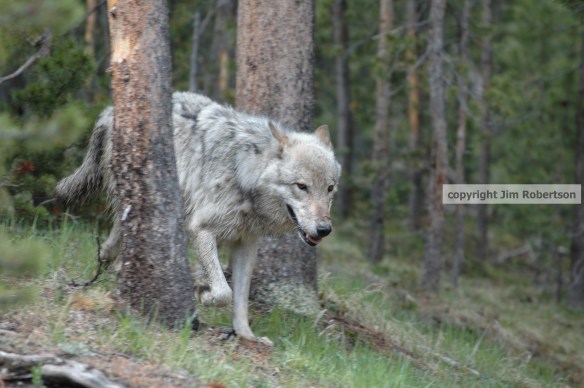
copyrighted Hayden wolf in lodgepoles


FWP Ends I-90 Wolf-Kill Investigation

Montana Fish, Wildlife & Parks ended its investigation today into a Facebook posting from Missoula resident Toby Bridges, where he claimed to have killed a wolf and injured another with his vehicle on Interstate 90 just east of the Idaho border. After having the Mineral County Attorney’s office review the investigation, FWP will not be filing any charges in this case.

FWP was first notified of the Facebook posting on September 17, and game wardens initiated an investigation the next day.

“In Montana, harassing or intentionally killing wildlife with a motor vehicle is illegal, and we take reports of such incidents very seriously,” said FWP Warden Captain, Joe Jaquith.

On September 18, wardens investigated the area described in Bridges’ online account, and found a wolf carcass off the shoulder of the road that was consistent in size and color with the online photo. The carcass, however, was far more decomposed than typical for a wolf killed at the time Bridges reported to have struck the wolf.  Wardens found no physical evidence of a collision on or near the Interstate.

Wardens also searched surrounding hillsides for signs of the second wolf that Bridges claimed to have hit and injured.  They could not locate any signs of a carcass or injured wolf, including evidence of blood, tracks, hair, odors, or scavengers.

Wardens interviewed Bridges and used his photographs from the scene for further investigation by other law enforcement officials and wildlife specialists.

A Montana Highway Patrol crash scene investigator analyzed Bridges’ photograph from the scene and concluded that based on the photograph, the vehicle had not been involved in an accident. No accident report had been filed.

Wardens searched for potential witnesses and worked with the Montana Department of Transportation as part of the investigation, but no witnesses came forward.

“In typical cases involving harassment or killing of wildlife with a vehicle, there has always been either a witness to the event, and/or fresh physical evidence that could be directly tied to the violation,” Jaquith said. “In this particular case the only witness appears to be Mr. Bridges, the vehicle shows no evidence of having been in an accident, and the lack of any other physical evidence supporting the claim precludes the filing of criminal charges.”

Brooks Fahy Executive Director

PREDATOR DEFENSE

Photo copyright Jim Robertson

Photo copyright Jim Robertson

FWP investigating after Missoula man runs over wolves

Photo copyright Jim Robertson

Photo copyright Jim Robertson

http://www.kpax.com/news/fwp-investigating-after-missoula-man-runs-over-wolves/

by Robbie Reynold – KPAX News

MISSOULA – A Missoula man is under investigation by Montana Fish, Wildlife, and Parks because of a controversial Facebook posting.

“This is one of the more ghoulish, gorish, postings I’ve ever seen,” said Predator Defense Executive Director Brooks Fahy.

You have to see it to believe it – pictures of a dead wolf posted on a Facebook page titled Lobo Watch, which is an anti-wolf organization.

A written message accompanies the pictures, which were posted on Sept. 16 – recounting an Aug. 14 incident in which a man driving his wife’s van ran over two wolves.

“When we first became aware of the post, it was right away something that we knew we needed to take seriously and to look into,” FWP spokesperson Vivica Crowser explained.

FWP is investigating the incident to determine whether or not the wolves were run over intentionally.

The message on Facebook is signed by Lobo Watch’s leader, Toby Bridges, who says he was driving on Interstate 90 near the Idaho-Montana border when he saw a calf, an elk cow, and four wolves.

Bridges wrote that the wolves were going after the calf, and that he decided to let off the brake and hit the accelerator.

The post said, “I was going to save that calf,” and goes on to say he heard two distinct “thumps”. He returned to the scene to find the dead wolf and another hobbling off with a broken leg.

Crowser told MTN news that investigators are now looking for more evidence related to the incident.

“Social media in itself isn’t enough. You have to uncover more through the case as you go along and finding things – like evidence on the scene or through other witnesses,” she said.

Fahy says he believes Montana should do more to protect wolves – especially against an incident like this.

“There’s an archery season, a trapping season, and a general hunting season for wolves. And there is no season to basically run over wolves with automobiles purposely.”

Missoula man runs-down wolves, brags on Facebook

John S. Adams 10:52 p.m. MDT September 19, 2014

Editor’s note: What follows is a graphic description that may be difficult for some readers.

A Montana Fish, Wildlife and Parks law enforcement official said Friday the agency is “looking into” a Missoula anti-wolf extremist’s Facebook claim that he purposefully ran down a pair of wolves on Interstate 90 just east of the Idaho-Montana border.

Montana FWP Region 2 Warden Capt. Joseph Jaquith said they were aware of Toby Bridges’ Facebook post in which he brags about killing two young wolves with his wife’s van.

“We’re trying to determine, first of all, what exactly we can do with something somebody says on Facebook with no other physical evidence,” Jaquith said. “Whether or not it’s true remains to be seen.”

Bridges, who runs an anti-wolf website and Facebook page called Lobo Watch, on Tuesday posted pictures on Facebook and described in graphic detail how he accelerated his vehicle in an apparent attempt to intentionally run down the wolves.

Bridges did not respond to an email seeking comment.

Bridges described a scene in which he claims a group of wolves were chasing a cow and calf elk across the highway about four miles east of Lookout Pass. Bridges said he “let off the brake and hit the accelerator.”

“Just past MM4 (mile maker 4), a cow elk and calf suddenly ran right out onto Interstate 90, and I let up on the gas and had just started to brake — in case more elk followed,” Bridges wrote. “What followed were two adult wolves. The cow jumped over the concrete barrier separating (sic) West and East traffic lanes, the calf stayed on ‘my’ side — and both were running up the highway, toward the pass. The wolves went after the calf … and I let off the brake and hit the accelerator. I was going to save that calf.”

Bridges said his vehicle was driving approximately 55 mph “when suddenly four young wolves shot right out in front of me.

Wolf Hunting Reinforces Intolerance

Attitudes about wolves after 1st wolf hunt
 
Hypotheses: Attitudes towards wolves and wolf policy among residents in wolf range since 2009, and since the wolf harvest, with increase in tolerance with hunt. (Note: this was one of the rationales the state used for establishing the legal hunt.)copyrighted Hayden wolf walking
Plurality of wolf range respondents  said tolerance would increase if people could hunt wolves in pre-hunt surveys.
Assumption: Making wolves a game species even in a limited number might make wolves part of the utilitarian culture of wildlife and provide rural residents with increased comfort.
Survey sample: 81% male, 19% females, 70% hunters. Most in “wolf range.”
Results: Significant change occurred: Tolerance decreased by 35% within the wolf range.
 
35% net shift towards agreement with the statement “killing wolves is the only way to protect people and pets.”
Conclusion: Wolf hunting reinforces social acceptance of intolerance, decreases tolerance for wolves in “wolf range” in Wisconsin.
Need to explore other publically acceptable, ecologically sustainable methods of carnivore conservation

Wolf hunt limits set for 2014-2015; landowners may kill up to 100 threatening wolves per year

Private land | Owners can kill wolves they believe are a threat without it counting toward hunting season

MISSOULA — Private landowners may kill up to 100 wolves a year they believe are threatening livestock, dogs or people under a new state law that doesn’t count toward Montana’s wolf-hunting season.

But Fish, Wildlife and Parks commissioners opted to monitor those landowner killings in blocks of 25 instead of an earlier plan to allow 50 kills before review. The decision came during the commission’s meeting in Missoula on Thursday.

The landowner quota is separate from the state’s annual wolf hunt. Hunters must have a wolf license and operate during an annual season, while landowners or their agents can kill wolves “that are a potential threat to human safety, livestock or domestic dogs” at any time of year. That option comes from Senate Bill 200, passed in the last Legislature.

Landowners may also kill wolves in the act of attacking livestock without affecting the 100-animal quota.

But they can only use that privilege on private land — not on public-land grazing allotments. And while landowners may allow private hunters to kill threatening wolves on their property under the quota, the landowner (not the hunter) would be responsible for any illegal wolf kill.

So, for example, if a rancher told elk hunters on his land they had his permission to shoot wolves near his cattle, they could do so under the landowner quota without using their hunting licenses. But if a hunter killed a wolf after the quota was exceeded or somewhere that the wolf posed no believable threat, the landowner could be liable for the violation.

On Thursday, the commissioners also set rules for the 2014-15 wolf hunting season, which remained generally the same as last year. The coming rifle season will run from Sept. 15 to March 15, with a bag limit of five wolves per hunter. Two hunting districts near Yellowstone National Park have quotas of three wolves, to protect packs popular with wildlife watchers in the park.

Hunters have no quota on wolves except in those areas close to Yellowstone and Glacier National parks. Last year, hunters killed 128 wolves while trappers took another 97.

Landowners have killed far fewer wolves under previous shoot-on-sight rules for livestock protection. FWP wildlife manager Quentin Kujula said the past several years averaged less than 10.

“Landowners want the opportunity to deal with the situation themselves,” FWP director Jeff Hagener said after the unanimous approval of the quota. “They don’t want to wait for compensation for wolf depredation or for (federal) Wildlife Services to arrive. This way, they don’t have additional costs, and we the taxpayers don’t have additional costs.”

That prompted commissioners Matthew Tourtlotte and Gary Wolfe to amend the landowner rule. The original version required commission review after the first 50 wolves were killed. Tourtlotte and Wolfe proposed making checks in 25-kill blocks.

“I’m really concerned about a perception there’s open season on wolves on private land in Montana,” Wolfe said. “This is to give landowners the ability to address legitimate perceived threats, not to create an open season on private land. It’s easier to become more liberal than try and back off in the future.”

Commission chairman Dan Vermillion said estimates of the state’s wolf population show it has been able to absorb the impact of no-quota hunting seasons. Montana has around 600 wolves.

copyrighted Hayden wolf in lodgepoles

“I think this is the kind of program that helps foster more tolerance for wolves on the landscape,” Vermillion said.

When wolves were protected under the federal Endangered Species Act, Montanans felt powerless to deal with the predators’ impact, and that fostered intolerance for their presence, he argued.