Trump win threatens Porcupine caribou herd, says Yukon MP

BLOG-Trump-Probably-Hates-This-News-About-Wind-Energy-0722-2015

‘The Republicans have always wanted to have drilling’ in calving grounds, Larry Bagnell says

CBC News <http://www.cbc.ca/news/cbc-news-online-news-staff-list-1.1294364> Posted: Nov 10, 2016 1:42 PM CT Last Updated: Nov 10, 2016 1:52 PM CT

The Porcupine herd is one of the largest migratory barren ground caribou herds in North America. Its range stretches from Alaska to Yukon. <http://i.cbc.ca/1.3320779.1447685936%21/fileImage/httpImage/image.jpg_gen/derivatives/16x9_620/porcupine-caribou.jpg>

The Porcupine herd is one of the largest migratory barren ground caribou herds in North America. Its range stretches from Alaska to Yukon. (Meagan Deuling/CBC)

Yukon MP Larry Bagnell believes Donald Trump’s victory does not bode well for one of the last thriving caribou herds in the North — the Porcupine caribou.

Bagnell says Trump’s winning the U.S. presidency, along with Republican victories in the Senate and Congress, will make protecting the herd’s calving grounds in Alaska from oil drilling “difficult.”

“The Republicans have always wanted to have drilling there, which would upset the life cycle of the herd,” Bagnell said.

The Porcupine herd is one of the largest migratory barren ground caribou herds in North America. Its range stretches from Alaska’s North Slope into northern Yukon. The size of the herd fluctuates but the last population estimate, from 2013, put the herd at about 197,000 animals.

Larry Bagnell <http://i.cbc.ca/1.3844691.1478742946%21/fileImage/httpImage/image.JPG_gen/derivatives/original_300/larry-bagnell.JPG>

Yukon MP Larry Bagnell says the new U.S. administration is going to make efforts to protect the Porcupine herd ‘difficult.’ (Cheryl Kawaja/CBC)

Many Indigenous people in Alaska and Yukon rely on the herd for food, and have lobbied for decades to ensure the herd’s calving grounds in the Arctic National Wildlife Refuge (ANWR) are protected from development. The area is rich in untapped oil.

President George W. Bush pushed to open the area to development, and Alaskan senator Lisa Murkowski introduced a bill last year that would have permitted oil production in the refuge.

President Barack Obama, however, sought to expand the protected area <http://www.cbc.ca/news/world/barack-obama-to-seek-protecting-alaska-arctic-refuge-from-drilling-1.2931246> .

Bagnell says now that Republicans will control the agenda in Washington, “it’s going to make that more challenging.”

Methane release from melting permafrost could trigger dangerous global warming

Not to mention the methane being released by animal agriculture, or as a byproduct of drilling for oil or natural gas, or the carbon emitted by modern catastrophic fires, etc. All these, and their feedback loops, are a result of out-of-control human activity–including breeding!

———

http://www.theguardian.com/environment/climate-consensus-97-per-cent/2015/oct/13/methane-release-from-melting-permafrost-could-trigger-dangerous-global-warming

A policy briefing from the Woods Hole Research Center concludes that the IPCC doesn’t adequately account for a methane warming feedback

Inupiat Eskimos go ice-hoping on the Chukchi Sea.
Inupiat Eskimos go ice-hoping on the Chukchi Sea. Photograph: Gilles Mingasson/Getty Images

While most attention has been given to carbon dioxide, it isn’t the only greenhouse gas that scientists are worried about. Carbon dioxide is the most important human-emitted greenhouse gas, but methane has also increased in the atmosphere and it adds to our concerns.

While methane is not currently as important as carbon dioxide, it has a hidden danger. Molecule for molecule, methane traps more heat than carbon dioxide; approximately 30 times more, depending on the time frame under consideration. However, because methane is present in much smaller concentrations (compared to carbon dioxide), its aggregate effect is less.

But what has scientists focusing on methane is the way it is released into the atmosphere. Unlike carbon dioxide, which is emitted primarily through burning of fossil fuels, methane has a large natural emission component. This natural emission is from warming permafrost in the northern latitudes. Permafrost is permanently frozen ground. Much of the permafrost is undisturbed by bacterial decomposition.

As the Earth warms, and the Arctic warms especially fast, the permafrost melts and soil decomposition accelerates. Consequently, an initial warming leads to more emission, leading to more warming and more emission. It is a vicious cycle and there may be a tipping point where this self-reinforcing cycle takes over.

Recently, a policy briefing from the world-leading Woods Hole Research Center has moved our understanding of this risk further through a clearly-written summary. The briefing cites two recent papers (here and here) that study the so-called permafrost carbon feedback.

One of these studies makes use of projections from the most recent IPCC report to estimate that up to 205 gigatons equivalent of carbon dioxide could be released due to melting permafrost. This would cause up to 0.5°C (up to 0.9°F) extra warming. Just as bad, the permafrost melting would continue after 2100 which would lock us into even more warming. Under this scenario, meeting a 2°C limit would be harder than anticipated. The current IPCC targets do not adequately account for this feedback.

To put this in perspective, permafrost contains almost twice as much carbon as is present in the atmosphere. In the rapidly warming Arctic (warming twice as fast as the globe as a whole), the upper layers of this frozen soil begin to thaw, allowing deposited organic material to decompose. The plant material, which has accumulated over thousands of years, is concentrated in to upper layers (half of it is in the top 10 feet). There is a network of monitoring stations that are measuring ground temperatures have detected a significant heating trend over the past few decades and so has the active layer thickness.

I communicated with Woods Hole expert Robert Max Holmes, who told me,

It’s essential that policymakers begin to seriously consider the possibility of a substantial permafrost carbon feedback to global warming. If they don’t, I suspect that down the road we’ll all be looking at the 2°C threshold in our rear-view mirror.

Dr. Robert Max Holmes.
Dr. Robert Holmes. Photograph: Woods Hole Research Center

So, this means that reducing carbon dioxide pollution is even more important. If we are to stop the warming–thawing–more warming cycle, it is critical to reduce emissions now. According to these experts, this is a serious issue, and we should listen to them.

Is the hydrocarbon economy too big to fail?

Is the hydrocarbon economy too big to fail?

If the woefully inadequate outcome of the Paris climate conference is any indication, the answer is still a resounding “Yes!” That’s because the overly optimistic agreement conspicuously ignored the core issue driving up the earth’s temperature and warping the world’s already misshaped markets.

The problem is Big Oil.

Simply put, Big Oil is a bad investment fueled by irrational exuberance, chronic cronyism and an increasingly indefensible misallocation of capital. And decades of throwing good money after bad has produced a distorted economic system that socializes risk, privatizes profits, externalizes costs and misallocates capital. This continues because policy makers sustain it with taxpayer-funded subsidies, costly tax breaks and low-overhead access to publicly held resources.

By failing to institute much-needed cost internalization mechanisms and by completely avoiding the key problem of government subsidization, the cork-popping cadre of COP21 tacitly admitted what most cynics already knew – policy makers still believe “Big Oil” is far too big to fail. But, like other distorted markets in history, the correction is coming. The growing impact of climate change is exposing the key fallacy at the heart of the hydrocarbon economy: Big Oil cannot simply exempt itself from the natural economy governing all things in this closed system called planet Earth.

It’s Only Natural

Since Adam Smith published The Wealth of Nations in 1776, few ideas have captured the capitalist imagination like the notion that “an invisible hand” directs enterprising, self-interested individuals to produce a widely distributed wealth of social goods in spite of their self-serving intentions.

When the “self-serving” butcher, brewer or baker sells quality products at a fair price, they each profit from the returning patronage of their customers. Their customers enjoy good meat, fine ale and fresh bread. An invisible hand rewards these enlightened purveyors with enough money to eat well and drink well, too. And in the process, the whole village eats and drinks and thrives. But unenlightened sellers – those who peddle unnatural combinations of poor products at high prices – are driven out of business by the unsustainable inefficiencies produced by bad decisions and ill intentions.

This market correction happens, in no small part, because they’ve thrown the whole town – which is itself a mini financial ecosystem – completely out of balance with their bad meat and the lost wages from food-borne illnesses. Even worse is the disruption to the ethical butcher who gets undercut by malicious pricing from unscrupulous sellers. But, according to the theory, an invisible hand restores order to the town’s financial ecosystem when consumers react and economic balance is restored.

It’s taken a while for all those bad debts and poor investments to fill up the ecological balance sheet with red ink.

Over time, free-market devotees transformed Smith’s original theory of “an invisible hand” into “the invisible hand.” They believe “the hand” is a universal, natural force governing markets, meting out economic justice and controlling the fate of humankind. And they may be right. But they may also be surprised to find that “the hand” is connected to the right arm of Mother Nature and she’s using it to punish one of history’s most inefficient and least “enlightened” business models. By turning up the thermostat, filling the seas, altering climactic patterns and disrupting food chains, nature’s increasingly visible hand is “correcting” the shortsighted, heavily subsidized use of hydrocarbons to power an unsustainable, ecosystem-denuding industrial system.

Back in 1776, Adam Smith bemoaned the problem of unenlightened short-term thinking in investment and the distortions caused by corporate influence in politics. Like the seller of bad meat at an artificially low price, Big Oil has profited mightily from a short-term emphasis on high returns while its disproportionate political influence ensured the global village subsidized everything it’s been selling.

But Mother Nature is not a day trader…

More:

http://www.truth-out.org/news/item/34409-mother-nature-s-invisible-hand-strikes-back-against-the-carbon-economy


The Dangers of Willful Denialism

A good friend and blog reader posited that perhaps humankind allowing anthropogenic global warming to run further and further amok is facilitated by the same ingrained denial that people employed as they saw Nazi Germany take control of more and more of Europe and carry out their brutal holocaust.

Maybe what the modern human world is doing to Nature by changing the climate so fast that wild species can’t adapt in time—resulting in mass extinction—is just too unbearable to comprehend or believe. Denial, she theorized, is “our forte”—the traditional fallback position.

I have to take it a step further by adding that such denial is willful. I read the blasé reactions to the shattering, unprecedented news that tropical wintertime hurricanes were now invading the arctic. CNN and FOX News set the tone by sounding a collective “ho hum.” Who can be bothered by calls to halt our carbon goose-steps? We humans have an appointment with a brick wall and nothing’s going to stop us until D-day.

Willful denialism allows folks to look the other way while the animal holocaust provides them with their methane-marinated meals of tortured beef cows, or tormented pigs, fish and chickens.

Possibly the epitome of willful denialism: the more people degrade their environment, the more they want to have babies.

1451324_650954518277931_1616731734_n

Obama Is a Climate Hypocrite. His Trip to Alaska Proves It.

By Eric Holthaus

Was574466
The dangerous gulf between Obama’s words and actions on climate change is growing wider. Above, a home in the the Alaskan village of Shishmaref is destroyed by beach erosion in 2006. The entire village is facing evacuation because of global warming.

Photo by Gabriel Bouys/AFP/Getty Images

On Monday morning President Obama headed to Alaska—the front lines of climate change—for a trip the White House is calling “a spotlight on what Alaskans in particular have come to know: Climate change is one of the biggest threats we face, it is being driven by human activity, and it is disrupting Americans’ lives right now.”

Problem is, those words fall flat when compared with Obama’s mixed record on climate. The widely publicized trip comes at a delicate moment for the president. Barely two weeks ago, his administration gave Royal Dutch Shell final approval to drill for oil offshore Alaska’s northwest Arctic coast—not exactly the sort of thing you’d expect from someone who professes to be “leading by example.”

ADVERTISING

The leases that allow Shell to drill in the Arctic were awarded by the George W. Bush administration, and the president had limited options to block them. Still, as ThinkProgress notes, Obama could have outright canceled Shell’s lease, or begun a process to declare the region a marine protected area, making future leases nearly impossible. Neither of these actions would be easy to do, but either would have sent a powerful message to industry: Starting now, climate change concerns trump energy exploration, period.

Climate activists vociferously opposed the approval of Shell’s permit: Last month a group of protesters in kayaks briefly blockaded an Arctic-bound Shell support ship while it was in a Portland, Oregon, port. In recent days Hillary Clinton, the leading Democratic candidate for president, has also voiced her opposition.

One progressive activist group, Credo Action, has called the unfortunate juxtaposition of Obama’s words and actions his “Mission Accomplished” moment, in reference to Bush’s declaration of victory in the Iraq war. I agree.

…  For many environmental activists, Obama’s approval of Shell’s Arctic drilling permit is the icing on an extremely hypocritical cake.

More: http://www.slate.com/blogs/the_slatest/2015/08/31/obama_trip_to_alaska_stark_difference_between_rhetoric_and_action_on_climate.html

Shell exec: ‘I have an issue’ with protests, ‘good progress’ in Arctic

ANCHORAGE, Alaska (AP) – The president of Shell Oil Co. said exploratory drilling off Alaska’s northwest coast is going well despite stormy weather last week that caused the company to halt operations for a few days.

And in an interview Tuesday with The Associated Press, Marvin Odum said he expects further protests against the company’s plans for Arctic drilling like the ones in Seattle and Portland where activists in kayaks tried to block Shell vessels.

Arctic offshore drilling is bitterly opposed by environmental groups that say a spill cannot be cleaned in ice-choked waters and that industrial activity will harm polar bears, walrus and ice seals already harmed by diminished sea ice.

In Seattle, Shell faced protests on the water by “kayaktivists” upset over the company staging equipment in the city. In Portland, Oregon, Greenpeace USA protesters hung from the St. Johns Bridge to delay a Shell support vessel, from heading to the Arctic.

“I think the right assumptions for me to make are, it’s not going to go away,” Odum said. “We saw quite a bit of very public opposition when we were in the Pacific Northwest.”

Odum said he’s “110 percent ready” to work with people who want to find ways to improve drilling.

“I do have an issue with those that oppose who use illegal means or put the safety of themselves or the safety of anybody associated with this operation at risk,” he said.

Odum said good progress is being made on the first well off Alaska’s northwest coast.

“We had a few days in the last week where we couldn’t operate because of the weather,” he said. “Now we’re coming out of that and it looks like we’re moving into a time period of good weather.”

President Barack Obama this week is in Alaska rallying support for measures to combat climate change, such as limits on carbon emissions.

Odum is staying in the same hotel as the president – the Hotel Captain Cook.

While environmentalists praise the president for curbing greenhouse gases, they pillory him for granting Shell permission to drill in the Chukchi Sea for the first time in 24 years.

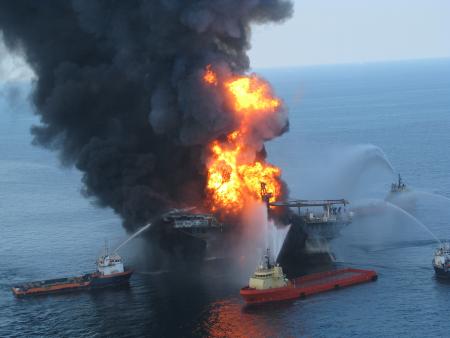
The U.S. Geological Survey estimates the Chukchi and Beaufort seas hold 26 billion barrels of [“recoverable”?] oil.Deepwater-Horizon-CDVIDS oil.

Oil will continue to be needed as the United States transitions to more renewable energy, Odum said.

“Oil will be required for a long time,” Odum said. “Let’s take a really close look at developing our own resources, control how it’s done and get all the benefits that go along with it.”

Shell in two years of exploratory drilling and with up to six wells hopes to confirm a vast reservoir of oil. If it’s found, Shell could apply for production permits and move oil by undersea pipe to the Alaska shore and then overland across northern Alaska to the trans-Alaska pipeline. That could take more than a decade.

Odum is confident exploration can be done safely, and the overriding factor dictating whether Shell completes an exploratory well this year will be safety.

Shell is operating under strict Arctic rules put in place after the Deepwater Horizon disaster in the Gulf of Mexico. Arctic offshore drilling has been scrutinized in the courts in lawsuits brought by drilling opponents, Odum said.

“It’s probably fair to say, this is the most scrutinized, analyzed project – oil and gas project – probably anywhere in the world. I’m actually sure of that,” he said.

All the scrutiny, along with Shell’s own internal review, have gone into safety considerations. It’s in the company’s best interest, he said.

“We can’t afford to have a problem here,” Odum said.

Obama Administration Grants Shell Final Permits to Start Drilling in Arctic Ocean

| July 23, 2015

Royal Dutch Shell was granted federal permits yesterday that clear the way for the oil company to begin drilling in the Arctic Ocean. The U.S. Department of the Interior granted the permits for Shell to drill off the coast of Alaska in the Chukchi Sea.

The company is only permitted to drill the top sections of its wells because it lacks the equipment to cap the wells in case of emergency. The ice breaker carrying the required capping stack for the wells, is receiving repairs to its damaged hull in Portland, Oregon. The permits also restricts Shell to drilling only one well at a time, due to a U.S. Fish and Wildlife regulation.

This announcement comes on the heels of a nationwide protest last weekend where people in 13 states gathered for a ShellNo” Day of Action asking President Obama to revoke oil and gas exploration leases in the Chukchi Sea.

Many environmental organizations are irate over the granting of the final permit to Shell. Here are several of their responses:

Greenpeace:

“This approval for Shell to drill in Alaska from the Obama administration is just the latest in a string of concessions for Shell, a company that cannot even make it to the Alaskan Arctic without significantly damaging its equipment,” said Tim Donaghy, Greenpeace senior research specialist. “By opening up the Arctic to oil drilling, President Obama is courting disaster and undermining his legacy on climate change. The world cannot afford to burn Arctic oil, and the consequences of a spill would be enormous.”

More: http://ecowatch.com/2015/07/23/obama-grants-shell-arctic-drilling/?utm_source=EcoWatch+List&utm_campaign=11f020c89b-Top_News_7_22_2015&utm_medium=email&utm_term=0_49c7d43dc9-11f020c89b-85955433

Arctic Drilling Is Not Just Wrong—It’s Crazy!

1979851_303991166423363_1363126940602880439_n

Saturday we participated in a Sea Shepherd volunteer garbage clean-up at Cannon Beach, a stretch of the Oregon coast noted for its nesting pelagic birds on scenic Haystack Rock. Haystack is one of the few sites on Earth where you can see fledgling murres, pigeon guillemots, puffins and cormorants, etc. take their first flights without intruding on some remote, fragile location like the arctic

Being the birthplace of so many vast flocks of seabirds, the arctic is supposed to be remote, but now, because of climate change, the Arctic Ocean is becoming more and more accessible to people most of whom have nothing but bad intent, like those at Shell Oil, who’s planning to drill for oil in the Arctic’s Chukchi Sea in a matter of days. In 1980, before most scientists even understood about global warming, Canadian naturalist John Livingston wrote a book, Arctic Oil: the Destruction of the North? about the risks to wildlife and nature inherent in drilling for oil in such an environment.

From Arctic Oil, “In winter, vast flocks of murres from the arctic islands drift south on prevailing currents to waters off Newfoundland, where they find themselves on or adjacent to major shipping lanes between North America and Europe. The concentration of murres often coincides with the concentration of oil. If a bird’s wings are oiled, they cannot fly, and if food is not immediately available, it will starve. Or, if its body is even slightly oiled, its feathers will lose their insulating properties and the bird will succumb to exposure in icy waters. Some birds, on the other hand, do make it to shore, where they attempt to preen their feathers clean. These will often die of starvation before they can take to the air again, or will perish from the toxicity of the oil swallowed during the preening process.

“It is impossible to know how many murres, eider ducks and other sea birds have been destroyed in this way over the years.”

In one spill off the British coastline, “160 kilometers had been oiled; it was estimated later that 25,000 sea birds died. It was a good ten years before the local biological system appeared to have healed.

“The record of accidental spills is cause not for mere concern but for raw fear. Oil tankers have become very large and numerous. At more or less regular intervals one of them cracks up.

“There seems no option but to expect that there will be more such events as super-tanker traffic intensifies on the high seas of the world. Year-round shipping, under all conditions, is being seriously proposed for the Northwest Passage. Accidents are wholly unpredictable as to timing and location, but entirely predictable in a sense of probability.

And on drilling Livingston writes, “In the high arctic islands, unfortunately, and in the Beaufort Sea and the Mackenzie Delta there are zones of ‘abnormally high’ geostatic pressure, which of course heightens the possibility of accident…The first such event in the Canadian arctic…took two weeks to shut off the gushing gas [natural—mostly methane.] A month later the well blew out of control again; this time it could not beDeepwater-Horizon-CDVIDS shut down until more than a year after the initial explosion. During that time it lost gas at the rate of 85,000 cubic meters per day. Five months after the Drake Point well blew out, another Pan Arctic well, this time on King Christian Island, went out. This one lost gas at about 2.8 million cubic meters per day, and, unlike the Drake Point gas jet, this one was on fire. The gigantic flame was finally extinguished three months later.

“Leaving to one side for the moment the sheer mechanical difficulty of dealing with a blow-out under the ice, or on the sea floor, or on the permafrost, the possible consequences for wildlife such as sea birds, even on the open arctic water, are hair-raising. (Of course a blow-out of Campeche massiveness would not be required; a much lesser spill, or even the accumulated effect of ‘normal’ leakage, could create havoc in the high arctic waters.)

“The critical question seems to be this: in certain knowledge of the undeniable risk, is the risk worth taking?”

Drilling for oil in the arctic is not just dead wrong, as Al Gore recently stated, “It’s crazy!” And he wasn’t even talking about global warming at the time.

11214207_829677830435133_118593585578390559_n

2 Scientists Drown Measuring Artic Sea Ice–Mother Jones

These Scientists Just Lost Their Lives in the Arctic. They Were Heroes.

These Scientists Just Lost Their Lives in the Arctic. They Were Heroes.

| Thu May 7, 2015
Philip de Roo (left) and Marc Cornelissen.

Early last month, veteran polar explorers and scientists Marc Cornelissen and Philip de Roo set out on skis from Resolute Bay, a remote outpost in the patchwork of islands between Canada and Greenland. Their destination was Bathurst Island, a treacherous 70-mile trek to the northwest across the frozen sea, where they planned to document thinning Arctic sea ice just a few months after NASA reported that the winter ice cover was the lowest on record.

It wasn’t hard to find what they were looking for, according to a dispatch Cornelissen uploaded to Soundcloud on April 28.

“We’re nearing into the coast of Bathurst,” he said. “We think we see thin ice in front of us…Within 15 minutes of skiing it became really warm. In the end it was me skiing in my underwear…I don’t think it looked very nice, and it didn’t feel sexy either, but it was the only way to deal with the heat.”

His next message, a day later, was an emergency distress signal picked up by the Royal Canadian Mounted Police. According to the Guardian, a pilot flying over the spot reported seeing open water, scattered equipment, and a lone sled dog sitting on the broken ice. By last Friday, rescuers had called off the search. The pair are presumed to have drowned, victims of the same thin ice they had come to study. Cornelissen was 46; de Roo had just turned 30.

Yesterday, Cold Facts, the nonprofit with whom the pair was working at the time, dispatched a snowmobile expedition to attempt to recover their belongings. You can follow their progress on Twitter here. The dog, Kimnik, was found a few days ago and is doing fine, the group said.

In a blog post on the website of the European Space Agency, Cornelissen was remembered by former colleagues as “an inspirational character, an explorer and a romantic. He had fallen in love with the spellbinding beauty of the poles and had made it a personal mission to highlight the magnitude of the human fingerprint on this last wilderness.”

It’s not clear whether the ice conditions the pair encountered were directly attributable to climate change, according to E&E News:

That the region had thin ice is evident. Perhaps the ice had been thinned by ocean currents that deliver warm water from below, or by the wind, which could generate open water areas. It is difficult to know. Climate change may have played a role, or it may not have…the impacts of the warming on ice thickness regionally can be unpredictable, [ESA scientist Mark] Drinkwater said.

Still, the Arctic is warming twice as fast as anywhere else on Earth. We rely on the work of scientists like these to know exactly what is happening there and how it will affect those of us who choose to stay safe in warmer, drier places. Their deaths are a testament to the dedication and fearlessness required to stand on the front lines of climate change.

Rest in peace, guys.