Exposing the Big Game

Forget Hunters' Feeble Rationalizations and Trust Your Gut Feelings: Making Sport of Killing Is Not Healthy Human Behavior

Exposing the Big Game

Great Barrier Reef at ‘terminal stage’: scientists despair at latest coral bleaching data

https://www.theguardian.com/environment/2017/apr/10/great-barrier-reef-terminal-stage-australia-scientists-despair-latest-coral-bleaching-data?
Last year was bad enough, this is a disaster,’ says one expert as Australia Research Council finds fresh damage across 8,000km

Back-to-back severe bleaching events have affected two-thirds of Australia’s Great Barrier Reef, new aerial surveys have found.

The findings have caused alarm among scientists, who say the proximity of the 2016 and 2017 bleaching events is unprecedented for the reef, and will give damaged coral little chance to recover.

Scientists with the Australian Research Council’s Centre of Excellence for CoralReef Studies last week completed aerial surveys of the world’s largest living structure, scoring bleaching at 800 individual coral reefs across 8,000km.

The results show the two consecutive mass bleaching events have affected a 1,500km stretch, leaving only the reef’s southern third unscathed.

Where last year’s bleaching was concentrated in the reef’s northern third, the 2017 event spread further south, and was most intense in the middle section of the Great Barrier Reef. This year’s mass bleaching, second in severity only to 2016, has occurred even in the absence of an El Niño event.

https://interactive.guim.co.uk/embed/aus/2017/apr/gbr-bleaching/bleach-16-17/

Mass bleaching – a phenomenon caused by global warming-induced rises to sea surface temperatures – has occurred on the reef four times in recorded history.

Prof Terry Hughes, who led the surveys, said the length of time coral needed to recover – about 10 years for fast-growing types – raised serious concerns about the increasing frequency of mass bleaching events.

“The significance of bleaching this year is that it’s back to back, so there’s been zero time for recovery,” Hughes told the Guardian. “It’s too early yet to tell what the full death toll will be from this year’s bleaching, but clearly it will extend 500km south of last year’s bleaching.”
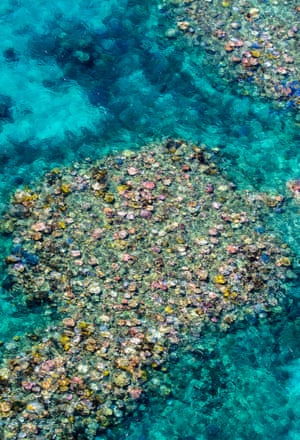
A reef from the air
Pinterest
Aerial surveys of the world’s largest living structure, scoring bleaching at 800 individual coral reefs across 8,000km. Photograph: Ed Roberts/ARC

Last year, in the worst-affected areas to the reef’s north, roughly two-thirds of shallow-water corals were lost.

Hughes has warned Australia now faces a closing window to save the reef by taking decisive action on climate change.

The 2017 bleaching is likely to be compounded by other stresses on the reef, including the destructive crown-of-thorns starfish and poor water quality. The category-four tropical cyclone Debbie came too late and too far south for its cooling effect to alleviate bleaching.

https://interactive.guim.co.uk/embed/aus/2017/apr/gbr-bleaching/gbr-coverage

But Hughes said its slow movement across the reef was likely to have caused destruction to coral along a path up to 100km wide. “It added to the woes of the bleaching. It came too late to stop the bleaching, and it came to the wrong place,” he said.

The University of Technology Sydney’s lead reef researcher, marine biologist David Suggett, said that to properly recover, affected reefs needed to be connected to those left untouched by bleaching.

He said Hughes’ survey results showed such connectivity was in jeopardy. “It’s that connection ultimately that will drive the rate and extent of recovery,” Suggett said. “So if bleaching events are moving around the [Great Barrier Reef] system on an annual basis, it does really undermine any potential resilience through connectivity between neighbouring reefs.”

Some reef scientists are now becoming despondent. Water quality expert, Jon Brodie, told the Guardian the reef was now in a “terminal stage”. Brodie has devoted much of his life to improving water quality on the reef, one of a suite of measures used to stop bleaching.
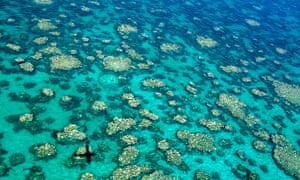
The reef from the air
Pinterest
ARC conducted an aerial and underwater survey of the reef which concluded that two-thirds of it has been hit by mass coral bleaching for second time in 12 months. Photograph: Ed Roberts/ARC

He said measures to improve water quality, which were a central tenet of the Australian government’s rescue effort, were failing.

“We’ve given up. It’s been my life managing water quality, we’ve failed,” Brodie said. “Even though we’ve spent a lot of money, we’ve had no success.”

Brodie used strong language to describe the threats to the reef in 2017. He said the compounding effect of back-to-back bleaching, Cyclone Debbie, and run-off from nearby catchments should not be understated.

“Last year was bad enough, this year is a disaster year,” Brodie said. “The federal government is doing nothing really, and the current programs, the water quality management is having very limited success. It’s unsuccessful.”
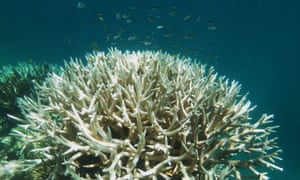
Bleached coral at Mission Beach Reefs
Pinterest
Bleached coral at Mission Beach Reefs. Photograph: Bette Willis/ARC Centre of Excellence for Coral Reef Studies

Others remain optimistic, out of necessity. Jon Day was a director of the Great Barrier Reef Marine Park Authority for 16 years until retiring in 2014.

Day, whose expertise lies in protected area planning and management, said the federal government’s approach to protecting the reef was sorely lacking. He said it was taking too relaxed an approach to fishing, run-off and pollution from farming, and the dumping of maintenance dredge spoil.

The government was far short of the $8.2bn investment needed to meet water quality targets, he said, and Australia was on track to fail its short-term 2018 water quality targets, let alone achieve more ambitious long-term goals.

“You’ve got to be optimistic, I think we have to be,” Day said. “But every moment we waste, and every dollar we waste, isn’t helping the issue. We’ve been denying it for so long, and now we’re starting to accept it. But we’re spending insufficient amounts addressing the problem.”
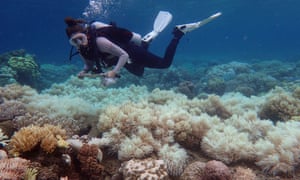
A diver over bleached coral at Orpheus Island
Pinterest
A diver over bleached coral at Orpheus Island. Photograph: Greg Torda/ARC Centre of Excellence for Coral Reef Studies

The Queensland tourism industry raised questions about the reliability of the survey, saying scientists had previously made exaggerated claims about mortality rates and bleaching.

https://interactive.guim.co.uk/charts/embed/apr/2017-04-09T01:14:30/embed.html

“There is no doubt that we have had a significant bleaching event off Cairns this time around,” said Col McKenzie, of the Association of Marine Park Tourism Operators.

“The far north probably did a little bit better, Port Douglas to Townsille has seen some significant bleaching,” he said. “Fortunately we haven’t seen much mortality at this time, and fortunately the temperatures have fallen.”

McKenzie said more money needed to be invested in water quality measures, and criticised what he saw as a piecemeal and uncoordinated approach to water quality projects up and down the coast.

Extinct creature sightings are piling up in Australia

[No thanks to Man.]

By Mike Wehner

http://www.foxnews.com/tech/2017/04/03/extinct-creature-sightings-are-piling-up-in-australia.html

File photo - Don Colgan, Head of the Evolutionary Biology Unit at the Australian Museum, speaks under a model of a Tasmanian Tiger at a media conference in Sydney as seen in this May 4, 2000 file photo regarding the quality DNA extracted from the heart, liver, muscle and bone marrow tissue samples of a 134 year-old Tiger specimen (R) preserved in alcohol. The last known Tasmanian Tiger died in 1936 after it was hunted down and wiped out in only 100 years of human settlement. (Reuters)

File photo – Don Colgan, Head of the Evolutionary Biology Unit at the Australian Museum, speaks under a model of a Tasmanian Tiger at a media conference in Sydney as seen in this May 4, 2000 file photo regarding the quality DNA extracted from the heart, liver, muscle and bone marrow tissue samples of a 134 year-old Tiger specimen (R) preserved in alcohol. The last known Tasmanian Tiger died in 1936 after it was hunted down and wiped out in only 100 years of human settlement. (Reuters)

Multiple reports of Tasmanian Tiger sightings are starting to flow in from everyday citizens in Australia. Several people have recently claimed they’ve spotted the animal, which isn’t a tiger at all — and, despite looking very much like a species of dog, isn’t of canine lineage either — but a carnivorous marsupial. Spotting an interesting creature in Australia isn’t exactly a rare occurrence, but there’s one problem with these reports in particular: the Tasmanian Tiger is supposed to be extinct.

The last known Tasmanian Tiger was captured in its native Australia in 1933 and lived for a few years in a zoo before dying, and its death has long been thought to be the final nail in the species’ coffin. Australians have occasionally claimed to have spotted the dog-like animals over the years, but the sightings were typically rare and attributed to nothing more than misidentification. That’s all changed now, as several “plausible sightings” are beginning to give life to the theory that the animal never actually went extinct at all.

Now, scientists in Queensland, Australia, are taking action in the hopes of actually finding evidence that the Tiger is still around. If confirmed, it would be an absolutely monumental discovery, considering the animal’s history. The team plans to set up cameras in areas where reported sightings have taken place in the hopes of confirming the claims.

In the late 1800s there were actually bounties on Tasmanian Tigers in Australia, and the creatures were hunted to the brink of extinction before any action was taken. By that point, the species was thought to be doomed, and when the last captive animal died it was assumed that was the end of the road. Now, it appears that might not be the case after all.

Kangaroo puncher keeps zoo job despite animal rights group complaints

http://www.newshub.co.nz/nznews/kangaroo-puncher-keeps-zoo-job-despite-animal-rights-group-complaints-2016120707

Paul Henry

An Australian man caught on camera punching a kangaroo in the face has been criticised for his actions, after it was revealed he is a zookeeper.

Greig ‘Goo’ Tonkins became an internet star after the clip came to light, which shows him rescuing his dog Max from a kangaroo’s headlock by firing a brutal right hook at its snout.

The footage was filmed in Euabalong, New South Wales back in June during a boar-hunting trip for a friend with terminal cancer who has since died.

After the video was shared around the world, animal rights groups condemned Mr Tonkins’ actions.

They’re calling for him to lose his job as an elephant keeper at Western Plains Zoo in New South Wales.

People for the Ethical Treatment of Animals (PETA) told Australian Regional Media that Mr Tonkins should not be “made out to be a national hero”, but rather prosecuted.

“Punching a kangaroo in the face is neither brave nor funny,” the group said.

Mr Tonkins also drew derision from the Humane Society International Australia, who said their efforts to rescue circus elephants in India is undermined if “we can’t even look after our own species here”.

“It is very disturbing of someone of this character has a position [at Western Plains Zoo]. They would have no trouble filling it with someone who respects animals,” they said.

The zoo disagrees, however, and says Mr Tonkins’ job is safe.

“Mr Tonkins is an experienced zookeeper and during his six years at Taronga Western Plains Zoo has always followed Taronga’s best practice approach to animal care and welfare,” said a zoo spokesperson.

“We continue to work with Mr Tonkins on his conduct in regards to this incident.”

Matthew Amor, a friend of Mr Tonkins’ who also attended the hunting trip, said their deceased mate “would be looking down from up there [heaven] and laughing” at the media furore.

“It was funny because [Mr Tonkins] is the most placid bloke. We laughed at him for chucking such a s**t punch,” Mr Amor told news.com.au.

Newshub.

Make Hunting, Culling the Wild Horses of the Brumby population Illegal !!

Hunting wild horses is not illegal in Australia. Proponents of hunting, or culling as they refer to it, point to the fact the Brumby is a non-native species that is invasive and destructive to the environment. Earlier this year, the Australian government released details of their plan to kill 90% of the Brumby population in the Snowy Mountain region. The wild horses in this region were made famous by the movie The Man From Snowy River. These horses have been there for 150 years, and opponents to this plan do not find a reason to change this. Please sign my petition to put an end to this brutal, unnecessary cruelty to horses.

http://www.thepetitionsite.com/853/590/680/make-hunting-culling-the-wild-horses-of-the-brumby-population-illegal-/?taf_id=26923072&cid=fb_na

Western Australian feedlot vandalised and truck set alight by anti live export ‘radicals’

10671222_10202527690853624_1897035803926677117_n

http://www.abc.net.au/news/2014-11-12/animal-rights-radicals-attack-feedlot-burn-truck-in-wa/5885244

Dead ducks left on Vic premier’s doorstep

 http://au.news.yahoo.com/thewest/national/a/22021637/dead-ducks-left-on-vic-premiers-doorstep/     

March 17, 2014, 1:02 pm

Animal rights activist have dumped dead ducks in front of the Victorian premier s office.      
AAP Animal rights activist have dumped dead ducks in front of the Victorian premier’s office.

Anti-duck hunting activists who dumped dead ducks outside the Victorian premier’s office say they are being barred from the state’s wetlands under new protest laws.

Coalition Against Duck Shooting activist Tony Murphy says the new move-on powers, which opponents say restrict the right to protest, have for the first time led to their rescuers being excluded from the wetlands.

“(Agriculture Minister) Peter Walsh’s strategy is to force us off the wetlands so that massacres of endangered waterbirds can continue in secret,” Mr Murphy said.

The activists dumped the carcasses of ducks collected over the weekend’s opening of the duck season outside Premier Denis Napthine’s Melbourne office on Monday, saying 33 were the endangered freckled duck species.