Exposing the Big Game

Forget Hunters' Feeble Rationalizations and Trust Your Gut Feelings: Making Sport of Killing Is Not Healthy Human Behavior

Exposing the Big Game

Grey whales free after beaching in Delta, B.C.’s, Boundary Bay

Fisheries and Oceans Canada, Vancouver Aquarium helped get animals free

A photo from the scene on Friday shows several people in the water of Boundary Bay, B.C., near the animals. (David Houston/Facebook)

54
comments

It just might be the happiest whale tale since Free Willy: a pair of grey whales stranded on the low-tide mudflats of Boundary Bay in B.C.’s Lower Mainland have escaped.

A rescue effort sprang into action Friday afternoon after the two whales — a mother and a calf — became beached near Centennial Park in Boundary Bay in Delta about a 40 minute drive south of Vancouver.

Fisheries and Oceans Canada led the effort with refloatation devices — large, inflatable airbags to lift the animals up — and a vessel. The Vancouver Aquarium was also on scene to handle any medical setbacks the animals may have suffered.

“It’s absolutely fantastic,” said Martin Haulena, the Vancouver Aquarium’s head veterinarian. “A very, very good ending.”

Haulena said the animals got stuck at approximately 2 p.m. PT. They were freed by about 6:30 p.m.

Fortunately for them, the tide was coming in to help their escape. A cheer rose from about 100 assembled onlookers as the whales began to move freely, flapping their fins.

Watch as the whales begin to right themselves in the rising tide:

CBC News Vancouver at 6
Whales get free in Delta, B.C.
 WATCH

00:00 00:34

After being stranded for much of Friday afternoon, a grey whale and her calf start to right themselves in the rising tide of Boundary Bay. 0:34

Dangerous position

Haulena said Boundary Bay — a wide, shallow bay straddling the Canada-U.S. border — is a place where grey whales could easily get stranded.

He described the animals as bottom feeders: they skim along the ocean floor filtering organisms from the sandy bottom through their mouths. He thinks they were likely foraging when the tide went out and became stuck.

As the tide rolled in the whales began to flap their fins and get free. (CBC)

Once out of the water, he continued, their large bodies put them in danger.

“They were never designed to bear weight,” he explained. “That can compress their lungs. They can’t breathe right. Their circulation gets very altered … it’s a very big deal potentially.”

He added that the whales are not out of the woods yet.

If they were injured too severely by their ordeal, they may still die.

Rash of beachings

Friday’s dramatic scene is one that has been happening all over the west coast of North America this year as an unusual number of grey whales have become stranded and died on their migration from their southern calving waters in Mexico to their northern feeding waters.

Some researchers are pointing to a lack of food as the cause.

Haulena said beachings tend to happen cyclically, with some years being worse than others, but agreed the population may be exhausting its food sources.

B.C. approves 314 cutblocks in caribou critical habitat while negotiating conservation plans

https://www.wildernesscommittee.org/news/bc-approves-314-cutblocks-caribou-critical-habitat-while-negotiating-conservation-plans?fbclid=IwAR3D0B2j-NNhYnw7fc4_Lf3Ydq59jBlKt3mthedEAjwr-oUo1pFJMF9NVhY

Thursday, March 14, 2019


Charlotte Dawe

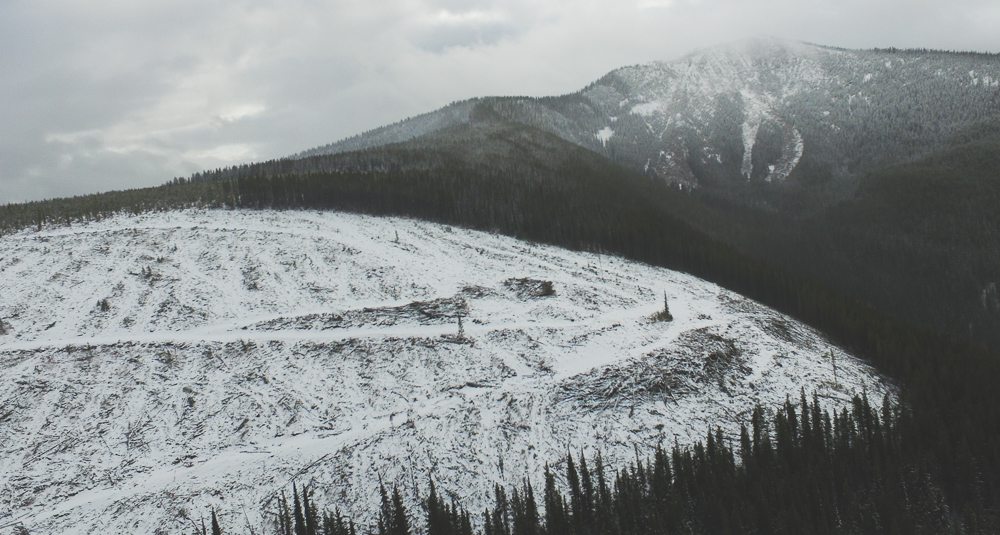
VANCOUVER – B.C. has greenlighted the logging of 314 new cutblocks in the critical habitat of southern mountain caribou across the province in the past four months alone.

The shocking discovery made by the Wilderness Committee is prompting the organization, along with Greenpeace Canada, to call on Catherine McKenna, federal minister of environment and climate change, to issue an emergency order to halt logging of southern mountain caribou critical habitat while negotiations for conservation plans are underway.

“If the province logs what little is left of caribou critical habitat then all this planning will be for nothing,” said Charlotte Dawe, conservation and policy campaigner for the Wilderness Committee. “We need the federal government to step in and protect habitat before it’s all gone.”

Four months ago, negotiations were well underway between the federal and provincial governments and First Nations to create an effective caribou conservation plan. But while in negotiations the B.C. government continued approving cutblocks in critical habitat.

“It’s as if B.C. is holding a clear out sale for logging companies to ‘get it while you can!’ It’s the great caribou con from our very own B.C. government,” said Dawe.

“On the one hand B.C. says it’s protecting caribou while on the other, they’re handing out permits to log habitat as fast as they can. How much more evidence does the federal government need to prove that B.C. is failing to protect caribou?”

McKenna, announced last summer that southern mountain caribou are facing imminent threats to their recovery noting, “immediate intervention is required to allow for eventual recovery.” The announcement came after the functional extinction of two caribou herds in B.C.

The evidence is piling up against the B.C. government’s claim that they are effectively protecting caribou throughout the province.

“If the B.C. government was serious about protecting and recovering caribou throughout the province then they should have rejected these cutblocks,” said Eduardo Sousa, Senior Campaigner for Greenpeace Canada. “Instead, by approving these blocks, they are negotiating conservation agreements in some of these very same areas in bad faith. It’s appalling and we can’t trust them now.”

Almost a year ago the Wilderness Committee revealed 83 cutblocks were approved in the critical habitat of B.C.’s eight most at-risk herds. Logging rates have increased since the finding; in the past four months, 134 new cutblocks have been approved in the same critical habitats.

There are two southern mountain caribou local populations where logging approvals are the highest in core critical habitat — the Telkwa and Chilcotin populations. Both have 13 cutblocks each set to be logged.

–30–

Attached are two maps of approved cutblocks in southern mountain caribou habitat from Oct. 19, 2018, to Feb. 28, 2019:
Map of 314 approved cutblocks in critical habitat across B.C.
Zoomed-in map of Telkwas and Chilcotin local populations with approved cutblocks in critical habitat.

Amid seal and sea lion boom, group calls for hunt on B.C. coast

Quickest way to reverse declining salmon stocks is to introduce a harvest: Pacific Balance Pinnipeds Society

Some fishermen want to see a cull of sea lions and seals which they say are overpopulated on the B.C. coast. (Nic Amaya/CBC)

For the first time in decades, a small-scale seal hunt is taking place on Canada’s West Coast — all in the hopes that it leads to the establishment of a commercial industry to help control booming seal and sea lion populations and protect the region’s fish stocks.

In early November, a group called the Pacific Balance Pinnipeds Society (PBPS) started using First Nations hunting rights as part of a plan to harvest 30 seals. The society plans to test the meat and blubber to see if it’s fit for human consumption and other uses.

“We can look at opening up harvesting and starting a new industry,” said Tom Sewid, the society’s director and a commercial fisherman. “Since the [West Coast] seal cull ended in the 1970s, the population has exploded.”

Sewid, a member of the Kwakwaka’wakw group of Indigenous peoples, points out that the animals have been hunted for thousands of years. Recent decades with little or no hunting have been an anomaly, he said, pointing to research that shows seal numbers are even higher now than in the 1800s.

Out go the nets, in come the sea lions

What’s become an ongoing battle between humans and sea lions played out on a recent nighttime fishing expedition, when Sewid and a crew of commercial fishermen set out in a 24-metre seine boat to fish for herring off the coast of Parksville, B.C.

The crew’s goal was to catch about 100 tonnes of herring, which rise to the surface to feed after dark. But the faint barking of sea lions was soon heard over the thrum of the boat’s diesel engine.

“All them sea lions out there are all happy — [they’re] all yelling, ‘Yahoo, it’s dinner time!'” Sewid said.

Once the crew spotted the herring, they let out hundreds of metres of net, while a smaller boat helped to circle it around the huge mass of fish. The crew then closed the bottom of the net, capturing the herring.

Watch sea lions pillage fishermen’s nets:

CBC News BC
Sea Lions feeding in fishing nets
 WATCH

00:00 00:27

Many Sea Lions are caught in fishing nets, as they try to feed. 0:27

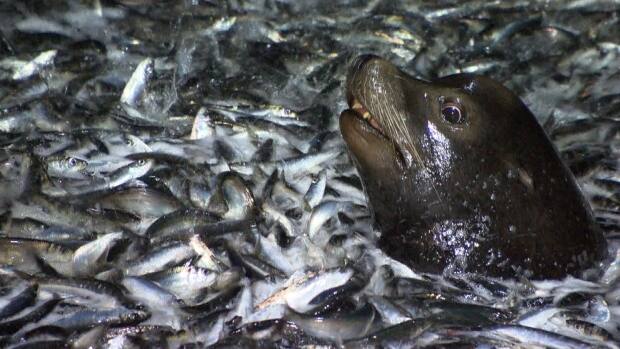
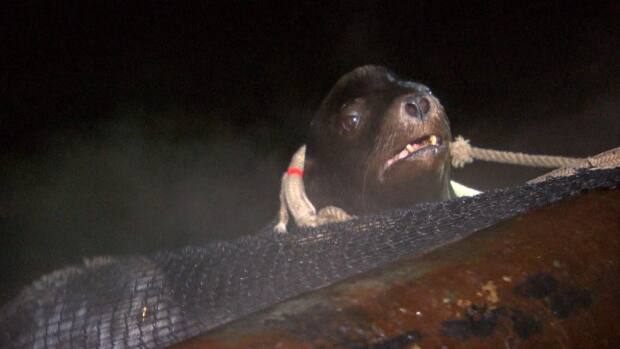
But the catch also provided some uninvited visitors with a captive dinner: Dozens of sea lions jumped over the floats holding up the net and started to gorge.

“These guys, it’s just a buffet for them,” said Sewid, as the bodies of the sea lions glistened in the boat’s floodlights. “Just like pigs at a trough.”

Sewid said the sea lions have learned there’s an easy meal to be had whenever they see or hear the fishing boats.

“They’re not afraid of us. They’ve habituated themselves to seeing that humans and fishing equates easy access to food, which is not right,” he said. “The animal kingdom is not supposed to be like that.”

Restarting a banned hunt

The hunting of seals and sea lions — which are collectively known as pinnipeds — has been banned on the West Coast for more than 40 years. It’s one reason their numbers have exploded along the entire Pacific coastline of North America.

According to one study, the harbour seal population in the Salish Sea is estimated at 80,000 today, up from 8,600 in 1975. The study also says seals and sea lions now eat six times as many chinook salmon as are caught in the region’s commercial and sports fisheries combined.

That adds up to millions of tonnes of commercially valuable fish.

Sewid’s group is proposing to cull current populations of harbour seals and sea lions by half, which would see thousands of the animals killed each year.

Tom Sewid is leading the effort to secure what he calls a sustainable harvest of seals and sea lions along the B.C. coast. (Greg Rasmussen/CBC)

The society’s small-scale “test” harvest is taking place between B.C.’s southern Gulf Islands and as far north as Campbell River, on Vancouver Island. It’s being carried out under the provisions of the Aboriginal Fisheries Strategy, which gives some First Nations harvesting and management rights for food and ceremonial purposes.

Testing the meat to see if it’s safe for human consumption is a first step in a plan to eventually gain permission for what the PBPS envisions as a sustainable, humane commercial hunt, which would largely be carried out by coastal First Nations.

“All the meat that’s in there, you’re looking at the high-end restaurants [that would sell it],” Sewid said. “The hides can also be used.”

Seal blubber is particularly valuable, he said, because it can be rendered down into an oil that’s in demand because of its high Omega-3 fatty acid content.

Watch fishing crew struggle to free sea lions entangled in their nets:

CBC News BC
Sea Lions freed from fishing nets
 WATCH

00:00 00:49

Watch as fishing crew struggles to free sea lions trapped in their nets. 0:49

One of the biggest hurdles facing the group is convincing the federal Department of Fisheries and Oceans to open a commercial hunt on the West Coast.

The seal hunt that takes place in the Atlantic and Arctic is controversial, and has long been subject to protests and fierce opposition from animal rights groups. The group expects a West Coast harvest to also face fierce confrontations.

Canadian Inuit have been waging a counter-campaign, highlighting the importance of the animal and the longstanding tradition of their hunt.

Most Canadian seal products are also banned in Europe and a handful of other countries, but the society says demand is strong in Asia.

Supporters and opponents

The PBPS does have a growing list of supporters, including 110 First Nations groups, a number of commercial fishing organizations, and some sectors of B.C.’s economically important sport fishing sector.

However, one key player, the Sport Fishing Institute of B.C., opposes a large commercial hunt, fearing it would generate public outrage and might not achieve the goal of enhancing fish stocks.

The institute’s director, Martin Paish, says the group sees some value in targeting some seals and other fish predators at specific times of year in a number of key river systems; he believes a limited hunt would help protect salmon stocks and boost the billion-dollar-a-year B.C. sport fishing industry.

“Our goal is to use predator control in a careful manner to improve chinook [salmon] production where it is needed,” said Paish.

Carl Walters is a fish biologist and UBC professor who supports cutting B.C.’s population of seals and sea lions by half. (Nic Amaya/CBC)

Fisheries scientist Carl Walters, a professor emeritus with UBC, believes culling the regions sea lions and seals could dramatically boost salmon stocks. He points to numerous studies showing how pinniped populations have been increasing, while salmon numbers have been plummeting.

“They’re killing a really high percentage of the small salmon shortly after they go into the ocean, about half of the coho smolts and a third of the chinooks,” he said.

Advocates of a hunt are also pitching it as a way to help B.C.’s endangered southern resident killer whales, which feed mainly on salmon.

“The thing that would benefit southern resident killer whales is to see improved survival of small chinook salmon — and I think the only way we can achieve that is by reducing seal numbers,” Walters said.

Peter Ross, from the Coastal Ocean Research Institute, says there would be little benefit to salmon from a seal and sea lion cull. (Nic Amaya/CBC)

Others disagree, including Peter Ross, the vice-president of research and executive director of the Coastal Ocean Research Institute.

“Killing of seals and sea lions is not going to have any positive impact for any salmon populations in coastal British Columbia,” he said.

While a few localized populations of salmon might benefit from a cull, Ross said climate change, habitat destruction and overfishing are all bigger factors in the overall decline of stocks.

Other subspecies of orcas, however, feed mainly on seals, so a hunt would reduce their access to prey.

Back on the boat, Sewid concedes a hunt would be controversial — but he firmly believes it’s necessary.

“All the indicators are there,” he said. “It’s time to get the balance back.”

The fishing crew from the Western Investor are shown harvesting herring in November. But they say they are being hampered by dozens of sea lions in their nets almost every night. (Nic Amaya/CBC)

Cubs rescued from dumpster

Reminder to keep garbage bins locked with hibernation just around the corner

A conservation officer tags the bear cubs’ ears before reuniting them with their mother. (B.C. Conservation Service)

https://www.cbc.ca/news/canada/british-columbia/bear-cubs-rescued-from-dumpster-1.4953176

Two bear cubs that somehow managed to get stuck in a recycling facility dumpster had to be rescued by conservation officers in Sooke, B.C., on Monday.

It’s not clear how the cubs climbed up and into the dumpster — but once in — they couldn’t get out.

Sgt. Scott Norris with the B.C. Conservation Service says the mother bear watched calmly from a distance when help arrived.

“When we showed up, we pulled into the yard and there was mom sitting at the back of the yard, sort of 50 yards away just watching,” he said.

View image on TwitterView image on Twitter

BC CO Service@_BCCOS

South Island CO’s rescued two bear cubs trapped in a dumpster at a materials recycling facility today in . The cubs were ear tagged and reunited with their mother who was patiently watching from afar. CO’s are reminding people that bears are still out looking for food

51 people are talking about this

The cubs were safely tranquilized, had their ears tagged and were pulled out of the dumpster.

They were then returned to their mother at a neighbouring property.

The dumpster didn’t have any food waste in it, but Debbie Reid with Wild Wise Sooke says the bear cubs’ rescue is a good reminder to secure all garbage bins.

“What triggers bears to sleep is the fact there is no food … but in Sooke we have people leaving out garbage and pet food and things like that,” she said.

“So the natural trigger isn’t being triggered.”

The conservation service says bears on Vancouver Island usually don’t go into hibernation until January.

Wolves on the rebound across B.C. — here’s how to live with them

Once widely hated and killed, the wolf is making a comeback across the province. (Shane Fowler/CBC)

It took a close encounter to twig Paula Wild to the charm — and danger — of the once-threatened wolf.

After crossing paths with the carnivore while driving her car near a remote Quadra Island hiking trail, Wild wondered about her initial “tingling up the spine” reaction, she told On the Coast guest host Margaret Gallagher.

“There was this huge wolf in the middle of the road,” she said. “And I thought, how would I have felt if I had been walking back on the trail all by myself? What would I have done?”

That feeling spawned the author’s upcoming book, Return of the Wolf: Conflict and Co-existence, a guide to living with a wolf population that has been steadily increasing across the province for the last 50 years.

The grey wolf has disappeared from broad swathes of the world, including most of western Europe. But the B.C. population began to return to healthy levels during the 1970s, according to a 2015 provincial report.

There are an estimated 8,500 in B.C. today.

Wild’s encounter with a wolf led to a book about how humans can learn to live with the storied carnivores. (Rick James)

Once ‘demonized’, now photography fodder

Wolves are now returning to areas they haven’t inhabited for decades, Wild said, making encounters with them more likely. Despite a “misconception” that healthy wolves won’t attack humans, it does happen, she added — and it’s usually due to human interference.

“People aren’t used to wolves. They’re not sure what to do,” Wild said. “Wolves are proving capable of adapting to living near human settlements.”

But Wild warns that humans don’t always share the same skill. Feeding wolves, or even getting close enough for a photograph, can habituate a wolf to humans and make bold behaviour more likely.

Keeping wolves wild

She thinks more education could teach nearby residents to keep their distance, make noise to scare away the more curious pack members and keep dogs on-leash when walking through wolf territory.

Poisoning wolf packs was widespread practice during the first half of the 20th century, and culling programs remain in place today.

But the centuries-long relationship between humans and wolves, Wild said, has been defined by shifting perceptions.

The wolf pops up in myths, fairy tales and common expressions, Wild said, pointing out their importance to language and culture.

“We’ve demonized wolves, but now people tend to either fear them or idolize them,” she said. “And we’re maybe not giving them the respect they need as wild animals that do have potential for danger.”

“I hope people will learn to see wolves for what they are, not for what we want or perceive them to be,” she said.

“Wolves will survive on our landscape today if we allow them to, if we learn how to live with them.”

B.C. didn’t do enough to protect rare fishers in the Interior, board says

Fishers said to be at high risk of decline or elimination in Interior

A fisher is shown in this handout image. An investigation by British Columbia’s forest practices watchdog has found the provincial government didn’t take steps to protect a local species at risk when it allowed for extensive logging in the central Interior. (Loney Dickson/Handout/Canadian Press)

An investigation by British Columbia’s forest practices watchdog has found the provincial government didn’t take steps to protect a local species at risk when it allowed for extensive logging in the central Interior.

The Forest Practices Board says the investigation of a complaint by two trappers in the Nazko area has determined that the fisher is at a high risk of decline or elimination in the region.

The forest in the area near Quesnel was devastated by the pine beetle and the government allowed extensive salvage harvesting between 2002 to 2017, but the trappers complained that impacted the fisher and other fur-bearing mammals.

The animal is a member of the weasel family and is about twice the size of a marten.

A fisher kit is seen up a tree in an undated photo. (Holly Kuchera/Shutterstock)

Board chairman Kevin Kriese says it found the government didn’t take steps to ensure the protection of fisher habitat, and while forestry firms did make some efforts, it wasn’t sufficient given the unprecedented scale of salvage.

He says the board is concerned that unplanned salvage of fire-damaged stands could make a grave situation worse and it recommends the government take steps to restore the local fisher population.

Fishers like older forests stands with lots of large trees and the board says even areas of mostly dead timber may still provide habitat for them.

Read more from CBC British Columbia

Moose hunting banned in Cariboo wildfire zones

The ministry-imposed ban affects areas west of Quesnel and Williams Lake

The Ministry of Forests, Lands, Natural Resource Operations and Rural Development announced today that two areas affected by wildfire in the Cariboo will be closed to moose hunting from Oct. 15-31 and Nov. 1-15.

The closures affect an area north of Highway 20 and west of Williams Lake and Quesnel, after the Chilcotin Plateau Fire ravaged the area this summer. The press release noted that the area is also important to First Nations sustenance hunting.

Doug Donaldson, Minister of Forests, Lands, Natural Resource Operations and Rural Development, said: “This has been an unprecedented wildfire season, with parts the Cariboo particularly hard hit. With moose populations already declining in this management zone, we need to take steps now to protect wildlife and ensure healthy moose populations in the future.”

The closure comes after First Nations groups in the region called for the province to instate a moratorium on moose hunting.

Contacted for comment, Nazko First Nation chief Stuart Alec said: “It’s great news to hear that the province is taking steps to address the situation and the concerns of the Nazko people and others concerned about the moose populations.

“We are looking forward to working further with the province to maintain moose populations in the region.

“We have not been hunting in the wildfire zones, and are focusing our hunts north of the Blackwater River.”

The ministry indicated that the areas impacted by the hunting ban will be assessed over the winter to inform what level of sustainable hunting will be available in the coming years.

Rare sighting of leatherback off B.C. coast raises issue of plastic pollution

Endangered giant turtle, a ‘living dinosaur,’ often bears brunt of waste in ocean, marine biologist says

Jennifer Wilson · CBC News · Posted: Aug 25, 2018 8:00 AM PT | Last Updated: an hour ago

<https://i.cbc.ca/1.4795678.1535143174!/fileImage/httpImage/image.jpg_gen/derivatives/16x9_780/leatherback-turtle.jpg>

There have been fewer than 135 leatherback sightings in B.C. waters since the 1930s. The giant turtles swim from Indonesia to feed on jellyfish. (Willie Mitchell / Jeremy Koreski)

A rare sighting of the endangered leatherback turtle off the B.C. coast is an opportunity to celebrate — but also to reflect on the danger of plastic waste in the oceans, a marine biologist says.

Earlier this month, two Vancouver Island men captured photos of the enormous sea turtle. It was one of fewer than 135 sightings recorded in B.C. waters since the 1930s.

The leatherback is one of the largest reptiles on the planet and can grow to the size of a Smart car. Instead of a shell, the turtles have a thick, collapsible leather-like back that allows them to dive to extreme ocean depths of up to 1,270 metres.

The turtles, which travel from Indonesia to feed on jellyfish, have seen their populations decline drastically in recent years, in part due to frequent entanglement in plastic pollution, according to the the Department of Fisheries and Oceans.

Turtles confuse balloons with jellyfish

In Jackie Hildering’s experience, marine species are often the first to bear the brunt of environmental problems and leatherbacks are no exception, as many are found with plastic in their stomachs.

Hildering, a researcher with the Marine Education and Research Society, said many people in B.C. may not even know the species exists in local waters, but that even small actions such as releasing a balloon into the air without thinking about where it might land can have an impact on the turtles’ survival.

“One of the powerful things to realize is that they can’t discern plastics and balloons from their jellyfish prey,” she told Jason D’Souza, host of CBC’s <https://www.cbc.ca/listen/shows/all-points-west> All Points West.

Leatherback turtles in Canada have been designated as an endangered species under the Species at Risk Act. The species has lost 70 per cent of its numbers in the past 15 years.

Tracking jellyfish

A major challenge in tracking and restoring leatherback populations in B.C. waters is first tracking their food source, the jellyfish, said Lisa Spaven, a scientist with the DFO’s Pacific Biological Station.

Marine biologists rely on fish surveys to include jellyfish population data, including density and location. Jellyfish are hard to track and scientists are still figuring out whether leatherbacks prefer areas with a high density of small jellyfish or a low density of large jellyfish, Spaven said.

<https://i.cbc.ca/1.4522193.1535071363!/fileImage/httpImage/image.jpg_gen/derivatives/original_780/jellyfish-bloom-b-c-ubc.jpg>

Hundreds of jellyfish float beneath the surface off Canada’s West Coast. They are the food source that draws the leatherback turtle across the ocean from Indonesia. (Keith Holmes/Hakai Institute)

“We’re still trying to get a handle on the currents and where the jellyfish are. There’s a lot of work yet to be done,” she said.

Funding for leatherback conservation was not approved by the DFO this year according to Spaven but her department continues to carry out habitat protection work in Indonesia, where nests are at risk from predators such as wild pigs.

‘​Smallest needle in the biggest haystack’

Former Vancouver Canucks defenceman Willie Mitchell and photographer Jeremy Koreski spotted the turtle on Aug. 6 just west of Tofino, B.C., and forwarded their photos to Hildering.

Hildering said the men recognized the turtle as a leatherback but, like many in B.C., did not know how important the sighting was.

“​I don’t think they knew that I would fall off my chair when they sent the photos, I don’t know that they knew they found the smallest needle in the biggest haystack,” she said.

Leatherbacks are “living dinosaurs” that “belong in B.C. waters,” Hildering said, and their presence is a reminder of the wide variety of species B.C. coastal waters should support under optimal conditions.

“It’s a testament to how rich our waters are supposed to be.”

http://www.cbc.ca/news/canada/british-columbia/rare-sighting-of-leatherback-off-b-c-coast-raises-issue-of-plastic-pollution-1.4795676

B.C.’s approach to wildlife management needs major ethical reform

Kyle Artelle, Paul Paquet, Faisal Moola, Chris Genovali, and Chris Darimont are scientists and writers at the Raincoast Conservation Foundation. Kyle Artelle, Paul Paquet, and Chris Darimont are also at the University of Victoria, and Faisal Moola is also at the University of Guelph

British Columbia has begun an ambitious effort to review the province’s approach to managing wildlife, with $14-million committed so far. The province’s interest in reform is encouraging. As explained in a letter we recently published in the journal Science, this endeavour and its justification are laudable, and if done properly, have the potential for making B.C. a continental leader in wildlife management. Whether this happens, however, will depend largely on whether the reform embraces principles of science honestly and openly, while involving the varied interests of all citizens, rather than only consumptive users (hunters and trappers).

British Columbia is blessed with a remarkable diversity of wildlife. Many of the 3,800 known plant and animal species in B.C. live only here. The province is also critical for winged migrations that extend over thousands of kilometres. Unlike most places in North America, B.C. has additionally retained all of the large land animals that were present at the time of European colonization, including grizzly bears, wolves, caribou and cougars, making it among the last havens for the large animals left on the continent.

A sub-adult grizzly bear chases down a salmon near Klemtu, B.C. (File Photo).

JOHN LEHMANN

However, many might be surprised to learn that instead of the management of this wildlife being primarily focused on conservation of species and the ecosystems on which they depend, in B.C., as across much of North America, the focus is typically on the management of wildlife to allow for sustained exploitation by hunters and trappers.

This consumptive focus can overshadow broader concerns about wildlife, including ethical considerations. Although there are clearly ethical considerations in any decisions about the environment, wildlife management is one of the few fields for which ethics remain notably absent. This stands in contrast with other areas of public policy, such as criminal justice and health care, where the recognition of ethics is foundational. Such consideration has led to better outcomes, such as improved well-being of those affected by policy decisions.

The scale of wildlife exploitation can be difficult to comprehend. Although hunting and trapping might evoke visions of traditional, low-scale and low-impact endeavours, both undertakings currently comprise an enormous extractive activity: For many wildlife species, humans kill more adults than all other predators combined.

Given this reality, one might hope that wildlife management would have considerable oversight and rigour to protect against potential negative impacts on wildlife populations. And wildlife managers across North America usually do claim a scientific foundation for their activities. However, recent research in the journal Science Advances found that key hallmarks of science are often missing in management of species across North America. For example, of the 667 management systems that study examined, only 26 per cent had measurable objectives, only 11 per cent explained how hunting quotas or limits were set and only 9 per cent were subject to external review.

To reform management so that science can honestly and credibly support policy decisions will require incorporating key hallmarks of science: 1) Clear objectives are needed for the public to understand what government wildlife managers are trying to achieve. These objectives need to be clear enough to allow assessment of whether they have been met, and their ethical basis needs to be clearly described; 2) Strong evidence is needed to ensure that well-informed decisions are made. In cases with weak evidence, strong caution is warranted; 3) Full transparency to the public is required in how wildlife is managed, including how the funding the public provides for management is used, and; 4) External scrutiny, whereby independentbodies (that is, individuals who are neither part of government, appointed by government, nor too closely affiliated to be unbiased) scrutinize the approach used by government, to ensure approaches used are credible.

The B.C. government recently made the courageous decision to end the province’s ethically questionable, controversial and scientifically suspect grizzly bear trophy hunt, a decision that government leaders acknowledged was partly in response to changing societal values about wildlife management. These included considerations of cultural and other non-lethal values and activities, such as wildlife viewing. The current review of provincial wildlife management provides a tremendous opportunity to further demonstrate leadership for the province and the continent, by addressing the critical need for broader wildlife policy reform that is informed by science and reflective of societal attitudes and desires, including ethical concerns in wildlife management.

B.C. works to safeguard livestock during another tough wildfire season

13,000 livestock, mostly cattle, have been in areas affected by evacuation orders and alerts

Cattle run on a ranch as the Shovel Lake wildfire burns in the distance sending a massive cloud of smoke into the air near Fort St. James. (Darryl Dyck/Canadian Press)

British Columbia’s agriculture minister says critical lessons learned from last year’s wildfires that had ranchers and producers suffering devastating losses will help save animals during another season that could force more people from their properties.

Lana Popham said Wednesday the province’s premises identification program, which was meant to trace cattle back to an operation during a disease outbreak, allowed animals to be rescued last year after evacuation orders were issued.

“As the fires increased last summer and this program seemed to have so much value we saw those numbers increase significantly,” she said of more farmers and ranchers registering for the program.

“That’s allowing us to get into areas that have been identified as heavy agricultural, livestock areas and be able to assess a situation and move those animals out as needed.”

In some cases, grazing cattle remained safe in certain areas after ranchers have left due to encroaching fires, Popham said, adding 35,000 livestock were on the loose last year at the height of the worst wildfire conditions.

“This program allows them to re-enter into evacuation zones and tend to their livestock so it’s extremely important for people to be registered for this program and I think over the last two years, especially, that message has hit home.”

So far this season, 13,000 livestock, mostly cattle but also sheep, horses and pigs, have been in areas affected by evacuation orders and alerts, Popham said, adding ministry staff are working with the B.C. Cattlemen’s Association to co-ordinate alternate grazing sites, organizing emergency feeds and helping with the relocation of animals.

“We won’t often know if they’ve been lost until they don’t come home later in the fall,” Popham said. “I have heard reports of cattle that have been burned, but no numbers on that yet.”

Williams Lake is one of the hardest-hit areas, Popham said.

“The emotional toll that these farmers and ranchers are feeling is tremendous. And we saw this last year. You see some of the strongest farmers you know break down when they realize some of their animals aren’t coming home.”

After the 2017 wildfires, the federal government provided $20 million in funding to help farmers and ranchers, but Popham said her ministry has not made any requests for financial help so far this year as it awaits assessments on areas that weren’t affected last year.