Exposing the Big Game

Forget Hunters' Feeble Rationalizations and Trust Your Gut Feelings: Making Sport of Killing Is Not Healthy Human Behavior

Exposing the Big Game

Hungry black bear boards four boats over three days

By Warren Schlote

https://www.manitoulin.ca/hungry-black-bear-boards-four-boats-over-three-days/

August 22, 2018

HEYWOOD ISLAND—Boaters seeking a quiet anchorage in the sheltered waters of Browning Cove, east of Little Current at Heywood Island, have instead found themselves facing a hungry bear that visited four different boats over the course of three days.

“I was down below fixing dinner, a bass I caught yesterday, when I heard this loud strange scratching noise,” says Brian Laux of Walworth, NY.

“I thought it might have been a human swimmer in trouble, someone who was so weak they couldn’t crawl out of the water. But when I went outside there was a bear right in the water—he was trying to climb up the side of the boat,” Mr. Laux recalled. “He sort of gave me a dirty look.”

– Advertisement –

Mr. Laux immediately got in contact with Roy Eaton, who runs the daily Cruiser’s Net broadcast out of Little Current, to share his incredible story. At the time, he did not consider the bear a major threat because of his timid interaction with it. Mr. Laux says he has heard the bear is often spotted swimming across the mouth of the bay in which he was anchored but more recently it has been seen making trips to Browning Island.

Fortunately, the bear left without much fuss after this first encounter. But it was not finished yet.

Mr. Laux had just finished listening to the morning broadcast when he heard the unmistakable sound of the bear paddling back towards his boat—perhaps ironically named Serenity. This time, the bear was more persistent. “I poked him in the nose with my boat hook,” said Mr. Laux. The bear, although seemingly annoyed by the gesture, swam around the boat a couple times and eventually retreated back to shore.

That morning, Mr. Laux was visited by the owners of a boat called Carandy. Unfortunately, Mr. Laux was not the first person to have an encounter with this bear. On the same day as Mr. Laux’s first encounter, the bear had already visited Carandy, which was anchored in the same area as Serenity. Carandy’s owners did not respond to a request for comment by press time.

When the bear arrived, Carandy’s owners were away on a kayak trip. When they returned, the bear was in the process of tearing apart their cabin. It had climbed aboard using the swim ladder they left down to get into their kayaks. Carandy’s cupboards were ripped off and nearly everything inside was eaten, chewed or covered in fur and bear spit. After making noise by banging on the hull, the bear finally was scared off and retreated to the island.

Carandy’s interior was trashed. With no other options, the boaters elected to clean up their mess and figure out what to do next. But as they were cleaning, the bear came back and attempted to board the boat again from the bow. After a solid whack on its nose from the boat hook, the bear swam back towards land and stared at Carandy from the shore. Feeling threatened by the bear’s continued presence, they moved to the middle of the bay and set up anchorage there.

Meanwhile, after Mr. Laux fended off the bear the following morning, he elected to stay one final night but repositioned himself further from shore. He went around to visit the other boats anchored in the area and made sure they knew of the bear’s presence and to keep their swim ladders up.

Mr. Laux’s warning and an advisory on Mr. Eaton’s Cruisers Net proved useful for Dennis Kirkwood, who had just arrived into the bay on his catamaran. After a late dinner with his girlfriend, they were getting ready for bed around midnight when they heard a thumping and scratching noise under the stern of the boat.

“I immediately suspected what it was,” said Mr. Kirkwood. “I ran out and grabbed a whisker pole and started clanking it around.”

The bear was under the swim platform, between the two hulls. The bear had knocked out the floor plate and its paw was coming up through the opening. After a continued effort, Mr. Kirkwood switched to his wooden oar to hit the bear’s paw. The bear pulled its paw back but remained under the platform, breathing heavily.

“It was very surrealistic,” said Mr. Kirkwood, adding that the pitch darkness of the night added a complicated aspect to the ordeal.

“He’s substantial sized, maybe 250 pounds; not a cub at all,” Mr. Kirkwood says.

Mr. Kirkwood continued to poke through the opening to encourage the bear to leave, but it stayed put. That was a surprise, as Mr. Kirkwood understood bears usually scatter upon hearing loud noises.

“I tried blasting my air horn like a madman trying to get him to leave, but he just stayed on.”

With that, Mr. Kirkwood decided to keep prodding it with his oar to encourage the bear to leave. It worked, but the bear managed to break his wooden oar in the process.

Mr. Kirkwood notified Mr. Eaton of his experience. The bear incidents were turning into a trend.

On Thursday night, Otto Gustafson had what may have been the closest experience yet. He arrived at Heywood Island and had anchored for the night. At about 9:30, he heard the telltale scratching and splashing of a bear next to his boat. His swim ladder was up, so he decided to stay put because the bear should not have been able to make it on board.

He was wrong.

Suddenly, the bear climbed the stern and appeared in the cockpit. The bear started sniffing for something to eat, and the two came within 18 inches of each other. Mr. Gustafson began screaming and making noise at the bear, but the bear seemed to ignore the disturbance. Mr. Gustafson even shone his spotlight into its eyes and sounded his foghorn, but nothing seemed to dissuade the bear.

The bear had put its paw through the screen that separated it from Mr. Gustafson, when a fellow boater heard the commotion and came alongside them on his dinghy. It was not a moment too soon. The presence of the dinghy seemed to scare off the bear which walked to the bow, entered the water and disappeared.

So far, these four boat boardings are the only reports The Expositor has heard of regarding bear encounters at Heywood Island or elsewhere.

“I suspect somebody might have fed it off a boat at one point. That’s a supposition, but he’s certainly learned that boats equal food,” says Mr. Laux.

Jolanta Kowalski from Ontario’s Ministry of Natural Resources and Forestry (MNRF) says this year’s wild food surveys have indicated a decrease in natural food availability for bears because of an ongoing drought.

“Bears have a phenomenal sense of smell and if they find food once at a location, they will return. It’s critical for boat residents and the public to manage anything that may attract bears such as garbage and food,” stresses Ms. Kowalski.

The Expositor asked at what point the MNRF would take action, if any, to deal with the situation, and what that action would entail.

According to an email received from the MNRF, if a bear is a public safety risk people should call 911 or their local police. A bear breaking into a residence – in this case a boat – would qualify as an emergency. (see below from Bear Wise web page)

Police will assess the situation. They may call MNRF for assistance to trap and relocate a specific problem bear.

The Ministry provides advice and education. The public can call the Bear Wise phone line 1-866-514-2327 <tel:+18665142327> for information about avoiding human-bear conflicts.

Who to contact

Emergencies

Call 911 or your local police, if you feel a bear poses an immediate threat to personal safety and:

* enters a school yard when school is in session
* enters or tries to enter a residence
* wanders into a public gathering
* kills livestock/pets and lingers at the site
* stalks people and lingers at the site

Generally, bears want to avoid humans. Most encounters are not aggressive and attacks are rare.

Non-emergencies

Call the Bear Wise reporting line at 1-866-514-2327 <tel:+18665142327> (*between April 1-November 30) if a bear is:

* roaming around, checking garbage cans
* breaking into a shed where garbage or food is stored
* in a tree
* pulling down a bird feeder or knocking over a barbecue
* moving through a backyard or field but is not lingering

https://www.manitoulin.ca/hungry-black-bear-boards-four-boats-over-three-days/

<https://www.manitoulin.ca/hungry-black-bear-boards-four-boats-over-three-days/>

Hungry black bear boards four boats over three days <https://www.manitoulin.ca/hungry-black-bear-boards-four-boats-over-three-days/>

http://www.manitoulin.ca <http://www.manitoulin.ca>

HEYWOOD ISLAND—Boaters seeking a quiet anchorage in the sheltered waters of Browning Cove, east of Little Current at Heywood Island, have instead found themselves facing a hungry bear that visited four different boats over the course of three days.

Mixed-ancestry wolves are recolonizing the Pacific Northwest

Their combination of coastal and inland DNA could help them survive a changing climate.

This article is from Hakai Magazine, an online publication about science and society in coastal ecosystems.

Mixed-ancestry wolves are recolonizing the Pacific Northwest

Wolves were wiped out in Washington state in the early 20th century — the victims of bounty hunting as ranching and farming expanded in the state. Over the past two decades, however, under the protection of state and federal wildlife authorities, wolves have been reclaiming their former turf. But as new research shows, the wolves now living and hunting in Washington’s forests are different from those that lived there more than a century ago. These new wolves are hybrids — crossbreeds of inland wolves from the interior United States and a unique, beach-loving subspecies from as far north as Southeast Alaska.

The ancestors of the wolves now recolonizing the Pacific Northwest include a coastal subspecies.
Chris Darimont / raincoast.org

The researchers who made this discovery think the hybrid wolves’ DNA could help them thrive in a changing landscape.

Conventional wisdom holds that the wolf packs slowly recolonizing not only Washington but Oregon and California are the descendants of animals that migrated west from the interior — from the mountains, plains, and forests of Montana and Idaho. But when researchers analyzed DNA samples from wolves throughout the Pacific Northwest, the results told a different story. Sarah Hendricks — now a computational biology doctoral candidate at the University of Idaho — was a research assistant at the University of California, Los Angeles when she and her colleagues amassed genetic samples from the region’s wolves. A recent analysis shows that some of the wolves have unique genetic markers that could have only come from the distinct coastal wolves of British Columbia and Southeast Alaska.

Coastal wolves differ from their interior cousins in a number of important ways. Unlike interior wolves, which stalk large mammals such as elk through forests and fields, coastal wolves spend much of their time on beaches, hunting salmon and marine mammals such as seals. Coastal wolves also look different — they’re smaller and their fur has a red-brown tinge.

So far, the hybrid wolves are sticking to the lifestyle of their ancestors from the east. “As of right now, the wolf packs are mostly in the habitat that’s suitable for interior wolves, but we think over time they’ll begin to establish in habitat that’s more suitable for coastal wolves,” says Hendricks. As the climate continues to change, Hendricks suspects the hybrid wolves’ genetic diversity will allow them to adapt better than if they just had genes from interior wolves.

Even without the benefits of genetic mixing, wolves are generally quite adaptable animals, says Jay Shepherd, who leads the wolf program for the nonprofit organization Conservation Northwest. In Yellowstone Park, for instance, wolves hunt bison. These wolves are much larger than those in surrounding regions, but their size is the consequence of a diet driven by learned behavior rather than genetics. Still, he agrees that hybrids could have an advantage in areas with a mix of habitats.

The coastal wolves of British Columbia and Southeast Alaska are a distinctive subpopulation with red-brown fur and a hunting style adapted to coastal life.
Chris Darimont / raincoast.org

The finding also offers a life preserver of a sort to the coastal wolves of British Columbia and Alaska, whose populations are dwindling in many parts of their range. For example, Hendricks points to a population in Southeast Alaska that is declining quite drastically. The hybrids may serve as a genetic reservoir, protecting some of the coastal wolves’ distinctive traits.

But while the hybrid wolf population may act as a reservoir, there could be complications if the Alaskan coastal wolves became protected under the United States Endangered Species Act. In that case, wildlife managers in the Pacific Northwest would find themselves charged with managing wolves that share genetic traits with federally protected animals. “The problem is that the Endangered Species Act doesn’t have a lot of language regarding how to deal with hybridization,” says Hendricks.

Hendricks hopes her findings will inspire biologists and policymakers to focus on sorting out the unanswered legal question of what should be done when the ancestor of a hybrid animal is an endangered species, whether these mixed-lineage descendants should be protected as well or left vulnerable to hunting and habitat loss. Either way, she thinks the hybrid wolves’ mixed heritage will be an asset as they continue to reclaim their species’ old haunts across the Pacific Northwest.

Rancher fears for 30 horses left behind near Telegraph Creek as fire rages on

The Alkali Lake and South Stikine River fires have merged, now engulfing almost 300 square kilometres of northwestern B.C. (B.C. Wildfire Service)

Vernon Marion had two hours to prepare to flee when he got the evacuation order to leave his home in Telegraph Creek, B.C., earlier this week as the Alkali Lake wildfire roared closer.

He ran outside, put some of his belongings in a field he thought would be safe from the fire, and tried to protect them with a tarp and water jugs.

“You don’t think properly when something like that’s happening,” he said.

“If you had to do it all over again you’d probably do it differently.”

Vernon Marion of Telegraph Creek, B.C., is concerned about the 30 horses he had to leave behind when he was evacuated from his home as a wildfire approached. (Philippe Morin/CBC)

Neighbours and outfitters have offered to take horse trailers into the area to rescue the animals, but officials told Marion it’s too dangerous.

So now he has to wait and find out what is to become of his ranch and his horses.

“We’ll go down there if we get a break [Friday] and round them up.”

‘We’re resilient’

Yukon Minister of Tourism and member of the Tahltan First Nation Jeanie Dendys was in Telegraph Creek during the evacuation where she and her sister helped people get out of the community.

“Our chief is working non-stop which is what we did during those initial days,” she said.

“There’s so much work to be done, but people are safe and that was what our main focus was.”

Dendys said the Tahltan people are heartbroken over the devastation the wildfire has caused in their region, but she believes the strength of the community will help them overcome the loss.

“We’re resilient,” she said. “The unity that we have among our people will bring us through this.”

Fires merged

Early Thursday, the South Stikine River and Alkali Lake fires merged created a fire covering almost 300 square kilometres.

At a meeting in Dease Lake on Wednesday night, B.C. Wildfire Service incident commander Hugh Murdoch said ground crews and air support are working to protect culturally significant sites and buildings in the area.

From left, Tony Falcao of the B.C. Wildfire Service, Chief Rick McLean of the Tahltan Nation and Hugh Murdoch of the B.C. Wildfire Service update the public on the fire situation on August 8, 2018. (Phillipe Morin/CBC)

“The type of efforts that we’ve been putting forward will continue,” Murdoch said.

A cold front is expected to pass through the area in coming days, and crews are preparing for a potential increase in wind and shift in its direction.

Sudbury police faces backlash after ‘dispatching’ injured bear cub

https://www.ctvnews.ca/canada/sudbury-police-faces-backlash-after-dispatching-injured-bear-cub-1.4022677

Molly Frommer talks to Sudbury police about the incident involving an injured bear cub that is drawing outrage on social media.
CTVNews.ca Staff
Published Saturday, July 21, 2018 1:51PM EDT 

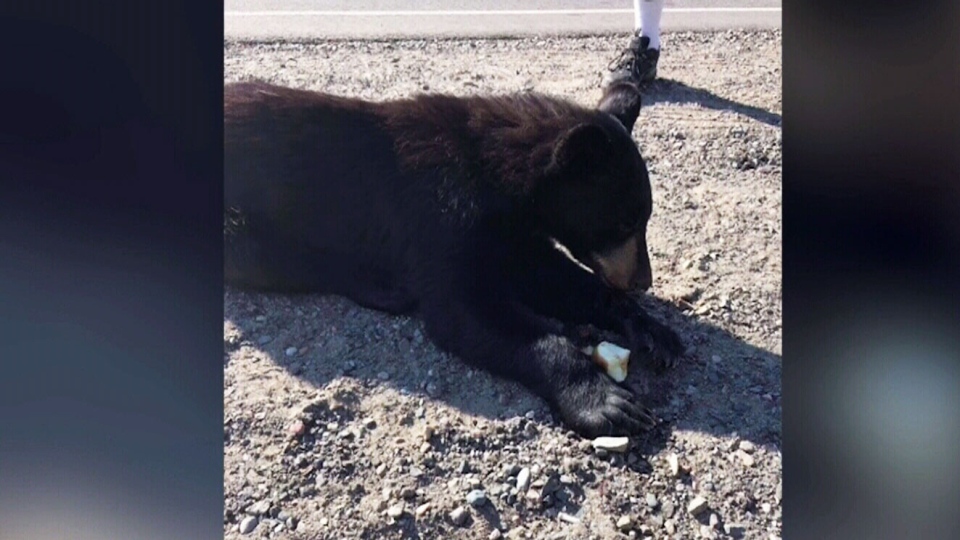
The Greater Sudbury Police Service is facing intense criticism after witnesses say two officers shot and killed an injured bear cub without properly assessing whether the animal could be saved.

Local resident Anne Chadwick wrote a post on Thursday about coming across a black bear cub on the highway that had just been hit by a vehicle and abandoned.

She said she and another passing driver helped the bear to the side of the road, where she says it appeared both disoriented and with injuries to its front legs.

They called 911 for help, but she alleges that when two police officers arrived, they didn’t fully assess the cub’s condition but instead retrieved a rifle from their cruiser.

She said she was ordered to stand back while one of the officers repeatedly shot the bear. She said the cub was shot four times before it died.

Chadwick wrote that she was traumatized by watching the animal die in front of her and wondered whether the bear’s life could have been saved.

“He looked well enough that he could have been helped (obviously I’m not a vet and don’t know for certain but neither were those police officers),” she wrote. “At the very least from what I’ve read he should have been tranquilized first.”

Her post has since been shared more than 5,800 times, prompting an outpouring of anger on social media.

The Greater Sudbury Police Service issued its own Facebook post about the incident on Thursday night, saying the officers had no other choice but to euthanize the animal.

“The bear cub was suffering, unable to move and struggling to breathe,” they wrote, adding that the officers “dispatched” the cub in order to end its pain.

The police service said the two officers would not have been able to safely handle or transport the injured animal, and though the Ministry of Natural Resources and Forestry and city animal services were contacted, they were informed that neither agency could come to the scene.

“This is not a situation that any officer wants to be in and the Police Service attempted to find an alternative before the Officers made the decision to dispatch the cub,” the police wrote in their post.

Sudbury District MNRF spokesperson Yolanta Kowalski confirmed that her office did receive a call from the Sudbury police, but said it was “to pick up a dead bear cub from the side of a road.” She said since the ministry isn’t responsible for the removal of dead wildlife, staff advised police to contact the City of Sudbury’s animal control services.

The Greater Sudbury Police Service’s Sgt. Terry Rumford defended the officers’ decision.

“I think we have to remember that these are judgement calls that officers have to make on a moment’s notice. Further, we are not equipped as a police service to transport bears,” he told CTV Northern Ontario.

He added that the police service would be reviewing the incident.

“With these types of incidents where there is community displeasure over certain incidents, we do what is called ‘administration reviews’ and we are in the process of doing that now,” he said.

With a report from CTV Northern Ontario’s Molly Frommer

New group calls for seal and sea lion cull on B.C.’s coast

Some B.C. First Nations and fishermen want the government to establish a new seal hunt on the west coast. As Jill Bennett reports, their reasons for the new hunt are being met with skepticism by opponents.

– A A +

Members of the Tsawwassen First Nation are teaming up with commercial and sport-fishers on B.C.’s coast to call on the new federal fisheries minister to allow a West Coast seal and sea lion harvest. The group, called the Pacific Balance Pinnipeds Society, says that growing populations of seals and sea lions endangers future salmon populations.

“If we want to see salmon around for our next generations, we have to go out there and bring that balance to the animal kingdom,” said Thomas Sewid, the director of the newly established society. “To go out, harvest those seals, utilize the whole carcass so the meats are going to markets in Europe and China, the fat is being rendered down for the omega 3s.”

WATCH HERE: Pod of hungry orcas hunt for sea lion between boats


The federal government has banned the cull of seals and sea lions on the West Coast since the 1970s, which still exists on the East Coast. The group is hoping to have a change in policy now that Jonathan Wilkinson, the MP for North Vancouver, is the new fisheries minister.

“I think we are going to see the balance to our oceans and our waters come back in place because of that minister,” said Sewid. “He understands. He has been out sport-fishing. He has seen big fat sea lions tear salmon off his hooks.”

READ MORE: Sea lion pulls young girl into water off Steveston Wharf in Richmond, B.C.

Sea lions are known to be aggressive, not just to animal populations, but towards humans as well. Last May, a sea lion that swam near Steveston Fisherman’s Wharf snagged a little girl by her dress and pulled her into the water. There were multiple Steveston Harbour Authority signs posted at the popular tourist destination warning people not to feed the sea mammals that frequent the area.

But there is some disagreement on how large an effect seals and sea lions actually have on the fish populations.

Scientists at Ocean Wise say their research does not support the idea a harbour seal cull improves the abundance of Chinook salmon in B.C. The scientist describes the fish population as “complex” and that the seal population has recovered from historical culls, and is no longer increasing significantly.

READ MORE: Hunters call for more licences, possible seal cull to combat growing population off N.L.

“Studies show only four per cent of the harbour seal diet is salmon. Herring and hake are their primary prey, with hake making up about 40 per cent of their diet,” said a statement from Ocean Wise. “Hake is actually a big salmon smolt predator, so a seal cull could actually have the opposite of its intended effect: by reducing the number of seals, the abundance of hake would likely increase, resulting in decreased salmon numbers overall.”

We also have a healthy and growing population of transient, or Biggs, killer whales, which eat marine mammals like seals and sea lions. So harbour seals are already being culled very effectively without any human interference at all. Reducing the seal population in the Salish Sea would mean a reduction in food for transient killer whales.

READ MORE: WATCH: Sea lion feeding frenzy on commercial herring catch

Ocean Wise has also found that with an increase in transient killer whales, which eat seals, the population is expected to slowly decline over time.

But Sewid’s group has provided numbers from the federal Department of Fisheries and Oceans that show a massive population boom that needs to be controlled. According to those numbers, harbour seals in the Georgia Straight have gone up from 12,500 in 1987 to 45,000 today.

As for sea lions, those same numbers from the population grew on B.C.’s coast from 13,000 in 1984 to 36,140 in 1997.

The populations have slowed since the mid-1990s, and has been relatively stable since. One of the challenges Sewid says in convincing people that the animals should be culled is that they look “cute.”

“They don’t understand that seals and sea lions are eating hundreds of salmon fry when the fry are going out to sea, down the rivers and when the salmon are coming home to spawn, those overpopulations over seals and sea lions are eating all that fish,” said Sewid. “We have to bring that balance on.”

[Sure, like it’s their job. Nature has been the expert on checks and balances since long before humans.]

Province lifts ban on rehabbing orphaned black bear cubs ‘Bears are not an animal that really needs to be feared’

Stephen Hunt · CBC News · Posted: Apr 18, 2018 7:18 PM MT | Last Updated: April 18

<https://i.cbc.ca/1.4607891.1523026902!/fileImage/httpImage/image.jpeg_gen/derivatives/16x9_1180/bear-cubs.jpeg?imwidth=720>

Estimated to be a couple of months old, this black bear was rescued in southern Manitoba after its mother was found dead. Alberta is lifting a ban on rehabilitating orphaned black bear cubs under the age of 12 months. (Manitoba Bear Rehabilitation Centre)

Orphaned black bear cubs have been given a reprieve by a new provincial policy that allows for them to be rehabilitated.

The new policy reverses a ban that’s been on the books since 2010.

Lisa Dahlseide, a wildlife biologist with the Cochrane Ecological Institute, says that ban resulted in the euthanizing of at least 24 black bear cubs, according to data collected from a report released in 2015.

Dahlseide described the change in policy as “wonderful news” in a Wednesday interview on <http://www.cbc.ca/listen/shows/the-homestretch> The Homestretch.

“[The change has been] a long time coming for black bear cubs,” she said. “It really is good news, because no longer will the Alberta government be euthanizing them.”

Instead, orphaned black bears under 12 months of age can be rehabilitated at places like the Cochrane Ecological Institute, or any other wildlife rehabilitation centre across the province that has approved facilities for bear cubs.

<https://i.cbc.ca/1.4625919.1524101971!/fileImage/httpImage/image.JPG_gen/derivatives/original_1180/cochrane-ecological-institute.JPG?imwidth=720>

This is a photo of an enclosure where orphaned black bear cubs are rehabilitated, at the Cochrane Ecological Institute. (Lucie Edwardson/CBC News)

The rehabilitation process involves a combination of human interaction, and teaching it how to survive without people involved.

“Generally they come and they’re very small,” Dahlseide said. “They’re still drinking milk, because they’re mammals. And so what happens is it’s very limited exposure with people — they only have one human that interacts with them to give them the bottle. As soon as they are done with bottle feeding, then that human interaction is done with as well.”

Adding water features to enclosures

At the Cochrane Ecological Institute, Dahlseide said orphaned bears stay in large enclosures — ranging from six to 20 acres — which are full of native food, as well as trees and other interactive things to give them exercise and learn to get fed without relying on people.

“There’s a lot that goes into rehabbing them to avoid habituation and food conditioning,” she said.

The institute is currently raising funds, through donations, to add water features to each enclosure, which is part of the requirements for the new government protocol.

“That’s actually a really good thing for the bears,” Dahlseide said. “Hopefully those water features can be stocked with fish, so they can get that experience.”

<https://i.cbc.ca/1.4135277.1497029442!/fileImage/httpImage/image.jpg_gen/derivatives/original_1180/a-manitoba-couple-wants-to-build-the-province-s-first-black-bear-cub-rehabilitation-in-rockwood.jpg?imwidth=720>

The new protocols include the stipulation that each bear enclosure must have a water feature. (Paul Conrad/Associated Press)

Other bears and other species not included

The new policy does not apply to orphaned grizzly bears, which are still euthanized — a policy that Dahlseide says is wrong-headed.

“Science has actually shown there are no known negative human conflicts with grizzly bears, post-relief,” Dahlseide said. “Other places in the world do rehabilitate them successfully — so I’m hoping the provincial government will be considering them and hopefully including them in the bear protocol as well.”

She pointed to the research of naturalist Charlie Russell, who has done extensive studies of grizzlies, Dahlseide said there’s no reason for people to be afraid.

“His research with bears has proven that bears are not an animal that really needs to be feared. If we trust them, they’ll trust us as well.”

‘No evidence, data or science to support those bans’

The list of orphaned animals banned from rehabilitation is not confined to grizzlies, either, Dahlseide said, adding “and again, the province has no evidence, data or science to support those bans. So we want to see that lifted for all species.”

Rallies are planned on Saturday in Calgary and Edmonton, calling for the lifting of the ban on all orphaned animals.

The Calgary rally takes place at Municipal Plaza, next to city hall, between 3 and 7 p.m.

“We wanted to show our support for the grizzly bears, the foxes, coyotes, wolves, bighorn sheep, and elk — the list goes on and on,” Dahlseide said. “All the animals that the province currently doesn’t allow for rehabilitation.”

http://www.cbc.ca/news/canada/calgary/orphan-black-bear-cub-ban-lifted-1.4625460

Agonizing death of raccoon caught in trap sparks calls for empathy

Animal chewed off own paw after it was caught in a legal trap set in Burnaby neighbourhood

Jason Proctor · CBC News · Posted: Apr 18, 2018 1:16 PM PT | Last Updated: April 18

<https://i.cbc.ca/1.4625319.1524080227!/fileImage/httpImage/image.jpg_gen/derivatives/16x9_1180/raccoon-trapped.jpg?imwidth=720>

This raccoon was brought into a shelter with its paw caught in a trap. The trap was removed, but the animal chewed its paw off. It was later euthanized. (Critter Care Wildlife Society)

Animal activists say the gory demise of a raccoon that chewed its own paw off after getting caught in a trap last week should be a lesson to would-be backyard vigilantes.

“Anybody using these type of traps, they’re wanting to inflict pain. I don’t know what type of people we have out there,” said Gail Martin, founder of the Langley-based Critter Care Wildlife Society.

“And when I say I am sick of what goes on out there, I am sick of it! People have got to learn to have empathy for other living beings.”

No release for 3-pawed raccoon

The raccoon was brought into Martin’s shelter last Thursday after getting its paw caught in a cuff-style legal trap put out in a mixed residential and industrial use area in Burnaby.

Martin said staff were able to remove the trap, but the animal’s foot was crushed. She said it still would have felt sensation in the paw, despite pain medication and chewed it off overnight.

The raccoon was then euthanized.

“He can’t be released with three paws,” she said. “He has to be able to survive out there.”

<https://i.cbc.ca/1.4625329.1524081272!/fileImage/httpImage/image.jpg_gen/derivatives/original_1180/raccoon-trapped.jpg?imwidth=720>

The raccoon at rest in the moments after the removal of the trap that crushed its paw. The animal was later euthanized. (Critter Care Wildlife Society)

Martin called for stronger laws and prosecution of people who maim wildlife through the indiscriminate setting of traps.

“People can get hurt. Cats, dogs, children,” she said. “Nobody should be allowed to use these type of traps.”

Raccoons are a frequent irritant on the Lower Mainland, where they regularly roam streets and backyards with their families in search of food.

Solving underlying issues

According to the province, they’re not considered aggressive but can be dangerous if threatened. Dogs are not considered an effective way of getting rid of them.

The province advises homeowners to keep garbage in plastic bags in buildings or sheds, to secure garbage can lids with rubbers straps or hooks and to clean garbage cans with ammonia or bleach.

It’s illegal to poison raccoons, which can be trapped (in season) by registered trappers who have a valid licence. A mother and her babies can’t be removed from a nesting site until the pups are able to leave

Adrian Nelson, with the Association for the Protection of Fur Bearing Animals, says the trap in question is legal. But he questions the morality of anything that would leave an animal in such pain.

“Our biggest recommendation is to bring in a wildlife control company that knows what they’re doing, that uses non-lethal measures,” he said.

“When it comes to trapping animals … we’re not really solving the underlying issue of why that animal is there. So, until we address the attractants or the habitat or whatever is drawing that animal in, we’re just going to continue to have problems.”

http://www.cbc.ca/news/canada/british-columbia/raccoon-trap-humane-pests-1.4625236

B.C. strengthens grizzly bear hunting ban with new regulations

$1,000 reward offered for conviction of snaring culprit

Vancouver non-profit responding to a spate of deaths involving grizzly bears, wolves and moose

Conservation Officer Service photo One of several snares discovered in the Kitimat River Valley. Conservation Officer Service photo

A Vancouver-based non-profit is offering a $1,000 reward for information leading to the conviction of those responsible for a series of illegal snaring incidents in the Kitimat River Valley.

The Association for the Protection of Fur-Bearing Animals made the offer public Thursday (Feb. 8) afternoon. “These disturbing incidents need to be condemned by all, and our hope is that this reward will help bring more attention to the case,” said spokesperson Adrian Nelson. “Anyone who has information is asked to contact the Conservation Officer Service so that the individual or individuals responsible can be stopped and face the consequences for their actions.”

Earlier this week the Terrace office of the Conservation Officer Service appealed for public assistance in their investigation, noting charges may be applicable under the Provincial Wildlife Act as well as the Canada Criminal Code for cruelty to animals and mischief.

Evidence was found throughout the valley where heavy-gauge wire had been used in attempts to capture large animals.

“So far we have located dead grizzly bears, wolves, and coyotes with evidence that moose are being caught as well. It’s beyond my comprehension why someone would think it is acceptable to indiscriminately snare our wildlife in such a callous calculated manner,” Sgt. Tracy Walbauer had said.

READ MORE: Public’s help sought in cruel and prolific animal snaring activity

“That the person responsible for this has no regard for wildlife and the snares are poorly designed and illegal — those animals observed in the snares endured a great deal of suffering before death.”

The locations identified so far have been semi-remote but Walbauer was concerned there may be traps closer to human habitation.

In a telephone interview with The Fur-Bearers, Nelson said it’s been about two years since the association has offered a reward in this manner, but the seriousness of these incidents justified the action.

“It’s the waste of wildlife in this case,” he said. “It’s one thing if someone is out subsistence hunting, but in this case it just seems flagrant that someone is putting traps in the bush and not coming back to check them.

“And it’s the range of animals that’s really scary. To be honest it’s one of the worst [cases] that we’ve seen.”

Nelson added The Fur-Bearers have a good-standing relationship with the Terrace COS and is optimistic the reward will prompt public tips to assist in their investigation.

“We don’t see a lot of this stuff, on this scale, in that area,” Nelson said. “For it to show up like this is kind of odd…people live there and move out there for that connection to the wildlife, so this wasting of wildlife I think will irk a lot of people.”

Anyone with information on the snaring activity in Kitimat River Valley is asked to contact the Conservation Officer Service at 1-877-952-7277.

READ MORE: Moose collisions prompt warning from Conservation

The Association for the Protection of Fur-Bearing Animals was founded in 1953, according to its website, with a mission to end the commercial fur trade and promote co-existence between humans and wildlife.

https://www.terracestandard.com/local-news/1000-reward-offered-for-conviction-of-snaring-culprit/

4 elk illegally shot and killed on private property without permission

http://www.cbc.ca/news/canada/british-columbia/4-elk-illegally-shot-and-killed-on-private-property-without-permission-1.4432517

The bodies of the animals were abandoned, while a fifth elk was wounded and left alive

By Andrew Kurjata, CBC News Posted: Dec 04, 2017 7:17 PM PT Last Updated: Dec 05, 2017 9:47 AM PT

Conservation officers near Hudson's Hope, in northeast B.C., are investigating after four elk were illegally killed by men shooting from a public road onto private property without permission.

Conservation officers near Hudson’s Hope, in northeast B.C., are investigating after four elk were illegally killed by men shooting from a public road onto private property without permission. (Conservation Officer Service of British Columbia)

Four elk have been illegally shot and killed on private property without permission.

The bodies of the animals were abandoned, while a fifth elk was wounded and left alive.

The incident occurred Sunday evening north of Hudson’s Hope, in northeast British Columbia, said acting Sgt. Brad Lacey of the Peace Region Conservation Officer Service.

A property owner in the area heard “a number of shots being discharged” at around 5:30 p.m. MST and went out to investigate, Lacey said.

The owner found a group of men shooting at the animals from the road and confronted them, at which point they got into their vehicles and left.

A limited-entry hunt for elk is currently occurring in the region, but Lacey said it’s not known if the men were licensed.

Investigation underway

Even if they were, he said, their methodology was illegal.

“Evidence at the scene would indicated that the hunt occurred on a maintained roadway, which isn’t allowed,” Lacey explained.

Additionally, the elk were on privately-owned land, and the owner did not give permission for the men to hunt there.

Elk in the region, which belong to the subspecies Rocky Mountain elk, are not considered at risk, but Lacey said it is still problematic for them to be killed without permission.

“There’s a public safety concern for any firearms being discharged on a maintained roadway,” he said.

Lacey said the dead elk will be maintained for evidence and then, “if the carcasses remain suitable for human consumption, they’ll be utilized by a local food bank.”

Anyone with information is asked to contact the service at 1-877-952-7277.