Exposing the Big Game

Forget Hunters' Feeble Rationalizations and Trust Your Gut Feelings: Making Sport of Killing Is Not Healthy Human Behavior

Exposing the Big Game

By one vote, Minnesota House moves to ban wolf hunting

PUBLISHED:  | UPDATED: 

By a one-vote margin, the Minnesota House on Tuesday voted to ban hunting on wolves — a victory for wolf protectionists hoping to gird against the Trump administration’s plan to remove protections for the iconic animal.


UPDATE: On Wednesday, Gov. Tim Walz said he supports a ban as well


A ban on wolf hunting would be a reversal for Minnesota — the only state in the Lower 48 where the animals were never eradicated and the first to adopt a hunting season when it became legal again several years ago.

Today, wolf hunting isn’t allowed — but only because the animal is on the federal endangered species list. Under current state law, if wolves were removed from the protections of the Endangered Species Act — as the Trump administration has announced it plans to seek — they could be hunted as soon as fall 2020, although some think a hunt this fall could be possible.

From 2012 to 2014, hunting and trapping seasons were held on wolves, until a federal judge ruled that the plans of Upper Midwestern states — Minnesota, Wisconsin and Michigan — were inadequate.

Biologists with the Department of Natural Resources have said the wolf population, which is most concentrated in the northeast portion of the state, is stable and able to withstand limited hunting and trapping. In September, the agency estimated the population around 2,655 wolves in 465 wolf packs.

WOLF-HUNTING POLITICS

But the question of whether to hunt them has remained divisive and the politics of wolf protections have often crossed party lines.

In broad strokes, metro lawmakers have often opposed hunting, while those in greater Minnesota have tended to be in favor of allowing it. That often has meant Democrats have opposed it, while Republicans have supported a hunt — but that’s an overly simplistic view.

Gov. Mark Dayton, for example, a Minneapolis Democrat, allowed the resumption of hunting in 2014, and U.S. Sen. Amy Klobuchar, also a Minneapolis Democrat and presidential candidate, has been a vocal supporter, often suggesting a “Governor’s Wolf Hunting Opener” when speaking to hunting groups. Each year for years, some lawmaker has proposed banning wolf hunting, but it’s never gained enough traction.

That phenomenon of crossing party lines was on display Tuesday, when state Rep. Rick Hansen, a hunter and one of the leaders of the House Democratic-Farmer-Labor Party Caucus on hunting-related issues, announced he would vote in favor of the wolf-hunting ban, but he recommended to his fellow lawmakers, “Vote your districts.” In other words, Hansen said, this issue is beyond mere party unity.

The ban was proposed by Rep. Peter Fischer, DFL-Maplewood, as an amendment to a larger environment and natural resources bill.

The amendment passed 66-65.

View image on TwitterView image on Twitter

Dave Orrick

@DaveOrrick

By ONE VOTE, MN House votes to ban wolf hunting. Here’s how they voted. (Green = a vote in favor of ban.)

16 people are talking about this

The larger environment bill passed 73-60.

CHANCES OF BECOMING LAW?

The likelihood of the ban becoming law was unclear Tuesday.

The ban is not included in the companion bill that passed the Senate last week, and past attempts to pass a ban in the Senate have failed. Nonetheless, it will now be the subject of negotiations between the two chambers and could be the subject of compromises and horse-trading. The bills vary on numerous issues, ranging from how to regulate deer farms, protection of pollinators, rules regarding pollution, and even how many fishing rods anglers can use.

Gov. Tim Walz, a hunter, doesn’t appear to have publicly stated a position. As of last month, he hadn’t made up his mind, saying only that he wanted a decision to be “thoughtful,” the Minnesota News Network reported. Lt. Gov. Peggy Flanagan’s position wasn’t easily discernible Tuesday, although many suspect that she would support a ban on a wolf hunt, based on her past record as a state lawmaker. She’s also a member of the White Earth Nation of Ojibwe, and American Indian groups have generally been united in opposition to wolf hunting and trapping.A request for clarification on Walz’s and Flanagan’s position from their office wasn’t immediately returned Tuesday.

Save Orangutans and Support Anti-Trophy Hunting Bill: 10 Petitions You Should Sign This Week to Help Animals!

Lead Image Source : Don Mammoser/Shutterstock

Ban the bunny: California aims to end post-Easter parade of unwanted rabbits

By Barbara Goldberg

NEW YORK (Reuters) – Californians can eat chocolate bunnies and snuggle plush Peter Cottontail dolls to their heart’s content this Easter.

But those who want to buy a live bunny as an Easter gift won’t find them for sale at pet stores this year after California became the first U.S. state to pass a law aimed at stemming a post-holiday deluge of maturing rabbits being abandoned or euthanized.

The legislation, which took effect in January, prohibits retail shops from selling commercially bred dogs, cats and rabbits. The idea is to encourage adoption of rescued animals and to crack down on the sale of pets from “puppy mills,” “kitty factories” and “bunny bundlers.”

Legislatures in New York, Massachusetts, Connecticut and Pennsylvania are considering similar bills. Dozens of cities, from Boston and Chicago to Salt Lake City already have local ordinances on the books.

The problem of abandonment and euthanasia is particularly acute for rabbits purchased in pet stores, as they tend to be impulse buys, especially in the days before Easter.

“In the one to three months after Easter, we traditionally see a spike in shelter rabbit intakes,” said Anne Martin, executive director of the House Rabbit Society, a nonprofit group that rescues rabbits and places them in foster care.

“In Northern California alone, thousands of stray and unwanted rabbits end up in the municipal shelter systems, and the majority of these rabbits are under a year old,” she said.

The Easter Bunny, an age-old symbol of fertility and renewal, plays an endearing role in the springtime holiday celebrating the resurrection of Jesus Christ, tempting parents to buy one of the cuddly-looking creatures for their families.

But to the surprise of many, rabbits are not low-maintenance balls of fur, their owners say, as they require daily cleaning and specialized medical care.

‘UNINTENTIONAL ANIMAL CRUELTY’

“There is a common misconception that a rabbit just can sit in a cage and eat carrots,” said Jacob Levitt, 44, a dermatologist who owns eight young, adopted bunnies that roam his New York City luxury apartment.

He said it was “unintentional animal cruelty” to keep a rabbit cooped up and to fail to give it a proper diet of grass hay.

Fulvio Roman, 32, whose fiance made a “spur of the moment” decision to buy a pet store rabbit, admitted to being unprepared for the demands of its care.

“Once she saw the bunny and was able to hold her, she immediately fell in love,” said Roman, who lives on Long Island and supervises kitchen workers in New York City public schools. “We didn’t know what it really took to have a bunny.”

Eight months later, after the rabbit resisted being picked up, chewed through air conditioner wires, and their landlord demanded a non-refundable $1,000 security deposit, they surrendered the rabbit to a shelter.

“Not everyone knows how much work a bunny takes. We ended up being educated by force,” Roman said.

Rabbits typically live 10 years and multiply every 30 days, with an average litter of eight babies. Pet stores often fail to neuter bunnies, according to House Rabbit.

Bunnies mature at 3 to 6 months and males spray urine and females become territorial. When they grow less adorable, house bunnies are left in backyard hutches or abandoned in fields or woods.

Under California’s Law, consumers can adopt animals from a shelter or buy them directly from a breeder.

Some 2.8 million U.S. households have rabbits as pets, according to the American Pet Products Association (APPA), compared with 60.2 million with a dog, 47.1 million with a cat, 7.9 million with a bird and 2.6 million with a horse.

The House Rabbit Society said bunnies are the third most abandoned pet in the United States. Advocates say rabbits are also the third most euthanized, based on a 2010 study of four shelters in Massachusetts and Rhode Island.

‘DISASTROUS CONSEQUENCES’ FOR INDUSTRY

In California, pet industry leaders, many of whom opposed the new law, say local shops that sell animals will suffer.

“We expect the California law will have disastrous consequences for the small, local business pet stores,” said Mike Bober, president and CEO of Pet Industry Joint Advisory Council.

But live animal sales account for just 3 percent of the industry’s roughly $70 billion in annual sales, according to APPA’s website. The bulk of U.S. pet store sales in recent years has been for food, vet care, supplies and over-the-counter medicines.

John Goodwin, a senior director at the Humane Society of the United States, urged Americans to pass on buying a live bunny as an Easter present.

“There are plenty of stuffed animals and chocolates in rabbit form,” Goodwin said.

(Reporting by Barbara Goldberg in New York; Editing by Frank McGurty and Bill Berkrot)

Victory! Spain’s Supreme Court Upholds Ban on Cruel Bullfighting Festival!


Victory! Spain’s Supreme Court Upholds Ban on Cruel Bullfighting Festival!

There are few nations more embroiled in the animal rights debate than Spain. In a country where bulls are abused, lit on fire, and ritually prodded to death, the fight to protect bulls rages on. According to survey results, 70% of Spanish citizens disapprove of the various bullfighting traditions around the country, and the governing bodies in Spain have finally begun to catch up.

In a ruling today, Spain’s Supreme Court proved they are finally ready to take action against the malicious treatment of bulls in their country, dismantling it piece by piece. The first stop? Putting an end to the insanely cruel Toro de la Vega, a sickening tradition held in the town of Tordesillas in central Spain.

During the grim ceremony, spear-wielding crowds chase a bull to the banks of the River Duero. Once the animal has no escape, the crowds lance the animal to death. Animal rights groups have long been opposed to the practice, and the Supreme Court’s ruling upholds the regional government’s decision to ban the activity entirely. The law also applies to similar practices that may be held in other towns in the area.

The Tordesillas local council has often argued with the ban, saying the legislation undermined “the essence of the popular rite that gave rise to bullfighting” and argued the move would trample of the enjoyment of the festival’s “40,000 fans.”

Since the ban was put in place, a new Toro de la Vega has been put in place, one which still involves a bull-run through town, but forgoes the animal’s public murder.

The president of Spain’s animal-rights party PACMA, Silvia Barquero, has spent years of her life fighting to end the abuses at Toro de la Vega festival. She praised the court’s effective and definitive ending of the practice, which is, according to her group, “not in accordance with the sensitivities of today’s society.” But Barquero still says there is much further to go, and the ruling will hopefully be the first of many victories in the battle to end bullfighting once and for all.

Advertisement
Advertisement

While it’s only one festival in a nation that tortures and executes bulls with regularity, the importance of the ruling cannot be overstated. As mentioned earlier, the Spanish public is overwhelmingly opposed to Bullfighting, which as seen as more of a tourist attraction than a reflection of Spanish society. Like any legislative battle, the wins come in small doses, but for the bulls at this years Toro de la Vega, the change couldn’t have come at a better time.

Love Animal Rights? Check out Animal Rights Groups Call on Government to Shut Down Country’s Cruelest Primate Testing Lab

THE BEAUTIFUL REASON COLOMBIA JUST BANNED RECREATIONAL TROPHY HUNTING

Senior Editor, UK | Contactable via charlotte@livekindly.co
 

Colombia has banned recreational trophy hunting, citing the protection of animals and the environment as its main reasons.

“Animals are not things, they are beings with feelings,” the magistrate behind the legislation said.

The ban – pushed forward by lawyer and animal advocate Laura Santacoloma  – will go into full effect in one year’s time, giving Colombians time to adapt. Fishing for sport will not be included under the ban.

According to the court, recreational trophy hunting is unconstitutional; it causes species numbers to decline and it’s harmful to the environment. Colombia is home to rich ecosystems and has the second-highest biodiversity in the world; more than 9,000 species in the country are endemic.

Despite what the Colombian Federation of Shooting and Recreational Hunting believes, the sport isn’t an inherent part of Colombian culture, notes the court.

According to Phys.Org, Magistrate Antonio J José Lizarazo said, “It is not constitutionally allowable to kill or mistreat animals for the sole purpose of recreation.”

Animal rights organization PETA (People for the Ethical Treatment of Animals) has praised Colombia’s decision, noting that the ban will save the lives of “countless deer, doves, ducks, rabbits, peccaries (who are related to pigs), and other animals.”

Colombia is only the second country in Latin America to ban recreational trophy hunting; Costa Rica was the first, passing a law against the sport in 2012. Similar bans have been proposed in other countries around the world, including Britain.

In December, musician and former Oasis frontman Liam Gallagher and a number of other influential figures – including MP Jeremy Corbyn and TV presenter Chris Packham – asked for the import of hunting trophies to be banned as soon as possible in the UK.

“Trophy hunting is having a negative impact on wildlife through the loss of significant numbers of healthy individuals that are key to the survival of rapidly declining populations,” they wrote in a lettersubmitted to national newspaper The Guardian.

Last September, Colombia made another significant step toward protecting animals. A bill was submitted to Congress calling for a ban on cosmetic animal testing, as well as testing for household cleaning items and other domestic products.

Amid seal and sea lion boom, group calls for hunt on B.C. coast

Quickest way to reverse declining salmon stocks is to introduce a harvest: Pacific Balance Pinnipeds Society

Some fishermen want to see a cull of sea lions and seals which they say are overpopulated on the B.C. coast. (Nic Amaya/CBC)

For the first time in decades, a small-scale seal hunt is taking place on Canada’s West Coast — all in the hopes that it leads to the establishment of a commercial industry to help control booming seal and sea lion populations and protect the region’s fish stocks.

In early November, a group called the Pacific Balance Pinnipeds Society (PBPS) started using First Nations hunting rights as part of a plan to harvest 30 seals. The society plans to test the meat and blubber to see if it’s fit for human consumption and other uses.

“We can look at opening up harvesting and starting a new industry,” said Tom Sewid, the society’s director and a commercial fisherman. “Since the [West Coast] seal cull ended in the 1970s, the population has exploded.”

Sewid, a member of the Kwakwaka’wakw group of Indigenous peoples, points out that the animals have been hunted for thousands of years. Recent decades with little or no hunting have been an anomaly, he said, pointing to research that shows seal numbers are even higher now than in the 1800s.

Out go the nets, in come the sea lions

What’s become an ongoing battle between humans and sea lions played out on a recent nighttime fishing expedition, when Sewid and a crew of commercial fishermen set out in a 24-metre seine boat to fish for herring off the coast of Parksville, B.C.

The crew’s goal was to catch about 100 tonnes of herring, which rise to the surface to feed after dark. But the faint barking of sea lions was soon heard over the thrum of the boat’s diesel engine.

“All them sea lions out there are all happy — [they’re] all yelling, ‘Yahoo, it’s dinner time!'” Sewid said.

Once the crew spotted the herring, they let out hundreds of metres of net, while a smaller boat helped to circle it around the huge mass of fish. The crew then closed the bottom of the net, capturing the herring.

Watch sea lions pillage fishermen’s nets:

CBC News BC
Sea Lions feeding in fishing nets
 WATCH

00:00 00:27

Many Sea Lions are caught in fishing nets, as they try to feed. 0:27

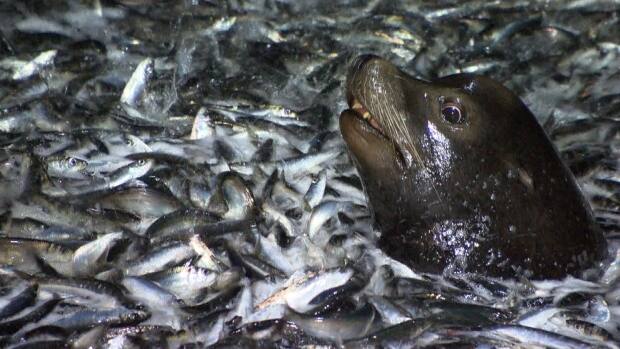
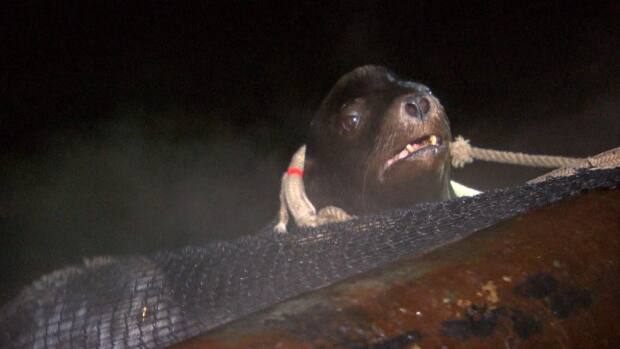
But the catch also provided some uninvited visitors with a captive dinner: Dozens of sea lions jumped over the floats holding up the net and started to gorge.

“These guys, it’s just a buffet for them,” said Sewid, as the bodies of the sea lions glistened in the boat’s floodlights. “Just like pigs at a trough.”

Sewid said the sea lions have learned there’s an easy meal to be had whenever they see or hear the fishing boats.

“They’re not afraid of us. They’ve habituated themselves to seeing that humans and fishing equates easy access to food, which is not right,” he said. “The animal kingdom is not supposed to be like that.”

Restarting a banned hunt

The hunting of seals and sea lions — which are collectively known as pinnipeds — has been banned on the West Coast for more than 40 years. It’s one reason their numbers have exploded along the entire Pacific coastline of North America.

According to one study, the harbour seal population in the Salish Sea is estimated at 80,000 today, up from 8,600 in 1975. The study also says seals and sea lions now eat six times as many chinook salmon as are caught in the region’s commercial and sports fisheries combined.

That adds up to millions of tonnes of commercially valuable fish.

Sewid’s group is proposing to cull current populations of harbour seals and sea lions by half, which would see thousands of the animals killed each year.

Tom Sewid is leading the effort to secure what he calls a sustainable harvest of seals and sea lions along the B.C. coast. (Greg Rasmussen/CBC)

The society’s small-scale “test” harvest is taking place between B.C.’s southern Gulf Islands and as far north as Campbell River, on Vancouver Island. It’s being carried out under the provisions of the Aboriginal Fisheries Strategy, which gives some First Nations harvesting and management rights for food and ceremonial purposes.

Testing the meat to see if it’s safe for human consumption is a first step in a plan to eventually gain permission for what the PBPS envisions as a sustainable, humane commercial hunt, which would largely be carried out by coastal First Nations.

“All the meat that’s in there, you’re looking at the high-end restaurants [that would sell it],” Sewid said. “The hides can also be used.”

Seal blubber is particularly valuable, he said, because it can be rendered down into an oil that’s in demand because of its high Omega-3 fatty acid content.

Watch fishing crew struggle to free sea lions entangled in their nets:

CBC News BC
Sea Lions freed from fishing nets
 WATCH

00:00 00:49

Watch as fishing crew struggles to free sea lions trapped in their nets. 0:49

One of the biggest hurdles facing the group is convincing the federal Department of Fisheries and Oceans to open a commercial hunt on the West Coast.

The seal hunt that takes place in the Atlantic and Arctic is controversial, and has long been subject to protests and fierce opposition from animal rights groups. The group expects a West Coast harvest to also face fierce confrontations.

Canadian Inuit have been waging a counter-campaign, highlighting the importance of the animal and the longstanding tradition of their hunt.

Most Canadian seal products are also banned in Europe and a handful of other countries, but the society says demand is strong in Asia.

Supporters and opponents

The PBPS does have a growing list of supporters, including 110 First Nations groups, a number of commercial fishing organizations, and some sectors of B.C.’s economically important sport fishing sector.

However, one key player, the Sport Fishing Institute of B.C., opposes a large commercial hunt, fearing it would generate public outrage and might not achieve the goal of enhancing fish stocks.

The institute’s director, Martin Paish, says the group sees some value in targeting some seals and other fish predators at specific times of year in a number of key river systems; he believes a limited hunt would help protect salmon stocks and boost the billion-dollar-a-year B.C. sport fishing industry.

“Our goal is to use predator control in a careful manner to improve chinook [salmon] production where it is needed,” said Paish.

Carl Walters is a fish biologist and UBC professor who supports cutting B.C.’s population of seals and sea lions by half. (Nic Amaya/CBC)

Fisheries scientist Carl Walters, a professor emeritus with UBC, believes culling the regions sea lions and seals could dramatically boost salmon stocks. He points to numerous studies showing how pinniped populations have been increasing, while salmon numbers have been plummeting.

“They’re killing a really high percentage of the small salmon shortly after they go into the ocean, about half of the coho smolts and a third of the chinooks,” he said.

Advocates of a hunt are also pitching it as a way to help B.C.’s endangered southern resident killer whales, which feed mainly on salmon.

“The thing that would benefit southern resident killer whales is to see improved survival of small chinook salmon — and I think the only way we can achieve that is by reducing seal numbers,” Walters said.

Peter Ross, from the Coastal Ocean Research Institute, says there would be little benefit to salmon from a seal and sea lion cull. (Nic Amaya/CBC)

Others disagree, including Peter Ross, the vice-president of research and executive director of the Coastal Ocean Research Institute.

“Killing of seals and sea lions is not going to have any positive impact for any salmon populations in coastal British Columbia,” he said.

While a few localized populations of salmon might benefit from a cull, Ross said climate change, habitat destruction and overfishing are all bigger factors in the overall decline of stocks.

Other subspecies of orcas, however, feed mainly on seals, so a hunt would reduce their access to prey.

Back on the boat, Sewid concedes a hunt would be controversial — but he firmly believes it’s necessary.

“All the indicators are there,” he said. “It’s time to get the balance back.”

The fishing crew from the Western Investor are shown harvesting herring in November. But they say they are being hampered by dozens of sea lions in their nets almost every night. (Nic Amaya/CBC)

Trapping bill highlights state’s urban-rural divide

  • Updated 
http://www.santafenewmexican.com/news/legislature/trapping-bill-highlights-state-s-urban-rural-divide/article_98de3134-0ae0-51f4-9958-9a8cd3f54676.html

Mary Katherine Ray has seen traps up close.

One caught the leg of her dog Greta while they were hiking.

“I will never forget the sound of Greta’s screaming,” Ray told a New Mexico legislative committee on Thursday.

It was a story lawmakers heard over and over again — a story of beautiful days outdoors turned bloody by traps lurking in the brush.

Animal welfare advocates and others are renewing a yearslong effort to ban trapping on New Mexico public lands. And with House Bill 366, lawmakers are reigniting a visceral debate over the humane treatment of animals and deep-rooted traditions.

Critics argue that banning trapping on public land would not stop the sort of illegal trapping that usually spurs outrage.

Trappers legally are supposed to get a license from the state, mark their traps with an identifying number and abide by rules about where they can place their traps.

Banning the practice, ranchers say, would only deprive them of a method that is key to defending their cattle from predators such as coyotes.

“This bill is government overreach and hinders cattle growers from protecting their livestock,” said Randell Major, president of the New Mexico Cattlegrowers Association.

In turn, ranchers say banning the practice would amount to one more blow to a way of life many of them already view as under threat.

But proponents of the ban argue that trapping has been ineffective, pointing to the coyote’s spread across North America.

Neighboring Arizona and Colorado have banned trapping on public lands. And a range of groups, including hikers, birders, and search and rescue teams, have raised concerns about the dangers of allowing the practice in New Mexico.

“Wildlife management needs to advance in New Mexico. We’re not controlling coyotes with these methods,” said former Santa Fe Mayor David Coss, chairman of the Sierra Club Rio Grande Chapter.

When the House Energy, Environment and Natural Resources Committee took testimony from the public about the issue Thursday, however, the biggest argument against trapping was simply that it is cruel.

In a packed hearing room, critics of trapping recounted stories like Ray’s of dogs or people caught in traps.

HB 366 has become known as Roxy’s Law, in honor of an 8-year-old heeler mix strangled in a trap last month at Santa Cruz Lake.

But perhaps more than any other bill in the Legislature this year, the proposal reveals the divide between urban and rural New Mexico.

Sen. Pete Campos, D-Las Vegas, has convened groups from opposing sides of the issue during the past couple of years to try to forge some sort of consensus. He proposed a ban a couple of years ago that foundered in the Legislature, and he remembers how divisive the issue was. This year, he has Senate Bill 390, which would ensure the State Game Commission can address issues of trapping on public land.

But groups including Animal Protection Voters are rallying behind HB 366, sponsored by Democratic Reps. Matthew McQueen of Galisteo, Christine Chandler of Los Alamos and Bobby Gonzales of Taos.

McQueen put forward a series of mostly technical changes when the bill received its first hearing Thursday, ensuring the law would not apply to corral traps, for example, to tribal governments or to spay-and-neuter programs that catch and release feral cats.

The committee is scheduled to vote on the bill Saturday.

While the bill is likely to make it out of the House Environment, Energy and Natural Resources Committee, trapping bans have faltered in the Senate, leaving its outlook uncertain.

NM Land commissioner bans killing contests on state property

Prohibition impacts coyote killing contests on 9 million acres of state land

Many hunters abhor killing contests and the carcasses they leave behind. | Matt Grubs | Matt Grubs

Calling animal killing contests “brutal, barbaric and inhumane,” new State Land Commissioner Stephanie Garcia Richard banned the practice on state trust land Thursday.

She made the prohibition by executive order, signed at a news conference.

“If you want to hold a contest to see who can accumulate the most coyote carcasses … from today forward, you will not be able to do that on state trust land,” Garcia Richard, who took office Jan. 1, said to a small group of staff and advocates.

Her office oversees more than 9 million surface acres of state trust land. Much of it is checkerboarded among private property and other government agencies, which will likely present a challenge for enforcing the ban. Garcia Richard said the office’s legal team can file action against those who violate the ban. She told reporters she’s also considered implementing a fee structure for hunters who are caught participating in the contests. Any new criminal penalities would likely have to be adopted by the state Legislature.

The ban impacts “unregulated” species like coyotes, and does not impact animals which hunters need a permit to pursue. Those hunters fall under the purview of the state Department of Game and Fish and its officers.

Animal advocates with Animal Protection Voters, Project Coyote, WildEarth Guardians, the Sierra Club and others applauded the order. Many members  stood behind the land commissioner as she made the announcement.

“She knows that healthy ecosystems and sustainable land use rely on robust interconnected wildlife populations,” said Jessica Johnson of Animal Protection Voters.

“This is not to say that NMSLO does not support hunters; hunters who hunt ethically, hunters who use practices that follow the law and include fair chase, hunters who use what they kill,” Garcia Richard said during the news conference. “This is not to say that our 3,000 agricultural lessees are going to be dissuaded from humanely combating depredation on their land to livestock and other companion animals. That’s not what today is about.”

Tiger Espinoza, vice president of the New Mexico chapter of Sportsmen for Fish and Wildlife, tells SFR the group has purposely avoided taking a stance on political issues like the contests.

“We don’t either support or not support this ban,” he says over the phone from Farmington. “I will say that Sportsmen for Fish and Wildlife 100 percent supports predator control. And if that involves killing a few coyotes, then that’s what it involves.”

The lifelong hunter says there are “thousands upon thousands” of coyotes in the state and that sometimes the public misunderstands their place in the food chain. “People think that they are not little baby deer, fawn killers. In all reality they are. I have seen that with my own eyes. It’s not just mountain lions. I’ve seen coyotes take down a buck deer with my own eyes.”

Opponents of the contest agree with people like Espinoza, who says the events don’t put a dent in coyote populations.

“There is no documented scientific evidence that coyote killing contests permanently reduce coyote abundance, increase populations of deer or other game species, or prevent conflicts between predators, humans and livestock,” Dave Parsons of Project Coyote said in a statement Thursday.

The anti-contest group plans to hold screenings of “Killing Games: Wildlife in the Crosshairs” tonight in Las Cruces and Saturday afternoon at the South Broadway Cultural Center in Albuquerque. Both shows have panel discussions planned after the film.

The order isn’t the first such ban on state trust lands. Former commissioners Ray Powell and Jim Baca also implemented such a prohibition during their terms.

Yavapai County Board of Supervisors (AZ) Passes Proclamation Condemning Wildlife Killing Contests

Unanimous vote follows Dewey-Humboldt Town Council resolution

YAVAPAI COUNTY, Ariz. — The Yavapai County Board of Supervisors voted unanimously yesterday in favor of a proclamation that opposes wildlife killing contests. Arizona citizens belonging to a coalition known as I AM WOLF NATION in partnership with Project Coyote and other wildlife and animal protection organizations have been working to end wildlife killing contests in Yavapai County and other Arizona localities. Yavapai County’s proclamation follows on the heels of a similar Dewey-Humboldt Town Council resolution that passed in November.

Wildlife killing contests are cruel events in which participants compete for fun and prizes by killing the greatest number or the heaviest of the target species. Last week, dozens of coyotes were slaughtered in the Santa Slay Coyote Tournament in Yavapai County and on public lands throughout Arizona. Manufacturers and sellers of firearms, predator-calling devices, and hunting gear were among its sponsors. Though the public at large remains largely unaware of these contests, killing contest social media posts often show photos of participants piling up and posing with the corpses of wildlife they have killed.

Increasing public outrage has led to several national newspapers editorializing against wildlife killing contests. Last week, on December 14, Pulitzer Prize-nominated columnist Linda Valdez wrote in The Arizona Republic: “The wildlife in Arizona belongs to all the people of Arizona. Did anyone ask you how you feel about contests [that] put a dollar value on killing as many wild animals as possible? Is that how you want your wildlife treated?”

Yavapai County’s proclamation recognizes that coyotes and other native carnivores play a key role in maintaining healthy ecosystems—which includes controlling rabbit and rodent populations. Just as importantly, the County proclaims that wildlife killing contests serve no genuine ecological or wildlife management purpose. The County proclamation further acknowledges that wildlife killing contests threaten the safety and well-being of hikers, dog walkers, bird watchers, hunters, horseback riders, and other outdoor enthusiasts who use public lands where killing contests take place.

“We applaud the Yavapai County Board of Supervisors for taking a strong stance against wildlife killing contests in Arizona,” said Matt Francis, Prescott, Arizona resident and a Project Coyote Program Associate. “The Arizona State Legislature should recognize that Arizona citizens will no longer tolerate these barbaric contests and should ban wildlife killing contests statewide.”

“Our team recognizes and appreciates Yavapai County making a statement against killing contests, which are blood sports and should never be compared to hunting as contest proponents try to do,” said Betsy Klein, Sedona, Arizona, resident and co-founder of I AM WOLF NATION™. “As an organization, we recognize the long-standing tradition of hunters and hunting in Arizona. In fact, hunters who practice fair chase principles have called these contests ‘inhumane’ and have openly opposed them, knowing there is a distinct difference between hunting and senseless slaughter.”

Currently, there is a contest slated to take place in Flagstaff in March of 2019 that will target bobcats, coyotes, and foxes.

Coyote killing contest organizers often justify the slaughter by claiming that by reducing the coyote population they are helping to reduce conflicts with coyotes. “There is no documented scientific evidence that coyote killing contests permanently reduce coyote abundance, increase populations of deer or other game species, or prevent conflicts between predators, humans and livestock,” said Dave Parsons, MS, retired career wildlife biologist with the U.S. Fish and Wildlife Service, former hunter, and Project Coyote Science Advisory Board Member. “Wildlife killing contests are symptomatic of a broader problem of misguided wildlife governance by state wildlife agencies that fail to recognize and value the crucial ecological roles of native predators.”

The Arizona Game and Fish Department (AZGFD) itself recognizes that killing coyotes doesn’t reduce their numbers, stating on their website: “Removing coyotes from one area generally results in other coyotes moving in from surrounding areas and breeding faster.” There is no way to know the effect that wildlife killing contests have on coyote populations in Arizona because AZGFD does not monitor the contests or track the number of coyotes killed in these events.

U.S. Congressman Raúl Grijalva of the 3rd Congressional District of Arizona, who serves on the House Committee on Natural Resources, recently weighed in on the issue: “Do you want a coyote-killing contest on your public lands this Saturday? Neither do we. Neither do Arizona locals in the threatened area. Let people know this is happening.”

Earlier this year, the city council of Albuquerque, New Mexico, unanimously passed a resolution calling for a state legislative ban on killing contests. Tucson and Pima County have passed similar resolutions in recent years. Vermont and California outlawed killing contests in 2018 and 2014, respectively. The National Coalition to End Wildlife Killing Contests, a growing alliance of more than 30 state and national wildlife and animal protection groups, along with local citizens, will pursue similar policy changes at the state and local levels across the nation in 2019.

* * * * *

I AM WOLF NATION — The power of the collective, working to protect the wolf and other persecuted wildlife in Arizona. For more information about joining the local effort to end wildlife killing contests, please visit our website.

Project Coyotea national non-profit organization, is a North American coalition of scientists, educators, ranchers, and citizen leaders promoting compassionate conservation and coexistence between people and wildlife through education, science and advocacy. Visit ProjectCoyote.org for more information.

Moose hunting banned in Cariboo wildfire zones

The ministry-imposed ban affects areas west of Quesnel and Williams Lake

The Ministry of Forests, Lands, Natural Resource Operations and Rural Development announced today that two areas affected by wildfire in the Cariboo will be closed to moose hunting from Oct. 15-31 and Nov. 1-15.

The closures affect an area north of Highway 20 and west of Williams Lake and Quesnel, after the Chilcotin Plateau Fire ravaged the area this summer. The press release noted that the area is also important to First Nations sustenance hunting.

Doug Donaldson, Minister of Forests, Lands, Natural Resource Operations and Rural Development, said: “This has been an unprecedented wildfire season, with parts the Cariboo particularly hard hit. With moose populations already declining in this management zone, we need to take steps now to protect wildlife and ensure healthy moose populations in the future.”

The closure comes after First Nations groups in the region called for the province to instate a moratorium on moose hunting.

Contacted for comment, Nazko First Nation chief Stuart Alec said: “It’s great news to hear that the province is taking steps to address the situation and the concerns of the Nazko people and others concerned about the moose populations.

“We are looking forward to working further with the province to maintain moose populations in the region.

“We have not been hunting in the wildfire zones, and are focusing our hunts north of the Blackwater River.”

The ministry indicated that the areas impacted by the hunting ban will be assessed over the winter to inform what level of sustainable hunting will be available in the coming years.