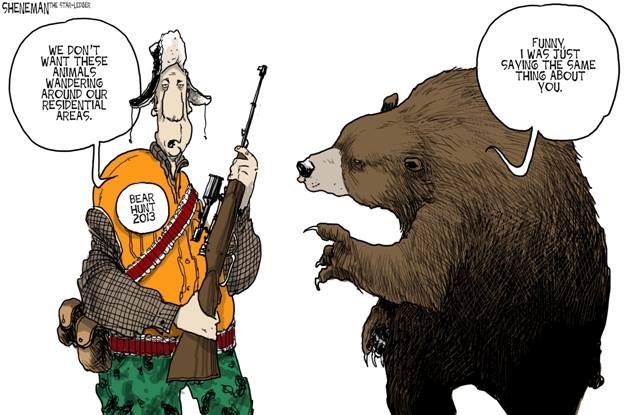
Exposing the Big Game

Forget Hunters' Feeble Rationalizations and Trust Your Gut Feelings: Making Sport of Killing Is Not Healthy Human Behavior

Exposing the Big Game

Group can’t bear hunt’s return

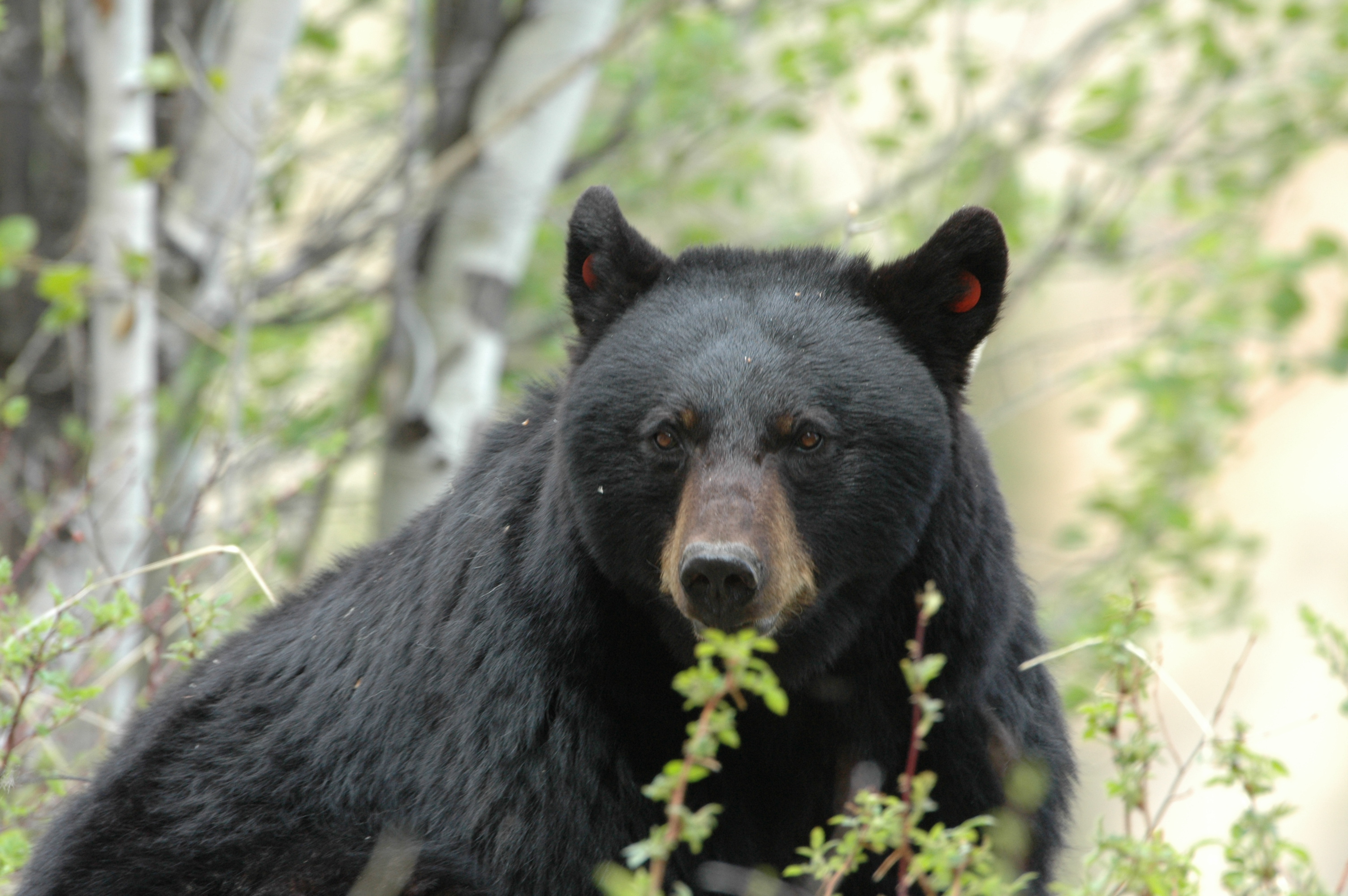
Photo Copyright Jim Robertson

Photo Copyright Jim Robertson

http://www.saultstar.com/2014/06/08/group-cant-bear-hunts-return

By Brian Kelly, Sault Star

A Toronto-based animal rights group is taking a swing at David Orazietti for bringing the spring bear hunt out of hibernation after more than a decade.

The Sault Ste. Marie MPP, who was appointed minister of natural resources in February 2013, oversaw the hunt’s limited return with a two-year pilot program to eight Northern Ontario communities this year.

They were chosen because of a large number of bear and human incidents. Fifty communities passed resolutions wanting in on the pilot program. Orazietti calls the hunt’s return “an effective management tool.”

“I think we’re taking a very pragmatic approach, a very thoughtful and strategic approach in terms of this program,” he said, noting no questions on the issue have been asked by politicians at Queen’s Park since last fall. “I think we’ve reached a very effective and appropriate balance on this issue.”

Not so, contends Animal Alliance of Canada in a colour advertisement published in Saturday’s edition of The Sault Star and a pamphlet delivered to Sault Ste. Marie households last week.

“Orazietti tells people he did (the hunt’s return) for public safety reasons,” the ad reads. “But he knows that’s not true.”

The handout accuses Orazietti and Liberal Leader Kathleen Wynne for “flagrantly” tossing aside environmental and animal protection laws and regulations “to serve their single minded goal of getting re-elected.”

The Liberals, in power provincially since 2003, have a worse environmental and animal protection record than the federal government, Animal Alliance argues.

The group suggests scientists with Orazietti’s ministry told him the hunt wouldn’t reduce problems with bears and humans.

Orazietti counters the Liberal government’s decision for a targeted hunt, after it was quashed outright by the Conservatives in 1999, has plenty of backers including civic, police and education leaders.

Mayor Debbie Amaroso and Sault Ste. Marie Police Service Chief Bob Davies appeared alongside the MPP when he announced the hunt’s return to eight wildlife management units in November. There are 94 units in Ontario.

“We did it for public safety reasons,” said Orazietti. “I think it’s insulting to Northerners to have a special interest group based out of Toronto attempting to dictate policy for Northerners, people in our community.”

He argues Ontario has a “very healthy, sustainable” black bear population of about 105,000 and that similar hunts take part in most Canadian provinces.

“I’m sure their (Animal Alliance staff) kids go to school and are able to go out for recess in a safe environment where there are not 400-pound black bears roaming their school yard,” said Orazietti. “That’s not safe and that’s not something we should be faced with in our community either.”

With a provincial election nearing on Thursday, the MPP says most voters he talks to at the 1,000-plus doors he’s knocked on are glad the hunt is back in the Sault, Sudbury, North Bay and Timmins. Some, Orazietti added, told him they would e-mail Animal Alliance to criticize its ad campaign.

Sault residents, he says, “know the realities of living in Northern Ontario (and are) fully aware of the potential safety risks of not effectively managing (the) black bear population well.”

“The number of people that are supporting what has been done here with our policy on this has been overwhelming,” said Orazietti.

Hunt opponents are concerned mother bears will be killed, leaving cubs orphaned and doomed to starve. Only male bears can be killed during the six-week hunt.

Its return doesn’t impress Josh Kerns either.

“There shouldn’t be an annual bear hunt to begin with,” he wrote on The Sault Star’s Facebook page. “Anybody who shoots animals for fun should be charged with animal cruelty.”

Animal Alliance is also critical of Ministry of Natural Resources for axing Bear Wise services including trapping and relocating problem bears.

Orazietti said packing up bruins and relocating them to the bush doesn’t work.

“It does not make sense to continue to operate the trap and relocate program when it’s not effective,” he said.

City police responded to several bear calls in the west end on Saturday. Locations include a business parking lot and housing complex on Second Line West, Nichol Avenue, Pittsburg Avenue and Edison Avenue.

Garbage and food sources shouldn’t be left out because they attract bears, police say.


Metallica Might Be Booted From Festival For Bear Hunting

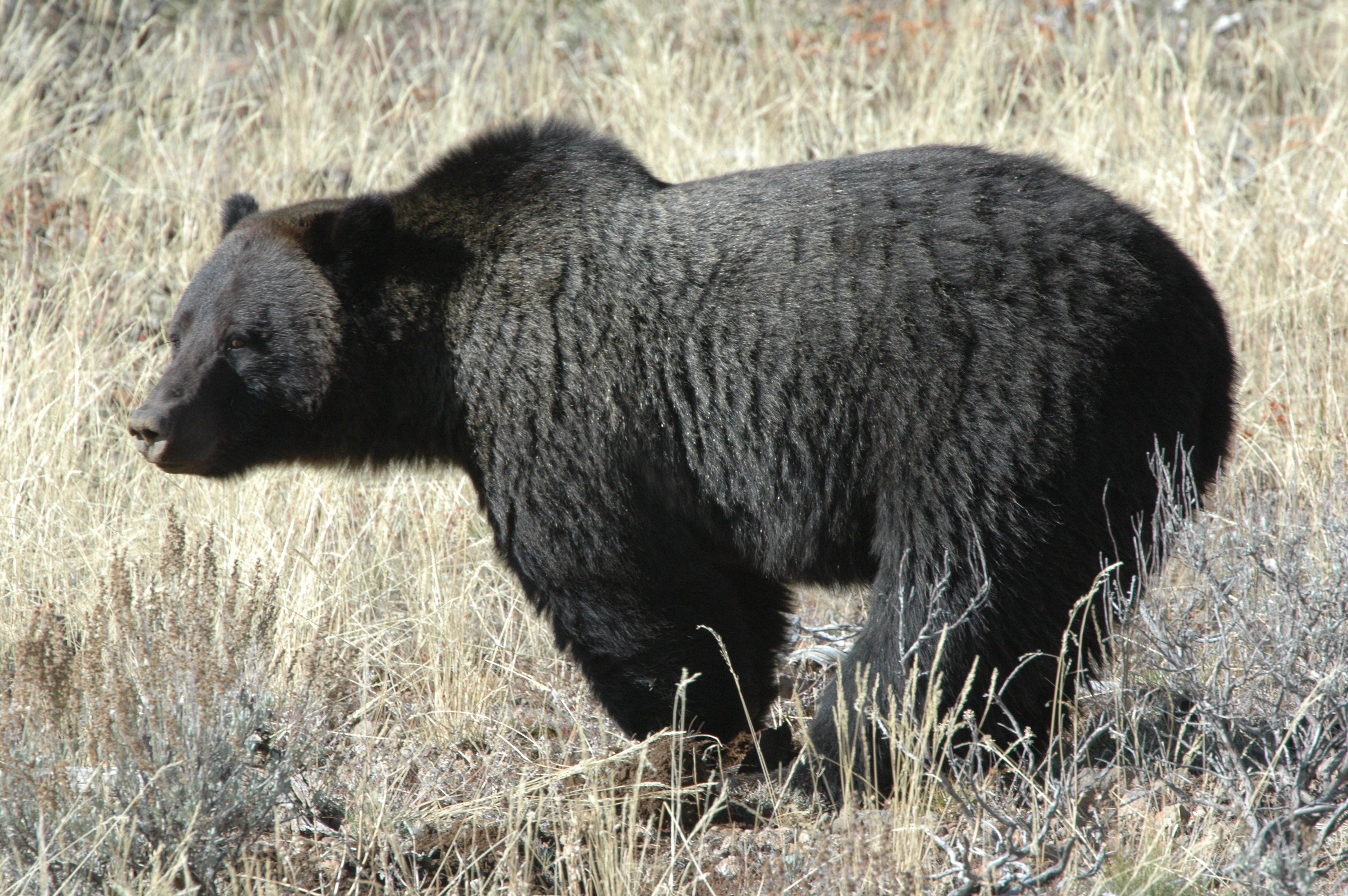
Grizzly photo Copyright Jim Robertson

Grizzly photo Copyright Jim Robertson

Animal rights activists want Metallica booted from the Glastonbury music festival because frontman James Hetfield is an enthusiastic hunter, the Telegraph reports.

A Facebook page calling for their removal, launched shortly after the History Channel announced that Hetfield will narrate its new series about bear hunting, already has over 27 thousand likes.

The page says that Hetfield’s “support of big game hunting…is incompatible with the spirit of Glastonbury and brings its good name into disrepute.”

Hetfield, who once admitted that he missed his son’s birthday while hunting bears in Russia,  is a member of the NRA and has described himself as “pretty conservative on a lot of things.”

Read more: http://dailycaller.com/2014/06/07/metallica-might-be-booted-from-festival-for-bear-hunting/#ixzz344VHOQ00

Controversial bear hunt reinstated in Ontario

WBFO’s Dan Karpenchuk reports1467382_575553635851437_268599181_n

After 15 years, Ontario’s spring bear hunt is on again, on an experimental basis. It began on May 1, despite an 11th hour legal bid by animal rights groups to prevent it.

The case to bring back the hunt was based on years of complaints from organizations and residents who say there have been more dangerous human-bear encounters since the hunt was canceled in 1999.

The case against the hunt was made by the Animal Alliance of Canada and Zoocheck Canada. Lawyers for the groups argued that an early hunt violates animal cruelty laws; cubs could be orphaned and then die of starvation or be killed by predators.

They went to court arguing for a judicial review, but just a day before it was to begin, an Ontario judge dismissed that legal attempt to block or delay the hunt.

Ontario’s natural resources minister says he is pleased with the decision, saying the priority from the start was for the public safety of people in the north. Fish and Game groups also praised the decision, saying the hunt is the only one tool for managing the bear population and without it, the number of dangerous encounters will increase.

The animal rights groups say they are disappointed but will continue to fight against the hunt by careful monitoring and perhaps even having members out observing the hunting.

The pilot project to reinstate the hunt will run for six weeks in eight regions known for having the most public safety incidents involving bears.

GRIZZLY NEXT TO YELLOWSTONE PARK ILLEGALY SHOT IN IDAHO SPRING BEAR HUNT

May 10

Adult male grizzly was shot May 7 near the Cave Falls Road-
Idaho spring black bear season began April 15, and the first Greater Yellowstone grizzly death of the season has been logged.

An eleven-year old male griz was shot by someone (so far unidentified) just off the Cave Falls Road near the southwest
corner of Yellowstone Park. In a news release, Idaho Fish and Game said they were investigating and promised any information gathered would be released.

The location of the illegal killing is generally flat with meadows where bears come to dig early season roots, bulbs, and rodents.
It is often hard to distinguish grizzlies from black bears, especially early in the year when they are thin from hibernation. Critics wonder why an area so rich with grizzlies is open to spring black bear hunting.

In recent years, U.S. Forest Service road closures after the completion of timber harvest has made the general area safer for grizzlies. The Cave Falls road (gravel) runs close to the southwest corner of the Park, dead-ending inside the Park at Cave Falls.

The death of a male grizzly is generally not regarded as serious
as that of a fertile female, especially one with cubs.

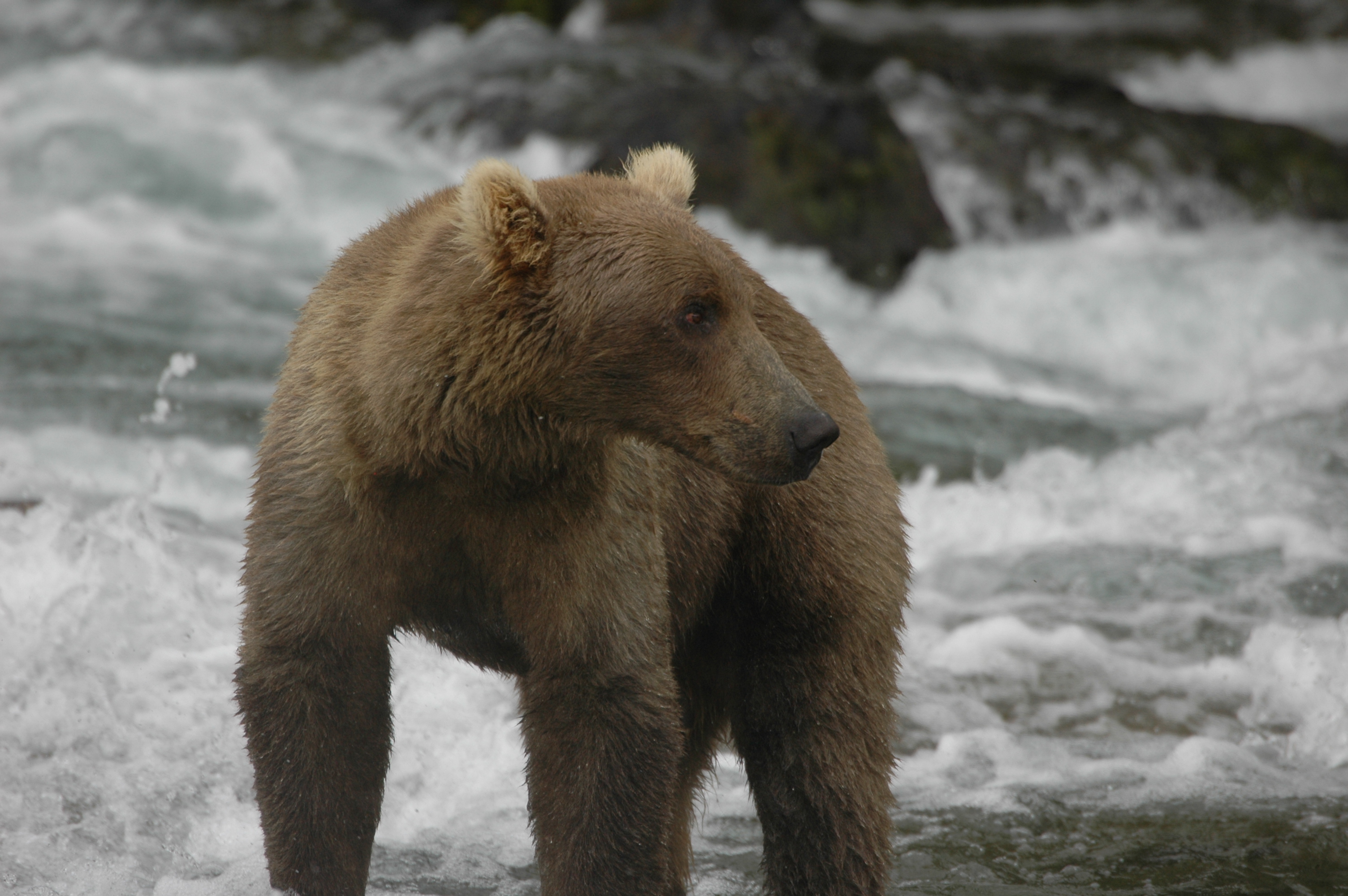
Photo Copyright Jim Robertson

Photo Copyright Jim Robertson

U.S. hunters may be invited to help control Ontario’s bear population

Photo Copyright Jim Robertson

Photo Copyright Jim Robertson

CTV Toronto
Published Saturday, April 26, 2014 11:41AM EDT

The Ontario government says it may consider opening up its bear hunt program to Americans if the spring pilot program fails to control the animal’s population.

Starting in May, a six-week bear hunt program will be reinstated in eight wildlife areas known for having public safety issues due to bears.

The program, which was originally nixed in 1999, was revived last year by Queen’s Park. It aims to reduce the number of emergency calls where nuisance bears pose a threat to the public, especially young children.

“We can’t have bears in the playgrounds,” Ontario’s Natural Resources Minister David Orazietti told CTV Toronto on Friday. “There are no parts of Ontario where this is acceptable and it certainly shouldn’t be acceptable in northern communities and cities.”

Currently, the spring bear hunt is limited to local hunters. But the Ontario government says it would consider opening it to Americans if the program is not as effective as planned.

While the program is not popular with many animal rights groups and activists, including TV personality Bob Barker, many residents in northern communities support the hunt.

During the spring season, it’s not uncommon for schools up north to be placed in lockdown as a result of a nearby bear.

The animal has also been known to wander into residential areas, leaving residents trapped in their home.

“I’ve had a situation where the bear was trying to crawl through a window, where the mom and the daughter were calling from a phone in the bedroom, trying to get somebody to deal with the bear,” Gilles Bisson, the Ontario NDP MPP for Timmins-James Bay, told CTV Toronto on Friday.

Nearly 50 mayors and city councils across northern Ontario have passed resolutions calling for participation in the spring bear hunt.

But earlier this month, Animal Alliance of Canada and Zoocheck Canada filed an application for judicial review and a notice of constitutional question in an attempt to stop the program from starting.

According to the groups, the hunt is tantamount to animal cruelty, because they say mother bears may be killed, leaving their orphaned cubs to certain death, either by starvation or predators.

“This is the only large-game species that are hunted when the young are still dependent on their mothers and it is inevitable that cubs will be orphaned,” Julie Woodyer, of Zoocheck Canada, told The Canadian Press earlier this month.

The case will be heard in court on Tuesday.

With files from CTV Toronto’s Paul Bliss and The Canadian Press   http://toronto.ctvnews.ca/u-s-hunters-may-be-invited-to-help-control-ontario-s-bear-population-1.1793759


Read more: http://toronto.ctvnews.ca/u-s-hunters-may-be-invited-to-help-control-ontario-s-bear-population-1.1793759#ixzz307K3wY35

Vote NO on FL Bear Hunting Poll

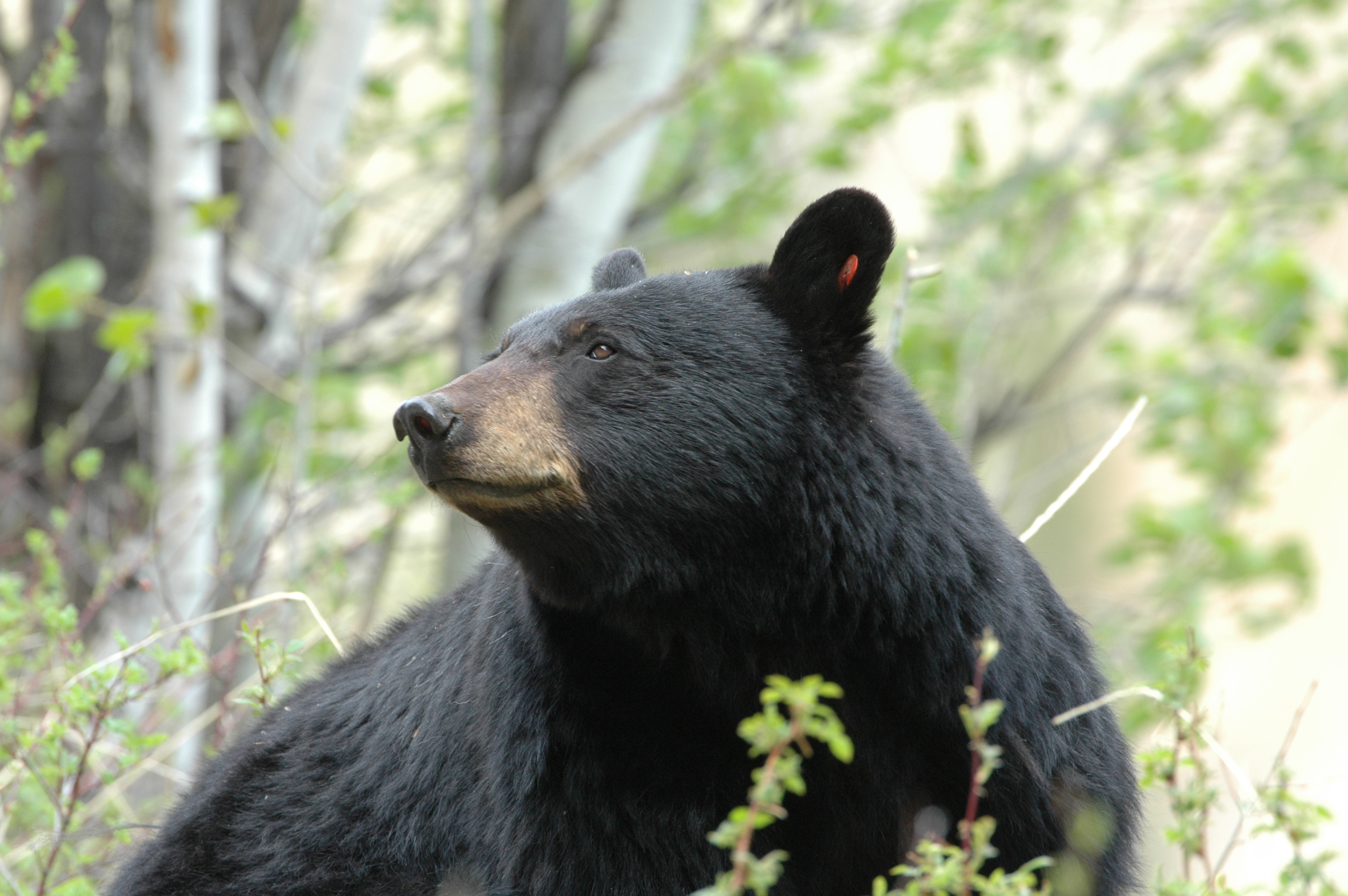
Black Bear photo

Black Bear

Do you think a bear hunting season is warranted?

Yes

No

Apparently the 7 bears they already killed weren’t sacrifice enough. Please go here and vote NO on the poll in the left hand column: http://www.wftv.com/news/news/local/lawmakers-propose-bear-hunting-reduce-population/nfgTD/

SEMINOLE COUNTY, Fla. —

There have been two bear attacks in Seminole County in the past four months and now some state lawmakers want to allow hunters to help reduce the bear population.

Recently Terri Frana spoke with Channel 9 about being mauled by a bear at her home in Lake Mary.

In December, several bears were killed after Susan Chalfant was attacked while walking her dog in Longwood.

New signs in the area warn residents to be “bear aware,” but some lawmakers and homeowners believe it’s not enough.

Wildlife officials said many of the bears in the area are used to humans and used to finding food in the neighborhoods.

State Rep. Jason Broeder from Sanford sent a letter signed by a dozen lawmakers proposing select bear hunts in specific areas to reduce the growing population and to reduce the number of dangerous encounters with neighbors.

Some of those living along Markham Road said that it may be time for a hunt.

“Outside of trying to secure my garbage, I don’t know how else to keep the separation,” said resident Fran Kipp. “I think controlling the population would help too.”

Broeder is also calling on waste management companies to provide bear-proof trash cans and is working to find the funding to teach homeowners how to co-exist with the bears, without making them feel so at home.

Representative Mike Clelland said he doesn’t believe bear hunting season is the best plan.

“I think it’s a little bit of a knee jerk reaction,” Clelland said.

Clelland said the state should make the penalties tougher on people feeding bears and not be quick to pull out guns.

“I can’t imagine us with rifles hunting bears between neighborhoods. It could only add to the public safety issue that I think is an issue now,” Clelland said.

Resident  Debbie Gunther agreed with Clelland.

“Do not kill the bears. Relocate them. Do not kill the bears. Can’t we trap the people who are feeding them? Can we have open season for that?” Gunther said.

An FWC spokeman said there can be a controlled hunt without putting the bears back on the threatened species list.

Ontario spring bear hunt to face court challenge from animal rights groups

http://kitchener.ctvnews.ca/ontario-spring-bear-hunt-to-face-court-challenge-from-animal-rights-groups-1.1780350

A black bear roams the forest A black bear roams the forest near Timmins, Ont., on Sunday, May 27, 2012. (THE CANADIAN PRESS/ Nathan Denette)
Allison Jones, The Canadian Press
Thursday, April 17, 2014

TORONTO — Two animal rights groups are taking the Ontario government to court in an attempt to stop a spring bear hunt pilot program before it begins, alleging it amounts to animal cruelty.

Animal Alliance of Canada and Zoocheck Canada say mother bears will be killed during the hunt, leaving their orphaned cubs to starve or be killed by predators.

“The babies at this time are very small,” said Julie Woodyer of Zoocheck Canada.

“This is the only large game species that are hunted when the young are still dependent on their mothers and it is inevitable that cubs will be orphaned.”

The animal rights groups have filed an application for judicial review and a notice of constitutional question, which are set to be heard in court on April 29, just days before the start of the program. They hope the court will at least delay the start of the hunt until it can rule on their legal actions.

The regulation would be contrary to animal cruelty laws in the Criminal Code, said the groups’ lawyer David Estrin.

“In our view, reinstituting this program would be tantamount to the minister and the Ministry of Natural Resources either wilfully permitting bear cubs to suffer or failing to exercise reasonable care or supervision of the bear cub population,” he said.

“The Criminal Code prohibits causing or allowing animals to suffer. This program of the Ontario Ministry of Natural Resources will cause black bears to suffer.”

The pilot project to reinstate the spring bear hunt will start May 1 and run for six weeks in eight wildlife areas known for having the most public safety incidents involving bears.

“In northern Ontario it is not responsible for a provincial government to ignore the concerns of thousands of residents who are concerned about their public safety,” said Natural Resources Minister David Orazietti.

“We have young children who can’t go out for recess at their schools, teachers wearing bear whistles because their children are threatened.”

Nearly 50 mayors and city councils across northern Ontario have passed resolutions calling for their participation in the program, Orazietti said. Out of 95 wildlife management units in Ontario, the pilot program will be in eight, he said.

“Some people who are completely unaffected by this issue and whose children may be perfectly safe in the schools that they attend have no understanding of the implications and the safety challenges in communities in northern Ontario,” Orazietti said.

The hunt was cancelled in 1999 and then-natural resources minister John Snobelen said it had left thousands of cubs orphaned since hunters too often mistakenly shoot mother bears.

“Really, the only answer we came up with was to end the spring bear hunt,” he said at the time. “It’s the only acceptable way.”

Orazietti said the government has learned over the past 15 years that other strategies to reduce human-bear incidents have met “fairly limited success.”

“This has been a very, very thoughtful and strategic approach,” he said Thursday. “We’re not suggesting a return of the spring bear hunt of yesteryear.”

The animal rights groups say the ministry’s own scientists have found no link between the end of the spring bear hunt and human-bear incidents. Orazietti said “that’s not completely true.”

“Our scientists do recognize that there are other scientists and other groups that have indicated that bear hunts do in fact have an impact on population,” he said.

Terry Quinney, the provincial manager of fish and wildlife services for the Ontario Federation of Anglers and Hunters, said the spring bear hunt was for decades a valuable wildlife population management tool.

“In reducing the density and distribution of bears in the spring, particularly those older male bears, it is absolutely reducing the probability of dangerous encounters with people,” he said.

Hunters target the male bears, Quinney said, and there are ways they can distinguish male and female bears, especially using suspended bait.

“It’s not hard to imagine that if a food source is placed, for example, hanging from a tree, a bear in order to reach that food source is going to stand on its hind legs, making its genitalia very visible to a hunter,” he said.

Quinney also said there would be economic and social benefits to re-establishing the spring bear hunt in northern communities.

“Prior to the cancellation of the spring bear hunt in Ontario there were approximately 600 family-based businesses in northern and central Ontario that were involved in the spring bear hunt, for example providing guiding services for hunters,” he said.

“Revenues to northern and central Ontario on an annual basis were in excess of $40 million a year. All of those economic benefits have disappeared from Ontario.”

Read more: http://kitchener.ctvnews.ca/ontario-spring-bear-hunt-to-face-court-challenge-from-animal-rights-groups-1.1780350#ixzz2zGxETLtP

VERY IMPORTANT! Please vote in the on line poll in the Toronto Sun to say NO to reviving the spring bear hunt in Ontario. The poll is on the bottom right of the home page here: http://www.torontosun.com/

Help STOP Bear Hunt in NJ For Good!

HELP STOP BEAR HUNT IN NJ FOR GOOD!!!!!!!!!!


Last year hunters in their “Rambo wannabe” get up, face painted psychopath massacred 600 Bears and this year again more bears will be killed. Will there ever be an end to this. According to bear in NJ expert NJ Fish and Games are full of corruption and there is likely never end to it. I remember 4 years ago there was a petition to stop bear hunting and all the petition and writing did not help. Bear like deer has a physiology to feel pain, they fear death and most of the killings are done by bows and arrow. According to a Veterinarian they have quoted that animals such as deer, bear and Elk suffers as we do.

“Consider the physiology of the deer (and bear) who dies by suffocation, choking on its own blood, or the deer who dies after an arrow penetrates the diaphragm. The presence of a highlysophisticated nervous system in deer certainly suggests that their nervous systems perform the same functions as human nervous systems. The presence of the same neurochemicals in deer as in humans similarly shows that they feel pain as we do.

In recent years there has been a major shift in the way the scientific community understands the mental life of animals, particularly mammals. Presently, researchers in a variety of animal-related disciplines generally agree that in addition to being sentient, mammals are consciously aware and have feelings and emotions.

Petition:http://www.thepetitionsite.com/151/762/110/help-stop-bear-hunt-in-nj/