Exposing the Big Game

Forget Hunters' Feeble Rationalizations and Trust Your Gut Feelings: Making Sport of Killing Is Not Healthy Human Behavior

Exposing the Big Game

What you should know about Washington’s murder hornets

Despite a swarm of worried calls, officials say humans don’t need to panic just yet.

Asian giant hornet perched on human finger

An Asian giant hornet from Japan is held on a pin by Sven Spichiger, an entomologist with the Washington State Department of Agriculture, May 4, 2020, in Olympia. The insect, which has been found in Washington state, is the world’s largest hornet, and has been dubbed the “murder hornet,” a reference to its appetite for honeybees and a sting that can be fatal to some people. (Ted S. Warren/AP)

ADVERTISEMENT

In the hours after the New York Times published an article Saturday about an invasive hornet with a potentially lethal sting, the Washington State Department of Agriculture didn’t see too many emails from concerned residents. But by the time public engagement specialist Karla Salp checked her phone after a virtual church service Sunday morning, she realized it was going to be an all-hands-on-deck type of day.

“It’s been just totally insane here,” Salp said Monday. “I’ve worked here since 2015 and this far exceeds anything that I have ever dealt with in communication. We just had another outreach person start today, bless her heart … so she’s definitely experiencing a little bit of baptism by fire.”

The New York Times first covered the Asian giant hornet’s presence in Washington in December, but the Department of Agriculture has been sharing identifying information with the public at least since publishing a revised invasive species pamphlet in October. The first of two dead detected specimen in Washington state was reported late last year near Blaine in Whatcom County.

But the most recent news of “murder hornets” has captured international attention and monopolized the waking hours of insect, forestry and agriculture professionals in the ground zero state of Washington.

There are plenty of reasons to fear this hornet: It’s big, it turns its preferred forest floor habitat into landmines of underground hives, it can sting multiple times, and it can deliver seven times as much toxin per sting as a honeybee and can pierce a bee suit. About 50 people die in Japan from Asian giant hornet stings every year, hence the nickname.

 

Entomologist Chris Looney, of the Washington State Department of Agriculture, with a dead Asian giant hornet for scale.

Entomologist Chris Looney of the state Department of Agriculture, with a dead Asian giant hornet for scale. (Department of Agriculture)

Entomologist Chris Looney of the state Department of Agriculture, with a dead Asian giant hornet for scale. (Department of Agriculture)

Salp and others say they appreciate the hundreds of emails, calls and sighting reports; The department hosts an Asian Giant Hornet Facebook group that nearly tripled in size after the New York Times article dropped. But those involved in the study and eradication of these hornets in Washington state say that for most people the panic far outweighs realistic concerns, at least for now.

So far, none but the original two specimen reports have turned up positive identifications. Salp says the most popular species misidentified as Asian giant hornets are European hornets (which aren’t known to exist in Washington); cicada killers; yellow jackets; or bumblebees. The Department of Agriculture offers education around bumblebee identification to prevent people from killing them in error.

With most Americans sheltering during the pandemic, the murder hornet has clearly struck a nerve.

Todd Murray, director of the Agricultural and Natural Resources Extension Program Unit at Washington State University, says he thinks the “murder hornet” nickname is driving interest. “Note to self: Stick ‘murder’ in front of it and it sure gets attention,” Murray says.

He and his colleagues are fielding a couple of dozen media requests a day. “It’s interesting because in the entomology community, there’s some strong feelings about the stigma around wasps and hornets,” he says, ”so there’s been backlash within our own community about the term.”

‘We don’t need to freak out’

With only two confirmed hornet sightings, only a few groups of people have reason to be afraid right now, experts say. “We don’t need to freak out, you know, but it is a serious concern for our state,” Salp says.

“This isn’t an issue that we need to panic about, especially in light of the pandemic,” adds Murray. “But I think there’s a benefit of being aware of what it’s like to live in a global economy, a global environment, where we have people and products constantly moving across the world. And we are bound to get hitchhikers like this one ⁠— and in Washington state it’s become all too common for new insects to be introduced. Early detection is really critical.”

To the best of the state’s knowledge, the hornet hasn’t been seen outside of Whatcom County: The two sightings that were verified were near Blaine. A hive was also eradicated in Nanaimo in British Columbia after a specimen was discovered in August 2019. “If you live outside of those areas, I would have less concern, but still have an awareness and then definitely be thinking about your connection to those areas” says Justin Bush, executive coordinator with the Washington Invasive Species Council. For instance, if you live along Interstate 5, that could be a pathway for accidental hornet trafficking by semitruck or RV. “But naturally, if they fly, the spread is a little bit slower than that,” Bush says.
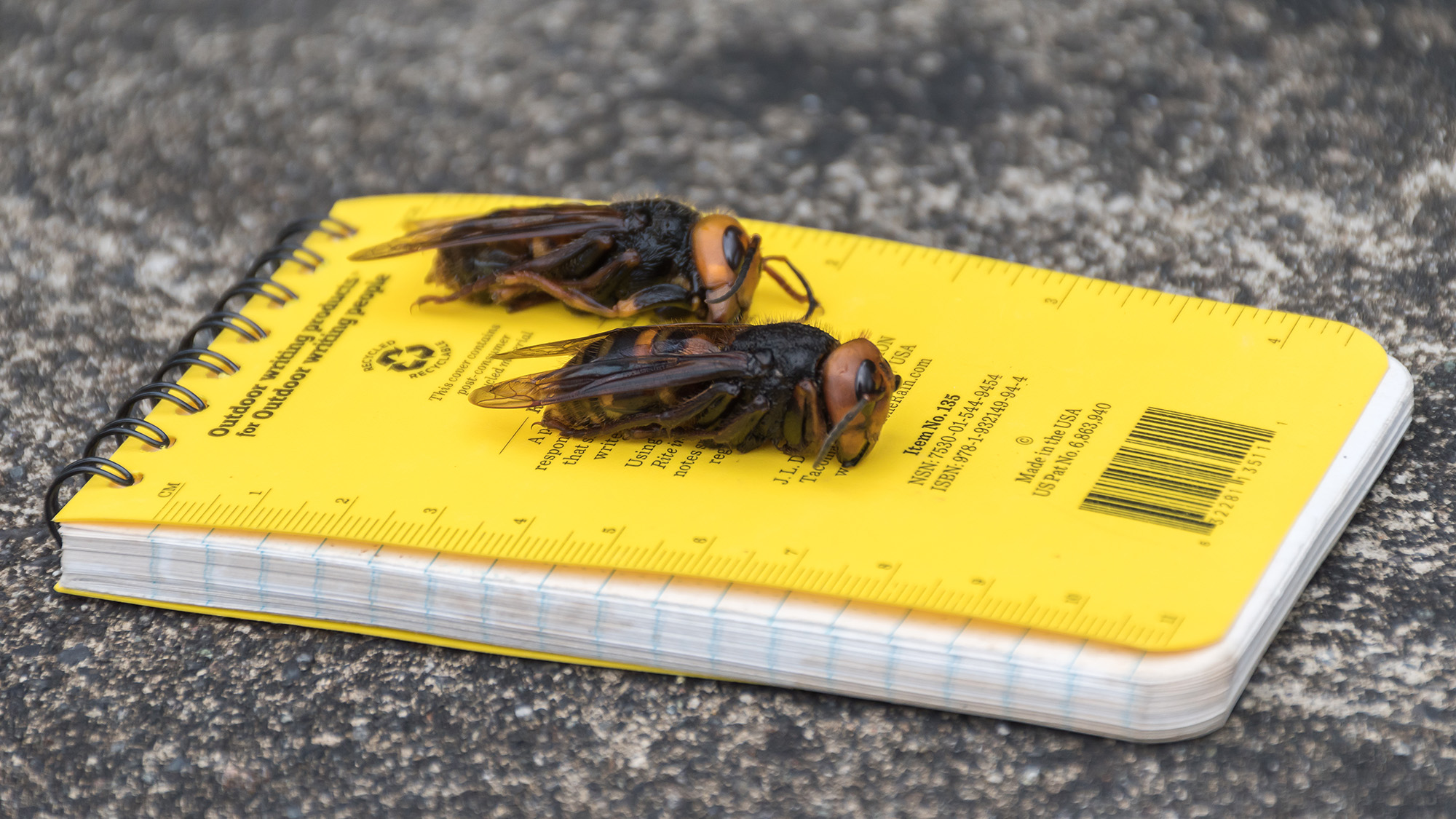
Asian giant hornets on a field notebook.
Dead Asian giant hornets rest on a field notebook. (Washington State Department of Agriculture)

Murray says that he would definitely be aware if he were in Blaine in semiforested conditions or where forest meets open fields.

Salp says Washington’s honeybees and the beekeepers and farmers who depend on them for honey and pollination have more serious reasons to be alarmed. The Asian giant hornets’ appetite for honeybees is enormous. The hornets take over beehives, chewing off the bees’ heads before feeding on their bodies. “They will defend that hive as their own, and if you try to approach or get them out of your hive yourself, you have a very high probability of being stung,” Salp says. The hornets can chew through more than 40 bees a minute and destroy a hive in 90 minutes.

With American honeybees already disappearing at an alarming rate, the invasive hornet further endangers the $20 billion sector of the U.S. farming industry that honeybees support. (A 2014 state report found bees in 2012 “added billions of dollars in harvest value to Washington’s economy, including nearly $3 billion from tree fruit and berries. The bees themselves added nearly $4 million from honey sales, but their chief value is as pollinators.”)

Murray says beekeepers are likely to be the first people to encounter the hornets this year if there’s an active population, but that might not be clear until late summer or early fall, when the hornets engage in their bee-killing sprees.

Ann Potter, a conservation biologist and insect specialist with the Washington Department of Fish and Wildlife, says she’s not aware of the hornets’ impacts on insect species other than honeybees, “but certainly there must be…. It’s unlikely to feed on only one species.” She notes that the European honeybees raised by beekeepers may be more vulnerable to hornets than also-declining native bees because they live in large colonies. (Japanese honeybees, on the other hand, protect themselves by cooking the Asian giant hornets alive.)

People allergic to wasp, bee, or hornet stings are vulnerable as well: Asian giant hornets carry more venom per sting than local bees and wasps. According to the Cleveland Clinic, about 2 million Americans are allergic to these types of stings, and approximately 50 people die every year from allergic reactions from them.

However, anyone who works or enjoys outdoor recreation should at least be aware and able to identify and report the giant hornets, Salp says ⁠— “not because Asian giant hornets are going to come after you, but [because] if you see them, we definitely want to know about it.”

“We don’t know how they’re going to interact with [our] environment,” Murray says. “We really don’t want this hornet to establish here in the Pacific Northwest because we really don’t know exactly how much it will impact our ecology and agriculture and, honestly, our daily life.”

Don’t panic — yet

Murray says he would be more concerned if people submitted sightings of the hornet over a much broader area than where they’ve been spotted, but he says there’s no reason to think it’s present elsewhere in the state yet. That means 2020 will be a critical year for trapping hornets and educating the public.

“The challenge is we don’t really know exactly how widespread it is for sure,” Salp says. Washington is home to vast amounts of the deep forest habitat the hornets prefer, and they are excellent fliers. Murray says some data show the hornets can forage up to 5 miles from their nesting site.

Europe has been dealing with the invasion of a similar species called the yellow-legged hornet since at least 2004: Thought to have arrived in bonsai tree shipments, the hornets have yet to be eradicated. Murray says honey production has decreased by up to two-thirds in Europe.

The only way to eradicate the bees, Salp says, is to track them back to their hives through live trapping, tagging and release because the colonies are almost always underground.

Murray says he’s “pretty optimistic” the hornet can be eradicated because the state was able to note its presence in December with the public’s help. “If we ignored this problem, each year that we get generation turnover, it would be likely significantly more difficult and very expensive to try and eradicate this,” he says.
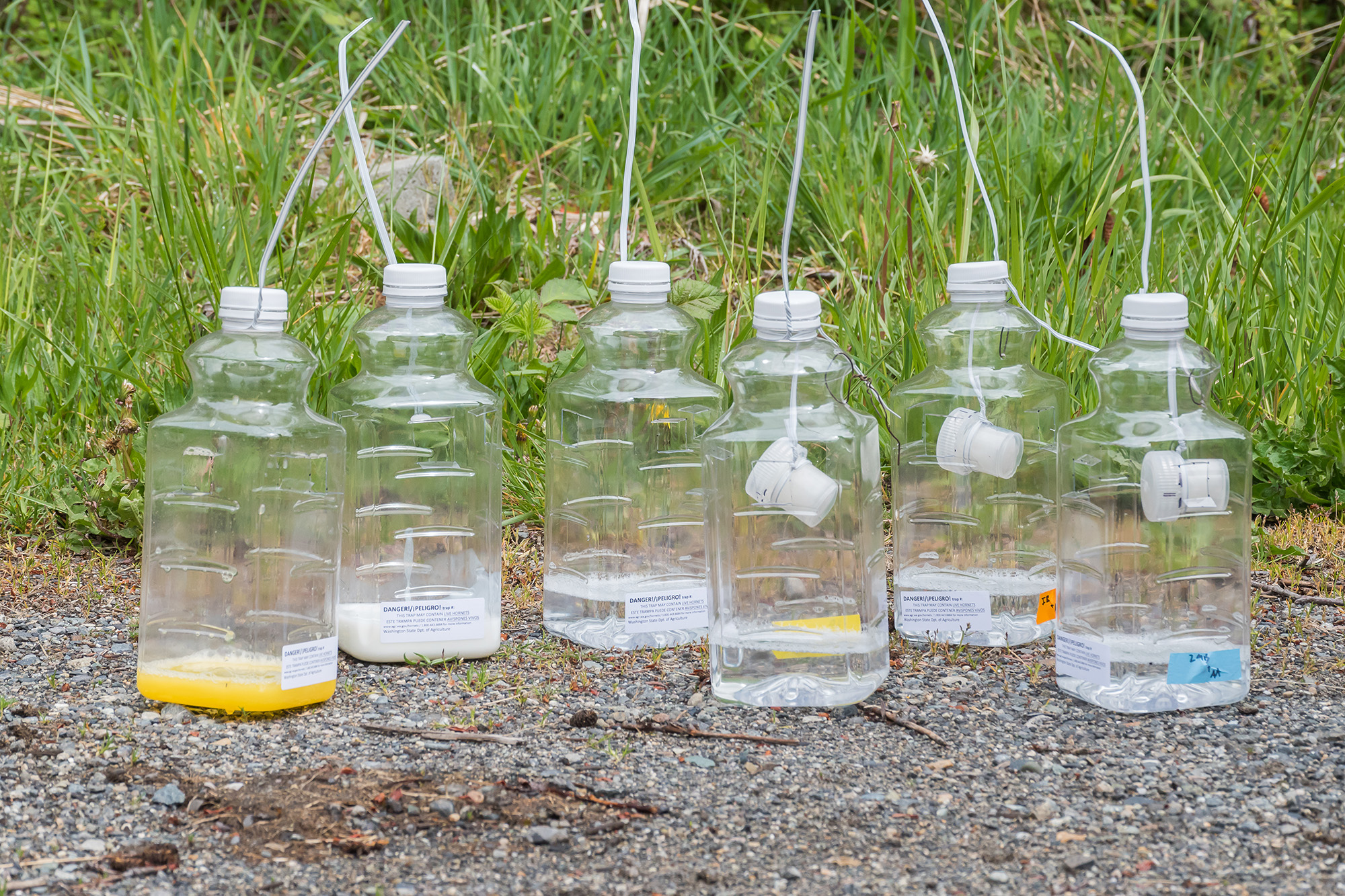
Asian giant hornet traps
Asian giant hornet traps can help people document specimens safely. The Department of Agriculture doesn’t want people to attempt to trap live hornets. (Washington State Department of Agriculture)

For people hoping to help the department take advantage of this critical window, Salp says the public should make sure to share and reference information only from reliable sources like Washington State University or the Department of Agriculture. They should submit possible sightings to the department via its web app with complete identifying information. Murray says if you see a live one, run and note your location for later. The Washington Invasive Species Counci’s Bush recommends sending photos, a GPS location and contact information in case someone with the state needs to follow up.

“With invasive species, especially ones that are relatively new [and high priority], a high percentage [of identifications] are going to be inaccurate,” Bush says. “And that’s OK, because the 1% or less than 1% [of IDs] that are accurate could help avoid millions if not billions of dollars of impact, that could potentially not be reversible.”

Murray says identifying an Asian giant hornet is easy. The Pacific Northwest is home to few large, flying insects. “The person that first detected it saw it come into a hummingbird feeder and it sure was obvious on its own. Some of our native beetles might get that large, but these look strikingly different.”

People in Whatcom, Skagit, San Juan, Jefferson and Clallam counties can also sign up for volunteer trapping, which Bush says is best done in June and July. The Department of Agriculture got state and federal funding for the trapping project, but there’s still limited capacity, Salp says. The pandemic is complicating tracking efforts as well. In-person trainings in Western Washington were canceled. There were also plans for specimen drop-offs at WSU, but now samples can be taken only by mail until stay-at-home restrictions are lifted.

“Between the beekeepers, the volunteers and our own staff, the project is moving forward — [but] this is all frankly kind of one big experiment,” Salp says. “The more folks that we have out there helping trap for them, the greater our chances of finding them and then eradicating them.”
Useful resources: 

⁠— How to identify Asian giant hornets

⁠— How to trap Asian giant hornets

⁠— How to submit Asian giant hornet sightings to the Washington State Department of Agriculture
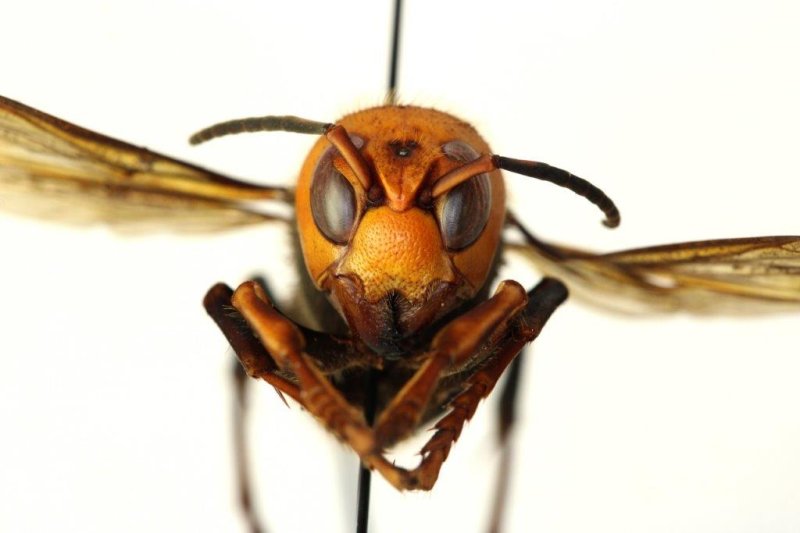
Invasive ‘Murder Hornets’ Have Appeared in the United States and Officials Worry They’re Here to Stay


Invasive Asian giant hornets (Vespa mandarinia) have been spotted in the United States for the first time.

Invasive Asian giant hornets (Vespa mandarinia) have been spotted in the United States for the first time.
Washington State Department of Agriculture
MAY 2, 2020 4:17 PM EDT

If you thought 2020 couldn’t get any worse, Asian giant hornets have appeared in the United States for the first time.

Asian giant hornets, which some researchers refer to as “murder hornets” according to the New York Times, had never been seen in the U.S. until December, when the Washington State Department of Agriculture (WSDA) verified four sightings of the hornets near Blaine and Bellingham, Wash. Canada also reported sightings of the insects in British Columbia the fall of 2019, per the WSDA.

Asian giant hornets are the largest species of hornet in the world. They attack and destroy honeybee hives, entering a “slaughter phase” where they literally decapitate bees and take the hive as their own, using the thoraxes from the dead bees to feed their young, according to the WSDA. Just a few hornets can decimate a honey bee hive in a number of hours.

If the hornets continue spreading through the state, officials worry they could have a devastating affect on Washington state’s — and the U.S.’s — bee population. The many crops that rely on bees for pollination would then be seriously affected. Officials don’t know how the insects got into the U.S., but they’re bracing for the hornets to start emerging soon, as they become active in April, according to a press release from Washington State University (WSU). The hornets are at their most destructive in late summer and early fall, per the release.

“At this time, Washington State Department of Agricultural has implemented an aggressive outreach and trapping campaign,” Rian Wojahn, the eradication coordinator for the WSDA, told TIME in an email. “Local beekeepers and other agencies are also helping get information out and using our trapping protocols to deploy traps.”

Wojahn said that while it’s unknown how much damage the hornets could do to the U.S. honeybee industry, a similarly invasive hornet in Europe ended up reducing beehives by 30 percent and honey yield by up to two-thirds. The WSDA will implement “an aggressive eradication campaign this summer,” he continued.

Asian giant hornets are usually 1.5 to two inches long, have black and yellow stripes on their abdomen, and have a large orange or yellow head, according to the WSDA. They don’t usually attack people or pets, but might if they are threatened, the WSDA continued. Their stingers are longer than a honey bee’s, more toxic and they can sting multiple times. Multiple stings can also kill a human even if they’re not allergic, according to the WSU release. The New York Times reports reports that in Japan, the hornets have been known to kill up to 50 people a year.

Research Links Pesticide Harmful to Bees With Collapse of Fisheries

Anew study out this week provides more evidence of harm caused by a class of pesticides known as neonicotinoids, with researchers linking use of the chemicals on a Japanese lake with impacts to an entire food web that resulted in the collapse of two fisheries.

“No surprise,” tweeted former UK Green Party leader leader Natalie Bennett, “soaking our planet in pesticides has broad systemic effects on biodiversity and bioabundance.”

For the study, published in the November 1 issue of the journal Science, the researchers looked at Lake Shinji and analyzed over two decades of data. They found cascading impacts that appeared to stem from the first use of neonicotinoids on nearby rice paddies.

André Müller@andreairplane9

First study in @sciencemagazine to show how –> application of neonicotinoids 💉 around lakes –> less dragonflies, mayflies 🦟 –> less fish 🐟 (perhaps birds and others). https://twitter.com/AFL_org/status/1190021637443325955 

Alliance for Freshwater Life@AFL_org

Fishery collapse ‘confirms Silent Spring pesticide prophecy’ –
Common pesticides found to starve #fish ‘astoundingly fast’ by killing aquatic #insects via @guardianeco https://www.theguardian.com/environment/2019/oct/31/fishery-collapse-confirms-silent-spring-pesticide-prophecy?CMP=share_btn_tw 

See André Müller’s other Tweets

Masumi Yamamuro@MasumiYamamuro

decreased and smelts in a Japanese lagoon through decreasing foods aquatic insects and crustaceans. Any comments and suggestions are welcome.https://science.sciencemag.org/content/366/6465/620/tab-pdf 

Neonicotinoids disrupt aquatic food webs and decrease fishery yields

It is now well known that neonicotinoids negatively affect pollinators. As research has expanded, it has become clear that these globally used insecticides directly affect other ecosystem components,…

science.sciencemag.org

See Masumi Yamamuro’s other Tweets

“Since the application of neonicotinoids to agricultural fields began in the 1990s, zooplankton biomass has plummeted in a Japanese lake surrounded by these fields,” the researchers wrote. “This decline has led to shifts in food web structure and a collapse of two commercially harvested freshwater fish species.”

“Using data on zooplankton, water quality, and annual fishery yields of eel and smelt,” the paper says, “we show that neonicotinoid application to watersheds since 1993 coincided with an 83% decrease in average zooplankton biomass in spring, causing the smelt harvest to collapse from 240 to 22 tons in Lake Shinji, Shimane Prefecture, Japan.”

As for the strength of the link between the pesticides and the collapse, Phys.org added:

The researchers note that they also studied other factors that might have led to fishery collapse, such as nutrient depletion or changes in oxygen or salt concentrations. They report that they were not able to find any evidence showing that there might have been something other than pesticides killing the food fish ate leaving them to starve. They conclude that the evidence strongly suggests it was the introduction of neonicotinoid pesticides into the lake environment that led to the die-offs.

The Guardian, in its reporting on the study, noted that the researchers pointed to the haunting warning from Rachelel Carson’s seminal work, Silent Spring:

In their report, the Japanese researchers said: “She wrote: ‘These sprays, dusts and aerosols are now applied almost universally to farms, gardens, forests and homes—nonselective chemicals that have the power to kill every insect, the ‘good’ and the ‘bad,’ to still the song of birds and the leaping of fish in the streams.’ The ecological and economic impact of neonicotinoids on the inland waters of Japan confirms Carson’s prophecy.”

Similar impacts, the researchers added, are likely felt in other locations.

“Just awful, what gruesome harm we are inflicting on the environment,” Matt Shardlow, CEO of the invertebrate conservation group Buglife, wrote on Twitter in response to the new study.

According to Nathan Donley, senior scientist at the Center for Biological Diversity and who was not involved in the study, the findings should spur action by the Environmental Protection Agency.

“This study highlights cascading harms to aquatic life from neonicotinoids that our EPA has known about but shrugged off,” said Donley. “The evidence is now overwhelming that these pesticides are turning our rivers, lakes, and streams into inhospitable environments for fish, frogs, and other aquatic life.”

“This landmark new research should make it impossible for even the Trump administration to ignore the immense damage caused by these dangerous chemicals,” Donley added.

Neonicotinoids, or neonics as they’re often called, have also been linked to harm to bees, other insectsbirds, and other animals.

Wild bees are building their homes from plastic—and scientists aren’t sure why

Sarah Gibbens
a small insect on a white background: Portrait of a leaf cutter bee, the species believed to be using plastic for construction material in Argentina.© Photograph by Joel Sartore, National Geographic Photo ArkPortrait of a leaf cutter bee, the species believed to be using plastic for construction material in Argentina.

Wild bees, nesting in Argentinian crop fields, were recently found constructing nests entirely made of the flimsy plastic packaging material left on farms.

From 2017 to 2018, researchers at Argentina’s National Agricultural Technology Institute crafted wooden, artificial nests for wild bees. Unlike bee species that have a large hive with queens and workers, wild bees burrow into nests to individually lay larvae. The constructed nests fit together like long rectangles with a narrow, hollow opening that allowed wild bees to crawl inside and fill it with cut leaves, twigs, and mud.

Sixty-three wooden nests were constructed, and three were found lined entirely with plastic. Similar in size and shape to a fingernail, the bits of plastic had been carefully cut by bees and arranged in an overlapping pattern in their nests. Based on the material, researchers think the plastic may have come from a plastic bag or film, which has a similar texture to the leaves bees typically use to line their nests.

Of the three plastic nests, one had not been finished, meaning the bee did not use it to lay her larvae, Science Alert reports. In the remaining two, one larva died and the other was not found, leading the researchers to believe it survived.

What does it mean for bees?

This new research, published in the journal Apidologie, documents the first time bees have been seen making nests only out of plastic, but for years scientists have known bees were incorporating plastic into their building materials.

In 2013, a paper published in Ecosphere outlined how bees were using plastic films and foams to line nests in urban areas throughout Toronto, Canada. Similar to the bees in Argentina, the wild bees observed in Canada cut pieces of plastic that resembled the leaves they commonly use.

Notably, the Canadian study found it wasn’t just flaps of plastic bags the bees were using. Plant resins, which can be fashioned into anything from gum to latex, often bind a bee’s building materials together. But some individuals, they observed, were hauling a plastic-based caulk back to their nests to use instead.

Both studies noted that more research needs to be done before scientists can outline the potential impact plastic might have on bees, but the nest building shows that bees are highly adaptive to changing environments. In both places, leaves were readily available as a building material.

“It would demonstrate the adaptive flexibility that certain species of bees would have in the face of changes in environmental conditions,” the study’s lead author Mariana Allasino wrote in a press release translated from Spanish.

Plastic dangers

Hollis Woodard, an entomologist who studies bees at the University of California Riversides Woodard Lab, isn’t surprised to see bees hauling plastic to their nests.

“I think it’s really sad,” she says. “It’s another example of the rampant use of materials that end up in places we don’t intend them to.”

Plastic often presents a threat to wildlife in the form of microplastics, the incredibly tiny bits of plastic that form as larger plastic trash breaks down. Microplastics are a danger to the animals that mistake them for food, which many do, especially in marine environments. No study, however, indicates that bees might be consuming plastic.

Among the dangers that bees face are pesticides, habitat destruction, and exposure to viruses or parasites.

Researchers have speculated that plastic may form a barrier against common nest issues like mold and parasites.

If the bees are in fact choosing plastic over natural materials, it wouldn’t be the first time animals have used trash to their advantage.

Sparrows and finches line their nests with cigarette butts to ward off parasitic mites, and black kites in the Italian Alps collect bright strips of plastic to decorate their nests and attract mates.

“It would take a lot more research to know what this means for the bees themselves,” says Woodard. “Sure it’s possible it might afford some benefits, but that hasn’t been shown yet. I think it’s equally likely to have things that are harmful.”

“It’s a miracle!”: Bees living on Notre-Dame cathedral roof survive blaze


Notre-Dame cathedralImage copyrightGETTY IMAGES
Image captionCathedral beekeeper Nicolas Geant says the bees would have got “drunk” on smoke from the fire

Notre-Dame’s smallest residents have survived the devastating fire which destroyed most of the cathedral’s roof and toppled its famous spire.

Some 200,000 bees living in hives on the roof were initially thought to have perished in the blaze.

However Nicolas Géant, the cathedral’s beekeeper, has confirmed that the bees are alive and buzzing.

Mr Géant has looked after the cathedral’s three beehives since 2013, when they were installed.

That was part of an initiative to boost bee numbers across Paris.

The hives sit on top of the sacristy by Notre-Dame’s south side, around 30m (98 ft) below the main roof. As a result, Mr Géant says they remained untouched by the flames.

European bees – unlike other species – stay by their hive after sensing danger, gorging on honey and working to protect their queen.

High temperatures would have posed the biggest risk, but Mr Géant explained that any smoke would have simply intoxicated them.

“Instead of killing them, the carbon dioxide makes them drunk, puts them to sleep,” he told AP.

Beekeepers commonly use smoke to sedate the insects and gain access to their hive.

“I was incredibly sad about Notre-Dame because it’s such a beautiful building,” Mr Géant said in an interview with CNN.

“But to hear there is life when it comes to the bees, that’s just wonderful.”

“Thank goodness the flames didn’t touch them,” he added. “It’s a miracle!”


Bees May Understand Zero, a Concept That Took Humans Millennia to Grasp

If the finding is true, they’d be the first invertebrates to join an elite club that includes primates, dolphins and parrots

image: https://thumbs-prod.si-cdn.com/4uqFneYzh6k1sdxlpygxthCm6zY=/800×600/filters:no_upscale()/https://public-media.smithsonianmag.com/filer/ba/6b/ba6b1209-f295-414b-a7f7-f8fc81bef30f/ertnwj.jpg

ERTNWJ.jpg

Australian researchers have shown that bees can distinguish nothing from various positive numbers. (Nigel Cattlin / Alamy)
SMITHSONIAN.COM

As a mathematical concept, the idea of zero is relatively new in human society—and indisputably revolutionary. It’s allowed humans to develop algebra, calculus and Cartesian coordinatesquestions about its properties continue to incite mathematical debate today. So it may sound unlikely that bees—complex and community-based insects to be sure, but insects nonetheless—seem to have mastered their own numerical concept of nothingness.

Despite their sesame-seed-sized brains, honey bees have proven themselves the prodigies of the insect world. Researcher has found that they can count up to about four, distinguish abstract patterns, and communicate locations with other bees. Now, Australian scientists have found what may be their most impressive cognitive ability yet: “zero processing,” or the ability to conceptualize nothingness as a numerical value that can be compared with more tangible quantities like one and two.

While seemingly intuitive, the ability to understand zero is actually quite rare across species—and unheard of in invertebrates. In a press release, the authors of a paper published June 8 in the journal Science called species with this ability an “elite club” that consists of species we generally consider quite intelligent, including primates, dolphins and parrots. Even humans haven’t always been in that club: The concept of zero first appeared in India around 458 A.D, and didn’t enter the West until 1200, when Italian mathematician Fibonacci brought it and a host of other Arabic numerals over with him.

But animal cognition researchers at the RMIT University of Melbourne, Monash University in Clayton, Australia and Toulouse University in France had a hunch that honey bees might just be one of the few species able to grasp the concept. Despite the fact that they have fewer than one million neurons in their brain—compared to 86,000 million in a human brain—the team recognized their cognitive potential.

“My lab was starting to accumulate some evidence that bees could do some advanced cognitive tasks, such as tool use, playing ‘soccer’—manipulating a ball to get a reward—and learning to encode information in human faces,” says Adrian Dyer, a postdoctoral student at RMIT University of Melbourne and co-author on the study. “We were aware that this animal model was very capable of learning complex things … it was the right time to formalize an experiment to see if the bee brain could process the concept of zero.”

To test this hypothesis, the team first taught the bees the concepts of “greater than” and “less than,” which previous research suggested the bees would be able to do. The researchers figured that if the bees could successfully show they understood that zero was less than various positive numbers, this would demonstrate the insects’ understanding of zero’s numerical value.

To do this, they first lured two groups of 10 bees each to a wall where two white panels containing different numbers of black shapes were displayed. They decided to teach half the bees “less than” and the other half “greater than,” using food rewards to train the bees to fly toward the panel with fewer or more shapes, respectively. When comparing two white panels with positive numbers of shapes in each, bees quickly learned to fly toward the correct one.

The real challenge, however, came when one of the panels contained no shapes at all. In several trials, the “less than” bees flocked to the empty panel, and the “greater than” bees to the panel with shapes. Despite the study’s small sample size, the researchers believed the bees were exhibiting zero processing capability.

The bees’ success at zero processing was much better when the blank panel was compared with a panel with many shapes—say, four or five—than when it was compared with a panel containing fewer. In other words, the further the comparison number got from zero, the better the bees were at determining which panel had fewer shapes. Interestingly, this is consistent with the results that researchers have found in human children using a similar experimental design, says Dyer. He says that this similarity in bees’ and humans’ development of zero processing capability suggests that bees and humans are likely conceptualizing zero in analogous ways.

Other bee cognition experts, however, doubt that this experiment definitively proves bees get the zero concept. Clint Perry, a research fellow at the Queen Mary University of London who has spent much of his career studying bee cognition, says that there likely could be other explanations for the bees’ behavior that make him “not convinced” that bees truly are understanding the concept of zero.

“The more parsimonious explanation for the results is the bees were using ‘reward history’ to solve the task—that is, how often each type of stimulus was rewarded,” Perry says. It’s possible the “less-than” bees, for example, were truly just learning that the blank panel earned them a reward 100 percent of the time, the one-shape panel 80 percent of the time, and so on. In other words, they were simply playing the best odds they could with the panels they were shown, without necessarily understanding the concept.

“I could see [bees’ zero processing] as a possibility—being able to count and being able to evaluate the value of numbers could give an adaptive advantage for survival,” says Perry. “I don’t see why [bees] couldn’t. But these experiments should be repeated and the interpretation verified to get at that.”

Dyer remains optimistic about the validity of his team’s results. He also says that this research suggests that the ability to conceptualize zero could be more common than we think—ancient humans, he postulates, likely had the potential for zero processing, cognitively speaking.

“We had some human ancient cultures which appear not to ever have used the concept of zero… but as we look across animal species, we see that their brains are capable of processing this information,” says Dyer. “So ancient civilizations had brains that for sure could process zero. It was just something about how their culture was set up; they were not so interested in thinking about number sequences.”

One practical implication for the research lies in the development of artificial intelligence; Dyer thinks reverse-engineering how the brains of animals like bees work could help us improve the abilities of artificial minds. But the first step is investigating the brain processes behind this ability.

“We’re at the dawn of trying to understand the concept of zero and how our brains might encode it,” he says. “This study produced high-quality behavioral data, and from that you can make some inferences. But we don’t know the exact neural networks at play—that is future work we hope to do.”

Read more: https://www.smithsonianmag.com/science-nature/bees-may-understand-zero-concept-took-humans-millennia-grasp-180969282/#UG6ksM62RUMAOtDz.99
Give the gift of Smithsonian magazine for only $12! http://bit.ly/1cGUiGv
Follow us: @SmithsonianMag on Twitter