Q. Which of these 3 bears is a grizzly bear?
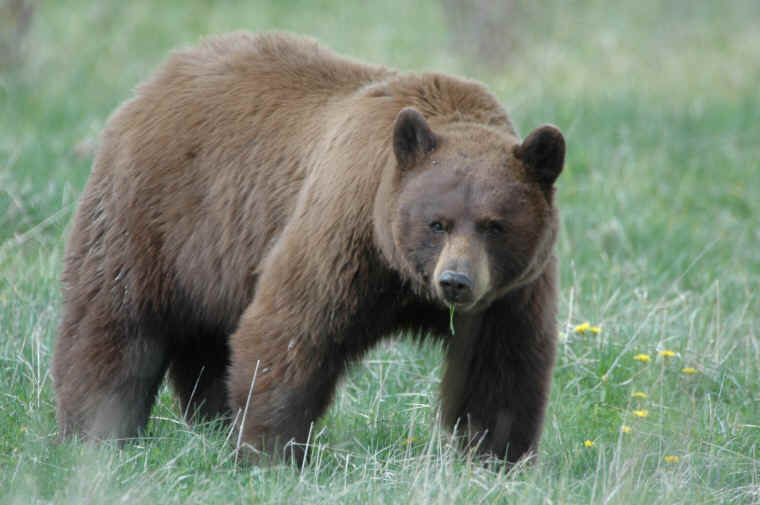
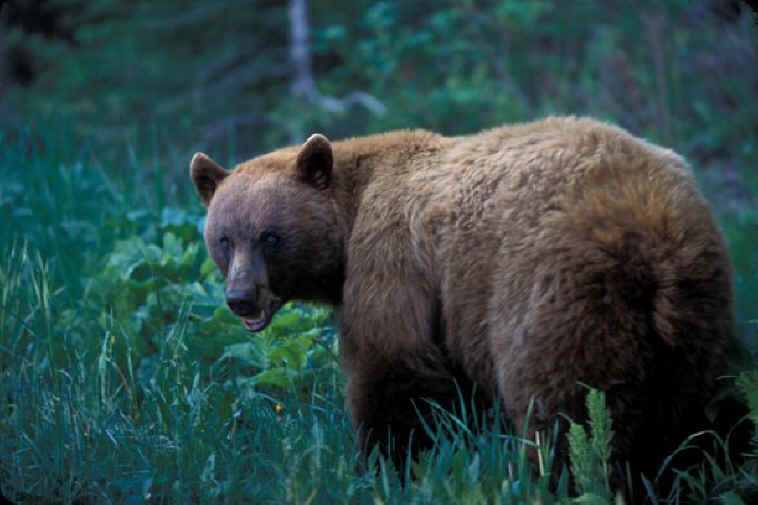
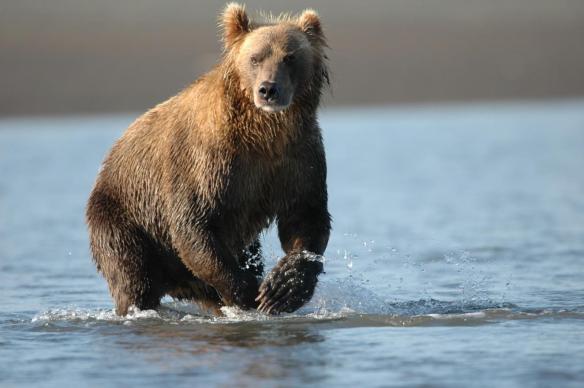
Please fll free to leave your answer in the comments section below. (And no fair going to my website for the answer, unless you are stumped).

Q. Which of these 3 bears is a grizzly bear?
Please fll free to leave your answer in the comments section below. (And no fair going to my website for the answer, unless you are stumped).
 (files) People are reminded, to not leave out food that can attract bears.
Fourth one shot, but ran off into forested area in Silver Valley on Wednesday.
The latter two were shot in the Silver Valley area for public and officer safety reasons, said Sgt. Todd Hunter, with the Conservation Officer Service.
Only one from Wednesday was confirmed dead, however.
Veronica Clark, in the Silver Valley Neighbourhoods Facebook group, shared a video of conservation officers dragging what appears to be a dead bear onto a truck.
Andrea Ross said in an email that she witnessed a bear shot by conservation officers on Foreman Drive in Silver Valley.
“But the bear was not fatally shot and ran off into the bushes. Very, very sad.”
Nicole Caithness, a conservation officer based in Maple Ridge, said a brown-coloured black bear was shot in the early afternoon on Wednesday on Foreman Drive.
It had been reported going into Silver Valley garages, approaching people, and was not “hazed off” even when a resident activated a car alarm to try and scare it away.
Once shot with a high-powered rifle, she said the bear ran into the wooded area north of Foreman Drive.
Conservation officers tracked the bear, but were not successful in locating it.
Caithness believes the injury will prove fatal, but said a large animal can cover ground even after sustaining a killing wound.
“All the signs point to that he was fatally shot,” she said.
Approximately two hours after the first bear was shot, a second large adult black bear was killed. He approached an unarmed wildlife safety officer, and the decision was made to euthanize the bear.
“He was extremely habituated to people, and frequenting the area in broad daylight,” Caithness said.
She added that residents of Silver Valley must be more vigilant in removing attractants, and noted even recycling put out the night before pickup attracts bears.
She warned that a 500-pound black bear is still an excellent climber, and residents who are putting bird feeders on their second-storey decks are not keeping them away from bears.
“It’s definitely our busy time of the year,” Hunter said earlier.
Hunter said as bears emerge from “torpor” – a period of inactivity that allows them to survive with little food – there’s not a lot of natural food available to them. He added they start looking for high-calorie food sources, such as beehives, chicken feed, household garbage, pet food and bird feeders.
Two other bears have been killed in Maple Ridge since April because they had become habituated to food sources that brought them into conflict with humans and were deemed a danger.
In the North Fraser Zone, which stretches from Anmore, west of the Tri-Cities, to Deroche, which is east of Mission, there have now been eight bears shot – seven confirmed as killed – since April 1.
Both the Conservation Officer Service and Maple Ridge Wildsafe community coordinator Dan Mikolay are campaigning to get people to keep their garbage secured, making it less of an attractant to bears.
Mikolay said that is critical to do so in May and June, as bears become more active.
READ ALSO: Study shows black bears need a variety of salmon species to be healthy
Mikolay urges people to:
• take garbage to the trash the morning of pickup, not the night before;
• wrap and freeze bones, waste meat or other highly attractive garbage before putting it out;
• don’t leave pet food outside;
• fill bird feeders only during harsh winter weather as seed attracts bears, as well as deer and rats, and therefore the animals that prey on them – coyotes and cougars.
“You’re going to have the whole food chain showing up,” Hunter said.
READ ALSO: Can’t kill bears for eating honey
• The Ministry of Environment Report All Poachers and Polluters line is 1-877-952-RAPP to report wildlife conflicts.
STEAMBOAT SPRINGS, Colo. (AP) – Wildlife officials in Colorado have killed a bear near Meeker after previously relocating it from Steamboat Springs. The Steamboat Pilot & Today reports that Colorado Parks and Wildlife officers killed the bear Monday after it disturbed a farmer’s beehive.
Officers relocated the 2-year-old cinnamon-colored black bear on April 8 after the animal got into several residential dumpsters downtown.

(credit: Kevin Dietrich)
Officers tranquilized the bear after it approached a day care center.
Steamboat resident Kevin Dietrich captured several photos of the bear.
“Such a great looking bear. Lock up the trash fellow downtown residents,” Dietrich wrote on Facebook.

(credit: Kevin Dietrich)
Steamboat area wildlife manager Kris Middledorf says this is the first bear the agency has killed in the state this year. Middledorf says days like Monday, where wildlife officials have to put down an animal, are “the worst.”

(credit: Matt Helm)
Middledorf urges residents to be vigilant about securing their trash and other wildlife attractants.
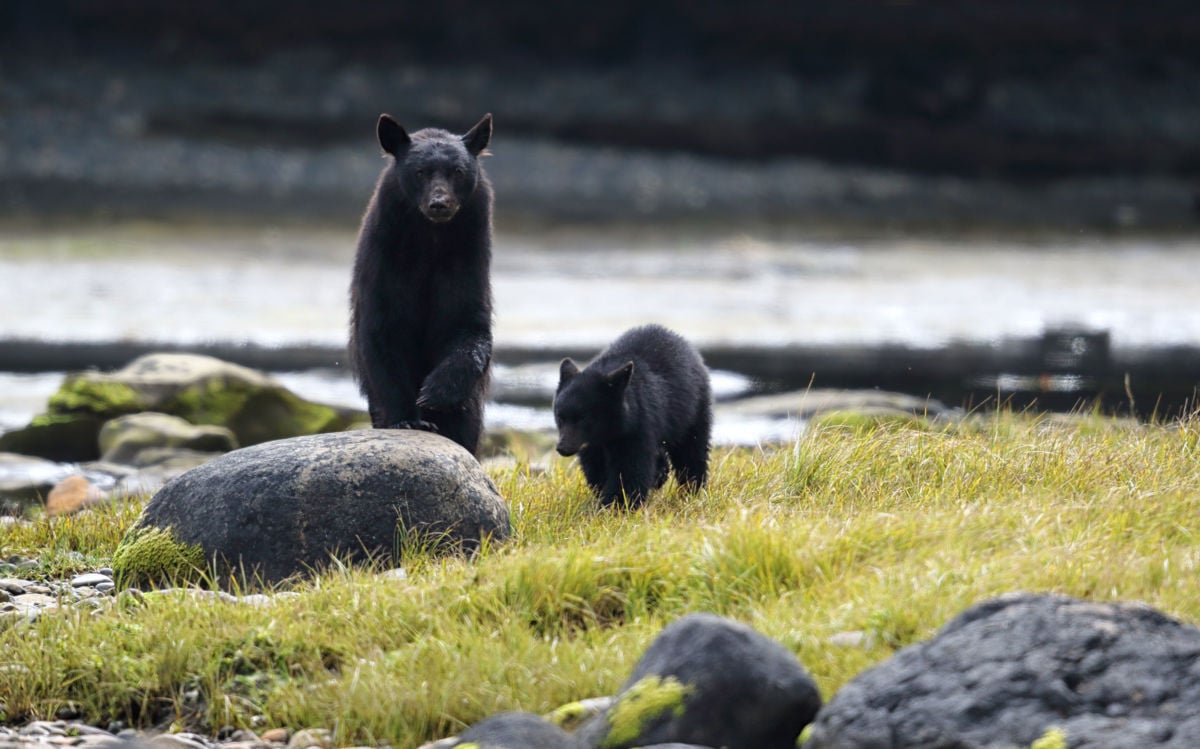
As a child Diana Doan-Crider loved hearing her grandfather’s tales of the grizzly bears and wolves he saw in the early 1900s while working to build Mexico’s railroads through the mountains. A Tepehuán Indian from Durango Mexico, he told vivid stories, and his knowledge of nature inspired her to become a wildlife biologist when she grew up and to spend decades researching black bears in northern Coahuila’s mountains, just across the Texas border.
That was an important time for black bears, which had all but vanished from Texas in the 1950s following decades of hunting, trapping and habitat loss. The animals started to return to Texas’s Big Bend National Park in the late 1980s. At first it was just a handful of bears, but soon visitors began reporting dozens sighted a year, including females with cubs.
Doan-Crider’s pioneering research, published in 1996, helped confirm what Texas wildlife managers long suspected: Black bears were regaining a foothold in southern Texas, not from other U.S. states but from Mexico.
Mexico has a thriving bear population, thanks to its mountainous expanse and greater cultural acceptance of the animals, both of which also made the recolonization possible, says Doan-Crider, who is now an adjunct professor at Texas A&M University and executive director of a nonprofit called Animo Partnership in Natural Resources.
“Mexico’s bear habitat is so huge, and some local densities are the same as what you’d see in Alaska,” she says. “You can see 25 bears in one day.”
The bears, Doan-Crider and other researchers found, were crossing into Texas from Mexico through the Sierra del Carmen Mountains, which are only separated from the mountains in Big Bend by the Rio Grande River.
Big Bend, which was established in 1944 when there were no bears in the area, is a stunning and geologically diverse landscape of mountains, desert and river that stretches for more than 1,200 square miles along the border where West Texas dips into Mexico. It’s also good habitat for the returning bears, and it quickly became a safe haven for the animals.
Today, with the bears still reestablishing themselves, Texas lists the black bear as a threatened species.
This fledgling recovery could now be in jeopardy, however. Experts worry that any obstacle to the animals’ movement, such as President Trump’s proposed border wall, would set back hard-fought efforts to rebuild the population — especially with climate change intensifying the episodes of drought and wildfire that serve as key drivers for bears expanding beyond their usual range.
“The ability for wildlife to move across that border is so important,” says Patricia Moody Harveson, a research scientist at Borderlands Research Institute at Sul Ross State University. “We would not have black bears in Texas anymore if it wasn’t for that transboundary movement across that border.”
It’s not clear whether the Trump administration plans to construct the border wall through Big Bend, although it continues pressing forward with plans to build the wall through the Santa Ana National Wildlife Refuge and a 100-acre butterfly refuge.
The National Park Service declined a request to be interviewed for this story.
A volunteer ranger at the park, who did not want to be identified, told The Revelator that talk of the wall is, “all buttoned up.” But he said it “goes against everything the park stands for” and wondered how a wall could be built when heavy machinery is banned from the park, even for the removal of old telephone poles.
Bears, of course, are only one of many species, from reptiles and amphibians to bighorn sheep, which would be affected by the proposed wall. Beyond Texas, conservationists recently claimed that building the wall would be “game over” for recovering jaguar and ocelot populations in Arizona.
Jonah Evans, state mammalogist at the Texas Parks and Wildlife Department, agrees with Harveson that, “when it comes to bears, being able to travel across large areas is important to recover their populations and thrive in a landscape as challenging as West Texas.”
Evans can’t say how big the bear population is in the state, but he says they’ve mapped breeding populations in just three of Texas’ 254 counties.
“Right now, we have very few,” he adds. “It’s a pretty isolated population.”
Bears are tough to count, because they cover huge distances and are expensive to catch and monitor. Texas Parks therefore relies on data from trail cameras and from voluntary reports of bear sightings by ranchers, such as at deer feeders.
Based on those reports, Evans says Big Bend National Park is “clearly one of the core breeding populations that we have.”
He adds, “If you don’t have breeding, you don’t have bears.”
Extreme weather events appear to be a key driver for bears crossing the border, according to Doan-Crider’s research.
“We’re now looking at how drought and events like wildfires are a driving mechanism for expanding a bear population,” says Doan-Crider. “Normally females might not leave their home range, but once those droughts hit, once wildfires come in, they will cover huge distances to find some habitat.”
Her research correlates maps of food sources like oak trees (acorns) and prickly pear with bear movements, documenting that female bears will travel twice as far as in times of drought, or what she calls the “threshold of misery.”
Black bears can have enormous ranges during these periods, as great as about 380 square miles, she says.
This can drive bears from Mexico into the United States or force them to journey in the opposite direction. Other researchers, including Dave Onorato and Raymond Skiles, the recently retired wildlife biologist for Big Bend, have also documented these border crossings during drought. At one point in the early 2000s, when food was scarce in Big Bend, all the bears left for Mexico and then returned a year a half later. Similarly, Harveson noted that two bears the Borderlands Research Institute was radio-tracking crossed over into Mexico during the severe 2012 drought.
As “horrified” as she is by the proposed border wall, Doan-Crider says she’s more concerned about what she calls the “invisible wall,” or the lack of social acceptance and lack of preparation bears hit when they cross into Texas.
Most wildlife managers and researchers are focused on Big Bend, but Doan-Crider says she thinks bears are also crossing into Texas farther east, from the mountains just south of Laredo, where Mexican land cooperatives are protecting bears. They don’t stand a chance on the U.S. side, she says, because of the likelihood that they’ll come into contact with humans who aren’t used to living with bears, or with landowners who have deer-hunting operations.
Meanwhile, Harveson says the breeding population at Big Bend appears to be spreading into the Davis Mountains, about 150 miles to the north. That could also put them at risk.
“As bears move into areas they haven’t been in for more than 50 years, we look for that potential for human-bear conflict,” she says. The Borderlands Research Institute plans to study the corridors that bears are using to traverse this distance, as well as their use of habitat and movements within the Davis Mountains. “We’d like to help make the adjustment easier.”
Doan-Crider agrees that more steps need to be taken to protect the black bears that have returned to their former range.
“If Texas wants to do something about bears, they should be putting a lot of money into educating the public,” she stresses.
Doan-Crider says the question of the wall, and the bigger question of bear recovery, is more about, “Do you want to have bears in Texas?”
If the answer is yes, then keeping the border open — especially at Big Bend — is vital.

A black bear, in front of the front-end loader, rummages around equipment at Kincaid Park on Jan. 25, 2019. (Craig Norman photo)
A black bear was spotted last week in Anchorage’s Kincaid Park, the wooded and popular recreation area on the west side of town.
Some reported the bear eating grass or drinking water or just wandering around, according to the Alaska Department of Fish and Game. At least a few young skiers with the Nordic Skiing Association of Anchorage’s Junior Nordic League saw the bear off the snowmaking loop last Wednesday evening during a particularly busy evening at the park. They reported the sighting to their coach, Geoff Wright.
“I assumed they were looking at a moose or a large dog or a coyote, but probably not a bear,” Wright said. “It’s stories from 6- and 7-year-old kids and they say all sorts of funny things.”
Like many park users, Wright has spotted bears in Kincaid in the summer. But in his 20 or so years of skiing in the park, he said, he’d never seen a bear there in the middle of winter. Still, he told his group to turn around just in case. Later, another skier showed him a picture of the bear taken that evening. Bear sighting confirmed.
Fish and Game hasn’t gotten a report of the Kincaid bear since last Friday, so it has likely headed back to its den, said department spokesman Ken Marsh. The department is aware of bear dens in Kincaid.
“They usually don’t stay up long unless they have that consistent food source,” Marsh said.
But the midwinter bear spotting raises the questions: Why was the bear awake? Did it have to do with the warmer-than-usual temperatures last week? Do bears actually sleep all winter?
Sean Farley, a Fish and Game wildlife physiologist, didn’t see the Kincaid Park bear last week, but here’s what he said about why a bear might be wandering around Anchorage in January:
Weather plays a role in when bears head into their dens. In the Anchorage area, black and brown bears generally hibernate from late October or November to April or May, he said. Female bears that are pregnant typically go in earliest and come out the latest.
Farley described hibernation as a “spectrum of physiological adaptations” to conserve energy. Arctic ground squirrels, for instance, can drop their body temperatures to below freezing. Bears aren’t like that.
“They’re not out cold like ground squirrels, they’re more like a sleeping dog that can be roused pretty easily,” Farley said. “They’ll get up and move around and thrash around.”
For bears, hibernation means heading into dens and lowering their metabolic rate. Their body temperature lowers from roughly 101 degrees to about 90 or 91 degrees, Farley said. It’s a survival tactic to make it through the winter, when there’s little to no food available.
[Support local journalism in Anchorage. Subscribe to the Anchorage Daily News / adn.com]
During hibernation, bears usually don’t eat, drink, urinate or defecate. They’ll lose about 20 to 25 percent of their body weight. Mostly fat, Farley said.
Yes, they also sleep, but not the whole time.
Bears cycle through periods of deep sleep and periods of arousal. Their body temperature will increase a bit when they’re aroused. They might shift positions. They might poke their heads out of their den. They might even leave for a few hours and come back — that’s not common, but it’s not unheard of, Farley said.
“When we say ‘leave the den,’ they don’t usually go on big walks,” he said.
Pregnant bears will give birth just a couple of months into hibernation. They’ll nurse their cubs in their dens, despite not eating or drinking.
“They’ve got these newborn cubs that they’ve got to take care of. They can’t go to sleep and just be out of it,” Farley said. “The cubs can’t do anything. … All they can do is eat and scream and that’s about it. She has to move them around and hold them close to her body so they can nurse. She has to clean them.”
It’s very unlikely that a female bear with cubs will leave its den in the winter, Farley said.
So, why might a bear head outside in January?
A bear might get restless and want to stretch its legs, Farley said.
It’s also possible the bear went into a den too skinny. Its energy reserves might have gotten so low at some point that it prompted the bear to wake up and go look for food. It’s that or starve to death, Farley said.
Or, maybe a noise outside of the den stirred it when it wasn’t in a deep sleep. Farley noted, however, that he has photographs of snowmachine tracks that go over a den hole that’s covered in snow.
What about last week’s weather? Temperatures spiked to 44 degrees on Friday at the Ted Stevens Anchorage International Airport. Could that be why the black bear wasn’t in its den?
A goal of a bear den: To keep the cold out, Farley said. So mild fluctuations in outside temperature shouldn’t really impact bears in insulated dens.
“If they’re deep inside in some sort of den, maybe covered with snow, they’re insulated,” he said. “So fluctuations in the ambient temperature outside the den don’t get reflected as strongly inside the den. Plus they’re in the den heating it themselves because they’re at least 90 degrees or so.”
In the Anchorage area, black bears often den in trees. Both brown and black bears will also dig into hillsides and excavate a dirt den. Bears can den in many other places too, Farley said.
If high temperatures melt snow and that leads to a bear’s den getting flooded, that’s another reason the bear might head outside. It’ll likely try to find another den, Farley said.
If you see a bear in the middle of winter, give it space, just as you would in the summer, Marsh said.
“Maybe turn around, change your course, you don’t want to push it,” he said.
Really this time of year, Marsh said, it’s more likely you’ll come upon a cranky moose.
“It’s been a long winter and they’re starting to get a little nutritionally stressed,” Marsh said. “Be alert just like you would in the summertime and give wildlife their space.”
A 3-year-old boy who was found alive after having been missing for days told family members that he was busy spending time with a bear.
Casey Hathaway was playing with other children on Tuesday when he vanished from his grandmother’s yard in a rural part of eastern North Carolina. He was found alive two days later from where he disappeared after community search crews received a tip.
Casey’s aunt, Breanna Hathaway, posted Friday on Facebook that her nephew was home, healthy and smiling ― and had quite the tale to relate about his experience.
“He said he hung out with a bear for two days,” Hathaway said.
She was willing to roll with the story, saying, “God sent him a friend to keep him safe. … Miracles do happen.”
In another post, Hathaway said Casey likes to watch “Masha and the Bear,” a show about a girl who lives in the woods with a paternal bear who keeps her safe.
Craven County Sheriff Chip Hughes said at a news conference Thursday that search crews found Casey wet, cold and tangled in vines, but not seriously injured.
The boy “didn’t really get into… how he was able to survive,” though he did mention “having a friend in the woods who was a bear,” the sheriff added, without commenting further on that scenario.
There were no signs of abduction, Hughes said.
“He’s up and talking,” Casey’s mother, Brittany Hathaway, said at the news conference after thanking search crews. “He’s already asked to watch Netflix, so he’s good, he’s good.”
The family is planning to set up a post office box to handle the huge wave of support, including from people who Hathaway said want to send stuffed teddy bears.
Breanna Hathaway posted on Facebook that the family appreciates the bear gifts, while advising those sending them to “remember that he can only [take] home so many.”

A conservation officer tags the bear cubs’ ears before reuniting them with their mother. (B.C. Conservation Service)
https://www.cbc.ca/news/canada/british-columbia/bear-cubs-rescued-from-dumpster-1.4953176
Two bear cubs that somehow managed to get stuck in a recycling facility dumpster had to be rescued by conservation officers in Sooke, B.C., on Monday.
It’s not clear how the cubs climbed up and into the dumpster — but once in — they couldn’t get out.
Sgt. Scott Norris with the B.C. Conservation Service says the mother bear watched calmly from a distance when help arrived.
“When we showed up, we pulled into the yard and there was mom sitting at the back of the yard, sort of 50 yards away just watching,” he said.


 BC CO Service@_BCCOS
The cubs were safely tranquilized, had their ears tagged and were pulled out of the dumpster.
They were then returned to their mother at a neighbouring property.
The dumpster didn’t have any food waste in it, but Debbie Reid with Wild Wise Sooke says the bear cubs’ rescue is a good reminder to secure all garbage bins.
“What triggers bears to sleep is the fact there is no food … but in Sooke we have people leaving out garbage and pet food and things like that,” she said.
“So the natural trigger isn’t being triggered.”
The conservation service says bears on Vancouver Island usually don’t go into hibernation until January.
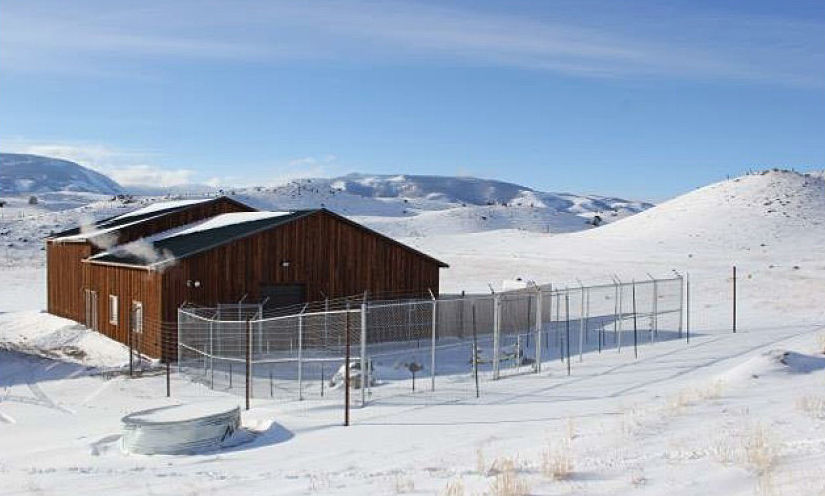
A Paradise Valley company is seeking a permit to house two black bears in a roadside menagerie near Emigrant, according to Montana Fish, Wildlife & Parks.
The agency is seeking public comment through June 30 on an environmental assessment for the Mayfield Roadside Menagerie, north of Emigrant, owned by Jason Mayfield.
Any person wishing to keep, in captivity, one or more wild animals for the evident purpose of exhibition or attracting trade must first secure a Roadside Menagerie Permit from the state of Montana. A USDA Class C Exhibitor’s permit is a prerequisite for permitting.
The facility has been built and is ready to receive the two bears and will be operated in conjunction with Camel Discovery along Highway 89.
The facility has an interior and exterior portion. The interior is constructed of poured concrete for the floor; partitioned cages constructed of welded wire and pipe; insulated walls; and water, electrical and gas services. The interior has ample room for food preparation and veterinary care if needed.
The exterior fencing is constructed of chain link fencing with four strands of charged electrical wire along the top. A secondary fence within the primary fencing is made of four strands of charged electrical wire attached to t-posts.
The proposed menagerie is in near proximity to the owner’s residence and doors and gates are to remain locked at all times to prevent escape of the bears or entry by unauthorized individuals.
The environmental assessment is available on FWP’s website at fwp.mt.gov. Click on the News tab and choose Recent Public Notices.
Comments can be submitted online or mailed to Attn: Mayfield Roadside Menagerie; Montana Fish, Wildlife and Parks Enforcement; P.O. Box 200701; Helena, MT 59620.

By Warren Schlote
https://www.manitoulin.ca/hungry-black-bear-boards-four-boats-over-three-days/
August 22, 2018
HEYWOOD ISLAND—Boaters seeking a quiet anchorage in the sheltered waters of Browning Cove, east of Little Current at Heywood Island, have instead found themselves facing a hungry bear that visited four different boats over the course of three days.
“I was down below fixing dinner, a bass I caught yesterday, when I heard this loud strange scratching noise,” says Brian Laux of Walworth, NY.
“I thought it might have been a human swimmer in trouble, someone who was so weak they couldn’t crawl out of the water. But when I went outside there was a bear right in the water—he was trying to climb up the side of the boat,” Mr. Laux recalled. “He sort of gave me a dirty look.”
– Advertisement –
Mr. Laux immediately got in contact with Roy Eaton, who runs the daily Cruiser’s Net broadcast out of Little Current, to share his incredible story. At the time, he did not consider the bear a major threat because of his timid interaction with it. Mr. Laux says he has heard the bear is often spotted swimming across the mouth of the bay in which he was anchored but more recently it has been seen making trips to Browning Island.
Fortunately, the bear left without much fuss after this first encounter. But it was not finished yet.
Mr. Laux had just finished listening to the morning broadcast when he heard the unmistakable sound of the bear paddling back towards his boat—perhaps ironically named Serenity. This time, the bear was more persistent. “I poked him in the nose with my boat hook,” said Mr. Laux. The bear, although seemingly annoyed by the gesture, swam around the boat a couple times and eventually retreated back to shore.
That morning, Mr. Laux was visited by the owners of a boat called Carandy. Unfortunately, Mr. Laux was not the first person to have an encounter with this bear. On the same day as Mr. Laux’s first encounter, the bear had already visited Carandy, which was anchored in the same area as Serenity. Carandy’s owners did not respond to a request for comment by press time.
When the bear arrived, Carandy’s owners were away on a kayak trip. When they returned, the bear was in the process of tearing apart their cabin. It had climbed aboard using the swim ladder they left down to get into their kayaks. Carandy’s cupboards were ripped off and nearly everything inside was eaten, chewed or covered in fur and bear spit. After making noise by banging on the hull, the bear finally was scared off and retreated to the island.
Carandy’s interior was trashed. With no other options, the boaters elected to clean up their mess and figure out what to do next. But as they were cleaning, the bear came back and attempted to board the boat again from the bow. After a solid whack on its nose from the boat hook, the bear swam back towards land and stared at Carandy from the shore. Feeling threatened by the bear’s continued presence, they moved to the middle of the bay and set up anchorage there.
Meanwhile, after Mr. Laux fended off the bear the following morning, he elected to stay one final night but repositioned himself further from shore. He went around to visit the other boats anchored in the area and made sure they knew of the bear’s presence and to keep their swim ladders up.
Mr. Laux’s warning and an advisory on Mr. Eaton’s Cruisers Net proved useful for Dennis Kirkwood, who had just arrived into the bay on his catamaran. After a late dinner with his girlfriend, they were getting ready for bed around midnight when they heard a thumping and scratching noise under the stern of the boat.
“I immediately suspected what it was,” said Mr. Kirkwood. “I ran out and grabbed a whisker pole and started clanking it around.”
The bear was under the swim platform, between the two hulls. The bear had knocked out the floor plate and its paw was coming up through the opening. After a continued effort, Mr. Kirkwood switched to his wooden oar to hit the bear’s paw. The bear pulled its paw back but remained under the platform, breathing heavily.
“It was very surrealistic,” said Mr. Kirkwood, adding that the pitch darkness of the night added a complicated aspect to the ordeal.
“He’s substantial sized, maybe 250 pounds; not a cub at all,” Mr. Kirkwood says.
Mr. Kirkwood continued to poke through the opening to encourage the bear to leave, but it stayed put. That was a surprise, as Mr. Kirkwood understood bears usually scatter upon hearing loud noises.
“I tried blasting my air horn like a madman trying to get him to leave, but he just stayed on.”
With that, Mr. Kirkwood decided to keep prodding it with his oar to encourage the bear to leave. It worked, but the bear managed to break his wooden oar in the process.
Mr. Kirkwood notified Mr. Eaton of his experience. The bear incidents were turning into a trend.
On Thursday night, Otto Gustafson had what may have been the closest experience yet. He arrived at Heywood Island and had anchored for the night. At about 9:30, he heard the telltale scratching and splashing of a bear next to his boat. His swim ladder was up, so he decided to stay put because the bear should not have been able to make it on board.
He was wrong.
Suddenly, the bear climbed the stern and appeared in the cockpit. The bear started sniffing for something to eat, and the two came within 18 inches of each other. Mr. Gustafson began screaming and making noise at the bear, but the bear seemed to ignore the disturbance. Mr. Gustafson even shone his spotlight into its eyes and sounded his foghorn, but nothing seemed to dissuade the bear.
The bear had put its paw through the screen that separated it from Mr. Gustafson, when a fellow boater heard the commotion and came alongside them on his dinghy. It was not a moment too soon. The presence of the dinghy seemed to scare off the bear which walked to the bow, entered the water and disappeared.
So far, these four boat boardings are the only reports The Expositor has heard of regarding bear encounters at Heywood Island or elsewhere.
“I suspect somebody might have fed it off a boat at one point. That’s a supposition, but he’s certainly learned that boats equal food,” says Mr. Laux.
Jolanta Kowalski from Ontario’s Ministry of Natural Resources and Forestry (MNRF) says this year’s wild food surveys have indicated a decrease in natural food availability for bears because of an ongoing drought.
“Bears have a phenomenal sense of smell and if they find food once at a location, they will return. It’s critical for boat residents and the public to manage anything that may attract bears such as garbage and food,” stresses Ms. Kowalski.
The Expositor asked at what point the MNRF would take action, if any, to deal with the situation, and what that action would entail.
According to an email received from the MNRF, if a bear is a public safety risk people should call 911 or their local police. A bear breaking into a residence – in this case a boat – would qualify as an emergency. (see below from Bear Wise web page)
Police will assess the situation. They may call MNRF for assistance to trap and relocate a specific problem bear.
The Ministry provides advice and education. The public can call the Bear Wise phone line 1-866-514-2327 <tel:+18665142327> for information about avoiding human-bear conflicts.
Who to contact
Emergencies
Call 911 or your local police, if you feel a bear poses an immediate threat to personal safety and:
* enters a school yard when school is in session
* enters or tries to enter a residence
* wanders into a public gathering
* kills livestock/pets and lingers at the site
* stalks people and lingers at the site
Generally, bears want to avoid humans. Most encounters are not aggressive and attacks are rare.
Non-emergencies
Call the Bear Wise reporting line at 1-866-514-2327 <tel:+18665142327> (*between April 1-November 30) if a bear is:
* roaming around, checking garbage cans
* breaking into a shed where garbage or food is stored
* in a tree
* pulling down a bird feeder or knocking over a barbecue
* moving through a backyard or field but is not lingering
https://www.manitoulin.ca/hungry-black-bear-boards-four-boats-over-three-days/
<https://www.manitoulin.ca/hungry-black-bear-boards-four-boats-over-three-days/>
Hungry black bear boards four boats over three days <https://www.manitoulin.ca/hungry-black-bear-boards-four-boats-over-three-days/>
http://www.manitoulin.ca <http://www.manitoulin.ca>
HEYWOOD ISLAND—Boaters seeking a quiet anchorage in the sheltered waters of Browning Cove, east of Little Current at Heywood Island, have instead found themselves facing a hungry bear that visited four different boats over the course of three days.
Stephen Hunt · CBC News · Posted: Apr 18, 2018 7:18 PM MT | Last Updated: April 18
Estimated to be a couple of months old, this black bear was rescued in southern Manitoba after its mother was found dead. Alberta is lifting a ban on rehabilitating orphaned black bear cubs under the age of 12 months. (Manitoba Bear Rehabilitation Centre)
Orphaned black bear cubs have been given a reprieve by a new provincial policy that allows for them to be rehabilitated.
The new policy reverses a ban that’s been on the books since 2010.
Lisa Dahlseide, a wildlife biologist with the Cochrane Ecological Institute, says that ban resulted in the euthanizing of at least 24 black bear cubs, according to data collected from a report released in 2015.
Dahlseide described the change in policy as “wonderful news” in a Wednesday interview on <http://www.cbc.ca/listen/shows/the-homestretch> The Homestretch.
“[The change has been] a long time coming for black bear cubs,” she said. “It really is good news, because no longer will the Alberta government be euthanizing them.”
Instead, orphaned black bears under 12 months of age can be rehabilitated at places like the Cochrane Ecological Institute, or any other wildlife rehabilitation centre across the province that has approved facilities for bear cubs.
This is a photo of an enclosure where orphaned black bear cubs are rehabilitated, at the Cochrane Ecological Institute. (Lucie Edwardson/CBC News)
The rehabilitation process involves a combination of human interaction, and teaching it how to survive without people involved.
“Generally they come and they’re very small,” Dahlseide said. “They’re still drinking milk, because they’re mammals. And so what happens is it’s very limited exposure with people — they only have one human that interacts with them to give them the bottle. As soon as they are done with bottle feeding, then that human interaction is done with as well.”
Adding water features to enclosures
At the Cochrane Ecological Institute, Dahlseide said orphaned bears stay in large enclosures — ranging from six to 20 acres — which are full of native food, as well as trees and other interactive things to give them exercise and learn to get fed without relying on people.
“There’s a lot that goes into rehabbing them to avoid habituation and food conditioning,” she said.
The institute is currently raising funds, through donations, to add water features to each enclosure, which is part of the requirements for the new government protocol.
“That’s actually a really good thing for the bears,” Dahlseide said. “Hopefully those water features can be stocked with fish, so they can get that experience.”
The new protocols include the stipulation that each bear enclosure must have a water feature. (Paul Conrad/Associated Press)
Other bears and other species not included
The new policy does not apply to orphaned grizzly bears, which are still euthanized — a policy that Dahlseide says is wrong-headed.
“Science has actually shown there are no known negative human conflicts with grizzly bears, post-relief,” Dahlseide said. “Other places in the world do rehabilitate them successfully — so I’m hoping the provincial government will be considering them and hopefully including them in the bear protocol as well.”
She pointed to the research of naturalist Charlie Russell, who has done extensive studies of grizzlies, Dahlseide said there’s no reason for people to be afraid.
“His research with bears has proven that bears are not an animal that really needs to be feared. If we trust them, they’ll trust us as well.”
‘No evidence, data or science to support those bans’
The list of orphaned animals banned from rehabilitation is not confined to grizzlies, either, Dahlseide said, adding “and again, the province has no evidence, data or science to support those bans. So we want to see that lifted for all species.”
Rallies are planned on Saturday in Calgary and Edmonton, calling for the lifting of the ban on all orphaned animals.
The Calgary rally takes place at Municipal Plaza, next to city hall, between 3 and 7 p.m.
“We wanted to show our support for the grizzly bears, the foxes, coyotes, wolves, bighorn sheep, and elk — the list goes on and on,” Dahlseide said. “All the animals that the province currently doesn’t allow for rehabilitation.”
http://www.cbc.ca/news/canada/calgary/orphan-black-bear-cub-ban-lifted-1.4625460
 Exposing the Big Game